




| Research Article | ||
Open Vet. J.. 2026; 16(2): 1027-1037
Open Veterinary Journal, (2026), Vol. 16(2): 1027-1037 Research Article The effect of housing system (semi-closed barn and closed barn) on some productive and carcass traits of Awassi male lambsNawfal Mohammed Ameen Saaed, Sinan Essam Al-Deen Salah, Mothana Rashid and Ahmed Mazen Ali*Department of Animal Production, College of Agriculture, University of Telafer, Telafer, Iraq *Corresponding Author: Ahmed Mazen Ali. Department of Animal Production, College of Agriculture, University of Telafer, Telafer, Iraq. Email: ahmed.m.ali [at] uotelafer.edu.iq Submitted: 28/07/2025 Revised: 10/01/2026 Accepted: 26/01/2026 Published: 28/02/2026 © 2026 Open Veterinary Journal
AbstractBackground: Sheep are a main source for meat, and animal housing is to protect them from harsh environmental conditions and to provide an environment suitable for animal comfort and in an economical manner as possible. Aim: The aim of this experiment was to compare the effect of two types of housing systems (semi-closed barn and closed barn) on some productive and carcass traits of Awassi male lambs. Methods: Two groups of Awassi lambs totaling forty weaned male lambs ranging in age from 4 to 6 months were divided into two types of barns: the first was housed in a semi-open barn, and the second in a closed barn with 20 lambs for each group. In order to find an effect between the two groups and to find out the significance of these differences, the obtained data were analyzed using the t-test. Results: No significant differences were observed between the two groups in productive traits and carcass, such as final weight, weight gain, feed conversion efficiency, feed intake, carcass weight, dressing percentage, and carcass residues from the head, feet, and skin. There were also no big differences in the viscera of the carcass, such as the lungs, heart, liver, spleen, kidneys, intestines, the weight of the full and empty rumen, or the weights of different fats, such as buttocks, abdomen, kidney, and heart fat. There were also no big differences in the area of the eye muscle or the thickness of the subcutaneous fat, or in the major and minor cuts. Moreover, the proportions of muscle, fat, and bone remained consistent. The net second transaction exhibits an arithmetic advantage. Conclusion: There was an arithmetic increase in favor of the first treatment, and this may be due to the increase in feed intake in the lambs of the semi-open pens compared to the closed ones. In addition to the availability of ideal conditions for the lambs, including fresh air and better oxygen availability, air movement inside the barn, and lower temperatures compared to a closed barn, thermal stress reduces weight gain. Keywords: Awassi lambs, Housing system, Growth performance, Carcass traits, Animal welfare. IntroductionSheep are often reared in villages with poor sheltering and subjected to low-quality nutrition, which can negatively affect growth and production (Vachon et al., 2007). The primary purpose of a sheltering system would therefore be to reduce climatic stress and create a microclimate inside the thermal neutral zone of the animal so that maximum energy can be devoted to production processes. There would be adverse effects on production if sheep were not provided with adequate sheltering and ventilation systems (Bhakat and Napgul, 2005; Sablik et al., 2023). Sheep and goats are raised under temperate and tropical environments, with small ruminants found in arid/semi-arid areas (Bhakat and Nagpul 2005). Every environment requires different factors for constructing proper housing for animals. The basic requirement for proper sheltering of animals relates to adaptability and ability for protection against predators and thief attacks (Saeed, 2023). Animal sheltering requires protection against adverse climatic factors to reduce stress associated with growth and production for optimal growth and production of animals (Park et al., 2020). Animal production requires considerable shelter against temperature, moisture, sunlight, wind velocity, and rainfall (Sablik et al., 2023). Animal sheltering requires more emphasis on facilitating husbandry practices, such as enough feeding and watering to benefit animals (Kapgate et al., 2016; Prache et al., 2021). Pens are an important part of sheep and goat production and account for a large share of capital expenditure. Well-planned pens maximize space utilization; hence, more capital can be allocated to other project expenditures (Saeed, 2023). Shelter refers to an animal husbandry unit wherein animals are provided with shelter or accommodation and protected against external factors like heat, cold, rainfall, or wind (Sharma and Gupta, 2024). The animals rest or sleep depending on their type or species. While other species make use of these shelters at night or particular times of the day, others will reside in these places every day or continuously, depending on their species and production plans (Stenberg et al., 2020). There cannot be any doubt that providing animals with properly designed and well-ventilated housing that has important features and benefits for breeding and production purposes forms a vital part of caring for animals and providing them with adequate living conditions (Bhatta et al., 2005).
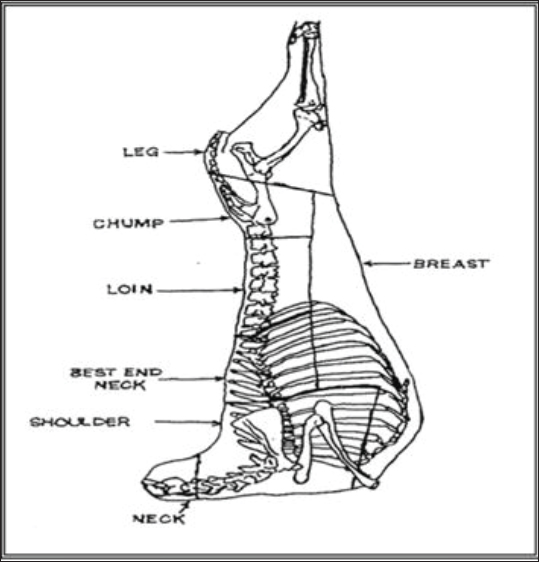
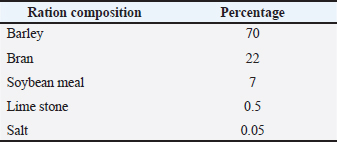
Fig. 1. Cutting the carcass according to the method of Cuthbertson et al. (1972). Table 1. Components and percentage of ration used in trial.
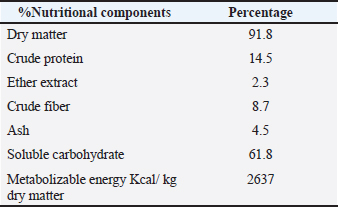
Table 2. Chemical composition of experimental ration.
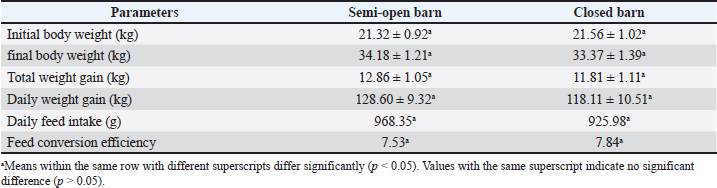
It becomes imperative to identify appropriate housing that not only guards animals against environmental influences but also ensures complete comfort and sustains health and desired production (Park et al., 2020). Cost factors become equally important while identifying or designing these housing systems because expenditures incurred when using these systems rank only second to those devoted to food (Kapgate et al., 2016). Therefore, housing should ideally be appropriate in terms of shape, design, and technical details to minimize labor time, increase agricultural profitability, and make animal rearing more economically feasible (Bhakat and Napgul, 2005). Many studies have focused on the control of environmental factors to improve meat production and fattening efficiency. It has been well acknowledged that adverse environmental factors negatively impact animal performance and productivity (Carrasco et al., 2009; Kaya, 2011). The aim of housing animals concerns protecting animals against adverse environmental factors and creating an economical environment amicable to animals. Some scientists assert that open pens allow more oxygen access and make animals more tolerant of heat (Karaback et al., 2015b). Semi-open barns are described with only one side (or sides) up to the animals' height, with other sides open to the roof; these types of barns can tolerate hot and semi-arid climatic conditions with moderate rainfall during different seasons. It can equally tolerate hot and humid climatic conditions with certain amendments, like raised floors with contours. It can protect against climatic factors to minimize heat stress (Sharm and Gupta, 2024). Physiological responses and production efficiency of sheep can be affected significantly by housing systems. Roofing systems can play an important role in controlling heat transfer inside sheep housing; therefore, insulation of roofing materials reduces the adverse effects of thermal forces inside sheep housing (Khalil et al., 2023). Hence, the objective of this study was to evaluate and compare the performances of lambs raised under semi-open and closed housing systems and investigate their influences on specific production and carcass characteristics. Materials and MethodsFor this experiment, forty male Awassi lambs at an age of 4–6 months were weighed and divided into two equal groups. The mean body weight was 21.44 ± 0.97 kg. Group one was raised in a semi-open pen (three sides closed and front open), while Group two was raised in a fully closed pen, with both systems using natural ventilation without cooling or heating systems. The pens were built using brick and cement with galvanized iron roofs. The lambs' diet consisted of unlimited concentrates. Parameters measured included body weight, feed intake, and feed efficiency ratio over a period of 100 days (Period of April to July) at Telafer, located at the top-most part of northern Iraq, because most fattening periods in northern Iraq take place during these months due to the abundance of lambs and their low prices. The lambs were given 1.5 m² of space in individual pens for both Group one and Group two. At the end of these periods, 20 lambs (10 for Group 2 and 10 for Group 1) were slaughtered after withholding their feed for 12 hours. Weights were recorded before slaughtering and were used to determine dressing percentage. The lamb was dissected into buttocks and pelvis, with the separation of the kidneys, and corresponding weighing done. Instead of cutting into portions of cuts (Langlier system), dissection was done into major and minor portions using the Cuthbertson method described comprehensively byCuthbertson et al. (1972) (Fig. 1). Ribs six were measured using an electronic caliper (Vernier), with the thickness of supraspinatus fats measured at the 12th rib, and the length of longissimus dorsi measured using Vernier calipers (Electronic). Area was measured using a grid system for the eye muscles at rib number 12, with computation done using the grid system. Ribs six were dissected manually into muscular tissues, fats, and bone, with corresponding percentage determination done for different tissues using dissecting principles described comprehensively using meat laboratory equipment, including knives and electronic scales. The animals of each group were fed separately. The animals of each group were housed separately, but they were fattened and fed collectively from one trough in the same pen. The feed intake of each animal was then calculated by dividing the total and daily feed intake by the number of animals in each group. The feed was weighed and placed in the trough in the morning and remained in front of the animals all day and night. The remaining feed was collected the next morning, weighed, and subtracted from the feed provided the day before to extract the feed consumed. Experimental lambs received a concentrate ration formulated according to NRC (2007) guidelines (Table 1), with chemical composition presented in Table 2. Feed conversion efficiency=feed intake / weight gain. The experimental design was completely random design (CRD) because it involved random assignment of lambs to treatments equally for the two housing systems to reduce bias and increase accuracy when comparing statistically. The statistical model for CRD was given by Y_ij=μ + T_i + e_ij, where Y_ij was the value of the jth lamb under treatment i; μ was the general mean value, while T_i was associated with its effect on housing systems; on the other hand, e_ij was taken to show random experimental error with equal variance and was normally distributed. The analysis of statistical significance of differences between housing systems was done with the aid of t test procedure using SAS software (version 9.4). The t-value was calculated according to the following formula: t=(X1 – X2) / √[S² × (1/n1 + 1/n2)] where: X1=the mean of the first sample (the half-open house treatment), X2=the mean of the second sample (the treatment of the closed house), S2=sample variance (population), n1=the number of observations of the first sample, n2=the number of observations of the second sample. This approach allowed the detection of significant differences between the two housing environments based on the probability level adopted for statistical decision-making. Ethical approvalThis study was approved by the Ethics Committee of the College of Agriculture, University of Telafer, Telafer, Iraq (NO: AP2 ) (Approval date: 15-02-2025). ResultsIn this experiment, there were no significant effects of housing type on production and carcass characteristics, as shown in the following: Live weight gainThe analysis of statistical differences shown in Table 3 revealed that there were no significant differences (p > 0.05) between the mean daily weight gain and total weight gain of lambs of the first treatment (open barn) (128.60 gm/day and 12.86 kg) and those of the rate of lambs of the second treatment (closed barn) (118.11 gm/day and 11.81 kg), though there was an arithmetic increase in favor of the first treatment. Fodder consumptionThere was no statistical analysis carried out with regard to fodder consumption, considering that consumption was done collectively, given that the animals belonging to each group were fed separately but were fattened and fed jointly using one trough within the same pen. The individual consumption was then determined for each animal, considering that the total daily consumption was divided by the number of animals within the group. The amount of consumption done by the lambs within the first treatment was (968.35) gm/day compared with (925.98) gm/day done by those within the second treatment, because it was mathematically superior. Feed conversion efficiencyThere was no statistical test performed on the rate of feed conversion efficiency because of the communal aspect of consumption, but it was observed that the first treatment group (half-open barn) was superior to the second treatment (closed barn). Table 3. Effect of housing system on production performance and growth rate of Awassi male lambs.
Table 4. Effect of housing system on some carcass characteristics of Awassi male lambs.
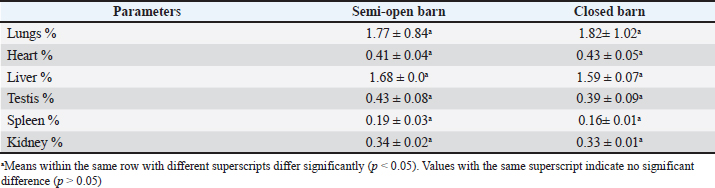
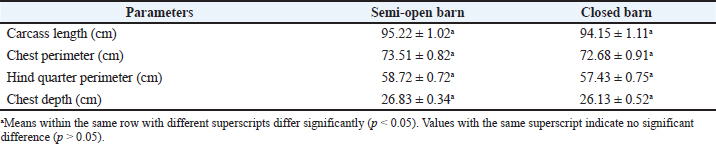
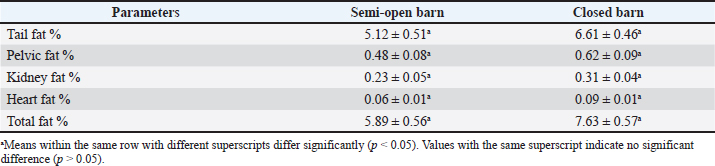
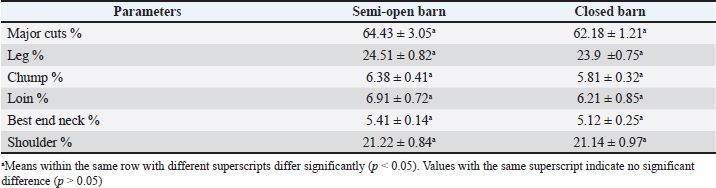
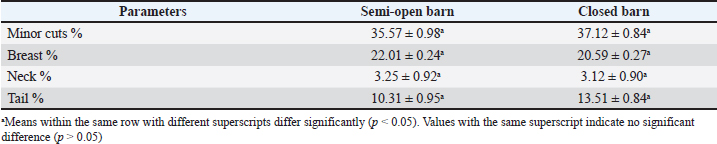
Weight of carcass and dressing percentageResults of analysis using statistics (Table 4) revealed that there were no differences (p > 0.05) between the two treatments with regard to the weight of hot carcass, with an average weight of (15.21) kgs recorded in the half-open treatment and (15.11) kgs recorded in the closed treatment. There were no differences between treatments with regard to live weight before slaughter. Slaughter residues and internal viscera of the carcassThe outcome of the analysis shown in Tables 5–7 revealed that there were no significant differences (p > 0.05) between the percentages of residuals of the carcass and internal viscera (edible and non-edible) and live weight before slaughtering for each of the first treatment (half open) and second treatment (closed) because of the lack of significant differences between the weights of the carcass and dressing percentages. Taking measurements of longitudinal carcass dimensionsThe outcome of the statistical analysis revealed that there were no significant differences (p > 0.05) between the longitudinal dimensions of the carcass measurements, such as length of carcass, breast circumference of carcass, thigh circumference of carcass, and breast depth of carcass (Table 8). Separate fatsResults of statistical analysis showed that there were no significant differences among percentages of separate body fats such as buttock fat, fat around the abdomen, fats of kidneys, heart fats, and total separate fats despite being mathematically higher in the semi-open house system, which could be due to an increase in fodder intake. Area of the eye muscleThe outcomes of statistical analysis showed that there were no significant differences at (p > 0.05) between the eye muscle area in the first treatment, which was (11.78) cm2, and the eye muscle area of the second treatment, which was (10.53) cm2, as shown in Table 10. Thickness of subcutaneous fatThere were no differences (p > 0.05) between the first treatment and the second treatment with regard to this variable (Table 10). The thicknesses were 7.24 mm and 8.12 mm, respectively. Major and minor cutsThe outcome of statistical analysis shows that there are no differences (p > 0.05) between the first treatment and the second treatment for major and minor cuts (Tables 11 and 12). Percentages of muscle, bone, and adipose tissueThe outcome of the statistical test showed that there were no significant differences (p > 0.05) in the percentage composition of muscles, bones, and fats when separating the six-rib cut from the carcass (Table 13). DiscussionLocal sheep varieties can adapt easily to local environmental factors and shorter periods of food accessibility. In addition to this, local sheep can easily withstand disease and difficult rearing conditions. An example of local sheep varieties found in this region is Awassi sheep, which is an ancient local breed of sheep found locally. Conditions under which sheep can be easily raised and maintained can easily affect their welfare. Well-placed sheep rearing facilities with a good micro-climate system, with easy access to pasture lands and adequate nutrition, can easily lead to improved sheep welfare. Intensive sheep rearing requires rearing sheep within enclosures that can easily offer improved micro-climate control and nutrition systems. Table 5. Effect of housing system on slaughter residues of the carcass of Awassi male lambs.
Table 6. Effect of housing system on internal edible organs percentage of the carcass of Awassi male lambs.
Table 7. Effect of the housing system on the percentage of internal inedible organs in the carcass of Awassi male lambs.
Table 8. Effect of housing system on some carcass length measurements.
Table 9. Effect of housing system on total separate fat percentage.
Table 10. Effect of housing system on eye muscle area and subcutaneous fat thickness.
For live weight gain, these findings were found to be consistent with Prawl et al. (1998), Diaz et al. (2002), Lupton et al. (2008), Kay (2011), Kuźnicka and Rant (2013), Honeyman et al. (2014), Karaback et al. (2015a) and Karaback et al. (2015b), and those who found that there was no significant effect of type of analgesic on live weight gain. However, other research findings showed significant superiority in weight gain in favor of open barns, like Pusillo et al. (1991), Birkelo and Lounsbery (1992), Koknaroglu et al. (2008), Ripoll et al. (2014). Additionally, other research findings showed significant superiority in favor of closed barns, like Lupton et al. (2007) and Gursoy et al. (2011). Khalil et al. (2023) found that there was an increase in weight gain for individual lambs within the same sheep house; however, there were no statistically significant differences among different houses. There were no statistically significant differences among various houses for weight gain in the first and third months of the experiment. Weight gain was significantly (p < 0.01) lower in the first month compared to weight gain recorded in the second and third months. Xiao et al. (2024) found that when lambs were reared outside under cold climatic conditions, their growth rate and immune response/antioxidant system were adversely affected, but indoor rearing (house and plastic tunnel) helped overcome these kinds of problems. The plastic tunnel would affect lambs' immunity more than either the house or outside rearing because of the presence of radiant heat. Mean weight gain and scalp and ear skin temperature were lower for lambs outside than inside the pen. Since it was colder and more windy outside, heat loss would increase, resulting in low temperatures and a low growth rate because more heat would be needed to keep their bodies warmer. There were no differences between trials for core body temperature; hence, sheep were thermally stable. Table 11. Effect of housing system on major cuts percentage.
Table 12. Effect of housing system on minor cuts percentage.
Table 13. Effect of housing system on lean, bone, and fat percentages.
Although there was an arithmetic increase for the benefit of the first treatment, this could be attributed to the increase in feed intake among lambs under semi-open pens compared with the closed ones. In addition to having ideal circumstances for lambs with fresh air and improved oxygen accessibility, there is air circulation inside the barn and lower temperatures compared to those under the closed system because heat stress impedes weight gain. For fodder intake, these findings were consistent with those of Hoffman and Self (1970), Pussilo et al. (1991), Prawl et al. (1998), Zervas et al. (1999), and Koknaroglu et al. (2008), suggesting that open barns were superior to closed ones with regard to feed intake. Since animals can segregate and perspire to lose heat; therefore, this can lead to the reduction of feed intake, especially under warmer climatic temperatures (Pusillo et al., 1991) because according to Hegg et al. (1974), heat stress can increase significantly the amount of high-energy rays given off among animals and at faster rates; therefore, this will cause an increase in the temperature inside the closed structure; consequently increasing heat stress on animals; and therefore, you will decrease feed intake, but not with regard to analgesic types because these findings agreed with Leu et al. (1977), Muhamad et al. (1983) which did not find any significant effect on feed intake, or with Gursoy et al. (2011), Kay (2011) and Honeyman et al. (2014), who also found no effect between analgesic types and feed intake. Regarding feed conversion efficiency, these findings were almost similar to those reported by Hoffman and Self (1970), Hegg et al. (1974), Pusillo et al. (1991), and Koknaroglu Oglu et al. (2008) because these studies confirmed that semi-open housing was significantly superior to closed housing. Since there was an arithmetic superiority of the weights of the first group over those of the second group. Owing to the afore-mentioned reasons, because of which there were more preferable conditions for lambs reared in semi-open houses; hence, there were positive effects on their productive properties, though insignificantly because of their low cost. Although other studies reported significant superiorities of closed barns, such as Prawl et al. (1998) and Zervas et al. (1999), other studies revealed insignificant effects of barn types, such as Leu et al. (1977), Muhamad et al. (1983), Koknar Oglu (2011), Kaya (2011), Honeyman et al. (2014), Nojoka et al. (2015), and Karaback et al. (2015a). *Provision of fresh air*It should be noted that providing animals with fresh air inside their barns is compulsory. In other words, if adequate ventilation is not provided inside the barns, somehow the air inside these infrastructural units becomes stale and warmer with high humidity levels and higher amounts of dust, ammonia, and microorganisms. On the other hand, if adequate ventilation is not provided inside the barns, heat stroke occurs among animals due to low appetite and intolerance to weather patterns or because of susceptibility to cold shock and respiratory ailments. Because most fattening periods in northern Iraq take place during these months due to the abundance of lambs during this period and their low prices, and because temperatures rise significantly during these periods, the heat becomes very high in closed barns and stressful for the animals, in addition to the weak thermal insulation of buildings in these areas and the lack of use of cooling system. On the other hand, more ventilation translates to more air currents inside the building; hence, there will be more heat loss from the animal’s body, making animals more vulnerable to cold shocks and impairing animals', especially calves', resistance to disease. Feeding behavior showed an increase and decrease in variable patterns among different types of housing systems and was not dependent on the type of housing. It can be attributed to the reason that when food was available, there was an increase in feeding behavior, and it has been reported that when animals were fed in pens, they were able to get more time to consume the allowed diet (Keskin et al., 2010). Additionally, the sheep were fed ad libitum; therefore, it can be said that the sheep’s feeding pattern could be affected by this, and increasing the number of times they eat and providing daily rations in small amounts at shorter periods of time normally exerts a stabilizing effect on rumen fermentation (Swelum et al., 2017). Casamassima et al. (2001) found that Comesana ewes' feeding behavior was not influenced by housing in indoor and outdoor groups, indicating that the housing system had little or no effect on ewes' welfare and production. For carcass weight, these results were consistent with Leu et al. (1977), Muhamad et al. (1983), Prawl et al. (1998), Koknar Oglu et al. (2005), Lupton et al. (2008), Carrasco et al. (2009), Gursoy et al. (2011), Honeyman et al. (2014) and Karaback et al. (2015b), Ripoll et al. (2014), who found no significant difference among different types of housing on carcass weights. Although this experiment failed to concur with Pusillo et al. (1991) and Karaback et al. (2015a), who found significant superiority in favor of half-barns. Zervas et al. (1999), Diaz et al. (2002) and Lupton et al. (2007) confirmed that closed housing was significantly superior. Since the fattening period overlaps with spring periods and climatic conditions were rather equal, there were no significant differences between slaughter or carcass value of Akarman lambs raised under indoor and outdoor systems. It would appear that the advantage of outdoor systems over indoor systems could be more apparent with summer lamb finishing systems. For these circumstances, it could be concluded that outdoor systems would provide an advantage over indoor systems with regard to construction cost. For these circumstances, only the construction cost provided an advantage with outdoor systems. Consequently, shelter can be recommended for breeders under outdoor systems. In conclusion, regardless of breed or species used important starting point would be to prioritize factors related to welfare and cost efficiency level, respectively, according to Karabacak et al. (2015b). Results obtained with 2-year experiment held 2 years consecutively with lambs weaned at 2 weeks of age reared under a cold environment showed that growth performances and carcass characteristics were not adversely affected when compared with those reared under a warmer environment. The findings of this experiment revealed that lamb breeders could utilize these techniques for decreasing production cost because building a structure under a cold environment was significantly cheaper when compared with heated facilities. For longitudinal carcass measurements, these findings agreed with Lupton et al. (2007), Lupton et al. (2008), Kuźnicka and Rant (2013), and Karaback et al. (2015a), who found there was no significant effect of types of shed on longitudinal carcass measurements. Although Gursoy et al. (2011) and Ripoll et al. (2014) found that there was no significance of carcass measurements, except that breast depth and carcass thickness were significant. However, Carrsco et al. (2009) found that most of the longitudinal carcass measurements were significant. Statistical analysis of segregated body fats (buttock, abdominal, perirenal, and cardiac) revealed no significant differences (p > 0.05) between housing systems, although values were numerically higher in the semi-open system, likely attributable to greater feed intake and consequently higher digestible energy availability promoting adipose deposition. These findings are consistent with previous studies reporting no significant effect of housing type on segregated fat deposition, including Leu et al. (1977), Muhamad et al. (1983), Koknaroglu et al. (2005), Carrasco et al. (2009), Ripoll et al. (2014), and Karabacak et al. (2015a) who found no significant effect on all separated fats. However, other studies pointed that percentage of separated fat was significantly higher on closed housing systems rather than open housing systems such as those studies of Zervas et al. (1999), Diaz et al. (2002), Joy et al. (2008) and Gursoy et al. (2011) because of lack movement of animals in closed housing system rather than open housing system and reduce temperatures in open housing system leading to increase oxidation of fats. Fat oxidation refers to how the body can break down fats (triglycerides) into simpler substances like free fatty acids and glycerol that can then be used as fuel or energy for different bodily processes. It happens mainly inside the mitochondria of every cell. It is an important aspect of physiological energy metabolism. According to current tendencies, the quality of animal products becomes increasingly important for consumers and markets requiring lean meat. The growth rate and quality of lambs' carcasses are determined by environmental factors when they gain weight. Since lambs held in warmer barns require lower amounts of energy for warming their bodies, this excess amount of energy translates into storing adipose tissues. Lower temperatures increase maintenance requirements and could limit the deposition of these fats when lambs graze. The expenditure of energy due to ambulatory activity translates into lower deposition of adipose tissues, too. The amount of fats within the carcasses of lambs that underwent walking exercise was lower compared to those held in barns (Kuźnicka, 2006). For the eye muscle areaThese findings were consistent with Leu et al. (1977), Muhamad et al. (1983), Prawl et al. (1998), Koknaroglu et al. (2005), Kuźnicka and Rant (2013), and Honeyman et al. (2014) because they found no significant effect of analgesic type on eye muscle area. Karabacak et al. (2015a) showed that the fattened lambs reared in an open dwelling were significantly superior to those reared in closed barns, while others, such as Gursoy et al. (2011), showed that those reared in closed barns were significantly superior to those reared in open dwellings. For the thickness of subcutaneous fat, these results were consistent with Leu et al. (1977), Muhamad (1983), Prawl et al. (1998), Koknaroglu et al. (2005), Lupton et al. (2008), Carrsco et al. (2009), Kuźnicka and Rant (2013), Honeyman et al. (2014), Karaback et al. (2015a), who found that there were no significant differences because of the variation related to the type of analgesic used. Conversely, these findings were not supported by Diaz et al. (2002), Lupton et al. (2007), Joy et al. (2008), who confirmed that this property was significantly superior among fattened lambs under closed housing systems, while Gursoy et al. (2011) proved that fattened lambs under closed housing were superior. In major and minor cuts, the outcomes of this experiment were consistent with Kuźnicka and Rant (2013), which showed that there were no significant differences among any of the major and minor parts of the carcass, while Carrasco et al. (2009) showed that there were no significant differences among all parts except the breast part. The outcomes showed consistency with other studies initiated by Gursoy et al. (2011) and Karaback et al. (2015a), which showed that there were no significant differences among all parts of the carcass except for the thigh part, which was significant. The outcomes were not consistent with those of Joy et al. (2008), which showed that there were no significant differences among parts of the carcass except for the thigh part in favor of closed housing systems. Karabacak et al. (2015b) pointed out that lambs reared indoors received lower oxygen but higher humidity compared to those reared outdoors. Results of heart, lungs, and liver measurements were higher in lambs reared indoors than those reared outdoors (p < 0.05). In addition, weight and percentage of foreleg ribs were lower compared to lambs reared outdoors (p < 0.05). It can therefore be concluded that because of lower oxygen and higher humidity inside the shelter, lamb muscles reared outdoors were more efficiently grown. For percentages of muscle, bone, and fat tissues, these findings were in line with those concluded by Gursoy et al. (2011), Nudda et al. (2013), and Karaback et al. (2012, 2015a) and those who said they could not find any differences between the two types of barns concerning any of the proportions of carcasses, but Lupton et al. (2007) found a significant superiority for the half-open barn with regard to the proportion of muscle tissues, while the the similar result of this research showed by Joy et al. (2008) and Kuznicka and Rant (2013). The superiority of the closed system was significant with regard to fat tissues because of the lack of movement of the animal inside the barn. ConclusionExpanding production to meet future global demand for meat as an added source of protein included in human nutrition is one of the important challenges facing the sheep industry. Early studies on different housing systems and their impact on sheep productivity under harsh climatic conditions have yielded mixed results. From the above-mentioned explanation of the different climatic conditions, we find that ventilation is indispensable whether in extreme cold or extreme heat. Therefore, we can, to some extent, determine the housing system according to the prevailing weather, but we may need to switch from one system to another during the breeding period and sometimes even during the same day. How each system works, and when and how to determine the preference for the use of one system over another. The answer is comfort inside its housing based on the animal's optimum needs for heat and humidity. You will need to know more about the mechanism of operation of each system and what it can provide the animal in terms of heat and humidity, how they affect the animal, and how the animal deals with them. Poor ventilation puts the sheep at a higher risk of respiratory infections and heat stress, both very important aspects of sheep welfare in barns. With poor ventilation, there is a buildup of noxious gases, such as ammonia and carbon dioxide, and particulate matter, which elevates physiological stress signs, suppresses behavioral activity, including feeding behavior, immune responses, and performance. One of the most important means of welfare assessment is monitoring animal behavior. Farmers should regularly monitor the behaviors of their animals because it provides real information about their welfare and needs. It will be necessary to choose an appropriate design for the farm, usually related to the type of production, the environmental conditions surrounding the area, and the agricultural situation. Sheep are very tolerant of different weather conditions and do not require expensive housing. Wool is a protective cover for sheep against winter cold and rain. Sheep can also stay outside buildings in pastures for long hours. As most of the fattening operations in this area, i.e., Telafer, take place in the spring and summer, because sheep births are seasonal and the availability of a sufficient number of fattening lambs is available during this period, cheap and easy-to-build sheep pens are the best for fattening lambs in this region, and there is no need for expensive enclosed housing. AcknowledgmentThe researchers would like to extend their sincere thanks to Prof. Dr. Abdul Aziz Ahmed, Prof. Dr. Hoda Ismaael, and Dr. Abdul Aziz Alwan for their assistance in conducting the research. The researchers would also like to thank Dr. Mohamed Hassan for his valuable advice. Conflict of interestThe authors declare that there is no conflict of interest. FundingNo external funding. Authors' contributionsAhmed Mazen Ali: Supervision, Statistical Analysis, Validation. Nawfal Mohammed Ameen Saaed: Conceptualization, Methodology, Formal analysis, Writing—Original Draft. Sinan Essam AL Deen Salah: Investigation, Data Collection, Writing—Review & Editing. Mothana K. Rashid: Literature Review, Data Curation, Visualization. Data availabilityThe datasets generated and/or analyzed during the current study are available from the corresponding author on reasonable request. ReferencesBhakat, C. and Nagpul, P.K. 2005. Effect of housing systems on the growth performance of crossbred goats. Indian J. Anim. Sci. 75(1), 69–73. Bhatta, R., Swain, N., Verma, D.L. and Singh, N.P. 2005. Effect of housing on physiological responses and energy expenditure of sheep in a semi-arid region of India. Asian-Australasian J. Anim. Sci. 18(8), 1188–1193. Birkelo, C.P. and Lounsbery, J. 1992. Effect of straw and newspaper bedding on cold-season feedlot performance in two housing systems. Cattle 2(22), 42–44. Carrasco, S., Ripoll, G., Sanz, A., Alcaraz-Rodriguez, J., Panea, B., Revilla, R. and Joy, M. 2009. Effect of feeding system on growth and carcass characteristics of Churra Tensina light lamb. Livestock Sci. 121, 56–63. Casamassima, D., Sevi, A., Palazzo, M., Ramacciato, R., Colella, G.E. and Bellitti, A. 2001. Effects of two different housing systems on behavior, physiology and milk yield of Comisana ewes. Small Ruminant Res. 41, 151–161. Cuthbertson, A., Harrington, G. and Smith, R.J. 1972. Tissue separation to assess beef and lamb variation. In: Proceedings of the British Society of Animal Production, Vol. 1. British Society of Animal Science, Edinburgh, UK, pp. 113–122. Diaz, M.T., Velasco, S.F., Caneque, V., Luzurica, S., Huidobro, F.R.D., Perez, C., Gonzalez, J. and Manzanares, J. 2002. Use of concentrate or pasture for fattening lambs and its effects on carcass and meat quality. Small Ruminant Res. 43(3), 257–268. Gabryszuk, M., Kuźnicka, E., Horbańczuk, K. and Oprządek, J. 2014. Effects of housing systems and diet supplements on slaughter value and mineral concentration in the loin muscle of lambs. Asian-Australasian J. Anim. Sci. 27(5), 726–732. Gürsoy, O., Şentut, T. and Çankaya, S. 2011. Feedlot performance and carcass characteristics of Kilis goat breed. Macedonian. J. Anim. Sci. 1(1), 39–51. Hegg, R.O., Larson, R.E., Moore, J.A., Meiske, J.C. and Goodrich, R.O. 1974. Five-year beef animal environment study in Minnesota. In: Proceedings of the International Livestock Environment Symposium. American Society of Agricultural Engineers (ASAE), St. Joseph, MI, USA. Hoffman, M.P. and Self, H.L. 1970. Shelter and feedlot surface effect on performance of yearling steers. J. Anim. Sci. 31(5), 967–972. Honeyman, M.S., Busby, W.D., Lonergan, S.M., Johnson, A.K., Maxwell, D.L., Harmon, J.D. and Shouse, S.C. 2014. Performance and carcass characteristics of finishing beef cattle in hoop barn system. J. Anim. Sci. 88, 2797–2801. Joy, M., Ripoll, G. and Delfa, R. 2008. Effects of feeding system on carcass and non-carcass composition of Churra Tensina light lamb. Small. Ruminant. Res. 78, 123–133. Kapgate, R.M., Prasade, N.N., Agre, H.M. and Kumar, S. 2016. Effect of housing system on physiological responses of Konkan Kanyal goat. Adv. Life. Sci. 5(7), 45–52. Karabacak, A., Aytekin, I. and Boztepe, S. 2012. Determination of fattening performance and carcass traits of Malya lambs at open sheep fold. Archiva Zootechnica 15, 13–22. Karabacak, A., Aytekin, I. and Boztepe, S. 2015a. Fattening performance and carcass characteristics of Akkaraman lambs in different housing systems. Indian. J. Anim. Res. 49(4), 515–522. Karabacak, A., Aytekin, I. and Boztepe, S. 2015b. Fattening performance and carcass traits of Anatolian Merino lambs in indoor and outdoor sheep folds. Indian J. Anim. Res. 49(1), 103–108. Kaweka, A. and Radkowska, I. 2018. Meat quality and slaughter traits of native Swiniarka lambs depending on housing system. J. Elementology. 23(4), 1423–1435. Kaya. and S. 2011. Effects of outdoor housing and cafeteria feeding on growth and feeding behavior of Awassi lambs in hot climate conditions. J. Anim. Vet. Adv. 10(19), 2550–2556. Ke, T., Zhao, M., Zhang, X., Cheng, Y., Sun, Y., Wang, P., Ren, C., Cheng, X., Zhang, Z. and Huang, Y. 2023. Review of feeding systems affecting production, carcass attributes, and meat quality of ovine and caprine species. Life 13, 1215. Keskin, M., Şahin, A., Gül, S. and Biçer, O. 2010. Effects of feed refreshing frequency on behavioural responses of Awassi lambs. Turkish. J. Vet. Anim. Sci. 34, 333–338. Khalil, F., Shehata, N., Emeash, H., Mohamed, M.Y. and Abdelghany, A.K. 2023. Effect of three housing conditions on Osimi lambs’ behaviour and performance under Upper Egypt climatic conditions. J. Adv. Vet. Res. 13(2), 230–235. Koknaroglu, H., Loy, D. and Hoffman, M. 2005. Effect of housing, initial weight and season on feedlot performance of steers in Iowa. South Afr. J. Anim. Sci. 35(4), 282–290. Koknaroglu, H., Otles, Z., Mader, T. and Hoffman, M.P. 2008. Environmental factors affecting feed intake of steers in different housing systems in summer. Int. J. Biometeorology 52, 419–429. Kuznicka, E. and Rant, W. 2008. Comparison of milk production and lamb growth in Zelanienska sheep kept in a barn or under overhead shelter. Ann. Anim. Sci. 8, 175–183. Kuźnicka. and E. 2006. Effects of forced walking on slaughter value and meat quality of lambs. Anim. Sci. 1(Suppl.), 162–164. Leu, B.M., Hoffman, M.P. and Self, H.L. 1977. Comparison of confinement, shelter and non-shelter for finishing yearling steers. J. Anim. Sci. 44, 717–721. Lupton, C.J., Huston, J.E., Craddock, B.F., Pfeiffer, F.A. and Polk, W.L. 2007. Comparison of three systems for concurrent production of lamb meat and wool. Small Ruminant Res. 72, 133–140. Lupton, C.J., Huston, J.E., Hruska, J.W., Craddock, B.F., Pfeiffer, F.A. and Polk, W.L. 2008. Comparison of systems for concurrent production of high quality mohair and meat from Angora kids. Small. Ruminant. Res. 78, 64–71. Muhamad, Y.B., Hoffman, M.P. and Self, H.L. 1983. Influence of corn and corn-silage ratios, housing systems, and season on the performance of feedlot steers. J. Anim. Sci. 56, 747–754. Nojoka, J. G., Hoffman, M. P., Berger, P. J., & Schulz, L. L. (2015). Effects of diet, housing, and season on feedlot cattle finishing programs. American Society of Animal Science – Midwest Section. Nudda, A., Battacone, G., Boe, R., Manca, M.G., Rassu, S.P.G. and Pulina, G. 2013. Influence of outdoor and indoor rearing of suckling lambs on fatty acid profile and lipid oxidation of raw and cooked meat. Italian. J. Anim. Sci. 12, 459–467. Park, R.M.Y., Foster, M. and Daigle, C.L. 2020. Scoping review: impact of housing systems and environmental features on beef cattle welfare. Animals 10, 565. Prache, S., Schreurs, N. and Guillier, L. 2021. Factors affecting sheep carcass and meat quality attributes. Int. J. Anim. Biosciences. 15(8), 100293. Prawl, Z. I., Owens, F. N., & Gill, D. R. (1998). Effects of pen size or housing on performance and carcass characteristics of feedlot steers. Animal Science Research Report, 83–88. Pusillo, G.M., Hoffman, M.P. and Self, H.L. 1991. Effects of placing cattle on feed at two-month intervals and housing on feedlot performance and carcass grades. J. Anim. Sci. 69(2), 443–450. Ripoll, G., Rodriguez, J.A., Sanz, A. and Joy, M. 2014. Capability of alfalfa grazing and concentrate-based feeding to produce homogeneous carcass quality in light lambs. Spanish J. Agricult. Res. 12(1), 167–179. Sablik, P., Pilarczyk, B. and Pilarczyk, R. 2023. Impact of housing and breeding conditions on sheep welfare. Acta Scientiarum Polonorum Zootechnica 22(4), 3–12. Saeed, N. M. A. (2023). Farm Animals Management and Husbandry: Part 1—Animal Housing. Sana House. Sharma, M.A. and Gupta, A. 2024. Housing of sheep and goats under different management systems. BioVetIno. Mag. 1(2), 1. Stenberg, E., Karlsson, A.H., Öhgren, C. and Arvidsson-Segerkvist, K. 2020. Carcass and meat quality attributes in lamb reared indoors or on pasture. Agricult. Food Sci. 29, 432–441. Swelum, A., Alshamiry, F., El-Waziry, A., Ali, M. and Shafey, T. 2017. Effect of feeding frequency on plasma metabolites and production cost in feed-restricted lambs. Anim. Nutr. Feed Technol. 17, 279–291. Vachon, M., More, R. and Cinq-Mars, D. 2007. Effects of raising lambs in cold vs. warm environments on performance and carcass traits. Can. J. Anim. Sci. 87, 29–34. Xiao, J., Guo, W., Han, Z., Xu, Y., Xing, Y., Phillips, C.J.C. and Shi, B. 2024. Effects of housing on growth, immune function, and antioxidant status of young female lambs in cold conditions. Animals 14, 518. Zervas, G., Hadjigeoriou, I., Zabeli, G., Koutsotolis, K. and Tziala, C. 1999. Comparison of grazing with indoor lamb fattening in Greece. Livestock. Prod. Sci. 61(2), 245–251. | ||





| How to Cite this Article |
| Pubmed Style Saaed NMA, Salah SEA, Rashid M, Ali AM. The effect of housing system (semi-closed barn and closed barn) on some productive and carcass traits of Awassi male lambs. Open Vet. J.. 2026; 16(2): 1027-1037. doi:10.5455/OVJ.2026.v16.i2.23 Web Style Saaed NMA, Salah SEA, Rashid M, Ali AM. The effect of housing system (semi-closed barn and closed barn) on some productive and carcass traits of Awassi male lambs. https://www.openveterinaryjournal.com/?mno=273777 [Access: June 26, 2026]. doi:10.5455/OVJ.2026.v16.i2.23 AMA (American Medical Association) Style Saaed NMA, Salah SEA, Rashid M, Ali AM. The effect of housing system (semi-closed barn and closed barn) on some productive and carcass traits of Awassi male lambs. Open Vet. J.. 2026; 16(2): 1027-1037. doi:10.5455/OVJ.2026.v16.i2.23 Vancouver/ICMJE Style Saaed NMA, Salah SEA, Rashid M, Ali AM. The effect of housing system (semi-closed barn and closed barn) on some productive and carcass traits of Awassi male lambs. Open Vet. J.. (2026), [cited June 26, 2026]; 16(2): 1027-1037. doi:10.5455/OVJ.2026.v16.i2.23 Harvard Style Saaed, N. M. A., Salah, . S. E. A., Rashid, . M. & Ali, . A. M. (2026) The effect of housing system (semi-closed barn and closed barn) on some productive and carcass traits of Awassi male lambs. Open Vet. J., 16 (2), 1027-1037. doi:10.5455/OVJ.2026.v16.i2.23 Turabian Style Saaed, Nawfal Mohammed Ameen, Sinan Essam Al-deen Salah, Mothana Rashid, and Ahmed Mazen Ali. 2026. The effect of housing system (semi-closed barn and closed barn) on some productive and carcass traits of Awassi male lambs. Open Veterinary Journal, 16 (2), 1027-1037. doi:10.5455/OVJ.2026.v16.i2.23 Chicago Style Saaed, Nawfal Mohammed Ameen, Sinan Essam Al-deen Salah, Mothana Rashid, and Ahmed Mazen Ali. "The effect of housing system (semi-closed barn and closed barn) on some productive and carcass traits of Awassi male lambs." Open Veterinary Journal 16 (2026), 1027-1037. doi:10.5455/OVJ.2026.v16.i2.23 MLA (The Modern Language Association) Style Saaed, Nawfal Mohammed Ameen, Sinan Essam Al-deen Salah, Mothana Rashid, and Ahmed Mazen Ali. "The effect of housing system (semi-closed barn and closed barn) on some productive and carcass traits of Awassi male lambs." Open Veterinary Journal 16.2 (2026), 1027-1037. Print. doi:10.5455/OVJ.2026.v16.i2.23 APA (American Psychological Association) Style Saaed, N. M. A., Salah, . S. E. A., Rashid, . M. & Ali, . A. M. (2026) The effect of housing system (semi-closed barn and closed barn) on some productive and carcass traits of Awassi male lambs. Open Veterinary Journal, 16 (2), 1027-1037. doi:10.5455/OVJ.2026.v16.i2.23 |


