




| Research Article | ||
Open Vet. J.. 2026; 16(5): 2948-2954 Open Veterinary Journal, (2026), Vol. 16(5): 2948-2954 Research Article Prevalence and characteristics of ovine cœnurosis in the province of Kenitra (Morocco)Kamal Brik1*, Hassouni Taoufik2 and Belghyti Driss11Department of Biology, Faculty of Sciences, Ibn Tofail University, Kenitra, Morocco 2Regional Center of the Trades of Education and Training, Team of Biology and Pedagogical Innovation, Meknes, Morocco *Corresponding Author: Kamal Brik. Department of Biology, Faculty of Sciences, Ibn Tofail University, Kenitra, Morocco. Email: kbmcity [at] gmail.com Submitted: 04/01/2026 Revised: 22/03/2026 Accepted: 31/03/2026 Published: 31/05/2026 © 2025 Open Veterinary Journal
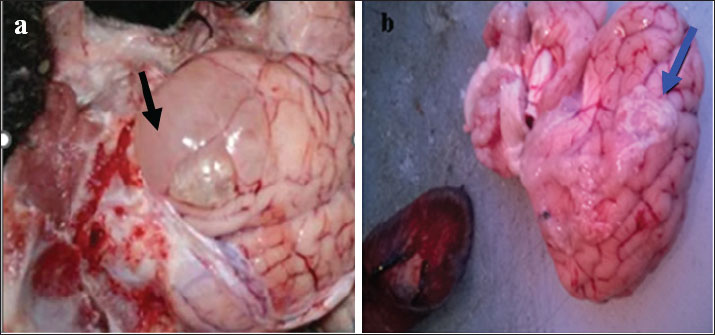
AbstractBackground: Cœnurosis is a cestodosis of the central nervous system of sheep is caused by Coenurus cerebralis, a larva of Taenia multiceps, a tapeworm that infests the small intestine of dogs. This parasitic disease is a major health problem that can lead to the death of the animal, causing significant economic losses. Cœnurosis generally shows no clinical symptoms at the onset of infection; therefore, farmers and veterinarians struggle to identify the early signs of the disease in the field. Aim: The objective of the research is to determine the prevalence of cœnurosis in sheep in the province of Kenitra and to highlight the relationship between this disease and risk factors, namely sex, age, farming system, and seasons. Methods: We conducted a study on 687 animals from various locations. The latter adopt extensive and intensive farming methods. We collected all brains of sheep showing neurological signs of cœnurosis; all cysts extracted from infected brains were stored in coolers for subsequent analysis of their fertility and viability to create a database for determining the prevalence of the disease and identifying the risk factors that influence its persistence. Results: Post-mortem examination of the heads of infected animals showed that 12.37% harboured cœnurosis cysts filled with a translucent fluid containing numerous clearly visible protoscolices; data analysis revealed a positive relationship between the prevalence of T. multiceps., age, and farming system, while there was no association with sex or season. The survey also showed a link between T. multiceps infection in dogs and cœnurosis. Conclusion: It should be concluded that the prevalence of sheep cœnurosis in Kenitra, Morocco, has reached a worrying level (12.37%), which requires increased attention to sheep health in the region to prevent the spread of this disease. It is necessary to raise awareness among sheep farmers, to permanently eliminate infected animals by burying or incinerating them, to regularly deworm dogs, and finally to collect and destroy dog droppings near feed storage areas or water points to prevent sheep from ingesting tapeworm eggs while grazing. Keywords: Cœnurosis, Coenurus cerebralis, Risk factors, Sheep, Taenia multiceps IntroductionCœnurosis is a larval Cestodosis due to the development in the central nervous system, particularly in sheep, of the Taenia multiceps larva of the dog called C. cerebralis (Scala et al., 2006; Amrabadi et al., 2015; Biçek et al. 2019). Parasitosis is clinically manifested by nervous disorders (both motor and sensory), which vary depending on the location, the size of the cysts, and the pressure they put on the brain (Abdollahi et al., 2023), and can often lead to the death of the animal (Avcioglu et al., 2010). In addition, noncerebral cœnurosis has been reported in the muscles and viscera of some intermediate hosts (Christodoulopoulos, 2006; Amrabadi et al., 2015). This parasitosis causes a major health problem in small ruminants in pastoralist communities in several parts of Africa (Desouky et al., 2011; Engida et al., 2015; Miran et al., 2015; Hughes et al., 2019). Indeed, in northern Tanzania, cœnurosis has been identified as the cause of very high mortality in small ruminants (Hughes et al., 2019). In Egypt, (Amer et al., 2017) recorded an infection rate of 3.03%. Cœnurosis has also been reported in other countries around the world with a variable prevalence rate (Akkuş and Oğuz, 2024). The prevalence of C. cerebralis has been reported as 3% in Jordan (Abo-Shehada et al., 2002), 6% in Italy (Varcasia et al., 2009), 5 % in Greece (Al-Riyami et al., 2016), in India (Soundararajan et al., 2016), and Iran (Tavassoli et al., 2011) reported infection rates of 12.30% and 18.65%, respectively. Taenia multiceps (T. multiceps) has zoonotic potential, as evidenced by multiple cases of cœnurosis in humans caused by this parasite (Hoberg, 2005; Collomb et al., 2007; Deplazes et al., 2019). Humans can become infected by accidentally ingesting eggs/larvae of the parasite transmitted into the environment with definitive host faeces (Sharma and Chauhan, 2006). Indeed, one case was recorded in Israel by (Benifla et al., 2007). However, human infections are not involved in the full life cycle of this parasite, making humans a dead-end host (Kibona et al., 2022). Cœnurosis infestation is made favourable by the coexistence of dogs and ruminants, including the herding dog (Sagni and Abebe, 2021) and (Varcasia et al., 2022), and also by the frequency of food deficiencies in times of scarcity leading to pica and coprophagia. Small ruminants are infected with the parasite (C. cerebralis) as a result of ingesting eggs dispersed on grass from pasture and contaminated water. Once absorbed (in humans and livestock), the oncosphere hatches and passes through the intestinal wall and into the bloodstream to eventually move to the brain and spinal cord (Alemu et al., 2016; Deplazes et al., 2019; Kibona et al., 2022). Metacestode larvae have a high affinity for cerebrospinal fluid, which stimulates differentiation and development into mature Coenurus cysts (Oge et al., 2012). As a result, neurological symptoms appear in young animals and sometimes even lead to their death (Abo-Shehada et al., 2002; Scott, 2012). Currently, in Morocco, data relating to cœnurosis remains unavailable, and there are no studies concerning this disease in our research region. The purpose of this survey was to determine the prevalence of cœnurosis in sheep, to highlight the impact of T. multiceps infection in dogs on the spread of this disease in a range of extensive and intensive breeding systems in Kenitra province, and to identify risk factors for maintaining cœnurosis in small sheep in the province. Materials and MethodsStudy areaThe study was conducted in Kenitra Province, the capital of the Gharb-Chrarda-Bini Hssen region. It covers an area of 3,052 km² and is located in northwest Morocco. The climate in this study area is considered hot and temperate. In winter, Kenitra receives more rainfall compared to the summer months. According to the Köppen–Geiger classification, the predominant climate in this region is classified as Csa. During the year, the temperature generally ranges from 8°C to 28°C. Approximately 343 mm of precipitation occurs each year (Weather Spark, Maroc.) The livestock sector gives the region considerable wealth. Indeed, the region has a significant and diverse livestock population estimated at 2,698,827 heads, including 1,936,253 (71.74 %) sheep, while cattle and goats make up 603,649 (22.37 %) and 158,925 (5.89 %), respectively (Regional Directorate of Agriculture - Morocco). Study methodsA cross-sectional study on cœnurosis in sheep from Kenitra province was conducted from December 2023 to November 2024. A total of 687 animals (480 ewes and 207 rams) from 31 flocks across various locations within the study area were examined. The breeding system in this region is extensive for 375 animals and intensive for 312. Among the sheep studied, 154 (22.42%) exhibited neurological signs (convulsive dizziness, blindness, and paralysis associated with stupor and immobility). Eighty-eight percent of these animals were taken to local slaughterhouses with the agreement of the herd owners, while the 12% with very advanced signs were slaughtered at home. All seized heads were examined for the presence of corneal cysts. The cysts extracted from the infected brains were stored in coolers for further analysis of their fertility and viability. Formal consent and authorization to use these cysts for research purposes were obtained from veterinarians at the relevant slaughterhouses. No experiments have been carried out on live animals. Individual data collected includes breeding system, month of sampling, age (estimated by dentition), and sex of animals. In parallel with this study, a coproscopic survey was conducted on 56 fecal samples from dogs accompanying the herds studied (32 dogs in extensive settings and 21 in intensive settings), as well as stool from stray dogs in the pastures of the study area. Ten grams of fresh fecal matter were taken from each dog to detect the presence of T. multiceps and quantify the Taeniid worm load. During laboratory examination, the enumeration of Taeniid eggs in faeces was carried out according to a modified McMaster technique, as described previously (Ballweber et al., 2014). This method is based on concentration by centrifugation and flotation using a Sheather's sucrose solution, the specific gravity of which is 1.27. This second investigation aimed to clarify the link between cœnurosis and dogs infected with T. multiceps. Data analysis and managementThe data generated were entered into the Microsoft Excel database management software and analysed using the statistical software SPSS v.26. The chi-square test (X2) was used to quantify the association between risk factors and cœnurosis. Statistically significant associations between variables were considered if the calculated p-value was < 0.05 with a 95% confidence level. These variables were categorised during data analysis. The categories of the variables were as follows: sex, age, farming system, and month of slaughter. Ethical approvalThis study examines the ethics guidelines of the Minister of Agriculture and Maritime Fisheries No. 244-13 of 4 Rabii I 1434 (January 16, 2013) relating to the authorization and health approval of establishments and businesses in the food sector animal and food sector. ResultsThe clinical examination revealed that 154 exhibited neurological disorders, including convulsive dizziness, blindness, head tremors, lack of coordination, and, in some cases, paralysis. The post-mortem inspection of the heads of these animals showed that only 85 sheep had cysts of coenurosis filled with a translucent liquid containing numerous well-visible protoscolices (Fig. 1). The overall prevalence of the infection is then 12.37% (i.e., 85/687). Since post-mortem examinations were limited to animals showing neurological symptoms, this should be considered as a limitation in interpreting the reported prevalence value.
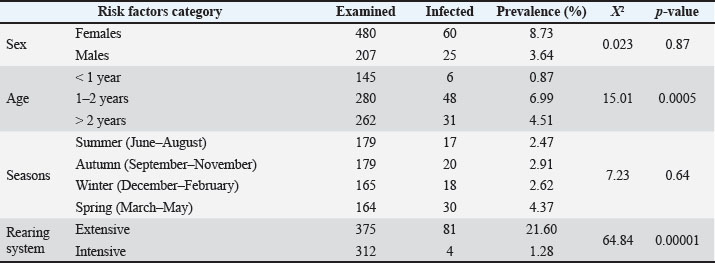
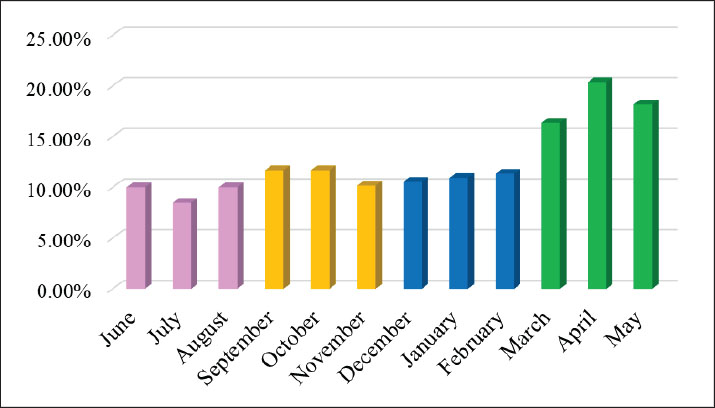
Fig. 1. Fertile Coenurus cerebralis on the sheep’s brain (a): Sheep’s Coenurus cyst filled with clear fluid (black arrow) (b): Cyst membrane bearing Scolices (blue arrow). Photo du laboratoire des sciences de l’université Ibn Tofail à Kénitra. Analysis of the data from post-mortem surveys on viable cysts showed that the seasons of animal slaughter and the sex of the sheep had no effect on the coenurosis infection (p > 0.05; Table 1) and (Fig. 2). However, a significant association was observed between cœnurosis and other factors such as: age, rearing system, and the presence of dogs infected with T. multiceps according to the rearing systems. Indeed, young animals aged less than 3 months showed no infection, and animals aged between more than 3 months and 2 years exhibited higher prevalences of cœnurosis compared to animals over 2 years old. Regarding the rearing system, the study reported a higher infection rate in the extensive system (21.60%) than in the intensive system (1.28%). Coprological stool test results revealed a T. multiceps infection rate of 65.63% (21/32) in dogs coexisting with extensively farmed sheep, compared to 4.17% (1/24) in intensively farmed sheep. As for stray dogs, the results revealed no infection; we therefore excluded this population. Table 1. Correlation between the prevalence of cœnurosis and risk factors.
Fig. 2. Monthly frequency of cœnurosis in the province of Kenitra. DiscussionIn Morocco, sheep farming occupies a prominent place. It is found throughout the country, where it is sometimes the essential source of income for farmers. Easy to handle, they do not require a sophisticated infrastructure, allow a quick return on investment, and therefore constitute a permanent cash flow for the breeder (Boujenane and I, 2005). In Kenitra, sheep farming is a very widespread practice. However, parasitic diseases constantly threaten these precious animals. The latter generate enormous economic losses, jeopardising the sustainability of this vital activity (Acıöz, 2019; Bhowmik et al., 2020). The results of the present study revealed a rate of C. cerebralis infection in Kenitra of 12.37 %, similar results were observed by (Soundararajan et al., 2016), (12.30 %) in Tamil Nadu, India and by (Gatie 2018) (13.29 %) in Al-Qadisiyah, Iraq. However, these data are lower than those of (Anwar et al., 2013; Aliye and Deressa, 2017; Biçek et al., 2019; Ajaj et al., 2021) who reported a cœnurosis prevalence of (18.30 %), (20.17 %), (64.7 %), and (26.53 %) in Egypt, Ethiopia, Turkey, and Iraq, respectively. Whereas (Paulos The data indicate that gender has no impact on the prevalence of this disease. This finding could be explained by the fact that individuals of both sexes were raised in the same system and living conditions, which gave them similar probabilities of being infected. These results corroborate those observed in Turkey by (Uslu and Guclu, 2007), which found comparable rates in rams (18.57%) and ewes (15.21). However, other studies have reported a higher prevalence in males, as highlighted (Biçek et al., 2019) and (Mohammed, 2020), while some research has indicated a higher prevalence in females, including the work of (Gicik et al., 2007; Miran et al., 2015; Amer et al., 2017; Mohamed et al., 2018). Regarding seasonal changes, the investigation showed that these changes have no effects on the disease. Indeed, the infection was observed throughout the year, with monthly variations generally insignificant. This finding was also reported in the study conducted by (Paulos et al., 2015); however, this data is in disagreement with the results of (Tavassoli et al., 2011) in Iran, who reported a positive correlation between the disease and the seasons. Indeed, they recorded a higher prevalence (42.42%) in March and a lower one (2.94%) in July (summer). The survey revealed a significant correlation (p < 5%) between infection and the age of the sheep examined; no lambs younger than 3 months have tested positive, while the 3–24-month-old groups together have the highest infection rate (84.71%). Older animals have the lowest infection rate (15.29%). These results confirm those of (Mohamed et al., 2018), who did not observe any cœnurosis in lambs < 3 months old, as well as those of Aliye and Deressa (2017); Biçek et al. (2019); Mohammed (2020), and Kızıltepe and Ayvazoğlu (2022), which recorded a higher rate in animals aged 1 to 2 years. These differences are explained by several factors: the absence of infection in 0–3-month-old lambs results from their feeding habits (mainly breast milk), the long incubation period, and maternal immunity (Sharma and Chauhan, 2006). The low prevalence in older animals (>2 years) can be explained by acquired immunity. Studies show that the period of susceptibility to the disease extends up to the age of 1 year, and that the risk of infection decreases with age (Biçek et al., 2019). ConclusionThe survey carried out made it possible to draw up an inventory of the epidemiological situation of coenurosis in Kenitra. It can be argued that the disease is influenced by the young age beyond 3 months and the breeding system (extensive or intensive), which is closely linked to the presence of dogs in the same places as sheep. These results suggest that the coexistence of dogs with sheep may be associated with the epidemiology of coenurosis in the study area. Moreover, sex or seasonal climate change does not influence this disease. RecommendationsTo cope with this Cestodosis, the regular application of medical prophylaxis, including the systematic deworming of guard dogs and vulnerable animals, is essential. In addition, sanitary prophylaxis in farms and slaughterhouses, aimed at interrupting the evolutionary cycle of T. multiceps, represents the most effective strategy against this disease. AcknowledgmentsWe sincerely thank the flock owners for granting access to their properties and allowing the use of their sheep for the purposes of this research. FundingThis study did not receive any funding support. Author’s contributionsConception and design of the study: B.K. Acquisition of data: B.K.; D.B. Analysis and/or interpretation of data: B.K.; D.B.; T.H.; A.N. Drafting the manuscript: B.K.; A.N. Critical review/revision: D.B.; T.H.; A.N. Conflict of interestThe authors declare that there is no conflict of interest. Data availabilityAll analysed data are included in the article. ReferencesAbdollahi, M., Lotfollahzadeh, S., Shokrpoor, S., Daneshi, M. and Darounkola, M.A. 2023. Acute cœnurosis in lambs. Vet. Med. Sci. 9(6), 2786–2790; doi:10.1002/vms3.1278 Abo-Shehada, M.N., Jebreen, E., Arab, B., Mukbel, R. and Torgerson, P.R. 2002. Prevalence of Taenia multiceps in sheep in northern Jordan. Prev. Vet. Med. 55(3), 201–207; doi:10.1016/s0167-5877(02)00056-9 Aciöz, M. 2019. Isparta’da kesilen sığırlarda distomatozis’in yayılışı. Erciyes Üniv. Vet. Fak. Derg. 16(2), 136–140; doi:10.32707/ercivet.595620 Ajaj, E.A., Mohammad, H.A. and Gharban, H.A.J. 2021. First molecular confirmation of Coenurus cerebralis in sheep and goats with neurological behaviors in Iraq. Vet. World. 14(6), 1420–1425; doi:10.14202/vetworld.2021.1420-1425 Akkuş, E. and Oğuz, F.E. 2024. Molecular prevalence of Coenurus cerebralis in sheep with neurological symptoms in iğdir province, Türkiye. Pak. Vet. J. 44(2), 499–503; doi:10.29261/pakvetj/2024.186 Alemu, B., Garrigues, A., and Hanotte, C. (2016). Preventing the spread of cœnurosis. A disease of sheep and goats. In Ilri Ethiopia Extension Brief. ILRI. https://hdl.handle.net/10568/76537 Aliye, J. and Deressa, F.B. 2017. Prevalence and economic importance of Coenurus Cerebralis in sheep and goats in and around “Legahida” district of bale zone, south eastern Ethiopia. Comparative. Clin. Pathol. 26(2), 483–492; doi:10.1007/s00580-017-2404-8 Al-Riyami, S., Ioannidou, E., Koehler, A.V., Hussain, M.H., Al-Rawahi, A.H., Giadinis, N.D., Lafi, S.Q., Papadopoulos, E. and Jabbar, A. 2015. Genetic characterisation of Taenia multiceps cysts from ruminants in Greece. Infect. Genet. Evol. 38, 110–116; doi:10.1016/j.meegid.2015.12.008 Amer, S., Elkhatam, A., Fukuda, Y., Bakr, L.I., Zidan, S., Elsify, A., Mohamed, M.A., Tada, C. and Nakai, Y. 2017. Prevalence and Identity of Taenia multiceps cysts “Coenurus cerebralis” in Sheep in Egypt. Acta Tropica 176, 270–276; doi:10.1016/j.actatropica.2017.08.012 Amrabadi, O., Oryan, A., Moazeni, M., Sharifiyazdi, H. and Akbari, M. 2015. Comparison of cerebral and non-cerebral cœnurosis by genetic markers of glycolytic enzyme (enolase) and mitochondrial sequences in sheep and goats. Vet. Parasitol. 214(3-4), 333–336; doi:10.1016/j.vetpar.2015.10.021 Anwar, S., Mahdy, E., El-Nesr, K.A., El-Dakhly, K.M., Shalaby, A. and Yanai, T. 2013. Monitoring of parasitic cysts in the brains of a flock of sheep in Egypt. Revista Brasileira De Parasitologia Veterinária/Brazilian J. Vet. Parasitology 22(3), 323–330; doi:10.1590/s1984-29612013000300002 Avcioglu, H., Yildirim, A., Duzlu, O., Inci, A., Terim, K.K. and Balkaya, I. 2010. Prevalence and molecular characterization of bovine cœnurosis from Eastern Anatolian region of Turkey. Vet. Parasitol. 176(1), 59–64; doi:10.1016/j.vetpar.2010.10.033 Ballweber, L.R., Beugnet, F., Marchiondo, A.A. and Payne, P.A. 2014. American Association of Veterinary Parasitologists’ review of veterinary fecal flotation methods and factors influencing their accuracy and use—Is there really one best technique?. Vet. Parasitol. 204(1–2), 73–80; doi:10.1016/j.vetpar.2014.05.009 Benifla, M., Barrelly, R., Shelef, I., El-On, J., Cohen, A. and Cagnano, E. 2007. Huge hemispheric intraparenchymal cyst caused by Taenia multiceps a child. J. Neurosurg. Pediatr. 107(6), 511–514; doi:10.3171/ped-07/12/511 Bhowmik, M., Hossen, M.A., Mamun, M.A., Hasib, F., Poddar, S., Hossain, M.A. and Ali, M.A. 2020. Prevalence of gastrointestinal parasitic infections in sheep and goats of Sandwip Island, Chattogram, Bangladesh. Van. Vet. J. 31(3), 152–157; doi:10.36483/vanvetj.821083 Biçek, K., Karakuş, A. and Değer, M.S. 2019. Prevalence of Coenurus cerebralis in Van, Turkey and the significance of the enolase (NSE) enzyme as a supporting parameter in the diagnosis of cœnurosis. Vet. Sci. Pract. 14, 185–192; https://gcris.yyu.edu.tr/entities/publication/e35e06d1-d80c-43b8-a22a-fd8ee4be08a3 Boujenane, I. 2005. L’élevage ovin en pratique. Actes Éditions. Rabat, Morocco: Institut Agronomique et Vétérinaire Hassan, p: 9981. https://www.agrimaroc.net/bulletins/elevage_ovin_en_pratique.pdf Christodoulopoulos, G. 2006. Two rare clinical manifestations of Cœnuroses in sheep. Vet. Parasitol. 143(3-4), 368–370; doi:10.1016/j.vetpar.2006.09.010 Climat, météo par mois, température moyenne pour Kénitra (Maroc) - Weather Spark. (n.d.-b). Weather Spark. https://fr.weatherspark.com/y/33172/M%C3%A9t%C3%A9o-moyenne-%C3%A0-K%C3%A9nitra-Maroc-tout-au-long-de-l'ann%C3%A9e Collomb, J., Machouart, M., Biava, M., Brizion, M., Montagne, K., Plénat, F. and Fortier, B. 2007. Contribution of NADH dehydrogenase Subunit I and cytochrome C oxidase Subunit I sequences toward identifying a case of human coenuriasis in France. J. Parasitol. 93(4), 934–937; doi:10.1645/ge-1160r.1 Deplazes, P., Eichenberger, R.M. and Grimm, F. 2019. Wildlife-transmitted Taenia and Versteria cysticercosis and cœnurosis in humans and other primates. Int. J. Parasitol. Parasites. Wildlife. 9, 342–358; doi:10.1016/j.ijppaw.2019.03.013 Desouky, E.A., Badawy, A.I. and Refaat, R.A. 2011. Survey on cœnurosis in sheep and goats in Egypt. Vet. Ital. 47(3), 333–340; https://www.academia.edu/15163595/Survey_on_Cœnurosis_in_sheep_and_goats_in_Egypt Diba, S and Garoma, A. 2021. Epidemiology and economic loss of coenurosis in small ruminants slaughtered at mojo halal export abattoir, Oromia reginal state, East Shoa Zone, Ethiopia. Int J Vet Sci Res. 7(2), 127–137; doi: 10.17352/ijvsr.000092 Engida, E., Guthiga, P., Karugia, J. (2015). The Role of Livestock in the Tanzanian Economy: Policy Analysis Using a Dynamic Computable General Equilibrium Model for Tanzania. AgEcon Search. (University of Minnesota, USA). https://doi.org/10.22004/ag.econ.212039 Gatie, J.A., Jaber, S.S. and Hanon, A. 2017. Sheep cœnurosis in Thi-Qar Province, Iraq. QJVMS 16(3), 111–114; https://pdfs.semanticscholar.org/79a6/56f081554344292d72e9df012c817480 Gicik, Y., Kara, M. and Arslan, M. 2007. Prevalence of Cœnurus cerebralis in sheep in Kars province, Turkey. Bull. Vet. Inst. Pulawy. 51, 379–382. Hoberg, E.P. 2005. Phylogeny of Taenia: species definitions and origins of human parasites. Parasitol. Int. 55, S23–S30; doi:10.1016/j.parint.2005.11.049 Hughes, E.C., Kibona, T.K., De Glanville, W.A., Lankester, F., Davis, A., Carter, R.W., De Jong, R.M.F., Nyasebwa, O.M., Claxton, J.R., Cleaveland, S. and Allan, K.J. 2019. Taenia multiceps cœnurosis in Tanzania: a major and under‐recognised livestock disease problem in pastoral communities. Vet. Rec. 184(6), 191; doi:10.1136/vr.105186 Kibona, T., Buza, J., Shirima, G., Lankester, F., Ngongolo, K., Hughes, E., Cleaveland, S. and Allan, K.J. 2022. The Prevalence and Determinants of Taenia multiceps Infection (Cerebral cœnurosis) in Small Ruminants in Africa: a Systematic Review. Parasitologia 2(2), 137–146; doi:10.3390/parasitologia2020013 Kızıltepe. and Ayvazoğlu, C. 2022. Prevalence of Cœnurus cerebralis in Sheep in Iğdır Region. MAS JAPS. 7, 1287–1293; doi:10.5281/zenodo.7496298 Miran, M.B., Nzalawahe, J., Kassuku, A.A. and Swai, E.S. 2015. Prevalence of cœnurosis in sheep and goats at three slaughter slabs in Ngorongoro District, Tanzania. Trop Anim Health Prod. 47(8), 1591–1597; doi: 10.1007/s11250-015-0903-7 Mohamed, E.B., Atwa, S., Abbas, I. and Aboelfadl, E. 2018. Clinical, some epidemiological and risk factors studies of cœnurosis in sheep at dakahlia governorate, Egypt. Assiut. Vet. Med. J. 64(157), 74–80; doi:10.21608/avmj.2018.168914 Mohammed, N.H. 2020. Prevalence, morphological and biochemical study of larval stage Cœnurus cerebralis of Taenia multiceps in sheep. Iraqi J. Vet. Sci. 34, 159–163; doi:10.33899/ijvs.2019.125660.1124 Oge, H., Oge, S., Gonenc, B., Ozbakis, G. and Asti, C. 2012. Cœnurosis in the lumbar region of a goat: a case report. Vet. Med. 57(6), 308–313; doi:10.17221/6018-vetmed Paulos Adane, Bersissa Kumsa, Adem Hiko and Berihun Afera. 2015. Prevalence of Coenurus cerebralis in small ruminants slaughtered at Hashim export Abattoir, Debre Zeit, Central Oromia. Europ. J. Appl. Sci. 7(1), 56–63; doi: 10.5829/idosi.ejas.2015.7.2.93193 Regional Directorate of Agriculture-Morocco. https://www.agriculture.gov.ma/fr/region/rabat-sale-kenitra Scala, A., Cancedda, G., Varcasia, A., Ligios, C., Garippa, G. and Genchi, C. 2006. A survey of Taenia multiceps cœnurosis in Sardinian sheep. Vet. Parasitol. 143(3–4), 294–298; doi:10.1016/j.vetpar.2006.08.020 Scott, P. 2012. Diagnosis and treatment of cœnurosis in sheep. Vet. Parasitol. 189(1), 75–78; doi:10.1016/j.vetpar.2012.03.034 Sharma, D.K. and Chauhan, P.P.S. 2006. Cœnurosis status in Afro-Asian region: a review. Small. Rumin. Res. 64(3), 197–202; doi:10.1016/j.smallrumres.2005.05.021 Soundararajan, C., Sivakumar, T. and Balachandran, C. 2016. Coenurus cerebralis and its pathology in an organized farm of Tamil Nadu. J. Parasit. Dis. 41(2), 510–513; doi:10.1007/s12639-016-0839-5 Tavassoli, M., Malekifard, F., Soleimanzadeh, A. and Tajik, H. 2011. Prevalence of Cœnurus cerebralis in sheep in Northwest of Iran. Vet. Res. Forum 2(4), 274–276; https://www.magiran.com/p982226 Uslu, U. and Guclu, F. 2007. Prevalence of Cœnurus cerebralis in sheep in Turkey. Vet. Med. 63(6), 678–680; http://www.medycynawet.edu.pl/images/stories/pdf/pdf2007/062007/200706s06780680.pdf Varcasia, A., Tamponi, C., Ahmed, F., Cappai, M.G., Porcu, F., Mehmood, N., Dessì, G. and Scala, A. 2022. Taenia multiceps cœnurosis : a review. Parasit. Vectors. 15(1), 84; doi:10.1186/s13071-022-05210-0 Varcasia, A., Tosciri, G., Coccone, G.S., Pipia, A., Garippa, G., Scala, A., Damien, V., Vural, G., Gauci, C. and Lightowlers, M. 2009. Preliminary field trial of a vaccine against cœnurosis caused by Taenia multiceps. Vet. Parasitol. 162(3–4), 285–289; doi:10.1016/j.vetpar.2009.03.008 | ||
| How to Cite this Article |
| Pubmed Style Brik K, Taoufik H, Driss B. Prevalence and characteristics of ovine coenurosis in the province of Kenitra (Morocco). Open Vet. J.. 2026; 16(5): 2948-2954. doi:10.5455/OVJ.2026.v16.i5.37 Web Style Brik K, Taoufik H, Driss B. Prevalence and characteristics of ovine coenurosis in the province of Kenitra (Morocco). https://www.openveterinaryjournal.com/?mno=305548 [Access: June 26, 2026]. doi:10.5455/OVJ.2026.v16.i5.37 AMA (American Medical Association) Style Brik K, Taoufik H, Driss B. Prevalence and characteristics of ovine coenurosis in the province of Kenitra (Morocco). Open Vet. J.. 2026; 16(5): 2948-2954. doi:10.5455/OVJ.2026.v16.i5.37 Vancouver/ICMJE Style Brik K, Taoufik H, Driss B. Prevalence and characteristics of ovine coenurosis in the province of Kenitra (Morocco). Open Vet. J.. (2026), [cited June 26, 2026]; 16(5): 2948-2954. doi:10.5455/OVJ.2026.v16.i5.37 Harvard Style Brik, K., Taoufik, . H. & Driss, . B. (2026) Prevalence and characteristics of ovine coenurosis in the province of Kenitra (Morocco). Open Vet. J., 16 (5), 2948-2954. doi:10.5455/OVJ.2026.v16.i5.37 Turabian Style Brik, Kamal, Hassouni Taoufik, and Belghyti Driss. 2026. Prevalence and characteristics of ovine coenurosis in the province of Kenitra (Morocco). Open Veterinary Journal, 16 (5), 2948-2954. doi:10.5455/OVJ.2026.v16.i5.37 Chicago Style Brik, Kamal, Hassouni Taoufik, and Belghyti Driss. "Prevalence and characteristics of ovine coenurosis in the province of Kenitra (Morocco)." Open Veterinary Journal 16 (2026), 2948-2954. doi:10.5455/OVJ.2026.v16.i5.37 MLA (The Modern Language Association) Style Brik, Kamal, Hassouni Taoufik, and Belghyti Driss. "Prevalence and characteristics of ovine coenurosis in the province of Kenitra (Morocco)." Open Veterinary Journal 16.5 (2026), 2948-2954. Print. doi:10.5455/OVJ.2026.v16.i5.37 APA (American Psychological Association) Style Brik, K., Taoufik, . H. & Driss, . B. (2026) Prevalence and characteristics of ovine coenurosis in the province of Kenitra (Morocco). Open Veterinary Journal, 16 (5), 2948-2954. doi:10.5455/OVJ.2026.v16.i5.37 |


