




| Case Report | ||
Open Vet. J.. 2026; 16(5): 3274-3280 Open Veterinary Journal, (2026), Vol. 16(5): 3274-3280 Case Report Syndactyly in pigsJosé L. Fernández-Vásquez, Samer Sánchez-Silva, Jorge Portal-Torres, Lizbeth Zambrano and Medali Cueva-Rodríguez*Veterinary Pathology Laboratory, Faculty of Veterinary Sciences, National University of Cajamarca, Cajamarca, Peru *Corresponding Author: Medali Cueva-Rodríguez. Veterinary Pathology Laboratory, Faculty of Veterinary Sciences, National University of Cajamarca, Cajamarca, Peru. Email: mcuevar [at] unc.edu.pe Submitted: 27/11/2025 Revised: 11/04/2026 Accepted: 23/04/2026 Published: 31/05/2026 © 2025 Open Veterinary Journal
AbstractBackground: Syndactyly, also known as mulefoot, is one of the most common physical extremity malformations. In pigs, syndactyly has been associated with genetic or environmental factors and occurs as an isolated defect or in association with other congenital anomalies. This case report aimed to describe a radiographically confirmed case of syndactyly in a piglet. Case Description: A 17-day-old 6.2 kg piglet showed syndactyly in all four limbs. Although this anomaly did not affect the patient’s daily activities, it was a congenital malformation of clinical and zootechnical relevance. A complete blood count, morphometric measurements, and limb radiographs were performed. Radiographs revealed a fusion of phalangeal bones in the forelimbs and an accessory phalangeal element located axially between the principal digits in the hindlimbs. The complete blood count revealed mild leukocytosis. Conclusion: Syndactyly occurs during embryonic development when the phalanges do not separate. Its severity can vary from a simple skin union to complete bone fusion. Syndactyly etiology is multifactorial and involves genetic and environmental factors. Keywords: Congenital limb defect, Mulefoot, Piglet, Syndactyly, Teratology. IntroductionSyndactyly is a congenital malformation characterized by the fusion or connection of two or more fingers or toes during embryonic development (Facioli et al., 2022). According to Rahe et al. (2022) this type of anomaly generally compromises limb function because its severity can vary from a simple skin union to complete bone fusion. Although syndactyly is often described as a multifactorial defect, current evidence suggests that its occurrence may involve disruptions in key developmental processes, such as the remodeling of interdigital tissue and skeletal pattern, which may be due to genetic inheritance or be influenced by prenatal environmental conditions (Facioli et al., 2022; Rahe et al., 2022). The coat is usually normal in pigs with syndactyly, as the variation mainly manifests itself at the bone level. The anomaly consists of the fusion or union of the phalanges, evidencing the malformation known as "mule foot". To date, the genetic markers associated with this phenotype have not been accurately identified, which limits our understanding of its origin and inheritance (Ellemann-laursen et al., 2016; Justolin et al., 2016; Facioli et al., 2022). Although syndactyly is a well-known congenital defect in pigs, detailed clinical and radiographic descriptions of this condition are still limited. Likewise, reports of syndactyly or clubfoot in the high Andean regions of Peru are almost nonexistent in the scientific literature. Documenting new cases contributes to improving diagnostic characterization, considering the clinical and zootechnical importance of this anomaly, as it can affect the locomotion and welfare of the animal (Madgwick et al., 2011). Therefore, this case report aimed to describe a radiographically confirmed case of syndactyly in a piglet. Case DetailsThe piglet with syndactyly was obtained from a family farm in La Pucara, Chota province, Cajamarca region (Fig. 1). The farm is located at 3031 m above sea level, with a latitude of 6° 25' 13.2" S and a longitude of 78° 30' 11.3" W, and is characterized by a cold climate. This report presents the case of a 17-day-old piglet with syndactyly affecting all four limbs. The litter consisted of nine piglets, and only one (1) showed malformation. The physiological parameters were within normal ranges, with an average heart rate of 73 beats per minute. On physical examination, everything appeared normal, except for the hooves. The animal moved normally from one place to another. It showed no signs of pain or lameness. It did not exhibit any other abnormalities or congenital anomalies; this was examined in detail during the necropsy performed on the animal. Everything was normal.
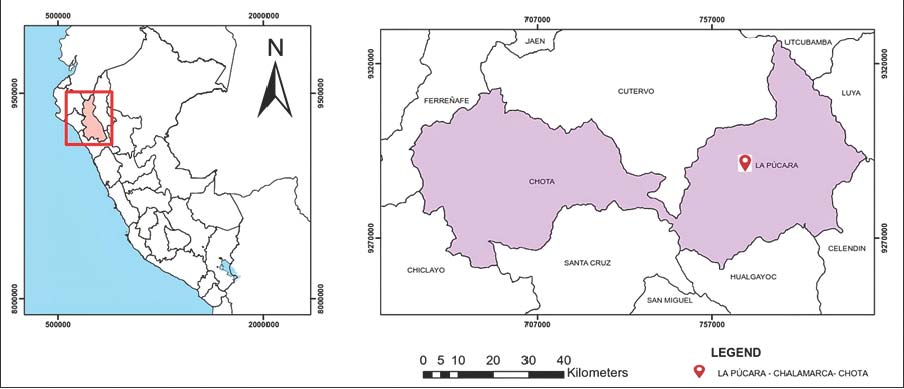
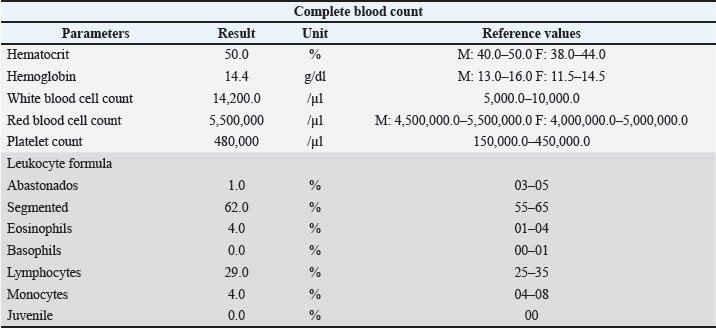
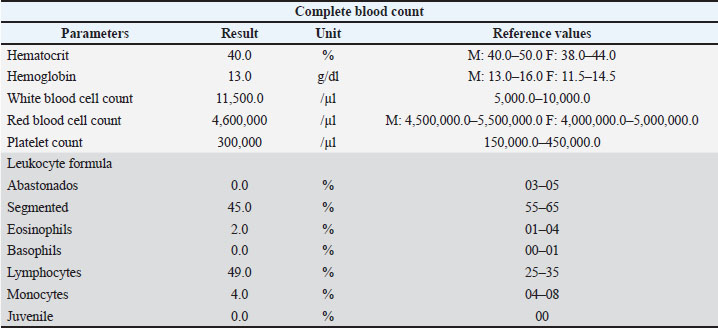
Fig. 1. Case location: La Pucara town center, Chota province, Peru Altitude 3031 m above sea level, latitude 6° 25' 13.2" S, longitude 78° 30' 11.3" W, cold climate. This was the first time this condition had been seen on the family farm and the first case reported in several years of pig breeding. The mother pig, a Pietrain breed, had two previous farrowings without complications, both of which resulted from natural mating. The father was a Pietrain crossed with a Criollo, with no previous congenital anomalies. A complete blood count was performed on the piglet with syndactyly at the laboratory of Chota Lab. A complete blood count (CBC) was performed on the affected piglet to assess systemic health status and rule out hematological evidence of infection or inflammation (Table 1). Overall, the hematological parameters were within or close to the reported reference ranges, with one level of mild leukocytosis (14,200/mm³) and marginal thrombocytosis (480,000). For comparison, a complete blood count was also performed on a second piglet (sibling), which showed a similar pattern, including mild leukocytosis (11,500/mm³) (Table 2). No clinically relevant systemic alteration is associated with the malformation; therefore, these findings are likely related to stress or physiological variations. Table 1. Complete blood count of syndactyly piglets.
Table 2. Complete blood count of sibling piglets without malformation.
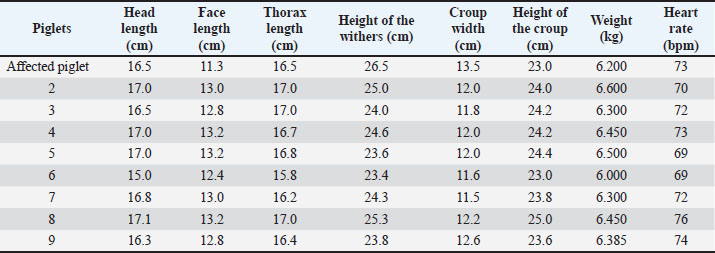
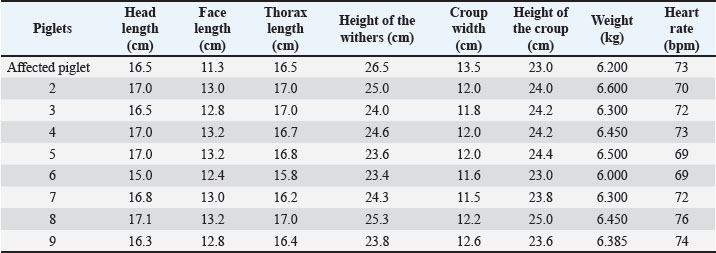
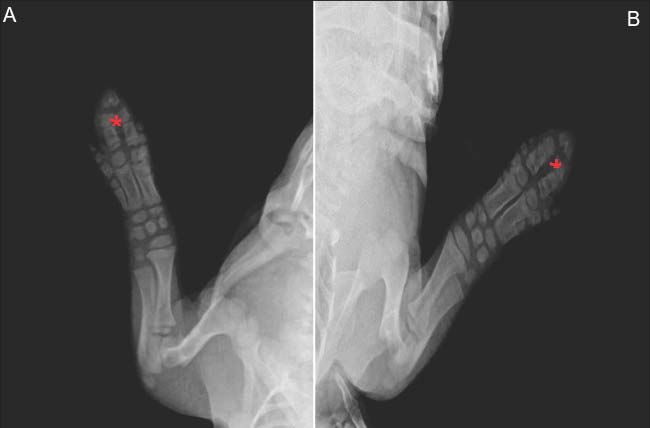
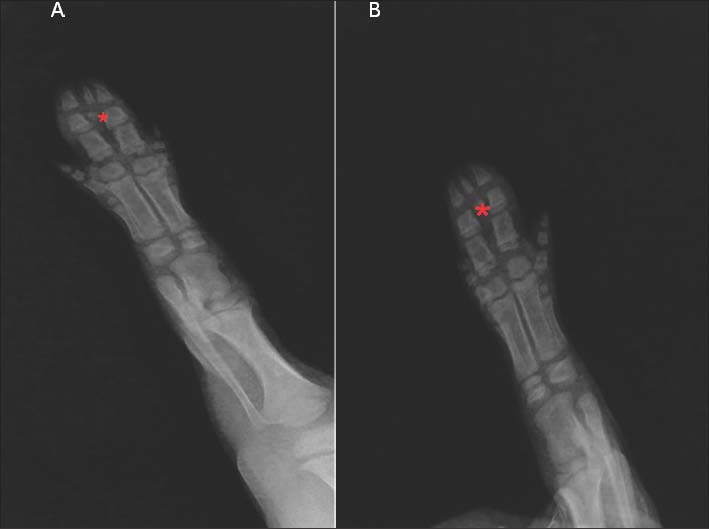
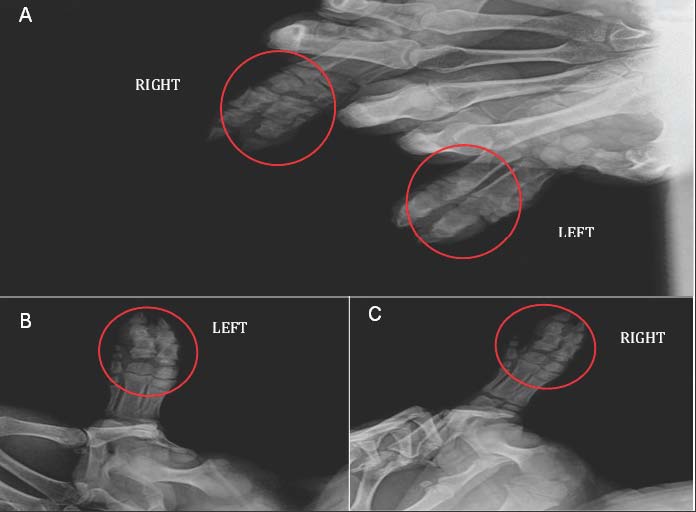
Morphometric measurements (body dimensions, weight, and heart rate) of the piglet with syndactyly and its siblings were also taken (Table 3). The piglet with syndactyly was found to have a normal size and body weight similar to that of its siblings. Additionally, its morphometric measurements are similar to those of the rest of the litter, indicating no apparent evidence of general developmental impairment. Additionally, radiographic examination was performed at the Trujillo clinic (Chota, Cajamarca) on the two pigs that underwent complete blood counts. The piglet with syndactyly had fused phalanges in both front feet (Fig. 2), while an accessory phalangeal element was identified in the hind limbs, located between the two main digits (Fig. 3). X-rays of the sibling pig showed no malformations (Fig. 4). Table 3. Morphometric measurements of the entire litter.
Table 4. Morphometric measurements of the entire litter.
Fig. 2. Radiographs of the affected piglet’s forelimbs showing phalangeal fusion consistent with syndactyly. (A) Dorsopalmar projection of the left forefoot: phalanges within the same hoof and bones fused at the phalanx head. (B) Dorsopalmar projection of the right forefoot: similar malformation. Red asterisks indicate the region where the fused phalanges of the main digits appear
Fig. 3. Radiographs of the affected piglet’s hind feet obtained in a dorsoplantar projection. The image shows an accessory phalangeal element (red asterisk) between the two main digits. (A) Left hind foot and (B) right hind foot.
Fig. 4. Radiographs of the hind feet of a piglet without syndactyly showing normal digit separation and normal phalangeal anatomy. (A) Dorsoplantar projection of both hind feet, with no bone abnormalities. (B) Dorsoplantar projection of the left hind foot: no abnormalities. (C) Dorsoplantar projection of the right hind foot: no modifications to the phalanges. The red circles indicate the normal separation and alignment of the main digit phalanges. DiscussionMultiple intrinsic and extrinsic factors, such as genetic susceptibility and prenatal environmental conditions, including maternal nutritional imbalances or exposure to toxins, can cause pathologies in pigs (Rahe et al., 2022). In the present report, syndactyly affected all four limbs and was confirmed by radiographs, showing phalangeal fusion in the forelimbs and an accessory phalangeal element in the hindlimbs. These results are important because they contribute to the characterization of this anomaly, considering that there is limited available evidence regarding this condition in pigs. Both the piglet with and without syndactyly presented similar hematological profiles, including mild leukocytosis, which may be associated with handling stress (Perri et al., 2017). Given that this result was observed in both individuals, it can be concluded that it is not directly related to CM. This agrees with other studies reporting that pigs with congenital malformations do not show systemic alterations detectable by complete blood count (Perri et al., 2017). No relevant systemic complications were identified in association with the malformation at the time of analysis. In this sense, syndactyly is a localized developmental defect without inflammatory or infectious involvement, which is consistent with clinical case reports in which the malformation occurred in isolation (Rahe et al., 2022). Similarly, the observed zoometric measurements were equivalent to those recorded in piglets without malformations, indicating that syndactyly does not impair early somatic growth. Syndactyly is a localized anomaly that does not compromise the physiological processes involved in body growth, where nutrition and genetics are typically the most influential factors (Hu et al., 2020). Zoometric studies in native and commercial pigs indicate that body variables such as weight, body length, and chest circumference are usually affected only when systemic compromise or more severe musculoskeletal pathologies are present (Agüero et al., 2008). The zoometric normality observed in this study is consistent with previous reports, where digital malformations do not significantly impact the overall development of the organism (Justolin et al., 2016). However, it is also necessary to analyze how environmental conditions during gestation can influence the development of CLMs. According to Coila (2024), livestock production in high-altitude Andean environments (>2500–3000 m a.s.l.) is characterized by adverse climatic conditions that limit food availability. The pig in this study was born in a high-altitude region, where environmental conditions may have affected maternal nutrition and fetal development. In this regard, Dittmer and Thompson (2015) have reported that skeletal anomalies have a strong nutritional basis; thus, deficiencies in macronutrients such as vitamin A or manganese have been associated with domestic animals’ congenital skeletal malformations. Vitamin A plays an important role in embryonic morphogenesis and skeletal development, and its deficiency during pregnancy has been associated with congenital limb abnormalities (Huang et al., 2025). Manganese deficiency has been associated with congenital joint laxity and skeletal deformities in animals (Schaeffer and Villar, 2024). Therefore, a nutritional origin may be present in the anomaly reported in this study. From an etiological perspective, the presence of only one affected individual in a litter of nine piglets, along with the absence of previous records on the farm, suggests that this anomaly may not have a genetic component and could have a teratogenic or nutritional origin (Dittmer and Thompson, 2015). However, it is important not to rule out a genetic component, since previous genetic studies have identified variants associated with digital malformations, such as ABCC4 mutations related to preaxial polydactyly (Ma et al., 2020) and the Mendelian models of the mulefoot phenotype described by Facioli et al. (2022). Syndactyly also has a hereditary component; in cattle, it has been described as an autosomal recessive trait (Thompson et al., 2008). It has also been associated with genetic inheritance in pigs (Facioli et al., 2022). However, because no genetic testing or pedigree analysis was performed, a hereditary origin cannot be confirmed. Finally, although no early functional limitation was detected in this case, this type of anomaly may have clinical and zootechnical implications. Digital malformations can cause alterations in hoof support, which may predispose to irregular wear, injuries, or locomotor difficulty as body weight increases. This may result in pain and reduced ability to move (Facioli et al., 2022; Nielsen et al., 2022; Kramer et al., 2024 ). In this sense, early identification of these cases is necessary to document, as it helps in making decisions. ConclusionSyndactyly affecting all four limbs in a 17-day-old piglet. The radiographs revealed the fusion of the phalanges in the forelimbs and the presence of an accessory phalangeal in the hindlimbs, whereas the CBC and morphometric values were comparable to those of an unaffected sibling. This information contributes to the clinical characterization of syndactyly in pigs because of its potential implications for locomotion and herd management. AcknowledgmentNone FundingThis study received no specific grant. Authors´ contributionsConceptualization: S. S., J. P. T.; methodology: L. Z.; formal analysis: J. L. F. V.; investigation: M. C. R.; writing – review and editing: J. P. T.; and S. S., supervision: J. P. T. Conflict of interestThe authors declare no conflicts of interest. Data availabilityAll data supporting this study´s findings are available within the manuscript. ReferencesAgüero , L.M., García, G., Santana, I., Molina, L. and Palacios, M. 2008. Nota sobre la presencia de sindactilia (pata de mula) y mamellas en cerdos criollo cubano del centro genético “San Pedro.”. RCPP 15(1), 55–56. Coila, P.U. 2024. Science and research: development of high Andean livestock farming in the context of climate change. JSAAS. 11(2), 32-34. Dittmer, K.E. and Thompson, K.G. 2015. Approach to investigating congenital skeletal abnormalities in livestock. Vet. Pathol. 52(5), 851–861. Ellemann-laursen S Marsden., Peter, E., Downes, B., Coulby, N. and Grossi, A.B. 2016. The incidence of congenital malformations and variations in Gu00f6ttingen minipigs. Reprod. Toxicol. 64, 162–168. Facioli, F.L., Da Silva, A.N., Dos Santos, E.D., De Camargo, J., Warpechowski, M.B., Da Oliveira Cruz, J., Lof, L.M. and Zanella, R. 2022. From Mendel laws to whole genetic association study to decipher the swine mulefoot phenotype. Res. Vet. Sci. 143, 58–65. Hu, L., Peng, X., Han, F., Wu, F., Chen, D., Wu, D., Feyera, T., Zhang, K. and Che, L. 2020. Effects of Birth Weight and Postnatal Nutritional Restriction on Skeletal Muscle Development, Myofiber Maturation, and metabolic status of early-weaned piglets. Animals 10, 156. Huang, X., Chen, Y., Dai, J., Zhou, Y., Wan, X., Wang, Z., Hu, X., Jiao, Y., Cai, H., Zhao, J., Sun, H., Huang, Y., Zhou, H., Chen, H., Qu, B., Zhu, D., Zhang, Y. and Shen, J. 2025. Vitamin A deficiency induces congenital vertebral malformation via retinoic acid signaling mediated sclerotome dysplasia. Neurospine 22(3), 748–762. Justolin, P.L.T., Rahal, S.C., Agostinho, F.S., Mamprim, M.J., Teixeira, C.R., Doiche, D.P. and Babicsak, V.R. 2016. Radiographic and computed tomographic evaluation and gait analysis of Brazilian minipigs with syndactyly. Am. J. Vet. Res. 77(9), 976–982. Kramer, T., Cornelison, A.S., Klein, A., Socha, M.T., Rapp, C., Rodrigues, L.A. and Alberton, G.C. 2024. Claw lesion status in Brazilian commercial sow herds from 2013 to 2023. Front. Vet. Sci. 11, 1400630. Ma, C., Khederzadeh, S., Adeola, A.C., Han, X.M., Xie, H.B. and Zhang, Y.P. 2020. Whole genome resequencing reveals an association of ABCC4 variants with preaxial polydactyly in pigs. BMC. Genomics. 21, 268–269. Madgwick, R., Forest, V. and Beglane, F. 2011. Syndactyly in pigs: a review of previous research and the presentation of eight archaeological specimens. Int. J. Osteoarchaeology. 23, 395–409. Nielsen, S.S., Alvarez, J., Bicout, D.J., Calistri, P., Canali, E., Drewe, J.A., Garin-Bastuji, B., Gonzales Rojas, J.L., Gortázar Schmidt, C., Herskin, M., Michel, V., Miranda Chueca, M.A., Padalino, B., Roberts, H.C., Stahl, K., Velarde, A., Viltrop, A., Winckler, C., Edwards, S., Ivanova, S., Leeb, C., Wechsler, B., Fabris, C., Lima, E., Mosbach-Schulz, O., Van Der Stede, Y., Vitali, M. and Spoolder, H. 2022. Scientific Opinion on the welfare of pigs on farm. EFSA. J. 20(8), 7421. Perri, A.M., O’Sullivan, T.L., Harding, J.C., Wood, R.D. and Friendship, R.M. 2017. Hematology and biochemistry reference intervals for Ontario commercial nursing pigs close to the time of weaning. Can. Vet. J. 58(4), 371–376. Rahe, M. C., Evrard, L., and Holmes, N. B. (2022). Congenital limb deformities in a neonatal crossbred pig. Case Rep. Vet. Med. 55, 16633. Schaeffer, D.J. and Villar, D. 2024. Evidence for and against manganese deficiency as causal for congenital joint deficiency disease in cattle. J. Vet. Diagnosis. Invest. 36(6), 827–831. Thompson, K.G., Piripi, S.A. and Dittmer, K.E. 2008. Inherited abnormalities of skeletal development in sheep. Vet. J. 177(3), 324–333. | ||
| How to Cite this Article |
| Pubmed Style Fernández-vásquez JL, Sánchez-silva S, Portal-torres J, Zambrano L, Cueva-rodríguez M. Syndactyly in pigs. Open Vet. J.. 2026; 16(5): 3274-3280. doi:10.5455/OVJ.2026.v16.i5.67 Web Style Fernández-vásquez JL, Sánchez-silva S, Portal-torres J, Zambrano L, Cueva-rodríguez M. Syndactyly in pigs. https://www.openveterinaryjournal.com/?mno=299851 [Access: June 26, 2026]. doi:10.5455/OVJ.2026.v16.i5.67 AMA (American Medical Association) Style Fernández-vásquez JL, Sánchez-silva S, Portal-torres J, Zambrano L, Cueva-rodríguez M. Syndactyly in pigs. Open Vet. J.. 2026; 16(5): 3274-3280. doi:10.5455/OVJ.2026.v16.i5.67 Vancouver/ICMJE Style Fernández-vásquez JL, Sánchez-silva S, Portal-torres J, Zambrano L, Cueva-rodríguez M. Syndactyly in pigs. Open Vet. J.. (2026), [cited June 26, 2026]; 16(5): 3274-3280. doi:10.5455/OVJ.2026.v16.i5.67 Harvard Style Fernández-vásquez, J. L., Sánchez-silva, . S., Portal-torres, . J., Zambrano, . L. & Cueva-rodríguez, . M. (2026) Syndactyly in pigs. Open Vet. J., 16 (5), 3274-3280. doi:10.5455/OVJ.2026.v16.i5.67 Turabian Style Fernández-vásquez, José L., Samer Sánchez-silva, Jorge Portal-torres, Lizbeth Zambrano, and Medali Cueva-rodríguez. 2026. Syndactyly in pigs. Open Veterinary Journal, 16 (5), 3274-3280. doi:10.5455/OVJ.2026.v16.i5.67 Chicago Style Fernández-vásquez, José L., Samer Sánchez-silva, Jorge Portal-torres, Lizbeth Zambrano, and Medali Cueva-rodríguez. "Syndactyly in pigs." Open Veterinary Journal 16 (2026), 3274-3280. doi:10.5455/OVJ.2026.v16.i5.67 MLA (The Modern Language Association) Style Fernández-vásquez, José L., Samer Sánchez-silva, Jorge Portal-torres, Lizbeth Zambrano, and Medali Cueva-rodríguez. "Syndactyly in pigs." Open Veterinary Journal 16.5 (2026), 3274-3280. Print. doi:10.5455/OVJ.2026.v16.i5.67 APA (American Psychological Association) Style Fernández-vásquez, J. L., Sánchez-silva, . S., Portal-torres, . J., Zambrano, . L. & Cueva-rodríguez, . M. (2026) Syndactyly in pigs. Open Veterinary Journal, 16 (5), 3274-3280. doi:10.5455/OVJ.2026.v16.i5.67 |


