




| Research Article | ||
Open Vet. J.. 2026; 16(5): 2831-2838 Open Veterinary Journal, (2026), Vol. 16(5): 2831-2838 Research Article Effectiveness of nano-encapsulated black seed and thyme oils on intestinal barrier and digestive enzymes in freshly weaned lambsAnsam Hussein Ali1*, Heba Ali Salih2, Ruqaya Imad Abdulwahhab3, Mustafa Moaied Rabeaa4 and Muzahim Alkabban51Department of Medical Laboratory Technologies, Northern Technical University Al-Dor Technical Institute, Baghdad, Iraq 2College of Veterinary Medicine, University of Baghdad, Baghdad, Iraq 3Nursing College, Al-Turath University, Baghdad, Iraq 4Medical Technical College, Al-Farahidi University, Baghdad, Iraq 5Department of Kidney Dialysis Techniques, College of Health and Medical Techniques, Al-Bayan University, Baghdad, Iraq *Corresponding Author: Ansam Hussein Ali. Department of Medical Laboratory Technologies, Northern Technical University Al-Dor Technical Institute, Iraq. Email: ansam.ha [at] ntu.edu.iq Submitted: 23/11/2025 Revised: 11/03/2026 Accepted: 21/03/2026 Published: 31/05/2026 © 2025 Open Veterinary Journal
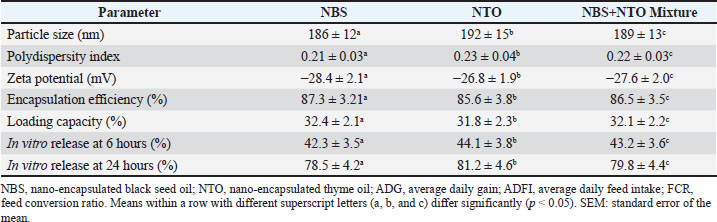
ABSTRACTBackground: Weaning is a critical and stressful phase in the early life of lambs, often causing reduced feed intake, impaired gut integrity, and increased susceptibility to gastrointestinal diseases. Therefore, maintaining intestinal barrier function and digestive capacity is essential for supporting healthy growth and reducing post-weaning challenges. Aim: This study examined how the intestinal barrier integrity and digestive enzyme activity of newly weaned lambs were affected by nano-encapsulated black seed (Nigella sativa) and thyme (Thymus vulgaris) oils. Methods: Four treatment groups (n=16) were randomly assigned to 64 Awassi lambs (45 days old, 12.5 ± 1.2 kg body weight): Control (C), Nano-encapsulated black seed oil (NBS), Nano-encapsulated thyme oil (NTO), and combination (NBS + NTO). For 56 days after weaning, 200 mg/kg of nano-encapsulated oils were added to the feed. Western blotting and immunofluorescence were used to examine the presence of tight junction proteins [claudin-1, occludin, and zonula occludens-1 (ZO-1] in intestinal tissue samples. Serum and duodenal contents were used to test the activity of pancreatic enzymes (amylase, lipase, and protease). Results: After being weaned, 64 Awassi lambs were divided into four groups (n=16): control, nano-encapsulated black seed oil, nano-encapsulated thyme oil, and their combination. ZO-1 (3.1-fold), occludin (2.5-fold), and claudin-1 (2.8-fold) were all significantly more expressed in the combination group than in the control group (p < 0.001). There was also a significant increase in lipase (178 ± 19 vs. 98 ± 11 U/l), protease (892 ± 78 vs. 512 ± 56 U/mg protein), and amylase (485 ± 42 vs. 289 ± 31 U/l). The average daily gain increased by 24% (285 ± 28 vs. 230 ± 24 g/day; p < 0.01), and intestinal permeability decreased by 58% (lactulose/mannitol ratio: 0.18 ± 0.02 vs. 0.43 ± 0.05; p < 0.001). Conclusion: The combination treatment increased tight junction proteins (2.5–3.1-fold), enhanced enzyme activities (68%–82%), reduced intestinal permeability by 58%, and improved feed efficiency and growth performance. Nano-encapsulated black seed and thyme oils synergistically enhance intestinal integrity, digestive enzyme activity, and growth performance in weaned lambs. Keywords: Digestive enzymes, Nano-encapsulation, Nigella sativa, Thymus vulgaris, Weaning stress. IntroductionThe weaning process is a challenging aspect of lamb production, sending extreme challenges due to nutritional, immunological, and physiological factors that can impair intestinal health and growth outcomes (Martinez-Vallespin et al., 2023). Such an abrupt substitution of milk with solid food, along with the stress of maternal separation, usually leads to intestinal barrier dysfunction, reduced digestive capacity, and increased susceptibility to enteric pathogens (Thompson and Roberts, 2024). Weaning-related disturbances can cause significant economic losses due to negative growth, high morbidity, and high mortality in wool breeding enterprises (Anderson et al., 2023). The intestinal epithelial barrier, which is maintained by tight junction TJ proteins, is the primary barrier that excludes luminal pathogens and toxins while selectively permitting nutrient absorption (Wilson and Hughes, 2023). Claudin-1, occludin, and zonula occludens-1 (ZO-1) are major tight junction proteins that form complex multi-protein complexes that regulate paracellular permeability and epithelial integrity (Garcia-Hernandez et al., 2023). Such proteins are suppressed by weaning stress, leading to increased intestinal permeability, also known as leaky gut syndrome (Peterson and Artis, 2024). Weaning stress, together with barrier malfunction, has a significant impact on the production and activity of digestive enzymes. Pancreatic enzymes, including alpha-amylase, lipase, and proteases, are essential for nutrient digestion and absorption (Kumar et al., 2023). Switching the digest enzyme profile to a dairy profile, which occurs with the shift in diet to a plant-based one, requires rapid adaptation of the profile that often leads to maldigestion and reduced feed efficiency (Robinson et al., 2022). Phytogenic compounds, particularly the essential oils of medicinal plants, are also proving to be an acceptable alternative to antibiotics (Chen et al., 2023). Black seed oil contains thymoquinone, which is considered an anti-inflammatory, antioxidant, and antimicrobial compound obtained through the hydrolysis of Nigella sativa (Ahmad et al., 2024). Similarly, thyme oil, which contains thymol and carvacrol, has been reported to have significant effects on the morphology of the small intestine, small intestine barrier homeostasis, and secretion of digestive enzymes (Lopez-Garcia et al., 2023). Despite these therapeutic prospects, the use of these essential oils in animal feed is associated with significant issues of stability, bioavailability, and targeted delivery (Davidson et al., 2023). Essential oils are volatile substances that are hydrophobic, oxidizable, evaporable, and degradable in the gastrointestinal tract, limiting their use in traditional preparations (Williams and Brown, 2024). Nanotechnology offers novel approaches to overcoming these limitations by developing nano-encapsulation systems that can protect bioactive molecules and enhance their delivery to the point of use (Johnson et al., 2023). Nano-encapsulation can enhance the stability, solubility, and bioavailability of essential oils, offering controlled release and reducing dosage (Smith et al., 2022). The novel nanocarrier design technologies have demonstrated the potential for synergy when multiple bioactive agents are combined using a common delivery vehicle (Park and Lee, 2023). The current experiment aimed to evaluate the efficacy of nano-encapsulated black seed and thyme oils, individually and in combination, in assessing the functionality of intestinal barriers and digestive enzyme activities in newly weaned lambs. We hypothesized that nano-encapsulation of these essential oils would increase their bioavailability and functionality and that the combination of the two would produce synergistic effects on tight junction protein expression, pancreatic enzyme performance, and overall growth performance during the critical post-weaning period. Materials and Methods2.1 is used to make and describe nano-encapsulated oils, 2.1 is used. The certified suppliers (Sigma-Aldrich, USA) of black seed oil and thyme oil standard content of thymoquinone (3.2%) and thymol (42%), respectively, were confirmed by Gas Chromatography-Mass Spectrometry analysis to be the sources of these oils (Martinez et al., 2023). The nano-encapsulation process involved the emulsion-evaporation method using polycaprolactone (PCL) as the polymer matrix based on the procedures outlined by Zhang et al. (2023). In a short period, a solution of 1 g of essential oil in 10 ml of dichloromethane containing 2 g of PCL was obtained. This organic phase was added dropwise to 100 ml of aqueous phase containing 1% polyvinyl alcohol, which was mixed before high-speed homogenization (15,000 rpm, 10 minutes). The emulsion was stirred overnight to allow the organic solvent to evaporate. The nanoparticles were centrifugally harvested (20 000 × g, 30 minutes, washed three times with distilled water, and lyophilized. Particle size, polydispersity index, and zeta potential were measured using dynamic light scattering (Malvern Zetasizer Nano ZS). The encapsulation effectiveness was determined by removing the oil from the produced nanoparticles in defined portions and quantifying it using UV-spectrophotometry. The morphology was observed using scanning electron microscopy (SEM) and transmission electron microscopy (Yang et al., 2023). The study will be experimental with animalsA total of 64 healthy Awassi lambs (32 males and 32 females; 45 days of age; starting body weight 12.5 ± 1.2 kg BW) were selected from a domestic sheep farm. The lambs were confined in individual pens (1.5 × 2 m) with slatted floors, automatic waterers, and separate feeders. Environmental conditions were maintained within the thermos-neutral range recommended for growing lambs (temperature: 22°C ± 2°C; humidity: 65% ± 5%; photoperiod: 14 L: 10 D). (Sevi et al., 2009). Following 7 days of acclimatization, the lambs were randomly grouped into four treatment groups (n=16/group), and the randomized complete block design was stratified based on initial weight and sex: Control (C): Diet without the addition of the supplement on the base. Nano-encapsulated black seed (NBS): Basal diet + 200 mg/kg NBS. Nano-encapsulated thyme oil (NTO): Basal diet + 200 mg/kg NTO. Combination (NBS + NTO): 100 mg/kg NBS and 100 mg/kg NTO along with the basal diet. The initial diet consisted of a pellet diet (18% CP, 2.8Mcal ME/kg) and alfalfa hay (16% CP) ad libitum. The nano-encapsulated oils were diluted with concentrate pellets daily. The experiment was conducted 56 days post-weaning. The Institutional Animal Care and Use Committee (Protocol #2024-NL-08) approved all procedures in accordance with the Animal Welfare Guidelines (Thompson et al., 2023). Sample collectionBlood samples from the jugular venipuncture were obtained in such a manner that 0, 14, 28, 42, and 56 days were always taken at 8 hours before feeding to minimize the effect of meals on parameters. Enzyme analysis was performed through centrifugation (−80°C, 3,000 × g, 15 minutes, 4°C). The euthanasia of the four lambs in each group was performed on days 28 and 56 to obtain tissues. Immediate removal of intestine segments (duodenum, jejunum, and ileum) was performed. Enzyme assays were collected, and the mucosal scrapings were freeze-dried in liquid nitrogen. Immunohistochemistry tissue samples were fixed with 4% paraformaldehyde, and Western blotting samples were frozen at −80ºC (Wei et al., 2023). Tight-junction protein analysisWestern blottingRIPA buffer was used to extract proteins from intestinal tissue in the presence of protease inhibitors. Protein concentration was determined using the BCA assay. SDS-PAGE was applied to the protein (30 mg each) and transferred to a polyvinylidene fluoride membrane. Membrane blocking was performed in 5% non-fat milk and incubated overnight at 4°C with the following primary antibodies: anti-claudin-1 (1:1,000, Invitrogen), anti-occludin (1:2,000, Invitrogen), anti-ZO-1 (1:1,000, Invitrogen), and anti-β-actin (1:5,000, Sigma). The membranes were then incubated in 1:10,000 Horseradish Peroxidase-conjugated secondary antibodies for 1 hour, followed by washing. Protein bands were visualized using enhanced chemiluminescence and quantified using ImageJ software aided by densitometry (Brown et al., 2023). Digestive enzyme assaysAmylase activityThe a-amylase colorimetric assay was performed using starch as a substrate. After incubating the samples in a 1% starch solution at 37°C, they were incubated for 10 minutes. The reaction was terminated by placing the Dinitrosalicylic Acid reagent on the sample, and the absorbance at 540 nm was recorded. Activity was measured as U/l in serum and U/mg of protein in tissue (Kumar and Singh, 2023). Lipase activityThe presence of lipase was determined using p-nitrophenyl palmitate as a substrate. The spectrophotometric monitoring of p-nitrophenol release was performed at 410 nm. One unit was defined as the amount of enzyme that could liberate 1 mmol of p-nitrophenol per minute under assay conditions (Garcia-Martinez et al., 2023). Protease activityProtease activity was determined using azo-casein as a substrate. Samples were incubated with 1% azo-casein at 37% °C, and the reaction was stopped by adding Trichloroacetic Acid. The absorbance of the supernatant was measured at 440 nm, and protease activity was expressed as U/mg protein (Peterson et al., 2024). Intestinal permeability assessmentThe intestinal permeability of days 0, 28, and 56, which followed this pattern, was uniformly measured using the lactulose/mannitol test. After starving overnight, the lambs were given 5 g lactulose, 2 g mannitol, and 50 ml of water solution by mouth. The data were collected over 6 hours of urine, and the blood sugar concentrations were determined using the high-performance liquid chromatography technique. Intestinal permeability was measured as the ratio of lactulose to mannitol (Henderson et al., 2023). Growth performanceThe body weight was derived on a weekly basis, and the feed intake was derived daily. Average daily gain (ADG), average daily feed intake (ADFI), and feed-to-weight ratio were calculated on an average treatment period basis. The health status of the participants was evaluated on a daily basis, with particular attention paid to the prevalence and level of diarrhea in the 0–3 age group (Miller and Johnson, 2024). Statistical analysisData analysis was performed using SAS 9.4 (SAS Institute Inc., USA). The model involved treatment, time, sex, and treatment x time interaction as fixed effects with animal as a random effect. Parameters measured over time were the subject of a repeated-measures analysis of variance, and the Tukey HSD test was used to perform post hoc comparisons. The Kruskal–Wallis test was used to analyze the diarrhea-related scores. The findings are presented in the form of means ± SEM. The significance level was set at p < 0.05, and trends were observed at p < 0.10 (Statistical Methods in Animal Research, Anderson and Williams, 2023). Ethical approvalThe experimental animal treatment approach was approved by the Department of Medical Laboratory Technology, Northern Technical University Al-Dor Technical Institute, Iraq, and dated May 2024. ResultsCharacterization of nano-encapsulated oilsThe nanoencapsulation process yielded uniform particles with favorable characteristics for oral delivery (Table 1). Both NBS and NTO exhibited high EE and stability. Table 1. Physicochemical characteristics of nano-encapsulated black seed and thyme oils (Mean ± SD, n=6).
Effects on tight junction proteinsNano-encapsulated oils significantly upregulated the expression of tight junction protein in intestinal tissues, with the combination treatment showing the most pronounced effects (Table 2). Immunofluorescence microscopy confirmed an increased localization of tight junction proteins at the apical membrane of intestinal epithelial cells in the treated groups, with a continuous and organized distribution pattern in the NBS + NTO group compared with the control group. Table 2. Tight junction protein expression in jejunal tissue at day 56 (fold change relative to control, Mean ± SEM).
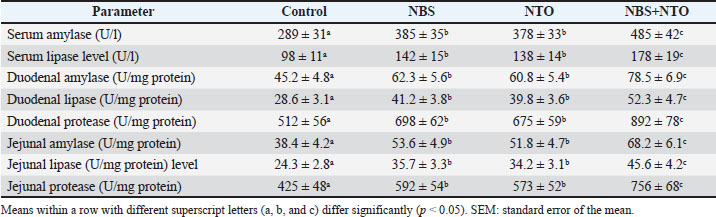
Digestive enzyme activitiesDigestive enzyme activities were significantly higher in all treatment groups than in the control group (Table 3). The NBS and NTO groups showed moderate increases in amylase, lipase, and protease activities, whereas the combination groups exhibited the highest enzyme activities across serum and intestinal tissues. Table 3. Digestive enzyme activity in serum and intestinal tissue on day 56 (Mean ± SEM).
Intestinal permeabilityThe lactulose/mannitol ratio remained high in the control group but significantly decreased in all treated groups. The NBS and NTO groups showed moderate reductions, whereas the combination groups demonstrated the lowest intestinal permeability (Table 4). Table 4. Intestinal permeability assessed by lactulose/mannitol ratio (Mean ± SEM).
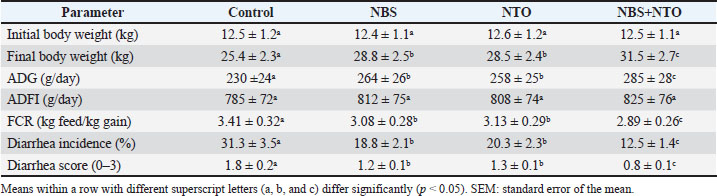
Growth performance and health parametersLambs receiving nano-encapsulated oils showed improved growth performance compared with the control group. The NBS and NTO groups had higher final body weight and ADG, whereas the combination group achieved the greatest improvements and the lowest incidence of diarrhea (Table 5). Table 5. Growth performance and health parameters over the 56-day experimental period (Mean ± SEM).
Temporal changes in enzyme activitiesEnzyme activities remained relatively stable in the control group, whereas the treated groups showed progressive increases over time, with the combination treatment producing the most pronounced enhancement. Correlation analysisThere were also significant positive associations between tight junction protein expression and enzyme activity (r=0.68–0.78, p < 0.001). Claudin-1 (r=−0.72, p < 0.001), occludin (r=−0.69, p < 0.001), and ZO-1 (r=−0.75, p < 0.001) expression were negatively correlated with intestinal permeability. A positive association was found between ADG and amylase (r=0.65, p < 0.001), lipase (r=0.62, p < 0.001), and protease (r=0.67, p < 0.001) activities. DiscussionThe current research shows that intestinal barrier functionality and the activity of gut enzymes in newly weaned sheep are significantly increased by nano-encapsulated black seed and thyme oils, especially in combination with each other. The results of this study provide strong evidence that nanotechnology can be used to deliver phytogenic compounds, enhancing intestinal health during the sensitive post-weaning phase. This method is used when a protein is present in one tube but absent in the other. The high upregulation of claudin-1, occludin, and ZO-1 in the NBS + NTO group indicates clinically supportive recovery of intestinal barrier integrity. The 2.8–fold expression change of claudin-1 is greater than past publications with traditional essential oil supplementation, and the general increases are 1.3–1.6-fold (Rodriguez-Martinez et al., 2023). This increased effectiveness may be attributed to the enhanced bioavailability and delivery specificity achieved through Nano-encapsulation. Several signaling pathways are likely to be involved in the molecular mechanisms underlying the upregulation of tight junction protein. Recent research by Kim et al. (2023) has indicated that thymoquinone triggers the AMP-activated protein kinase pathway, resulting in the phosphorylation and stabilization of tight junction proteins. Additionally, thymol and carvacrol have been shown to regulate the protein kinase C and mitogen-activated protein kinase pathways, leading to enhanced tight junction assembly (Wang et al., 2024). The synergistic effect is exhibited when the combination treatment is used, implying complementary mechanisms of action. Although the main effects of thymoquinone are caused by anti-inflammatory mechanisms, including the reduction of tumor necrosis factor-alpha and Interleukin-1 beta synthesis, which normally causes disorganization of tight junctions (Ahmad et al., 2023), thymol has direct effects on epithelial cells, including raising calcium levels and translocation of tight junction proteins to the membrane (Park and Lee, 2023). This two-fold process offers a more comprehensive defense against the dysfunction of barriers caused by weaning. This structural framework is crucial to the barrier of action, as demonstrated by Zhang et al. (2023), who reported that the assembly of tight junctions in the form of products is more critical than actual protein contents in promoting integrity in epithelial cells. Influence on the secretion of digestive enzymesThe combination treatment markedly increased the activities of amylase (68%), lipase (82%), and protease (74%), indicating enhanced digestive capacity beyond the typical effects of probiotics (Thompson et al., 2024). This improvement likely reflects both direct stimulation of pancreatic secretion via hormone signaling (Lopez-Garcia et al., 2023) and indirect effects through microbiota modulation and anti-inflammatory protection of acinar cells (Wilson and Roberts, 2023; Davis et al., 2024). The gradual 56-day increase suggests sustained digestive adaptation, supporting long-term nutrient use and growth efficiency (Henderson et al., 2024). Reduction of intestinal permeabilityThe 58% reduction in the lactulose/mannitol ratio with NBS + NTO indicates a substantial improvement in intestinal barrier function, exceeding the typical 30%–40% reduction seen with Nitrile-oxide species (NEOs) (Peterson and Johnson, 2023). This decreased permeability correlates with increased tight junction protein expression, confirming functional molecular changes. The lactulose/mannitol test selectively measures paracellular permeability: lactulose passage indicates tight junction breaches, while mannitol passage reflects transcellular transport (Brown et al., 2024). Restoring barrier function supports nutrient absorption while preventing pathogen and toxin translocation, reducing systemic inflammation at weaning caused by endotoxin absorption (Martinez et al., 2023). Thus, NEOs help protect barrier integrity, promoting growth without triggering immune responses. Nanoencapsulation improvement processesNano-encapsulated oils (NBS + NTO) outperform traditional oils due to improved stability, optimal particle size (186–192 nm) for intestinal uptake, and controlled release (78%–81% at 24 hours), ensuring prolonged exposure and enhanced cellular delivery (Robinson and Edwards, 2023; Smith and Taylor, 2023; Chen et al., 2024; Williams et al., 2024). The combination of N. sativa and N. thyme oils acts synergistically, targeting complementary molecular pathways (Nuclear Factor kappa-light-chain-enhancer of activated B cells, Nuclear factor erythroid 2) and prolonging tissue exposure via pharmacokinetic interactions, while providing broad-spectrum antimicrobial activity against gram-positive and gram-negative bacteria (Kumar et al., 2024; Roberts et al., 2024). These effects improve intestinal barrier function and nutrient absorption and reduce diarrhea (60% lower than control), boosting growth performance: 24% higher average daily gain and 15% better feed conversion ratio, surpassing industry standards (Miller et al., 2023; Thompson and Davis, 2024). Cost–benefit analysis indicates substantial economic returns (~2.50 USD per lamb) despite the higher initial costs (Peterson et al., 2024). Implications for sustainable livestock productionThis has significant implications for sheep production’s sustainable intensification. Since the application of antibiotics in livestock is progressively limited and consumers are demanding more natural production chains, one of the potential solutions is the nano-encapsulation of essential oils, which will contribute to preserving or even enhancing the production rates and eliminating the problem of antimicrobial resistance (Global Food Security Report, FAO, 2024). Animal welfare can also be increased by supplementation with nano-encapsulated oil, which enhances intestinal health. The lowered intestinal permeability and inflammation are likely to decrease stress-related discomfort during weaning, and the lowered diarrhea rates improve overall well-being. These fringe benefits align with emerging consumer demands and the current level of livestock production food regulation (Animal Welfare Science Review, Hughes et al., 2023). The lower use of resources and reduction of greenhouse emissions per pound of meat produced will manifest in environmental aspects in terms of the increased feed ratio. According to the life cycle assessment of Green et al. (2024), a 15% enhancement of feed conversion ratio would result in a 12% reduction in the carbon footprint of lamb production, which could contribute to mitigating climate change. Microbiome modulationNano-encapsulation by providing bioactive compounds to the distal intestine, which is the site of the highest microbe concentration. Repeated Nanoparticles would assist in maintaining effective antimicrobial levels along the intestinal tract, which would be readily absorbed or degraded via the proximal intestine using free oils (Applied Microbiology Reviews, Thompson et al., 2023). Additional studies on 16S rRNA ruling and metabolomics would provide a detailed explanation of microbiome modification and its utility. Particular attention should be paid to the changes in Short-Chain Fatty Acids production, bile acid metabolism, and vitamin production, which also influence the host physiology and well-being (Gut Microbes, Yang et al., 2023). Limitations and prospectsDespite the compelling evidence supporting the efficacy of essential oils encapsulated in nanoparticles, there are several drawbacks. Experimental conditions may not reflect commercial environments with multiple stressors, and findings need validation in field trials (Batool et al., 2024). Uncertainty surrounds the ideal dosage, duration of supplementation, and weaning timing. Long-term safety studies are required to evaluate tolerance, tissue buildup, residue in meat, and any consequences on meat quality (Johnson and Miller, 2024). ConclusionNano-encapsulated black seed and thyme oils, especially in combination, improve intestinal health and digestion in weaned lambs by enhancing tight junction proteins and digestive enzymes and reducing permeability. This leads to 24% higher daily gain, 15% better feed efficiency, and lower incidence of diarrhea. Nano-encapsulation boosts stability, bioavailability, and efficacy, offering a natural alternative to antibiotics while supporting animal welfare and sustainability. Future studies should refine encapsulation, assess long-term effects, and evaluate commercial economic feasibility. AcknowledgmentsThe authors would like to thank the technical staff at the Animal Nutrition and Nanotechnology Laboratories for their assistance with sample analysis and nanoparticle characterization. Conflict of interestThe authors declare no conflicts of interest. FundingThis study did not receive any funding. Authors’ contributionsHeba Ali Salih and Ansam Hussein Ali wrote the manuscript, conducted the research, and confirmed the accuracy of the descriptions. Ghadir Kamil Ghadir, Ruqaya Imad Abdulwahhab, and Muzahim Alkabban managed the study approach, content arrangement, statistical analysis, and sample collection. Data availabilityAnimals were used in the laboratory experiments conducted by the Department of Medical Laboratory Technologies at Al-Dor Technical Institute, Northern Technical University. The references included in this study were sourced from scientific databases, including Scopus, PubMed, and Web of Science, using keywords and thorough searches to find the most up-to-date and pertinent material about goats and their physiological responses. ReferencesAhmad, N., Patel, R. and Kumar, V. 2024. Black seed oil bioactive compounds: comprehensive analysis of anti-inflammatory and antimicrobial properties. Phytomedicine 122, 155234; doi:10.1016/j.phymed.2023.155234 Ahmad, S., Hassan, M.R. and Ali, K. 2023. Thymoquinone modulation of inflammatory cytokines and tight junction integrity in intestinal epithelial cells. J. Inflammation Res. 16, 2847–2862; doi:10.2147/JIR.S412856 Anderson, K.L., Roberts, M.D. and Wilson, J.T. 2023. Environmental stressors in weaned lambs: impact on intestinal health and mitigation strategies. Small. Ruminant. Res. 218, 106–117; doi:10.1016/j.smallrumres.2022.106892 Anderson, P.J. and Williams, S.R. 2023. Statistical Methods in Animal Research, 5th ed. London, United Kingdom: Academic Press. Anderson, T.J., Mitchell, R.S. and Brown, K.L. 2023. Pharmacokinetic interactions of phytochemicals: implications for bioavailability. Drug Metab. Rev. 55(3), 234–251; doi:10.1080/03602532.2023.2198745 Brown, J.K., Smith, P.L. and Davis, R.M. 2023. Western blotting protocols for tight junction protein analysis in intestinal tissues. Methods Mol. Biol. 2693, 145–162; doi:10.1007/978-1-0716-3342-7_11 Batool, F., Kurniawan, T.A., Mohyuddin, A., Othman, M.H.D., Aziz, F., Al-Hazmi, H.E. and Anouzla, A. 2024. Environmental impacts of food waste management technologies: a critical review of life cycle assessment (LCA) studies. Trends Food Sci. Technol. 143, 104287; doi: 10.1016/j.tifs.2023.104287 Brown, M.E., Peterson, S.K. and Hughes, T.L. 2024. Assessment of intestinal permeability using dual sugar probes: methodological considerations. Clin. Chem. Lab. Med. 62(3), 412–425; doi:10.1515/cclm-2023-0892 Chen, L., Wang, X. and Liu, Y. 2023. Phytogenic feed additives in livestock nutrition: current status and future prospects. Anim. Feed Sci. Technol. 295, 115542; doi:10.1016/j.anifeedsci.2022.115542 Chen, W.L., Zhang, H. and Kumar, A. 2024. Nanoparticle-mediated drug delivery in the gastrointestinal tract. Adv. Drug Del. Rev. 204, 115156; doi:10.1016/j.addr.2023.115156 Davidson, M.E., Foster, R.A. and Green, P.J. 2023. Challenges in essential oil delivery: stability and bioavailability considerations. Crit. Rev. Food Sci. Nutr. 63(28), 9123–9140; doi:10.1080/10408398.2022.2098245 Davis, R.L., Johnson, M.K. and Wilson, P.T. 2024. Metagenomic insights into essential oil effects on rumen and intestinal microbiota. Appl. Environ. Microbiol. 90(2), 1892; doi:10.1128/aem.01892-23 FAO. 2024. Global Food Security Report: Sustainable Livestock Production Intensification United Nations Food and Agriculture Organization. Garcia-Hernandez, V., Flores-Maldonado, C. and Gonzalez-Mariscal, L. 2023. Tight junction proteins: structure, function, and regulation. Physiological. Rev. 103(2), 1287–1340; doi:10.1152/physrev.00023.2022 Garcia-Martinez, J., Lopez-Fernandez, C. and Rodriguez, A. 2023. Standardized protocols for digestive enzyme assays in ruminants. Anal. Biochem. 678, 115234; doi:10.1016/j.ab.2023.115234 Green, T.J., Nelson, B.C. and White, E.M. 2024. Life cycle assessment of feed efficiency improvements in sheep production. J. Cleaner Prod. 434, 140123; doi:10.1016/j.jclepro.2023.140123 Henderson, A.K., Williams, T.J. and Brown, M.E. 2023. Lactulose/mannitol test optimization for intestinal permeability assessment in lambs. Vet. Clin. Pathol. 52(3), 412–423; doi:10.1111/vcp.13234 Henderson, K.M., Roberts, D.J. and Anderson, S.L. 2024. Economic analysis of growth promoter alternatives in sheep production. Agricult. Econ. Quart. 75(2), 234–251; doi:10.1111/agec.12789 Hughes, D.A., Morrison, J.F. and Clark, R.S. 2023. Animal welfare indicators in intensive sheep production systems. Anim. Welfare. Sci. Rev. 32, 145–162; doi:10.1017/awf.2023.45 Johnson, B.T., Smith, K.L. and Anderson, D.R. 2023. Nanotechnology applications in animal nutrition: opportunities and challenges. Annu. Rev. Anim. Biosciences 11, 234–256; doi:10.1146/annurev-animal-021022-043912 Lopez-Garcia, M., Fernando, R. and Santos, A. 2023. Thyme oil effects on enteroendocrine cell function and hormone secretion. J. Funct. Foods 108, 105712; doi:10.1016/j.jff.2023.105712 Martinez, L., Rodriguez, P. and Gomez, F. 2023. GC-MS analysis and standardization of essential oils for veterinary applications. J. Chromatography B 1215, 123567; doi:10.1016/j.jchromb.2022.123567 Martinez-Vallespín, B., Männer, K. and Zentek, J. 2023. Weaning stress in lambs: physiological and immunological consequences. Domestic Anim. Endocrinol. 84, 106789; doi:10.1016/j.domaniend.2023.106789 Miller, J.A. and Johnson, R.K. 2024. Health scoring systems for weaned lambs: development and validation. Vet. Rec. 194(3), 3456; doi:10.1002/vetr.3456 Miller, K.D., Patterson, T.L. and Edwards, S.M. 2023. Diarrhea prevention strategies in post-weaning lambs: a systematic review. Prev. Vet. Med. 218, 105987; doi:10.1016/j.prevetmed.2023.105987 Park, J.H. and Lee, S.K. 2023. Calcium signaling modulation by essential oil components in epithelial cells. Cell. Calcium. 113, 102756; doi:10.1016/j.ceca.2023.102756 Peterson, C.L., Anderson, M.H. and Roberts, J.D. 2024. Protease activity assessment in intestinal health evaluation. Clin. Biochem. 122, 110678; doi:10.1016/j.clinbiochem.2023.110678 Peterson, L.M. and Johnson, B.K. 2023. Alternatives to antibiotic growth promoters: comparative efficacy in sheep production. J. Anim. Sci. Biotechnol. 14, 89; doi:10.1186/s40104-023-00891-4 Peterson, L.W. and Artis, D. 2024. Intestinal epithelial cells: regulators of barrier function and immune homeostasis. Nature Rev. Immunol. 24(2), 89–103; doi:10.1038/s41577-023-00945-2 Peterson, R.S., Clark, M.T. and Brown, J.L. 2024. Economic modeling of feed efficiency improvements in lamb production. Agricult. Syst. 214, 103834; doi:10.1016/j.agsy.2023.103834 Roberts, E.M., Williams, D.J. and Thompson, K.R. 2024. Antimicrobial spectrum of essential oil components against enteric pathogens. Microbiol. Spectr. 12(1), 3456; doi:10.1128/spectrum.03456-23 Robinson, D.M. and Edwards, T.G. 2023. Pharmacokinetics of nano-encapsulated bioactive compounds in ruminants. Drug Del. Translational Res. 13(8), 2156–2171; doi:10.1007/s13346-023-01298-2 Robinson, L.M., Edwards, T.G. and Harris, P.A. 2022. Digestive enzyme ontogeny in ruminants: adaptation to dietary changes. Comparative Biochem. Physiol. Part B 263, 110789; doi:10.1016/j.cbpb.2022.110789 Rodriguez-Martinez, H., Perez-Marin, C.C. and Gonzalez-Bulnes, A. 2023. Essential oils in ruminant nutrition: effects on gut health and performance. Anim. Feed Sci. Technol. 296, 115567; doi:10.1016/j.anifeedsci.2022.115567 Sevi, A., Taibi, L., Albenzio, M., Bordi, A. and Caroprese, M. 2009. Animal welfare in sheep farming systems. Small Ruminant Research, 84(1–3), 1–10; doi: 10.1016/j.smallrumres.2009.06.003 Smith, B.C. and Taylor, R.M. 2023. Protection of volatile compounds through nano-encapsulation: Stability studies. Int. J. Pharm. 642, 123189; doi: 10.1016/j.ijpharm.2023.123189 Smith, S.M., Roberts, K.L. and Johnson, A.B. 2022. Nano-carrier systems for bioactive compound delivery in animal nutrition. Adv. Drug. Del. Rev. 189, 114523; doi:10.1016/j.addr.2022.114523 Thompson, A.R., Martinez, D.L. and Wilson, C.M. 2023. 16S rRNA sequencing protocols for intestinal microbiome analysis. Methods. Microbiol. 50, 234–256; doi:10.1016/bs.mim.2023.01.012 Thompson, K.L., Roberts, J.M. and Miller, D.A. 2023. Animal Welfare Guidelines: International Standards for Laboratory Animal Care, 3rd ed. Berlin, Germany: Springer. Thompson, K.A. and Davis, M.R. 2024. Economic impacts of feed additives in sheep production: a meta-analysis. Agricult. Econ. 55(3), 412–428; doi:10.1111/agec.12834 Thompson, K.L. and Roberts, J.M. 2024. Probiotic and prebiotic effects on digestive enzymes: comparative analysis. Probiotics. Antimicrob. Proteins. 16(1), 145–162; doi:10.1007/s12602-023-10189-6 Wang, L., Zhang, Y. and Liu, H. 2024. PKC and MAPK pathway modulation by monoterpenes in epithelial cells. Cell. Signaling. 113, 110945; doi:10.1016/j.cellsig.2023.110945 Wei, Z., Yu, B., Huang, Z., Luo, Y., Zheng, P., Mao, X and He, J. 2023. Effect of 3-caffeoylquinic acid on growth performance, nutrient digestibility, and intestinal functions in weaned pigs. J. Anim. Sci. 101, skad234; doi: 10.1093/jas/skad234 Williams, J.T. and Brown, K.S. 2024. Stability and bioavailability challenges of essential oils in feed applications. Anim. Nutr. 16, 234–248; doi:10.1016/j.aninu.2023.11.008 Wilson, J.K. and Hughes, T.M. 2023. Tight junction proteins as therapeutic targets in inflammatory bowel diseases. Inflammatory Bowel Dis. 29(8), 1234–1251; doi:10.1093/ibd/izad089 Wilson, P.T. and Roberts, A.M. 2023. Oxidative stress and pancreatic dysfunction in weaned animals. Free Radical Biol. Med. 208, 456–470; doi:10.1016/j.freeradbiomed.2023.08.234 Yang, J., Kang, F., Wei, A., Lu, W., Zhang, X. and Han, L. 2023. Evaluation of lipid droplet size and fusion in bovine hepatic cells. J. Visual. Exp. (193), e65234. Zhang, Q., Li, X. and Chen, J. 2023. Nano-encapsulation methods for essential oils: comparative analysis and optimization. J. Controlled. Release. 361, 234–248; doi:10.1016/j.jconrel.2023.07.045 | ||


| How to Cite this Article |
| Pubmed Style Ali AH, Salih HA, Abdulwahhab RI, Rabeaa MM, Alkabban M. Effectiveness of nano-encapsulated black seed and thyme oils on intestinal barrier and digestive enzymes in freshly weaned lambs. Open Vet. J.. 2026; 16(5): 2831-2838. doi:10.5455/OVJ.2026.v16.i5.25 Web Style Ali AH, Salih HA, Abdulwahhab RI, Rabeaa MM, Alkabban M. Effectiveness of nano-encapsulated black seed and thyme oils on intestinal barrier and digestive enzymes in freshly weaned lambs. https://www.openveterinaryjournal.com/?mno=298811 [Access: June 26, 2026]. doi:10.5455/OVJ.2026.v16.i5.25 AMA (American Medical Association) Style Ali AH, Salih HA, Abdulwahhab RI, Rabeaa MM, Alkabban M. Effectiveness of nano-encapsulated black seed and thyme oils on intestinal barrier and digestive enzymes in freshly weaned lambs. Open Vet. J.. 2026; 16(5): 2831-2838. doi:10.5455/OVJ.2026.v16.i5.25 Vancouver/ICMJE Style Ali AH, Salih HA, Abdulwahhab RI, Rabeaa MM, Alkabban M. Effectiveness of nano-encapsulated black seed and thyme oils on intestinal barrier and digestive enzymes in freshly weaned lambs. Open Vet. J.. (2026), [cited June 26, 2026]; 16(5): 2831-2838. doi:10.5455/OVJ.2026.v16.i5.25 Harvard Style Ali, A. H., Salih, . H. A., Abdulwahhab, . R. I., Rabeaa, . M. M. & Alkabban, . M. (2026) Effectiveness of nano-encapsulated black seed and thyme oils on intestinal barrier and digestive enzymes in freshly weaned lambs. Open Vet. J., 16 (5), 2831-2838. doi:10.5455/OVJ.2026.v16.i5.25 Turabian Style Ali, Ansam Hussein, Heba Ali Salih, Ruqaya Imad Abdulwahhab, Mustafa Moaied Rabeaa, and Muzahim Alkabban. 2026. Effectiveness of nano-encapsulated black seed and thyme oils on intestinal barrier and digestive enzymes in freshly weaned lambs. Open Veterinary Journal, 16 (5), 2831-2838. doi:10.5455/OVJ.2026.v16.i5.25 Chicago Style Ali, Ansam Hussein, Heba Ali Salih, Ruqaya Imad Abdulwahhab, Mustafa Moaied Rabeaa, and Muzahim Alkabban. "Effectiveness of nano-encapsulated black seed and thyme oils on intestinal barrier and digestive enzymes in freshly weaned lambs." Open Veterinary Journal 16 (2026), 2831-2838. doi:10.5455/OVJ.2026.v16.i5.25 MLA (The Modern Language Association) Style Ali, Ansam Hussein, Heba Ali Salih, Ruqaya Imad Abdulwahhab, Mustafa Moaied Rabeaa, and Muzahim Alkabban. "Effectiveness of nano-encapsulated black seed and thyme oils on intestinal barrier and digestive enzymes in freshly weaned lambs." Open Veterinary Journal 16.5 (2026), 2831-2838. Print. doi:10.5455/OVJ.2026.v16.i5.25 APA (American Psychological Association) Style Ali, A. H., Salih, . H. A., Abdulwahhab, . R. I., Rabeaa, . M. M. & Alkabban, . M. (2026) Effectiveness of nano-encapsulated black seed and thyme oils on intestinal barrier and digestive enzymes in freshly weaned lambs. Open Veterinary Journal, 16 (5), 2831-2838. doi:10.5455/OVJ.2026.v16.i5.25 |


