




| Research Article | ||
Open Vet. J.. 2026; 16(5): 3121-3129 Open Veterinary Journal, (2026), Vol. 16(5): 3121-3129 Research Article Enhancing the conception rate in water buffalo using post-AI intravaginal bio-stimulation and clitoral massageAnup Sarker, Dibyendu Biswas and Ashit Kumar Paul*Department of Medicine, Surgery and Obstetrics, Faculty of Animal Science and Veterinary Medicine, Patuakhali Science and Technology University, Barishal, Bangladesh *Corresponding Author: Ashit Kumar Paul. Department of Medicine, Surgery and Obstetrics, Faculty of Animal Science and Veterinary Medicine, Patuakhali Science and Technology University, Barishal, Bangladesh. Email: akpaul2008 [at] gmail.com; ashitpaul [at] pstu.ac.bd Submitted: 23/09/2025 Revised: 11/03/2026 Accepted: 25/03/2026 Published: 31/05/2026 © 2025 Open Veterinary Journal
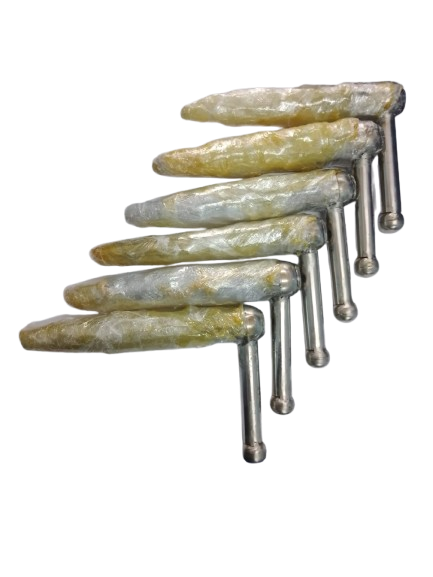
AbstractBackground: Suboptimal reproductive performance following artificial insemination (AI) remains a primary constraint to the profitability of buffalo farming in Bangladesh. Aim: This study aimed to evaluate the efficacy of intravaginal bio-stimulation and clitoral massage (CM) in enhancing the post-AI conception rates in buffaloes. Methods: A total of 125 female buffaloes were randomly selected, and their age, parity, breed, body condition score, reproductive health (RH), and calving difficulty were recorded. The buffaloes were divided into five groups (n=25 in each group): group A (natural mating), group B (AI during observed estrus), group C [AI followed by penis-like device (PLD) application], group D (AI with CM), and group E (AI followed by PLD and CM). Group B (only AI) served as the control for the intervention groups (C, D, and E). Results: The overall conception rate was 46.4%, with group A having the highest rate (64.0%). The conception rate of group E (52.0%) was higher than that of groups C (44.0%), D (40.0%), and B (32.0%). Parity and previous calving difficulty significantly influenced the conception rates (p < 0.05). Buffaloes aged between 4.6 and 5.5 years were 4.3 times more likely to conceive compared with other age groups (p < 0.05). Correlation coefficient analysis revealed a significant positive correlation between age and parity (p < 0.01) and a significant negative correlation with the RH of cows. Conclusion: Intravaginal bio-stimulation using a PLD combined with CM post-AI significantly improves the conception rate in buffaloes. Keywords: Artificial insemination, Buffalo, Clitoral massage, Conception rate, Penis-like device. IntroductionThe rearing of buffalo (Bubalus bubalis) in Bangladesh encompasses diverse systems, including household, intensive, semi-intensive, and “bathan” farming systems (free-range rearing of animals on fallow land and river-basin areas). Extensive or “bathan” farming is the most traditional system in Bangladesh’s coastal region. In bathan practice, the buffalo are not housed and remain in the bathan area throughout the year. In contrast, “semi-bathan” is a seasonal system in which animals are housed during rice cultivation and graze on islands for the remainder of the year (Sagor et al., 2024). Major constraints to buffalo farming in Bangladesh include inadequate grazing land, a haphazard breeding system, lack of fresh drinking water, salinity, lack of proven bull or artificial insemination (AI) facilities, seasonal anestrus, and so on (Samad, 2020). Although both natural mating and AI are practiced, AI adaptation remains limited (Sarker et al., 2024). A significant challenge in buffalo breeding is that estrus behavior often occurs at night. The optimal breeding window has frequently passed by the time farmers identify a cow in heat and locate a fertile bull, resulting in low conception rates. Although AI involves the mechanical deposition of preserved semen under hygienic conditions, its success depends heavily on accurate heat detection, timely insemination, and sire fertility. Timely ovulation is a critical factor; in natural service, conception rates were typically higher because the bull can precisely detect the optimal stage of estrus. The bulls’ bio-stimulation during mating exerts a stimulatory effect on estrus and ovulation in females. This phenomenon, termed bio-stimulation (Chenoweth and McPherson, 2016), can accelerate the onset of puberty, stimulate cyclic activity in females in seasonal and lactational anestrus, and regulate the timing of estrus. Intromission provides essential genital stimulation, which is a prerequisite for ovulation in species such as cats and rabbits (Clemens and Christensen, 1975). Physical stimulation of the vagina and cervix during copulation promotes the release of reproductive hormones, specifically oxytocin and Luteinizing hormone (LH). Oxytocin helps induce uterine contractions, which aid in sperm transport toward the fallopian tubes for fertilization. The LH surge is necessary for ovulation. Research indicates that clitoral bio-stimulation following AI can increase bovine conception rates by 6.3%–7.5% (Chenoweth, 1983; Ramiro et al., 2020). Earlier, a penis-like instrument called a penis-like device (PLD) was used following or during AI to provide intravaginal stimulation, resulting in an approximately 15% increase in the conception rate in cows (Biswas et al., 2022) and 10%–12% higher in buffalo (Sarker et al., 2024; Paul et al., 2025) compared to AI alone. Although a bovine PLD was previously reported by Sarker et al. (2024) application limitations were noted, leading to a modified version for buffaloes by Paul et al. (2025). However, a knowledge gap remains regarding the combined effect of clitoral massage (CM) and buffalo-specific PLD-assisted bio-stimulation on conception rates, especially compared with natural services. Therefore, this study aimed to assess the efficacy of combined intravaginal bio-stimulation and CM for increasing AI conception rates and compare it with natural insemination services in buffaloes. Materials and MethodsStudy locationTheriogenology and Reproductive Biotechnology Laboratory, Patuakhali Science and Technology University, Barishal Campus, Babuganj, Barishal, Bangladesh. Study areaThe study was conducted in randomly selected coastal areas of Bangladesh, namely Bhola Sadar upazila of the Bhola district (latitude: 22° 41' 25.08" N, longitude: 90° 39' 9.00" E) and Bauphal upazila of the Patuakhali District (latitude: 22° 25' 45.12" N, longitude: 90° 30' 50.04" E). Data collection and management of animalsA total of 125 sexually matured buffalo cows [(local/indigenous (n=90), cross (n=26), and murrah (n=9)] were randomly selected. The body condition score (BCS) of all selected animals was between 2.5 and 3.5 (out of 5 scale), with no abnormalities in estrus signs or mucus secretions. During selection, ages (2.5–8.0 years), breeds, parities (heifer=25, cow=100), BCS, reproductive health (RH), and calving difficulty or dystocia were noted using a pre-tested format of the data sheet. The buffalo’s uterus and ovarian health status were checked through per rectum manual palpation before AI. Following selection, anthelmintics (Navadex® Vet 2 g bolus, Navana Pharmaceuticals Limited, Dhaka, Bangladesh, at a dosage of 1 bolus per 75 kg body weight and dose repeated after 7 days), vitamins (ES AD3E® Vet 100 ml Syrup, Square Pharmaceuticals Limited, Dhaka, Bangladesh, at a dosage of 10 ml orally every day for 30 days), and minerals (Bolus Nutripower® 2 g, Navana Pharmaceuticals Limited, Dhaka, Bangladesh, at a dosage of 1 bolus/day/animal for 10 days) were provided to each animal. Farmers were instructed to inform the principal investigator and technicians when their buffaloes exhibited estrus signs. Once estrus signs were observed, the study procedures were carried out. The buffaloes were reared in the semi-bathan system. Farmers typically allowed the animals to graze in the early morning and in the afternoon. Additionally, approximately 7–10 kg of concentrate was supplied per animal per day in the morning; this consisted of rice polis (25%–30%), wheat bran (25%–30%), broken rice (15%–20%), and oil cake (18%–20%). The estrus detection and AI were conducted during winter (November to February). Grouping of the animalsAnimals were categorized into groups based on the research hypothesis. The buffaloes were categorized into indigenous/local, Murrah, and crossbreed by observing their phenotypic characteristics. Buffalo cows were categorized according to age into five groups: 2.5–3.5, 3.6–4.5, 4.6–5.5, 5.6–6.5, and > 6.5 years, following the methodology of Banerjee (2010). Parity was classified as P0 (heifer), P1 (one calving), P2 (two calvings), P3 (three calvings), and ≥ P4 (four or more calvings). The BCS was grouped into three ranges: 2.0–2.5, 3.0–3.5, and 4.0. RH was assessed as “good” or “moderate” via per-rectal palpation of the uterus and ovaries, as described by Biswas et al. (2022). Calving difficulty or dystocia was recorded as either “present” or “absent” based on clinical history. No teaser bulls were used for estrus detection; instead, initial detection was performed by farmers based on behavioral signs and subsequently confirmed by a researcher or trained technician through per-rectal palpation. Study designThe study was divided into five experimental groups. Each treatment was applied to five buffaloes and replicated five times. Simple randomization by the researcher focusing on the research hypothesis. Animals were randomly allocated after observing estrus signs for the experimental group. A single service was conducted and counted for each buffalo. Group A (natural service):Animals were mated naturally. Group B (AI):Animals were AI following the observation of estrus signs. Group C (AI + PLD):AI was supplemented with intra-vaginal bio-stimulation using PLD for 30–60 seconds. Group D (AI + CM):AI was followed by 30 seconds of CM. Group E (AI + PLD + CM):Intravaginal bio-stimulation (PLD) and CM were performed along with AI. Preparation and use of the PLDThe PLD was constructed and used according to the specifications of Paul et al. (2025) (Fig. 1). The device measured 20 cm in length, with a tapering diameter ranging from 12 cm at the base to 5 cm at the tip, and featured a 12-cm handle. The device included two internal channels for AI gun passage. A superior port near the handle was integrated to facilitate the infusion of warm water, simulating the thermal sensation of an erect bull penis. The PLD was sterilized with 70% ethanol and lubricated with coconut oil before vaginal insertion. For bio-stimulation, the device was inserted and manually manipulated (pushed and pulled) three to four times over a duration of 30 seconds. Post-procedure, the device was cleaned with fresh water, re-sterilized with 70% ethanol, and stored in a sterile container (Biswas et al., 2022).
Fig. 1. PLD for buffalo cows. Estrus detection and AI techniqueEstrus detection and AI protocols were performed as described by Praveen et al. (2024). Estrus was primarily observed during the night and early morning, characterized by cardinal signs such as vaginal mucus discharge and a standing-to-be-mounted response. Secondary signs, including excessive bellowing, vulval swelling, restlessness, and temporary teat engorgement, were also recorded. In the case of silent heat, estrus was confirmed via per-rectal palpation, with uterine tonicity and coiled horns as definitive indicators. A hyperemic vulva accompanied by clear mucus streaming was used to identify estrus. A skilled technician inseminated the estrus buffaloes by using the AM-PM rule, specifically 12–18 hours after the onset of estrus signs. This study used a single insemination protocol per female patient. Pregnancy diagnosisPregnancy was checked and confirmed through per-rectal palpation of the uterus and ovaries on day 60–90 of post-serviced. A trained person diagnosed the pregnancy rather than a technician who conducted AI on the buffalo to blindly assess the conception rate and avoid biasness. The animals were rechecked after 7 days by a different person. Statistical analysisStatistical analyses were performed using the Statistical Package for the Social Sciences (version 26.0; IBM Corp., Armonk, NY). Data were initially recorded and coded in Microsoft Excel spreadsheets. Conception rates are expressed as percentages (%). Categorical data were analyzed using the chi-square test, and logistic regression was employed to identify factors associated with conception. For the experimental groups, continuous data were analyzed using one-way analysis of variance; where significant differences were found, post hoc comparisons were concluded using Duncan’s multiple range test. Statistical significance for all tests was set at p < 0.05.
The statistical model is as follows:
where: P(Y=1)=Probability of a successful event (e.g., conception or pregnancy). P(Y=0)=Probability of a failure event (e.g., no conception or pregnancy). β0=Intercept (constant). β1, β2, …, βn=Coefficients of the predictors. X1, X2, …, Xn=independent variables The Pearson’s correlation coefficient formula is as follows:
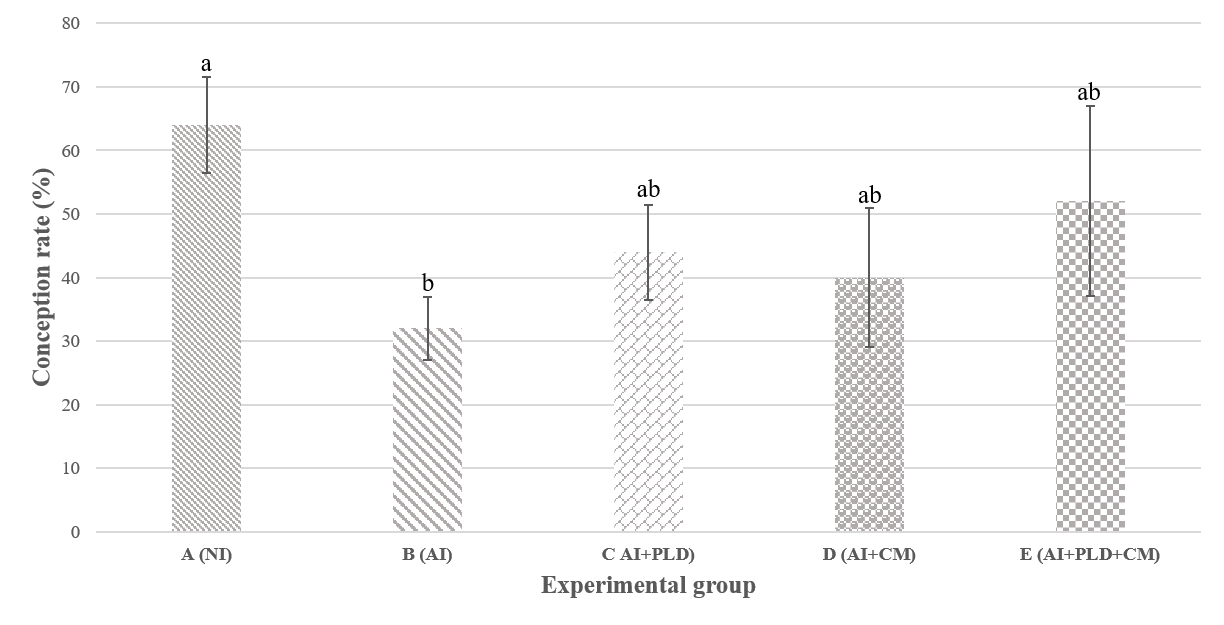
where x is the independent variable, y is the dependent variable, n is the sample size, and Σ represents a summation of all values. Ethical approvalAll procedures involving animals were conducted in compliance with internationally accepted guidelines for animal welfare, and the Animal Ethics Committee of Patuakhali Science and Technology University (Ref. No. PSTU/IEC/2025/32). Consent was obtained from the animal owner prior to the application of experimental intervention. The observance of any complication during or after AI and after pregnancy diagnosis was recorded in the data record sheet. ResultsThe overall conception rate for buffaloes was 46.4% (58/125), comprising 24.0% (6/25) in heifers and 52.0% (52/100) in cows. The overall conception rate in buffalo cows was comparatively higher than that in heifers. Rate of conception in different interventionsConception rates for groups A (natural service), B (AI control), C (AI with vaginal bio-stimulation with PLD), D (AI with CM), and E (AI with combined vaginal bio-stimulation and CM) were 64.0%, 32.0%, 44.0%, 40.0%, and 52.0%, respectively (Fig. 2). The conception rate achieved via natural mating with a fertile bull (Group A) was significantly higher than that of the AI control group (Group B; p < 0.05). Conversely, no significant differences were observed between the AI control and intervention groups (Groups C, D, and E; p > 0.05). Furthermore, no adverse effects were observed following the intervention application.
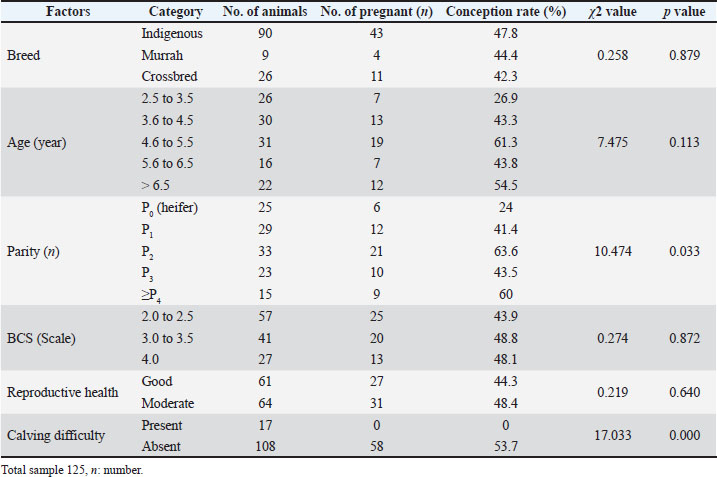
Fig. 2. Conception rate in different interventions (NI: natural insemination; AI: artificial insemination; PLD: penis-like device; CM: clitoral massage). Bars with different letters (a-b) represent significant differences within the respective endpoint (p < 0.05). Each group consisted of 25 buffalos. The experiment was replicated five times. Factors influencing the conception rate of buffalo cowsTable 1 presents the conception rate categorized by various factors. The conception rates for indigenous, Murrah, and crossbred buffaloes were 47.8%, 44.4%, and 42.3%, respectively, with no significant variation observed (χ2=0.258, p > 0.05). Analyzing by age, conception rates for the 2.5–3.5, 3.6–4.5, 4.6–5.5, 5.6–6.5, and >6.5 years cohorts were 26.9%, 43.3%, 61.3%, 43.8%, and 54.5%, respectively. These differences were not statistically significant (χ2=7.475, p > 0.05). In terms of parity, conception rates for P0, P1, P2, P3 and ≥P4 were 24.0%, 41.4%, 63.6%, 43.5%, and 60.0%, respectively, indicating significant variation across categories (χ2=10.474, p < 0.05). Regarding BCS, the conception rates for 2.0 to 2.5, 3.0 to 3.5, and 4.0 were 43.9%, 48.8%, and 48.1%, respectively. No significant variation was observed across the categorial variable (χ2=0.274, p < 0.05). Buffaloes with good vs. moderate RH showed conception rates of 44.3% and 48.4%, respectively. No significant variation was observed among these two categories (χ2=0.219, p > 0.05). Finally, the conception rates for recorded calving difficulties were 0.0% and 53.7%, respectively, representing a highly significant variation (χ2=17.033, p < 0.01). Table 1. Factors affecting the rate of conception.
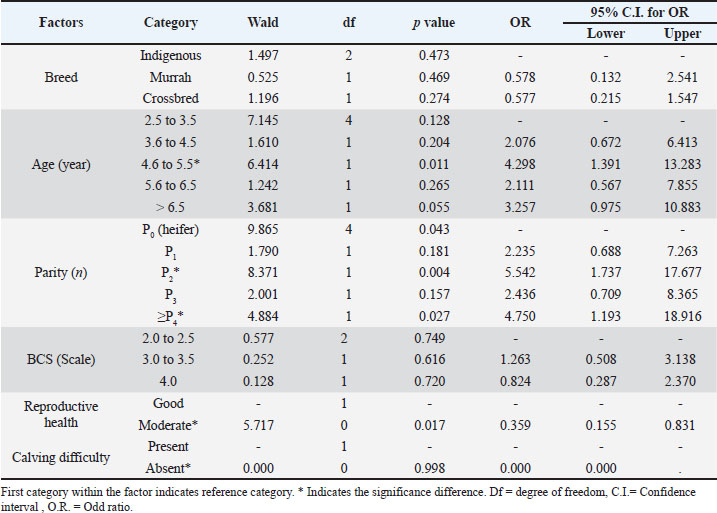
Logistic regression of factors associated with conceptionTable 2 presents the binary logistic regression analysis of factors associated with conception. In this study, no significant association was observed for breed, BCS, and previous calving difficulty across their respective categories (p > 0.05). However, cows aged 4.6 to 5.5 years exhibited a significantly higher likelihood of conception, with a 4.3-fold increase compared to other age groups [Wald=6.414, p < 0.05, odd ratio (OR)=4.298, 95% C.I of OR (1.391–13.283)]. Parity 2 and ≥4 showed significantly 5.5 and 4.8 times, respectively, more chances of conception rates [Wald=8.371, p < 0.01, OR=5.542, 95% C.I of OR (1.737–17.677) and Wald=4.884, p < 0.05, OR=4.750, 95% CI of OR (1.193–18.916)] than that of other categories. The moderate RH buffaloes showed a significant association of conception rates across the categories [Wald=5.717, p < 0.05, OR=0.359, 95% C.I of OR (0.155–0.831)]. Table 2. Logistic regression analysis of factors associated with conception.
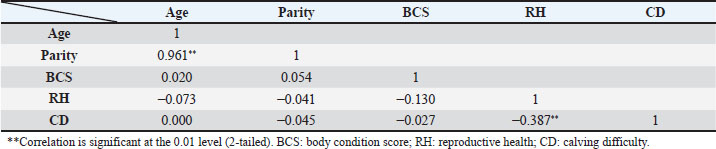
Correlation coefficient of influencing factors of conceptionTable 3 summarizes the correlation coefficient between continuous variables influencing the conception rate. Analysis revealed that animal age was strongly and significantly correlated with parity (r=0.961; p < 0.001). Conversely, RH exhibited a significant negative correlation with a history of calving difficulty (r=−0.387; p < 0.05). Table 3. Correlation coefficients between different factors.
DiscussionThe overall conception rate was 46.4%, which is consistent with the findings of Sarker et al. (2024) and Riaz et al. (2018). However, the conception rate in the present study was higher than the 41.3% reported by Yousuf et al. (2015) and the 28.0% reported by Huque (2014). The application of PLD and CM provided intra-vaginal bio-stimulation, which likely stimulated the neuroendocrine system (NES), thereby hastening the ovulation mechanism and enhancing sperm transport. The PLD likely stimulated vaginal epithelial cells, potentially triggering the hypothalamus and posterior pituitary gland to secrete oxytocin, mimicking the physiological response to natural coitus. Consequently, buffaloes exhibited a high degree of responsiveness to PLD-induced bio-stimulation during standing estrus, which may have facilitated the release of oxytocin by the NES. This mechanism likely enhanced sperm transport and uterine contractility, contributing to the higher conception rates observed in this study compared with those in previous reports. The conception rate in group A (natural insemination, NI) was the highest at 64.0%. In natural mating, visual and olfactory cues are critical for triggering reproductive hormone secretion and sexual arousal, which facilitate effective fertilization. Among the intervention groups, group E (AI + PLD + CM) exhibited the highest conception rate (52.0%), surpassing Groups B, C, and D. These findings align with those of Paul et al. (2025). In group E, AI was performed following the observation of estrus signs, followed by intravaginal stimulation via a PLD and CM. Such stimulations likely sensitized the dam, promoting both ovulation and uterine sperm transport, thereby enhancing the conception rate (Biswas et al., 2022). Group C achieved a conception rate of 44.0%, which was higher than that of groups B and D but lower than that of groups A and E. In this group, AI was conducted during standing estrus characterized by clear mucus discharge following intravaginal bio-stimulation with the PLD to accelerate ovulation and sperm movement. Group D recorded a conception rate of 40.0%, exceeding that of group B but falling below that of groups A, C, and E. In group D, AI was followed by 30 seconds of CM. Previous studies have demonstrated that clitoral stimulation during AI favorably influences bovine conception rates by 6.3% to 7.5% (Chenoweth, 1983; Ramiro et al., 2020). Furthermore, Biswas et al. (2022) reported that the PLD increased conception rates through vaginal bio-stimulation across species, including cattle and buffalo (Cow vs. buffalo). Similarly, Choudhary et al. (2020) and Fiol and Ungerfeld (2016)noted that bull-mediated bio-stimulation enhances reproductive efficiency and follicular development in anestrus heifers (Cattle). The PLD was specifically designed to provide intra-vaginal bio-stimulation for heifers and cows. No physiological abnormalities or behavioral changes were observed following PLD use; feedback from farmers was positive, indicating that the device is a practical and effective tool for improving reproductive outcomes. The conception rate of indigenous buffaloes (47.8%) was numerically higher than that of Murrah (44.4%) and crossbred (42.3%) buffaloes. This higher rate may be attributed to better environmental adaptation, aligning with Karim et al. (2013) who reported a conception rate of 43.0% in indigenous breeds. However, these results are also consistent with those of Hossain et al. (2015) as logistic regression confirmed no significant difference (p > 0.05) in conception rates among breeds. Regarding age, buffaloes aged 4.6–5.5 years achieved the highest conception rate (61.3%). While the rate increased from the 2.5–3.5 to 3.6–4.5 years of age groups, a decline was observed after 5.5 years, a trend supported by Hamid et al. (2016) and Singh and Balhara (2015). An OR of 4.3 in the 4.6–5.5-year-old cows indicated a significantly higher likelihood of conception rate [Wald=6.414, p < 0.05, OR=4.298, 95% CI of OR (1.391–13.283)]. Furthermore, age was strongly correlated with parity (r=0.961; p < 0.001), likely reflecting physiological maturation. The highest conception rate by parity (63.6%) was observed in second parity (P2) buffaloes, consistent with Chebel et al. (2004); Grimard et al. (2006) and Sarker et al. (2024) however, Paul et al. (2025) reported higher conception rates in P3. We observed an upward trend from the first to fourth parity, followed by a decline, as previously noted by Bhagat and Gokhale (1999). Significant variation existed across parity categories (χ2=10.474, p < 0.05), with parity 2 and parity ≥4 animals being 5.5 times [Wald=8.371, p < 0.01, OR=5.542, 95% CI of OR (1.737–17.677)] and 4.8 times [Wald=4.884, p < 0.05, OR=4.750, 95% CI of OR (1.193–18.916)], respectively, more likely to conceive than nulliparous heifers. Regarding BCS, the highest conception rate (48.8%) occurred in buffaloes with a BCS of 3.0–3.5, similar to the findings of Kumar et al. (1997). Logistic regression analysis showed no significant effect of BCS (p > 0.05), likely because only healthy reproductive animals were included. No significant difference (χ2=0.219, p > 0.05) was found between good and moderate RH. Both categories appeared to be equally capable of conceiving and maintaining pregnancy. Consistent with Sachan et al. (2015), Sarker et al. (2024) and Paul et al. (2025). Notably, RH was significantly and negatively correlated with a history of dystocia (r=−0.387, p < 0.001). This mirrors the findings of Paul et al. (2025). As the comparing value was 0, the logistic regression analysis was determined to be 0.000. Dystocia often causes endometrial laceration and hemorrhage leading to endometritis and fibrosis. Such trauma compromises uterine health, significantly reducing the likelihood of embryo implantation. ConclusionThese interventions appeared to improve the under field conditions. While natural insemination remains the most effective method, the application of an intra-vaginal device for bio-stimulation in AI programs may enhance reproductive efficiency. Further studies featuring larger population sizes across diverse ecological zones are recommended to optimize device usage and explore the long-term benefits of bio-stimulation in buffalo reproduction. Future research should include hormonal assays to investigate the effects of AI on assisted stimulation, cervical stimulation, clitoral stimulation, natural insemination, and sperm count. Finally, the PLD is safe, user-friendly, and cost-effective for farmers operating in field conditions. AcknowledgmentsThe authors would like to express their sincere gratitude to the Bangladesh University Grants Commission (UGC) for their financial support (UGC Grant No. BS-35, FY 2021-2022). Conflict of interestThe authors have no conflicts of interest to declare. FundingBangladesh University Grants Commission (UGC), the financial support (UGC Grant No. BS-35, FY 2021-2022). Authors’ contributionsAS: data acquisition and interpretation, formal analysis, validation, writing of the original article, and final editing. DB: data acquisition and interpretation, formal analysis, and validation AKP: conceptualization, methodology, formal analysis and validation, supervision, and final review. Data availabilityAll data supporting the findings of this study are available within the manuscript. Additional data are available from the corresponding author upon request. ReferencesBanerjee, G.C. 2010. A textbook of animal husbandry, 8th ed. New Delhi, India: IBH Publishing Company Pvt Limited, p: 435. Available via https://books.google.com/books/about/A_Textbook_of_Animal_Husbandry.html?id=01GjRPHKzoEC Bhagat, R.L. and Gokhale, S.B. 1999. Factors affecting pregnancy rate in cows under field conditions. Indian. J. Dairy. Sci. 52, 298–302; Available via https://www.researchgate.net/publication/340181725_Factors_Affecting_Pregnancy_Rate_in_AI_Bred_Cattle_Under_Field_Conditions Biswas, S., Swarna, M. and Paul, A.K. 2022. Improvement of bovine pregnancy rate through intra-vaginal bio-stimulation with penis-like device. Bangladesh. J. Sci. Ind. Res. 57, 101–108; doi:10.3329/bjsir.v57i2.58655 Chebel, R.C., Santos, J.E.P., Reynolds, J.P., Cerri, R.L.A., Juchem, S.O. and Overton, M. 2004. Factors affecting conception rate after artificial insemination and pregnancy loss in lactating dairy cows. Anim. Reprod. Sci. 84(3-4), 239–255. Chenoweth, P.J. 1983. Sexual behavior of the bull: a review. J. Dairy Sci. 66, 173–179; doi:10.3168/jds.S0022-0302(83)81770-6 Chenoweth, P.J. and Mcpherson, F.J. 2016. Bull breeding soundness, semen evaluation and cattle productivity. Anim. Reprod. Sci. 169, 32–36; doi:10.1016/j.anireprosci.2016.03.001 Choudhary, S., Kamboj, M.L., Raheja, N., Kumar, S., Saini, M. and Lathwal, S.S. 2020. Influence of bull bio-stimulation on age at puberty and reproductive performance of Sahiwal heifers. Indian. J. Ani. Sci. 90, 28–34; doi:10.56093/ijans.v90i1.98172 Clemens , L.G. and Christensen, L.W. 1975. Sexual behavior in the behavior of domestic animals, 3rd ed. In Reproductive behavior. Ed., Hafez E.S.E. Baltimore, MD: Williams and Wilkins Co.; doi: 10.3168/jds.S0022-0302(83)81770-6 Fiol, C. and Ungerfeld, R. 2016. Positive effects of bio-stimulation on luteinizing hormone concentration and follicular development in anestrus beef heifers. J. Ani. Sci. 94(3), 971–977; doi:10.2527/jas.2016-9435 Grimard, B., Freret, S., Chevallier, A., Pinto, A., Ponsart, C. and Humblot, P. 2006. Genetic and environmental factors influencing first service pregnancy rate and late embryonic/fetal mortality in low fertility dairy herds. Ani. Reprod. Sci. 91, 31–44; doi:10.1016/j.anireprosci.2005.03.003 Hamid, M.A., Ahmed, S., Rahman, M.A. and Hossain, K.M. 2016. Status of buffalo production in Bangladesh compared to SAARC countries. Asian J. Ani. Sci. 10, 313–329. Hossain, M.I., Huq, A.K.M.M. and Huque, A.K.M.F. 2015. Pathological investigation on buffalo disease in Bangladesh. III. Survey of buffalo diseases. Bang. Vet. 11, 123–127. Huque, K. 2014. A performance profile of dairying in Bangladesh—programs, policies, and way forward. Bangladesh. J. Ani. Sci. 43(2), 81–103; doi:10.3329/bjas.v43i2.20662 Karim, M.R., Hossain, M.Z., Islam, M.R., Parvin, M.S. and Matin, M.A. 2013. Reproductivity, productivity, and management system of indigenous buffalo (Bubalus bubalis) cows in coastal areas of Pirojpur and Borguna district of Bangladesh. Progre. Agri. 24, 117–122. Available via https://www.researchgate.net/publication/314402701 Kumar, A., Solanki, V.S., Jindal, S.K., Tripathi, V.N. and Jain, G.C. 1997. Oocyte retrieval and histological studies of follicular population in buffalo ovaries. Anim. Reprod. Sci. 47, 189–195; doi:10.1016/s0378-4320(96)01588-6 Ramiro, V., Oliveira Filho, R.V., Cooke, R.F., De Mello, G.A., Pereira, V.M., Vasconcelos, J.L.M. and Pohler, K.G. 2020. The effect of clitoral stimulation post artificial insemination on pregnancy rates of multiparous Bos indicus beef cows submitted to estradiol/progesterone-based estrus synchronization protocol. J. Ani. Sci. 98, 195; doi:10.1093/jas/skaa030 Paul, A.K., Fakruzzaman, M., Alam, M.A., Deb, G.K. and Khandoker, M.A.M.Y. 2025. Intra-vaginal bio-stimulation and clitoral massage to enhance pregnancy rates in Water Buffalo in Coastal Bangladesh. Animals 15, 597. Available via https://www.mdpi.com/2076-2615/15/4/597 Praveen, D.K.S., Radhika, V., Chandrika, T., Srihari, J., Manoranjan, I., Srikanth, N. and Rao, M.M. 2024. Artificial insemination in cattle and buffalo: an update. Int. J. Vet. Sci. Anim. Husb. 9, 221–225; doi:10.22271/veterinary.2024.v9.i5d.1690 Riaz, U., Hassan, M., Husnain, A., Naveed, M.I., Singh, J. and Ahmad, N. 2018. Effect of timing of artificial insemination in relation to onset of standing estrus on pregnancy per AI in Nili-Ravi buffalo. Anim. Reprod. 15, 1231–1235. Available via https://pmc.ncbi.nlm.nih.gov/articles/PMC8203108 Sachan, R., Sankhala, G. and Manjusha, J. 2015. Productive and reproductive performance of buffalo. Asian J. Ani. Sci. 10, 29–36. Available via https://www.researchgate.net/publication/281564734 Sagor, S.I., Marma, U., Chowdhury, S., Ape, T.S., Rumi, H.J., Hossain, M.H., Nath, S.C., Paul, O.B, Islam, M.F., Hossain, D., Singha, S., Vecchio, D., Hoque, M.A., Boqvist, S., Koop, G., Derks, M., Ceciliani, F., Persson, Y. and Rahman, M.M. 2024. Buffalo farming in Bangladesh: a guide for buffalo farmers, veterinarians and veterinary students. A publication of Udder Health Bangladesh. 1st Ed. Chattogram, Bangladesh: Housing and management, pp: 24–26. Available via https://www.researchgate.net/publication/379220131 Samad, M.A. 2020. A systematic review of research findings on buffalo health and production published during the last six decades in Bangladesh. J. Vet. Med. OH. Res. 2(1), 01–62; Available via http://www.lepvmbj.org/public/files/file_manager/1584264349.pdf Sarker, A., Biswas, D., Fakruzzaman, M., Deb, G.K., Hossain, S.M.J., Alam, M.A., Khandoker, M.A.M.Y. and Paul, A.K. 2024. Enhancement of the pregnancy rate of buffalo cows through intra-vaginal bio-stimulation with penis-like device in the coastal area of Bangladesh. Adv. Anim. Vet. Sci. 12(7), 1301–1308; doi:10.17582/journal.aavs/2024/12.7.1301.1308 Singh, I. and Balhara, A.K. 2015. New approaches in buffalo artificial insemination programs with special reference to India. Theriogenology 86, 194–199; doi:10.1016/j.theriogenology.2016.04.031 Yousuf, M.R., Martins, J.P.N., Husnain, A., Riaz, U., Riaz, H., Sattar, A., Javed, K. and Ahmad, N. 2015. Effect of oestradiol benzoate on oestrus intensity and pregnancy rate in CIDR-treated anoestrus nulliparous and multiparous buffalo. Anim. Reprod. Sci. 159, 104–108; doi:10.1016/j.anireprosci.2015.05.007 | ||


| How to Cite this Article |
| Pubmed Style Sarker A, Biswas D, Paul AK. Enhancing the conception rate in water buffalo using post-AI intravaginal bio-stimulation and clitoral massage. Open Vet. J.. 2026; 16(5): 3121-3129. doi:10.5455/OVJ.2026.v16.i5.53 Web Style Sarker A, Biswas D, Paul AK. Enhancing the conception rate in water buffalo using post-AI intravaginal bio-stimulation and clitoral massage. https://www.openveterinaryjournal.com/?mno=285902 [Access: June 26, 2026]. doi:10.5455/OVJ.2026.v16.i5.53 AMA (American Medical Association) Style Sarker A, Biswas D, Paul AK. Enhancing the conception rate in water buffalo using post-AI intravaginal bio-stimulation and clitoral massage. Open Vet. J.. 2026; 16(5): 3121-3129. doi:10.5455/OVJ.2026.v16.i5.53 Vancouver/ICMJE Style Sarker A, Biswas D, Paul AK. Enhancing the conception rate in water buffalo using post-AI intravaginal bio-stimulation and clitoral massage. Open Vet. J.. (2026), [cited June 26, 2026]; 16(5): 3121-3129. doi:10.5455/OVJ.2026.v16.i5.53 Harvard Style Sarker, A., Biswas, . D. & Paul, . A. K. (2026) Enhancing the conception rate in water buffalo using post-AI intravaginal bio-stimulation and clitoral massage. Open Vet. J., 16 (5), 3121-3129. doi:10.5455/OVJ.2026.v16.i5.53 Turabian Style Sarker, Anup, Dibyendu Biswas, and Ashit Kumar Paul. 2026. Enhancing the conception rate in water buffalo using post-AI intravaginal bio-stimulation and clitoral massage. Open Veterinary Journal, 16 (5), 3121-3129. doi:10.5455/OVJ.2026.v16.i5.53 Chicago Style Sarker, Anup, Dibyendu Biswas, and Ashit Kumar Paul. "Enhancing the conception rate in water buffalo using post-AI intravaginal bio-stimulation and clitoral massage." Open Veterinary Journal 16 (2026), 3121-3129. doi:10.5455/OVJ.2026.v16.i5.53 MLA (The Modern Language Association) Style Sarker, Anup, Dibyendu Biswas, and Ashit Kumar Paul. "Enhancing the conception rate in water buffalo using post-AI intravaginal bio-stimulation and clitoral massage." Open Veterinary Journal 16.5 (2026), 3121-3129. Print. doi:10.5455/OVJ.2026.v16.i5.53 APA (American Psychological Association) Style Sarker, A., Biswas, . D. & Paul, . A. K. (2026) Enhancing the conception rate in water buffalo using post-AI intravaginal bio-stimulation and clitoral massage. Open Veterinary Journal, 16 (5), 3121-3129. doi:10.5455/OVJ.2026.v16.i5.53 |


