



| Case Report | ||
Open Vet. J.. 2026; 16(6): 3818-3825 Open Veterinary Journal, (2026), Vol. 16(6): 3818-3825 Case Report Oral cabergoline for the management of equine pituitary pars intermedia dysfunction: Five casesEleanor M. Kellon*Equine Cushing’s and Insulin Resistance Group, Inc., 2307 Rural Road, Tempe, AZ 85282, USA *Corresponding Author: Eleanor M. Kellon. Equine Cushing’s and Insulin Resistance Group, Inc., 2307 Rural Road, Tempe, AZ 85282, USA. Email: drkellon [at] gmail.com Submitted: 01/02/2026 Revised: 11/05/2026 Accepted: 26/05/2026 Published: 16/06/2026 © 2025 Open Veterinary Journal
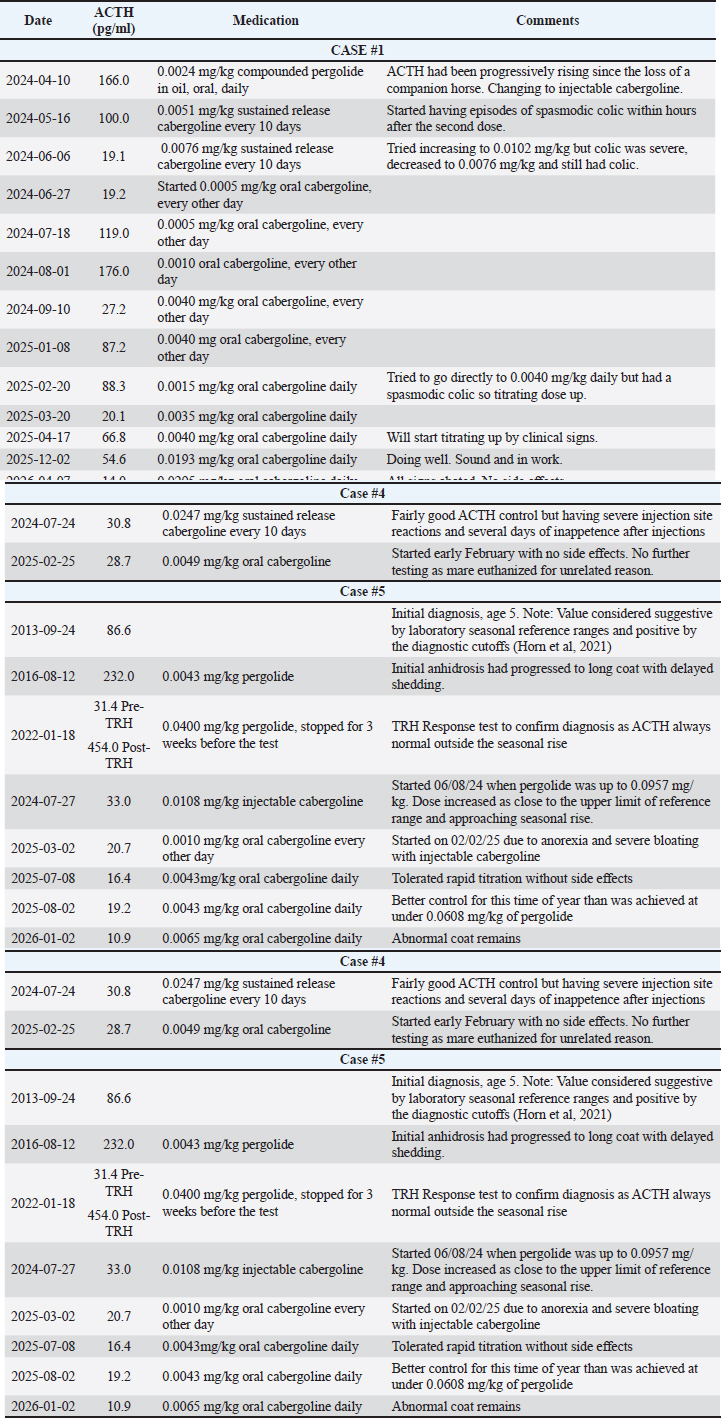
AbstractBackground: Oral pergolide has become the mainstay of treatment for equine pituitary pars intermedia dysfunction (PPID). It has a high success rate, but some horses are, or become, refractory to the effects. Others have intolerable behavioral or gastrointestinal side effects. The only widely used alternative to oral pergolide has been injectable sustained-release cabergoline. There is scant published information on alternative oral therapies. Case Descriptions: Here, we report on the response of five confirmed PPID horses to oral cabergoline. All horses failed to be controlled by oral pergolide, and four of the five were also tried on injectable sustained-release cabergoline, but with intolerable side effects. No changes were made other than the switch to oral cabergoline. Diet, drugs and management otherwise remained the same. Conclusion: Preliminary response seen in these five cases and the one in the literature indicates that daily oral cabergoline has the potential to be a well-tolerated and effective alternative. Keywords: Horses, PPID, Therapy, Oral, Cabergoline. IntroductionHistory and approach to therapyIn 1990, a histological and immunochemical study of pituitary glands from 19 horses with adenomas and 7 normals, ranging in age from 7 to 32 years (Heinrichs et al., 1990), revealed weak immunochemical reaction for ACTH, strong reaction for proopiomelanocortin (POMC), and moderate to strong reaction for α-melanocyte-stimulating hormone (α-MSH) and β-endorphin in the adenomatous glands. Several other studies confirmed that equine Cushing’s disease was distinct from the human and canine conditions involving corticotrophs in the pars distalis and was instead driven by an overabundance of POMC-derived hormones from the pars intermedia (Millington et al., 1988; Boujon et al., 1993; Fey et al., 1998; Yoshikawa et al., 2001; Carmalt et al., 2018). It was proposed as early as 1994 (Dybdal et al., 1994) that pituitary pars intermedia dysfunction (PPID) is a more appropriate name for the condition than Cushing’s disease, as the hormonal profile is quite different. Millington demonstrated eight-fold higher dopamine levels and its metabolites in the pars intermedia of normal horses compared to those with adenomas (Millington et al., 1988). McFarlane demonstrated increased oxidative stress in the hypothalamus of horses with PPID, with subsequent destruction of dopaminergic neurons which normally regulate the activity of the intermediate lobe of the pituitary (McFarlane et al., 2005). It has become clear that the way to manage this condition is to compensate for the loss of dopaminergic activity in neurons originating from the hypothalamus. It was demonstrated over four decades ago that infusions of dopamine led to rapid reduction in POMC hormones in horses with pituitary adenomas (Orth et al., 1982). This led to the use of dopaminergic agents, specifically bromocriptine, pergolide, and, most recently, cabergoline as therapeutic approaches. Cyproheptadine has also been tried, although this H1 antihistamine does not directly act on dopamine receptors, but rather is a potent antagonist of serotonin, which opposes the actions of dopamine. Theoretically, this drug should enhance dopamine effects (Di Giovanni et al., 2010). Therapeutic agentsCyproheptadineInterest in cyproheptadine stemmed from early studies demonstrating that serotonin stimulated, while dopamine inhibited, release of POMC-derived hormones from the pars intermedia (Sapun-Malcolm et al., 1986). A report from Cornell University looked at 32 animals treated with cyproheptadine and 10 with pergolide (Perkins et al., 2002). They reported no correlation between normalization of ACTH and clinical improvement. Problems with this study included a short average time to the first recheck (only 2 months), unclear interval to second retest, and especially that there was no seasonal data available to determine what changes may have been related to time of year. The study was done before seasonal ACTH changes with a peak in the fall, and ACTH levels in general increasing with age, were reported (Donaldson et al., 2005). Another study reported on 14 horses and 13 ponies, average age 20 years (range 17 to 25), treated with either cyproheptadine (n=7) or pergolide (n=20) (Donaldson et al., 2002). Horses treated with pergolide had significantly lower ACTH, which also correlated with dose and duration of treatments. Owner satisfaction among pergolide users was 85% compared to 27% for cyproheptadine-treated animals. Similarly, Schott had reported that it was found that pergolide (n=20) resulted in significant laboratory and clinical improvement after 6 to 12 months, but treatment with cyproheptadine (n=7) was no better than controls with no treatment (n=5) (Schott et al., 2001). Cyproheptadine continues to sometimes be recommended as an adjunct to pergolide, particularly when horses are not responding well to the arbitrary upper recommended dose of 4 mcg/kg in the USA. (Upper recommendation for the same drug, same manufacturer, is 10 mcg/kg in the European Union.) However, there has not been any newly published evidence to support its use. BromocriptinePergolidePerhaps the first mention of pergolide use in horses was the chapter on Diseases of the pituitary gland, in Equine Medicine and Surgery, 5th edition (Beech, 1999). Enthusiasm for cyproheptadine was short-lived, and pergolide rapidly emerged as the preferred treatment. Pharmacokinetics and pharmacodynamics have now also been well established (McFarlane et al., 2017; Rendle et al., 2019). In 2011, pergolide as Prascend®, from Boehringer Ingelheim, was the first drug to receive United States Food and Drug Administration (FDA) approval as a treatment for equine PPID at dosages up to 4 mcg/kg bodyweight. Prior to this, all treatment had been off-label as a compounded drug or the human-approved drug, Permax®. According to the new animal drug application submitted to the FDA (NADA 141–331), the most common side effect was decreased appetite (32.8%), followed by nonspecified lameness (18%), diarrhea/loose stool or colic (both 9.8%), and lethargy (9.8%). Behavioral change was noted in 4.9%. Horses were evaluated for effectiveness by clinical signs and ACTH or Dexamethasone Suppression Test results at days 90 and 180, all starting at a dose of 2 mcg/kg BW. Clinical signs evaluated included hirsutism, hyperhidrosis, polyuria/polydipsia, fat redistribution, and muscle atrophy. [Note: Laminitis was not included as a clinical sign but was listed under side effects where 8.2% experienced laminitis during treatment; 30% new cases and 70% recurrent.] At day 90, 41.6% required a dosage increase to 4 mcg/kg because of failure of endocrine tests to improve. Overall success rate was 76.1% at 180 days as judged by improvements. Neither endocrine test results nor clinical signs had normalized at that time. Prascend® is also approved in Canada, the United Kingdom, the European Union, Australia, New Zealand, some Middle Eastern and African nations, and those South American countries that rely on FDA and European Medicines Agency (EMA) marketing approvals. As of December 19, 2025, the FDA approved an abbreviated new animal drug application for Zygolide®, the first generic of Prascend®. A recent study (Schott et al., 2025) reported the results of following 30 client-owned horses being treated with Prascend® for up to 14.5 years, with a mean age of 23.1 years at the time of enrollment, range 17 to 29 years. Twenty-nine of the 30 horses died or were euthanized within 0.6 to 10.5 years of starting the study, with a median survival of 3.6 years, but only five were euthanized for recognized complications of PPID, i.e., laminitis. If you also consider poor condition/wasting as a sign of PPID, the number rises to 11. Three horses were lost to long-term endocrine testing after 180 days. Of the remainder, four that had negative dexamethasone suppression testing (DST) after the initial 180 days subsequently failed their DST, and nine failed to normalize at any time during the study, for a total pergolide failure rate of 48.1% of the horses available for long-term follow-up. Injectable CabergolineHebert 2012, in a Master's thesis for Louisiana State University, established a model for assessing the appropriateness of dopamine agonists for PPID treatment using estrogen-primed, sulpiride-challenged geldings in winter and also validated by the repeatability of prolactin suppression in mares. These findings were formally published a year later (Hebert et al., 2013a,b). Based on its ability to suppress prolactin for 10 days following a single injection of 5 mg in a sustained-release formula, cabergoline was found to be superior to daily 2 mg oral pergolide mesylate or daily 2 mg sustained-release pergolide mesylate injection. Pergolide injections had a duration of activity of 24 hours, oral pergolide about 6 hours, and a single injectable cabergoline 6+ days. Cabergoline sustained-release injection, 5 mg every 10 days, has also been documented to suppress α-MSH in response to sulpiride injection in normal mares (Arana Valencia et al., 2014). There were no published studies on effectiveness in PPID until Sundra et al. (2024) did a retrospective study looking at response to sustained-release cabergoline at either low dose (n=30) of 5 mcg/kg or high dose (n=10) of 10 mcg/kg, which was the dose used in previous studies. The lower dose was used to decrease the chances of appetite suppression (30% vs 60%). Median ACTH was reduced to a similar extent for both dosages at both early (5 to 8 days) and long-term (1 year) rechecks after initial injection. Owners reported clinical improvement in 78.1% of the low-dose group and 100% of the high-dose group. Adverse effects included lethargy in 16.7% and mild colic in 6.7%. Partial anorexia, typically for concentrates, is the most common side effect with both oral pergolide and cabergoline injection, but reaction to one drug was not predictive of response to the other in this series. Oral CabergolineThere is one case report of a 25-year-old Chilean Creole mare treated with oral cabergoline (Godoy and de la Fuente, 2022). She had presented with severe laminitis and classical signs of hyperhidrosis, fat redistribution and hirsutism, with an ACTH of 60 pg/ml. Twelve weeks after initiation of 2 mg cabergoline daily orally, ACTH had decreased to 43.1 pg/ml. By 3 months, all clinical signs had remitted, and dexamethasone suppression test was negative. The mare was treated for a total of 8 years without recurrence, except for a period during the COVID-19 pandemic when the drug became difficult to obtain in Chile, and the dose was reduced to 1 mg. Signs remitted again on increase to 2 mg (Christian I. De la Fuente, personal communication). There is no further information available on the response to, or adverse reactions from, oral cabergoline in normal or PPID horses. Based on the success with the Chilean mare, members of the ECIR group decided to try this as an alternative to pergolide or injectable cabergoline. All horses were under the direct care of their personal veterinarians. Case DetailsACTH levels, details of medication and dosing as well as further clinical notes on all cases are shown in Table 1. Endogenous ACTH levels, as well as ACTH response to thyrotropin-releasing hormone (TRH), were all interpreted according to the seasonally adjusted values used by the Veterinary Diagnostic Laboratory at Cornell University. All horses were confirmed PPID by these criteria.. Horses were considered failures of mainline therapy (pergolide, injectable sustained-release cabergoline) if it was failing to control ACTH and clinical signs (all cases). There were also intolerable side effects in 4 out of 5, and this made owners and veterinarians reluctant to increase the dose. Sustained-release cabergoline in all cases was obtained from BET Pharmacy in Lexington, Kentucky, USA. All horses on pergolide were started on Prascend® and kept on it until a more concentrated formulation was needed, when they were switched to compounded. Compounded pergolide was either in capsules or oil suspension. Table 1. ACTH values.
Case #1This is a 491 kg, 19-year-old Quarter Horse and Arabian cross mare. She was diagnosed with PPID at age 13. She did well on pergolide until early 2024, age 17, when ACTH began climbing. It was still elevated at a dose of 23 mcg/kg. In early April, the decision was made to switch to injectable sustained-release cabergoline at intervals of 10 days. Every injection was followed within 6 to 8 hours by moderate-to-severe spasmodic colic. The colics resolved within 24 hours, but because of the repeated episodes, it was decided to try oral cabergoline. The mare was very slowly titrated up on an alternate day schedule starting at 0.5 mcg/kg. By January 2025, ACTH remained elevated, and she was switched to daily dosing, again using a low dose to start because of another episode of spasmodic colic when initially switched to 4.1 mcg/kg/day orally. She was successfully brought up to a dose of 19.3 mcg/kg daily by December, with ACTH still mildly elevated. In April 2026, ACTH had normalized with a dose of 29.5 mcg/kg. The mare is in work, with a normal coat and no side effects. Symptomatically, she had no GI side effects while on pergolide, spasmodic colic with every dose of injectable cabergoline, but much milder and reducing in frequency until gone with oral cabergoline. Her coat did not improve on pergolide, was the best on injectable cabergoline, remains good on oral cabergoline, although with some long guard hairs that disappeared on a dose that controlled ACTH. Anorexia and depression response were marked with Prascend and injectable cabergoline but have resolved on oral cabergoline. She has had no overt classical laminitis episodes, but periods of blood in the white line and unexplained bilateral forelimb lameness. This has completely resolved on oral cabergoline, and the mare is in regular work. Case #2This is a 410 kg, 17-year-old Icelandic mare, diagnosed at the age of 14. She had pre-existing metabolic syndrome. PPID-specific signs included lethargy, abnormal coat, and recurrent skin infections. Treatment was initiated with pergolide 2.4 mcg/kg, and the dose quickly escalated because ACTH continued a steady rise with minimal improvement in signs. Seventeen months after starting pergolide, her ACTH was significantly elevated at a dosage of 35.9 mcg/kg once daily. She was considered a pergolide failure and switched to oral cabergoline. She was started on 2.4 mcg/kg oral cabergoline every other day, and rapidly titrated up to 7.3 mcg/kg every other day. She had an episode of spasmodic colic and bloating, which was not clearly drug-related as it occurred on a day she was not dosed. Three months into treatment, ACTH was still over 100 pg/mL, and the mare was switched to 4.8 mcg daily. At the 6-month mark, she was up to 19.2 mcg/kg daily and showing improvement in owner-reported energy level and skin. Titration continued over the ensuing months to a total of 21.9 mcg/kg daily. The mare demonstrated periods of hyperpnea with normal body temperature, recurrent skin infections, and an oral abscess during the seasonal ACTH rise. These resolved, and she again had increased energy and improved coat coming out of the seasonal rise, although ACTH has remained elevated. Her owner has ridden her again for the first time in years. Work will continue adjusting her dose in the coming months. Case #3This is a 415 kg, 29-year-old Arabian mare, diagnosed with PPID at age 22. She was started on pergolide and was up to 72.3 mcg/kg of a compounded oil suspension with erratic ACTH control and then switched to injectable sustained-release cabergoline in June of 2024 at 12.1 mcg/kg q 10 days. This was progressively increased to a maximum of 24.2 mcg/kg in September, at which point the mare started to show severe injection site reactions, which would persist for several days. Because of this, she was switched to oral cabergoline on 3/20/25, starting at 2.4 mcg/kg/day and titrating up progressively to 12.1 mcg/kg/day in September, with excellent ACTH control even during the seasonal rise. Symptomatically, this mare is a former endurance horse, continues to do 10 to 15 miles while being ponied several times a week, and her owner reported she retains her competitive spirit. Her owner described that energy levels are noted to wane a bit with ACTH spikes, but she brightens when out on the trail. She has never had an overt laminitis episode. She only showed depression and poor appetite when on injectable cabergoline. She was developing an abnormal coat before starting on pergolide. She then had long guard hairs appear whenever her ACTH was not controlled. This resolved completely with injectable cabergoline and has stayed the same with oral cabergoline, except for long guard hairs on her head in the winter, which shed out normally. Case #4This was a 405 kg, 26-year-old Arabian mare diagnosed with metabolic syndrome at age 14, and with PPID at age 18, at which time she was started on oral pergolide. Signs at time of diagnosis were recurrent respiratory tract infections with nasal discharge and the development of new hypersensitivity reactions to insect bites. Pergolide was controlling those signs reasonably well over the next 6.5 years, but her coat had become abnormal, and the dose was up to 47.7mcg/kg/day. At age 25, she was switched to injectable cabergoline and titrated up to 12.3 mcg/kg q 10 days, at which point her coat normalized after not shedding for several years prior. Dose was titrated up to 23.6 mcg/kg q 10 days to keep ACTH within range, but the mare started having severe injection site reactions and several days of inappetence with each injection. She was switched to daily oral at 2.5 mcg/kg, titrating up quickly to 5 mcg/kg then 6.2 mcg/kg. ACTH and signs were well controlled, but she started showing intermittent abdominal discomfort in April, culminating in an episode of severe colitis with profuse bloody diarrhea and hypovolemic shock in May of 2025. She was euthanized at that time. Death was not believed to be related to the medication, as there is no known mechanism of action of dopamine agonists that would explain this type of presentation in any species. No necropsy was performed. Case #5This is a 115 kg, 18-year-old miniature horse gelding. He was diagnosed with both metabolic syndrome and PPID at the early age of 5, only having ACTH outside the seasonal reference ranges during the fall rise. The first sign was anhidrosis, which progressed to coat changes at age 7, with delayed shedding and polyuria/polydipsia during the seasonal ACTH rise. Coat changes progressed to complete failure to shed. This horse is unusual in that he only tested abnormal by ACTH during the seasonal rise and has remained that way, despite anhidrosis and failure to shed all year. In January 2022, at the age of 14, his pergolide was stopped for 3 weeks, and a TRH response test was performed, with a clearly abnormal 10-minute ACTH value confirming the diagnosis, and pergolide was resumed. Despite ACTH remaining normal outside the seasonal rise period, clinical signs of anhidrosis, long coat, and failure to shed continued. Periods of polydipsia and polyuria have also been observed. Pergolide had been titrated up to a dose of 95.7 mcg/kg when the owner decided to switch to injectable cabergoline because another of her horses (case #4) had such a positive response. After the first two injections of 4 mcg/kg, he shed out completely to his original black coat. However, the coat improvements were short-lived, and long-acting cabergoline injections were slowly titrated up to 29.7 mcg/kg. He began experiencing prolonged anorexia and spasmodic colic with extreme bloating after each injection, so the decision was made to switch him to oral cabergoline on February 2, 2025. Because of the gastrointestinal complications on injectable cabergoline, he was started very slowly with 2 mcg/kg every other day and had been titrated up to 4.3 mcg/kg every other day when he began showing polydipsia and polyuria, so the decision was made to go to daily dosing. This began at 2.6 mcg/kg daily, increased again to 4.3 mcg/kg on 6/27/25 for continued PU/PD, and finally to 6.5 mcg/kg on October 21, 2025 for continued abnormal tan-colored coat with very rough, wiry texture and extremely long black guard hairs. There has been no anorexia or gastrointestinal problems with the oral formulation. PU/PD resolved, but the abnormal coat remains. ACTH remained normal in January 2026. Discussion and LimitationsThis represents a retrospective case series of horses owned by members of the equine Cushing’s and Insulin Resistance Group, which is an online resource for owners of horses with metabolic problems. As such, we are most likely to be sought out by people who are not getting good results with the therapeutics available to them. We do also have members who come to the group for guidance early in their journey, but the ones that are most likely to remain active long term are those with difficult-to-control cases. We therefore cannot speculate with any confidence as to how often the problem of pergolide or sustained-release injectable cabergoline failure occurs. These cases illustrate the wide variability in presentation, progression and response to medication in PPID cases (Horn et al., 2021). Two of the horses in this case series had evidence of rapidly progressive PPID and were clear nonresponders to pergolide early in their treatment course. The other three had prolonged courses of pergolide with diminishing returns. In all instances, extremely high doses of pergolide were reached before deciding to try another therapy. Primary or secondary resistance to dopamine agonists is a well-recognized, but still incompletely explained, phenomenon in human pituitary adenomas (Pivonello et al., 2022). We do not have the same level of understanding of the equine dopamine receptors so cannot even speculate if similar mechanisms might be at work when current mainline therapy fails, but an interesting observation from the human work is that the dopamine agonist drugs work by different mechanisms. This explains why one drug in the same class might be successful when another failed. In humans, pergolide’s Tmax is 2 to 3 hours with t1/2 of 21 to 27 hours (Blin, 2003), while in horses they are 0.53 ± 0.31 hours and 24 ± 10 hours, respectively (McFarlane et al., 2017). Cabergoline in people has a Tmax of 2 to 3 hours and t1/2 of 63 to 109 hours, allowing for alternate day or even twice weekly administration in some human conditions (Del Dotto and Bonuccelli, 2003). Although both drugs are synthetic ergot derivatives, there was no guarantee horses would metabolize cabergoline more quickly than humans, as they do pergolide. With no data available for horses at the time, and only the one prior equine case study as a guide, it was decided to proceed cautiously with titration of the dose, especially in horses that had experienced gastrointestinal side effects with pergolide or injectable sustained-release cabergoline. Due to the prolonged half-life in people and no equine data available, there was a potential for doses to accumulate. Titration schedules were determined by the treating veterinarians and owners. Ultimately, all horses in this series have required daily oral dosing for good response. All horses were either very long-standing PPID cases or had a fulminant course. Despite this, cases #1 and 3 through 5 attained normal ACTH with no medication side effects on oral cabergoline. Case #2 is rather unusual in that while clinical signs responded very well and ACTH did come down, it remains significantly elevated and did not drop further even after the seasonal rise had passed, and clinical signs abated. It is speculated the ACTH in this case may possibly be largely not biologically active, as described by Cordero et al. (2011), although this was not confirmed. The cases reported here had all failed to have clinical signs and ACTH controlled by pergolide, and in 4 of the 5 had failed injectable sustained-release cabergoline due to either severe injection site reactions and/or gastrointestinal side effects, so the switch to a more untested therapy was determined to be warranted. We believe our preliminary results in these very difficult cases were encouraging and further work should be undertaken to determine the pharmacodynamics and pharmacokinetics of oral cabergoline in horses, side effect profile, and effective doses for less challenging cases. AcknowledgmentsThe author extends her gratitude to the horse owners and veterinarians who provided the case histories and laboratory reports needed for this communication, and to the volunteers of the Equine Cushing’s and Insulin Resistance Group Inc. who organize and maintain the database. Conflicts of interestThe author declares that there are no conflicts of interest. Author contributionsE.K. was solely responsible for the content of this article. Ethical approvalNot necessary—a retrospective review of case histories and published data. All horses were privately owned and attended by their regular veterinarians. FundingThis work received no funding. Data availabilityAll data supporting the findings are available within the manuscript. ReferencesArana Valencia, N., Thompson, D.L., Oberhaus, E.L. and Gilley, R.M. 2014. Long-term treatment of insulin-insensitive mares with cabergoline: effects on prolactin and melanocyte stimulating hormone responses to sulpiride and on indices of insulin sensitivity. J. Equine Vet. Sci. 34(5), 680–686. Beck, D.J. 1992. Effective long‐term treatment of a suspected pituitary adenoma with bromocriptine mesylate in a pony. Equine Vet. Educ. 4(3), 119–122. Beech, J. 1999. Diseases of the pituitary gland. In Equine Medicine and Surgery. Colahan, P.T., Mayhew, I.G. and Merritt, A.M Blin, O. 2003. The pharmacokinetics of pergolide in Parkinson's disease. Curr. Opinions. Neurol. 16, S9–12. Boujon, C.E., Bestetti, G.E., Meier, H.P., Straub, R., Junker, U. and Rossi, G.L. 1993. Equine pituitary adenoma: a functional and morphological study. J. Comparative. Pathol. 109(2), 163–178. Carmalt, J.L., Mortazavi, S., Mconie, R.C., Allen, A.L. and Unniappan, S. 2018. Profiles of pro-opiomelanocortin and encoded peptides, and their processing enzymes in equine pituitary pars intermedia dysfunction. PLos One 13(1), e0190796. Cordero., M., Shrauner, B., . and McFarlane, D. 2011. Bioactivity of plasma ACTH from PPID-affected horses compared to normal horses. J. Vet. Internal. Med. 25, 1431–1438. Cushing, H.W. 1932. The basophilic adenomas of the pituitary body and their clinical manifestations (pituitary baso-philism). Bull. Johns. Hopkins. Hosp. 50, 138–195. Del Dotto, P. and Bonuccelli, U. 2003. Clinical pharmacokinetics of cabergoline. Clin. Pharmacokinet. 42(7), 633–645. Di Giovanni, G., Esposito, E. and Di Matteo, V. 2010. Role of serotonin in central dopamine dysfunction. CNS Neurosci. & Therapeutics 16(3), 179–194. Donaldson, M.T., Lamonte, B.H., Morresey, P., Smith, G. and Beech, J. 2002. Treatment with pergolide or cyproheptadine of pituitary pars intermedia dysfunction (equine Cushing's disease). J. Vet. Internal. Med. 16(6), 742–746. Donaldson, M.T., Mcdonnell, S.M., Schanbacher, B.J., Lamb, S.V., Mcfarlane, D. and Beech, J. 2005. Variation in plasma adrenocorticotropic hormone concentration and dexamethasone suppression test results with season, age, and sex in healthy ponies and horses. J. Vet. Internal. Med. 19(2), 217–222. Dybdal, N.O., Hargreaves, K.M., Madigan, J.E., Gribble, D.H., Kennedy, P.C. and Stabenfeldt, G.H. 1994. Diagnostic testing for pituitary pars intermedia dysfunction in horses. J. Am. Vet. Med. Assoc. 204(4), 627–632. Fey, K., Jonigkeit, E. and Moritz, A. 1998. Equine Cushing syndrome (ECS). Case report, review of its diagnosis and therapy and substantial differences from Cushing syndrome in dogs. Tierarztliche. Praxis. Ausgabe. G. Grosstiere/Nutztiere. 26(1), 41–47. Godoy, A.F. and De La Fuentes, C.I. 2022. Cabergoline monotherapy in a chilean creole horse with pituitary pars intermedia dysfunction (cushing’s disease): a case report. Clin. Res. AnimSci. 2(3), 1–4. Hebert, R.C., Thompson, D.L., Mitcham, P.B. and Lestelle, J.D. 2013. Repeatability of prolactin responses to a small dose of sulpiride in estrogen-primed geldings in spring and in mares during the estrous cycle in summer. J. Equine. Vet. Sci. 33(9), 683–689. Hebert, R.C., Thompson, D.L., Mitcham, P.B., Lestelle, J.D., Gilley, R.M. and Burns, P.J. 2013b. Inhibitory effects of pergolide and cabergoline formulations on daily plasma prolactin concentrations in geldings and on the daily prolactin responses to a small dose of sulpiride in mares. J. Equine. Vet. Sci. 33(10), 773–778. Hebert, R.C. 2012. Repeatability of prolactin response to sulpiride in mares and geldings and the effect of pergolide and cabergoline. M.S. Thesis, Louisiana State University and Agricultural and Mechanical College, Baton Rouge, LA. Available at https://repository.lsu.edu/gradschool_theses/3588/ Heinrichs, M., Baumgärtner, W. and Capen, C.C. 1990. Immunocytochemical demonstration of proopiomelanocortin-derived peptides in pituitary adenomas of the pars intermedia in horses. Vet. Pathol. 27(6), 419–425. Hess, H., Bracken, A., Rao, S., Nout‐Lomas, Y., Gustafson, D. and Bass, L. 2025. Pharmacokinetics and adverse effects of a long‐acting IM dopamine agonist: cabergoline in healthy horses. Equine Vet. Educ. 1–9. Available via https://beva.onlinelibrary.wiley.com/doi/pdfdirect/10.1111/eve.70091 Horn, R., Stewart, A.J., Jackson, K.V., Dryburgh, E.L., Medina-Torres, C.E. and Bertin, F.R. 2021. Clinical implications of using adrenocorticotropic hormone diagnostic cutoffs or reference intervals to diagnose pituitary pars intermedia dysfunction in mature horses. J. Vet. Internal Med. 35(1), 560–570. Loos, C.M.M., Urschel, K.L., Vanzant, E.S., Oberhaus, E.L., Bohannan, A.D., Klotz, J.L. and Mcleod, K.R. 2022. Effects of bromocriptine on glucose and insulin dynamics in normal and insulin dysregulated horses. Front. Vet. Sci. 9, 889888. Mcfarlane, D., Banse, H., Knych, H.K. and Maxwell, L.K. 2017. Pharmacokinetic and pharmacodynamic properties of pergolide mesylate following long‐term administration to horses with pituitary pars intermedia dysfunction. J. Vet. Pharmacol. Therapeutics 40(2), 158–164. Mcfarlane, D., Dybdal, N., Donaldson, M.T., Miller, L. and Cribb, A.E. 2005. Nitration and increased α‐synuclein expression associated with dopaminergic neurodegeneration in equine pituitary pars intermedia dysfunction. J. Neuroendocrinology. 17(2), 73–80. Millington, W.R., Dybdal, N.O., Dawson, R., Manzini, C. and Mueller, G.P. 1988. Equine Cushing’s disease: differential regulation of β-endorphin processing in tumors of the intermediate pituitary. Endocrinology 123(3), 1598–1604. Orth, D.N., Holscher, M.A., Wilson, M.G., Nicholson, W.E., Plue, R.E. and Mount, C.D. 1982. Equine Cushing's disease: plasma immunoreactive proopiomelanocortin peptide and cortisol levels basally and in response to diagnostic tests. Endocrinology 110(4), 1430–1441. Pallaske, G. 1932. To the case studies of rare tumors in the pets. J. Cancer Res. 36(1), 342–353. Perkins, G.A., Lamb, S., Erb, H.N., Schanbacher, B., Nydam, D.V. and Divers, T.J. 2002. Plasma adrenocorticotropin (ACTH) concentrations and clinical response in horses treated for equine Cushing's disease with cyproheptadine or pergolide. Equine Vet. J. 34(7), 679–685. Pivonello, C., Patalano, R., Negri, M., Pirchio, R., Colao, A., Pivonello, R. and Auriemma, R.S. 2022. Resistance to Dopamine Agonists in Pituitary Tumors: molecular Mechanisms. Front. Endocrinol. (Laus0anne). 12, 791633. Rendle, D.I., Doran, G., Ireland, J. and Edwards, S. 2019. Pharmacokinetics and pharmacodynamics of pergolide mesylate after oral administration in horses with pituitary pars intermedia dysfunction. Domestic. Anim. Endocrinol. 68, 135–141. Sapun-Malcolm, D., Jr, F. and Mueller, G.P. 1986. Serotonin and dopamine independently regulate pituitary β-endorphin release in vivo. Neuroendocrinology 42(3), 191–196. Schott, H.C., Coursen, C.L., Eberthart, S.W., Nachreiner, R.J., Refsal, K.R., Ewart, S.L. and Marteniuk, J.V. 2001. The Michigan Cushing’s Project. In Proceedings of the American Association of Equine Practitioners annual meeting, 2001. Vol. 47, p 22–24. Schott, H.C., Strachota, J.R., Marteniuk, J.V. and Refsal, K.R. 2025. Long-Term Response of Equids With Pituitary Pars Intermedia Dysfunction to Treatment With Pergolide. J. Vet. Intern. Med. 39(3), e70109. Sundra, T., Kelty, E., Rossi, G. and Rendle, D. 2024. Retrospective assessment of the use of extended-release cabergoline in the management of equine pituitary pars intermedia dysfunction. Front. Vet. Sci. 11, 1332337. U. S. Food and Drug Administration Sept 7, 2011. Corrected Freedom of Information Act. New Animal Drug Application. NADA 141–331. Available at https://animaldrugsatfda.fda.gov/adafda/app/search/public/document/downloadFoi/890 Yoshikawa, H., Oishi, H., Sumi, A., Ueki, H., Oyamada, T. and Yoshikawa, T. 2001. Spontaneous pituitary adenomas of the pars intermedia in 5 aged horses: histopathological, immunohistochemical and ultrastructural studies. J. Equine Sci. 12(4), 119–126. | ||
| How to Cite this Article |
| Pubmed Style Eleanor M. Kellon. Oral cabergoline for the management of equine pituitary pars intermedia dysfunction: Five cases. Open Vet. J.. 2026; 16(6): 3818-3825. doi:10.5455/OVJ.2026.v16.i6.52 Web Style Eleanor M. Kellon. Oral cabergoline for the management of equine pituitary pars intermedia dysfunction: Five cases. https://www.openveterinaryjournal.com/?mno=308874 [Access: June 26, 2026]. doi:10.5455/OVJ.2026.v16.i6.52 AMA (American Medical Association) Style Eleanor M. Kellon. Oral cabergoline for the management of equine pituitary pars intermedia dysfunction: Five cases. Open Vet. J.. 2026; 16(6): 3818-3825. doi:10.5455/OVJ.2026.v16.i6.52 Vancouver/ICMJE Style Eleanor M. Kellon. Oral cabergoline for the management of equine pituitary pars intermedia dysfunction: Five cases. Open Vet. J.. (2026), [cited June 26, 2026]; 16(6): 3818-3825. doi:10.5455/OVJ.2026.v16.i6.52 Harvard Style Eleanor M. Kellon (2026) Oral cabergoline for the management of equine pituitary pars intermedia dysfunction: Five cases. Open Vet. J., 16 (6), 3818-3825. doi:10.5455/OVJ.2026.v16.i6.52 Turabian Style Eleanor M. Kellon. 2026. Oral cabergoline for the management of equine pituitary pars intermedia dysfunction: Five cases. Open Veterinary Journal, 16 (6), 3818-3825. doi:10.5455/OVJ.2026.v16.i6.52 Chicago Style Eleanor M. Kellon. "Oral cabergoline for the management of equine pituitary pars intermedia dysfunction: Five cases." Open Veterinary Journal 16 (2026), 3818-3825. doi:10.5455/OVJ.2026.v16.i6.52 MLA (The Modern Language Association) Style Eleanor M. Kellon. "Oral cabergoline for the management of equine pituitary pars intermedia dysfunction: Five cases." Open Veterinary Journal 16.6 (2026), 3818-3825. Print. doi:10.5455/OVJ.2026.v16.i6.52 APA (American Psychological Association) Style Eleanor M. Kellon (2026) Oral cabergoline for the management of equine pituitary pars intermedia dysfunction: Five cases. Open Veterinary Journal, 16 (6), 3818-3825. doi:10.5455/OVJ.2026.v16.i6.52 |


