




| Case Report | ||
Open Vet. J.. 2026; 16(6): 4081-4088 Open Veterinary Journal, (2026), Vol. 16(6): 4081-4088 Case Report Prolonged disease-free intervals following partial mastectomy combined with daily administration of Huaier-derived proteoglycan in three cats with mammary carcinomaMakoto Akiyoshi1,2 and Masaharu Hisasue1*1Laboratory of Small Animal Internal Medicine, School of Veterinary Medicine, Azabu University, Sagamihara City, Kanagawa, Japan 2Akiyoshi Animal Clinic, Yamato City, Kanagawa, Japan *Corresponding Author: Masaharu Hisasue. Laboratory of Small Animal Internal Medicine, School of Veterinary Medicine, Azabu University, Sagamihara City, Kanagawa, Japan. Email: hisasue [at] azabu-u.ac.jp Submitted: 28/01/2026 Revised: 23/05/2026 Accepted: 08/06/2026 Published: 30/06/2026 © 2025 Open Veterinary Journal
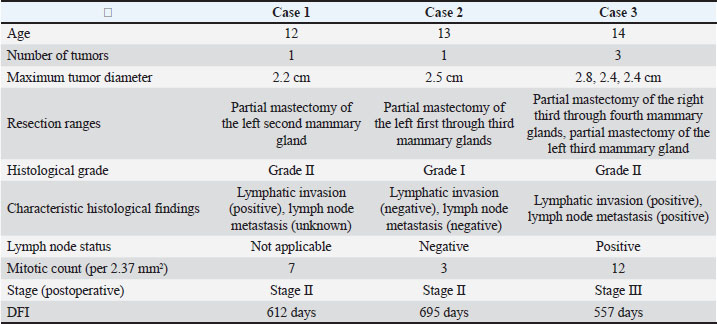
AbstractBackground: Feline mammary carcinoma (FMC) is a highly aggressive malignancy that shares substantial molecular features with human epidermal growth factor receptor 2 (HER2)-positive and triple-negative breast cancers. Conservative surgical strategies, such as partial mastectomy, typically result in short disease-free intervals (DFIs), with previous studies reporting postoperative DFIs of 205–428 days. In traditional Chinese medicine, Trametes robiniophila Murr. (Huaier), containing the bioactive proteoglycan TPG-1, has demonstrated multifaceted antitumor effects, including macrophage activation, inhibition of angiogenesis, suppression of epithelial–mesenchymal transition, and modulation of tumor-associated macrophages. However, to our knowledge, the clinical application of a Huaier-derived proteoglycan preparation (containing TPG-1) in veterinary oncology has not yet been reported. Case Description: Three spayed female cats (12–14 years old) diagnosed with FMC received partial mastectomy followed by daily oral administration of a Huaier-derived proteoglycan preparation (containing TPG-1; Animmune®, HACHI Co., Ltd., Japan), beginning on postoperative day 2. No additional conventional adjuvant therapies, such as chemotherapy or radiotherapy, were administered. All three cats achieved prolonged DFIs, with no local recurrence or distant metastasis detected through serial thoracic radiography and abdominal ultrasonography. At the time of this report, the DFIs were 612, 695, and 557 days, respectively, exceeding the DFIs typically reported following conservative surgery alone (approximately 205–428 days). Conclusion: Despite the presence of high-risk pathological features, including lymphatic invasion, multifocal disease, muscular infiltration, and, in one case, advanced stage III disease with lymph node metastasis, the DFIs exceeded previously reported expectations for partial mastectomy alone. These findings suggest that postoperative administration of Huaier-derived proteoglycan (containing TPG-1) may be associated with prolonged DFIs and warrant further clinical investigation in cats with FMC. However, these observations are based on a small uncontrolled case series. No adverse effects were observed during long-term administration in any of the three cats. Keywords: Adjuvant therapy, Feline mammary carcinoma, Huaier-derived proteoglycan, Partial mastectomy, TPG-1. IntroductionFeline mammary carcinoma (FMC) is among the most common malignant neoplasms in cats, with 80%–90% of mammary tumors classified as malignant. FMC exhibits aggressive biological behavior characterized by rapid local invasion, early lymphatic and distant metastasis, and high mortality. Molecular studies have demonstrated striking parallels between FMC and human epidermal growth factor receptor 2 (HER2)-positive and triple-negative breast cancers, including HER2 overexpression, basal-like phenotypes, and elevated proliferative indices (Millanta et al., 2005; Rasotto et al., 2011; Soares et al., 2013; Wiese et al., 2013; Soares et al., 2016). These molecular and clinical similarities underscore the need for improved multimodal management strategies. Surgical excision remains the cornerstone of FMC treatment. Extensive procedures such as unilateral or bilateral chain mastectomy offer the greatest survival benefit, while conservative procedures, including partial mastectomy or regional gland excision, have been associated with inferior local control and shorter disease-free interval (DFI). Published case reports and retrospective series have documented DFI ranges between 205 and 428 days (MacEwen et al., 1984; Novosad et al., 2006; Borrego et al., 2009; Mcneill et al., 2009; Gemignani et al., 2018; Rodrigues-Jesus et al., 2025). Nevertheless, many feline patients are elderly or possess comorbidities that preclude aggressive surgery, necessitating alternative strategies for postoperative disease control. In human oncology, preparations derived from Trametes robiniophila Murr. (Huaier), a medicinal fungus used in traditional Chinese medicine, have been reported to exert immunomodulatory and tumor-suppressive effects through multiple biological mechanisms (Yang et al., 2019; Ji et al., 2024). These preparations contain the bioactive proteoglycan TPG-1 as a major functional component. Biological mechanisms of the preparations include activation of macrophages via toll-like receptor 4/nuclear factor-κB (TLR4/NF-κB) and mitogen-activated protein kinase (MAPK) signaling pathways, inhibition of angiogenesis and epithelial–mesenchymal transition (EMT), and modulation of tumor-associated macrophage polarization toward a less immunosuppressive phenotype (Hu et al., 2019; Yang et al., 2019; Luo et al., 2024). Notably, these effects have been primarily demonstrated in experimental and clinical studies in human oncology (Hu et al., 2019; Yang et al., 2019; Luo et al., 2024). Despite this broad mechanistic profile, to our knowledge, Huaier-derived proteoglycan preparations have not previously been evaluated in veterinary cancer patients. Many of the signaling pathways implicated in these effects, including TLR4/NF-κB, MAPK, and VEGF-related pathways, are evolutionarily conserved across mammalian species, providing biological plausibility for potential activity in feline patients. The present report describes three clinical cases of FMC treated with partial mastectomy followed by postoperative administration of a Huaier-derived proteoglycan preparation containing TPG-1. Case DetailsCase 1A 12-year-old spayed female Scottish Fold feline weighing 4.0 kg presented with a firm mass in the left second mammary gland (Fig. 1). The tumor measured 2.2 cm at its longest diameter and was clinically classified as stage II FMC based on tumor size and the absence of nodal or distant metastasis. Preoperative thoracic radiography and abdominal ultrasonography confirmed no evidence of metastatic disease (Table 1). A partial mastectomy of the affected gland was performed with 2-cm lateral margins and excision of the deep fascial plane (Fig. 1). The axillary and accessory axillary lymph nodes were not removed, as no enlargement was detected on physical examination or diagnostic imaging at the time of surgery. Therefore, lymphadenectomy was not considered clinically indicated at the time of surgery. Table 1. Summary of mammary carcinomas, age, resection ranges, histopathological findings, lymph node status, mitotic count, stage, and DFIs in three cases.
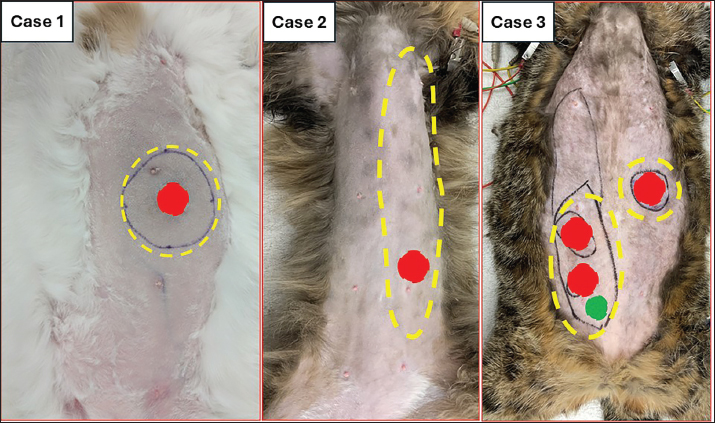
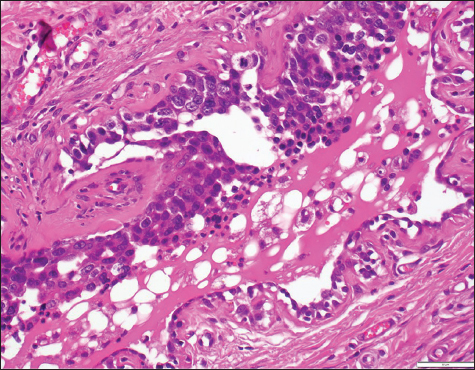
Fig. 1. Macroscopic findings for Cases 1, 2, and 3. Red indicates the location of the mammary carcinoma, green indicates the location of the inguinal lymph nodes, and the yellow dotted line indicates the resection margin. Tumor grading was performed according to the Elston and Ellis modification of the Scarff–Bloom–Richardson grading system adapted for FMC (Elston and Ellis, 1991; Mills et al., 2015). Formalin-fixed tissues were routinely processed and stained with hematoxylin and eosin (H&E) for histopathological evaluation. Histopathological evaluation revealed an intermediate-grade (grade II) tubulopapillary mammary carcinoma characterized by infiltrative epithelial proliferation forming irregular tubular structures within a moderately fibrous stroma, exhibiting infiltrative growth extending into the underlying muscle. Definite lymphatic invasion was identified (Fig. 2). The mitotic count was 7 per 2.37 mm² (equivalent to 10 high-power fields), corresponding to a mitotic index of 0.7 per high-power field. Surgical margins were considered complete, with negative margins.
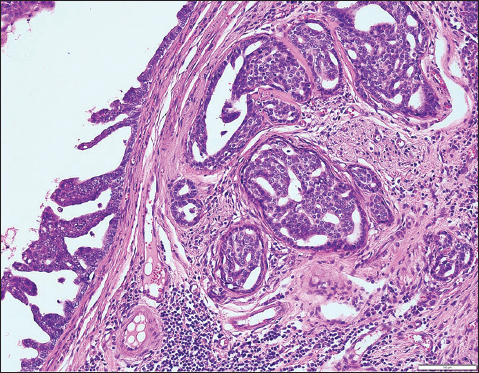
Fig. 2. Histopathological findings for Case 1. Hematoxylin and eosin stain showing lymphatic vessel invasion by neoplastic epithelial cells. Bar=50 μm. Postoperatively, a Huaier-derived proteoglycan preparation (Animmune®, HACHI Co., Ltd., Japan), containing the bioactive proteoglycan TPG-1, was administered orally at a dose of 1 g/day, corresponding to twice the manufacturer’s recommended daily dose, beginning on postoperative day 2. This dosage was selected empirically based on clinical experience and the absence of reported adverse effects associated with this preparation in companion animals. The owner reported occasional missed doses; however, overall compliance was considered good. No adverse effects were observed. Thorough palpation of the mammary gland region, three-view thoracic radiography, and abdominal ultrasonography were performed at 2-month intervals postoperatively. As of day 612, the cat has remained clinically healthy with no evidence of local recurrence, new mammary lesions, or distant metastasis based on serial imaging (Table 1). Case 2A 13-year-old spayed female mixed-breed cat weighing 3.8 kg presented with a palpable mass measuring 2.5 cm in the left third mammary gland (Fig. 1). Thoracic radiography and abdominal ultrasonography showed no evidence of metastasis, and the case was classified as stage II FMC (Table 1). Surgical management consisted of partial mastectomy of the left first through third mammary glands, including removal of the axillary and accessory axillary lymph nodes (Fig. 1). Tumor grading was performed according to the Elston and Ellis modification of the Scarff–Bloom–Richardson grading system adapted for FMC (Elston and Ellis, 1991; Mills et al., 2015). Histopathological analysis identified a low-grade (grade I) tubulopapillary mammary carcinoma characterized by well-differentiated glandular structures and mild stromal invasion, with limited infiltration into adjacent tissue and no muscular invasion (Fig. 3). Lymphatic invasion was not observed. The mitotic count was 3 per 2.37 mm² (equivalent to 10 high-power fields). Surgical margins were complete, with negative margins. The axillary and accessory axillary lymph nodes were negative for metastasis.
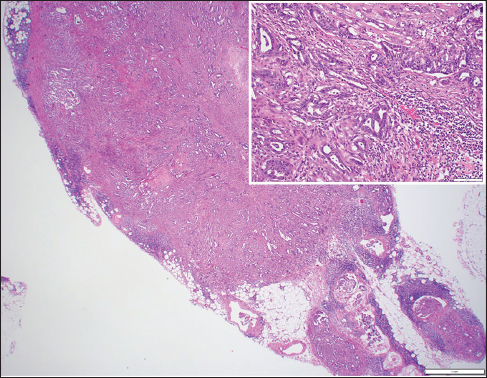
Fig. 3. Histopathological findings for Case 2. Hematoxylin and eosin stain showing a low-grade mammary carcinoma with few mitotic figures. Bar=100 μm. The same Huaier-derived proteoglycan preparation and dosage (1 g/day) were administered orally beginning on postoperative day 2. The owner reported occasional missed doses; however, overall compliance was considered good. No adverse effects were observed. Follow-up evaluations, including thorough mammary palpation, three-view thoracic radiography, and abdominal ultrasonography, were performed every 2 months. As of day 695, the longest follow-up duration among the three cases, the cat has remained free of local recurrence, new mammary lesions, or distant metastasis (Table 1). Case 3A 14-year-old spayed female mixed-breed cat weighing 5.8 kg presented with multiple mammary masses involving both mammary chains. Preoperative thoracic radiography and abdominal ultrasonography revealed no evidence of distant metastasis. Physical examination identified a 2.8-cm mass in the right third mammary gland, a 2.4-cm mass in the right fourth mammary gland, and a 2.4-cm mass in the left third mammary gland (Fig. 1). In addition, the right inguinal lymph node was moderately enlarged on palpation. Based on the presence of multiple tumors and suspected nodal involvement, the cat was provisionally classified as clinical stage III FMC (Table 1). Surgical treatment consisted of en-bloc excision of the right third and fourth mammary glands together with the right inguinal lymph node, using 2-cm lateral margins and removal of the deep fascial plane. The left third mammary gland was excised separately with 2-cm lateral margins and removal of a single deep fascial layer, as this lesion was anatomically distinct from the right-sided tumors (Fig. 1). Tumor grading was performed according to the Elston and Ellis modification of the Scarff–Bloom–Richardson grading system adapted for FMC (Elston and Ellis, 1991; Mills et al., 2015). Histopathological examination revealed a low-grade (grade I) mammary carcinoma in the right third mammary gland, composed of well-differentiated tubular structures with mild nuclear atypia and infiltrative growth, without evidence of lymphatic invasion. The mitotic count was 1 per 2.37 mm². The right fourth mammary gland contained an intermediate-grade (grade II) mammary carcinoma with definite lymphatic invasion and a mitotic count of 12 per 2.37 mm². The left third mammary gland showed benign mammary duct ectasia with epithelial dysplasia, without malignant features. Histopathological examination of the right inguinal lymph node revealed extensive metastatic involvement, with approximately 80%–90% of the nodal architecture replaced by carcinoma cells. Surgical margins for all excised tissues were complete, with negative margins (Fig. 4).
Fig. 4. Histopathological findings for Case 3. Hematoxylin and eosin stain showing metastatic mammary carcinoma within the inguinal lymph node. The inset shows a higher magnification of the metastatic focus. Bar=1 mm. The same Huaier-derived proteoglycan preparation (1 g/day) was administered orally beginning on postoperative day 2. The owner reported occasional missed doses; however, overall compliance was considered good. No adverse effects were observed. Follow-up evaluations, including mammary palpation, three-view thoracic radiography, and abdominal ultrasonography, were performed every 2 months. As of day 557, follow-up imaging has continued to show no evidence of local recurrence, new mammary lesions, or distant metastasis, despite the initially high metastatic burden (Table 1). Ethical approvalInstitutional ethical approval was not required for this study, as all procedures were performed as part of routine clinical care with informed owner consent. DiscussionThis case series describes three cats with mammary carcinoma that achieved prolonged DFIs following partial mastectomy combined with postoperative daily administration of a Huaier-derived proteoglycan preparation containing TPG-1. All three patients exhibited DFIs that exceeded those historically reported for conservative surgical management alone. Two cases (Cases 1 and 3) demonstrated high-risk pathological features typically associated with early recurrence, including lymphatic invasion, muscular infiltration, high mitotic activity, and, in Case 3, extensive inguinal lymph node metastasis. Although Case 2 was classified as a low-grade carcinoma without lymphatic or muscular invasion, conservative surgery alone in similar stage II FMC cases is generally associated with relatively short DFI. The consistently prolonged DFIs observed across all three cases, particularly in the stage III case with nodal metastasis, may suggest a possible association with postoperative administration of TPG-1, irrespective of baseline pathological risk. However, causal inference cannot be established given the small sample size and the descriptive nature of this case series. Historically, FMC has been managed primarily through surgical excision, with the extent of surgery strongly correlating with clinical outcome. Radical procedures such as unilateral or bilateral chain mastectomy offer significantly improved disease control compared with that by conservative approaches. Conversely, conservative surgical approaches, including single-gland excision or regional mastectomy, have generally been associated with shorter DFIs. Across retrospective studies with heterogeneous case populations, reported DFIs following partial mastectomy have typically ranged from 205 to 428 days (MacEwen et al., 1984; Novosad et al., 2006; Borrego et al., 2009; McNeill et al., 2009; Gemignani et al., 2018; Rodrigues-Jesus et al., 2025). These values represent historical reference ranges rather than directly comparable outcome measures, as prognosis is influenced by tumor burden, pathological features, and study design. However, many feline patients are elderly or have chronic comorbidities such as cardiomyopathy, chronic kidney disease, or respiratory compromise, rendering them unsuitable candidates for more aggressive surgical interventions. For such felines, effective postoperative adjuvant therapies capable of suppressing microscopic residual disease will offer substantial clinical value. The biological activities of Huaier-derived proteoglycans, including TPG-1, have been widely studied in human oncology, revealing a range of antitumor mechanisms relevant to the biology of FMC (Hu et al., 2019; Yang et al., 2019; Luo et al., 2024). Previous studies in human and experimental oncology have suggested that Huaier-derived proteoglycans may exert antitumor effects through multiple biological pathways, including inhibition of EMT, suppression of angiogenesis, modulation of inflammatory signaling pathways, and regulation of tumor cell proliferation and migration. These mechanistic observations provide a possible biological context for the favorable clinical outcomes observed in the present cases. However, these mechanisms have not been investigated in FMC and should therefore be regarded as speculative in the context of this case series. Such broad-spectrum modulation may be particularly relevant in cases with heterogeneous tumor biology or lymphatic dissemination, as observed in Case 3. Notably, lymph node metastasis typically predicts early recurrence; however, this patient has remained disease-free as of 557 days postoperatively, raising the possibility that TPG-1 may help suppress microscopic metastatic deposits or inhibit progression of circulating tumor cells. Clinical studies in human oncology have reported improved recurrence-free survival in postoperative patients receiving Huaier-based preparations (Zhang et al., 2019; Li et al., 2024), suggesting that the biological effects of Huaier-derived proteoglycans may translate into clinical benefits. Although the pathophysiology of FMC is not identical to that of human malignancies, it is widely regarded as a spontaneous and clinically relevant model of aggressive human breast cancers, including triple-negative breast cancer (TNBC) (Wiese et al., 2013; Soares et al., 2016). Accordingly, the present findings may offer translational insight into the potential role of TPG-1 in TNBC-like disease contexts (Wiese et al., 2013). However, it should be emphasized that the antitumor effects of TPG-1 discussed here are primarily extrapolated from experimental and human clinical studies, and its clinical efficacy has not yet been established in veterinary oncology. To our knowledge, this report represents the first clinical description of postoperative administration of TPG-1 in cats with mammary carcinoma. A notable clinically relevant observation in our series was the absence of adverse effects across all three cats, despite long-term administration at twice the manufacturer’s recommended dose. This favorable safety profile is particularly important given the advanced age of the patients and the frequent coexistence of comorbidities in feline oncology. This observation may be particularly relevant in geriatric feline patients, in whom treatment tolerance often limits the use of conventional adjuvant therapies. This study had some limitations, including the small sample size, lack of a control group, and reliance on conventional imaging modalities for follow-up. In addition, there was considerable heterogeneity among the three cats with respect to tumor grade, lymph node status, and surgical management, all of which may have influenced the observed outcomes independently of TPG-1 administration. In addition, although the administered preparation was standardized to contain TPG-1, Huaier-derived formulations may include multiple bioactive constituents, and the contribution of non–TPG-1 components cannot be entirely excluded. Despite these limitations, the consistent prolongation of DFIs across three biologically diverse cases, including one with nodal metastasis, supports further prospective investigation of TPG-1 as a postoperative adjuvant therapy in FMC. The optimal dose and duration of TPG-1 administration in cats remain unknown and warrant investigation in future prospective studies. In conclusion, daily postoperative administration of the Huaier-derived proteoglycan TPG-1 following partial mastectomy was associated with prolonged DFIs in three cats with mammary carcinoma, including one patient with stage III disease and confirmed lymph node metastasis. These findings suggest that TPG-1 may represent a potential postoperative therapeutic option for selected cats with mammary carcinoma and warrant further prospective investigation. However, given the small sample size, case heterogeneity, and lack of a control group, no causal relationship between TPG-1 administration and the observed outcomes can be established. Further prospective, controlled, and multi-institutional studies are warranted to evaluate the safety, optimal dosing, and potential clinical utility of TPG-1 in feline mammary carcinoma. AcknowledgmentsThe authors thank Dr. Midori Goto Asakawa (Dipl. ACVP), a board-certified veterinary anatomic pathologist, for providing the histopathological diagnoses and representative histopathological images. The authors also thank Masami Akiyoshi and the animal care staff at the Akiyoshi Animal Clinic for their dedicated assistance. FundingThis research received no specific grant or source of funding. Authors’ contributionsMA conceived and designed the clinical study, analyzed and interpreted the data, and drafted the manuscript. MH contributed to data analysis and interpretation. Conflict of interestThe authors declare that there are no conflicts of interest related to this study. Data availabilityAll relevant patient data are included within this manuscript. ReferencesBorrego, J.F., Cartagena, J.C. and Engel, J. 2009. Treatment of feline mammary tumours using chemotherapy, surgery and a COX-2 inhibitor drug (meloxicam): a retrospective study of 23 cases (2002-2007). Vet. Comp. Oncol. 7, 213–221. Elston, C.W. and Ellis, I.O. 1991. Pathological prognostic factors in breast cancer. I. The value of histological grade in breast cancer: experience from a large study with long-term follow-up. Histopathology 19, 403–410. Gemignani, F., Mayhew, P.D., Giuffrida, M.A., Palaigos, J., Runge, J.J., Holt, D.E., Robertson, N.A., Seguin, B., Walker, M., Singh, A., Liptak, J.M., Romanelli, G., Martano, M., Boston, S.E., Lux, C., Busetto, R., Culp, W.T.N., Skorupski, K.A. and Burton, J.H. 2018. Association of surgical approach with complication rate, progression-free survival time, and disease-specific survival time in cats with mammary adenocarcinoma: 107 cases (1991-2014). J. Am. Vet. Med. Assoc. 252, 1393–1402. Hu, B., Yan, W., Wang, M., Cui, X., Hu, Y., Chen, Q., Zhang, Y., Qi, X. and Jiang, J. 2019. Huaier polysaccharide inhibits the stem-like characteristics of ERα-36high triple negative breast cancer cells via inactivation of the ERα-36 signaling pathway. Int. J. Biol. Sci. 15, 1358–1367. Ji, H., Ma, W., Zheng, A. and Tang, D. 2024. The role and molecular mechanism of Trametes robiniophila Murr (Huaier) in tumor therapy. J. Ethnopharmacol. 334, 118578. Li, C., Wang, X., Xing, L., Chen, T., Li, W., Li, X., Wang, Y., Yang, C. and Yang, Q. 2024. Huaier-induced suppression of cancer-associated fibroblasts confers immunotherapeutic sensitivity in triple-negative breast cancer. Phytomedicine 135, 156051. Luo, K.F., Zhou, L.X., Wu, Z.W., Tian, Y., Jiang, J. and Wang, M.H. 2024. Molecular mechanisms and therapeutic applications of huaier in breast cancer treatment. Front. Pharmacol. 14, 1269096. MacEwen, E.G., Hayes, A.A., Harvey, H.J., Patnaik, A.K., Mooney, S. and Passe, S. 1984. Prognostic factors for feline mammary tumors. J. Am. Vet. Med. Assoc. 185, 201–204. McNeill et al., C.J., Sorenmo, K.U., Shofer, F.S., Gibeon, L., Durham, A.C., Barber, L.G., Baez, J.L. and Overley, B. 2009. Evaluation of adjuvant doxorubicin-based chemotherapy for the treatment of feline mammary carcinoma. J. Vet. Intern. Med. 23, 123–129. Millanta, F., Calandrella, M., Citi, S., Della Santa, D. and Poli, A. 2005. Overexpression of HER-2 in feline invasive mammary carcinomas: an immunohistochemical survey and evaluation of its prognostic potential. Vet. Pathol. 42, 30–34. Mills, S.W., Musil, K.M., Davies, J.L., Hendrick, S., Duncan, C., Jackson, M.L., Kidney, B., Philibert, H., Wobeser, B.K. and Simko, E. 2015. Prognostic value of histologic grading for feline mammary carcinoma: a retrospective survival analysis. Vet. Pathol. 52, 238–249. Novosad, C.A., Bergman, P.J., O’Brien, M.G., McKnight, J.A., Charney, S.C., Selting, K.A., Graham, J.C., Correa, S.S., Rosenberg, M.P. and Gieger, T.L. 2006. Retrospective evaluation of adjunctive doxorubicin for the treatment of feline mammary gland adenocarcinoma: 67 cases. J. Am. Anim. Hosp. Assoc. 42, 110–120. Rasotto, R., Caliari, D., Castagnaro, M., Zanetti, R. and Zappulli, V. 2011. An immunohistochemical study of HER-2 expression in feline mammary tumours. J. Comp. Pathol. 144, 170–179. Rodrigues-Jesus, J., Vilhena, H., Canadas-Sousa, A. and Dias-Pereira, P. 2025. Feline mammary tumors: a comprehensive review of histological classification schemes, grading systems, and prognostic factors. Vet. Sci. 12, 736. Soares, M., Correia, J., Rodrigues, P., Simões, M., De Matos, A. and Ferreira, F. 2013. Feline HER2 protein expression levels and gene status in feline mammary carcinoma: optimization of immunohistochemistry (IHC) and in situ hybridization (ISH) techniques. Microsc. Microanal. 19, 876–882. Soares, M., Madeira, S., Correia, J., Peleteiro, M., Cardoso, F. and Ferreira, F. 2016. Molecular based subtyping of feline mammary carcinomas and clinicopathological characterization. Breast 27, 44–51. Wiese, D.A., Thaiwong, T., Yuzbasiyan-Gurkan, V. and Kiupel, M. 2013. Feline mammary basal-like adenocarcinomas: a potential model for human triple-negative breast cancer (TNBC) with basal-like subtype. BMC Cancer 13, 403. Yang, A., Fan, H., Zhao, Y., Chen, X., Zhu, Z., Zha, X., Zhao, Y., Chai, X., Li, J., Tu, P. and Hu, Z. 2019. An immune-stimulating proteoglycan from the medicinal mushroom Huaier up-regulates NF-κB and MAPK signaling via toll-like receptor 4. J. Biol. Chem. 294, 2628–2641. Zhang, Y., Wang, X. and Chen, T. 2019. Efficacy of Huaier granule in patients with breast cancer. Clin. Transl. Oncol. 21, 588–595. | ||
| How to Cite this Article |
| Pubmed Style Akiyoshi M, Hisasue M. Prolonged disease-free intervals following partial mastectomy combined with daily administration of Huaier-derived proteoglycan in three cats with mammary carcinoma. doi:10.5455/OVJ.2026.v16.i6.74 Web Style Akiyoshi M, Hisasue M. Prolonged disease-free intervals following partial mastectomy combined with daily administration of Huaier-derived proteoglycan in three cats with mammary carcinoma. https://www.openveterinaryjournal.com/?mno=308311 [Access: June 28, 2026]. doi:10.5455/OVJ.2026.v16.i6.74 AMA (American Medical Association) Style Akiyoshi M, Hisasue M. Prolonged disease-free intervals following partial mastectomy combined with daily administration of Huaier-derived proteoglycan in three cats with mammary carcinoma. doi:10.5455/OVJ.2026.v16.i6.74 Vancouver/ICMJE Style Akiyoshi M, Hisasue M. Prolonged disease-free intervals following partial mastectomy combined with daily administration of Huaier-derived proteoglycan in three cats with mammary carcinoma. doi:10.5455/OVJ.2026.v16.i6.74 Harvard Style Akiyoshi, M. & Hisasue, . M. (2026) Prolonged disease-free intervals following partial mastectomy combined with daily administration of Huaier-derived proteoglycan in three cats with mammary carcinoma. doi:10.5455/OVJ.2026.v16.i6.74 Turabian Style Akiyoshi, Makoto, and Masaharu Hisasue. 2026. Prolonged disease-free intervals following partial mastectomy combined with daily administration of Huaier-derived proteoglycan in three cats with mammary carcinoma. doi:10.5455/OVJ.2026.v16.i6.74 Chicago Style Akiyoshi, Makoto, and Masaharu Hisasue. "Prolonged disease-free intervals following partial mastectomy combined with daily administration of Huaier-derived proteoglycan in three cats with mammary carcinoma." doi:10.5455/OVJ.2026.v16.i6.74 MLA (The Modern Language Association) Style Akiyoshi, Makoto, and Masaharu Hisasue. "Prolonged disease-free intervals following partial mastectomy combined with daily administration of Huaier-derived proteoglycan in three cats with mammary carcinoma." doi:10.5455/OVJ.2026.v16.i6.74 APA (American Psychological Association) Style Akiyoshi, M. & Hisasue, . M. (2026) Prolonged disease-free intervals following partial mastectomy combined with daily administration of Huaier-derived proteoglycan in three cats with mammary carcinoma. doi:10.5455/OVJ.2026.v16.i6.74 |


