Open Veterinary Journal, (2026), Vol. 16(6): 3903-3911
Research Article
10.5455/OVJ.2026.v16.i6.59
Evaluating the cryo-response of buck sperm in different commercial extenders
Casmuti Casmuti1, Mokhamad Fakhrul Ulum2, Syahruddin Said3, Taufiq Purna Nugraha3 and
Raden Iis Arifiantini2*
1Study Program of Veterinary Biomedical Sciences, School of Veterinary Medicine and Biomedical Sciences, IPB University, Bogor, Indonesia
2Division of Reproduction and Obstetrics, School of Veterinary Medicine and Biomedical Sciences, IPB University, Bogor, Indonesia
3Research Center for Applied Zoology, National Research and Innovation Agency (BRIN), Bogor, Indonesia
*Corresponding Author: Raden Iis Arifiantini. Division of Reproduction and Obstetrics, School of Veterinary Medicine and Biomedical Sciences, IPB University, Bogor, Indonesia. Email: arifiantini [at] apps.ipb.ac.id
Submitted: 25/01/2026 Revised: 11/05/2026 Accepted: 23/05/2026 Published: 20/06/2026
© 2025 Open Veterinary Journal
This is an Open Access article distributed under the terms of the Creative Commons Attribution-Non Commercial-No Derivatives License (http://creativecommons.org/licenses/by-nc-nd/4.0/), which permits non-commercial re-use, distribution, and reproduction in any medium, provided the original work is properly cited, and is not altered, transformed, or built upon in any way.
Abstract
Background: The application of frozen semen in buck artificial insemination is widely practiced; however, depending on the extender used, cryopreservation can compromise sperm quality.
Aim: This study aimed to evaluate the effects of different commercial extenders on post-thaw sperm quality and kinematic characteristics in bucks.
Methods: Semen samples were collected from 4 bucks (2 Etawah Grade and 2 Anglo-Nubian), and 5 ejaculates were obtained from each individual. Comprehensive evaluations were conducted using three extenders (AndroMed®, BoviFree®, and Steridyl®), with three straws per extender per ejaculate, totaling 180 straws. The quality of frozen semen was evaluated based on sperm motility, kinematics, viability, acrosome integrity, and abnormalities.
Results: The commercial extender type significantly affected sperm motility and kinematics (p < 0.05). Steridyl® exhibited the highest total and progressive motility (60.19% ± 1.31% and 58.11% ± 1.33%, respectively). AndroMed® was associated with the highest sperm kinematic values: curvilinear path, straight-line path, velocity average path, distance curved line, distance average path, amplitude of lateral head displacement, and head activity. Sperm viability, abnormalities, and acrosome integrity were not significantly different between the extenders (p > 0.05). These results indicate that different commercial extenders may exert specific effects on overall sperm motility versus kinematic variables.
Conclusion: Commercial extenders exhibited function-specific effects on post-thaw sperm quality, with Steridyl® supporting sperm motility, AndroMed® enhancing sperm kinematics, and BoviFree® showing intermediate performance, indicating that no single commercial extender outperformed others across all functional domains.
Keywords: Buck semen, Frozen semen, Commercial extender, CASA.
Introduction
Goats are small ruminants that are highly adaptable and play an important role in providing animal proteins. The Etawah Grade and Anglo-Nubian goats are dual-purpose breeds used for meat and milk production. Goat productivity can be improved by enhancing reproductive efficiency using artificial insemination (AI) technology. The application of AI with frozen semen is an effective strategy to accelerate the dissemination of superior genetics at a relatively low cost (Souza-Fabjan et al., 2023). The success of AI programs depends on the quality of both fresh and frozen semen. The type of extender employed and the semen cryopreservation process influence the frozen semen used in AI. Cryopreservation can cause various structural and functional damage to sperm, including damage to the plasma membrane, acrosome, and Deoxyribonucleic Acid (DNA), which can decrease sperm viability and motility (Bustani and Baiee, 2021). Recent studies have highlighted the challenges in goat semen cryopreservation and the need for optimized extenders and freezing-thawing protocols to improve post-thaw sperm quality (Bodu et al., 2025).
The selection of an appropriate semen extender is crucial for maintaining semen quality during freezing and storage. Extenders act as sperm protectants and nutrient sources during freezing and storage. Different extenders have been used to cryopreserve buck semen. The best semen extender for freezing Bengal black goat semen is Triladyl®, followed by AndroMed® and Tris (Rimi et al., 2023). Other researchers reported the highest sperm viability (67.53%) and the lowest sperm abnormality (1.87%) in frozen Saanen goat semen when using AndroMed® compared with egg yolk-Tris and OviXcell® (Nisfimawardah et al., 2023). The highest sperm motility in liquid Boer goat semen was achieved with a combination of AndroMed® and human tubular fluid (HTF) (86.3%), compared with using AndroMed® or HTF alone (Quintero-Elisea et al., 2023). Supplementing semen extenders with antioxidants or plant-derived compounds can improve post-thaw sperm quality by reducing oxidative stress (Liu et al., 2025). In addition, certain antioxidants have been reported to directly protect mitochondrial function and enhance adenosine triphosphate (ATP) production in frozen-thawed goat sperm (Zhu et al., 2025).
Previous studies have added various substances to semen extenders. Kamal et al. (2023) added trehalose to an egg yolk Tris extender to freeze Beetal goat semen, thereby improving the quality of frozen semen. The addition of 2 mM selenium (Se) to an egg yolk Tris extender increased sperm motility in frozen Kamohri goat semen by 10.7% compared with no Se addition (Ali et al., 2024). Three types of semen extenders were used: AndroMed®, BoviFree®, and Steridyl® (Minitube, Germany). The main components of these extenders were soybean lecithin in AndroMed®, animal-free protein liposomes in BoviFree®, and sterile egg yolk in Steridyl®. Although extenders for buck semen have been studied previously, comparative research directly assessing the ability of modern commercial extenders to maintain post-thaw sperm quality, especially velocity- and trajectory-related kinematic variables measured using computer-assisted sperm analysis (CASA), remains scarce. Therefore, this study aimed to evaluate the effects of different commercial extenders on the quality and kinematic characteristics of post-thaw buck semen sperm.
Materials and Methods
Experimental location
This study was conducted at the Lembang AI Center, West Bandung Regency, West Java Province, Indonesia, and the Semen Analysis Laboratory, the Reproductive Rehabilitation Unit of the School of Veterinary Medicine and Biomedical Sciences, IPB University. The study was conducted from July to September 2025.
Experimental design
This study was conducted on 4 bucks (2 Etawah Grade and 2 Anglo-Nubian goats) aged 3–4 years. Figure 1 shows the experimental workflow of the study. The bucks were kept in individual pens under similar management conditions. Semen was collected using an artificial vagina, and 5 ejaculates were obtained from each buck. Each ejaculate served as a biological replicate and was divided into three equal aliquots, which were diluted using three commercial extenders: AndroMed®, BoviFree®, and Steridyl®. For each ejaculate, semen diluted with each extender was packaged into 3 0.25-ml straws, resulting in 180 semen straws for cryopreservation and subsequent evaluation.
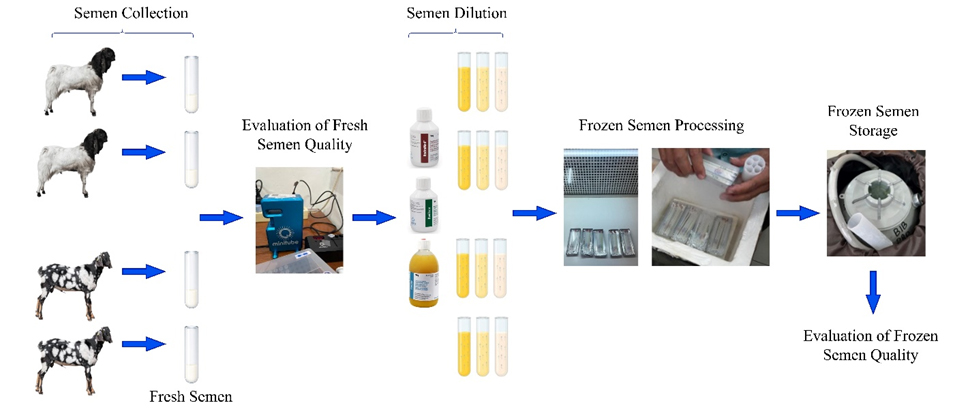
Fig. 1. Experimental workflow from semen collection to semen quality evaluation in bucks.
Although multiple semen straws were analyzed, they originated from a limited number of ejaculates and animals, and the ejaculates served as the primary biological replicates, whereas semen straws were used as technical replicates to evaluate post-thaw semen quality variables. Therefore, observations derived from semen straws originating from the same ejaculate are not independent and were treated accordingly in the statistical analysis. Owing to the limited number of animals available per breed, we pooled semen samples from Etawah Grade and Anglo-Nubian bucks to evaluate the effects of commercial extenders. Breed was excluded as a factor in the statistical model to avoid overparameterization and unreliable estimates given the small sample size per breed. Therefore, the breed was excluded as a factor in the experimental design. This approach prioritizes the evaluation of extender effects while acknowledging that potential breed-related variability cannot be fully separated in this study. Following cryopreservation and thawing, the semen quality variables were evaluated. Sperm motility and kinematic variables were assessed using the CASA system with all 180 semen straws. Sperm viability, acrosome integrity, and abnormalities were evaluated using one straw from each ejaculate extender, yielding 60 semen straws.
Preparation of the extender materials
This study used 3 types of commercial extenders: AndroMed®, BoviFree®, and Steridyl® (Minitube, Germany). AndroMed® and BoviFree® were diluted with distilled water at a ratio of 1:4, whereas Steridyl® was diluted at a ratio of 1:1.5. The extenders were maintained in a 32°C water bath before semen dilution.
Semen collection
Semen was collected biweekly in the morning using an artificial vagina in accordance with the Lembang AI Center’s Standard Operating Procedures. Freshly collected semen was promptly transported to the laboratory and maintained at 32°C before evaluation.
Evaluation of the quality of fresh semen
Fresh semen was evaluated for both macroscopic and microscopic quality. Macroscopic quality evaluations included semen volume, color, consistency, and pH. Microscopic quality evaluations included motility, viability, sperm abnormality, acrosome integrity, and sperm concentration. The volume of semen was measured by reading the scale on the tube according to the amount of semen collected (ml). Semen color was visually observed in the semen collection tubes. Consistency is evaluated by slowly tilting and returning the collection tube to its original position. Consistency was assessed by noting the speed of the semen fluid against the tube wall using the following categories: thin, medium, thick, and very thick. The pH of the semen was measured to determine acidity using a pH meter inserted into the semen.
Sperm motility in fresh semen was analyzed using a portable CASA (AndroScope; Minitube, Germany). Ten microliters of semen were diluted with 490 µl of Tris buffer, and 2.9 µl of the mixture was placed on a prewarmed Leja slide, resulting in an optimal sperm count (approximately 250–350 cells per field of view) to ensure reliable CASA measurements. Observations were made in 4 fields to determine the average sperm motility. The sperm motility subcategories were defined according to established CASA thresholds: immotile sperm had a HAC < 0.087 rad; local motility had a VCL < 48 µm/s and VSL < 24 µm/s; circular motility had a motility radius between 9 and 90 µm and rotation > 0.70; slow motility had a VCL < 120 µm/s; and fast motility included all remaining motile sperm. The observed sperm kinematic variables included curvilinear path (VCL), straight-line path (VSL), velocity average path (VAP), amplitude of lateral head displacement (ALH), distance curved line (DCL), distance straight line (DSL), distance average path (DAP), beat cross-frequency (BCF), head activity (HAC), linearity (LIN), and straightness (STR).
Sperm viability and abnormalities were evaluated using eosin-nigrosin staining. As described by Arifiantini (2012), the semen-to-eosin-nigrosine ratio was maintained at 1:10, and the mixture was homogenized and prepared as a smear. Subsequently, the smear was dried on a heating table at 37°C. The staining and dilution conditions were adjusted to achieve an appropriate sperm density (approximately 20–40 cells per field of view), allowing the evaluation of at least 200 sperm cells per sample for accurate and consistent assessment. Sperm viability and abnormalities were observed under a binocular microscope at 400 × magnification. Observations were classified into 4 categories: normal live sperm, abnormal live sperm, normal dead sperm, and abnormal dead sperm. Acrosome integrity in fresh semen sperm was assessed by combining semen with Tris buffer at a 1:30 ratio on an object glass and then preparing a smear on another glass slide. The smear was air-dried, immersed in ethanol for 10 minutes, and then immersed in Giemsa stain for 3 hours. The samples were then rinsed and dried with running water. Similarly, dilution and smear preparation were optimized to achieve an appropriate sperm density (approximately 20–40 sperm cells per field of view), allowing the evaluation of at least 200 sperm cells per sample for reliable morphological assessment. Acrosome integrity was assessed under a microscope at 400 × magnification. The percentage of acrosomal integrity was calculated as follows:
Acrosome integrity (%)=(Count of sperm with intact acrosome/Total sperm) × 100%.
Processing of frozen semen
Semen from each male subject was processed individually for analysis. Each sample was divided into 3 portions and diluted with AndroMed®, BoviFree®, and Steridyl®. During homogenization at room temperature, the commercial extender was gradually added (Arifiantini et al., 2024) until a final concentration of 200 million sperm/ml was reached. The diluted semen samples were packaged into 0.25-ml straws at a concentration of 50 million cells/straw (Badan Standardisasi Nasional, 2023). Semen was equilibrated at 5°C for 4 hours and then conventionally frozen and stored in liquid nitrogen-filled containers.
Evaluation of the quality of frozen semen
Comprehensive evaluations were conducted using the 3 commercial extenders for all individuals. Before quality assessment, the semen was thawed by immersing the straw in warm water at 37°C for 30 seconds (Arifiantini et al., 2024). Sperm motility, kinematics, viability, acrosome integrity, and abnormalities were assessed. Several frozen semen quality tests were performed using the same procedures as those used for fresh semen, with certain modifications. For sperm motility and kinematic evaluation, thawed semen was diluted 1:5 before analysis using a CASA system. For sperm viability and abnormality assessment, semen was stained with eosin–nigrosin at a 1:5 ratio. Acrosome integrity was evaluated using the same procedure as for fresh semen; however, samples were diluted (1:10) using the corresponding commercial extender assigned to each straw before smear preparation. To achieve an appropriate sperm concentration, the selected dilution ratios were optimized for each assessment. For CASA analysis, approximately 250–350 sperm cells were obtained per field of view. For morphological assessments (viability, abnormalities, and acrosome integrity), smears were prepared to allow evaluation of at least 200 sperm cells per sample, ensuring reliable and representative measurements.
Data analysis
Data are presented as the mean ± standard error of the mean. The normality and homogeneity of variance were assessed using Shapiro–Wilk and Levene’s tests, respectively. Post-thaw semen quality variables were analyzed using a linear mixed-effects model, with commercial extender type as a fixed effect and buck and ejaculate nested within buck as random effects to account for biological variability and repeated measures. The model structure explicitly accounts for the data’s hierarchical nature, with repeated observations within ejaculates and within individuals. Buck was included as a random effect to capture inter-individual variability, whereas ejaculate nested within buck accounted for within-animal repeated measures.
All 180 straws were analyzed individually for sperm motility and kinematics, whereas 60 straws were analyzed for sperm viability, abnormalities, and acrosome integrity. Ejaculates were considered biological replicates, whereas semen straws represented technical replicates derived from each ejaculate. Although all straws were included in the statistical analysis to retain measurement-level variability, observations from straws originating from the same ejaculate were not independent.
This non-independence was accounted by including ejaculate nested within buck as random effects, allowing appropriate variance partitioning and reducing the risk of pseudoreplication. Consequently, statistical inferences were primarily made at the level of biological replication (ejaculates) rather than individual semen straws. Post hoc comparisons were performed using the Bonferroni test when significant differences were detected. Statistical significance was set at p < 0.05. All statistical analyses were performed using the Statistical Package for the Social Sciences software (version 30; IBM Corp., USA).
Ethical approval
The Animal Ethics Committee of the School of Veterinary Medicine and Biomedical Sciences, IPB University, approved this study (Approval No. 351/KEH/SKE/VII/2025).
Results
Fresh semen quality of the bucks
The fresh semen samples analyzed in this study had commendable quality. The assessment of fresh buck semen yielded the following results: semen volumes were measured at 2.60 ± 0.14 ml, with a coloration ranging from milky white to creamy, a thick consistency, and a pH value of 6.64 ± 0.02. Progressive sperm motility was 76.98% ± 1.97%, and sperm viability was 85.74% ± 1.47%. The percentage of acrosome integrity was 97.02% ± 0.58%, sperm abnormalities were noted at 7.32% ± 0.55%, and sperm concentration was determined to be 2327.20 ± 31.03 × 10⁶/ml.
Sperm motility of frozen buck semen treated with different commercial extenders
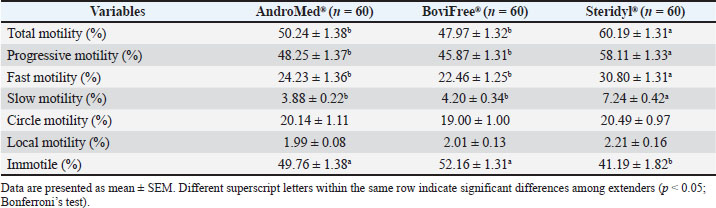
Table 1 shows the sperm motility of frozen buck semen treated with different commercial extenders. This study found differences in sperm motility variables, such as total motility, progressive motility, fast motility, slow motility, and immotile sperm, among buck semen diluted in different commercial extenders (p < 0.05). Circle and local motility did not differ among buck semen samples diluted with different commercial extenders (p > 0.05).
Table 1. Sperm motility of frozen buck semen treated with different commercial extenders.
Sperm kinematics of frozen buck semen treated with different commercial extenders
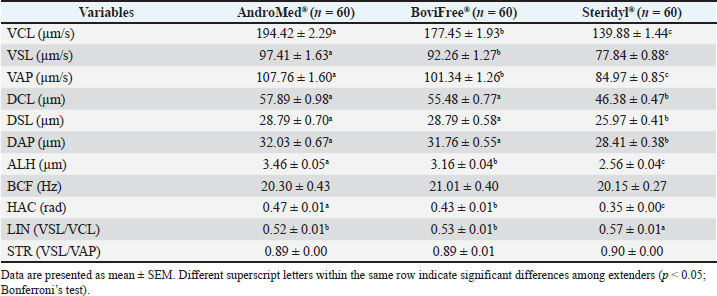
Sperm kinematics analysis (Table 2) revealed a significant effect of extender type (p < 0.01). AndroMed® showed dominance in velocity-related parameters (VCL, VSL, VAP, DCL, DSL, DAP, ALH, and HAC), indicating preferential preservation of sperm kinetic vigor rather than overall motility, whereas Steridyl® exhibited the highest LIN. In contrast, BCF and STR were not significantly affected (p > 0.05), indicating that certain trajectory-related features are less sensitive to the composition of the extender.
Table 2. Sperm kinematics of frozen buck semen treated with different commercial extenders.
Sperm viability, acrosome integrity, and sperm abnormality in frozen buck semen treated with different commercial extenders
Table 3 shows the sperm viability, acrosome integrity, and sperm abnormality of frozen buck semen treated with different commercial extenders. No significant differences in sperm viability, acrosome integrity, or sperm abnormality were observed among the commercial extenders (p > 0.05).
Table 3. Sperm viability, acrosome integrity, and sperm abnormality in frozen buck semen treated with different extenders.

Discussion
Motility of buck sperm using various commercial extenders
Sperm motility is a critical indicator of both fertilization potential and cryotolerance, as initial motility reflects the structural and physiological integrity of spermatozoa before freezing (Tamargo et al., 2024). Sperm motility tended to be lower in AndroMed® and BoviFree® than in Steridyl®, suggesting the differential efficacy of the extender composition in preserving membrane stability during cryogenic stress, particularly in relation to lipid–protein interactions and oxidative balance. Consistent with the findings of Saratsi et al. (2024) Steridyl® tended to produce higher total and progressive motility than the other extenders, supporting the functional relevance of phospholipid-rich extenders in maintaining post-thaw motility.
The higher sperm motility observed in Steridyl®-diluted semen may be attributed to the presence of sterile egg–yolk-derived lipoproteins and cholesterol, which stabilize the sperm plasma membrane during cryopreservation. Ďuračka et al. (2024) reported that egg yolk is extensively used as a membrane protectant because of its high low-density lipoprotein content, which mitigates ice crystal formation during freezing. Steridyl® comprises sterilized egg–yolk-derived lecithin and cholesterol. These components protect the structural integrity of sperm during freezing while minimizing the risks of contamination.
This supports the observed differences between extenders, where lecithin-mediated antioxidant protection likely contributed to improved post-thaw membrane stability and sustained motility. Cholesterol regulates plasma membrane stability by limiting phospholipid mobility, thereby reducing membrane phase transitions and mitigating damage induced by ice crystallization and osmotic stress during cryopreservation. Collectively, these mechanisms likely enhance resistance to phase transition-induced membrane destabilization, thereby sustaining post-thaw motility capacity.
The higher velocity parameters observed in AndroMed® indicate enhanced mitochondrial efficiency, enabling greater ATP availability for sustained flagellar activity. Zang et al. (2025) reported that freezing alters mitochondrial energy metabolism, including mitochondrial ultrastructure, membrane potential, and ATP production, which collectively diminish total motility. ATP generated by glycolysis and oxidative phosphorylation supports the progressive movement of sperm. Li et al. (2023) demonstrated that glucose deprivation activates the liver kinase B1 and AMP-activated protein kinase pathways in dairy goat sperm, thereby enhancing high-speed linear motility, supporting metabolic efficiency, and sperm kinematics. Thus, the velocity patterns observed in this study likely reflect differential mitochondrial resilience across commercial extenders. This metabolic preservation likely contributes to the sustained ATP availability required for flagellar beating, thereby explaining the observed differences in post-thaw motility among extenders.
Collectively, these findings indicate that membrane stabilization and oxidative stress mitigation mechanisms primarily mediate cryoprotective efficiency. Steridyl® preferentially supported motility-related parameters, indicating enhanced preservation of membrane integrity under cryogenic stress, rather than indicating a universally superior performance across all sperm functional attributes.
The percentage of progressive motility across all commercial extenders in this study met the minimum requirements for the production of frozen buck semen, as stipulated by the Indonesian National Standard 4869–3:2023, which mandates a progressive motility of ≥ 40% (Badan Standardisasi Nasional, 2023). These findings demonstrate that all formulations provide adequate baseline quality for AI application despite functional differences among extenders.
Sperm kinematics of buck semen in different commercial extenders
The results of this study demonstrate that the type of commercial extender significantly influences sperm kinematic variables in frozen–thawed buck semen. AndroMed® produced the highest values for most velocity-related variables, indicating that the soybean lecithin components in this extender help maintain sperm membrane stability and metabolic activity during cryopreservation. During cryopreservation, soybean lecithin nanoparticles effectively bind to and coat the sperm plasma membrane, thereby protecting membrane integrity, reducing lipid peroxidation and DNA fragmentation, and supporting higher post-thaw sperm viability and mitochondrial membrane potential compared with controls (Khaledi et al., 2024). This preservation likely improves the energy transduction efficiency for flagellar propulsion, thereby explaining the higher velocity-related kinematic variables observed in AndroMed®. Mechanistically, this may be associated with improved mitochondrial membrane potential and reduced lipid peroxidation, which together enhance flagellar propulsion efficiency and sperm trajectory dynamics.
Velocity-related parameters (VCL, VSL, and VAP) reflect sperm energy output and propulsive efficiency. The highest VCL, VSL, and VAP values were observed in the AndroMed® extender (194.42 ± 2.29, 97.41 µm/s ± 1.63, and 107.76 ± 1.60 µm, respectively), which were lower than those reported by Saratsi et al. (2024) in Skopelos bucks. Higher values of these variables are associated with stronger flagellar propulsion and greater sperm vigor, which may enhance the ability of spermatozoa to migrate through the female reproductive tract’s viscous environment and approach the oocyte. This functional advantage is particularly relevant under in vivo conditions, where sperm must overcome physical and biochemical barriers within the female reproductive tract.
Trajectory-related variables, such as LIN and STR, describe sperm movement efficiency and directionality. LIN represents the ratio of VSL to VCL, whereas STR represents the ratio of VSL to VAP. The higher LIN and STR values observed in Steridyl® indicate improved sperm movement directional efficiency. Compared with that reported by Saratsi et al. (2024), the combination of lower LIN and higher STR values indicates a shift in sperm trajectory dynamics. The consistently higher LIN and STR in Steridyl® indicate more efficient directional movement, potentially enhancing sperm progression through the female reproductive tract.
Additional kinematic variables provide further insight into sperm movement dynamics. The ALH reflects sperm hyperactivation and the acrosome reaction required for ZP penetration (Yanagimachi, 1994; Fernández-Montoro et al., 2025). Distance-related variables, including DCL, DSL, and DAP, represent sperm cell displacement along their respective movement paths during observation. These variables describe sperm progression and motility persistence. Semen diluted with AndroMed® showed DCL, DSL, DAP, and ALH values of 57.89 ± 0.98 µm, 28.79 ± 0.70 µm, 32.03 ± 0.67 µm, and 3.46 ± 0.05 µm, respectively. The ALH value in Skopelos bucks was higher than that reported by Saratsi et al. (2024). Higher ALH values reflect stronger flagellar activity, which may facilitate sperm penetration of the zona pellucida and contribute to greater fertilization potential (Utami et al., 2025).
BCF represents the frequency at which the sperm head crosses its mean path, reflecting the dynamics of flagellar motion that underlies sperm motility, whereas HAC represents a geometric ratio describing the sperm head’s circularity, expressed as a percentage, reflecting the extent to which the sperm head approximates a circular shape (Hine et al., 2026). The mean BCF and HAC values were 20.30 ± 0.43 Hz and 0.47 ± 0.01 rad, respectively. Higher HAC values were observed in the AndroMed® extender, whereas the BCF value obtained in this study was higher than that reported by Saratsi et al. (2024) in Skopelos bucks. A higher BCF value indicates a faster and more rhythmic pattern of flagellar beating, which may contribute to more dynamic sperm movement.
Overall, the differences observed among extenders highlight that cryopreservation media may preserve distinct aspects of sperm motility. AndroMed® primarily supported higher velocity variables, whereas Steridyl® tended to promote more linear trajectories. Because successful fertilization requires both efficient sperm transport and sufficient propulsive force for zona pellucida penetration, evaluating multiple CASA-derived kinematic variables provides a more comprehensive assessment of sperm functional quality and potential fertility in AI programs in goats.
Viability, acrosome integrity, and abnormality of buck sperm obtained using different commercial extenders
The findings revealed no statistically significant differences in sperm viability, acrosome integrity, or sperm abnormalities among the commercial extenders. This indicates that all 3 commercial extenders exhibited comparable efficacy in preserving post-thaw sperm survival. Saratsi et al. (2024) reported that the lecithin egg–yolk-based commercial extender Steridyl® effectively maintained viability, functional membrane integrity, and acrosome integrity of buck sperm during low-temperature storage, in contrast to extenders lacking phospholipids. Egg yolk phospholipids and cholesterol contribute to the maintenance of sperm membrane fluidity (Castro et al., 2025), thereby mitigating thermal stress-induced damage and ice crystal formation. This result is consistent with the present observations and supports the proposed mechanism by which lipid-rich extenders enhance membrane robustness.
The high acrosome integrity values observed across all commercial extenders indicate that the freezing process inflicted minimal structural damage to the sperm acrosome. The acrosome, an organelle that stores essential fertilization enzymes, such as acrosin and hyaluronidase, is crucial for successful fertilization in mammals (Yanagimachi, 2022). Acrosome integrity values in the AndroMed® extender were comparable to those observed in the other extenders, indicating the efficacy of SLE in protecting acrosomal membrane integrity. The inclusion of soybean lecithin in AndroMed® helps maintain sperm membrane and acrosome integrity during cryopreservation while mitigating oxidative stress. This protection enhances progressive motility and fertilization potential (Fathi et al., 2019). Soybean lecithin-based formulations offer distinct advantages in preserving fertilization-related structures.
Previous studies have similarly demonstrated that extenders based on soybean lecithin effectively preserve membrane integrity and fertilization potential in goat sperm. Liang et al. (2023) reported that AndroMed® (soybean lecithin-based) improved membrane integrity, acrosome structure, and sperm viability in Yunshang Black goats compared with skimmed milk extenders and l-α-phosphatidylcholine. This indicates that the soybean lecithin content in AndroMed® effectively protected the acrosomal structure during cryopreservation and thawing. Chelucci et al. (2015) also demonstrated that soybean lecithin-based extenders preserved the post-thawing fertilization potential and maintained DNA and acrosome integrity in Sarda goat sperm, rendering them a safe and effective alternative. The absence of significant differences in sperm abnormalities across commercial extenders indicates that the cryopreservation process remained relatively stable across all commercial extenders.
The slightly elevated proportion of abnormalities observed in the Steridyl® group may be attributed to osmotic pressure fluctuations during freezing. During cryopreservation, damage to sperm structures, including the head, tail, and midpiece, is strongly associated with osmotic stress (Sharafi et al., 2022). Egg-yolk-based sterile extenders, such as Steridyl®, enhanced sperm viability, whereas soybean-lecithin-based extenders, such as AndroMed®, were more effective in preserving acrosomal integrity. The efficacy of a commercial extender depends on the compatibility between the sperm biochemical composition and physiological characteristics. Therefore, when optimizing cryopreservation strategies to improve reproductive outcomes, commercial extenders should be considered.
This study has several limitations. The small number of bucks (n=4) restricts biological replication and may not fully capture individual variability in the cryoresponse. In addition, semen from two breeds was pooled due to the limited number of animals per breed, and breed effects were not modeled to avoid overparameterization and unreliable estimates, despite their potential influence on semen characteristics and cryotolerance.
The pooling strategy was considered appropriate within the specific objective of this study, which focused on evaluating extender-related effects rather than breed-specific differences. Accordingly, the experimental design should be interpreted as an exploratory assessment of cryoresponsive to commercial extenders under controlled conditions, where the primary source of variation was the extender composition. Although breed-related variability cannot be excluded, the observed responses are more appropriately interpreted as generalizable patterns of extender–sperm interaction at the cellular level, particularly in terms of membrane stabilization and metabolic preservation, rather than as breed-dependent effects. This approach allowed improved sample representation while maintaining model stability, although it inherently limits breed-level inference.
Ejaculates were treated as biological replicates, whereas semen straws were treated as technical replicates. Although all straws were included to retain measurement-level variability, observations within the same ejaculate were not independent. The hierarchical structure of the data, including repeated observations within ejaculates and within individuals, was addressed using a linear mixed-effects model with buck and ejaculate nested within buck as random effects. This approach allows appropriate variance partitioning and accounts for within-individual and within-ejaculate dependencies, thereby reducing the pseudoreplication risk. Accordingly, statistical inference is primarily made at the level of biological replication (ejaculates) rather than individual semen straws. This distinction is critical to avoid technical replicates being over interpreted as independent biological observations. Therefore, the findings of this study should be regarded as preliminary and mechanism-oriented, providing insight into extender-specific effects on sperm functional attributes. Further studies with larger sample sizes and balanced breed representation are required to validate these results and assess their applicability under field conditions.
Conclusion
Commercial extenders differentially modulate post-thaw sperm quality in bucks, revealing clear functional trade-offs. Steridyl® primarily supported motility-related parameters, AndroMed® enhanced key kinematic variables, and BoviFree® maintained structural integrity without a marked superiority in either domain. No extender consistently outperformed the others across all parameters, underscoring the cryoprotective efficacy’s function-specific nature. Accordingly, extender selection should be aligned with targeted reproductive outcomes rather than a universal performance criterion, providing a more precise framework for optimizing semen cryopreservation in artificial buck insemination systems.
Acknowledgments
The authors sincerely thank the Indonesia Endowment Fund for Education (LPDP), which is affiliated with the Ministry of Finance, Republic of Indonesia, for their financial support. The authors extend their sincere appreciation to the Lembang Artificial Insemination Center for their assistance and provision of facilities throughout this research. The Laboratory of the Reproductive Rehabilitation Unit, School of Veterinary Medicine and Biomedical Sciences, IPB University, for providing laboratory facilities and technical support throughout the study, was also gratefully acknowledged.
Conflict of interest
The authors declare no conflict of interest.
Funding
The Ministry of Finance of the Republic of Indonesia supported this study through the Indonesia Endowment Fund for Education (LPDP) under Grant No. SKPB-3907/LPDP/LPDP.3/2024.
Authors' contributions
CC: conceptualization, data curation, formal analysis, funding acquisition, investigation, methodology, and writing. MFU: formal analysis, investigation, supervision, review, and editing. SS: conceptualization, methodology, validation, writing, review, and editing. TPN: formal analysis, methodology, software, validation, visualization, writing, review, and editing. RIA: conceptualization, data curation, investigation, methodology, resources, supervision, formal analysis, methodology, software, validation, visualization, writing, review, and editing.
Data availability
All data that support the conclusions of the study are presented in the manuscript.
References
Ali, N., Ahmed Memon, A., Kaka, A., Hussain Mirani, A., Ibrahim Panhwar, M., Ahmed Solangi, N., Ali Malik, K., U Rahman, F. and Akhtar Vistro, M. 2024. In-vitro and in-vivo fertilizing potential of Kamohri buck semen frozen in tris-based egg yolk extender supplemented with selenium. J. Anim. Health. Prod. 12, 64–70.
Arifiantini, I. 2012. Teknik koleksi dan evaluasi semen pada hewan. Bogor, Indonesia: IPB Press.
Arifiantini, I., Karja, N.W.K., Susilawati, T., Said, S. and Mahendra, H.C. 2024. Manual produksi semen beku sapi. Bogor, Indonesia: IPB Press.
Badan Standardisasi Nasional (BSN). 2023. Semen beku—Bagian 3: Kambing dan domba (SNI 4869-3:2023). Jakarta, Indonesia: Badan Standardisasi Nasional.
Bodu, M., Hitit, M., Greenwood, O.C., Murray, R.D. and Memili, E. 2025. Extender development for optimal cryopreservation of buck sperm to increase reproductive efficiency of goats. Front. Vet. Sci. 12, 1554771.
Bustani, G.S. and Baiee, F.H. 2021. Semen extenders: an evaluative overview of preservative mechanisms of semen and semen extenders. Vet. World 14, 1220–1233.
Castro, M., Leal, K., Pezo, F. and Contreras, M.J. 2025. Sperm membrane: molecular implications and strategies for cryopreservation in productive species. Animals 15, 1808.
Chelucci, S., Pasciu, V., Succu, S., Addis, D., Leoni, G.G., Manca, M.E., Naitana, S. and Berlinguer, F. 2015. Soybean lecithin–based extender preserves spermatozoa membrane integrity and fertilizing potential during goat semen cryopreservation. Theriogenology 83, 1064–1074.
Ďuračka, M., Benko, F., Kačániová, M. and Tvrdá, E. 2024. Comparative study: efficacy of egg-yolk vs soy lecithin-based diluent in preservation of chilled bovine semen—bacteriology and sperm quality. Czech J. Anim. Sci. 69, 400–409.
Fathi, M., Zaher, R., Ragab, D., Gamal, I., Mohamed, A., Naga, E.E. and Badr, M. 2019. Soybean lecithin–based extender improves Damascus goat sperm cryopreservation and fertilizing potential following artificial insemination. Asian Pac. J. Reprod. 8, 174–180.
Fernández-Montoro, A., Araftpoor, E., De Coster, T., Angel-Velez, D., Bühler, M., Hedia, M., Gevaert, K., Van Soom, A., Pavani, K.C. and Smits, K. 2025. Decoding bull fertility in vitro: a proteomics exploration from sperm to blastocyst. Reproduction 169, e240296.
Hine, T.M., Nalley, W.M., Uly, K., Kune, P., Lawa, A.B., Setyani, N.M.P., Bette, Y.Y., Banamtuan, A.N. and Riwu, R.M.J. 2026. Synergistic impact of cholesterol-loaded cyclodextrin and moringa leaf extract on post-thaw boar sperm kinematics. Trop. Anim. Sci. J. 49, 30–38.
Kamal, M., Alam, M., Das, S., Yeasmin, M., Ahmed, S., Rahman, M., Das, D., Gofur, M. and Masum, M. 2023. Effects of glucose and trehalose on tris–citric acid–egg yolk–fructose diluents for semen cryopreservation in goat. J. Adv. Vet. Anim. Res. 10, 169–177.
Khaledi, S., Towhidi, A., Movahedin, M., Nikkhah, M. and Halvaei, I. 2024. Evaluation of the effect of lecithin and nanolecithin in repairing membrane damage, maintaining membrane integrity, and improving human sperm function in the freezing–thawing process. J. Assist. Reprod. Genet. 41, 3133–3146.
Li, Y., Zhang, G., Wen, F., Xian, M., Guo, S., Zhang, X., Feng, X., Hu, Z. and Hu, J. 2023. Glucose starvation inhibits ferroptosis by activating the LKB1/AMPK signaling pathway and promotes the high speed linear motility of dairy goat sperm. Animals 13(9), 1442.
Liang, J., Zhang, M., Lin, J., Zhang, X., Zhang, Y., Fang, Z., Deng, X. and Quan, G. 2023. Fertility results after exocervical insemination using goat semen cryopreserved with extenders based on egg yolk, skim milk, or soybean lecithin. Theriogenology 58, 431–442.
Liu, F., Sun, L., Xu, J., He, M., Wu, C., Shen, H., Zhu, H., Luo, F., Gao, J. and Dai, J. 2025. Isoglycyrrhizin supplementation of frozen goat semen-extender improves post-thaw sperm quality and in vitro fertilization rates. Theriogenology 234, 133–142.
Nisfimawardah, L., Firmawati, A., Nur Ihsan, M., Susilawati, T. and Wahjuningsih, S. 2023. Semen cryopreservation quality and sperm kinematics of saanen goats using different diluents. World Vet. J. 13, 300–309.
Quintero-Elisea, J.A., Clemente-Sánchez, F., Cortez-Romero, C., Velázquez-Morales, J.V., Olguín-Arredondo, H.A. and Orozco-Lucero, E. 2023. Increase of the motility of buck semen with AndroMed® extender and the addition of HTF. Agro Product 16, 41–47.
Rimi, M., Akter, T., Akhtar, M. and Khandoker, M. 2023. Effect of diluters on frozen semen production of Black Bengal goat. Bangladesh. J. Anim. Sci. 52, 105–113.
Saratsi, A., Samartzi, F., Tsiokos, D., Theodosiadou, E.K., Panagiotidis, I., Ligda, C. and Rekkas, C.A. 2024. Effect of three commercially available extenders containing phospholipids of different sources on Skopelos buck liquid-stored sperm quality. Vet. Sci. 11, 494.
Sharafi, M., Borghei-Rad, S.M., Hezavehei, M., Shahverdi, A. and Benson, J.D. 2022. Cryopreservation of semen in domestic animals: a review of current challenges, applications, and prospective strategies. Animals 12, 3271.
Souza-Fabjan, J.M., Oliveira, M.E., Guimarães, M.P., Brandão, F.Z., Bartlewski, P.M. and Fonseca, J.F. 2023. Non-surgical artificial insemination and embryo recovery as safe tools for genetic preservation in small ruminants. Animals 17, 100787.
Tamargo, C., Garriga, F., Yeste, M., Pinart, E., Muiño, R., Carbajo, M.T. and Hidalgo, C.O. 2024. Predictive indicators of cryotolerance and fertility in bovine sperm: evaluating fresh semen quality to improve AI outcomes with frozen–thawed sperm. Reprod. Domest. Anim. 59, e14742.
Utami, P., Yekti, A.P.A., Simbolon, C.N.A., Syah, H.A., Amaliya, A., Siswoyo, T.A., Isnaini, N. and Susilawati, T. 2025. Analysis of kinetic parameters of sexed Holstein-Friesian bull spermatozoa using Percoll density gradient centrifugation with computer-assisted sperm analysis. Vet. World 18, 287.
Yanagimachi, R. 1994. Fertility of mammalian spermatozoa: its development and relativity. Zygote 2, 371–372.
Yanagimachi, R. 2022. Mysteries and unsolved problems of mammalian fertilization and related topics. Biol. Reprod. 106, 644–675.
Zang, S., Zou, S., Chen, X., Pan, B., Ning, A., Qin, J., Wei, Y., Du, K., Ye, J., Liang, Q., Fang, Y., Qiongla., Cirenlamu., Song, T. and Zhou, G. 2025. Abnormalities in mitochondrial energy metabolism induced by cryopreservation negatively affect goat sperm motility. Front. Vet. Sci. 11, 1514362.
Zhu, Z., Li, W., Ding, K., Bastawy, E.M., Kamel, A.M., Kou, X. and Min, L. 2025. Ellagic acid maintains post-thaw goat sperm quality via protecting mitochondrial function from ROS damage. Cryobiology 119, 105231.