Open Veterinary Journal, (2026), Vol. 16(6): 4008-4021
Research Article
10.5455/OVJ.2026.v16.i6.68
Antimicrobial efficacy of HOCl-surfactant treatments against V. parahaemolyticus in Tilapia fish fillets: Effects on the virulence gene toxR
Khalid Tolba1, Amani Abd El Latif Mosleh2, Hanan S. Khalefa3*, Dalia A. Abdel-moneam4,
Dina Ismail El Zahaby5, Nesreen Zakaria Eleiwa1 and Nada M. El-Kabany3
1Department of Meat Hygiene and Safety, Animal Health Research Institute -ARC, Giza, Egypt
2Department of Bacteriology, Agricultural Research Center, Animal Health Research Institute, ARC, Giza, Egypt
3Department of Veterinary Hygiene and Management, Faculty of Veterinary Medicine, Cairo University, Giza, Egypt
4Department of Aquatic Animal Medicine and Management, Faculty of Veterinary Medicine, Cairo University, Giza, Egypt
5Department of Food Hygiene, Agricultural Research Center (ARC), Animal Health Research Institute, Giza, Egypt
*Corresponding Author: Hanan S. Khalefa. Department of Veterinary Hygiene and Management, Faculty of Veterinary Medicine, Cairo University, Giza, Egypt. Email: hanansaad04 [at] gmail.com; hanan_saad [at] cu.edu.eg
Submitted: 23/01/2026 Revised: 05/05/2026 Accepted: 19/05/2026 Published: 30/06/2026
© 2025 Open Veterinary Journal
This is an Open Access article distributed under the terms of the Creative Commons Attribution-Non Commercial-No Derivatives License (http://creativecommons.org/licenses/by-nc-nd/4.0/), which permits non-commercial re-use, distribution, and reproduction in any medium, provided the original work is properly cited, and is not altered, transformed, or built upon in any way.
Abstract
Background: Vibrio parahaemolyticus is a major foodborne pathogen associated with raw or undercooked fish. Hypochlorous acid (HOCl) is a widely used sanitizer; however, its antimicrobial performance may be influenced by formulation components, such as surfactants, that enhance surface penetration.
Aim: This study aimed to evaluate the short-term antimicrobial efficacy of HOCl combined with different surfactants on Nile tilapia (Oreochromis niloticus) fillets contaminated with Vibrio spp. and to assess associated physicochemical changes and virulence gene expression.
Methods: Nile tilapia fillets were screened for Vibrio spp., and V. parahaemolyticus was confirmed using species-specific 16S rRNA and virulence toxR genes. The fillets were assigned to four experimental groups: a control group treated with phosphate-buffered saline (G1), and three treatment groups receiving HOCl (20 ppm) combined with polysorbate 80 (0.5%; G2), lecithin (1%; G3), and distilled monoglyceride (1%; G4). Antimicrobial activity was evaluated over a 20-minute exposure period by enumerating total Vibrio counts. Physicochemical parameters [pH, electrical conductivity (EC), total dissolved solids (TDS), salinity, and residual chlorine] were measured, and toxR gene expression was assessed using quantitative polymerase chain reaction (PCR).
Results: All HOCl–surfactant treatments significantly reduced Vibrio counts compared with the control. The greatest microbial reduction was observed in the monoglyceride group [4.41 log colony-forming units (CFU)/g], followed by polysorbate 80 (3.90 log CFU/g) and lecithin (3.71 log CFU/g). The treated fillets exhibited lower pH values and increased EC, TDS, and salinity, with the highest changes recorded in the monoglyceride group. Residual chlorine levels remained within acceptable limits. Quantitative PCR analysis showed significant down-regulation of the toxR gene, with lecithin treatment producing the greatest suppression (0.1377-fold).
Conclusion: Combining HOCl with lipid-based surfactants enhances its immediate antimicrobial activity against V. parahaemolyticus and reduces virulence gene expression while inducing measurable physicochemical changes in fish fillets. These results support the potential application of HOCl–surfactant formulations as short-term decontamination treatments to improve seafood safety. However, further storage studies are required to determine their impact on shelf life.
Keywords: Food safety, HOCl, Nile tilapia, Vibrio parahaemolyticus, Virulence gene.
Introduction
Aquaculture has emerged as one of the fastest-growing food production sectors globally, primarily because of the increasing demand for aquatic proteins (Hua et al., 2019). However, the intensification of aquaculture practices, particularly tilapia farming, has introduced significant challenges related to microbial contamination and food safety (Reverter et al., 2020; Abdelsalam et al., 2021; Mosleh et al., 2025). Vibrio spp. have gained prominence as major pathogens affecting both fish and shellfish, leading to substantial economic losses due to high mortality rates in different aquaculture systems (Abdel-moneam et al., 2021; Mishra et al., 2024).
Vibrio spp. are halophilic, Gram-negative bacteria naturally present in marine and estuarine environments. Their adaptability to a broad range of salinity and temperatures facilitates their persistence and pathogenicity in aquaculture ecosystems (Khalefa et al., 2021; Triga et al., 2024). Vibrio parahaemolyticus is a major foodborne pathogen that is often associated with seafood consumption, especially marine fish and shellfish. This bacterium has the ability to accumulate in filter-feeding organisms and can subsequently contaminate fish products during post-harvest handling and processing (Wang et al., 2015; Odeyemi, 2016; Campbell et al., 2022).
The pathogenicity of V. parahaemolyticus is largely attributed to a suite of virulence factors, including toxins, adhesins, and regulatory genes, such as toxR, which acts as a master regulator of virulence gene expression (Childers and Klose, 2007). Understanding the expression dynamics of these virulence genes under antimicrobial stress is crucial for evaluating the efficacy of disinfection strategies and mitigating public health risks. Antibiotics have been traditionally used to control bacterial infections in aquaculture settings. However, the overuse of these agents has contributed to the emergence of antimicrobial-resistant strains and the accumulation of residual drugs, thereby raising significant concerns for both environmental sustainability and human health (Luthman et al., 2024; Khalefa et al., 2025). There is a growing interest in exploring natural and safe antimicrobial alternatives for disease control and seafood preservation.
Hypochlorous acid (HOCl), a chlorine-based disinfectant, has demonstrated superior bactericidal activity compared with conventional chlorine compounds and is widely used in aquaculture and food safety (Sathiyamoorthi et al., 2024). The effective concentrations of HOCl vary depending on the application, where 0.21–0.64 mg/l is the ideal concentration for aquaculture water treatment (Yeh et al., 2013), 50–100 ppm for fish fillets sanitization (Chung et al., 2024), and up to 250 ppm for achieving >6-log reductions in foodborne pathogens under laboratory conditions (Veasey and Muriana, 2016). However, the presence of organic matter, such as proteins, can significantly reduce free chlorine availability and efficacy (Deborde and Von Gunten, 2008). The antimicrobial activity of HOCl is influenced by several factors, including pH, concentration, contact time, and organic load, with optimal efficacy observed at a slightly acidic pH (6.2–7.0) (Lee et al., 2023).
Recent studies have explored the synergistic potential of disinfectants and surfactants to enhance their antimicrobial performance. Surfactants improve the wetting properties of disinfectant solutions, reduce surface tension, and facilitate better interaction with microbial cells (Rosen and Kunjappu, 2012). Non-ionic surfactants, such as polysorbates, particularly polysorbate 80, are widely used in food applications because of their emulsifying properties and their Generally Recognized As Safe status (Rowe et al., 2009). Lecithin, a natural phospholipid, and monoglycerides also demonstrate antimicrobial potential by disrupting bacterial membranes and exhibiting broad-spectrum activity across various pH levels (Jackman et al., 2022; Szabó et al., 2023).
Surfactants play a crucial role in the production of numerous common food items, facilitating processes such as cholesterol extraction, oil solubilization, liquor emulsification, component separation prevention, and essential nutrient solubilization. The non-toxic nature of lecithin has contributed to its widespread application as an additive or emulsifier in the food industry. Lecithin stabilizes emulsions and fat spreads, minimizes spattering during frying, and enhances the texture and flavor release of spreads. Synthetic surfactants, including sorbitan esters (Tweens), ethoxylates, and sucrose esters, have been extensively used in food emulsions (Sharma, 2014).
Despite these promising findings, limited research has examined the combined application of HOCl and surfactants for the short-term decontamination of fish fillets. Most studies have focused on the effects of individual sanitizing agents or electrolyzed water systems without evaluating the synergistic role of surfactants. Therefore, the present study aimed to address this gap by determining the prevalence of V. parahaemolyticus isolated from Oreochromis niloticus and by evaluating the immediate effects of HOCl-based treatments combined with lecithin (1%), polysorbate 80 (0.5%), and monoglyceride (1%) on the physicochemical properties of tilapia fillets, including pH, electrical conductivity (EC), total dissolved solids (TDS), salinity, and residual chlorine. In addition, the short-term antimicrobial efficacy of these treatments was assessed, and the expression of the toxR virulence gene was analyzed in V. parahaemolyticus-infected fish fillets following HOCl exposure.
Materials and Methods
Collection of fish samples
A total of 110 Nile tilapia fish samples were randomly collected from six retail fish outlets in El-Menoufia Governorate, Egypt. Each sample was properly labeled and immediately transported to the laboratory for bacteriological analysis, isolation, and identification. Before sampling, the inedible fins were removed, and the external surface of each fish was sterilized using 70% ethyl alcohol to minimize contamination. Muscle tissue samples were collected aseptically from each fish for further examination.
Bacterial isolation and identification of V. parahaemolyticus
Ten grams of fish muscle was homogenized with 90 ml of sterile alkaline peptone water (APW; Micro Master, India). The mixture was incubated at 30°C for 24–48 hours, following the protocol outlined by the International Organization for Standardization (ISO/TS 21872-1:2007). After incubation, a loopful of the enriched APW broth was streaked onto thiosulfate citrate bile salt sucrose (TCBS) agar plates (Hi-Media, India), which were then incubated overnight at 30°C. Vibrio parahaemolyticus colonies exhibiting pin-pointed greenish pigmentation were selected for further analysis. Biochemical identification was performed using arginine dihydrolase, lysine decarboxylase, ornithine decarboxylase, citrate utilization, D-glucosamine utilization, Voges-Proskauer reaction tests, and growth in up to 8% NaCl. The purified bacterial colonies were preserved in brain heart infusion (BHI) broth (USA) supplemented with 20% (v/v) glycerol and stored at −20°C for long-term storage.
Molecular characterization and detection of toxR virulence gene
Isolated V. parahaemolyticus was cultured on tryptic soy agar supplemented with 2% NaCl to promote optimal growth. Genomic DNA was extracted from the cultured isolates using the PrepMan® Ultra Sample Preparation Reagent (Applied Biosystems, Massachusetts, USA) according to the manufacturer’s instructions. Polymerase chain reaction (PCR) amplification of the Vibrio spp. were done as shown in Table 1. 16S rRNA was performed in a total reaction volume of 25 µl for each sample as previously described by Montieri et al. (2010) followed by the detection of the toxR gene of V. parahaemolyticus as a species-specific marker. The primer sequences and thermal cycling conditions used in this study were based on the protocols outlined by Abdelaziz et al. (2017). Positive control V. parahaemolyticus (NCTC 10885) was used.
Table 1. Sequences of used oligonucleotides primers.

Experimental design
Bacterial strain and preparation of inoculation
V. parahaemolyticus isolates recovered from fish samples were used for prevalence assessment and biochemical characterization. All subsequent experimental assays involving antimicrobial treatment evaluation were performed using a reference strain of V. parahaemolyticus (NCTC 10885). The National Reference Laboratory, Dokki, Giza, Egypt, provided this reference strain, thereby ensuring methodological standardization, experimental reliability, and reproducibility. The bacterial suspension stored in refrigeration on nutrient agar was activated in Broth (BHI, USA) and incubated under aerobic conditions for 24 hours at 30℃. After this period, the tubes were centrifuged at 3500 rpm (5190 × g) for 10 minutes at 4℃, the supernatants were discarded, and the pellets were washed three times in a row using sterile saline (0.85% w/v). The pellets were then rehydrated in sterile saline to adjust the concentration to 108 log colony-forming units (CFU)/ml per inoculum using the MacFarland scale (0.5 suspension).
Preparation of fish fillets samples
Approximately 400 g of tilapia fish dorsal muscle/fillet was obtained, placed in a sterile tray, and aseptically cut into pieces of approximately 10 g each (6 cm long × 2 cm wide and 0.3 cm thick) in a laminar flow chamber. Then, the fillets were placed on sterile plates (90 mm diameter) and exposed to UV light for 10 minutes on each side to promote surface decontamination of the present microbiota. No microorganisms were detected in the fillets after this decontamination process.
Preparation of HOCl solution
HOCl was generated on-site using a standard electrolysis method in an electrolytic cell containing a dilute NaCl solution (0.1%). The solution was subjected to controlled electrolysis to produce a free chlorine solution primarily composed of HOCl. Immediately after generation, the pH was adjusted and stabilized at 6.0–6.5, the range in which HOCl exhibits its highest biocidal activity. The pH stability during use was maintained by preparing each fresh batch and verifying the pH with a calibrated pH meter before application. The final free available chlorine concentration was standardized to 20 ppm ± 1 ppm and confirmed calorimetrically using the N,N-diethyl-p-phenylenediamine (DPD) method. HOCl applied at concentrations of approximately 20 ppm can effectively sanitize seafood while maintaining key quality attributes, with no adverse effects on physical or chemical properties such as texture, color, or structural integrity.
Surface decontamination treatments on tilapia fillets samples
For each fillet, 0.1 ml of bacterial culture was inoculated from the bacterial suspension onto the fillet surface, reaching a concentration of approximately 106 CFU/g. Then, the samples were left in laminar flow inside the petri dishes for 5 minutes without UV light to dry/fix the aliquots on the fillets surface. To conduct the experiments, 40 tilapia fillets pieces were prepared and divided into four experimental groups (G1–G4), each consisting of 10 samples. All analyses were performed using three independent biological replicates per group. Group allocation was as follows: (G1) served as the control and was exposed to sterile PBS solution. (G2) was exposed to HOCl (20 ppm) + polysorbate 80 (Tween 80, food grade; Lab Alley, USA) (0.5% w/v), (G3) was exposed to HOCl (20 ppm) + lecithin (food grade; MSK) (1% w/v), and (G4) was exposed to HOCl (20 ppm) + distilled monoglycerides (E471, food grade; Lambert, China) (1% w/v). All treatment solutions were prepared using sterile distilled water. Fish fillets were subjected to each treatment by spraying for 20 minutes. A small sprayer was used to apply the treatment to the experimental box containing the fillets samples. The device was cleaned, sanitized with 70% alcohol, and placed under laminar flow in UV light for 15 minutes before use. The inoculated fillets samples were placed inside an acrylic box on a sterilized screen. Figure 1 shows the application process of different surface decontamination treatments on tilapia fillets.
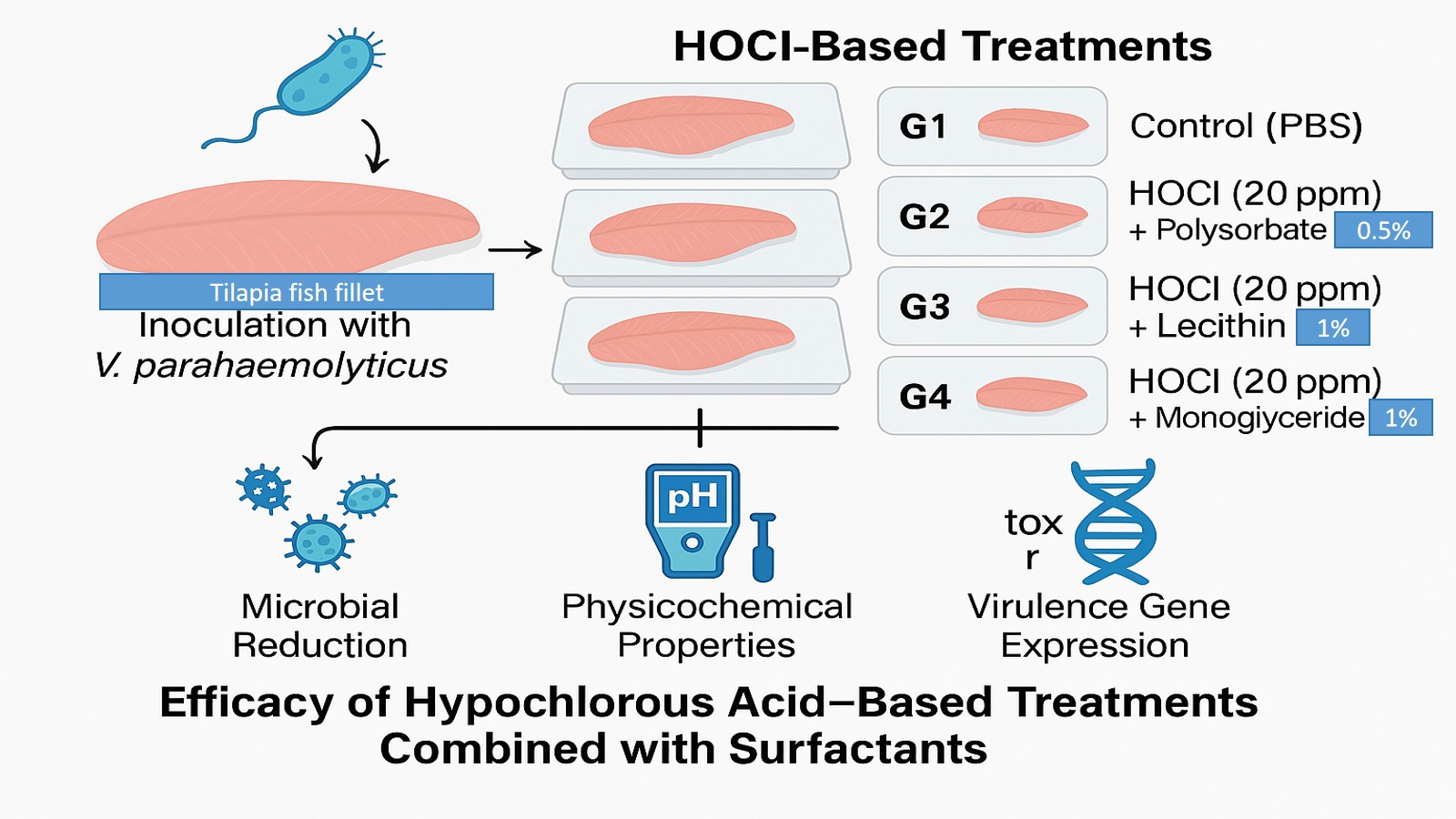
Fig. 1. Graphical presentation of the experimental design.
Investigation of the physicochemical quality parameters of the treated fish fillets
The effects of various HOCl-based treatments on the physicochemical characteristics of fish fillets in all experimental groups (untreated control and each treated group), including pH, EC, TDS, salinity, and residual chlorine levels, were evaluated by homogenization of approximately 5 g of each sample with 20 ml of distilled water. The pH, EC, and salinity were measured using a calibrated digital pH meter equipped with a probe-type electrode (Lovibond Senso Direct) following the methodology described by Lee and Shin (2019). Three replicate measurements were taken for each experimental group, and the average values were calculated. Residual chlorine concentration was determined using the colorimetric-photometric method in which the residual chlorine in the test solution reacts with DPD, producing a color change that is quantified via photometry. This method allows detection within a concentration range of 0.05–4.0 mg/l, as described by Li (2021).
Evaluation of V. parahaemolyticus bacterial count after treatment
The short-term survival of V. parahaemolyticus in tilapia fish fillets was evaluated after exposure to different HOCl-based treatments combined with surfactants at defined contact times (0, 5, 10, and 20 minutes). After treatment, 1 g of fish fillet from each group was aseptically homogenized in 10 ml of sterile physiological saline and subjected to 10-fold serial dilutions. To immediately neutralize residual oxidizing activity, 0.1% (v/v) sodium thiosulfate (Labsynth®, Brazil) was added to each sample immediately after treatment. Subsequently, 0.1 ml aliquots from appropriate dilutions were surface-plated onto TCBS agar and incubated at 30°C for 24 hours for total Vibrio count enumeration.
The effectiveness of each treatment was quantified by calculating the percentage reduction in bacterial counts using the following formula:

where:
- Initial CFUs=colony-forming units per milliliter (CFU/ml) before treatment.
- Final CFU=CFU/ml after treatment.
Gene expression analysis of toxR virulence gene in treated fish fillets
The toxR virulence gene was employed as a key molecular target to evaluate the effects of each treatment on bacterial detection.
Preparation of fillets samples
To ensure stabilization and prevent degradation, RNA was extracted from three tilapia fillets samples in each group using a standardized protocol. Each sample was treated with 1 ml of RNAprotect Bacteria Reagent (Qiagen, Germany) combined with 0.5 ml of bacterial broth and incubated for 5 minutes at room temperature. The mixture was centrifuged at 8000 rpm for 10 minutes, and the supernatant was discarded. The resulting pellet was resuspended in 200 µl of TE: Tris–EDTA buffer buffer containing 1 mg/ml lysozyme (Biochemica, Applichem) to facilitate cell lysis. The QIAamp RNeasy Mini Kit (Qiagen, Germany) was used to perform RNA extraction following the “Enzymatic Lysis of Bacteria” protocol, which included the addition of 700 µl of RLT buffer supplemented with β-mercaptoethanol and 500 µl of absolute ethanol to ensure efficient RNA purification.
Quantitative real-time polymerase chain reaction (qRT-PCR) analysis of toxR gene
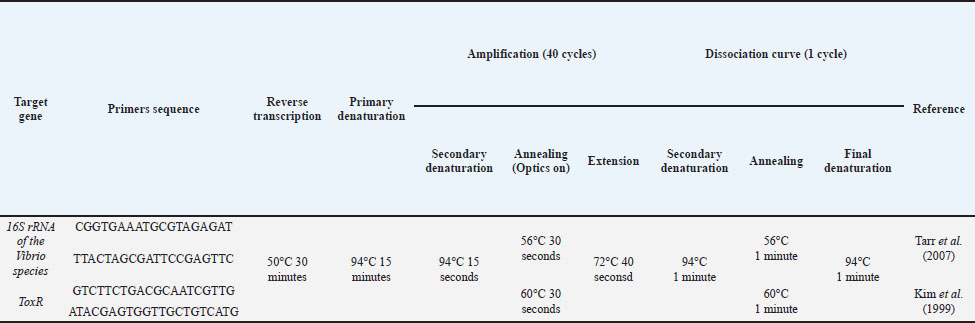
qRT-PCR was conducted to assess gene expression using primers obtained from Metabion (Germany), as listed in Table 2. Each 25 µl reaction mixture contained 12.5 µl of 2× QuantiTect SYBR Green PCR Master Mix (Qiagen, Germany), 0.25 µl of RevertAid Reverse Transcriptase (200 U/µl; Thermo Fisher), 0.5 µl of each primer (20 pmol), 8.25 µl of nuclease-free water, and 3 µl of RNA template. Amplification was performed using a Stratagene MX3005P real-time PCR system under optimized cycling conditions. The amplification curves and Ct values were determined using the Stratagene MX3005P software. To estimate the variation of gene expression on the RNA of the different samples, the Ct of each sample was compared with that of the positive control group according to the “ΔΔCt” method (Yuan et al., 2006) as follows:
Table 2. Sequences of primers, target genes, and cycling conditions for SYBR green RT-PCR.
ΔCt=Ct target − Ct referencee
ΔΔCt=ΔCt treated − ΔCt control.
The 16S rRNA gene was used as an internal reference for normalization because of its stable and constitutive expression across experimental conditions in V. parahaemolyticus. The stability of the 16S rRNA reference gene was assessed by comparing the Ct values across all treatment groups, and no significant variation was observed.
Statistical analysis
Bacterial reduction counts were log₁₀-transformed before analysis to improve normality and homogeneity of variance. Results are presented as mean ± SE. As independent fillets samples were examined at each sampling time, statistical comparisons among treatment groups were performed separately for each time point using one-way analysis of variance. When significant differences were detected, Tukey’s post hoc test was applied to identify differences among means. All microbiological, physicochemical, and gene-expression measurements were conducted in triplicate, and the resulting data were statistically analyzed using the JMP software (SAS Institute Inc., USA). Statistical significance was set at p < 0.05.
Ethical approval
Not required for this study.
Results
Biochemical identification and isolation of V. parahaemolyticus
Vibrio species were detected in fish fillets samples with an overall prevalence of 20.9% (n=23/110), whereas V. parahaemolyticus was highly prevalent (43.5%) (n=10/23). Vibrio parahaemolyticus appeared as smooth and green pin-pointed non-sucrose fermenter colonies on TCBS agar (Fig. 2). Microscopic examination revealed gram-negative, curved rods. All isolates tested positive for oxidase, catalase, gelatin liquefaction, citrate utilization, and indole production, whereas urease and hydrogen sulfide production were negative.
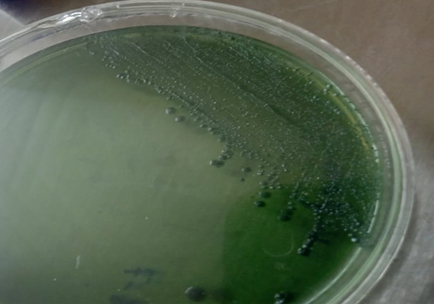
Fig. 2. Pin-pointed green V. parahaemolyticus colonies on TCBS agar.
Molecular identification of V. parahaemolyticus
All biochemically positive Vibrio isolates were initially subjected to PCR targeting the 16S rRNA gene. Successful amplification of a 700 bp product in all samples confirmed the presence of high-quality genomic DNA. Subsequently, species-specific toxR gene PCR assays were performed to identify V. parahaemolyticus, and the amplified bands of selected isolates were detected at 368 bp.
Impact of HOCl-based treatments on fish fillets physicochemical properties
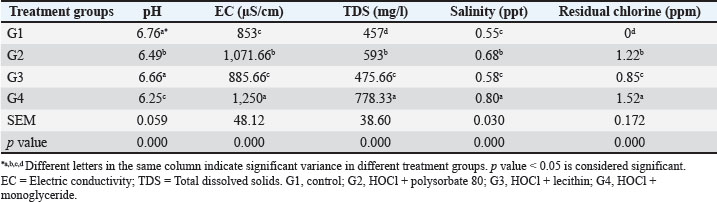
The effects of HOCl-based treatments on the physicochemical properties of fish fillets were evaluated in terms of pH changes. All treated groups (G2, G3, and G4) showed a measurable reduction in pH compared with that of the control group (6.76), indicating mild acidification associated with HOCl exposure. The greatest reduction in pH was observed in the monoglyceride-treated group (G4; pH 6.25). Treatments containing polysorbate 80 (G2) and lecithin (G3) resulted in more moderate decreases in pH (6.49 and 6.60, respectively), consistent with their emulsifying and buffering properties.
The EC and TDSs values increased in all HOCl-treated groups compared with the control, indicating an increase in the ionic content and solubilized constituents following treatment exposure. Fillets treated with polysorbate 80 and lecithin also showed elevated EC and TDS values, although these increases were less pronounced than those observed in the monoglyceride-treated group. Salinity exhibited a comparable trend, with the lowest value recorded in the control group (0.55 ppt) and the highest value observed in the monoglyceride group (0.80 ppt).
As expected, residual chlorine was undetectable in the control group, as expected. Distilled monoglyceride retained the highest chlorine residual (1.5 ppm), followed by polysorbate 80 (1.2 ppm) and lecithin (0.85 ppm). Detailed data are presented in Table 3 and Figure 3.
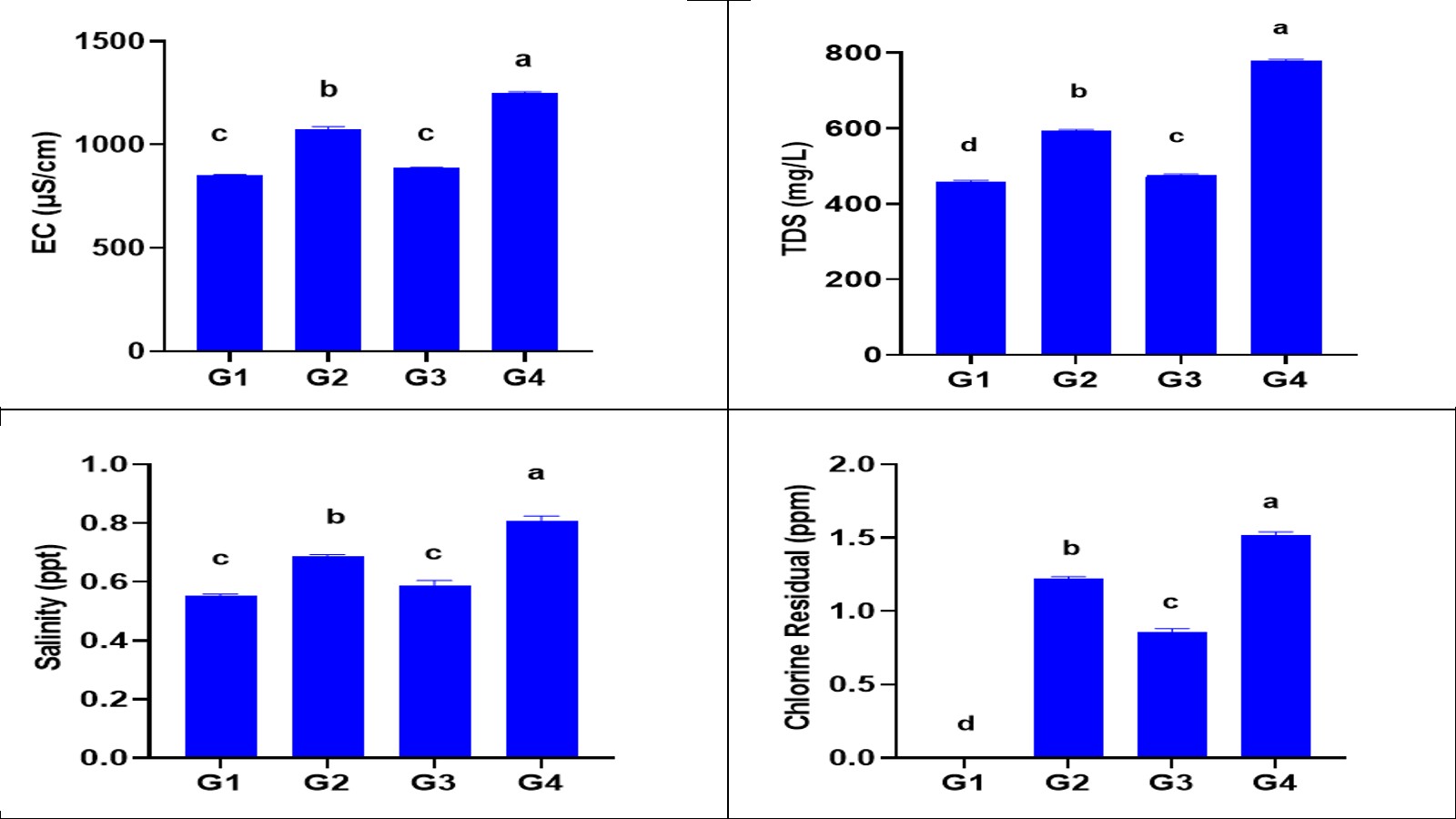
Fig. 3. Effect of HOCl-based treatments on the physicochemical properties of fish fillets in different treatment groups.
Table 3. Effect of HOCl-based treatments on the physicochemical properties of fish fillets.
Impact of HOCl-based treatments on the reduction of V. parahaemolyticus count
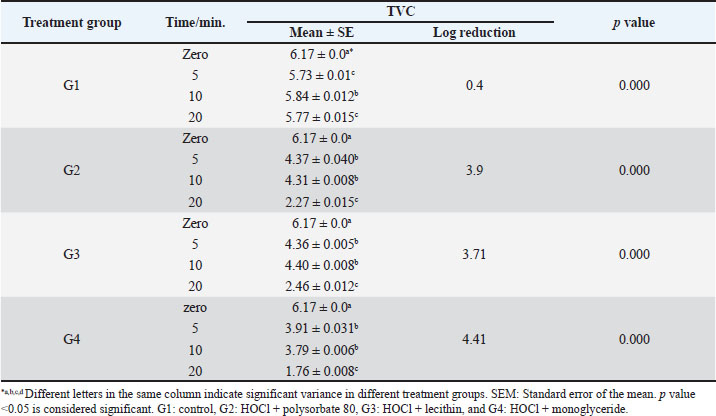
The antimicrobial efficacy of the four treatment groups (G1–G4) was evaluated by monitoring the reduction in total vibrio count (TVC) over time intervals of 0, 5, 10, and 20 minutes. Group 1 (G1), serving as the untreated control, exhibited a minimal reduction in TVC, with a final log reduction of only 0.4 log CFU/g, indicating a negligible antimicrobial impact. In contrast, group 2 (G2), treated with HOCl + polysorbate 80, demonstrated a substantial antimicrobial effect, reducing TVC to 2.27 log CFU/g by 20 minutes, corresponding to a log reduction of 3.9. Group 3 (G3), treated with HOCl + lecithin, showed moderate effectiveness, achieving a final TVC of 2.46 log CFU/g and a log reduction of 3.71. Group 4 (G4), treated with HOCl + monoglyceride, was the most effective, with a decrease in TVC to 1.76 log CFU/g and a log reduction of 4.41 by 20 minutes (Table 4). These reductions were statistically significant and biologically meaningful, indicating strong antimicrobial activity. Figure 4 visually illustrates the downward trends in bacterial counts over time for G2, G3, and G4, with G4 consistently outperforming the other treatments. Error bars represent standard deviations, indicating low variability and supporting the measurement reliability.
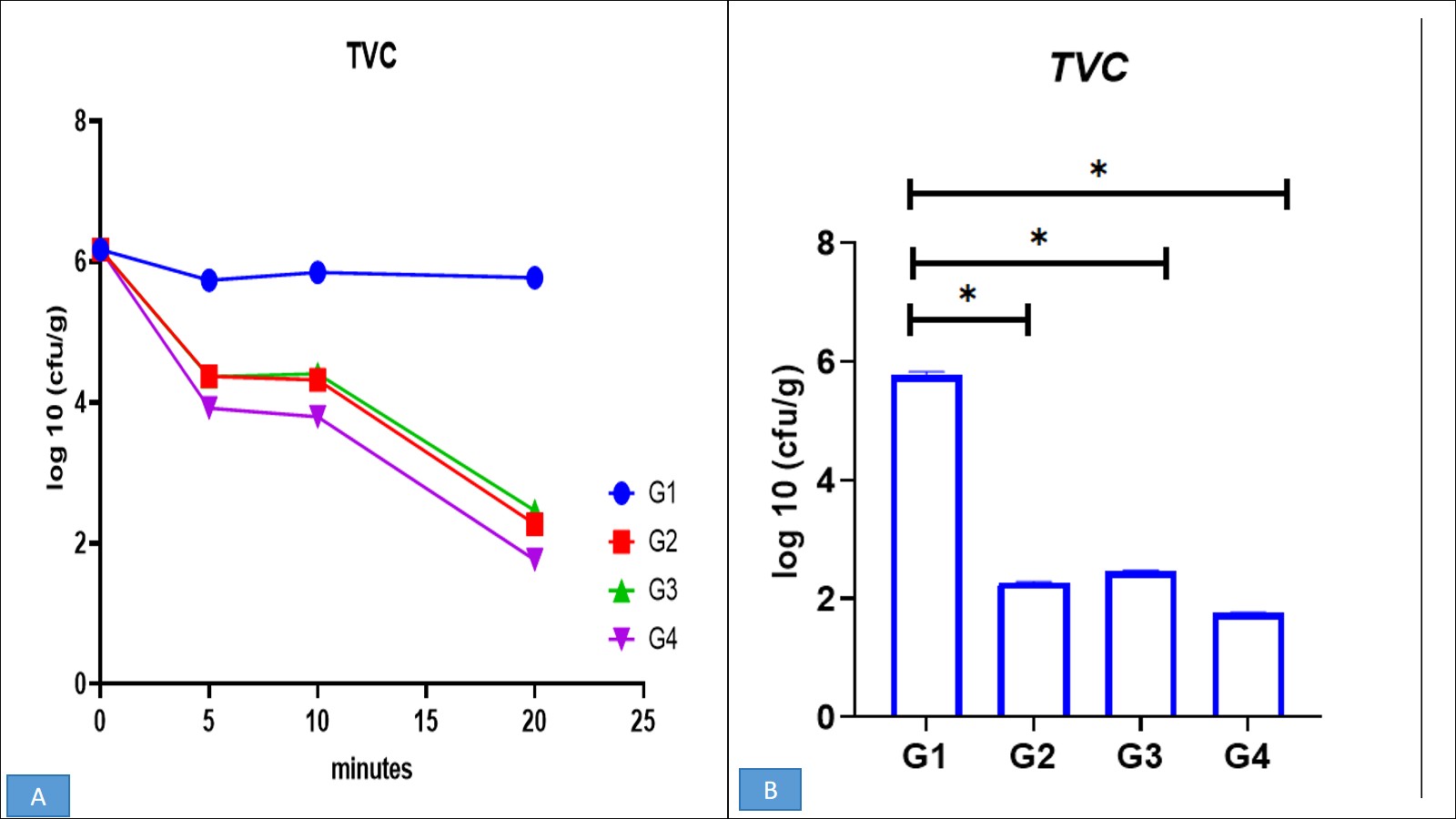
Fig. 4. A) Effect of different treatments (G1–G4) on total vibrio count (TVC) over time (0, 5, 10, and 20 minutes). B) Log vibrio counts over a contact time of 20 minutes for G2, G3, and G4, with error bars indicating SE. G1 shows minimal bacterial reduction, whereas G2, G3, and G4 demonstrate significant decreases in bacterial counts, with G4 being the most effective.
Table 4. Mean total vibrio count (TVC), log reductions, and statistical significance across treatment groups over different contact times.
Gene expression analysis of the toxR virulence gene after treatment
Different HOCl-based treatment combinations significantly influenced the expression of the toxR virulence gene in V. parahaemolyticus in experimentally inoculated tilapia fillets. As shown in Figure 5, quantitative PCR analysis revealed that all treated groups (G2–G4) exhibited reduced toxR expression compared with the untreated control group (G1). The highest level of gene suppression was observed in the HOCl + lecithin group (G3), with toxR expression reduced to 0.1377-fold compared with that in the control group. This was followed by the HOCl + polysorbate 80 group (G2; 0.3660-fold reduction), while the HOCl + distilled monoglyceride group (G4) showed the least reduction (0.7423-fold reduction).
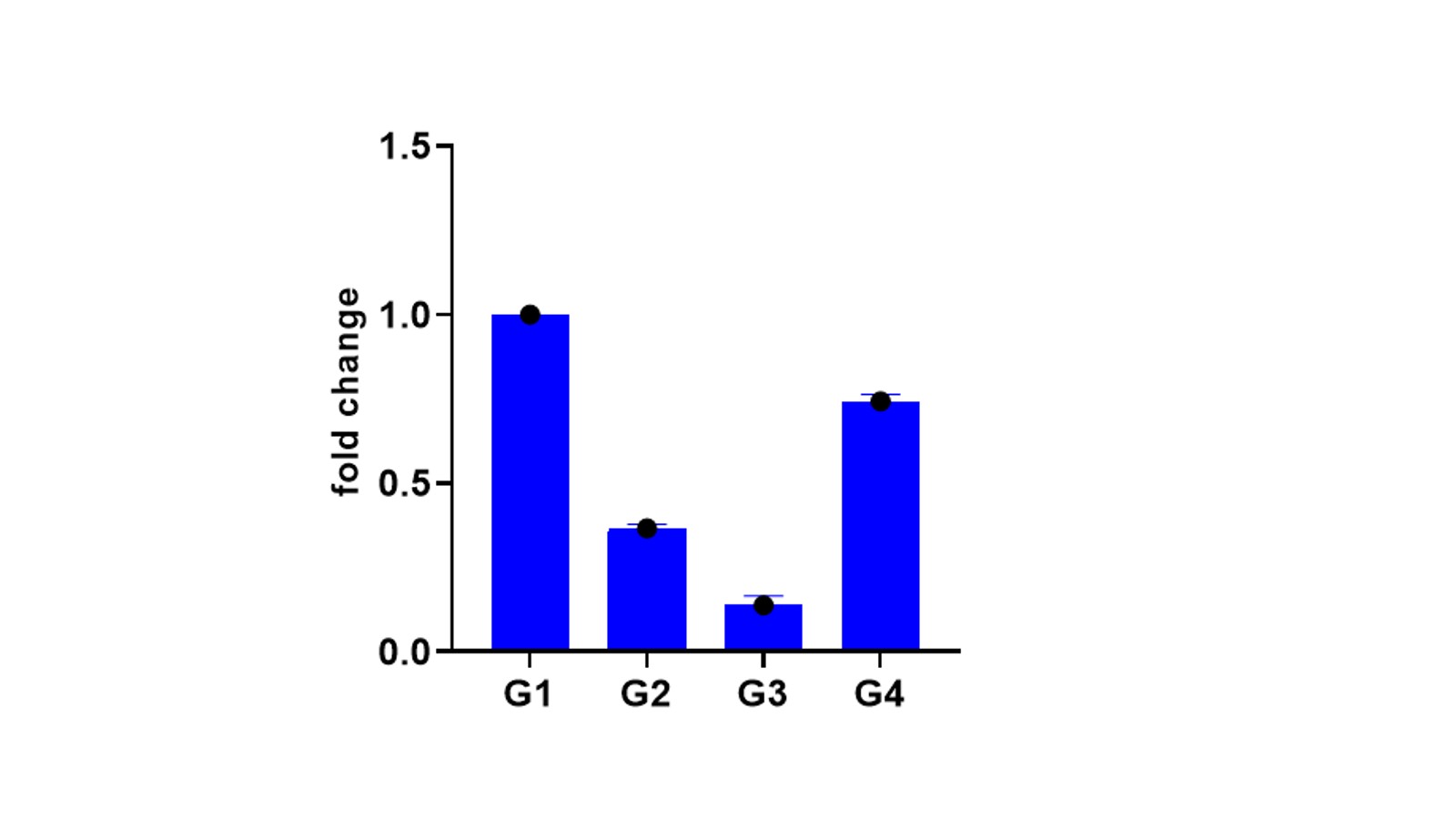
Fig. 5. Expression levels of the toxR gene in different experimental groups (G1–G4). Data are presented as mean ± SEM. *Asterisks show statistical significance (p < 0.05) between the compared groups, as shown by brackets.G1: control; G2: HOCl + polysorbate 80; G3: HOCl + lecithin; G4: HOCl + monoglyceride.
Discussion
HOCl has been widely recognized as an effective antimicrobial agent in food safety and aquaculture applications because of its broad-spectrum activity against pathogenic microorganisms (Lee et al., 2023). However, the current literature provides limited information on the behavior and outcomes of HOCl in combination with surfactants in fish processing systems. Although previous studies have independently investigated the antimicrobial effects of HOCl or the functional roles of surfactants in food matrices, studies evaluating HOCl-surfactant combinations in fish fillets remain scarce, particularly with respect to their physicochemical effects and influence on bacterial virulence factors. In light of these gaps and acknowledging that HOCl alone was not evaluated as a standalone treatment in the present study, this study aimed to assess the effects of HOCl-based treatments combined with lecithin (1%), polysorbate 80 (0.5%), and distilled monoglyceride (1%) on the physicochemical characteristics of Nile tilapia fish fillets. In addition, this study evaluated the short-term antimicrobial activity of these treatment formulations against foodborne V. parahaemolyticus and examined changes in toxR virulence gene expression following treatment exposure relative to that in an untreated control.
Vibrio spp. were detected in 23 fish fillets samples in the present study, with an overall prevalence of 20.9%. Among these isolates, V. parahaemolyticus accounted for 43.5%, indicating its relatively high occurrence in the examined samples. V. parahaemolyticus is a halophilic bacterium that is naturally present in marine and estuarine environments and may contaminate fish fillets during harvesting, handling, or processing (Samarajeewa, 2023). This pathogen is a leading cause of seafood-associated gastroenteritis, and its detection in fish products highlights potential food-safety concerns, particularly when contamination originates from marine environments or inadequately controlled processing conditions. Consequently, the presence of V. parahaemolyticus underscores the importance of implementing appropriate antimicrobial control strategies to reduce microbial load while maintaining the physicochemical quality of seafood products.
Physicochemical assessment of treated tilapia fish fillets revealed significant variations in pH values among the different treatment groups. The control group (G1) exhibited a pH of 6.76, which is within the normal range reported for fresh fish muscle tissue (Gill and Holley, 2004). All HOCl-treated groups showed reduced pH values relative to the control, with the most pronounced decrease observed in G4 (HOCl + distilled monoglyceride; pH 6.25), followed by G2 (HOCl + Polysorbate 80; pH 6.49) and G3 (HOCl + lecithin; pH 6.66). These pH values fall within the range (approximately 6.2–7.0) in which HOCl is known to be chemically stable and predominantly present in its active molecular form (Lee et al., 2023). The observed differences among treatment groups suggest that the type of surfactant used may influence pH conditions during short-term exposure, potentially affecting the treatment environment without implying a direct enhancement of HOCl activity. Previous studies have shown that HOCl exhibits antimicrobial activity across a broad pH range (approximately 4.3–7.0) through oxidative mechanisms (Shane and Swain, 2002), and mildly acidic conditions may contribute to reduced bacterial survival, as many foodborne pathogens are sensitive to lower pH environments (Rahman et al., 2016).
EC values increased in all HOCl treated groups compared with the control, indicating measurable changes in ionic characteristics following treatment exposure. The highest EC was recorded in G4 (HOCl + distilled monoglyceride; 1,250 µS/cm), representing an increase of approximately 47% compared with the control group (G1; 853 µS/cm), followed by G2 (HOCl + polysorbate 80; 1071.66 µS/cm) and G3 (HOCl + lecithin; 885.66 µS/cm). These increases may be associated with elevated ionic strength resulting from HOCl dissociation and the presence of chloride ions in the treatment formulations. Variations among the treated groups indicate that surfactant type influences the extent of EC changes observed during short-term exposure. Oxidizing agents and surfactant-containing systems can affect membrane integrity and ionic distribution (Mokudai et al., 2012).
TDSs and salinity exhibited trends similar to those observed for EC, which is expected given the close relationship among these parameters. The highest TDS and salinity values were recorded in G4 (HOCl + distilled monoglyceride), reaching 778.33 mg/l and 0.80 ppt, respectively, representing increases of approximately 70% (TDS) and 45% (salinity) relative to the control group. Groups G2 and G3 exhibited more moderate increases in both parameters. These differences indicate variations in the accumulation of dissolved ionic constituents following exposure to treatment. The elevated TDS, EC, and salinity values observed in the treated groups may be associated with the presence of dissolved chlorine-related compounds and other ions within the fillets matrix (Cao et al., 2009). However, because HOCl alone was not evaluated in this study, the observed changes should be interpreted as treatment-specific physicochemical responses rather than evidence of enhanced tissue penetration or functional effects on product quality.
Residual chlorine concentrations differed among the treated groups, with the highest level detected in G4 (HOCl + distilled monoglyceride; 1.52 ppm), followed by G2 (HOCl + Polysorbate 80; 1.22 ppm) and G3 (HOCl + lecithin; 0.85 ppm), whereas no residual chlorine was detected in the control group. All measured values were below the maximum allowable limit of 4 ppm established by the US Food and Drug Administration for seafood products, indicating compliance with regulatory safety standards (FDA, 2018). The variation in residual chlorine among the treated groups corresponded with observed differences in physicochemical parameters, indicating that the composition of the formulation may influence chlorine retention and distribution within the fillet matrix. These differences may reflect varying degrees of chlorine association, binding, or neutralization within the tissue environment in the presence of different surfactants.
HOCl is widely recognized for its antimicrobial activity, which has been attributed to its strong oxidizing capacity and ability to damage microbial cellular components (Tsai et al., 2022). HOCl can interact with bacterial cell envelopes and induce oxidative stress that affects membranes, proteins, and nucleic acids due to its small molecular size and neutral charge (Fukuzaki, 2006). Previous studies have shown that electrolytically generated HOCl exhibits concentration-dependent antimicrobial effects across a wide range of microorganisms. Slightly acidic electrolyzed water (SAEW) containing HOCl reduces bacterial loads in both laboratory suspensions and food matrices. For example, Lou et al. (2024) demonstrated that SAEW significantly reduced Shewanella baltica populations in phosphate-buffered saline (up to 3.82 log CFU/ml) and on fish sticks (up to 1.40 log CFU/g). Similarly, Kasai et al. (2001) reported that low concentrations of HOCl (0.21 mg/l) achieved rapid inactivation of V. anguillarum within 1 minute. Collectively, these findings support the established antimicrobial potential of HOCl-based treatments, although differences in efficacy may depend on the concentration, exposure conditions, and application matrices.
As Gram-negative bacteria, Vibrio species are generally susceptible to chlorine-based disinfectants due to the permeability of their outer membranes (Liao et al., 2007). In the present study, reductions in total Vibrio counts followed the order G4 (HOCl + distilled monoglyceride) > G2 (HOCl + Polysorbate 80) > G3 (HOCl + lecithin) > G1 (control), with corresponding log reductions of 4.41, 3.90, 3.71, and 0.40, respectively, after short-term exposure. These reductions indicate that all HOCl-based treatment combinations were effective in lowering bacterial counts relative to the untreated control. Although direct regulatory equivalence cannot be assumed, the observed reductions ranging from 3.71 to 4.41 log CFU/g fall within ranges commonly reported for effective antimicrobial surface treatments used in food applications (FDA, 2019). Differences among the treatment groups demonstrate that formulation composition may influence antimicrobial outcomes. Previous studies have noted that lipid-active or amphiphilic compounds can influence sanitizer performance and microbial susceptibility under certain conditions (Shen et al., 2016; Ramírez Orejel and Cano-Buendía, 2020), but the present study did not directly examine such mechanisms. Collectively, the findings demonstrate that HOCl-based treatment combinations achieved substantial short-term reductions in V. parahaemolyticus on fish fillets under the tested conditions, supporting their potential applicability as decontamination treatments while highlighting the need for further studies incorporating HOCl-only controls and storage evaluations.
The 20-minute exposure duration applied in the present study is consistent with the established disinfection kinetics described by the Chick–Watson model, which emphasizes rapid initial microbial inactivation during the early contact periods. Previous research has demonstrated that a substantial proportion of the bactericidal activity of HOCl occurs within the first 10 minutes of exposure (Cao et al., 2009). Chlorine-based disinfectants, including sodium hypochlorite at concentrations ranging from 50 to 200 ppm, have been reported to achieve reductions of approximately 3–5 log CFU under controlled conditions (Pao et al., 2008). In this context, the log reductions observed for the HOCl-based treatment combinations in the present study (3.71–4.41 log CFU/g) fall within the ranges commonly reported for effective antimicrobial surface interventions in seafood processing. Regulatory agencies, such as the U.S. Food and Drug Administration and the European Food Safety Authority have referenced ≥3–4 log reductions as indicative of meaningful microbial control in seafood and shellfish processing scenarios (EFSA Panel on Biological Hazards (BIOHAZ) Panel, 2013).
The toxR gene is a central transcriptional regulator of several virulence-associated genes in V. parahaemolyticus, including tdh and trh (Makino et al., 2003). In the present study, qRT-PCR analysis revealed differential modulation of toxR expression among the treatment groups compared with the PBS control. Notably, the HOCl + lecithin treatment (G3) exhibited the greatest reduction in toxR transcription (0.1377-fold relative to the control), despite demonstrating intermediate reductions in viable bacterial counts. In contrast, the HOCl + polysorbate 80 and HOCl + distilled monoglyceride treatments resulted in more moderate decreases in the expression of toxR. These findings indicate that bacterial viability and virulence gene transcription may respond differently to short-term treatment exposure, consistent with previous observations that stress responses and virulence regulation can be partially uncoupled in Vibrio spp. (Reen et al., 2006).
Although reduced toxR transcription has been associated with attenuated virulence phenotypes in V. parahaemolyticus (Lin et al., 1993), the present results are limited to gene expression data and do not directly demonstrate changes in virulence at the protein or functional level. The results of this study indicate that the different HOCl-based treatment formulations were associated with varying effects on the viability and expression of toxR in V. parahaemolyticus. The HOCl + distilled monoglyceride treatment (G4) produced the greatest reduction in bacterial counts, whereas the HOCl + lecithin treatment (G3) resulted in comparatively lower reductions in viable cells while demonstrating the greatest suppression of toxR transcription. These findings demonstrate that reductions in bacterial viability and modulation of virulence-associated gene expression represent distinct responses to treatment exposure rather than directly coupled outcomes. The differences observed among the treatment groups may reflect treatment-specific interactions with bacterial cells.
Statistically significant differences in toxR and 16S rRNA Ct values (p < 0.001) were observed among the treatment groups, indicating measurable transcriptional responses following exposure to the tested formulations. Differences in toxR expression relative to the PBS control suggest that HOCl-based treatments incorporating lipid-containing components are associated with the modulation of virulence-related gene transcription, with the HOCl + lecithin treatment showing the greatest reduction in toxR expression under the conditions examined. However, the underlying mechanisms responsible for these transcriptional changes cannot be determined because the analysis was limited to mRNA levels, and no protein level or functional assays were performed. The use of 16S rRNA as a reference gene enabled normalization of target gene expression; nevertheless, observed variations in Ct values across treatments may also reflect broader transcriptional responses to ASM rather than changes specific to virulence regulation (Huggett et al., 2005). Although the suppression of virulence-associated gene expression has been proposed as a complementary approach to microbial reduction in food safety contexts (Clatworthy et al., 2007), the present findings should be interpreted with caution. The differential transcriptional responses observed among treatment formulations indicate that short-term antimicrobial exposure may not uniformly affect bacterial viability and virulence gene expression. Further studies incorporating HOCl-only controls, protein-level validation, and functional virulence assays are required to clarify the biological relevance of these observations and their potential implications for food safety risk assessment (FAO/WHO, 2011).
The present study was not specifically designed to evaluate sensory attributes; therefore, only general visual and olfactory observations were made following treatment. No obvious changes in color, odor, or overall appearance of the tilapia fillets were noted after 20 minutes of exposure, indicating that the applied concentration and contact time did not result in visibly detectable sensory alterations under the experimental conditions. However, no formal sensory analysis or quality assessment was conducted; therefore, definitive conclusions regarding sensory quality cannot be drawn. Although HOCl treatment may be associated with reduced drip loss and maintenance of certain quality indices during storage (Chung et al., 2024), such effects were not evaluated in the present study.
Despite the antimicrobial activity observed under the experimental conditions, the present study has several limitations. The investigation focused exclusively on short exposure periods (0–20 minutes), which restricted the evaluation of long-term microbial behavior, including potential regrowth, persistence, and survival during storage. In addition, this study was conducted using experimentally treated fish fillets and did not assess naturally contaminated samples or complex microbial communities. Such conditions may influence HOCl performance due to the presence of higher organic loads and interactions among competing microorganisms. Consequently, the findings may not fully represent microbial dynamics in commercial processing or storage environments. Future studies should therefore incorporate fieldscale trials under realistic processing conditions, including naturally contaminated fillets, mixed microbiota, and extended storage periods, to better assess the practical performance, scalability, and industrial relevance of HOCl-based treatment formulations.
Conclusion
This study reports the presence of Vibrio spp. in Nile tilapia fish fillets collected from Egyptian markets. Among the isolates, V. parahaemolyticus was the most frequently detected species. The application of HOCl made with different surfactants resulted in observable reductions in Vibrio counts and measurable alterations in selected physicochemical parameters compared with the untreated control. Among the tested formulations, the HOCl + distilled monoglyceride treatment was associated with the greatest reduction in total Vibrio counts (4.41 log CFU/g) and more pronounced changes in pH and ionic-related parameters, whereas the HOCl + lecithin formulation showed the greatest reduction in toxR virulence gene expression under the experimental conditions. These findings indicate that short-term exposure to HOCl-based treatments combined with different surfactants can produce distinct microbiological and physicochemical responses. However, while the observed reductions suggest the potential applicability of HOCl-based formulations as decontamination treatments for fish fillets, additional studies incorporating appropriate controls and storage-based evaluations are required because an HOCl-only treatment group was not included.
Acknowledgments
Not included.
Conflict of interest
The authors declare no competing interests.
Funding
This work did not receive any external funding.
Authors’ contributions
Khalid Tolba: Conceptualization, Methodology, Investigation, and Validation. Amani Abd El Latif Mosleh: Data curation, supervision, original draft writing, review, and editing. Hanan S. Khalefa: Conceptualization, methodology, validation, data curation, supervision, original draft writing, review, and editing. Dalia A. Abdel-Moneam: Conceptualization, Methodology, Validation, Data curation, Supervision, Original Draft Writing, Review & Editing. Dina Ismail El Zahaby: Methodology and writing of the original draft. Rescreen Zakaria Eleiwa: Methodology, writing, and original draft. Nada M. El-Kabany: Methodology, writing, original draft, review, and editing.
Data availability
All relevant data are included in the manuscript.
References
Abdelaziz, M., Ibrahem, M.D., Ibrahim, M.A., Abu-Elala, N.M. and Abdel-Moneam, D.A. 2017. Monitoring of different Vibrio species affecting marine fishes in Lake Qarun and Gulf of Suez: phenotypic and molecular characterization. Egypt. J. Aquat. Res. 43(2), 141–146.
Abdel-Moneam, D.A., Ibrahim, R.A., Nashaat, M. and Shaalan, M. 2021. Multifactorial causes of mass mortality in Oreochromis niloticus in Kafr El-Sheikh, Egypt. Bull. Eur. Assoc. Fish. Pathol. 41(1), 41.
Abdelsalam, M., Ewiss, M.A.Z., Khalefa, H.S., Mahmoud, M.A., Elgendy, M.Y. and Abdel-Moneam, D.A. 2021. Coinfections of Aeromonas spp., Enterococcus faecalis, and Vibrio alginolyticus isolated from farmed Nile tilapia and African catfish in Egypt, with an emphasis on poor water quality. Microb. Pathog. 160, 105213; doi:10.1016/j.micpath.2021.105213
Campbell, V.M., Chouljenko, A. and Hall, S.G. 2022. Depuration of live oysters to reduce Vibrio parahaemolyticus and Vibrio vulnificus: a review of ecology and processing parameters. Compr. Rev. Food. Sci. Food. Saf. 21(4), 3480–3506; doi:10.1111/1541-4337.12991
Cao, W., Zhu, Z.W., Shi, Z.X., Wang, C.Y. and Li, B.M. 2009. Efficiency of slightly acidic electrolyzed water for inactivation of Salmonella enteritidis and its contaminated shell eggs. Int. J. Food Microbiol. 130(2), 88–93; doi:10.1016/j.ijfoodmicro.2008.12.021
Childers, B.M. and Klose, K.E. 2007. Regulation of virulence in Vibrio cholerae: the ToxR regulon. Future. Microbiol. 2(3), 335–344; doi:10.2217/17460913.2.3.335
Chung, W.H., Chaklader, M.R. and Howieson, J. 2024. Efficacy evaluation of chlorine dioxide and hypochlorous acid as sanitations on quality and shelf life of Atlantic salmon (Salmo salar) fillets. Foods 13(19), 3156; doi:10.3390/foods13193156
Clatworthy, A.E., Pierson, E. and Hung, D.T. 2007. Targeting virulence: a new paradigm for antimicrobial therapy. Nat. Chem. Biol. 3(9), 541–548; doi:10.1038/nchembio.2007.24
Deborde, M. and Von Gunten, U. 2008. Reactions of chlorine with inorganic and organic compounds during water treatment—kinetics and mechanisms: a critical review. Water. Res. 42(1), 13–51; doi:10.1016/j.watres.2007.07.025
EFSA Panel on Biological Hazards (BIOHAZ) Panel. 2013. Scientific opinion on the risk posed by pathogens in food of non-animal origin. Part 1 (outbreak data analysis and risk ranking of food/pathogen combinations). EFSA. J. 11(1), 3025; doi:10.2903/j.efsa.2013.3025
FAO/WHO [Food and Agriculture Organization of the United Nations/World Health Organization]. 2011. Risk assessment of Vibrio parahaemolyticus in seafood: Interpretative summary and Technical report. Microbiological Risk Assessment Series No. 16. Rome, p: 193.
FDA. 2018. Food additives permitted for direct addition to food for human consumption. Code of Federal Regulations, 21 CFR Part 173. Washington, D.C: Food and Drug Administration (FDA).
FDA. 2019. Hazards of fish and fishery products and control guidance, 4th ed. U.S. Food and Drug Administration.
Fukuzaki, S. 2006. Mechanisms of actions of sodium hypochlorite in cleaning and disinfection processes. Biocontrol Sci. 11(4), 147–157; doi:10.4265/bio.11.147
Gill, A.O. and Holley, R.A. 2004. Mechanisms of bactericidal action of cinnamaldehyde against Listeria monocytogenes and of eugenol against L. monocytogenes and Lactobacillus sakei. Appl. Environ. Microbiol. 70(10), 5750–5755; doi:10.1128/AEM.70.10.5750-5755.2004
Hua, K., Cobcroft, J.M., Cole, A., Condon, K., Jerry, D.R., Mangott, A., Praeger, C., Vucko, M.J., Zeng, C., Zenger, K. and Strugnell, J.M. 2019. The future of aquatic protein: implications for protein sources in aquaculture diets. One Earth 1(3), 316–329; doi:10.1016/j.oneear.2019.10.018
Huggett, J., Dheda, K., Bustin, S. and Zumla, A. 2005. Real-time RT-PCR normalization; strategies and considerations. Genes Immune. 6(4), 279–284; doi:10.1038/sj.gene.6364190
Jackman, J.A., Lavergne, T.A. and Elrod, C.C. 2022. Antimicrobial monoglycerides for swine and poultry applications. Front. Anim. Sci. 3(1019320), 1019320; doi:10.3389/fanim.2022.1019320
Kasai, H., Watanabe, K. and Yoshimizu, M. 2001. Disinfectant effects of hypochlorite produced by batch electrolytic system on fish pathogenic bacteria and virus. Aquacult. Sci. 49(2), 237–241; doi:10.11233/aquaculturesci1953.49.237
Khalefa, H.S., Abdel-Moneam, D.A, Ismael, E., Mostafa Fathy Waziry, M., Samir Gaber Ali, M. and M. Zaki, M. 2021. The effect of alterations in water quality parameters on the occurrence of bacterial diseases in different aquatic environments. Adv. Anim. Vet. Sci. 9(12), 2084–2094.
Khalefa, H.S., Arafa, A.A., Hamza, D., El-Razik, K.A.A. and Ahmed, Z. 2025. Emerging biofilm formation and disinfectant susceptibility of ESBL-producing Klebsiella pneumoniae. Sci. Rep. 15(1), 1599; doi:10.1038/s41598-024-84149-x
Kim, Y.B., Okuda, J., Matsumoto, C., Takahashi, N., Hashimoto, S. and Nishibuchi, M. 1999. Identification of Vibrio parahaemolyticus strains at the species level by PCR targeted to the toxR gene. J. Clin. Microbiol. 37(4), 1173–1177; doi:10.1128/JCM.37.4.1173-1177.1999
Lee, J., Kim, J., Kim, K. and Yoon, Y. 2023. Disinfection effects and disinfection by-products generation characteristics of a continuous hypochlorous acid water producing device using citric acid as a pH control agent. Environ. Anal. Health Toxicol. 26(3), 110–117; doi:10.36278/jeaht.26.3.110
Lee, E.J. and Shin, H.S. 2019. Development of a freshness indicator for monitoring the quality of beef during storage. Food Sci. Biotechnol. 28(6), 1899.
Li, P. 2021. Concise review on residual chlorine measurement: interferences and possible solutions. J. Clean. Prod. 323, 129119; doi:10.1016/j.jclepro.2021.129119
Liao, L.B., Chen, W.M. and Xiao, X.M. 2007. The generation and inactivation mechanism of oxidation-reduction potential of electrolyzed oxidizing water. J. Food Eng. 78(4), 1326–1332; doi:10.1016/j.jfoodeng.2006.01.004
Lin, Z., Kumagai, K., Baba, K., Mekalanos, J.J. and Nishibuchi, M. 1993. Vibrio parahaemolyticus has a homolog of the Vibrio cholerae toxRS operon that mediates environmentally induced regulation of the thermostable direct hemolysin gene. J. Bacteriol. 175(12), 3844–3855; doi:10.1128/jb.175.12.3844-3855.1993
Lou, X., Shu, W., Wang, Y., Guo, C., Liu, H. and Yang, H. 2024. Effect of slightly acidic electrolyzed water against Shewanella baltica in phosphate-buffered saline and on golden pomfret sticks. Food Control 156, 11013; doi:10.1016/j.foodcont.2023.110131
Luthman, O., Robb, D.H.F., Henriksson, P.J.G., Jørgensen, P.S. and Troell, M. 2024. Global overview of national regulations for antibiotic use in aquaculture production. Aquac. Int. 32, 9253–9270; doi:10.1007/s10499-024-01614-0
Makino, K., Oshima, K., Kurokawa, K., Yokoyama, K., Uda, T., Tagomori, K. and Hattori, M. 2003. Genome sequence of Vibrio parahaemolyticus: a pathogenic mechanism distinct from that of V. cholerae. Lancet 361(9359), 743–749; doi:10.1016/S0140-6736(03)12659-1
Mishra, A., Kim, H.S., Kumar, R. and Srivastava, V. 2024. Advances in Vibrio-related infection management: an integrated technology approach for aquaculture and human health. Crit. Rev. Biotechnol. 44(8), 1610–1637; doi:10.1080/07388551.2024.2336526
Mokudai, T., Nakamura, K., Kanno, T. and Niwano, Y. 2012. Presence of hydrogen peroxide, a source of hydroxyl radicals, in acid-electrolyzed water. PLoS One 7(9), e46392; doi:10.1371/journal.pone.0046392
Montieri, S., Suffredini, E., Ciccozzi, M. and Croci, L. 2010. Phylogenetic and evolutionary analysis of V. parahaemolyticus and V. alginolyticus isolates based on the toxR gene sequence. New. Microbiol. 33, 359–372.
Mosleh, A., El-Bialy, A., El-Zahaby, D., El-Saadany, A., Anter, A. and Khalefa, H. 2025. Efficacy of copper sulfate and potassium permanganate in reducing bacterial infection and mortality in polycultured farmed fish at El-Menoufia, Egypt: a microbiological and environmental analysis. Iraqi. J. Vet. Sci. 39(4), 735–746.
Odeyemi, O.A. 2016. Incidence and prevalence of Vibrio parahaemolyticus in seafood: a systematic review and meta-analysis. SpringerPlus 5, 1364; doi:10.1186/s40064-016-2115-7
Pao, S., Ettinger, M.R., Khalid, M.F., Reid, A.O. and Nerrie, B.L. 2008. Microbial quality of raw aquacultured fish fillets procured from Internet and local retail markets. J. Food. Prot. 71(8), 1544–1549; doi:10.4315/0362-028x-71.8.1544
Rahman, S.M., Khan, I. and Oh, D.H. 2016. Electrolyzed water as a novel sanitizer in the food industry: current trends and future perspectives. Compr. Rev. Food Sci. Food Saf. 15(3), 471–490; doi:10.1111/1541-4337.12200
Ramírez Orejel, J.C. and Cano-Buendía, J.A. 2020. Applications of electrolyzed water as a sanitizer in the food and animal-by-products industry. Processes 8, 534; doi:10.3390/pr8050534
Reen, F.J., Almagro-Moreno, S., Ussery, D. and Boyd, E.F. 2006. The genomic code: inferring Vibrionaceae niche specialization. Nat. Rev. Microbiol. 4(9), 697–704; doi:10.1038/nrmicro1476
Reverter, M., Sarter, S., Caruso, D., Avarre, J.C., Combe, M., Pepey, E., Pouyaud, L., Vega-Heredía, S., De Verdal, H. and Gozlan, R.E. 2020. Aquaculture at the crossroads of global warming and antimicrobial resistance. Nat. Commun. 11, 1870; doi:10.1038/s41467-020-15735-6
Rosen, M.J. and Kunjappu, J.T. 2012. Surfactants and interfacial phenomena, 4th ed. New York, NY: John Wiley & Sons Ltd; doi:10.1002/9781118228920
Rowe, R.C., Sheskey, P.J. and Quinn. 2009. Handbook of pharmaceutical excipients, 6th ed. London, Chicago, Washington, DC: Pharmaceutical Press; American Pharmacists Association.
Samarajeewa, U. 2023. Emerging challenges in maintaining marine food‐fish availability and food safety. Compr. Rev. Food Sci. Food Saf. 22(6), 4734–4757.
Sathiyamoorthi, E., Lee, J.H. and Lee, J. 2024. Antibacterial and antibiofilm activity of halogenated phenylboronic acids against Vibrio parahaemolyticus and Vibrio harveyi. Front. Cell. Infect. Microbiol. 14, 1340910; doi:10.3389/fcimb.2024.1340910
Shane, T.J. and Swain, H. 2002. Pressurized solution feed system for introducing hypochlorous acid to a fluid stream (U.S. Patent). Alexandria, VA: United States Patent and Trademark Office.
Sharma, R. 2014. Surfactants: basics and versatility in food industries. PharmaTutor Mag. 2(3), 17–29.
Shen, C., Norris, P., Williams, O., Hagan, S. and Li, K. 2016. Generation of chlorine by-products in simulated wash water. Food. Chem. 190(1), 97–102; doi:10.1016/j.foodchem.2015.04.146
Szabó, R.T., Kovács-Weber, M., Zimborán., Kovács, L. and Erdélyi, M. 2023. Effects of short- and medium-chain fatty acids on production, meat quality, and microbial attributes-a review. Molecules (Basel. Switzerland) 28(13), 4956; doi:10.3390/molecules28134956
Tarr, C.L., Patel, J.S., Puhr, N.D., Sowers, E.G., Bopp, C.A. and Strockbine, N.A. 2007. Identification of Vibrio isolates by a multiplex PCR assay and rpoB sequence determination. J. Clin. Microbiol. 45(1), 134–140; doi:10.1128/JCM.01544-06
Triga, A., Issa, Z.A., Smyrli, M., Fenske, L. and Katharios, P. 2024. Virulence and pangenome analysis of Vibrio harveyi strains from Greek and Red Sea marine aquaculture. Aquaculture 587, 740839; doi:10.1016/j.aquaculture.2024.740839
Tsai, S.Y., Liu, Y.M., Lin, Z.W. and Lin, C.P. 2022. Antimicrobial activity effects of electrolytically generated hypochlorous acid-treated pathogenic microorganisms by isothermal kinetic simulation. J. Therm. Anal. Calorim. 148(4), 1613–1627; doi:10.1007/s10973-022-11727-4
Veasey, S. and Muriana, P. 2016. Evaluation of electrolytically-generated hypochlorous acid (‘electrolyzed water’) for sanitation of meat and meat-contact surfaces. Foods 5(2), 42.
Wang, R., Zhong, Y., Gu, X., Yuan, J., Saeed, A.F.U.H. and Wang, S. 2015. The pathogenesis, detection, and prevention of Vibrio parahaemolyticus. Front. Microbiol. 6, 144; doi:10.3389/fmicb.2015.00144
Yeh, S.P., Hsia, L.F. and Liu, C.H. 2013. Usage of electrolytic water system in the giant freshwater prawn, Macrobachium rosenbergii (De Man) larval hatchery system. Aqua. Res. 44(5), 713–727.
Yuan, J.S., Reed, A., Chen, F. and Stewart, C.N. 2006. Statistical analysis of real-time PCR data. BMC. Bioinf. 7, 85; doi:10.1186/1471-2105-7-85