




| Case Report | ||
Open Vet. J.. 2026; 16(6): 4089-4097 Open Veterinary Journal, (2026), Vol. 16(6): 4089-4097 Case Report Equine placental extract supplementation in six elderly dogs with cognitive dysfunction: A six-case seriesMami Irimajiri1†, Kentarou Tahara2† and Eiichi Hirano2*1Department of Veterinary Medicine, Faculty of Agriculture, Tokyo University of Agriculture and Technology, Advanced Research Center for One Welfare, Tokyo, Japan 2Medical Affairs Department, Japan Bio Products Co., Ltd., Tokyo, Japan *Corresponding Author: Eiichi Hirano. Medical Affairs Department, Japan Bio Products Co., Ltd, Tokyo, Japan. Submitted: 19/01/2026 Revised: 11/04/2026 Accepted: 23/04/2026 Published: 30/06/2026 © 2025 Open Veterinary Journal
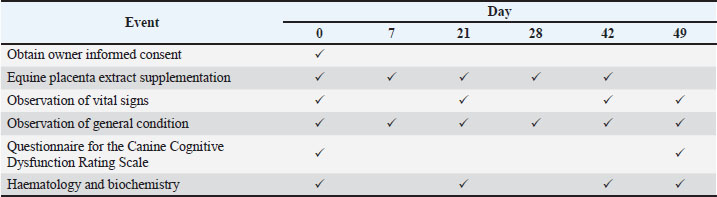
AbstractBackground: Canine cognitive dysfunction is a common age-related neurodegenerative condition in elderly dogs with limited effective treatment options. Equine placental extract (eqPE) has gained traction as a potential nutraceutical intervention to improve cognitive function. Case Description: Six client-owned dogs aged ≥10 years with a Canine Cognitive Dysfunction Rating Scale (CCDR) score of ≥50 received eqPE orally for 4 weeks (2 ml/day for dogs <10 kg; 4 ml/day for dogs ≥10 kg and <20 kg). Cognitive function was evaluated using CCDR at baseline and on day 49. Secondary assessments included vital signs, veterinarian- and owner-reported clinical scores, and laboratory parameters at predefined time points. Five of the 6 dogs exhibited a reduction in CCDR scores on day 49 compared with baseline. The vital signs and laboratory parameters remained stable throughout the study, and no serious adverse events were reported. Minor fluctuations were noted in the owner- and veterinarian-reported clinical scores. Conclusion: In this descriptive case series of 6 elderly dogs with cognitive dysfunction, eqPE supplementation was associated with lower CCDR scores in most dogs and was well tolerated. However, causal relationships cannot be established due to the uncontrolled study design. These preliminary findings suggest that eqPE supplementation may represent a potentially feasible supportive approach, although further controlled studies are required to clarify its effects. Keywords: Canine cognitive dysfunction; Case series; Cognitive function; Elderly dogs; Equine placental extract; Nutraceutical. IntroductionCertain physiological and morphological changes occur as a result of aging in dogs (Cilek and Kavak, 2012). Canine cognitive dysfunction (CCD) is a naturally occurring age-related neurodegenerative condition that commonly affects geriatric dogs. Furthermore, it has been increasingly recognised as a substantial health concern in aging canine populations (Blanchard et al., 2025; Landsberg et al., 2012; Haake et al., 2023; Alsulami et al., 2025). The prevalence of CCD and its impact on the quality of life have become more prominent in clinical practice (Osella et al., 2007; Fast et al., 2013; Blanchard et al., 2025), with the average lifespan of companion dogs increasing in recent decades. Canine cognitive dysfunction currently has no definitive cure, and available pharmacologic and non-pharmacologic treatments remain limited. Although selegiline is the only approved pharmacological option in some regions, and various supplements and enriched diets have been investigated, evidence supporting their consistent efficacy remains variable and inconclusive (Landsberg et al., 2012; Taylor et al., 2023; Blanchard et al., 2025; Simon et al., 2025). Additionally, there is growing interest in assessing novel therapeutic and nutraceutical approaches to support cognitive health in aged dogs (Haake et al., 2023; Alsulami et al., 2025). The Canine Cognitive Dysfunction Rating Scale (CCDR) is a validated owner-completed questionnaire widely used in clinical and research settings to evaluate cognitive dysfunction in aging dogs. The scale comprises 13 behavioural items and categorises dogs as normal, at-risk, or cognitively impaired. The CCDR has been compared with other validated assessment tools, including the Canine Dementia Scale and the Canine Cognitive Assessment Scale (Salvin et al., 2011; Madari et al., 2015; Ciurli et al., 2023; Haake et al., 2024). These behavioural assessment tools reflect underlying neuropathological changes associated with CCD, which share several features with age-related neurodegenerative processes described in both canine and human studies (Araujo et al., 2005; Vite and Head, 2014). Selegiline has been approved for managing certain clinical manifestations. However, the optimal therapeutic strategies remain uncertain, and evidence supporting supplemental or dietary interventions is inconclusive (Kim and Hao, 2025; Simon et al., 2025; Vitturini et al., 2025). Moreover, despite the widespread prevalence of CCD, universally accepted guidelines for its diagnosis and management are absent, and the variability in treatment approaches among veterinarians poses an additional difficulty. These limitations underscore the need for novel, safe, and practical management options for CCD (Taylor et al., 2023; Simon et al., 2025). Equine placental extract (eqPE) has gained traction as a biologically active supplement with potential benefits for age-related dysfunction. In a small clinical case report, eqPE supplementation in dogs diagnosed with CCD was linked to enhancements in night barking and behavioural signs without reported adverse events. This suggests its potential use in managing age-related cognitive and behavioural alterations in elderly dogs (Amano et al., 2022). Preclinical studies further support the neurobiological effects of placental extracts: in rodent models, placental extract treatment improved neurogenesis and ameliorated amyloid β–associated memory deficits, and porcine placental extract enhanced learning and memory in aged mice (Yamauchi et al., 2019; De Toledo et al., 2021). Although the underlying mechanisms remain to be completely elucidated, these results provide a rationale for further examination of eqPE as an adjunct approach to support cognitive function in dogs with CCD. This case series aimed to describe the clinical course and changes in cognitive function scores in six elderly dogs with cognitive dysfunction receiving equine placental extract supplementation for 49 days. Case DetailsCase overview and selection criteriaThis case series was prepared in accordance with the CARE (CAse REport) guidelines for reporting case reports and case series. This study included 6 client-owned dogs aged ≥10 years with a CCDR score ≥50, diagnosed with cognitive dysfunction based on owner interviews and clinical evaluation by veterinarians. Between November 8, 2023 and July 1, 2024, the dogs were presented to Takahashi Animal Hospital (Osaka, Japan), Izumi Dog and Cat Clinic (Kanagawa, Japan), Hiroo no Mori Animal Hospital (Tokyo, Japan), Kitano Animal Hospital (Hyogo, Japan), Hitachinohigashi Animal Clinic (Ibaraki, Japan), and Minase Animal Hospital (Kyoto, Japan). Intervention and evaluationFollowing baseline assessment (day 0), dogs received eqPE supplementation for 4 weeks. The supplement was administered orally at a dose of 2 ml daily for dogs weighing <10 kg and 4 ml daily for dogs weighing ≥10 kg but <20 kg. The supplementation period was preceded by a baseline observation phase and followed by a post-supplementation follow-up, with clinical monitoring conducted over a total study period of 49 days. Cognitive function was evaluated using the CCDR at baseline (day 0) and on day 49 (Table 1). Secondary clinical assessments, including vital signs, veterinarian-reported clinical scores, hematological parameters, serum biochemical parameters, and oxidative stress-related parameters, were evaluated at baseline and on days 21, 42, and 49. These parameters were included primarily to monitor general health status and safety during supplementation rather than as direct indicators of cognitive improvement. Owner-reported clinical scores were recorded at baseline and on days 7, 21, 28, 42, and 49 (Table 1). Haematological, serum biochemical, and oxidative stress-related parameters were analysed using standard automated analysers in a commercial laboratory. All results are presented as median (interquartile range). No formal statistical analyses were performed due to the small sample size (n=6), and all results are presented descriptively without inferential statistical testing. The number of observations for each parameter is indicated in the corresponding tables. Minor variations in sample size occurred because some measurements were unavailable at certain time points. Table 1. Schedule of events.
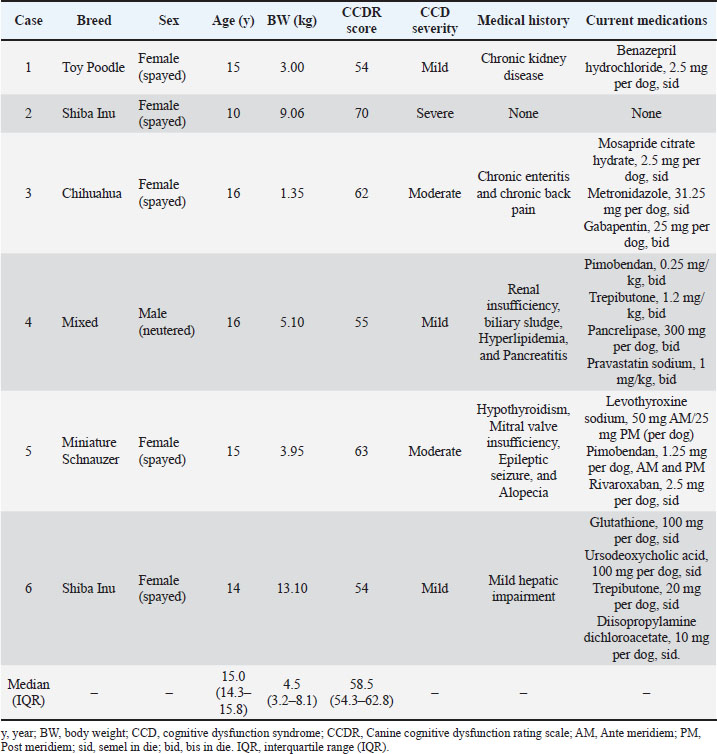
Baseline characteristicsTable 2 summarises the baseline characteristics and CCDR severity (scores). One dog was of a mixed breed, and 5 belonged to 4 distinct breeds. The population consisted of one male (neutered) and 5 females (spayed). The median age of the dogs was 15.0 (range: 14.3–15.8) years. The median weight of the dogs was 4.5 kg (range: 3.2–8.1 kg). The median CCDR score was 58.5 (range: 54.3–62.8). The CCD severity was categorised as mild in 3 animals, moderate in 2, and severe in one. A historical account of this condition has been documented for 5 animals. Five dogs were administered concurrent medications at baseline. Table 2. Baseline characteristics of the six dogs included in this case series.
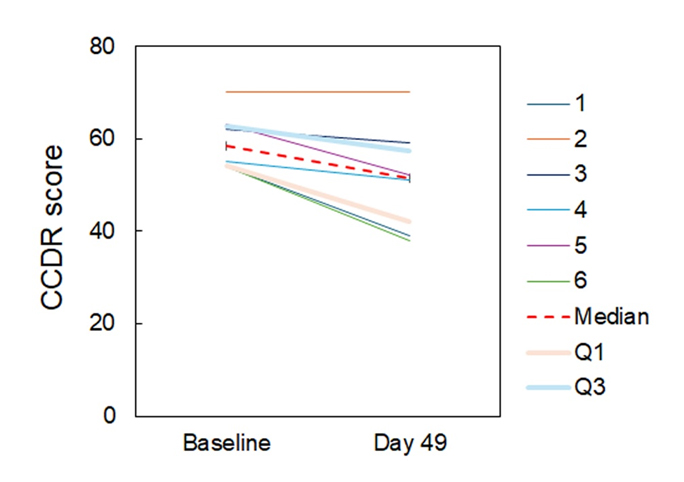
Clinical outcomesCognitive scoresTable 3 and Fig. 1 show the changes in CCDR scores. The baseline CCDR score was 58.5 (54.3–62.8) but decreased to 51.5 (42.0–57.3) on day 49. In each case, only case 2 showed no change before and after eqPE intake. In the remaining 5 cases, a reduction in the CCDR score was noted on day 49 compared with the baseline (Fig. 1).
Fig. 1. Changes in CCDR score between days 0 and 49 in dogs receiving eqPE. Individual CCDR scores for each dog are shown as a spaghetti plot connecting baseline and Day 49 values. Numbers indicate individual dogs (1-6). The first quartile (Q1), median, and third quartile (Q3) are also shown. CCDR, Canine Cognitive Dysfunction Rating Scale; eqPE, equine placental extract. Table 3. Changing CCDR score of this case series at baseline and day 49.
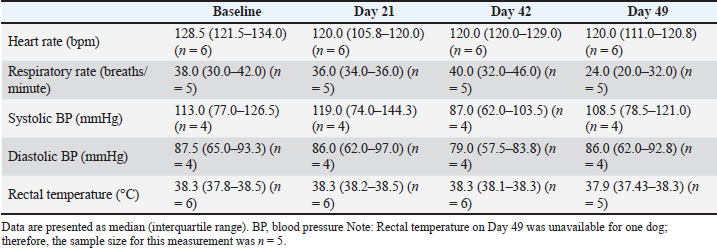
Vital signsTable 4 summarises the changes in vital signs during the study period. The heart rate revealed a mild reduction from baseline to day 21 and remained stable thereafter. The respiratory rate and systolic blood pressure fluctuated over time, whereas the diastolic blood pressure decreased between days 21 and 42 and subsequently increased by day 49. The body temperature remained stable throughout the study period. Table 4. Changes in vital signs between baseline and day 49.
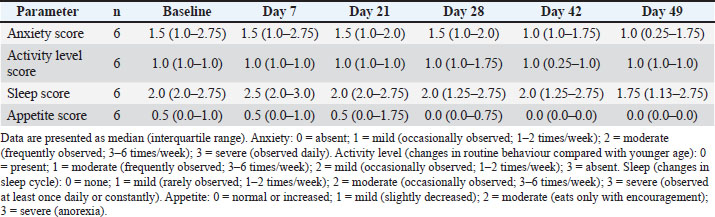
Veterinarian- or owner-reported clinical scoresTable 5 shows the veterinary assessors’ evaluation of pain and skin and coat findings. Negligible variation in pain was observed between baseline and day 49. No changes were noted in skin or coat conditions between baseline and day 42; however, a reduction in scores was documented on day 49. Table 6 presents the results regarding anxiety, activity level, sleep, and appetite as assessed by the owners. The anxiety score did not change from baseline to day 28; however, by day 42, a decline was noted. The score on day 49 was equivalent to that on day 42. Activity level scores were stable and remained relatively constant from baseline to day 28. Sleep scores demonstrated stability from baseline to day 42 but declined on day 49. The mean appetite scores were stable from baseline to day 21 but declined on day 28 and remained consistent until day 49. Table 5. Changes in veterinarian-reported clinical scores from baseline to day 49.
Table 6. Changes in owner-reported clinical scores from baseline to Day 49.
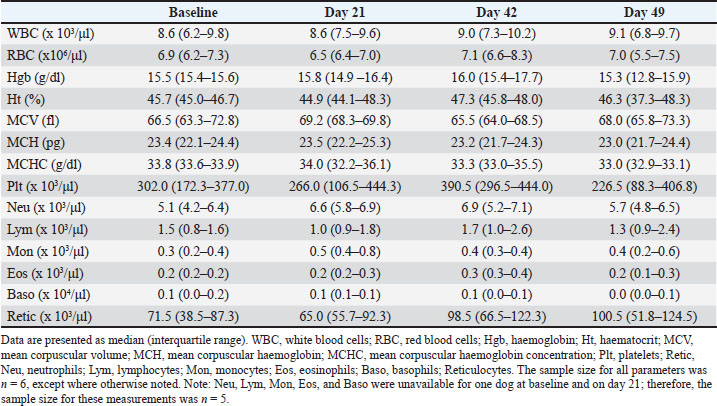
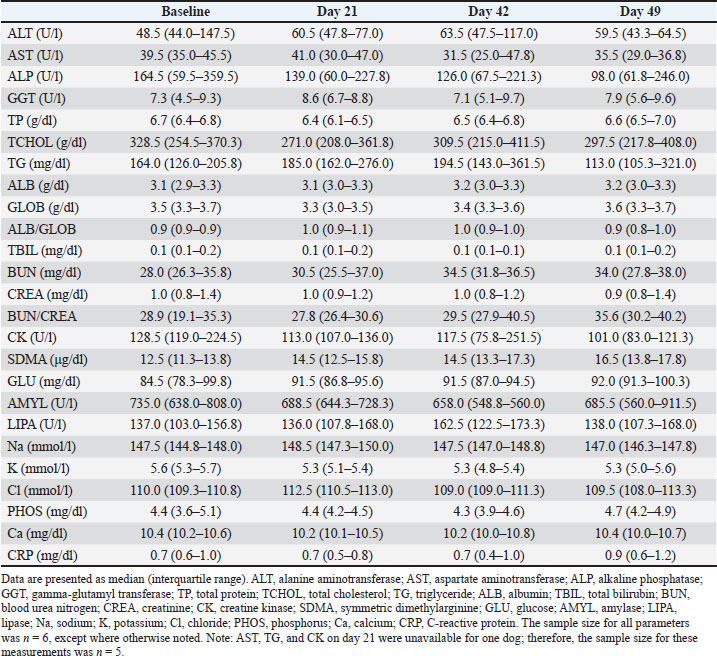
Laboratory findingsTable 7 summarises the haematological changes between baseline and day 49. Despite minor fluctuations between baseline and day 49, all values remained within the established reference range. Table 8 summarises the biochemical changes between baseline and day 49. The baseline alkaline phosphatase (ALP) level was marginally outside the reference range; however, it remained within the reference range until day 49. The triglyceride (TG) levels remained outside the reference range from baseline to day 49. The blood urea nitrogen (BUN) and symmetric dimethylarginine (SDMA) levels were within the reference range at baseline; however, they remained marginally outside the reference range until day 49. All other parameters remained within the reference range from baseline to day 49. Oxidative stress-related parameters, including diacron reactive oxygen metabolites (dROMs) and biological antioxidant potential (BAP), exhibited minor fluctuations within or close to the reference ranges (Table 9). The dROMS marginally diminished and subsequently increased from day 42 to day 49 between baseline and day 21. However, it remained below the reference values for both instances. BAP showed minimal fluctuations and remained within an established reference range. Table 7. Haematological changes from baseline to day 49 in dogs receiving supplementation.
Table 8. Biochemical changes from baseline to day 49 in dogs receiving supplementation.
Table 9. Changes in oxidative stress–related parameters (dROMs and BAP) from baseline to day 49 in dogs receiving supplementation.
Ethical approvalThe study was originally designed as a prospective before-and-after clinical study and was reviewed and approved by the ethics committee of the Japanese Society for Complementary and Alternative Medicine (Kanazawa, Japan) (Approval Number: 2211–01). The ethical approval date was December 23, 2022. Due to the limited number of cases enrolled, six dogs were ultimately included in the study, and the clinical findings are reported here as a descriptive case series. All procedures, including laboratory analyses, were performed in accordance with the approved protocol, and informed owner consent was obtained for all dogs. DiscussionIn this case series, supplementation with eqPE for 49 days was associated with lower CCDR scores in 5 of six elderly dogs diagnosed with cognitive dysfunction. Although the magnitude of change differed among individual cases, a decrease in CCDR scores was observed in most dogs during the observation period. No serious adverse events were observed, and eqPE supplementation appeared to be well tolerated throughout the study period. Notably, one dog (Case 2) did not show improvement in CCDR score, which may reflect individual variability in disease progression, comorbid conditions, or differential responsiveness to nutraceutical interventions. Canine cognitive dysfunction shares several pathological and clinical features with human neurodegenerative disorders, including progressive cognitive decline and behavioral changes (Vite and Head, 2014; Prpar Mihevc and Majdič, 2019). Non-pharmacological approaches, including dietary supplementation, have been increasingly investigated as potential supportive strategies for managing cognitive dysfunction in aging dogs. Nutritional interventions such as diets enriched with antioxidants, omega-3 fatty acids, and other nutraceutical compounds have been reported to support neuronal metabolism and mitigate age-related oxidative stress (Pan et al., 2018; Blanchard et al., 2025; Kang et al., 2025; Muršec et al., 2025). In addition, clinical and observational studies indicate that dog owners frequently use dietary supplements to alleviate cognitive and behavioural changes associated with aging (Haake et al., 2023). Although evidence supporting the efficacy of individual supplements remains variable, these findings highlight the growing clinical interest in nutraceutical approaches for canine cognitive dysfunction. Several limitations of this case series should be acknowledged. First, the small sample size (n=6) and the absence of a control group limit the ability to draw definitive conclusions regarding the efficacy of eqPE supplementation. In addition, the small sample size precluded evaluation of potential sex-related differences in behavioural responses. Second, cognitive function was evaluated using the CCDR, an owner-reported questionnaire that may be influenced by subjective perception and caregiver expectations. Furthermore, the minimal clinically important difference for CCDR scores has not been firmly established, making it difficult to interpret the magnitude of score changes in small observational studies. Third, the relatively short observation period precludes conclusions regarding the long-term sustainability of the observed changes. Cognitive assessment was performed on Day 49 to allow evaluation of potential delayed responses following the 4-week supplementation period; however, the absence of longer term follow-up limits conclusions regarding the persistence of the observed changes. Finally, spontaneous variation in clinical signs or placebo effects cannot be excluded in an uncontrolled observational study of this nature. These methodological considerations have been recognized in previous studies investigating cognitive dysfunction in companion animals (Simon et al., 2024; Simon et al., 2025). In addition, the enrolled dogs presented with various comorbidities and concurrent medications, some of which may influence behaviour or activity levels, and therefore cannot be excluded as potential confounding factors affecting the observed cognitive scores. Furthermore, although CCD diagnosis was based on clinical assessment and CCDR scoring by veterinarians, the presence of comorbid conditions commonly observed in geriatric dogs cannot be completely excluded as potential contributors to behavioral changes. Despite these limitations, the present findings provide preliminary clinical observations suggesting that eqPE supplementation may represent a feasible and well-tolerated approach for supporting cognitive function in elderly dogs. Given the limited availability of established treatments for CCD, nutraceutical strategies with favorable safety profiles may offer a practical adjunct in clinical settings. However, larger prospective studies with appropriate control groups and longer follow-up periods are required to further clarify the potential efficacy, optimal dosage, and long-term safety of eqPE supplementation in dogs with cognitive dysfunction. Future studies should also incorporate blinded assessment of owner-reported outcomes to reduce caregiver expectation bias and enable a more robust evaluation of treatment effects. ConclusionIn this descriptive case series of six elderly dogs with cognitive dysfunction, eqPE supplementation over a 49-day observation period was associated with lower CCDR scores in 5 dogs and was not accompanied by serious adverse events. However, causal relationships cannot be established due to the uncontrolled study design and small sample size. These preliminary observations suggest that eqPE supplementation may represent a potentially feasible supportive approach for dogs with CCD, although further controlled studies are required to confirm these findings. AcknowledgmentsWe would like to thank the veterinarians, veterinary nurses, and dog owners who participated and supported this case series. Their cooperation was vital for the success of the study. We would also like to thank Editage (www.editage.jp) for English language editing. Conflict of interestMami Irimajiri had a consulting agreement with Japan Bio Products Co., Ltd., established after the study was completed; this relationship did not affect the conduct or results of the study. Kentarou Tahara and Eiichi Hirano are employees of the Japan Bio Products Co., Ltd. All authors contributed to the study design, data interpretation, and manuscript preparation. FundingThis study was funded by Japan Bio Products Co., Ltd., which provided financial support for the study design, data collection, and the supply of study supplements, and contributed to manuscript preparation. Authors' contributionsMI conceived and designed the clinical study, analysed and interpreted the data, and reviewed the manuscript. KT interpreted the data. EH interpreted the data and wrote the manuscript. All authors approved the final draft of the manuscript. Data availabilityThe data supporting the findings of this study are available from the corresponding authors upon reasonable request. ReferencesAlsulami, A., Boland, S.W., Mcgrath, S., Maclean, E.L., Latimer, C.S., Darvas, M. and Moreno, J.A. 2025. Plasma and cerebrospinal fluid biomarkers in aged dogs with cognitive decline. BMC. Vet. Res. 21, 617. Amano, T., Ikeda, T., Yamaguchi, M., Kakehi, N., Hanada, K., Watanabe, T., Tahara, K. and Hirano, E. 2022. Equine placental extract supplement as a night barking remedy in dogs with cognitive dysfunction syndrome. Vet. Med. Sci. 8, 1887–1892. Araujo, J.A., Studzinski, C.M. and Milgram, N.W. 2005. Further evidence for the cholinergic hypothesis of aging and dementia from the canine model of aging. Prog. Neuropsychopharmacol. Biol. Psychiatry. 29, 411–422. Blanchard, T., Eppe, J., Mugnier, A., Delfour, F. and Meynadier, A. 2025. Enhancing cognitive functions in aged dogs and cats: a systematic review of enriched diets and nutraceuticals. Geroscience 47, 2925–2947. Cilek, S. and Kavak, G. 2012. Some morphological characteristics of Kangal shepherd dogs (Karabas) raised at villages by farmers in Kirikkale Province. Asian. J. Anim. Vet. Adv. 7, 403–341. Ciurli, L., Casini, L., Cecchi, F., Baragli, P., Macchioni, F., Curadi, M.C., Gazzano, V. and Gazzano, A. 2023. The canine cognitive dysfunction syndrome: rating scales | La sindrome da disfunzione cognitiva canina: scale di valutazione. Dog Behav. 9, 23–35. De Toledo, A., Nomoto, K., Hirano, E. and Tohda, C. 2021. Horse placental extract enhances neurogenesis in the presence of amyloid β. Nutrients 13, 1672. Fast, R., Schütt, T., Toft, N., Møller, A. and Berendt, M. 2013. An observational study with long-term follow-up of canine cognitive dysfunction. Vet. J. 196, 92–97. Haake, J., Meller, S., Meyerhoff, N., Twele, F., Charalambous, M., Talbot, S.R. and Volk, H.A. 2024. Comparing standard screening questionnaires of canine behavior for assessment of cognitive dysfunction. Front. Vet. Sci. 11, 1374511. Haake, J., Meyerhoff, N., Meller, S., Twele, F., Charalambous, M., Wilke, V. and Volk, H. 2023. Investigating owner use of dietary supplements in dogs with canine cognitive dysfunction. Animals (Basel). 13, 3056. Kang, M.H. and Park, H.-M. 2025. Cognitive dysfunction in aging dogs and cats: diagnosis and management perspectives. J. Vet. Sci. 26(Suppl 1), S125–S138. Kim, S.H. and Hao, J. 2025. Recent advances in diagnostic and therapeutic strategies for canine cognitive dysfunction. Am. J. Vet. Res. 29(1), 1–8. Landsberg, G.M., Nichol, J. and Araujo, J.A. 2012. Cognitive dysfunction syndrome: a disease of canine and feline brain aging. Vet. Clin. North. Am. Small. Anim. Pract. 42, 749–768. Madari, A., Farbakova, J., Katina, S., Smolek, T., Novak, P., Weissova, T., Novak, M. and Zilka, N. 2015. Assessment of severity and progression of canine cognitive dysfunction syndrome using the Canine Dementia Scale (CADES). Appl. Anim. Behaviour. Sci. 171, 138–145. Muršec, A., Poljšak, B., Nemec Svete, A. and Erjavec, V. 2025. Antioxidant strategies for age-related oxidative damage in dogs. Vet. Sci. 12, 962. Osella, M.C., Re, G., Odore, R., Girardi, C., Badino, P., Barbero, R. and Bergamasco, L. 2007. Canine cognitive dysfunction syndrome: prevalence, clinical signs and treatment with a neuroprotective nutraceutical. Appl. Anim. Behav. Sci. 105, 297–310. Pan, Y., Landsberg, G., Mougeot, I., Kelly, S., Xu, H., Bhatnagar, S., Gardner, C.L. and Milgram, N.W. 2018. Front Nutr. 5, 419598. Front. Nutr. 5, 419598. Prpar Mihevc, S. and Majdič, G. 2019. Canine cognitive dysfunction and Alzheimer’s disease – two facets of the same disease?. Front. Neurosci. 13, 604. Salvin, H.E., McGreevy, P.D., Sachdev, P.S. and Valenzuela, M.J. 2011. The canine cognitive dysfunction rating scale (CCDR): a data-driven and ecologically relevant assessment tool. Vet. J. 188, 331–336. Simon, K.E., Gruen, M.E. and Olby, N.J. 2025. Current practices for diagnosis and management of Canine Cognitive Dysfunction Syndrome in the United States. Front. Vet. Sci. 12, 685430. Simon, K.E., Russell, K., Mondino, A., Yang, C.C., Case, B.C., Anderson, Z., Whitley, C., Griffith, E., Gruen, M.E. and Olby, N.J. 2024. A randomized, controlled clinical trial demonstrates improved owner-assessed cognitive function in senior dogs receiving a senolytic and NAD+ precursor combination. Sci. Rep. 14, 12399. Taylor, T.L., Fernandez, E.J., Handley, K.N. and Hazel, S.J. 2023. Non-pharmacological interventions for the treatment of canine cognitive dysfunction: a scoping review. Appl. Anim. Behav. Sci. 269, 106097. Vite, C.H. and Head, E. 2014. Aging in the canine and feline brain. Vet. Clin. North Am. Small Anim. Pract. 44(6), 1113–1129. Vitturini, C., Cerquetella, M., Spaterna, A., Bazzano, M. and Marchegiani, A. 2025. Diagnosis of canine cognitive dysfunction syndrome: a narrative review. Vet. Sci. 12, 781. Yamauchi, A., Tone, T., Sugimoto, K., Seok Lim, H., Kaku, T., Tohda, C., Shindo, T., Tamada, K., Mizukami, Y. and Hirano, E. 2019. Porcine placental extract facilitates memory and learning in aged mice. Food Sci. Nutr. 7, 2995–3005. | ||



| How to Cite this Article |
| Pubmed Style Irimajiri M, Tahara K, Hirano E. Equine placental extract supplementation in six elderly dogs with cognitive dysfunction: A six-case series. doi:10.5455/OVJ.2026.v16.i6.75 Web Style Irimajiri M, Tahara K, Hirano E. Equine placental extract supplementation in six elderly dogs with cognitive dysfunction: A six-case series. https://www.openveterinaryjournal.com/?mno=307273 [Access: June 28, 2026]. doi:10.5455/OVJ.2026.v16.i6.75 AMA (American Medical Association) Style Irimajiri M, Tahara K, Hirano E. Equine placental extract supplementation in six elderly dogs with cognitive dysfunction: A six-case series. doi:10.5455/OVJ.2026.v16.i6.75 Vancouver/ICMJE Style Irimajiri M, Tahara K, Hirano E. Equine placental extract supplementation in six elderly dogs with cognitive dysfunction: A six-case series. doi:10.5455/OVJ.2026.v16.i6.75 Harvard Style Irimajiri, M., Tahara, . K. & Hirano, . E. (2026) Equine placental extract supplementation in six elderly dogs with cognitive dysfunction: A six-case series. doi:10.5455/OVJ.2026.v16.i6.75 Turabian Style Irimajiri, Mami, Kentarou Tahara, and Eiichi Hirano. 2026. Equine placental extract supplementation in six elderly dogs with cognitive dysfunction: A six-case series. doi:10.5455/OVJ.2026.v16.i6.75 Chicago Style Irimajiri, Mami, Kentarou Tahara, and Eiichi Hirano. "Equine placental extract supplementation in six elderly dogs with cognitive dysfunction: A six-case series." doi:10.5455/OVJ.2026.v16.i6.75 MLA (The Modern Language Association) Style Irimajiri, Mami, Kentarou Tahara, and Eiichi Hirano. "Equine placental extract supplementation in six elderly dogs with cognitive dysfunction: A six-case series." doi:10.5455/OVJ.2026.v16.i6.75 APA (American Psychological Association) Style Irimajiri, M., Tahara, . K. & Hirano, . E. (2026) Equine placental extract supplementation in six elderly dogs with cognitive dysfunction: A six-case series. doi:10.5455/OVJ.2026.v16.i6.75 |


