Open Veterinary Journal, (2026), Vol. 16(6): 3401-3413
Research Article
10.5455/OVJ.2026.v16.i6.11
Genetic polymorphisms and haplotype diversity of the HSP27 and HSP70 genes in Pesisir cattle, West Sumatra, Indonesia
Masrizal Masrizal1*, Tinda Afriani1, Kusnadidi Subekti1, Khasrad Khasrad1, Atha Tiffany Putri2,
Anita Febriana2 and Ananda Ananda1
1Department of Animal Production Technology, Faculty of Animal Science, Universitas Andalas, Padang, Indonesia
2Undergraduate Program, Faculty of Animal Science, Universitas Andalas, Padang, Indonesia
*Corresponding Author: Masrizal Masrizal. Department of Animal Production Technology, Faculty of Animal Science, Universitas Andalas, Padang, Indonesia. Email: mmasrizal [at] ansci.unand.ac.id
Submitted: 18/01/2026 Revised: 24/04/2026 Accepted: 06/05/2026 Published: 05/06/2026
© 2026 Open Veterinary Journal
This is an Open Access article distributed under the terms of the Creative Commons Attribution-Non Commercial-No Derivatives License (http://creativecommons.org/licenses/by-nc-nd/4.0/), which permits non-commercial re-use, distribution, and reproduction in any medium, provided the original work is properly cited, and is not altered, transformed, or built upon in any way.
ABSTRACT
Background: Heat stress is a major constraint in the production of tropical cattle, reducing performance and reproductive efficiency through cellular thermal and oxidative challenges. Heat shock proteins, including HSPB1 (HSP27) and HSP70, play central cytoprotective roles; however, information on genetic polymorphisms and haplotype diversity of these genes in indigenous Indonesian cattle, particularly Pesisir cattle, remains limited.
Aim: This study aimed to characterize the sequence polymorphisms and haplotype diversity of the HSP27 (HSPB1) and HSP70 genes in Pesisir cattle.
Methods: Blood samples were collected from 95 Pesisir cattle in Pesisir Selatan Regency, West Sumatra, Indonesia. Genomic DNA was extracted and PCR-amplified for HSP27 (1415 bp) and HSP70 (963 bp) fragments, followed by one-directional Sanger sequencing. Sequence alignment was performed to identify SNPs and insertions/deletions (indels). Genotype and allele frequencies, heterozygosity, HWE, and haplotype patterns were analyzed.
Results: A total of 31 nucleotide variants were identified across both genes, comprising 20 in HSP27 and 11 in HSP70. HSP27 variants included 15 in intron 1 and 5 in exon 2, whereas HSP70 variants were detected within the coding region. Population-genetic analyses were conducted for 15 and 8 SNP loci in HSP27 and 8 SNP loci in HSP70. Heterozygosity indicated low-to-moderate genetic variation, and HWE departures were observed at multiple loci (HSP27: 11/15; HSP70: 6/8). Putative haplotype patterns were identified for both genes, indicating within-breed sequence diversity.
Conclusion: HSP27 (HSPB1) and HSP70 genes in Pesisir cattle exhibit measurable polymorphism and haplotype variation. These baseline genetic data provide a foundation for future validation and genotype–phenotype studies related to thermotolerance, as well as for the development of conservation and genetic improvement strategies for Pesisir cattle.
Keywords: Heat stress adaptation, HSPB1 (HSP27), HSP70, Genetic polymorphism, Pesisir cattle.
Introduction
Heat stress is a major constraint for cattle production in tropical regions, where the animals’ thermoneutral zone (i.e., the environmental range in which body temperature can be maintained with minimal energy expenditure) is often exceeded by ambient temperature, humidity, and solar radiation. Under these conditions, to maintain homeostasis, cattle activate thermoregulatory and metabolic responses, such as increased respiration rate, reduced feed intake, and endocrine adjustments (Dahl et al., 2020; Zazueta-Gutiérrez et al., 2021; Wang et al., 2024). Although these responses facilitate heat dissipation, prolonged exposure can reduce nutrient utilization and increase oxidative stress, resulting in impaired growth and milk performance and economic losses (Hauser et al., 2023; Chen et al., 2024). Reproductive performance is particularly vulnerable to heat stress, which may disrupt endocrine signaling and compromise gamete quality and early embryo survival (Silva et al., 2023; Lee et al., 2024; Zhu et al., 2024). These impacts highlight the importance of identifying the biological mechanisms and genetic factors associated with heat resilience in cattle raised in tropical environments.
At the cellular level, the heat shock response supports heat tolerance by increasing the expression of heat shock proteins (HSPs). HSPs act as molecular chaperones that help maintain proteostasis by preventing protein misfolding/aggregation and facilitating refolding or degradation of damaged proteins (Antolin et al., 2021; Zhang et al., 2022; Angelini et al., 2024). Among HSP families, HSP70 is a major stress-inducible chaperone, whereas HSP27 (encoded by HSPB1) contributes to cytoprotection, antioxidant defense, and apoptosis-related pathway regulation (Pastén et al., 2021; Nosaka et al., 2023; Kim et al., 2025). Genetic variation in HSP-related genes may contribute to differences in stress responses among cattle populations (Abbas et al., 2020; Prihandini et al., 2022; Haddar et al., 2022).
Pesisir cattle are an important indigenous genetic resource concentrated in the coastal region of West Sumatra and are generally classified within the Bos indicus cluster in Indonesian cattle diversity studies (Hartati et al., 2024; Pazla et al., 2024). Demographic information specific to “Pesisir cattle” as a breed is not consistently available in annual censuses; however, Pesisir Selatan Regency is widely recognized as the core distribution area. An early report from Pesisir Selatan recorded 96,443 head of cattle in 2001, with approximately 95% identified as Pesisir cattle, underscoring its regional concentration and the importance of demographic monitoring. In the past decade, official livestock statistics for Pesisir Selatan (beef cattle) show a fluctuating but concerning pattern, including 81,786 (2017), 82,339 (2018), 83,687 (2019), 86,593 (2021), and 86,630 (2022), followed by a decrease to 59,575 (2024). In addition, Indonesia statistics (BPS) indicate substantially larger beef cattle populations in major cattle-producing provinces (e.g., East Java and Bali), suggesting that Pesisir cattle are managed within a more regionally concentrated production system that may be more vulnerable to demographic and genetic erosion. Although Pesisir cattle are valued for their adaptability, these traits do not preclude genetic erosion. In smallholder systems, erosion may be promoted by unstructured mating and limited breed-focused breeding programs, demographic pressures (e.g., high offtake of productive animals) that reduce effective population size, and potential dilution of breed identity through crossbreeding and changing production environments. These factors reinforce the need for baseline genetic characterization to support conservation and sustainable breeding management (Hendri et al., 2024; Masrizal et al., 2025; Ananda et al., 2025; Jaswandi et al., 2025). In this context, the characterization of genetic variation in stress-response candidate genes is relevant not only for understanding adaptive genetic resources in Pesisir cattle but also for providing baseline information needed to monitor genetic erosion and support conservation-oriented breeding decisions. Using different marker systems, including growth-related genes and mitochondrial haplotypes, previous studies on Indonesian local cattle have reported genetic variation, supporting the distinct genetic background of these cattle within the broader Bos indicus lineage (Putra et al., 2016; Hartatik et al., 2018; Yendraliza et al., 2020).
From a population-genetic perspective, baseline variation can be described using single-nucleotide polymorphisms (SNPs) and insertions/deletions (indels), genotype and allele frequencies, heterozygosity, and Hardy–Weinberg equilibrium (HWE; expected genotype distribution under random mating) (Rosado et al., 2021). However, systematic data on polymorphisms and haplotype diversity in candidate genes for stress response, particularly HSPB1 (HSP27) and HSP70, remain limited in Pesisir cattle. Therefore, this study aimed to characterize genetic polymorphisms and haplotype patterns in the HSPB1 (HSP27) and HSP70 genes of Pesisir cattle using targeted sequencing, including identification of nucleotide variants, prediction of amino acid substitutions for coding changes, and evaluation of genotype/allele frequencies, heterozygosity, HWE, and haplotype patterns.
Materials and Methods
Sample collection
This study was conducted in Pesisir Selatan Regency, West Sumatra, Indonesia, focusing on Koto XI Tarusan District and Bayang District (Fig. 1). These districts were selected because Pesisir cattle are commonly reared in these areas, and the locations were feasible for field sampling during the study period. Animals were sampled from smallholder households, where cattle are typically managed in backyard systems, and each farmer commonly owns approximately 1 to 3 animals. Therefore, the number of “farms” was operationally defined as the number of participating farmers/households. A total of 95 animals were obtained from 33 farmers/households across the 2 districts. Households were approached on the basis of accessibility and willingness to participate, and sampling was conducted to represent local cattle-keeping households within each district. Eligible animals available at the time of sampling were included within each household. Approximately 3–5-mL blood was collected from the jugular vein using sterile syringes and transferred into ethylenediaminetetraacetic acid tubes. The samples were labeled and stored at −20°C until genomic DNA extraction.
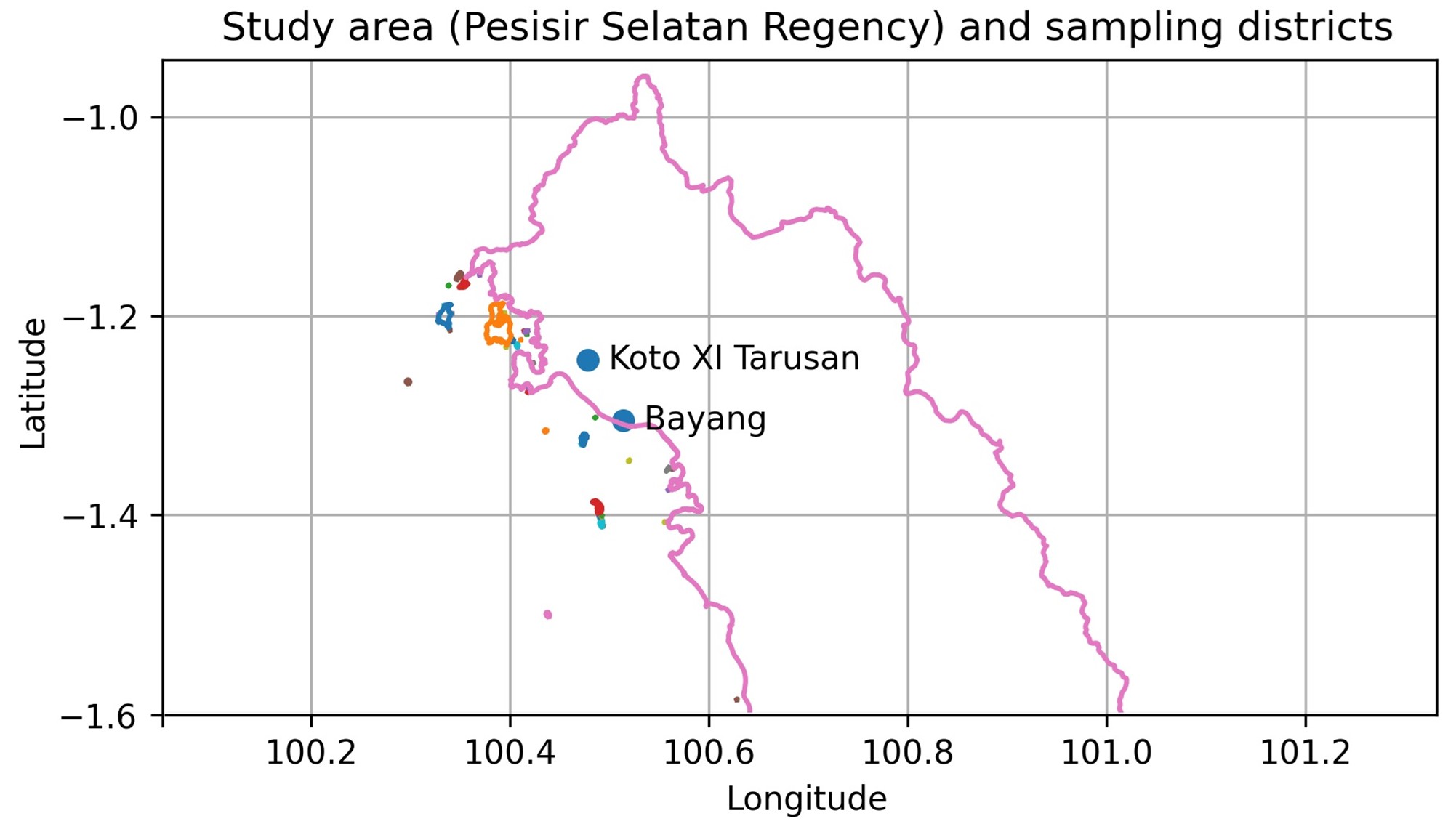
Fig. 1. Study area and sampling districts in Pesisir Selatan Regency, Indonesia. The outline indicates the administrative boundary of Pesisir Selatan Regency (source: Badan Informasi Geospasial/GeoServices), and points mark the Koto XI Tarusan and Bayang subdistrict locations.
Genomic DNA extraction and quality assessment
Genomic DNA was extracted from whole blood using the Genomic DNA Mini Kit (Geneaid, Taiwan) according to the manufacturer’s instructions. DNA concentration and purity were initially assessed using a NanoDrop microvolume spectrophotometer (Thermo Fisher Scientific, USA) by measuring absorbance at 260 and 280 nm. Because field-collected blood samples may show variable purity, samples with A260/A280 ratios ranging from 1.3 to 1.9 were provisionally retained; however, NanoDrop purity was not used as the sole inclusion criterion. Downstream use was determined by performance-based quality control: (i) PCR amplification produced a single clear band of the expected size on agarose gel, and (ii) Sanger chromatogram quality (readable sequence traces with clear peaks after trimming low-quality ends) was acceptable. Samples that failed to amplify consistently, produced nonspecific bands, or yielded poor/ambiguous chromatograms were excluded from variant analyses.
PCR amplification of the HSP27 and HSP70 fragments
PCR was performed in a 40 µl reaction volume using a thermal cycler (Thermo Fisher Scientific, USA). Each reaction contained 2 µl genomic DNA template, 20 µl MyTaq™ HS Red Mix (Meridian Bioscience, USA), 15 µl nuclease-free water, and 1.5 µl (10 pmol/µl) each of forward and reverse primers. The primer sequences for the HSP27 gene were forward 5′-TTTCCGCGACTGGTATCCG-3′ and reverse 5′-TGGTCAGTGATGGCTACTTGT-3′, while those for the HSP70 gene were forward 5′-CGCAGATCCTCTTCACCGAT-3′ and reverse 5′-CCTGGTGATGGACGTGTAGA-3′. Primers were designed using Primer3 based on Bos taurus reference sequences (NC_037350.1 for HSP27 and AY149618 for HSP70). During primer design and PCR optimization, potential primer–dimer formation and secondary structures were evaluated, and specificity was empirically supported by obtaining a single clear amplicon band of the expected size under the optimized PCR conditions. The thermal cycling conditions consisted of an initial denaturation at 95°C for 3 minutes, followed by 40 cycles of denaturation at 95°C for 30 s, annealing at 60°C for 30 s (HSP70) or 61°C for 30 s (HSP27), and extension at 72°C for 30 s, with a final extension at 72°C for 5 minutes.
Agarose gel electrophoresis (AGGE)
We verified the PCR products by electrophoresis on a agarose gel concentration to 2% agarose gel in 1× TBE buffer at 100 V for 55 minutes. This gel concentration was used to facilitate the migration of the larger HSP27 amplicon (1415 bp), although higher agarose concentrations generally provide sharper resolution for fragments in this size range. For gel preparation, a 0.8 g of agarose was dissolved in 40 ml 1× TBE buffer. Five microliters of the PCR product were loaded alongside SiZer™ 100 DNA Marker (iNtRON Biotechnology). DNA bands were visualized using RedSafe™ Nucleic Acid Staining Solution (iNtRON Biotechnology, Korea) under UV illumination and documented using a gel documentation system.
Sanger sequencing and sequence analysis
Amplicons were subjected to Sanger sequencing at the 1st BASE (Malaysia). Chromatograms were visually inspected using a FinchTV (Geospiza, USA) to evaluate the base-calling quality, peak resolution, and background noise. We trimmed low-quality bases at the sequence ends prior to downstream analyses. Variant calls were accepted only when they were supported by clear and interpretable chromatogram peaks; ambiguous positions (e.g., low signal-to-noise ratio, overlapping peaks, or poor resolution around indels) were treated conservatively and excluded from variant analyses. Indels and rare ambiguous base calls were manually rechecked in the chromatograms to minimize miscalling artifacts associated with one-directional reads.
The edited sequences were aligned in MEGA version 12 (Kumar et al., 2024) against publicly available reference sequences (Bos taurus NC_037350.1 for HSP27 and Bos taurus AY149618 for HSP70) to identify SNPs and insertions/deletions (indels). These reference accessions were used because they are well curated and widely used, enabling standardized coordinate-based reporting for the targeted fragments. Note that reference choice may influence positional numbering and the representation of indels; therefore, indel coordinates should be interpreted cautiously and may differ if a Bos indicus (zebu) reference is used.
Population genetic analyses
Genotype and allele frequencies were calculated following the method of Nei and Kumar (2000). The observed heterozygosity (Hₒ) and expected heterozygosity (Hₑ) were estimated according to Ye et al. (1999). HWE was assessed using the chi-square test (df=1; p < 0.05); however, because several loci showed low minor allele frequencies, HWE results should be interpreted cautiously in the absence of exact testing. Haplotype patterns (putative haplotypes) were defined as unique combinations of variant states across each sequenced fragment. To obtain pattern frequencies, variant positions were identified from the multiple sequence alignment in MEGA version 12 and tabulated in Microsoft Excel (Microsoft Corporation, USA). Because haplotypes were not experimentally phased or statistically inferred, phase ambiguity may remain in diploid individuals with multiple heterozygous sites; therefore, the reported haplotypes should be interpreted as putative rather than fully resolved haplotypes. The haplotype diversity was calculated according to the method of Fan et al. (2021).
Ethical approval
All procedures involving animals were reviewed and approved by the Ethics Committee of the Faculty of Medicine, Universitas Andalas, Padang, Indonesia (Approval No. 462/UN.16.2/KEP-FK/2024).
Results
DNA quality and polymerase chain reaction amplification
Genomic DNA extracted from 95 Pesisir cattle showed a mean concentration of 81.57 ± 46.59 ng/µl (range: 7.95–279.05 ng/µl; Table 1). The mean A260/A280 ratio was 1.74 ± 0.10 (range: 1.30–1.90; Table 1). Although the A260/A280 ratios varied and a proportion of samples were outside the ideal range, NanoDrop purity alone did not determine whether samples were included for downstream analysis. Only samples that produced specific PCR products and readable Sanger chromatograms were retained for variant calling, and ambiguous positions were manually inspected in chromatograms to minimize base-calling artifacts. We did not perform a formal correlation analysis between A260/A280 ratios and HWE deviations or rare ambiguous calls; therefore, any such relationship cannot be concluded from the present dataset. Based on the QC criteria summarized in Table 1, 87/95 (91.6%) samples had DNA concentration ≥20 ng/µl, and 83/95 (87.4%) had A260/A280 ratios within 1.7–2.0. Within this broader working-quality range, 52/95 (54.7%) samples also fell within the more stringent conventional range of 1.8–2.0.
Table 1. Genomic DNA concentration and purity of Pesisir cattle samples (n=95).

Detected sequence variants in HSP27 and HSP70
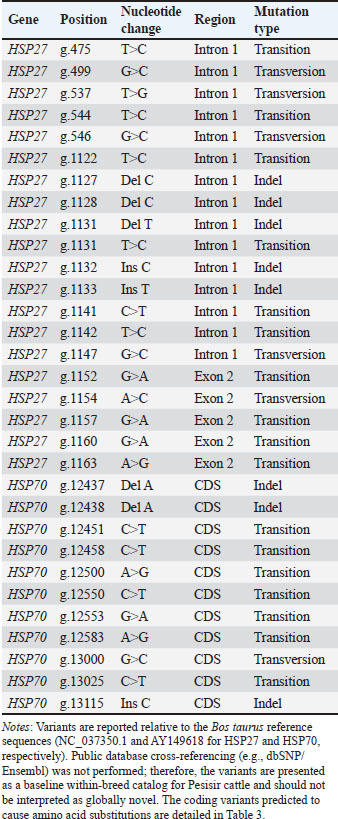
A total of 31 nucleotide variants were identified across the 2 genes (Table 2). For HSP27, 20 variants were detected, including 15 variants in intron 1 and 5 variants in exon 2 (Table 2). In HSP70, 11 variants, including SNPs and indels, were detected within the amplified coding region (Table 2). Because public database cross-referencing (e.g., dbSNP/Ensembl) was not performed, these variants are reported as a baseline within-breed catalog for Pesisir cattle and should not be interpreted as globally novel.
Table 2. Nucleotide variants detected in Pesisir cattle HSP27 and HSP70 genes.
Predicted substitution of amino acids
Eight missense substitutions were identified across both genes (Table 3). In HSP27 exon 2, 6 missense changes were predicted, including Lysine→Asparagine (g.1152 G>A), Histidine→Proline (g.1154 A>C), Glutamate→Lysine (g.1157 G>A and g.1160 G>A), and Arginine→Glycine (g.1163 A>G) (Table 3). Rare ambiguous base calls were observed in a small number of chromatograms at g.1152 and g.1157; therefore, these sites were treated conservatively as biallelic loci based on the dataset’s predominant allelic pattern, supported by manual chromatogram inspection, and were not analyzed as separate multi-allelic loci. Two missense substitutions were predicted in the HSP70 coding region, namely Lysine→Glutamate (g.12500 A>G) and Serine→Phenylalanine (g.13025 C>T) (Table 3; Fig. 3).
Table 3. Predicted amino acid substitutions caused by coding variants in Pesisir cattle HSP27 (exon 2) and HSP70 (CDS).
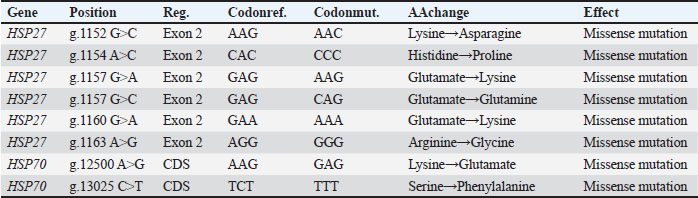
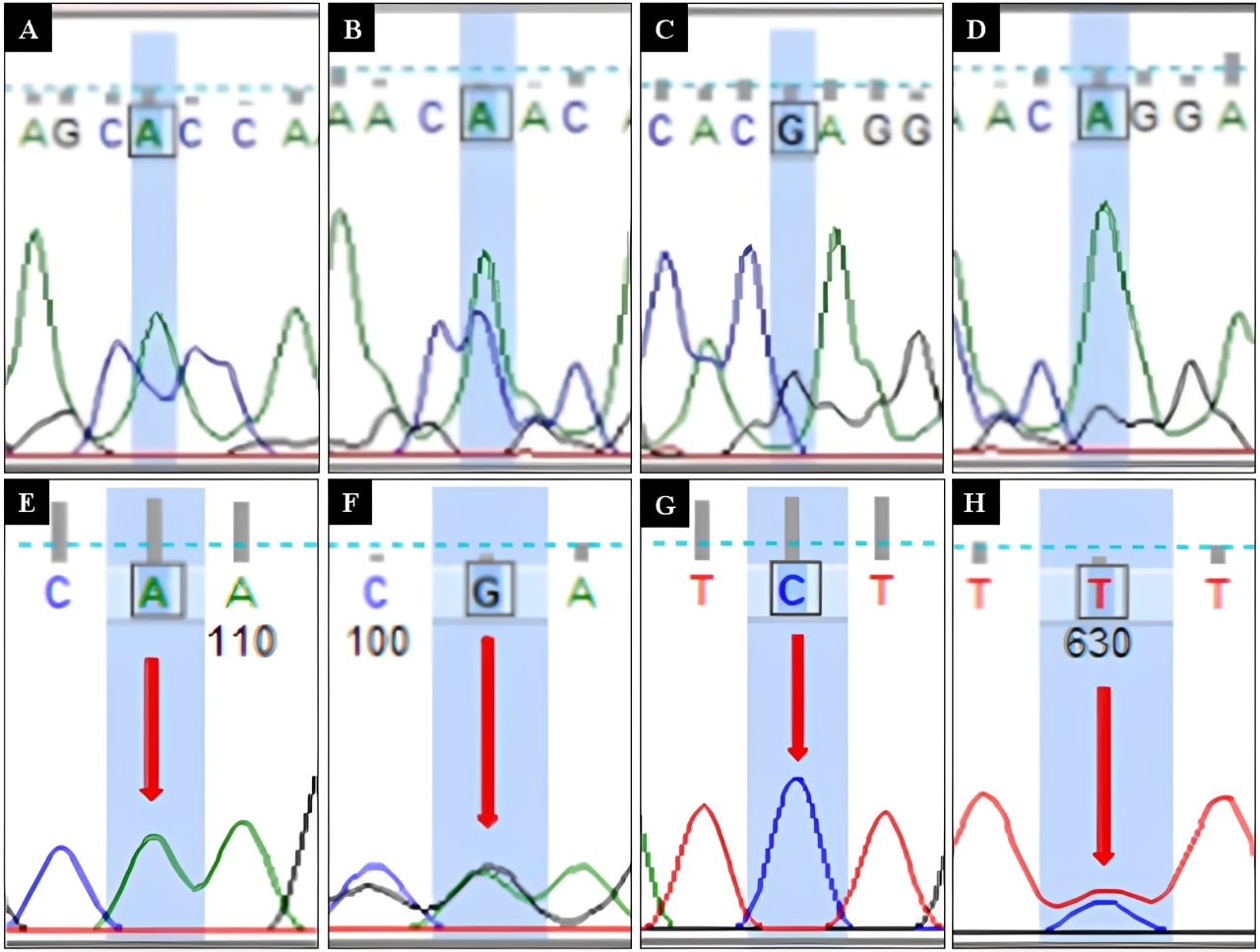
Fig. 3. Representative Sanger sequencing chromatograms of HSP27 and HSP70 coding variants in Pesisir cattle. Representative chromatograms showing nucleotide substitutions detected in the HSP27 exon 2 and HSP70 coding sequences (CDSs) of cattle from the Pesisir family. The polymorphic sites are highlighted (blue shading) indicated by arrows. Panels A–B show HSP27 g.1154 A>C variant, and panels C–D show HSP27 g.1157 G>A variant. Panels E–F show HSP70 g.12500 A>G variant, and panels G–H show HSP70 g.13025 C>T variant. The displayed chromatograms represent different genotype examples for each variant.
Genotype and allele frequencies, heterozygosity, and Hardy–Weinberg equilibrium
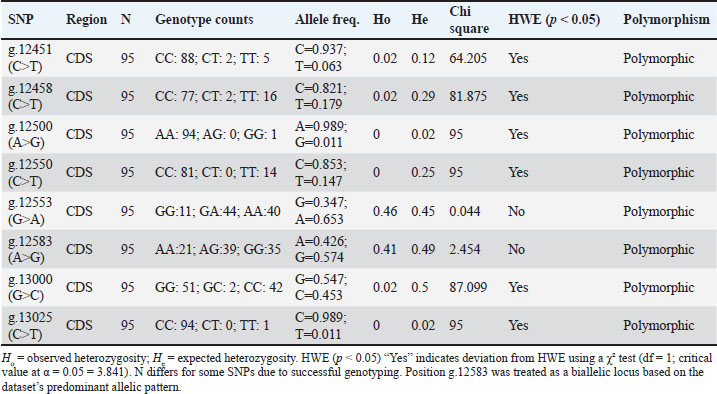
For HSP27, 15 SNP loci were analyzed (Table 4). The observed heterozygosity (Ho) ranged from 0.000 to 0.174, whereas the expected heterozygosity (He) ranged from 0.011 to 0.496 (Table 4). Eleven of the 15 loci deviated from the Hardy–Weinberg equilibrium based on the χ² test (df=1; critical value=3.841 at α=0.05; p < 0.05). For HSP70, 8 SNP loci were summarized (Table 5). The observed heterozygosity (Ho) ranged from 0.000 to 0.463, whereas the expected heterozygosity (He) ranged from 0.020 to 0.500 (Table 5). Six of 8 loci deviated from Hardy–Weinberg equilibrium based on the χ² test (df=1; critical value=3.841 at α=0.05; p < 0.05). In a small number of chromatograms, rare ambiguous base calls were observed at g.12583; therefore, this position was treated conservatively as a biallelic locus based on the predominant allelic pattern, supported by manual chromatogram inspection (Table 5). In addition to single-locus analyses, we identified putative haplotype patterns in both HSP27 and HSP70 based on combinations of variant states across each sequenced fragment, indicating within-breed sequence diversity. These results should be interpreted as putative haplotype patterns rather than fully resolved haplotypes because haplotypes were not experimentally phased or statistically inferred.
Table 4. Genotype distribution, allele frequencies, heterozygosity, and Hardy–Weinberg equilibrium test for HSP27 variants in Pesisir cattle.
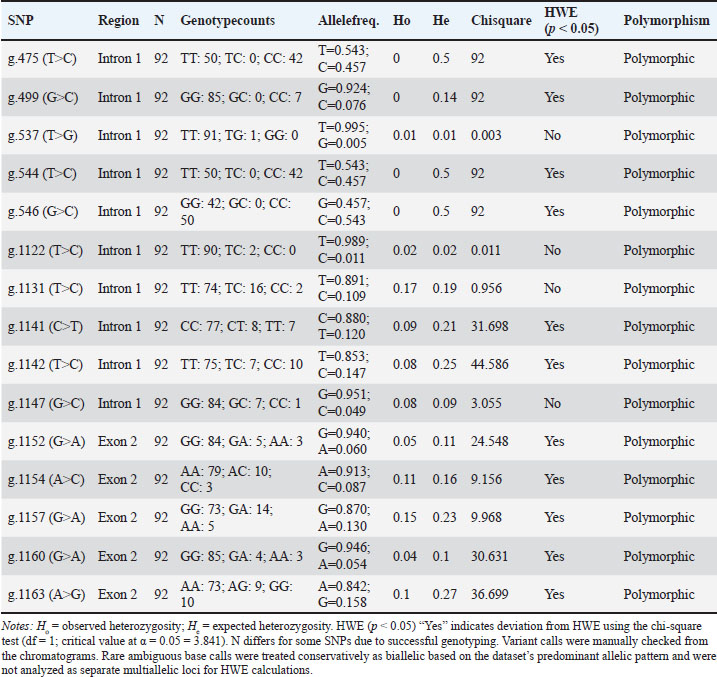
Table 5. Genotype distribution, allele frequencies, heterozygosity, and Hardy–Weinberg equilibrium test for HSP70 variants in Pesisir cattle.
Discussion
This study provides baseline genetic information on 2 candidate stress-response genes, HSPB1 (HSP27) and HSP70, in Pesisir cattle. Target fragments were successfully amplified and sequenced (Fig. 2), enabling the identification of multiple nucleotide variants, including substitutions and indels (Table 2). Several coding variants were predicted to result in amino acid substitutions (Table 3; Fig. 3). Because heat-stress phenotypes were not recorded, the present findings should be interpreted as molecular characterization that can support future genotype–phenotype studies and conservation-oriented breeding programs.
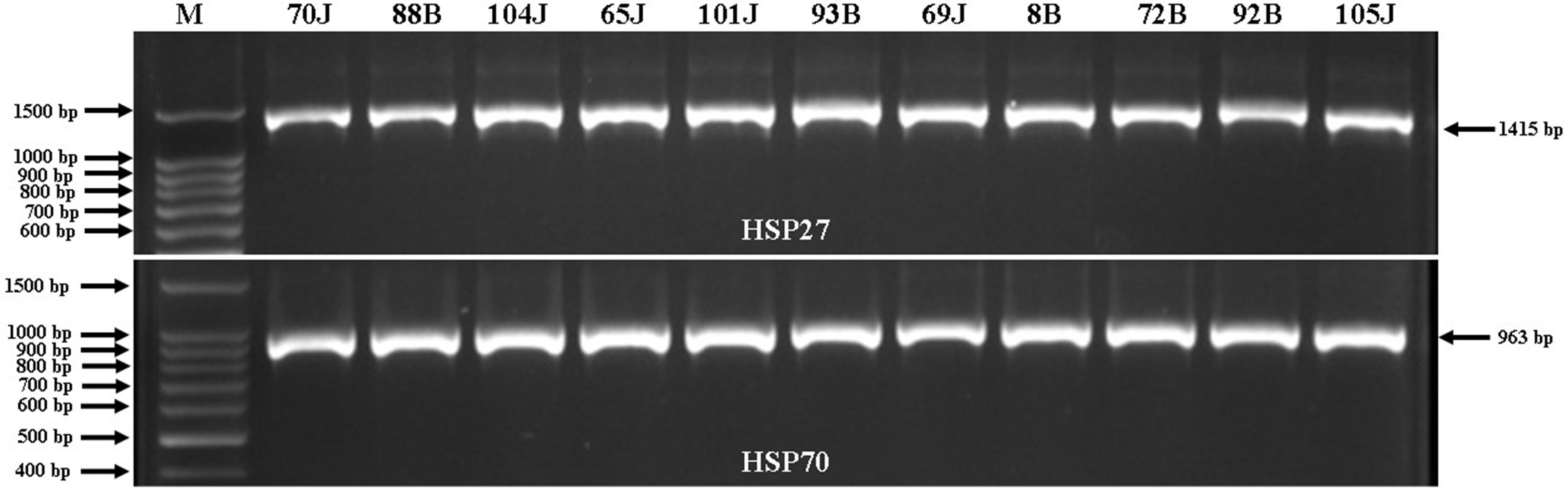
Fig. 2. PCR amplification of the HSP27 and HSP70 genes in Pesisir cattleRepresentative agarose gel electrophoresis of polymerase chain reaction products from Pesisir cattle genomic DNA. The upper panel shows the amplification of the HSP27 gene with an expected amplicon size of 1415 bp, and the lower panel shows the amplification of the HSP70 gene with an expected amplicon size of 963 bp. M, DNA ladder marker; lane labels (e.g., 70J–105J) indicate representative sample IDs. The arrows indicate the expected product sizes.
Variation in HSP70 genes and their relevance to stress response
Heat shock protein 70 is a central component of the cellular heat shock response. It functions as an ATP-dependent molecular chaperone involved in folding nascent proteins, refolding denatured proteins, and preventing protein aggregation (Kim et al., 2025). HSPs are highly conserved stress-response components across taxa, and ecological studies have reported genetic variation in thermal tolerance among natural populations together with variation in HSP70-related responses, consistent with temperature acting as an important selective pressure in challenging environments (Sørensen et al., 2001). Importantly, broader evolutionary/ecological evidence also indicates that inducible HSP expression can involve physiological costs and trade-offs, meaning that higher HSP induction is not necessarily uniformly beneficial across contexts (Sørensen et al., 2001). HSP70 has been widely investigated as a candidate gene for thermotolerance in cattle because it is heat-inducible and has been associated with physiological responses during thermal challenge (Guzmán et al., 2023). Previous studies have shown that polymorphisms in regulatory regions (e.g., promoter/5′ flanking region and 5′ UTR) may influence HSP70 transcriptional activity and stress-induced expression (Abbas et al., 2020; Prihandini et al., 2022; Haddar and Jakaria Noor, 2022). Breed-specific differences in HSP70 polymorphisms have also been reported, and some studies have explored associations between HSP70 variants and thermotolerance-related physiological or production traits in cattle exposed to hot environments (Onasanya et al., 2021; Prasanna et al., 2022). In addition to thermal challenge, mammalian studies have shown that HSP70 participates in broader stress signaling through its role in glucocorticoid receptor (GR) folding and regulation, highlighting that HSP70 function is integrated with broader stress-response networks (Bei et al., 2013). Within this broader context, the variants identified in the present study extend breed-specific baseline data for Pesisir cattle and may facilitate future investigations that integrate genotypes with standardized heat stress indicators or performance traits.
HSPB1 (HSP27) variation in gene expression and cytoprotective roles
The HSPB1 fragment displayed substantial sequence variation across intronic and exonic regions (Table 2). Although intronic variants do not directly alter protein sequence, they can be useful as genetic markers and may be linked to regulatory or splicing-related mechanisms depending on their genomic context. Because intronic variants and indels were not evaluated for overlap with predicted splice regulatory elements, potential splice-related cis-effects could not be assessed.
Importantly, six predicted missense substitutions were identified in HSPB1 exon 2 (Table 3; Fig. 3), indicating the presence of coding variation in this stress-response gene within the Pesisir cattle population. Although heat-stress phenotypes were not recorded, the presence of multiple coding variants is consistent with the possibility that standing variation in HSPB1 may contribute to inter-individual differences in cellular protection under tropical heat load. HSPB1 (HSP27) is a small heat shock protein with established cytoprotective roles during thermal and oxidative stress. In bovine systems, HSPB1 is upregulated under stress conditions, with heat shock factor-1 (HSF-1)-mediated induction, and it has been implicated in maintaining cell viability during stress exposure (He et al., 2016; Marques et al., 2017). At the cellular level, HSPB1 is implicated in maintaining protein homeostasis and supporting redox balance, and it has been associated with modulation of apoptosis-associated pathways under oxidative stress (Scharf et al., 2019; Eiro et al., 2022). Therefore, the missense variants detected here should be considered candidate variants for future validation studies that integrate standardized heat-stress indicators and/or expression profiling to test whether specific HSPB1 variants or haplotype patterns are associated with “hardiness” traits in Pesisir cattle.
Predicted amino acid substitution and functional considerations
Missense substitutions were predicted in HSPB1 and HSP70 (Table 3). Amino acid changes can affect chaperone stability, folding efficiency, and interactions with client proteins or regulatory partners, thereby influencing cellular stress protection. However, functional effects cannot be inferred from sequence data alone because consequences depend on domain location, physicochemical change, and compensatory mechanisms. Therefore, the predicted amino acid substitutions reported here should be considered candidates for future validation using in silico functional prediction and/or experimental approaches such as expression profiling under controlled thermal challenge or association testing with standardized heat stress indicators.
Genetic diversity and Hardy–Weinberg equilibrium patterns
Genotype and allele frequency distributions along with observed (Ho) and expected (He) heterozygosity (Tables 4 and 5), provide baseline estimates of within-breed variation at the targeted loci. In the present dataset, all analyzed SNP loci were polymorphic; however, several loci showed very low minor allele frequencies, resulting in low Hₒ values and limited informativeness at those positions. Such baseline frequency information is important for genetic monitoring and for prioritizing candidate loci for future association testing in Pesisir cattle (Rosado et al., 2021; Lee et al., 2024).
Departures from HWE can occur in managed livestock populations because equilibrium assumptions (e.g., random mating, no selection, no migration, and large effective population size) are rarely met. HWE deviations were observed at multiple loci (HSP27: 11/15 loci; HSP70: 6/8 loci; Tables 4 and 5), with apparent heterozygote deficiency at several positions. One plausible explanation is population substructure (Wahlund effect), because samples were collected from two districts and analyzed as a pooled dataset. When combined, differences in allele frequencies between local breeding units can produce an excess of homozygotes (Garnier-Géré and Chikhi, 2013). A second, non-mutually exclusive explanation is non-random mating and localized inbreeding, which can occur in smallholder systems where cattle are kept in small numbers per household and mating may rely on a limited number of bulls or repeated use of related sires. Similar departures from HWE have been reported in studies of Indonesian native cattle using microsatellite markers, indicating that HWE deviation is usual in structured or managed populations (Agung et al., 2019).
The primers were designed from Bos taurus reference sequences and applied to Pesisir cattle, which are generally classified within the Bos indicus cluster. Therefore, primer-template mismatches cannot be excluded. Such mismatches may reduce amplification efficiency at some alleles and could contribute to clear heterozygote deficiency or null-allele-like patterns at certain loci. Although the optimized PCR conditions yielded a single clear amplicons of the expected size and chromatograms were manually inspected, this possibility remains a technical limitation of the present study and should be addressed in future work using bidirectional sequencing and/or independent genotyping approaches.
At the same time, technical contributors cannot be fully excluded, particularly given one-directional Sanger sequencing and the presence of indels, where allele dropout or conservative genotype calling may influence HWE tests at loci with very low observed heterozygosity. Although chromatograms were manually inspected and representative chromatograms are provided as supplementary material, genotyping replicates and formal sensitivity analyses were not performed. Therefore, the observed HWE deviations should be interpreted primarily as a population-genetic signal that warrants follow-up validation, ideally including location-stratified analyses and independent genotyping or bidirectional sequencing.
Haplotype patterns in candidate gene regions
Haplotype-based summaries can complement single-locus analyses by describing variant combinations observed within a sequenced fragment. In this study, haplotype patterns (putative haplotypes) were defined as unique combinations of variant states across each targeted fragment and were tabulated from the aligned sequences in Microsoft Excel. Because haplotypes were not statistically phased, phase ambiguity may remain in diploid individuals with multiple heterozygous sites; therefore, the reported haplotypes should be interpreted as putative rather than fully resolved haplotypes. In addition, the linkage disequilibrium (LD) structure and haplotype block boundaries could not be assessed due to the targeted fragment design. Despite these limitations, the observed haplotype patterns in HSPB1 and HSP70 provide baseline within-breed information that may support future studies using broader marker coverage and phenotype data to evaluate potential haplotype–trait relationships (Zhao et al., 2021; Li et al., 2023; Wang et al., 2024).
Implications for conservation and future research
Pesisir cattle are an important indigenous genetic resource in Indonesia and are valued for their adaptability and hardiness, making molecular characterization relevant for conservation and sustainable breeding management (Hartati et al., 2024; Pazla et al., 2024). The generated baseline variant and haplotype information can support genetic monitoring and breed-focused management, particularly in smallholder production systems where effective population size may be limited, and mating may be locally structured. Reports highlighting demographic pressure and genetic erosion risk in local cattle populations further emphasize the importance of developing evidence-based breeding strategies that maintain breed identity while reducing inbreeding risk (Hastarina et al., 2025). Integrating standardized heat-stress indicators and performance data with independent genotyping/bidirectional sequencing and location-stratified analyses would help validate candidate variants and clarify whether specific loci or haplotype patterns contribute to thermotolerance-related traits under tropical production conditions.
Study limitations
The targeted sequencing design of this study limits the detection of variation across full-length genes and distant regulatory elements. Sequencing was performed using one-directional Sanger reads, which may reduce confidence in some base calls compared with bidirectional confirmation, particularly near lower-quality chromatogram regions and around indels. The functional impact of the identified missense variants was not assessed using in silico prediction tools or experimental validation.
Most HSPB1 variants were located in intronic regions, and the overlap with predicted splice regulatory elements was not evaluated for intronic variants/indels. Without full-length gene coverage or transcriptomic data, potential splice-related cis-effects cannot be assessed, and the biological interpretation of intronic variation remains limited. Sampling from more than one location was not explicitly modeled for population substructure, which may contribute to the Wahlund effect.
To clarify the functional relevance of candidate variants and haplotypes, future studies should incorporate bidirectional sequencing or independent genotyping validation, expand genomic coverage (including regulatory regions), probabilistic phasing, and standardized heat-stress phenotyping, ideally complemented by expression or transcript-based analyses.
Conclusion
This study provides baseline genetic data for HSPB1 (HSP27) and HSP70 in Pesisir cattle by identifying sequence variants and putative haplotype patterns within the targeted fragments. A key finding was that many loci deviated from the Hardy–Weinberg equilibrium, often with heterozygote deficiency. Although technical contributors cannot be fully excluded, this pattern may reflect population subdivision (Wahlund effect) and/or non-random mating in this endemic breed under smallholder management. Therefore, follow-up validation and genetic monitoring are warranted. The identified single-nucleotide polymorphism (SNP) markers and haplotype patterns provide a practical resource for future location-stratified studies and for designing breeding and mating strategies aimed at reducing inbreeding risk while maintaining breed identity in conservation and genetic improvement programs.
Acknowledgments
We gratefully acknowledge the farmers and local field staff in Koto XI Tarusan District and Bayang District (Pesisir Selatan Regency) for their assistance during sample collection. We also thank the laboratory staff for their technical support during the DNA extraction and PCR procedures.
Conflict of interest
The authors declare no conflict of interest.
Funding
This work was supported by the Faculty of Animal Science, Universitas Andalas (grant no. 03/SPK/BBPT/RD/RKAT-UNAND/2025).
Authors' contributions
M conceived and designed the study, coordinated sample collection, acquired research funding, and supervised the overall project. TA performed the laboratory work (DNA extraction, polymerase chain reaction (PCR) optimization, and electrophoresis), compiled the dataset, and assisted in drafting the manuscript. KS conducted sequence alignment, variant identification, and population genetic analyses (genotype/allele frequencies, heterozygosity, Hardy–Weinberg equilibrium, and haplotype diversity) and prepared the tables and figures. K contributed to methodological validation and critically revised the manuscript. ATP and AF assisted with field sampling, laboratory procedures, and data organization. A contributed to the study design, interpretation of findings, and writing and revision of the manuscript. All authors reviewed, discussed, and approved the final version of the manuscript.
Data availability
The data that support the findings of this study are available within the manuscript, and additional data are available upon reasonable request from the corresponding author.
References
Abbas, Z., Hu, L., Fang, H., Sammad, A., Kang, L., Brito, L.F., Xu, Q. and Wang, Y. 2020. Association analysis of polymorphisms in the 5' flanking region of the HSP70 gene with blood biochemical parameters of lactating Holstein cows under heat and cold stress. Animals. (Basel). 10(11), 2016; doi:10.3390/ani10112016
Agung, P.P., Saputra, F., Zein, M.S.A., Wulandari, A.S., Putra, W.P.B., Said, S. and Jakaria, J. 2019. Genetic diversity of Indonesian cattle breeds based on microsatellite markers. Asian-Australasian. J. Anim. Sci. 32(4), 467–476; doi:10.5713/ajas.18.0283
Ananda, A., Gusdinal, H., Ramadhan, R., Abimanyu, A.A., Ningsih, W.H. and Jaswandi, J. 2025. Impacts of cryopreservation on semen quality and sperm protein profiles of Pesisir bulls. Trop. Anim. Sci. J. 48(3), 189–198; doi:10.5398/tasj.2025.48.3.189
Angelini, G., Russo, S. and Mingrone, G. 2024. Intestinal heat shock proteins in metabolic syndrome: novel mediators of obesity and its comorbidities resolution after metabolic surgery. Cell. Stress. Chaperones. 29(2), 217–226; doi:10.1016/j.cstres.2024.02.003
Antolin, A.A., Clarke, P.A., Collins, I., Workman, P. and Al-Lazikani, B. 2021. Evolution of kinase polypharmacology across HSP90 drug discovery. Cell. Chem. Biol. 28(10), 1433–1445; doi:10.1016/j.chembiol.2021.05.004
Bei, E.S., Salpeas, V., Alevizos, B., Anagnostara, C., Pappa, D. and Moutsatsou, P. 2013. Pattern of heat shock factor and heat shock protein expression in lymphocytes of bipolar patients: increased HSP70-glucocorticoid receptor heterocomplex. J. Psychiatr. Res. 47(11), 1725–1736; doi:10.1016/j.jpsychires.2013.07.018
Chen, H., Yang, M., Shang, X., Chen, H., Li, Y., Li, Y., Li, L., Qu, M. and Song, X. 2024. Pogostemon cablin essential oil as feed additive promotes the repair of the rumen epithelial barrier in heat-stressed beef cattle. Anim. Nutr. 18, 433–440; doi:10.1016/j.aninu.2024.06.001
Dahl, G.E., Tao, S. and Laporta, J. 2020. Heat stress impacts immune status in cows across the life cycle. Front. Vet. Sci. 7, 116; doi:10.3389/fvets.2020.00116
Eiro, N., Sendon-Lago, J., Cid, S., Saa, J., De Pablo, N., Vega, B., Bermudez, M.A., Perez-Fernandez, R. and Vizoso, F.J. 2022. Conditioned medium from human uterine cervical stem cells regulates oxidative stress and angiogenesis of retinal pigment epithelial cells. Ophthalmic Res. 65(5), 556–565; doi:10.1159/000524484
Fan, P., Fjeldså, J., Liu, X., Dong, Y., Chang, Y., Qu, Y., Song, G. and Lei, F. 2021. An approach for estimating haplotype diversity from sequences with unequal lengths. Methods. Ecol. Evol. 12(9), 1658–1667; doi:10.1111/2041-210X.13643
Garnier-Géré, P.H. and Chikhi, L. 2013. Population subdivision, Hardy–Weinberg equilibrium and the Wahlund effect. In eLS. Chichester, UK: John Wiley & Sons, Ltd.; doi:10.1002/9780470015902.a0005446.pub3
Guzmán, L.F., Martínez-Velázquez, G., Villaseñor-González, F., Vega-Murillo, V.E., Palacios-Fránquez, J.A., Ríos-Utrera, A. and Montaño-Bermúdez, M. 2023. Expression of heat shock protein genes in Simmental cattle exposed to heat stress. Anim. Biosci. 36(5), 704–709; doi:10.5713/ab.22.0266
Haddar, M.A., Jakaria and Noor, R.R. SNP g.1117G>A HSP70 gene polymorphism in domestic beef cattle using PCR-RFLP method. IOP Conf. Ser.: Earth Environ. Sci. Bristol, UK, IOP Publishing, 2022, vol. 1020, p 012002; doi:10.1088/1755-1315/1020/1/012002
Hartati, H., Putra, W.P.B., Handiwirawan, E., Ramon, E., Firison, J., Zubir, Z., Suretno, N.D., Mariyono, M., Yusriani, Y., Robba, D.K., Destomo, A., Anggraeni, T., Anwar, P., Irmawanti, S., Aprisal, A., Elieser, S. and Kurniawati, D. 2024. Genome-wide association study of genetic markers of coat color patterns in Sumatran native cattle. Vet. World. 17(11), 2537–2543; doi:10.14202/vetworld.2024.2537-2543
Hartatik, T., Putra, D.E., Volkandari, S.D., Kanazawa, T. and Sumadi, S. 2018. Genotype analysis of partial growth hormone gene (GH891|MspI) in Pesisir cattle and Simmental-Pesisir crossbred cattle. J. Indonesian. Trop. Anim. Agric. 43(1), 1–H8; doi:10.14710/jitaa.43.1.1-8
Hastarina, R., Purnomoadi, A., Sutopo, S., Lestari, D.A., Mustofa, F., Gariri, P.N., Prahara, P.G., Kamila, F.T., Philco, S.V., Da’I, M.A.M. and Setiaji, A. 2025. Analysis of genetic diversity and phylogenetic relationships among Indonesian native cattle breeds using microsatellite markers: a review. Vet. World. 18(4), 1036–1046; doi:10.14202/vetworld.2025.1036-1046
Hauser, A., França, M., Hauser, R., Scheid, A.L., Perazzoli, L., Mendes, B.P.B., Telles, I.P., Miletti, L.C. and Thaler Neto, A. 2023. Effect of heat stress and solar radiation on dry matter intake, biochemical indicators, production, and quality of Holstein and Jersey cows' milk. Arq. Bras. Med. Vet. Zootec. 75(4), 721–734; doi:10.1590/1678-4162-12884
He, H., Chen, S., Liang, W. and Liu, X. 2016. Genome-wide proteomics analysis on longissimus muscles in Qinchuan beef cattle. Anim. Genet. 48(2), 131–140; doi:10.1111/age.12508
Hendri, H., Jaswandi, J., Indriastuti, R. and Ananda, A. 2024. Sperm kinematics of Pesisir bull thawed at different temperatures and times. Bul. Peternak. 48(4), 233–241; doi:10.21059/buletinpeternak.v48i4.96459
Jaswandi, J., Masrizal, M. and Ananda, A. 2025. Effects of trehalose supplementation on Pesisir bull sperm quality during storage. Open Vet. J. 15(7), 3115–3123; doi:10.5455/OVJ.2025.v15.i7.23
Kim, W.S., Jo, Y.H., Nejad, J.G. and Lee, H.G. 2025. Effects of heat shock protein 70 gene polymorphism on heat resistance in beef and dairy calves based on proliferation and heat shock protein 70 gene expression in peripheral blood mononuclear cells and hair follicles. Animals (Basel). 15(4), 475; doi:10.3390/ani15040475
Kumar, S., Stecher, G., Suleski, M., Sanderson, M., Sharma, S. and Tamura, K. 2024. MEGA12: Molecular evolutionary genetic analysis version 12 for adaptive and green computing. bioRxiv 2024.12.10.627672. https://doi.org/10.1101/2024.12.10.627672
Lee, Y.J., Lee, J.W., Huang, C.W., Yang, K.T., Peng, S.Y., Yu, C., Lee, Y.H., Lai, I.L. and Shen, P.C. 2024. Identification of molecular profile of ear fibroblasts derived from spindle-transferred Holstein cattle with ooplasts from Taiwan Yellow cattle under heat stress. Animals. (Basel). 14(9), 1371; doi:10.3390/ani14091371
Li, S., Lei, H., Li, J., Sun, A., Ahmed, Z., Duan, H., Chen, L., Zhang, B., Lei, C. and Yi, K. 2023. Analysis of genetic diversity and selection signals in Chaling cattle of southern China using whole-genome scan. Anim. Genet. 54(3), 284–294; doi:10.1111/age.13305
Marques, T., Da Silva Santos, E., Diesel, T., Leme, L., Martins, C., Dode, M., Alves, B., Costa, F., De Oliveira, E. and Gambarini, M. 2017. Melatonin reduces apoptotic cells, SOD2 and HSPB1 and improves the in vitro production and quality of bovine blastocysts. Reprod. Domest. Anim. 53(1), 226–236; doi:10.1111/rda.13097
Masrizal, Udin, Z., Hendri, Afriani, T., Jaswandi, and Ananda. 2025. Optimizing equilibration time for enhanced post-thaw quality of Pesisir bull frozen semen. Int. J. Vet. Sci. 14(2), 281–288; doi:10.47278/journal.ijvs/2024.239
Nei, M. and Kumar, S. 2000. Molecular Evolution and Phylogenetics. New York, NY: Oxford University Press.
Nosaka, M., Ishida, Y., Kuninaka, Y., Ishigami, A., Taruya, A., Shimada, E., Hashizume, Y., Yamamoto, H., Kimura, A., Furukawa, F. and Kondo, T. 2023. Relationship between intrathrombotic appearance of HSP27 and HSP70 and thrombus ages in a murine model of deep vein thrombosis. Sci. Rep. 13(1), 22416; doi:10.1038/s41598-023-48987-5
Onasanya, G.O., Msalya, G.M., Thiruvenkadan, A.K., Sreekumar, C., Tirumurugaan, G.K., Fafiolu, A.O., Adeleke, M.A., Yakubu, A., Ikeobi, C.O.N. and Okpeku, M. 2021. Heterozygous single-nucleotide polymorphism genotypes at the heat shock protein 70 gene potentially influence thermo-tolerance among four Zebu breeds of Nigeria. Front. Genet. 12, 642213; doi:10.3389/fgene.2021.642213
Pastén, C., Lozano, M., Rocco, J., Carrión, F., Alvarado, C., Liberona, J., Michea, L. and Irarrázabal, C.E. 2021. Aminoguanidine prevents the oxidative stress, inhibiting elements of inflammation, endothelial activation, mesenchymal markers, and confers a renoprotective effect in renal ischemia and reperfusion injury. Antioxidants. (Basel). 10(11), 1724; doi:10.3390/antiox10111724
Pazla, R., Zain, M., Agustin, F., Marlida, Y., Udin, Z., Jaswandi, J., Masrizal, M., Hendri, H., Negara, W., Tjiptosumirat, T., Putri, E.M. and Muslim, M. 2024. Influence of protein-energy balance on growth, production, and reproduction in Pesisir heifers. Adv. Anim. Vet. Sci. 12(3), 546–558; doi:10.17582/journal.aavs/2024/12.3.546.558
Prasanna, J.S., Rao, S.T.V., Prakash, M.G., Rathod, S., Kalyani, P. and Reddy, B.R. 2022. Association of SSCP polymorphisms of HSP70 gene with physiological, production and reproduction performance in Sahiwal and crossbred cows. Asian J. Dairy Food Res. 41(2), 150–155.
Prihandini, P.W., Primasari, A., Aryogi, A., Luthfi, M. and Hariyono, D.N.H. 2022. Genetic polymorphisms of the 5' untranslated regions of the HSP70 gene in Indonesian cattle populations. Vet. World 15(1), 168–172; doi:10.14202/vetworld.2022.168-172
Putra, D.E., Kanazawa, S. and Hartatik, T. 2016. Identification of growth hormone gene polymorphism for beef cattle in Pesisir Selatan District, West Sumatra, Indonesia. Biodiversitas 17(2), 711–715; doi:10.13057/biodiv/d170246
Rosado, R.D.S., Oliveira, A.M.C., Santos, I.G., Carneiro, P.C.S., Cruz, C.D. and Cecon, P.R. 2021. Parental selection based on molecular information under a population genetics approach. Agron. Sci. Biotechnol. 7, 1–9; doi:10.33158/ASB.r131.v7.2021
Scharf, C., Eymann, C., Emicke, P., Bernhardt, J., Wilhelm, M., Görries, F., Winter, J., von Woedtke, T., Darm, K., Daeschlein, G., Steil, L., Hosemann, W. and Beule, A. 2019. Improved wound healing of airway epithelial cells is mediated by cold atmospheric plasma: a time course-related proteome analysis. Oxid. Med. Cell. Longev. 2019, 7071536. https://doi.org/10.1155/2019/7071536
Silva, W.C.D., Silva, J.A.R.D., Camargo-Júnior, R.N.C., Silva, E.B.R.D., Santos, M.R.P.D., Viana, R.B., Silva, A.G.M.E., Silva, C.M.G.D. and Lourenço-Júnior, J.D.B. 2023. Animal welfare and effects of per-female stress on male and cattle reproduction-a review. Front. Vet. Sci. 10, 1083469; doi:10.3389/fvets.2023.1083469
Sørensen, J.G., Dahlgaard, J. and Loeschcke, V. 2001. Genetic variation in thermal tolerance among natural populations of Drosophila buzzatii: down regulation of HSP70 expression and variation in heat stress resistance traits. Funct. Ecol. 15(3), 289–296; doi:10.1046/j.1365-2435.2001.00525.x
Wang, L., Yan, X., Wu, H., Wang, F., Zhong, Z., Zheng, G., Xiao, Q., Wu, K. and Na, W. 2024. Selection signal analysis reveals Hainan yellow cattle are being selectively bred for heat tolerance. Animals (Basel). 14(5), 775; doi:10.3390/ani14050775
Ye, F.C., Yang, R.C. and Boyle, T. 1999. POPGENE version 1.31 Microsoft Windows-based freeware for population genetic analysis. University of Alberta, Canada.
Yendraliza, Rodiallah, M., Astuti, T. and Elfawati. 2020. Reproduction status and population dynamic of Kuantan cattle in the Kuantan Singingi Regency. J. Ilmu Ternak Vet. 25(4), 162–172; doi:10.14334/jitv.v25i4.2541
Zazueta-Gutiérrez, A.C., Romo-Valdez, A.M., Castro-Pérez, B.I. and Ríos-Rincón, F.G. 2021. Heat stress mitigation strategies for beef cattle under intensive finishing in the Mexican dry tropics. Agro Productividad 14(7), 23–30; doi:10.32854/agrop.v14i7.1874
Zhang, Z., Liu, H., Hu, X., He, Y., Li, L., Yang, X., Wang, C., Hu, M. and Tao, S. 2022. Heat shock protein 70 mediates the protective effect of naringenin on high-glucose-induced alterations of endothelial function. Int. J. Endocrinol. 2022, 7275765; doi:10.1155/2022/7275765
Zhao, G., Liu, Y., Niu, Q., Zheng, X., Zhang, T., Wang, Z., Xu, L., Zhu, B., Gao, X., Zhang, L., Gao, H., Li, J. and Xu, L. 2021. Runs of homozygosity analysis reveals consensus homozygous regions affecting production traits in Chinese Simmental beef cattle. BMC. Genomics. 22(1), 678; doi:10.1186/s12864-021-07992-6
Zhu, K., Li, T., Liu, D., Wang, S., Wang, S., Wang, Q., Pan, Y., Zan, L. and Ma, P. 2024. Estimation of genetic parameters for fertility traits in Chinese Holstein of south China. Front. Genet. 14, 1288375; doi:10.3389/fgene.2023.1288375