




| Research Article | ||
Open Vet. J.. 2026; 16(6): 4048-4055 Open Veterinary Journal, (2026), Vol. 16(6): 4048-4055 Research Article Typology of camel production systems in southern Tunisia: A descriptive analysisElhem Ben Aicha1*, Sana Kalthoum1, Ben Salem Ameni1, Lachtar Monia1, Hajlaoui Haikel1, Ben Slimane Imed1, Chendoul Walid2, Hechmi Bouabdella3, Bel Haj Mohamed Bassem1, Dabbek Hafedh4, Bennaceur Samed4, Ourabi Makram5, Ben Houcine Atef5, Boubaker Chayma4, Khelifi Taib5, Omri Houda6 and Baccar Mohamed Naceur11National Center of Zoosanitary Vigilance, Ministry of Agriculture, Tunis, Tunisia 2Commissariat Régional au Développement Agricole de Médenine, Ministry of Agriculture, Médenine, Tunisia 3Commissariat Régional au Développement Agricole de Gabes, Ministry of Agriculture, Gabes, Tunisia 4Commissariat Régional au Développement Agricole de Kebili, Ministry of Agriculture, Kebili, Tunisia 5Commissariat Régional au Développement Agricole de Tozeur, Ministry of Agriculture, Tozeur, Tunisia 6Commissariat Régional au Développement Agricole de Gafsa, Ministry of Agriculture, Gafsa, Tunisia 7Commissariat Régional au Développement Agricole de Tataouine, Ministry of Agriculture, Tataouine, Tunisia *Corresponding Author: Elhem Ben Aicha. National Center of Zoosanitary Vigilance, Ministry of Agriculture, Tunis, Tunisia. Submitted: 08/01/2026 Revised: 15/05/2026 Accepted: 01/06/2026 Published: 30/06/2026 © 2025 Open Veterinary Journal
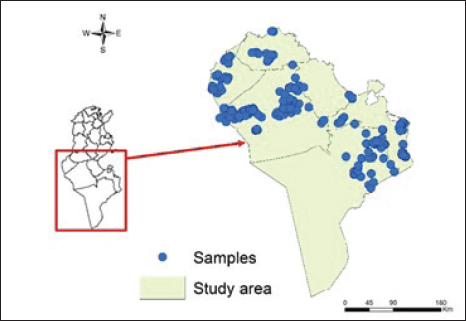
ABSTRACTBackground: Camel breeding constitutes a significant socio-economic activity in the arid and semi-arid regions of southern Tunisia, where it represents one of the most resilient livestock systems under harsh environmental conditions. Despite its importance, the structural diversity of camel production systems remains poorly documented, limiting the development of targeted and sustainable interventions in the sector. Aim: This study aimed to identify and characterize the typology of camel production systems in southern Tunisia to improve the understanding of their structural organization and management practices. Methods: A field survey was conducted among 277 camel owners distributed across six southern governorates of Tunisia (Gafsa, Gabes, Kebili, Tataouine, Tozeur, and Medenine). Data on herd size, production objectives, feeding practices, health management, and marketing were collected using a structured questionnaire. To identify distinct production system types, multivariate analysis combining multiple correspondence analysis and hierarchical agglomerative clustering was performed. Results: Three main types of camel production systems were identified. Type 1 (47.3%) included small-scale breeders managing herds of 1–12 camels, mainly located in Tataouine and Medenine. Type 2 (39.7%) included breeders with medium-sized herds (13–59 camels), predominantly located in Kebili. Type 3 (13%) comprised large-scale breeders managing herds of 60–377 camels, exclusively located in Medenine. Across all types, camel husbandry was largely practiced under extensive or semi-extensive management systems, with mixed milk–meat production predominating. Conclusion: This typology highlights the heterogeneity of camel production systems in southern Tunisia and provides a useful framework for designing targeted development strategies to improve the sustainability and performance of the camel sector in arid environments. Keywords: Camelus dromedarius, Farming systems, Pastoralism, Southern Tunisia, Typology. IntroductionThe camel (Camelus dromedarius) is a key component of desert and semi-desert ecosystems, providing essential services to human populations living under harsh climatic conditions (Altaf, 2000; Abdel Aziz and Abdulkareem, 2023). Camels are particularly suited to arid and semi-arid environments because of their unique bio-physiological adaptations (Kammoun, 2018). They are among the few domestic species capable of thriving in desert conditions (Eisa and Mustafa, 2001; Bengoumi et al., 2002) and can efficiently convert poor-quality forage resources—such as halophytic and thorny plants—into valuable animal products (Longo, 2007). Camels represent one of the most resilient livestock species in Tunisia and play an important socio-economic role in pastoral and agro-pastoral systems. The southern region of the country is the main camel-rearing area, hosting approximately 83% of the national camel breeders (Ouled Ahmed, 2009; OEP, 2017). Camel production contributes to household income and regional economic activity (Kammoun, 2011). Meat production remains the sector’s primary output, estimated at 5,600 tons annually (Khorchani, 1997). However, sector development is constrained by structural challenges, including limited production system organization, weak marketing channels, and insufficient product valorization (Letaief and Bedhiaf-Romdhani, 2022). Despite the recognized importance of camel breeding in southern Tunisia, comprehensive and updated analyses of the structural organization of camel production systems are scarce. Existing studies are limited in scope or outdated. Typological approaches have been successfully applied in other arid regions to characterize the diversity of camel farming systems. For example, distinct production systems have been identified in Saudi Arabia based on herd structure, management strategies, and market integration (Abdallah et al., 2012). Similarly, structural typology has revealed heterogeneous farm types across agro-ecological zones in northern Algeria (Ben Semaoune et al., 2019). Therefore, a detailed understanding of the structural diversity of camel production systems in Tunisia is necessary to inform development strategies and support evidence-based decision-making. This study aims to establish a typology of camel production systems in southern Tunisia to improve knowledge of the organization and management practices. The findings provide a basis for designing targeted interventions adapted to the specific characteristics and constraints of different breeder groups by identifying distinct farm types. Materials and MethodsStudy areaThis study was conducted in six of the 24 governorates in Tunisia (Gafsa, Tataouine, Kebili, Tozeur, Medenine, and Gabes) (Fig. 1). These governorates are located in the southern part of the country and are characterized by a desert climate with minimal rainfall and extreme heat. The average maximum temperature is around 38°C in Gafsa in July and August, and 40°C in Tozeur. In summer, heat records are considerable, reaching up to 52°C. In contrast, winter temperatures can drop considerably during the night, with minimum temperatures falling to around 5°C–7°C in some areas. This pronounced daily and seasonal thermal variation illustrates the harsh environmental conditions under which camel production systems operate. They are located along a 480 km coastal band, bordered by Libya to the east and Algeria to the west. These governorates are recognized as the primary camel-rearing areas in the country, with the one-humped dromedary being the most productive livestock species. According to statistics from the ODS (2017), the camel population in these six governorates is approximately 40,868, representing a significant portion of the national herd. Kebili holds the largest share (32.6%), followed by Medenine (27.3%) and Tataouine (23.9%).
Fig. 1. Map of Tunisia showing the six investigated governorates and geographical locations of the sampled herds. Study design and calculation of sample sizeA typological study of camel production systems was conducted between December 2018 and December 2019 across six southern governorates of Tunisia. A total of 277 camel owners were surveyed using a structured questionnaire. The sampling frame was established from the official lists of registered camel breeders provided by the regional veterinary services in each governorate. To ensure unbiased selection, owners were selected from these lists using simple random sampling based on a random number table generated in Microsoft Excel. Questionnaire design and data collectionBreeders’ information was collected through direct face-to-face interviews during a single visit per farm using a pretested structured questionnaire with close-ended questions. The survey included the following number of farms per governorate: Gabes (n=5 farms), Gafsa (n=10 farms), Kebili (n=86 farms), Medenine (n=73 farms), Tataouine (n=75 farms), and Tozeur (n=26 farms). A total of 277 questionnaires (farms) were included in the typology analysis. The inclusion criteria were as follows:
The questionnaire was divided into the following two sections:
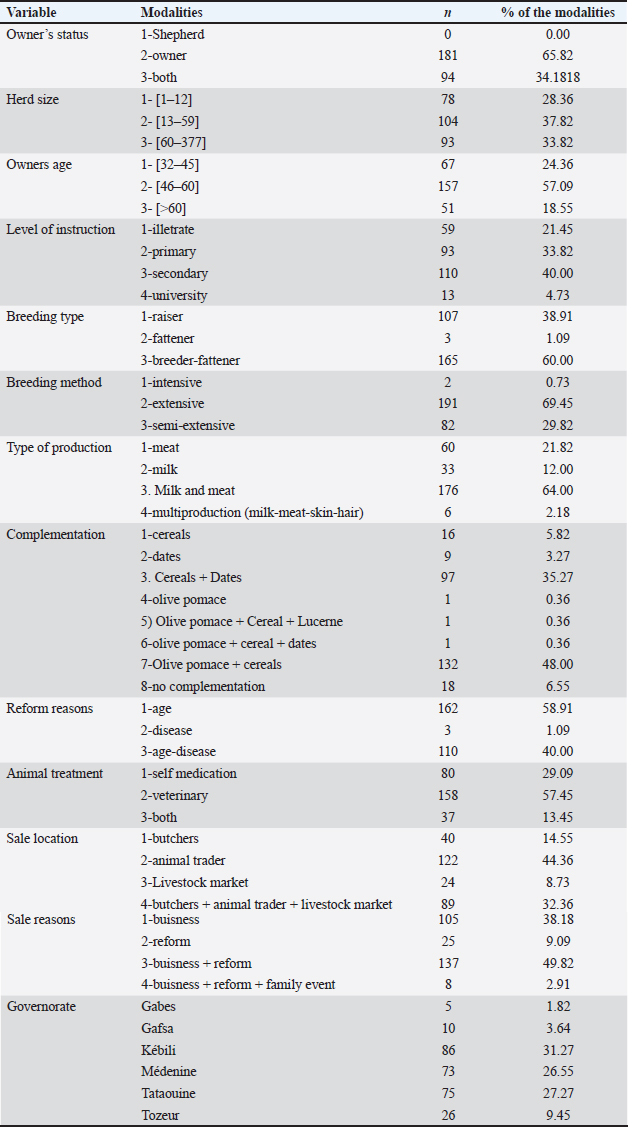
The geographical coordinates of each visited location were recorded using the Global Positioning System device (Trimble Juno B) and were used to generate a map of the sampled herds. Statistical analysisThe typology of camel production systems was established using a multivariate approach combining Multiple Correspondence Analysis (MCA) and Hierarchical Agglomerative Clustering (HAC). Variables with only one modality were excluded to ensure consistency for multivariate analysis. The quantitative variables were converted into categorical variables using predefined and biologically meaningful classes. Categories representing 5% of the total sample were considered rare and were grouped with similar categories to avoid statistical distortion in the multivariate analysis. Table 1 presents the list of variables retained in the final multivariate model with their different modalities, number (n), and frequencies. Table 1. List of variables retained in the final multivariate model with their different modalities and the number (n) of each modality.
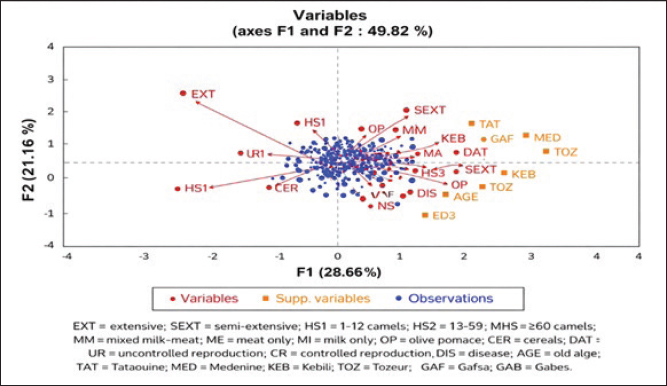
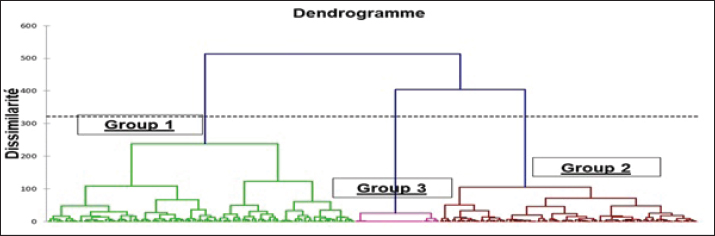
The analysis was conducted in three main steps: (a) Active and illustrative variables were selected based on their relevance to herd structure and management practices. (b) MCA application was applied to explore relationships between categorical variables and reduce data dimensionality. (c) Performance of HAC using Euclidean distances calculated on the retained MCA axes and Ward’s minimum variance method to group similar farms. The optimal number of clusters was determined based on dendrogram interpretation and silhouette index evaluation. Cluster interpretation was based on the contribution of variables to class formation. Only variables showing a statistically significant association with cluster membership (chi-square test, p < 0.05) were retained for interpretation. The MCA was performed on a dataset that included 277 farms, 12 active variables, and one illustrative variable (governorate). All statistical analyses were performed using the XLSTAT software (version 2019). Ethical approvalThe authors declare that the study was conducted according to the national guidelines and data related to breeders were not published. The study was approved by the Ethics Committee in Animal Experimentation of the Sidi Thabet national school of veterinary medicine in Tunisia (Number: CEEA-ENMV 36/21). ResultsCharacteristics of the breeders and herds sampledAmong the 277 surveyed owners, 44.4% (123/277) were located in the southwest governorates and 55.5% in the southeast. Livestock farming was the primary activity for 97.4% of the respondents, while only 2.5% reported occasional involvement in livestock production. Most owners were married (92.4%), and 7.5% were single. The mean age was 54 years (range: 32–85 years). Approximately 44.7% had attained secondary or university education. An extensive production system was predominant (approximately 70% of farms). Overall, most systems were mixed milk–meat production systems (64%), while 22% specialized in meat production and 12% in milk production only. Natural rangelands constituted the primary feeding resource, with 93.5% of the herds receiving supplementary feed. Reproduction was predominantly uncontrolled (92.7%), and only 7.2% of owners reported controlled breeding practices. Water is supplied by collective wells (93.1%), followed by private water sources (6.8%). Cluster analysis of the practicesHierarchical clustering identified three distinct types of camel production systems (Figs. 2 and 3). Overall, most owners across the three types were aged between 46 and 60 years.
Fig. 2. Distribution of camel farms on the main factor axes.
Fig. 3. Dendrogram of camel farms in the study area. Type 1: small-scale extensive systems (47.3%)Type 1 included 131 owners (47.3% of the sample), primarily located in Tataouine (57.3%) and Medenine (27.5%). Most participants had a primary education level (38.2%) and were mainly raisers (82.4%). They managed small herds (1–12 camels) and predominantly operated under extensive production systems (84%). The supplementation was mainly based on olive pomace and cereals (73.3%). Culling was primarily due to advanced age and disease (68%). Type 2: large semi-extensive commercial systems (13%)Type 2 comprised 36 (13%) owners located exclusively in Medenine. Most had a secondary education level (88.9%). All farms in this group managed large herds (60–377 camels) under a semi-extensive production system. Owners were exclusively raisers, and 91.7% were owners without drivers. The animals were primarily sold for commercial purposes. Culling was primarily associated with disease and advanced age. Type 3: medium-scale mixed systems (39.7%)Type 3 included 110 owners (39.7%), predominantly located in Kebili (70.9%) and Tozeur (15.5%). Most had secondary education (88.9%). Herd sizes ranged from 13 to 59. The production was mainly mixed milk–meat (63.6%). Farms operated under extensive (74.5%) or semi-extensive (25.5%) systems. The supplementation mainly relied on olive pomace and dates (80%). Animals were primarily sold to traders (48.2%), followed by butchers (18.2%). Culling was mainly due to advanced age (94.5%). DiscussionBased on a survey of 277 owners, this study established a typology of camel production systems in southern Tunisia. Hierarchical clustering identified three production types that differed mainly in herd size and production orientation: small extensive systems (type 1), large semi-extensive commercial systems (type 2), and medium-scale mixed systems (type 3). Few studies have described camel production systems in Tunisia and North Africa. Previous typologies were conducted in Algeria (Adamou, 2008 ; Ben Semaoune et al., 2019), Morocco (Faye et al., 2014 ; Kamili et al., 2020), Mauritania (Biya et al., 2021), Niger (Chaibou and Faye, 2005 ), and Mali (Traoré et al., 2014). However, these studies relied on different sets of structural and management variables, which limits direct comparison. The average age of camel owners in our study (54 years) is comparable to that reported in Algeria (Ben Semaoune et al., 2019). Camel breeding requires long-term experience and technical knowledge, which may explain the predominance of middle-aged and older breeders. In contrast, younger owners have been reported in Mali (Traoré et al., 2014), highlighting regional differences in generational involvement. Approximately half of the surveyed owners had secondary or university education, indicating a clear improvement compared to earlier reports in Tunisia (Kammoun, 2011). This contrasts with findings from Sudan, where a very small proportion of camel owners were university graduates (Ishag and Ahmed, 2011). Animal sales constitute a major economic function of camel breeding. In the overall sample, most animals were sold either for commercial purposes or as culling (disease or old age), confirming the economic importance of camel husbandry for household income. Similar observations have been reported in southeast Tunisia (Tardif et al., 2014 ) and Sudan (Ishag and Ahmed, 2011). Camel production is increasingly described as an expanding economic sector in Saharan regions (Senoussi et al., 2023 ). Veterinary service use remains moderate, as more than half of breeders reported consulting a veterinarian during health events. In comparison, ethno-veterinary practices dominate in Mali (Traoré et al., 2014), whereas access to veterinary services varies considerably across African camel systems (Ishag and Ahmed, 2011). The three types of production were predominantly mixed milk–meat. Although mixed systems are common, meat appears to remain the primary economic driver in southern Tunisia due to strong regional demand (Moslah et al., 2004 ). Milk production is generally limited under extensive rangeland conditions and is largely intended for self-consumption. Similar patterns have been reported across North Africa (Faye et al., 2014). Structural constraints, including low milk potential under natural grazing conditions and limited milk collection infrastructure, continue to hinder camel dairy sector development (Traoré et al., 2014). The marketing channels appear relatively informal. Animal traders were the main intermediaries between breeders and final buyers in the overall sample, which is consistent with previous findings in Tunisia (Kammoun, 2011). In contrast, Morocco reports a stronger role of livestock markets (Kamili et al., 2020). These differences may reflect variations in market organization and mobility constraints. Culling was mainly associated with disease and advanced age, which is in agreement with the findings of Keskes et al. (2013b), who also highlighted declining productive performance as a contributing factor. The extensive production system remains dominant, particularly in types 1 and 3, whereas type 2 is more associated with semi-extensive management. Similar patterns have been described in Tunisia (Selmi, 2018 ; Letaief and Bedhiaf-Romdhani, 2022), although semi-extensive systems may dominate in certain Algerian regions (Ben Semaoune et al., 2019). Across African pastoral systems, management strategies vary from sedentary to highly mobile systems depending on rangeland availability and water access (Homann et al., 2008; Moula, 2023). In types 1 and 3, feeding did not exclusively rely on natural grazing. Supplementation with olive pomace, cereals, or dates reflects the availability of regional resources and seasonal adaptation. Similar supplementation practices have been documented in Mauritania (Biya et al., 2021), Mali (Traoré et al., 2014), Sudan (Idriss, 2003 ), Iraq (Abdel-Rahman et al., 2020 ), and Ethiopia (Mirkena et al., 2018). Although the dromedary is well adapted to arid rangelands, supplementation is increasingly used to compensate for fluctuating forage availability and to support lactating or weakened animals. ConclusionThis study identified three main camel production systems in southern Tunisia, which were primarily differentiated by herd size, management intensity, and production orientation. Small- and medium-sized herds operating under extensive systems remain predominant, whereas a smaller proportion of large semi-extensive farms reflects emerging commercialization trends. Although mixed milk–meat systems are common, meat production remains the main economic driver. Camel breeding continues to play a significant socio-economic role in arid regions, largely relying on natural rangelands with strategic supplementation adapted to regional conditions. However, limited milk valorization, informal marketing channels, and moderate use of veterinary services indicate structural constraints that may hinder sector development. Strengthening market organization, improving veterinary support, and enhancing value chains—particularly for camel milk—could contribute to the sustainable development of camel production systems in southern Tunisia. AcknowledgmentsWe are grateful to the chiefs of the regional veterinary services of Tozeur, Kebili, Tataouine, Medenine, Gafsa, and Gabes for their collaboration and support. Conflict of interestThe authors have no competing interests to declare. FundingThe authors declare that no funds, grants, or other support were received during the preparation of this manuscript. Authors’ contributionsElhem Ben Aicha and Sana Kalthoum: Conception of the study. Monia Lachtar, Ben Salem Ameni, Bassem Ben Haj Mohamed, Haikel Hajlaoui, Ben Slimane Imed, Chandoul Walid, Hechmi Bouabdallah, Dabbek Hafedh, Bennaceur Samed, Ourabi Makram, Ben Houcine Atef, and Khelifi Taib: Data collection and validation. Elhem Ben Aicha, Sana Kalthoum, and Ben Salem Ameni: Original draft. Elhem Ben Aicha and Sana Kalthoum: Statistical analyses. Elhem Ben Aicha, Sana Kalthoum, and Ben Salem Ameni: Review. All authors have approved the final version of the manuscript. Data availabilityData are available upon request from the corresponding author. ReferencesAbdallah, H.R., Faye, B. and Al-Mutairi, S.E. 2012. Typology of camel farming systems in Saudi Arabia. Emir. J. Food. Agric. 24, 250–260. Abdel Aziz, M. and Abdulkareem, T. 2023. Camel production systems under arid conditions. J. Arid. Environ. 210, 104900. Abdel-Rahman, K.A., Abdulkareem, T.A., Eidan, S.M., Al-Salihi, K.A., Jameel, M.S., Ibrahim, F.F., Abdulkarim, M.G., Al-Abadi, O.S. and Shihab, T.A. 2020. Analytical study for camel breeding in Iraq. Directorate of Animal Resource, Ministry of Agriculture, Iraq. Adamou, A. 2008. Camel breeding typologies in Algeria. Emirates J. Food Agri. 20(1), 69–76. Altaf. 2000. Role of camel in desert ecosystem. J. Camel. Pract. Res. 7, 127–130. Ben Semaoune, Y., Senoussi, A. and Faye, B. 2019. Typologie structurale des élevages camelins au Sahara septentrional Algérien—cas de la wilaya de Ghardaïa. Livestock Res. Rural Dev. 31(2), 19. Bengoumi, M., Faye, B. and Bakkoury, M. 2002. Thermoregulation and physiological adaptation of the dromedary camel. Rev. Elev. Med. Vet. Pays Trop. 55, 147–153. Biya, M.B., Chrif Ahmed, M.S., Dieye, C.Y., Diop, A.K.M., Mohamed, R.B., Salem, M.M., Sidatt, M. Elemine, K.S., Mohamed, M.S., N'Diaye, F.B. and Meiloud, G. 2021. Typologie descriptive des systèmes d'élevage camelin en Mauritanie. Livestock Res. Rural Dev. 33(3), 18. Chaibou, M. and Faye, B. 2005. Herding strategies of camel husbandry in Agadez sub urban area in Niger. Typological Survey 58(4), 273–283. Eisa, M.O. and Mustafa, A.B. 2001. Production systems and productivity of camels. Livest. Res. Rural Dev. 13, 1–9. Faye, B., Konuspayeva, G. and Loiseau, G. 2014. The camel today: assets and potentials. J. Camelid Sci. 7, 1–18. Faye, B., Konuspayeva, G. and Loiseau, G. 2014. The camel today: assets and potentials. J. Camelid Sci. 7, 1–18. Homann, S., Rischkowsky, B. and Steinbach, J. 2008. The role of mobility in pastoral livestock systems. Pastoralism 2, 45–58. Idriss, S.E. 2003. Camel feeding systems in Sudan: the need for alternative feed resources. In Proceedings of the Second International Conference on the Future of Drylands, Tunis, Tunisia, pp 83–95. Ishag, I.A. and Ahmed, M.K.A. 2011. Camel production systems in Sudan. Pastoralism 1, 12. Kamili, A., Faye, B. and El Aich, A. 2020. Typology of camel production systems in Moroccan Sahara. Trop. Anim. Health Prod. 52, 1541–1552. Kammoun, M. 2011. Rapport synthétique sur l’élevage camelin en Tunisie. Tunis, Tunisia: Office de l’Élevage et des Pâturages. Kammoun, M., Rekik, M., Belfaqih, N., Ben Salem, H. and Abidi, S. 2018. Camel production systems in North Africa: a comprehensive review. Trop. Anim. Health Prod. 50(4), 753–769. Khorchani, T., et al. 1997. Camel meat production in Tunisia. Options Mediterr. 22, 105-110. Letaief, N. and Bedhiaf-Romdhani, S. 2022. Constraints and opportunities in the Tunisian camel sector. J. Camelid. Sci. 15, 45–58. Longo, H.F. 2007. Feeding behavior of camels in arid zones. J. Arid Land Stud. 17, 89–95. Mirkena, T., Walelign, E., Tewolde, N., Gari, G., Abebe, G. and Newman, S. 2018. Camel production systems in Ethiopia: a review of literature with notes on MERS-CoV risk factors. Pastor. Res. Policy Pract. 8(1), 30. Moula, N. 2023. Evolution of sedentary camel production systems in North Africa. Animals 13, 987. Moslah, M., Hammadi, M. and Khorchani, T. 2004. Productivité de l'élevage camelin dans les parcours du Sud tunisien. In: (comp. & collab.), Réhabilitation des pâturages et des parcours en milieux méditerranéens. Ed., Ferchichi A. Zaragoza: CIHEAM, pp: 343–347. (Cahiers Options Méditerranéennes, n° 62) Office de Développement du Sud (ODS). 2017. Statistiques de l'élevage dans le Sud tunisien. Tunis, Tunisie: Office de Développement du Sud. Office de l’Élevage et des Pâturages. 2017. Les chiffres clés de l’élevage 2017. Tunis, Tunisia. Office de l'Élevage et des Pâturages (OEP). 2017. Les chiffres clés de l'élevage 2017. Tunis, Tunisie: Ministère de l'Agriculture. Selmi, H. 2018. Breeding and breeding management of camels (Camelus dromedarius) in southern Tunisia. J. Camelid Sci. 11, 1–11. Senoussi, A., Abazi, A., Bezziou, S. and Brahimi, Z. 2023. The camel in Algeria: animal of the past, present, and future: What is the scope of farming systems? Biol. Life Sci. Forum, 22(1), 3. Ouled Ahmed, N. 2009. La filière cameline en Tunisie : des contraintes de production aux enjeux de valorisation. Cahiers Agricultures 18(1), 24–30. Tardif, N., Jaouad, M., Khorchani, T. and Faye, B. 2014. Contribution of camel breeding to the household economy in southeast Tunisia. In: Forage resources and ecosystem services provided by mountain and Mediterranean grasslands and rangelands. Eds. Baumont R. Zaragoza: CIHEAM / INRA / FAO / VetAgro Sup Clermont-Ferrand / Montpellier SupAgro. pp: 745–749. Traoré, B., Faye, B. and Kone, A. 2014. Typology of camel breeding systems in Mali. Pastoralism 4(1), 1–11. | ||
| How to Cite this Article |
| Pubmed Style Aicha EB, Kalthoum S, Ameni BS, Monia L, Haikel H, Imed BS, Walid C, Bouabdella H, Bassem BHM, Hafedh D, Samed B, Makram O, Atef BH, Chayma B, Taib K, Houda O, Naceur BM. Typology of camel production systems in southern Tunisia: A descriptive analysis. doi:10.5455/OVJ.2026.v16.i6.70 Web Style Aicha EB, Kalthoum S, Ameni BS, Monia L, Haikel H, Imed BS, Walid C, Bouabdella H, Bassem BHM, Hafedh D, Samed B, Makram O, Atef BH, Chayma B, Taib K, Houda O, Naceur BM. Typology of camel production systems in southern Tunisia: A descriptive analysis. https://www.openveterinaryjournal.com/?mno=306084 [Access: June 28, 2026]. doi:10.5455/OVJ.2026.v16.i6.70 AMA (American Medical Association) Style Aicha EB, Kalthoum S, Ameni BS, Monia L, Haikel H, Imed BS, Walid C, Bouabdella H, Bassem BHM, Hafedh D, Samed B, Makram O, Atef BH, Chayma B, Taib K, Houda O, Naceur BM. Typology of camel production systems in southern Tunisia: A descriptive analysis. doi:10.5455/OVJ.2026.v16.i6.70 Vancouver/ICMJE Style Aicha EB, Kalthoum S, Ameni BS, Monia L, Haikel H, Imed BS, Walid C, Bouabdella H, Bassem BHM, Hafedh D, Samed B, Makram O, Atef BH, Chayma B, Taib K, Houda O, Naceur BM. Typology of camel production systems in southern Tunisia: A descriptive analysis. doi:10.5455/OVJ.2026.v16.i6.70 Harvard Style Aicha, E. B., Kalthoum, . S., Ameni, . B. S., Monia, . L., Haikel, . H., Imed, . B. S., Walid, . C., Bouabdella, . H., Bassem, . B. H. M., Hafedh, . D., Samed, . B., Makram, . O., Atef, . B. H., Chayma, . B., Taib, . K., Houda, . O. & Naceur, . B. M. (2026) Typology of camel production systems in southern Tunisia: A descriptive analysis. doi:10.5455/OVJ.2026.v16.i6.70 Turabian Style Aicha, Elhem Ben, Sana Kalthoum, Ben Salem Ameni, Lachtar Monia, Hajlaoui Haikel, Ben Slimane Imed, Chendoul Walid, Hechmi Bouabdella, Bel Haj Mohamed Bassem, Dabbek Hafedh, Bennaceur Samed, Ourabi Makram, Ben Houcine Atef, Boubaker Chayma, Khelifi Taib, Omri Houda, and Baccar Mohamed Naceur. 2026. Typology of camel production systems in southern Tunisia: A descriptive analysis. doi:10.5455/OVJ.2026.v16.i6.70 Chicago Style Aicha, Elhem Ben, Sana Kalthoum, Ben Salem Ameni, Lachtar Monia, Hajlaoui Haikel, Ben Slimane Imed, Chendoul Walid, Hechmi Bouabdella, Bel Haj Mohamed Bassem, Dabbek Hafedh, Bennaceur Samed, Ourabi Makram, Ben Houcine Atef, Boubaker Chayma, Khelifi Taib, Omri Houda, and Baccar Mohamed Naceur. "Typology of camel production systems in southern Tunisia: A descriptive analysis." doi:10.5455/OVJ.2026.v16.i6.70 MLA (The Modern Language Association) Style Aicha, Elhem Ben, Sana Kalthoum, Ben Salem Ameni, Lachtar Monia, Hajlaoui Haikel, Ben Slimane Imed, Chendoul Walid, Hechmi Bouabdella, Bel Haj Mohamed Bassem, Dabbek Hafedh, Bennaceur Samed, Ourabi Makram, Ben Houcine Atef, Boubaker Chayma, Khelifi Taib, Omri Houda, and Baccar Mohamed Naceur. "Typology of camel production systems in southern Tunisia: A descriptive analysis." doi:10.5455/OVJ.2026.v16.i6.70 APA (American Psychological Association) Style Aicha, E. B., Kalthoum, . S., Ameni, . B. S., Monia, . L., Haikel, . H., Imed, . B. S., Walid, . C., Bouabdella, . H., Bassem, . B. H. M., Hafedh, . D., Samed, . B., Makram, . O., Atef, . B. H., Chayma, . B., Taib, . K., Houda, . O. & Naceur, . B. M. (2026) Typology of camel production systems in southern Tunisia: A descriptive analysis. doi:10.5455/OVJ.2026.v16.i6.70 |


