




| Case Report | ||
Open Vet. J.. 2026; 16(6): 3942-3949 Open Veterinary Journal, (2026), Vol. 16(6): 3942-3949 Case Report Adjuvant administration of danazol contributed to the maintenance of platelet counts in two dogs with splenectomy-unresponsive immune-mediated thrombocytopeniaKeiichi Furusawa1, Yuji Fujii1,2*, Tetsuya Shimoda3, Yui Kobatake1,4, Satoshi Takashima1,4 and Naohito Nishii1,41Animal Medical Center, Gifu University, Gifu, Japan 2National Research Center for the Control and Prevention of Infectious Diseases, Nagasaki University, Nagasaki, Japan 3Sanyo Animal Medical Center, Akaiwa, Okayama, Japan 4Laboratory of Veterinary Internal Medicine, Faculty of Applied Biological Sciences, Gifu University, Gifu, Japan *Corresponding Author: Yuji Fujii. National Research Center for the Control and Prevention of Infectious Diseases, Submitted: 05/01/2026 Revised: 22/05/2026 Accepted: 02/06/2026 Published: 20/06/2026 © 2025 Open Veterinary Journal
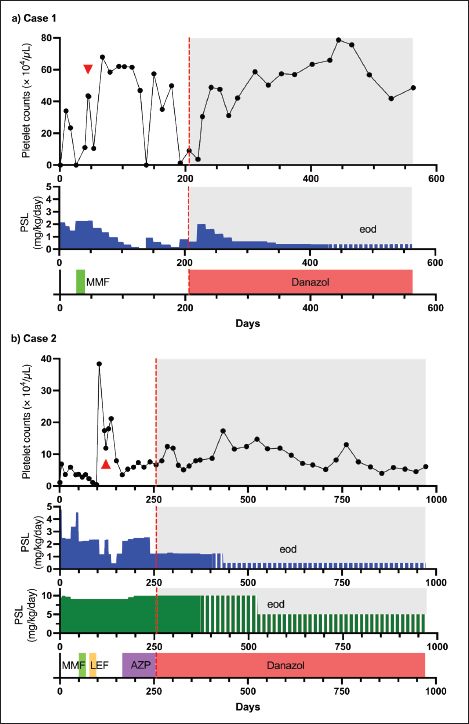
ABSTRACTBackground: Maintaining platelet (PLT) counts with lower doses of corticosteroid is an important clinical goal in the treatment of immune-mediated thrombocytopenia (IMT) in dogs. However, since some cases of refractory IMT are unresponsive to adjuvant therapies, including immunosuppressive agents and splenectomy, it is necessary to expand the treatment options for IMT. In this study, we evaluated the efficacy of danazol, a synthetic steroid reported to increase PLT counts through immunomodulatory and hormonal effects in human medicine. Case Description: This report describes the clinical course of two IMT dogs treated with adjunctive danazol therapy, which remains underexplored in veterinary medicine. In both cases, PLT counts remained difficult to control despite prednisolone (PSL) administration, multiple immunosuppressive agents, and splenectomy. Following the introduction of danazol, PLT counts were maintained within clinically acceptable ranges, and gradual tapering of PSL was achieved for at least 364 days in Case 1 and 716 days in Case 2. No clinically significant adverse effects associated with danazol administration were observed during the follow-up period. Conclusion: Our findings indicate that adjunctive danazol therapy may contribute to long-term PLT stabilization in some dogs with refractory IMT that remain poorly controlled after splenectomy. Further studies are warranted to evaluate the clinical utility and safety of danazol as an adjunctive treatment option in canine IMT. Keywords: Adjunctive therapy, Corticosteroid tapering, Immune-mediated disease, Refractory disease, Splenectomy. IntroductionImmune-mediated thrombocytopenia (IMT) is one of the most common hematologic diseases in dogs (Grindem et al., 1991). Especially, IMT cases with severe thrombocytopenia [platelet counts (PLT) below 50,000/µl] carry a high risk of spontaneous bleeding, which is directly related to life-threatening conditions such as gastrointestinal and cerebral hemorrhage (Putsche and Kohn, 2008; O’Marra et al., 2011; Cooper et al., 2016; Scuderi et al., 2016). Therefore, maintenance of PLT counts is a critical therapeutic goal in the treatment of IMT. Immunosuppressive therapy comprising high-dose corticosteroids, including prednisolone (PSL), is a widely accepted treatment for IMT and aims to maintain PLT counts within clinically acceptable ranges while reducing the risk of spontaneous bleeding (Whitley and Day, 2011; Nakamura et al., 2012). On the other hand, long-term administration of high-dose PSL is associated with adverse effects, including gastrointestinal complications, hepatopathy, muscle wasting, and increased susceptibility to infection, often requiring dose reduction. However, many cases experience recurrent relapse during gradual PSL dose reduction or with poor responsiveness to PSL (Simpson et al., 2018). In such cases of refractory IMT, combination therapy [e.g., additional immunosuppressive agents such as cyclosporine and mycophenolate mofetil (MMF)] should be employed in addition to PSL (Kristiansen and Nielsen, 2021). Several studies have suggested that splenectomy may contribute to PLT stabilization in selected dogs with refractory IMT by reducing PLT destruction and immune dysregulation (Jans et al., 1990; Bestwick et al., 2022). These findings indicate that, although the appropriate target population for splenectomy is still under debate, splenectomy may be a treatment option in cases of refractory IMT (LeVine et al., 2024a). However, maintenance of PLT counts within clinically acceptable ranges remains difficult in some dogs with refractory IMT despite multimodal therapy; therefore, veterinarians often employ multiple therapeutic approaches based on individual clinical responses. These observations highlight the need to expand individualized treatment options for dogs with refractory IMT. Danazol, a synthetic steroid with anti-gonadotropic and anti-estrogenic activities, is one of the oldest treatment options for immune-mediated diseases in humans (Ahn et al., 1983; Maloisel et al., 2004). Danazol is a 17β-hydroxysteroid and a terminal acetylenic compound. It is approved by the U.S. Food and Drug Administration for the treatment of endometriosis, fibrocystic breast disease, and hereditary angioedema. This drug exerts its effects through diverse mechanisms of action; it is particularly well known for its ability to bind to corticosteroids and sex hormone-binding globulin, thereby increasing their concentration and potency (Shah et al., 2024). Several studies in human medicine have reported increased PLT counts associated with danazol administration, potentially through immunomodulatory and hormonal mechanisms (Schreiber et al., 1987). In addition, several clinical studies have shown that adjunctive danazol administration in combination with corticosteroids and/or other immunosuppressive therapies has been associated with corticosteroid dose reduction and relapse control in some patients with immune thrombocytopenia (ITP) (Maloisel et al., 2004; Huang et al., 2022). Therefore, danazol adjunctive therapy is still recognized as a long-term treatment option for ITP in human patients who are unresponsive to standard options, including splenectomy and immunosuppressive agent administration (Neunert et al., 2011). On the other hand, evidence regarding the efficacy of danazol in veterinary medicine is insufficient, with only two studies reporting on the adjunctive use of danazol in IMT-affected dogs (Bloom et al., 1989; Lewis and Meyers, 1996). One possible explanation for this is that the advent of various immunosuppressive agents has led to a declining trend in the frequency of danazol use, thus preventing the accumulation of related evidence (regardless of favorable/unfavorable effects) in veterinary medicine (Miller, 1997). Herein, we describe cases of two dogs with refractory IMT in which adjunctive danazol therapy yielded long-term maintenance of PLT counts. Case DetailsCase 1Case 1 was a 9-year-old spayed female Welsh Corgi Pembroke presented for evaluation of bloody stool, lethargy, and severe thrombocytopenia. Physical examination revealed pale mucous membranes and hematochezia without evidence of lymphadenopathy or abdominal distension. The clinical course of Case 1 is presented in Figure 1a.
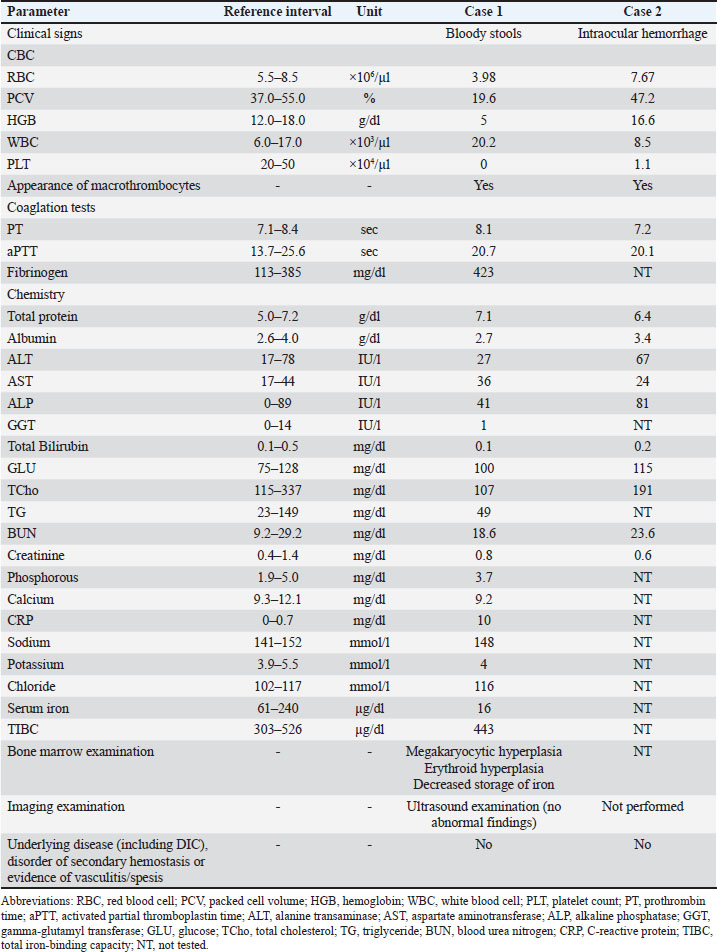
Fig. 1. Transition of PLT counts and treatment strategies in Case 1 (a) and Case 2 (b). Arrowheads indicate the timing of splenectomy (Case 1: day 45, Case 2: day 123). The gray-shaded areas indicate the periods of adjunctive danazol therapy (Case 1: initiated on day 199; Case 2: initiated on day 256). Abbreviations: eod, every other day; PSL, prednisolone; MMF, mycophenolate mofetil (9.3–11 mg/kg, twice daily); CsA, cyclosporine; LEF, leflunomide (1 mg/kg/day); AZP, azathioprine (2 mg/kg/day). On the day of admission (day 1), complete blood count (CBC) examination revealed severe thrombocytopenia (PLT: 0/µl) and regenerative anemia (Table 1). Coagulation testing showed no clinically relevant abnormalities suggestive of disseminated intravascular coagulation or other secondary hemostatic disorders. In addition, microscopic examination revealed no blood-borne infectious organisms, including Babesia species. Abdominal ultrasonography identified no evidence of neoplasia or inflammatory disease. Bone marrow examination demonstrated megakaryocytic hyperplasia, supporting peripheral PLT destruction. Based on these findings and exclusion of secondary causes of thrombocytopenia, the dog was diagnosed with primary IMT. Table 1. Examination findings at the time of the first visit (Day 1).
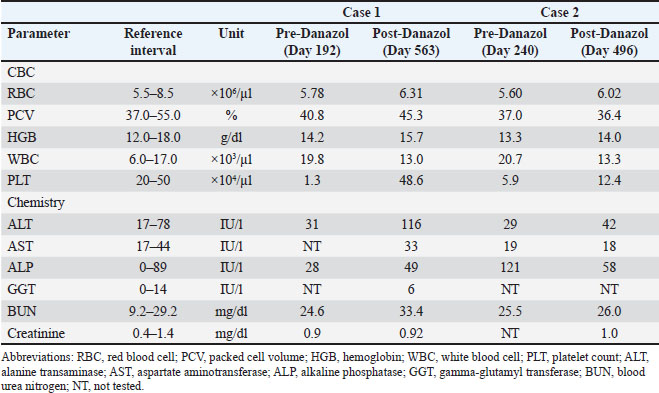
The dog was initially treated with PSL [2 mg/kg/day, oral administration (p.o.)], achieving an increase in PLT (341,000/μl) on day 10. In addition, lansoprazole was administered. However, IMT (PLT: 0/μl) relapse occurred on day 26 during gradual tapering of PSL (1.5 mg/kg/day). Thereafter, the dog was administered MMF (9.3 mg/kg, twice daily, p.o.) combined with PSL (2.2 mg/kg/day). Subsequently, the dog developed severe gastrointestinal adverse effects, including hematochezia and frequent diarrhea. Because continuation of MMF was considered difficult due to these side effects, and the owner declined further administration of additional immunosuppressive agents, splenectomy was performed on day 45. Histopathological examination of the spleen revealed no lesions suggestive of neoplasia, chronic splenitis, or other diseases associated with secondary IMT. Following splenectomy, PSL monotherapy was continued. However, repeated relapses of thrombocytopenia were observed during PSL dose reduction, including recurrence on day 138 (10 days after PSL withdrawal) and day 192 (PSL dosage: 0.8 mg/kg/day). Because PLT counts remained difficult to maintain despite splenectomy and corticosteroid therapy, adjunctive danazol therapy was initiated on day 206 with owner consent. Danazol was administered at 4 mg/kg twice daily (p.o.) in combination with PSL (2 mg/kg/day, p.o.). To monitor potential adverse effects associated with danazol administration, the dog underwent regular follow-up examinations at intervals of approximately 1–3 months. Monitoring included blood screening (CBC, serum biochemical testing, including hepatic and renal parameters) and imaging examinations when clinically indicated. No clinically significant hepatotoxicity, nephrotoxicity, or other adverse effects attributable to danazol were identified even after more than 6 months of concomitant danazol administration (Table 2 shows findings on Day 563). On day 563 (364 days after the initiation of danazol use), PLT remained stable without recurrence of clinically significant thrombocytopenia while receiving dose-tapered PSL (0.4 mg/kg, every other day, p.o.) and danazol (4 mg/kg, twice daily, p.o.). Furthermore, no clinically important deterioration in quality of life, including decreased appetite, gastrointestinal symptoms, or reduced activity, had been observed at the time of article submission. Table 2. Examination findings before and after Danazol administration.
Case 2Case 2 (Fig. 1b) was an 11-year-old male Yorkshire terrier referred for evaluation of intraocular hemorrhage and persistent thrombocytopenia. Physical examination at presentation identified ocular bleeding without evidence of pyrexia, lymphadenopathy, or abdominal abnormalities. The clinical course of Case 2 is summarized in Figure 1b. CBC examination on day 1 revealed severe thrombocytopenia (PLT: 11,000/µl) without marked anemia or leukocytosis (Table 1). Peripheral blood smear examination demonstrated macrothrombocytes, whereas infectious microorganisms were not identified. Coagulation abnormalities suggestive of disseminated intravascular coagulation were not detected. Although bone marrow examination and advanced imaging studies were not performed at the initial evaluation, no clinical findings suggestive of neoplastic disease, systemic infection, vasculitis, or other major causes of secondary thrombocytopenia were identified. Because primary IMT was considered the most likely differential diagnosis at presentation, empirical immunosuppressive treatment was initiated with PSL (5 mg/kg/day) and cyclosporine (CsA; 10 mg/kg, twice-daily). Following initiation of therapy, PLT counts transiently increased to 69,000/µl, suggesting responsiveness to immunosuppressive treatment. Based on the hematologic findings, exclusion of major differential diagnoses, and partial therapeutic response to corticosteroid-based immunosuppressive therapy, the dog was clinically diagnosed with IMT. However, thrombocytopenia persisted, and PLT counts subsequently decreased during gradual tapering of PSL to below 2.5 mg/kg/day. Because sustained PLT stabilization could not be achieved, additional immunosuppressive agents were sequentially administered. More specifically, MMF (11 mg/kg, twice daily, p.o.) was administered from days 50 to 80, leflunomide (1 mg/kg/day, p.o.) from days 78 to 105, and azathioprine (2 mg/kg/day, p.o.) from days 166 to 256, instead of CsA. Nevertheless, adequate PLT control remained difficult despite these therapeutic modifications. Thus, splenectomy was performed on day 123 following the administration of human immunoglobulin (0.5 g/kg, intravenous administration). Histopathological examination of the spleen revealed no pathological findings, including tumors or chronic splenitis. However, the PLT gradually decreased even after splenectomy; the lowest PLT of 35,000 /µl was observed at the PSL dose of 1.25 mg/kg/day on day 166. Based on the insufficient response to corticosteroids, multiple immunosuppressive agents, and splenectomy, this dog was considered to have refractory IMT. Therefore, adjunctive danazol was initiated on day 256 with owner consent. Danazol was administered at 5 mg/kg twice daily (p.o.) in combination with PSL (2.5 mg/kg/day) and CsA (10 mg/kg, twice daily). Adverse effects of danazol were assessed as in Case 1. Following initiation of danazol therapy, PLT increased (up to 173,000/µl). Thereafter, the doses of PSL and CsA were reduced gradually from day 373. No clinically significant adverse effects were observed even after continuing combined administration of danazol for more than 6 months (Table 2 shows findings on day 496). On day 716 after the initiation of the danazol combination (day 972), PLT remained above 50,000/µl while receiving low-dose PSL (0.5 mg/kg/day, every other day, p.o.) and CsA (5 mg/kg, twice daily, every other day, p.o.). In addition, no clinical abnormalities, such as decreased appetite or gastrointestinal symptoms, were observed during the follow-up period. Ethical approvalThe treatments described in this report were performed as part of routine clinical care and not as experimental interventions for research purposes. Therefore, formal approval by a research ethics committee was not required according to institutional policies applicable at the time of treatment. Written informed consent for treatment and the use of anonymized clinical information for publication was obtained from the owners of both dogs. The treatments for the above cases were performed at two hospitals in Japan (Case 1: Animal Medical Center of Gifu University; Case 2: Sanyo Animal Medical Center) under the supervision of the same veterinarian (YF). DiscussionIn human medicine, danazol has been used as an adjunctive treatment option for ITP for more than 30 years (Ahn et al., 1983; Liu et al., 2016). Proposed mechanisms include reduction of Fc receptors on monocytes and synergistic effects with glucocorticoids through displacement of cortisol from glucocorticoid-binding globulin (Schreiber et al., 1987; Mori et al., 1990). Danazol has also been described as a relatively well-tolerated and cost-effective therapeutic option in selected patients with ITP. On the other hand, there is insufficient accumulating evidence on the efficacy of danazol use in veterinary medicine. Although danazol has occasionally been evaluated in dogs with immune-mediated diseases (Yo et al., 2022), reports specifically focusing on canine IMT remain limited (Bloom et al., 1989; Lewis and Meyers, 1996; Şentürk et al., 2010). This report revisits the potential role of danazol therapy, which has long remained of little interest in IMT treatment strategy, and considers it as a treatment option for IMT dogs. In the present cases, danazol was introduced after insufficient PLT stabilization despite splenectomy and administration of multiple immunosuppressive agents. In Case 1, recurrent severe thrombocytopenia repeatedly developed during PSL tapering even after splenectomy. Following initiation of adjunctive danazol therapy, PLT counts remained stable for at least 364 days while the PSL dosage was gradually reduced. Similarly, in Case 2, clinically significant thrombocytopenia persisted despite administration of PSL, cyclosporine, MMF, leflunomide, azathioprine, and splenectomy. After the addition of danazol, PLT counts subsequently remained above levels generally associated with spontaneous severe bleeding, and gradual tapering of PSL and cyclosporine became possible during long-term follow-up. Because this report describes only two clinical cases without a controlled comparison group, causality between danazol administration and clinical improvement cannot be definitively established. Spontaneous fluctuation in disease activity, delayed responses to previously administered immunosuppressive therapies, or combined effects of concurrent medications may also have contributed to the observed clinical courses. Nevertheless, the temporal association between danazol initiation and subsequent PLT stabilization in both dogs suggests that danazol may have contributed to disease control in these refractory cases. An important aspect of the present report is that both dogs remained poorly responsive even after splenectomy. Splenectomy is recognized as one therapeutic option for selected dogs with refractory IMT because the spleen plays a role in PLT destruction and immune dysregulation (Lewis and Meyers, 1996; Nakamura et al., 2012; Bestwick et al., 2022). However, recurrence or insufficient PLT control after splenectomy has also been documented in canine IMT (LeVine et al., 2024a). The present cases therefore highlight the clinical challenge of managing dogs that remain refractory despite aggressive multimodal treatment strategies. In human medicine, several studies have reported favorable responses to danazol in patients with splenectomy-unresponsive ITP (Maloisel et al., 2004; Huang et al., 2022). Although direct comparison between canine IMT and human ITP should be interpreted cautiously, the present findings may support further investigation of danazol as an adjunctive option in dogs with similarly refractory disease. Potential adverse effects associated with danazol administration include hepatotoxicity, masculinization or feminization, weight gain, and gastrointestinal complications (Kobayashi et al., 2016). Therefore, careful long-term monitoring is important when danazol is administered in dogs. In the present cases, no clinically significant adverse effects attributable to danazol were identified during prolonged treatment periods. Serial monitoring of hematologic and biochemical parameters did not reveal marked hepatic or renal dysfunction. However, the number of evaluated cases remains very limited, and the safety profile of danazol in dogs with IMT cannot be determined from this report alone. This study has several limitations. First, this report included only two dogs, and treatment regimens were not standardized. Second, complete diagnostic evaluation according to the recently published American College of Veterinary Internal Medicine (ACVIM) consensus statement was not performed in all cases, particularly in Case 2, in which bone marrow examination and advanced imaging studies were unavailable at initial presentation (LeVine et al., 2024b). Therefore, it cannot be definitively stated that the diagnostic process for IMT was conducted using the full range of tests currently widely performed. Third, multiple concurrent therapies were administered before and during danazol treatment, making it difficult to isolate the specific contribution of danazol to clinical improvement. In addition, because no washout period was established between treatment modifications, residual effects of previously administered immunosuppressive agents may have influenced treatment response. Future studies evaluating the efficacy of danazol are needed based on more stringent diagnostic and treatment criteria. ConclusionThis report demonstrated that the adjunctive use of danazol, which has garnered little interest as a therapeutic option for IMT, was clinically effective in the treatment of two dogs with IMT with poorly controlled PLT counts even after splenectomy. Our findings encourage further investigation to expand treatment options for IMT-affected dogs, particularly those unresponsive to conventional treatments. AcknowledgmentsNone. Conflict of interestThe authors declare that there is no conflict of interest. FundingThis research received no specific grant. Authors' contributionsConceptualization: Y.F. Investigation: K.F., Y.F., and T.S. Methodology: Y.K., S.T., and N.N. Writing - the original draft: K.F. and Y.F. Writing - review & editing: All authors. Data availabilityAll data supporting the findings of this study are available within the manuscript. ReferencesAhn, Y.S., Harrington, W.J., Simon, S.R., Mylvaganam, R., Pall, L.M. and So, A.G. 1983. Danazol for the treatment of idiopathic thrombocytopenic purpura. N. Engl. J. Med. 308, 1396–1399. Bestwick, J.P., Skelly, B.J., Swann, J.W., Glanemann, B., Bexfield, N., Gkoka, Z., Walker, D.J., Silvestrini, P., Adamantos, S., Seth, M. and Warland, J. 2022. Splenectomy in the management of primary immune-mediated hemolytic anemia and primary immune-mediated thrombocytopenia in dogs. J. Vet. Intern. Med. 36, 1267–1280. Bloom, J.C., Meunier, L.D., Thiem, P.A. and Sellers, T.S. 1989. Use of danazol for treatment of corticosteroid-resistant immune-mediated thrombocytopenia in a dog. J. Am. Vet. Med. Assoc. 194, 76–78. Cooper, S.A., Huang, A.A. and Raskin, R.E. 2016. Clinical data, clinicopathologic findings and outcome in dogs with amegakaryocytic thrombocytopenia and primary immune-mediated thrombocytopenia. J. Small. Anim. Pract. 57, 142–147. Grindem, C.B., Breitschwerdt, E.B., Corbett, W.T. and Jans, H.E. 1991. Epidemiologic survey of thrombocytopenia in dogs: a report on 987 cases. Vet. Clin. Pathol. 20, 38–43. Huang, H.E., Lin, K.M., Lin, J.C., Lin, Y.T., He, H.R., Wang, Y.W., Yu, S.F., Chen, J.F. and Cheng, T.T. 2022. Danazol in refractory autoimmune hemolytic anemia or immune thrombocytopenia: a case series report and literature review. Pharmaceuticals 15, 1377. Jans, H.E., Armstrong, P.J. and Price, G.S. 1990. Therapy of immune-mediated thrombocytopenia. J. Vet. Intern. Med. 4(4), 4–7. Kobayashi, K., Shimokawa Miyama, T., Itamoto, K., Noguchi, S., Baba, K., Mizuno, T. and Okuda, M. 2016. Development of hepatocellular carcinoma after long-term immunosuppressive therapy including danazol in a dog. J. Vet. Med. Sci. 78, 1611–1614. Kristiansen, P.S. and Nielsen, L.N. 2021. Immunomodulatory and immunosuppressive drug protocols in the treatment of canine primary immune thrombocytopenia, a scoping review. Acta. Vet. Scand. 63, 54. Levine, D.N., Goggs, R., Kohn, B., Mackin, A.J., Kidd, L., Garden, O.A., Brooks, M.B., Eldermire, E.R.B., Abrams-Ogg, A., Appleman, E.H., Archer, T.M., Bianco, D., Blois, S.L., Brainard, B.M., Callan, M.B., Fellman, C.L., Haines, J.M., Hale, A.S., Huang, A.A., Lucy, J.M., O'Marra, S.K., Rozanski, E.A., Thomason, J.M., Walton, J.E. and Wilson, H.E. 2024. ACVIM consensus statement on the treatment of immune thrombocytopenia in dogs and cats. J. Vet. Intern. Med. 38, 1982–2007. Levine, D.N., Kidd, L., Garden, O.A., Brooks, M.B., Goggs, R., Kohn, B., Mackin, A.J., Eldermire, E.R.B., Chang, Y.M., Allen, J., Christopherson, P.W., Glanemann, B., Maruyama, H., Naskou, M.C., Nielsen, L.N., Shropshire, S., Viall, A.K., Birkenheuer, A.J., Forman, M.A., Hanzlicek, A.S., Langner, K.F., Lashnits, E., Lunn, K.F., Makielski, K.M., Roura, X. and Spada, E. 2024. ACVIM consensus statement on the diagnosis of immune thrombocytopenia in dogs and cats. J. Vet. Intern. Med. 38, 1958–1981. Lewis, D.C. and Meyers, K.M. 1996. Canine idiopathic thrombocytopenic purpura. J. Vet. Intern. Med. 10, 207–218. Liu, W., Gu, X., Fu, R., Li, Y., Lv, M., Sun, T., Lv, C., Liu, X., Xue, F., Zhang, L. and Yang, R. 2016. The effect of danazol in primary immune thrombocytopenia: an analysis of a large cohort from a single center in China. Clin. Appl. Thromb. Hemost. 22, 727–733. Maloisel, F., Andrès, E., Zimmer, J., Noel, E., Zamfir, A., Koumarianou, A. and Dufour, P. 2004. Danazol therapy in patients with chronic idiopathic thrombocytopenic purpura: long-term results. Am. J. Med. 116, 590–594. Miller, E. 1997. The use of danazol in the therapy of immune-mediated disease of dogs. Semin. Vet. Med. Surg. (Small Anim). 12, 167–169. Mori, H., Nakagawa, M., Itoh, N., Wada, K. and Tamaya, T. 1990. Danazol suppresses the production of interleukin-1 beta and tumor necrosis factor by human monocytes. Am. J. Reprod. Immunol. 24, 45–50. Nakamura, R.K., Tompkins, E. and Bianco, D. 2012. Therapeutic options for immune-mediated thrombocytopenia. J. Vet. Emerg. Crit. Care. 22, 59–72. Neunert, C., Lim, W., Crowther, M., Cohen, A., Solberg, L. and Crowther, M.A. 2011. The American Society of Hematology 2011 evidence-based practice guideline for immune thrombocytopenia. Blood 117, 4190–4207. O’Marra, S.K., Delaforcade, A.M. and Shaw, S.P. 2011. Treatment and predictors of outcome in dogs with immune-mediated thrombocytopenia. J. Am. Vet. Med. Assoc. 238, 346–352. Putsche, J.C. and Kohn, B. 2008. Primary immune-mediated thrombocytopenia in 30 dogs (1997-2003). J. Am. Anim. Hosp. Assoc. 44, 250–257. Schreiber, A.D., Chien, P., Tomaski, A. and Cines, D.B. 1987. Effect of danazol in immune thrombocytopenic purpura. N. Engl. J. Med. 316, 503–508. Scuderi, M.A., Snead, E., Mehain, S., Waldner, C. and Epp, T. 2016. Outcome based on treatment protocol in patients with primary canine immune-mediated thrombocytopenia: 46 cases (2000-2013). Can. Vet. J. 57, 514–518. Şentürk, S., Temizel, M., Cihan, H. and Aytuğ, N. 2010. Comparison of the effects of prednisolone, danazol and testosterone propionate therapy in dogs with immune-mediated hemolytic anemia and thrombocytopenia. Uludağ. Üniversitesi. Vet. Fakültesi. Derg. 29, 57–63. Shah, S., Yadav, R., Bhattarai, A., Dahal, K., Tharu, S., Gautam, S., Rawal, L., Thapa, S., Sah, S.K., Sharma, S. and Gundabolu, K. 2024. Safety and efficacy of danazol in immune thrombocytopenia: a systematic review. Res. Pract. Thrombosis. Haemostasis. 8, 102444. Simpson, K., Chapman, P. and Klag, A. 2018. Long-term outcome of primary immune-mediated thrombocytopenia in dogs. J. Small. Anim. Pract. 59, 674–680. Whitley, N.T. and Day, M.J. 2011. Immunomodulatory drugs and their application to the management of canine immune-mediated disease. J. Small. Anim. Pract. 52, 70–85. Yo, S., Park, H.J. and Song, K.H. 2022. Effectiveness of Danazol as an adjunctive therapy in dogs with immune-mediated hemolytic anemia. Korean J. Vet. Serv. 45, 165–169. | ||
| How to Cite this Article |
| Pubmed Style Furusawa K, Fujii Y, Shimoda T, Kobatake Y, Takashima S, Nishii N. Adjuvant administration of danazol contributed to the maintenance of platelet counts in two dogs with splenectomy-unresponsive immune-mediated thrombocytopenia. Open Vet. J.. 2026; 16(6): 3942-3949. doi:10.5455/OVJ.2026.v16.i6.63 Web Style Furusawa K, Fujii Y, Shimoda T, Kobatake Y, Takashima S, Nishii N. Adjuvant administration of danazol contributed to the maintenance of platelet counts in two dogs with splenectomy-unresponsive immune-mediated thrombocytopenia. https://www.openveterinaryjournal.com/?mno=305568 [Access: June 26, 2026]. doi:10.5455/OVJ.2026.v16.i6.63 AMA (American Medical Association) Style Furusawa K, Fujii Y, Shimoda T, Kobatake Y, Takashima S, Nishii N. Adjuvant administration of danazol contributed to the maintenance of platelet counts in two dogs with splenectomy-unresponsive immune-mediated thrombocytopenia. Open Vet. J.. 2026; 16(6): 3942-3949. doi:10.5455/OVJ.2026.v16.i6.63 Vancouver/ICMJE Style Furusawa K, Fujii Y, Shimoda T, Kobatake Y, Takashima S, Nishii N. Adjuvant administration of danazol contributed to the maintenance of platelet counts in two dogs with splenectomy-unresponsive immune-mediated thrombocytopenia. Open Vet. J.. (2026), [cited June 26, 2026]; 16(6): 3942-3949. doi:10.5455/OVJ.2026.v16.i6.63 Harvard Style Furusawa, K., Fujii, . Y., Shimoda, . T., Kobatake, . Y., Takashima, . S. & Nishii, . N. (2026) Adjuvant administration of danazol contributed to the maintenance of platelet counts in two dogs with splenectomy-unresponsive immune-mediated thrombocytopenia. Open Vet. J., 16 (6), 3942-3949. doi:10.5455/OVJ.2026.v16.i6.63 Turabian Style Furusawa, Keiichi, Yuji Fujii, Tetsuya Shimoda, Yui Kobatake, Satoshi Takashima, and Naohito Nishii. 2026. Adjuvant administration of danazol contributed to the maintenance of platelet counts in two dogs with splenectomy-unresponsive immune-mediated thrombocytopenia. Open Veterinary Journal, 16 (6), 3942-3949. doi:10.5455/OVJ.2026.v16.i6.63 Chicago Style Furusawa, Keiichi, Yuji Fujii, Tetsuya Shimoda, Yui Kobatake, Satoshi Takashima, and Naohito Nishii. "Adjuvant administration of danazol contributed to the maintenance of platelet counts in two dogs with splenectomy-unresponsive immune-mediated thrombocytopenia." Open Veterinary Journal 16 (2026), 3942-3949. doi:10.5455/OVJ.2026.v16.i6.63 MLA (The Modern Language Association) Style Furusawa, Keiichi, Yuji Fujii, Tetsuya Shimoda, Yui Kobatake, Satoshi Takashima, and Naohito Nishii. "Adjuvant administration of danazol contributed to the maintenance of platelet counts in two dogs with splenectomy-unresponsive immune-mediated thrombocytopenia." Open Veterinary Journal 16.6 (2026), 3942-3949. Print. doi:10.5455/OVJ.2026.v16.i6.63 APA (American Psychological Association) Style Furusawa, K., Fujii, . Y., Shimoda, . T., Kobatake, . Y., Takashima, . S. & Nishii, . N. (2026) Adjuvant administration of danazol contributed to the maintenance of platelet counts in two dogs with splenectomy-unresponsive immune-mediated thrombocytopenia. Open Veterinary Journal, 16 (6), 3942-3949. doi:10.5455/OVJ.2026.v16.i6.63 |


