



| Research Article | ||
Open Vet. J.. 2026; 16(6): 3759-3769 Open Veterinary Journal, (2026), Vol. 16(6): 3759-3769 Research Article Calcium beta-hydroxy-beta-methylbutyrate improves canine performance in greyhounds and mushing dogsJohn C. Fuller Jr.* and John A. RathmacherMTI Biotech, Inc., ISU Research Park, 2711 S. Loop Dr. Suite 4400, Ames, IA 50010, USA *Corresponding Author: John C. Fuller, Jr. MTI Biotech, Inc., ISU Research Park, 2711 S. Loop Dr. Suite 4400, Ames, IA 50010, USA. Email: Fuller [at] MTIBiotech.com Submitted: 29/12/2025 Revised: 05/05/2026 Accepted: 18/05/2026 Published: 16/06/2026 © 2025 Open Veterinary Journal
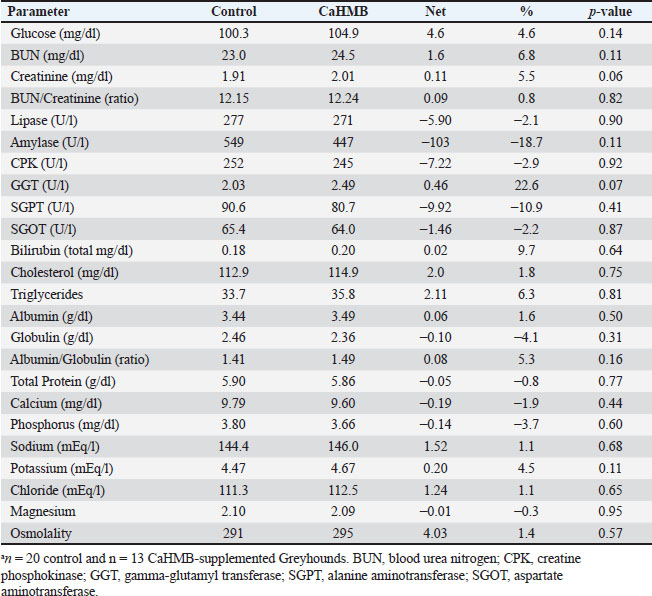
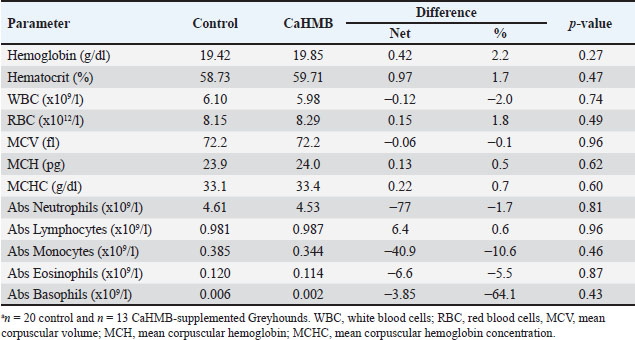
ABSTRACTBackground: The leucine metabolite β-hydroxy-β-methylbutyrate (HMB) has been extensively studied as a supplement to improve athletic performance in humans; however, data on its efficacy in canine athletes remain limited. Aim: To determine the safety and efficacy of calcium HMB (CaHMB) in canine athletes, we conducted two complementary studies with different designs: (1) a randomized trial in racing greyhounds (a sprint athletic model) and (2) an exploratory observational study in mushing dogs (an endurance athletic model). Methods: We studied greyhound racing during a 12-week race meet. A total of 37 dogs (18 controls, 19 CaHMB-supplemented receiving 1 g daily) were followed during pre-race training and then throughout the meet, and race times and placings were recorded. Blood was drawn for analysis during the racing period. In a second observational study, 22 mushing dogs (10 control, 12 CaHMB-supplemented, receiving 1 g daily) were studied. Blood chemistry was analyzed after an endurance training event. Results: Comprehensive blood chemistry and hematology panels indicated that HMB was safe with no adverse effects. HMB-supplemented greyhounds showed significantly better performance maintenance: race times increased by 0.18 s versus 0.73 s in controls (p < 0.05). Placement rankings improved markedly during the first 2 weeks post-supplementation (−0.78 places for HMB vs. +1.01 places worsened in controls; p=0.002). In the observational mushing dog study, HMB was well-tolerated with no adverse effects. Muscle damage markers (creatine phosphokinase and lactate dehydrogenase) showed numerically lower values in the HMB group. HMB-supplemented mushing dogs demonstrated significantly lower blood glucose (73.3 vs. 82.9 mg/dl; p=0.03) and cholesterol (218.8 vs. 254.4 mg/dl; p=0.05), which may reflect metabolic differences. Conclusion: These findings establish the safety of CaHMB supplementation in canine athletes and demonstrate significant benefits for sprint performance in a trial, with preliminary observational signals in endurance canine athletes that warrant confirmation in larger controlled trials. Larger controlled studies are needed to confirm efficacy in endurance contexts and to evaluate applicability to aging or sedentary companion dogs. Keywords: Dogs, Endurance, HMB, Safety, Sprinting. Introductionβ-Hydroxy-β-methylbutyrate (HMB), a metabolite of the amino acid leucine, has been studied extensively as a performance-enhancing supplement in humans for decades. HMB is metabolized to β-hydroxy-β-methylglutaryl-CoA (HMG-CoA), which serves as a precursor for the synthesis of intracellular cholesterol (Nissen and Abumrad, 1997). Intracellular cholesterol is essential for cell membrane function, particularly in muscle and immune cells, where it is critical for T-tubule function and muscle contraction (Barrientos et al., 2017). Muscle cells may be unable to synthesize sufficient cholesterol during intense exercise and training to maintain adequate membrane integrity and cellular function. Under these conditions, supplemental HMB could provide an alternative source of HMG-CoA for cholesterol synthesis (Bloch et al., 1954; Adamson and Greenberg, 1957; Rosenthal et al., 1974; Mathias et al., 1981), thereby supporting protein synthesis through activation of the mechanistic target of rapamycin and reducing protein degradation through inhibition of ubiquitin protease activity (Eley et al., 2008a,b; Wilkinson et al., 2018). The mechanistic rationale is supported by extensive human data showing that HMB supplementation increases strength and muscle mass while reducing muscle protein breakdown markers, including urinary 3-methylhistidine and plasma creatine phosphokinase (CPK) (Nissen et al., 1996). Additionally, HMB improves aerobic performance in humans by improving maximal oxygen consumption, lactic acid threshold, and respiratory compensation point (Lamboley et al., 2007; Robinson et al., 2014) as well as mitochondrial biogenesis (He et al., 2016). In racing equine, HMB supplementation promoted 46% lower creatine kinase levels post-race and improved performance in initial racing sessions and race placements (Miller et al., 1998). A second equine study found that 16 weeks of supplementation significantly lowered creatine kinase and lactic acid levels following strenuous training or racing (Ostaszewski et al., 2012). These findings demonstrate that HMB affects muscle protein metabolism and aerobic adaptations in both animal athletes and humans. Few studies have reported on supplemental nutrition for enhancing canine performance. Studies have largely focused on the potential for decreasing oxidative stress after a race (Scott et al., 2001) or after endurance exercise (Baskin et al., 2000). In another study, supplementing sled dogs with antioxidants before exercise did not attenuate the increase in creatine kinase activity, and the authors concluded that muscle damage was likely caused by a different mechanism (Piercy et al., 2000). Additionally, one study reported that supplementing vitamin C to reduce oxidative stress in greyhounds reduced racing performance (Marshall et al., 2002). Despite the extensive evidence in humans and equine studies, data in canine athletes remain limited, and the efficacy and safety of calcium HMB (CaHMB) supplementation in canine athletes have not been systematically evaluated across different athletic contexts (sprint vs. endurance performance). This gap in the literature motivated this investigation. Two complementary studies were conducted to evaluate the effects of CaHMB supplementation in canine athletes: Study 1, a randomized trial in racing greyhounds (sprint performance model), and Study 2, an exploratory observational study in mushing dogs (endurance performance model). HMB was administered as a calcium salt because the powder is more easily mixed into normal canine diets than the free-acid form. We hypothesized that CaHMB would be safe in both groups and would improve sprint performance maintenance in greyhounds and endurance in mushing dogs. Materials and MethodsStudy 1: racing greyhounds (Randomized controlled trial)Greyhounds from one kennel (trainer) were studied at a major U.S. dog track (Bluffs Run, Council Bluffs, Iowa, USA). The trainer received approval from the racing commission for the supplementation study. Animal care at the track met or exceeded the standard parameters. Dogs received a high-quality diet, fresh clean water, and routine veterinary care and were maintained in clean facilities with appropriate socialization. All greyhounds were actively competing at enrollment. The exclusion criteria were older animals approaching retirement and younger animals with no previous race history, as these have inherently different performance trajectories. Greyhounds ranged in age from 2 to 4 years. The average male weight was 32.3 ± 0.5 kg (n=17), whereas the average female weight was 27.8 ± 0.5 kg (n=20). Greyhounds were chosen for this study because of their extreme sprinting performance. Greyhounds were stratified by sex and baseline race time and then randomized to the control (n=18; 5 g dextrose–electrolyte mixture) or CaHMB (n=19; 1 g CaHMB with 4 g dextrose–electrolyte mixture) groups. The CaHMB was obtained from Metabolic Technologies (Ames, IA, USA). This dosage was chosen to approximate the most common dosage used in similar human studies (Fernández-Landa et al., 2024). Supplements (raw meat and kibble) were administered with morning feedings. In addition to the daily electrolytes, a mineral and vitamin supplement was administered on race days. All greyhounds in the kennel received the same diet consisting of meat protein (beef) and a dry food blend providing carbohydrates and fats. On a caloric basis, the diet consisted of 35% protein, 15% fat, and the remaining 50% carbohydrates. The CaHMB dosage was approximately 31 and 36 mg/kg body weight·day⁻¹ in males and females, respectively. Each dog was assigned a study number and a color-coded supplement to ensure compliance and reduce bias. All race times were recorded electronically by the track using standardized procedures; personnel recording race data were blinded to treatment assignment. The greyhounds ran races of either 0.5 km or 0.6 km. Supplementation was continued throughout the 12-week racing session. The primary efficacy endpoints, defined a priori, were the change in mean race time and placement ranking from pre- to post-supplementation. The primary safety endpoint was the comprehensive blood chemistry and hematology panels. Study 2: iditarod mushing dogs (Exploratory observational study)This study was explicitly designed as an exploratory, hypothesis-generating investigation and does not constitute a rigorous trial of efficacy. The observation, post hoc design without randomization or blinding, limits causal inference but provides preliminary signals that warrant investigation in larger controlled studies. A total of 22 mushing dogs (3 teams) from 2 trainers/mushers competed in a multiday endurance training competition. Dogs ranged in age from 3 to 9 years and were both male and female. Team 1 (trainer A) served as the control (n=10), Team 2 (trainer A) received CaHMB (n=5), and Team 3 (trainer B) received CaHMB (n=7). CaHMB was obtained from Metabolic Technologies, Ames, IA, USA. The dogs were not randomized as the dog’s assignment was determined by team membership and trainer preference. CaHMB-supplemented dogs received 1 g daily (four 250-mg capsules) added to morning feed, beginning at least 2 weeks prior to competition and continuing throughout. The control and treatment teams experienced similar training conditions. Body weights were not systematically recorded for individual mushing dogs; thus, an exact mg/kg·day⁻¹ dose cannot be reported. Based upon typical mushing dog body weights of 20–25 kg, the dose of 1 g/day corresponds to an approximate range of 40–50 mg/kg·day⁻¹, which is broadly comparable to the doses used in the Greyhound study. Blood collection and analysisStudy 1: Greyhounds Blood samples were collected throughout the supplementation period and analyzed by Antech Diagnostics (Fountain Valley, CA) using comprehensive chemistry and hematology panels. The primary end point of the blood analysis was to determine the safety of CaHMB administration in canines via comprehensive chemistry and hematology panels. A licensed veterinarian drew all blood from the cephalic vein and collected samples for blood chemistry and complete blood count (CBC). The dogs sampled had an average of 2 blood draws during the supplementation period, and the results were averaged for analysis. Blood chemistry and hematology were analyzed. The blood chemistry panel measured glucose, blood urea nitrogen (BUN), creatinine, BUN/Creatinine (ratio), lipase, amylase, CPK, gamma-glutamyl transferase (GGT), serum glutamic pyruvic transaminase (SGPT), serum glutamic oxaloacetic transaminase (SGOT), bilirubin (total), cholesterol, triglycerides, albumin, globulin, albumin/globulin (ratio), total protein, calcium, phosphorus, sodium, potassium, chloride, magnesium, and osmolality. The CBC included hemoglobin, hematocrit, white blood cells (WBCs), red blood cells (RBCs), mean corpuscular volume (MCV), mean corpuscular hemoglobin (MCH), mean corpuscular hemoglobin concentration (MCHC), and absolute counts of neutrophils, lymphocytes, monocytes, eosinophils, and basophils. Study 2 Mushing of dogsBlood samples were collected 24 hours after completion of the training race (not immediately upon finishing) and analyzed by either Providence Alaska Medical Center (Anchorage, AK) or Fairbanks Memorial Hospital (Fairbanks, AK), depending upon the location of the trainer. A licensed veterinarian performed all blood collection from the cephalic vein. The 24-hour timing was chosen for logistical feasibility but represents a limitation, as peak CPK and lactate dehydrogenase (LDH) levels may occur 24–48 hours post-race, and sampling only at 24 hours may underestimate peak muscle damage markers. The primary biomarkers of interest were muscle damage markers, CPK, LDH, and metabolic parameters (glucose and cholesterol). Blood urea nitrogen, creatinine, BUN/Creatinine (ratio), uric acid, GGT, SGPT, SGOT, bilirubin (total), albumin, globulin, albumin/globulin (ratio), total protein, alkaline phosphate, calcium, phosphorus, sodium, potassium, chloride, and total tetraiodothyronine (T-4) were all measured. Statistical analysisANOVA was performed using SAS (Statistical Analysis System for Windows 9.4) with a general linear model (Proc GLM). For the primary outcomes, 95% confidence intervals (CIs) around the effect estimates are reported. A significance threshold of p < 0.05 was used. Findings with 0.05 ≤ p ≤ 0.10 are described as trends but interpreted cautiously. Findings with p > 0.10 are described as "numerically lower/higher" without causal interpretation. For the mushing dog study, individual dogs were not randomly allocated; rather, entire teams were assigned to the treatments according to trainer preference, producing a clustered (hierarchical) data structure in which dogs nested within teams nested within trainers cannot be treated as independent observations. This clustering raises the risk of pseudoreplication and may inflate or deflate apparent treatment effects depending on whether unmeasured team- or trainer-level factors (training protocols, kennel diet, and environmental exposure) are associated with treatment assignment. A formal mixed-effects model with team and trainer as random effects was considered but not pursued because the limited number of clusters (3 teams across 2 trainers) provides insufficient degrees of freedom at the cluster level for reliable variance component estimation. Consequently, all p-values reported for Study 2 should be regarded as descriptive rather than inferential, and any clear treatment effects cannot be disentangled from team- or trainer-level confounding. Inter-individual variability in muscle damage markers was characterized using the coefficient of variation (CV) calculated as (CV=standard deviation (SD)/mean × 100%) to quantify heterogeneity. Ethical approvalThese studies were conducted under the regulatory oversight of the respective racing commissions, which approved the supplementation protocol. The greyhound study was conducted at a licensed racing facility where animal care meets or exceeds industry standards. Blood sampling was conducted by licensed veterinarians following standard veterinary practice in the mushing dog study. No formal Institutional Animal Care and Use Committee review was required because the research was conducted at privately operated commercial facilities using nutritional supplementation within normal husbandry practices. ResultsStudy 1: greyhound racingCaHMB supplementation resulted in no significant changes in blood chemistry over the 12-week period (Table 1) and no differences in blood hematology parameters (Table 2). Creatinine showed a trend toward an increase in the CaHMB group (p=0.06, difference=0.11 mg/dl), but both groups remained within the physiological range for racing greyhounds, which have elevated creatinine due to high muscle mass. These findings indicate that CaHMB supplementation is safe in actively racing greyhounds with no adverse hematologic or hepatic effects. Table 1. The effect of 12 weeks of calcium β-hydroxy-β-methylbutyrate (CaHMB) supplementation on blood chemistry in racing greyhounds.a
Table 2. The effect of 12 weeks of calcium β-hydroxy-β-methylbutyrate (CaHMB) supplementation on blood hematology in racing greyhounds.a
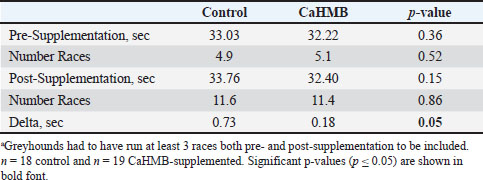
The baseline performance (pre-supplementation) did not significantly differ between the treatment groups (Table 3, p=0.36). Over the 12-week racing period, both groups exhibited increased race times. However, the magnitude differed significantly between the groups (Table 3). CaHMB-supplemented greyhounds showed a mean increase of 0.18 s compared to 0.73 s in controls (p < 0.05), representing a 75% smaller performance decline [95% (CI) for difference: -1.11–0.01 s]. When expressed as a percentage change from baseline, CaHMB dogs increased by 0.6%, whereas controls increased by 2.2%, a 3.7-fold difference. Table 3. Race times (sec) pre- and post-supplementation with calcium β-hydroxy-β-methylbutyrate (CaHMB).a
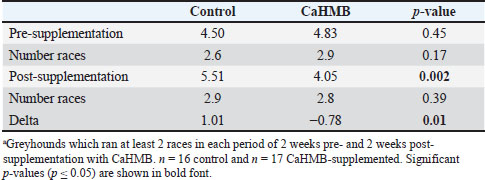
During the first 2 weeks after supplement initiation, placement rankings improved markedly in CaHMB-supplemented dogs (−0.78 places; p=0.002), whereas they worsened in controls (+1.01 places; p < 0.01) (Table 4). This represents a 1.5-place difference between the groups (95% CI: 0.56–2.35). This acute improvement in the early post-supplementation period is consistent with observations in Thoroughbred racing and indicates a rapid response to HMB supplementation. Over the full 12-week meet, placement improvement gradually diminished as both groups experienced normal fatigue accumulation, although CaHMB-supplemented dogs maintained better overall performance. Table 4. Greyhound race placing 2 weeks pre- and 2 weeks post-supplementation with calcium β-hydroxy-β-methylbutyrate (CaHMB)a.
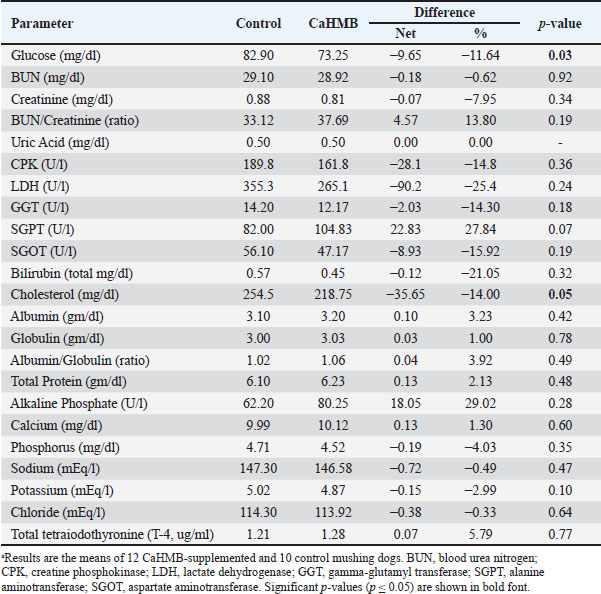
The number of races completed did not differ between the groups in either the pre- or post-supplementation periods (Table 3; p > 0.50), ensuring equal exposure to competitive stress. Study 2: mushing of dogs (explanatory findings)These results are from an observational, nonrandomized study and are presented as exploratory, hypothesis-generating findings. These results should not be interpreted as definitive evidence of efficacy and require confirmation through larger prospective controlled trials. No serious adverse effects were observed in either group 24 hours after the multi-day endurance competition. A comprehensive blood chemistry analysis (Table 5) revealed no significant abnormalities in either group. Table 5. The effect of calcium β-hydroxy-β-methylbutyrate (CaHMB) supplementation on blood chemistry in mushing dogs 24 hours post multi-day endurance event.a
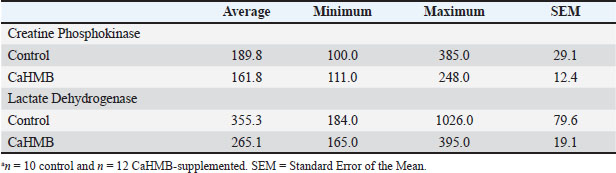
The values of muscle damage markers were numerically lower in the CaHMB group (Table 6). CPK was 14.8% lower in CaHMB dogs (p=0.36), and LDH was 25.4% lower (p=0.24). These differences did not reach statistical significance, likely due to the limited sample size and the timing of blood collection 24 hours post-race (peak markers may occur at 24–48 hour post-extreme endurance exercise). Table 6. Serum creatine phosphokinase and lactate dehydrogenase measured 24 hours post multi-day endurance event. Range of values and standard error of the means in mushing dogs supplemented with Calcium β-hydroxy-β-methylbutyrate (CaHMB)a.
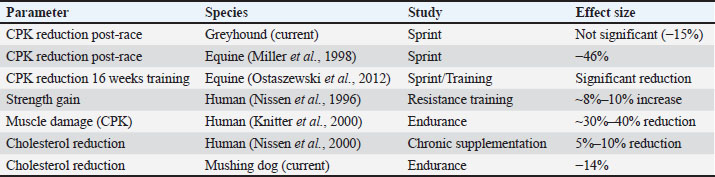
A notable finding was that inter-individual variability in muscle damage markers was substantially reduced among CaHMB-supplemented dogs. CPK CV was 26% in the CaHMB group versus 48% in the control group (almost 2-fold difference). LDH showed even greater stabilization, with a CV of 25% in CaHMB-supplemented dogs versus 71% in controls (almost 3-fold difference) (Table 6). This reduced inter-individual variability may result from more consistent muscle membrane stability with CaHMB supplementation, although larger studies and direct measurement of membrane integrity are required for confirmation. Serum glucose was significantly lower in CaHMB-supplemented mushing dogs (73.25 mg/dl vs. 82.90 mg/dl in controls; p=0.03; difference=−9.65 mg/dl, 95% CI: −18.2 to −1.1 mg/dl). Serum cholesterol was 14% lower in CaHMB-supplemented dogs than in controls (218.75 mg/dl vs. 254.40 mg/dl; p=0.05; difference=−35.65 mg/dl, 95% CI: −70.8 to −0.5 mg/dl). Other parameters that tended to change were potassium, which tended to be lower in the CaHMB group (p=0.10), and SGPT (alanine aminotransferase), which tended to be higher (p=0.07), neither reaching statistical significance nor consistent with hepatotoxicity patterns. DiscussionThis is the first systematic report of CaHMB supplementation in canine athletes, providing evidence that HMB is safe across both sprint and endurance athletic contexts. The absence of significant adverse blood chemistry or hematologic changes in both studies is reassuring. A recent independent pilot study in six dogs with Duchenne muscular dystrophy administered 3 g of CaHMB without adverse effects over 4 weeks (Nghiem et al., 2025) provided independent confirmation, further supporting canine safety. The long history of safe human supplementation (Nissen and Abumrad, 1997; Nissen et al., 2000) and safety data from the free acid form over more than a decade (Wilson et al., 2014; Rathmacher et al., 2025) strengthen confidence in the safety of this compound class in dogs. The greyhound study provides controlled evidence that HMB supplementation preserves sprint performance during intensive training. Although this study did not directly measure aerobic parameters (maximal oxygen consumption (VO₂ max) and lactate threshold), these findings are best hypothesized to be consistent with metabolic adaptation. Human studies have shown that HMB improves maximal oxygen consumption and lactic acid threshold (Vukovich and Dreifort, 2001; Fernández-Landa et al., 2024), and equine studies have shown increases in RBC numbers and distance run during exercise (Miller et al., 1998). Similar aerobic improvements may be observed in this greyhound cohort despite normal hematologic measures. In equine athletes, a 46% reduction in creatine kinase was observed (Miller et al., 1998). However, the lack of a significant finding in greyhounds may not be surprising as this breed of canine has specialized metabolism for sprinting (Zaldivar-Lopez et al., 2011). Spanish greyhounds, often used for hare hunting, showed increased blood levels of CPK after running four to seven sprints (races) in an 8-hour period. However, in the present study, greyhounds were provided with recovery time between the sprinting races (Lucas et al., 2015). The greyhound findings favorably compared with prior HMB studies in other species in effect size (Table 7). Although the improvements in sprint performance are modest relative to some human strength gains, they align well with the improvements observed in humans. Table 7. Comparison of β-hydroxy-β-methylbutyrate effects across species.
The mushing dog component is explicitly exploratory and does not constitute definitive evidence of efficacy due to its observational, nonrandomized design and the clustering of observations within teams and between trainers. However, several findings merit discussion as hypothesis-generating signals. The significantly lower post-competition glucose levels in HMB-supplemented dogs (p=0.03) are notable, as it was consistent across two different trainers using two different laboratories. Whether this reflects altered glucose utilization, intake, hepatic gluconeogenesis, or unmeasured team- or trainer-level differences cannot be determined from the present data, and the observation should be regarded as hypothesis-generating rather than evidence of a specific metabolic mechanism. Previous studies have shown that conditioning in sled dogs increases the expression of glucose transporters in muscle cells (Barrett and Scott Davis, 2023), whereas in late gestation sows, CaHMB improved the adsorption of nutrients and glucose from the gut (Flummer et al., 2012). It is possible that the interaction of the endurance exercise and CaHMB may have improved glucose uptake in the muscle, but without further investigation, these findings are best hypothesized to be consistent with metabolic adaptation. The 14% cholesterol reduction is particularly intriguing, as it substantially exceeds the 5%–10% reductions typically observed in humans during chronic HMB supplementation (Nissen and Abumrad, 1997; Nissen et al., 2000). This species-specific difference may reflect different baseline cholesterol metabolism in dogs compared with that in humans, which may be related to differences in hepatic cholesterol regulation, lipoprotein metabolism, or dietary cholesterol intake. Consistent with HMB’s metabolic position upstream of HMG-CoA, one speculative explanation is that HMB-derived HMG-CoA could spare hepatic cholesterol synthesis; however, this remains a hypothesis only, as the present study did not measure cholesterol synthetic flux, lipoprotein subfractions, or dietary cholesterol intake. Confounding by team- or trainer-level differences in feeding practices cannot be excluded. The 2-to-3-fold reduction in the inter-individual variability of muscle damage markers (particularly LDH) in HMB-supplemented mushing dogs is intriguing and suggests more consistent muscle membrane stability; however, it requires confirmation through direct measurement of membrane integrity. Study design considerationsStrengths and limitations of study 1 (Greyhounds)The randomized, blinded design of Study 1, coupled with electronic timing by track personnel and baseline equivalence between groups, provides controlled evidence for the benefits of sprint performance. However, several important limitations circumscribe the generalizability of these findings. The study was conducted with dogs from a single kennel under the management of one trainer, raising questions about whether these benefits would manifest across different training philosophies and breeding lines. Although race frequency was balanced between groups, individual dogs nonetheless experienced variable numbers of races, which could introduce unmeasured confounding related to individual athletic capacity. The study population was further restricted to dogs in their athletic prime (2–4 years of age), excluding older dogs approaching retirement and younger, inexperienced dogs that might respond differently to supplementation. In addition, although male and female dogs received slightly different dosages (31 and 36 mg/kg·day⁻¹, respectively), the modest sample size precluded sex-stratified analyses that might have revealed sex-specific responses to HMB. It should also be acknowledged that the performance was assessed across a 12-week race meet, during which the racing experience itself can alter the performance trajectories. The between-group comparison remains valid because both arms were equally exposed to the meet schedule; however, the absolute performance trajectories observed reflect the combined effects of training maturation, fatigue accumulation, and any treatment effect. Limitations of study 2 (Mushing dogs)The exploratory, observational nature of Study 2, in addition to the clustering of the mushing dog data within teams and among trainers, carries inherent limitations that must be acknowledged when interpreting its findings. The study employed a post-hoc, nonrandomized design without blinding, with team assignment determined by trainer preference rather than random allocation. The small sample size of just 22 dogs distributed across only two trainers and three teams severely constrains statistical power and generalizability, particularly given that dogs within the same team share training protocols, feeding practices, and environmental exposure that could systematically influence their metabolic responses. Blood samples were collected at a single time point (24 hours post-race). Without serial sampling, it is not possible to distinguish whether HMB altered the peak magnitude of CPK and LDH release or the slope of post-exercise recovery, an ambiguity that limits the mechanistic interpretation of the muscle damage marker data. These limitations collectively mean that although the findings of the mushing dog are intriguing and hypothesis-generating, they cannot be interpreted as definitive evidence and require confirmation through larger, prospectively designed controlled trials. Future directionsThe promising findings from this initial investigation point to several important areas for future research. A critical next step will be to conduct larger prospective controlled studies that confirm the efficacy of CaHMB in canine sprint athletes, examining whether performance benefits can be generalized across multiple trainers and varying track conditions beyond the single kennel studied here. Controlled randomized investigations in diverse mushing teams will be equally important to determine whether the observations we recorded translate into genuine performance improvements in endurance athletes. Given that most companion dogs are aging, sedentary, and struggling with obesity or age-related muscle loss, investigating whether HMB’s protective effects extend to these populations is another compelling direction, potentially offering a novel therapeutic approach to sarcopenia in companion animals. Future work should directly measure the biochemical pathways through which HMB exerts its effects, including protein turnover (via urinary 3-methylhistidine and amino acid profiles), cholesterol synthetic pathways, and muscle membrane composition, to move beyond empirical observation toward mechanistic understanding. The reassuring safety profile consistently observed across both sprint and endurance athletic contexts provides a foundation for broader investigation. The primary mode of action underlying these performance improvements may involve HMB-dependent enhancement of muscle protein metabolism (Wilkinson et al., 2018). HMB also improves aerobic metabolism by upregulating the expression of peroxisome proliferator-activated receptor gamma coactivator 1-alpha, the master regulator of mitochondrial biogenesis, and activating adenosine monophosphate-activated protein kinase kinase Sirt1 (Bruckbauer and Zemel, 2013; Standley et al., 2020). This process could potentially promote mitochondrial biogenesis in both muscle cells and adipocytes, leading to improvements in carbohydrate and fat metabolism energy, increased oxygen consumption, and reduced fat mass (Bruckbauer et al., 2012; He et al., 2016; Sun and Zemel, 2009). The direct evidence of these specific pathways in canine muscle tissue remains limited and an important area for future mechanistic research. ConclusionThese preliminary studies demonstrate that HMB is safe and provides benefit to athletic performance in greyhounds. In an observational study, preliminary signals consistent with, but not establishing, an effect on endurance performance in mushing dogs should be tested in randomized controlled trials. Further studies are warranted to determine if the optimal dosage was used, as well as further studies in other canine populations, such as whether these benefits might extend to aging companion dogs with sarcopenia. AcknowledgmentsThe authors wish to acknowledge the trainers’ support in conducting the studies reported here. The authors also want to acknowledge the ardent work of Mr. Shawn Baier, who oversaw the studies. Conflict of interestJAR is employed by MTI Biotech, which originally developed HMB. JCF was previously employed by MTI Biotech and is a consultant to MTI Biotech. JAR and JCF are inventors on various HMB patents. FundingMTI Biotech, Inc. (Ames, IA, USA) provided funding for this study. Authors’ contributionsJCF and JAR participated in the study design. JCF was responsible for the statistical analysis. JCF and JAR wrote and reviewed the manuscript. Data availabilityData are available upon request from the corresponding author. ReferencesAdamson, L.F. and Greenberg, D.M. 1957. The significance of certain carboxylic acids as intermediates in the biosynthesis of cholesterol. Biochimica. Et Biophysica. Acta (BBA). Gen. Subjects 23, 472–479. Barrett, M.R. and Scott Davis, M. 2023. Conditioning-induced expression of novel glucose transporters in canine skeletal muscle homogenate. PLos One 18(5), 285424; doi: 10.1371/journal.pone.0285424 Barrientos, G., Sánchez-Aguilera, P., Jaimovich, E., Hidalgo, C. and Llanos, P. 2017. Membrane cholesterol in skeletal muscle: a novel player in excitation-contraction coupling and insulin resistance. J. Diabetes Res. 2017, 3941898; doi:10.1155/2017/3941898 Baskin, C.R., Hinchcliff, K.W., Disilvestro, R.A., Reinhart, G.A., Hayek, M.G., Chew, B.P., Burr, J.R. and Swenson, R.A. 2000. Effects of dietary antioxidant supplementation on oxidative damage and resistance to oxidative damage during prolonged exercise in sled dogs. Am. J. Vet. Res. 61(8), 886–891; doi:10.2460/ajvr.2000.61.886 Bloch, K., Clark, L.C. and Harary, I. 1954. Utilization of branched chain acids in cholesterol synthesis. J. Biol. Chem. 211, 687–699. Bruckbauer, A. and Zemel, M.B. 2013. Synergistic effects of metformin, resveratrol, and hydroxymethylbutyrate on insulin sensitivity. Diabetes Metab. Syndr. Obes. 6, 93–102. Bruckbauer, A., Zemel, M.B., Thorpe, T., Akula, M.R., Stuckey, A.C., Osborne, D., Martin, E.B., Kennel, S. and Wall, J.S. 2012. Synergistic effects of leucine and resveratrol on insulin sensitivity and fat metabolism in adipocytes and mice. Nutr. Metab. 9(1), 77; doi:10.1186/1743-7075-9-77 Eley, H.L., Russell S.T. and Tisdale, M.J. 2008a. Attenuation of depression of muscle protein synthesis induced by lipopolysaccharide, tumor necrosis factor and angiotensin II by β-hydroxy-β-methylbutyrate. Am. J. Physiol. Endocrinol. Metab. 295, E1409–E1416. Eley, H.L., Russell, S.T. and Tisdale., M.J. 2008b. Mechanism of attenuation of muscle protein degradation induced by tumor necrosis factor alpha and angiotensin II by beta-hydroxy-beta-methylbutyrate. Am. J. Physiol. Endocrinol. Metab. 295, E1417–E1426. Fernández-Landa, J., Todorovic, N., Santibañez-Gutierrez, A., Ostojic, S.M., Calleja-González, J., Sekulic, D. and Mielgo-Ayuso, J. 2024. Effects of HMB on endurance performance in a healthy population: a systematic review and meta-analysis. J. Strength Cond. Res. 38, e202–e210; doi:10.1519/jsc.0000000000004690 Flummer, C., Lyby, H., Storli, K.S., Bjerre-Harpøth, V., Nielsen, B.M., Krämer, M., Røjen, B.A., Kristensen, N.B. and Theil, P.K. 2012. Effects of beta-hydroxy beta-methyl butyrate supplementation to sows in late gestation on absorption and hepatic metabolism of glucose and amino acids during transition. J. Anim. Sci. 90, 146–148. He, X., Duan, Y., Yao, K., Li, F., Hou, Y., Wu, G. and Yin, Y. 2016. beta-Hydroxy-beta-methylbutyrate, mitochondrial biogenesis, and skeletal muscle health. Amino Acids 48(3), 653–664; doi:10.1007/s00726-015-2126-7 Knitter, A.E., Panton, L., Rathmacher, J.A., Petersen, A. and Sharp, R. 2000. Effects of β-hydroxy-β-methylbutyrate on muscle damage following a prolonged run. J. Appl. Physiol. 89, 1340–1344. Lamboley, C.R., Royer, D. and Dionne, I.J. 2007. Effects of beta-hydroxy-beta-methylbutyrate on aerobic-performance components and body composition in college students. Int. J. Sport. Nutr. Exerc. Metab. 17(1), 56–69. Lucas, V., Barrera, R., Duque, F.J., Ruiz, P. and Zaragoza, C. 2015. Effect of exercise on serum markers of muscle inflammation in Spanish Greyhounds. Am. J. Vet. Res. 76(7), 637–643. Marshall, R.J., Scott, K.C., Hill, R.C., Lewis, D.D., Sundstrom, D., Jones, G.L. and Harper, J. 2002. Supplemental vitamin C appears to slow racing greyhounds. J. Nutr. 132(6 Suppl 2), 1616s–1621s. Mathias, M.M., Sullivan, A.C. and Hamilton, J.G. 1981. Fatty acid and cholesterol synthesis from specifically labeled leucine by isolated rat hepatocytes. Lipids 16, 739–743. Miller, P., Sandberg, L. and Fuller, Jr J.C. 1998. The effects of supplemental beta-hydroxy-beta-methylbutyrate (HMB) on training and racing thoroughbreds. Equine Sports Med. 1, 23–24. Nghiem, P.P., Rutledge, A.M., Tehas, K., Kaderli, C., Poling, M., Arnim, S., Dernov, V., Van Sas, C., Mackey, M.L., Have, G.A.M.T., Engelen, M.P.K.J. and Deutz, N.E.P. 2025. Beta-hydroxy-beta-methylbutyrate (HMB) improves daily activity and whole-body protein metabolism in Duchenne muscular dystrophy dogs: a pilot study. Scientific. Rep. 15(1), 4026; doi:10.1038/s41598-025-88651-8 Nissen, S., Sharp, R.L., Panton, L., Vukovich, M., Trappe, S. and Fuller, Jr., J.C. 2000. Beta-hydroxy-beta-methylbutyrate (HMB) supplementation in humans is safe and may decrease cardiovascular risk factors. J. Nutr. 130(8), 1937–1945; doi:10.1093/jn/130.8.1937 Nissen, S., Sharp, R., Ray, M., Rathmacher. J.A., Rice, D., Fuller, Jr., J.C., Connelly, A.S. and Abumrad, N.N. 1996. Effect of leucine metabolite β-hydroxy β-methylbutyrate on muscle metabolism during resistance-exercise training. J. Appl. Physiol. 81, 2095–2104; doi:10.1152/jappl.1996.81.5.2095 Nissen, S.L. and Abumrad, N.N. 1997. Nutritional role of the leucine metabolite β-hydroxy-β-methylbutyrate (HMB). J. Nutr. Biochem. 8, 300–311. Ostaszewski, P., Kowalska, A., Szarska, E., Szpotanski, P., Cywinska, A., Balasinska, B. and Sadkowski, T. 2012. Effects of β-hydroxy-β-methylbutyrate and γ-oryzanol on blood biochemical markers in exercising Thouroughbred race horses. J. Equine Vet. Sci. 32, 542–551. Piercy, R.J., Hinchcliff, K.W., Disilvestro, R.A., Reinhart, G.A., Baskin, C.R., Hayek, M.G., Burr, J.R. and Swenson, R.A. 2000. Effect of dietary supplements containing antioxidants on attenuation of muscle damage in exercising sled dogs. Am. J. Vet. Res. 61(11), 1438–1445; doi:10.2460/ajvr.2000.61.1438 Rathmacher, J.A., Pitchford, L.M., Stout, J.R., Townsend, J.R., Jäger, R., Kreider, R.B., Campbell, B.I., Kerksick, C.M., Harty, P.S., Candow, D.G., Roberts, B.M., Arent, S.M., Kalman, D.S. and Antonio, J. 2025. International society of sports nutrition position stand: β-hydroxy-β-methylbutyrate (HMB). J. Int. Soc. Sports Nutr. 22(1), 2434734; doi:10.1080/15502783.2024.2434734 Robinson, IV E.H., Stout, J.R., Miramonti, A.A., Fukuda, D.H., Wang, R., Townsend, J.R., Mangine, G.T., Fragala, M.S. and Hoffman, J.R. 2014. High-intensity interval training and beta-hydroxy-beta-methylbutyric free acid improves aerobic power and metabolic thresholds. J. Int. Soc. Sports. Nutr. 11, 16. Rosenthal, J., Angel, A. and Farkas, J. 1974. Metabolic fate of leucine: a significant sterol precursor in adipose tissue and muscle. Am. J. Phys. 226, 411–418. Scott, K.C., Hill, R.C., Lewis, D.D., Boning, A.J. and Sundstrom, D.A. 2001. Effect of alpha-tocopheryl acetate supplementation on vitamin E concentrations in Greyhounds before and after a race. Am. J. Vet. Res. 62(7), 1118–1120; doi:10.2460/ajvr.2001.62.1118 Standley, R.A., Distefano, G., Trevino, M.B., Chen, E., Narain, N.R., Greenwood, B., Kondakci, G., Tolstikov, V.V., Kiebish, M.A., Yu, G., Qi, F., Kelly, D.P., Vega, R.B., Coen, P.M. and Goodpaster, B.H. 2020. Skeletal muscle energetics and mitochondrial function are impaired following 10 days of bed rest in older adults. J. Gerontol. Ser. A. Biol. Sci. Med. Sci. 75(9), 1744–1753; doi:10.1093/gerona/glaa001 Sun, X. and Zemel, M.B. 2009. Leucine modulation of mitochondrial mass and oxygen consumption in skeletal muscle cells and adipocytes. Nutr. Metab. 6, 26; doi:10.1186/1743-7075-6-26 Vukovich, M.D. and Dreifort, G.D. 2001. Effect of beta-hydroxy beta-methylbutyrate on the onset of blood lactate accumulation and V(O)(2) peak in endurance-trained cyclists. J. Strength Cond. Res. 15(4), 491–497. Wilkinson, D.J., Hossain, T., Limb, M.C., Phillips, B.E., Lund, J., Williams, J.P., Brook, M.S., Cegielski, J., Philp, A., Ashcroft, S., Rathmacher, J.A., Szewczyk, N.J., Smith, K. and Atherton, P.J. 2018. Impact of the calcium form of beta-hydroxy-beta-methylbutyrate upon human skeletal muscle protein metabolism. Clin. Nutr. 37, 2068–2075; doi:10.1016/j.clnu.2017.09.024 Wilson, J.M., Lowery, R.P., Joy, J.M., Andersen, J.C., Wilson, S.M.C., Stout, J.R., Duncan, N., Fuller, J.C., Baier, S.M., Naimo, M.A. and Rathmacher, J. 2014. The effects of 12 weeks of beta-hydroxy-beta-methylbutyrate free acid supplementation on muscle mass, strength, and power in resistance trained individuals: a randomized, double-blind, placebo-controlled study. Eur. J. Appl. Physiol. 114, 1217–1227. Zaldívar-López, S., Marín, L.M., Iazbik, M.C., Westendorf-Stingle, N., Hensley, S. and Couto, C.G. 2011. Clinical pathology of Greyhounds and other sighthounds. Vet. Clin. Pathol. 40(4), 414–425; doi:10.1111/j.1939-165X.2011.00360.x | ||
| How to Cite this Article |
| Pubmed Style Jr. JCF, Rathmacher JA. Calcium beta-hydroxy-beta-methylbutyrate improves canine performance in greyhounds and mushing dogs. Open Vet. J.. 2026; 16(6): 3759-3769. doi:10.5455/OVJ.2026.v16.i6.47 Web Style Jr. JCF, Rathmacher JA. Calcium beta-hydroxy-beta-methylbutyrate improves canine performance in greyhounds and mushing dogs. https://www.openveterinaryjournal.com/?mno=304940 [Access: June 26, 2026]. doi:10.5455/OVJ.2026.v16.i6.47 AMA (American Medical Association) Style Jr. JCF, Rathmacher JA. Calcium beta-hydroxy-beta-methylbutyrate improves canine performance in greyhounds and mushing dogs. Open Vet. J.. 2026; 16(6): 3759-3769. doi:10.5455/OVJ.2026.v16.i6.47 Vancouver/ICMJE Style Jr. JCF, Rathmacher JA. Calcium beta-hydroxy-beta-methylbutyrate improves canine performance in greyhounds and mushing dogs. Open Vet. J.. (2026), [cited June 26, 2026]; 16(6): 3759-3769. doi:10.5455/OVJ.2026.v16.i6.47 Harvard Style Jr., J. C. F. & Rathmacher, . J. A. (2026) Calcium beta-hydroxy-beta-methylbutyrate improves canine performance in greyhounds and mushing dogs. Open Vet. J., 16 (6), 3759-3769. doi:10.5455/OVJ.2026.v16.i6.47 Turabian Style Jr., John C. Fuller, and John A. Rathmacher. 2026. Calcium beta-hydroxy-beta-methylbutyrate improves canine performance in greyhounds and mushing dogs. Open Veterinary Journal, 16 (6), 3759-3769. doi:10.5455/OVJ.2026.v16.i6.47 Chicago Style Jr., John C. Fuller, and John A. Rathmacher. "Calcium beta-hydroxy-beta-methylbutyrate improves canine performance in greyhounds and mushing dogs." Open Veterinary Journal 16 (2026), 3759-3769. doi:10.5455/OVJ.2026.v16.i6.47 MLA (The Modern Language Association) Style Jr., John C. Fuller, and John A. Rathmacher. "Calcium beta-hydroxy-beta-methylbutyrate improves canine performance in greyhounds and mushing dogs." Open Veterinary Journal 16.6 (2026), 3759-3769. Print. doi:10.5455/OVJ.2026.v16.i6.47 APA (American Psychological Association) Style Jr., J. C. F. & Rathmacher, . J. A. (2026) Calcium beta-hydroxy-beta-methylbutyrate improves canine performance in greyhounds and mushing dogs. Open Veterinary Journal, 16 (6), 3759-3769. doi:10.5455/OVJ.2026.v16.i6.47 |


