




| Short Communication | ||
Open Vet. J.. 2026; 16(6): 3713-3716 Open Veterinary Journal, (2026), Vol. 16(6): 3713-3716 Short Communication Larvicidal activity of silver nitrate against different larval instars of Culex pipiens under laboratory conditionsHarith Qasim Mahdi* and Zeina Nabeel Al-AzawiiDepartment of Biology, College of Education for Pure Sciences Ibn Al-Haitham, University of Baghdad, Baghdad, Iraq *Corresponding Author: Harith Qasim Mahdi. Department of Biology, College of Education for Pure Sciences Ibn Al-Haitham, University of Baghdad, Baghdad, Iraq. Email: harith.q.m [at] ihcoedu.uobaghdad.edu.iq Submitted: 08/12/2025 Revised: 03/03/2026 Accepted: 11/03/2026 Published: 12/06/2026 © 2025 Open Veterinary Journal
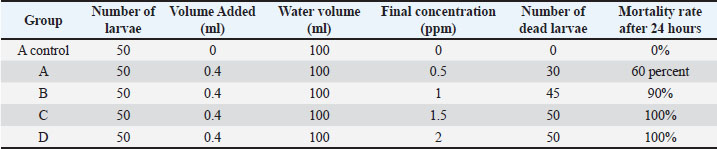
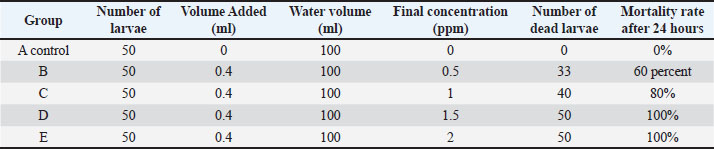
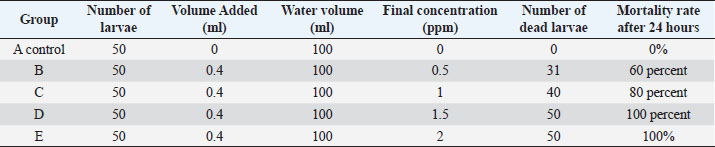
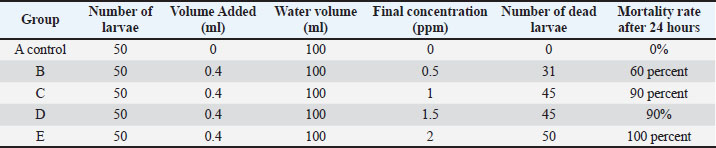
ABSTRACTBackground: The increasing resistance of mosquitoes to conventional chemical insecticides has encouraged the search for effective alternative control agents. Aim: This study aimed to evaluate the larvicidal activity of silver nitrate (AgNO3) against the four larval instars of Culex pipiens under laboratory conditions. Methods: Five concentrations (0, 0.5, 1, 1.5, and 2 ppm) were tested using 50 larvae per instar with five replicates. Larval mortality was recorded after 24 hours of exposure at 25°C. Results: Larval mortality increased in a concentration-dependent manner for all instars. The highest mortality (100%) was recorded at 2 ppm, whereas no mortality occurred in the control treatment. Conclusion: Silver nitrate demonstrated strong larvicidal activity against C. pipiens larvae and may represent a promising alternative larvicide. The increasing resistance of mosquitoes to conventional chemical insecticides has encouraged the search for effective alternative control agents. Silver nitrate was evaluated for its larvicidal activity against the 4 larval instars of C. pipiens under laboratory conditions. Five concentrations (0, 0.5, 1, 1.5, and 2 ppm) were tested using 50 larvae per instar with 5 replicates. Mortality was assessed after 24 hours of exposure at 25°C. Larval mortality increased in a concentration-dependent manner, with the highest mortality observed at 2 ppm. These findings suggest that silver nitrate at appropriate concentrations may serve as a promising larvicidal agent. Keywords: Culex pipiens, Larval instars, Larvicidal activity, Mosquito control, Silver nitrate. IntroductionMosquitoes, particularly Culex pipiens, are important vectors of several human diseases that pose significant public health concerns worldwide. Conventional mosquito control strategies heavily rely on synthetic chemical insecticides. However, their extensive and repeated use has resulted in the development of insecticide resistance and may also contribute to environmental pollution and adverse effects on non-target organisms (Govindarajan et al., 2016; Abdel-Wahab and Al-Deeb, 2022). Consequently, an increasing need exists to explore safer and more effective alternative control agents. Silver-based compounds have attracted attention as potential candidates due to their well-documented antimicrobial properties and broad-spectrum biological activity. Silver ions interfere with vital cellular processes by inactivating essential enzymes, disrupting membrane integrity, altering permeability, and inducing structural damage that ultimately leads to cell death (Al-Husayni and Hatoor, 2014). Silver nitrate (AgNO3) has demonstrated toxicity against various insect species. Nevertheless, only a limited number of studies have investigated its direct larvicidal activity against mosquito larvae under controlled laboratory conditions (Alumairi et al., 2023; Aljoboory and Saber, 2022). Therefore, the present study aimed to evaluate the larvicidal efficacy of silver nitrate against C. pipiens larvae at different developmental stages (instars) and to assess mortality responses across a range of concentrations under laboratory conditions. Materials and MethodsCollection methodsC. pipiens larvae were collected from stagnant water in urban areas and identified using standard morphological keys. Healthy, active larvae were selected and divided into four groups based on instar stage (L1, L2, L3, and L4) (Ali and Ablas, 2012; and Aljaf et al., 2019). Preparation of the silver nitrate solutionA stock solution of silver nitrate was prepared using distilled water and serially diluted to obtain final concentrations of 0.5, 1.0, 1.5, and 2.0 ppm. A control treatment consisting of only distilled water (0 ppm) was included for comparison. Working methodFor each concentration and larval stage, 50 larvae were placed in 100 ml of the relevant test solution using a micropipette. The experiment was conducted in five replicates. They were stored in lidded plastic containers at 25°C, with no larval food provided during the experiment. 2.4.Mortality Assessment Larval mortality was recorded 24 hours after exposure. The larvae were considered dead if they did not move when probed with a fine needle. The mortality percentage was calculated for each treatment group. Ethical approvalNot needed for this study Results and DiscussionThe mortality results for the different larval instars of C. pipiens are presented in Tables 1–5. Mortality of C. pipiens larvae exposed to silver nitrate increased significantly with increasing concentration and varied according to the developmental stage of the larva. No mortality was recorded in any instar in the control treatments (0 ppm), confirming that the observed effects were exclusively attributable to silver nitrate exposure. Govindarajan et al. (2016) reported similar results to our study, noting that silver nitrate, synthesized in green, exhibited larvicidal activity against the Aedes aegypti mosquito, indicating the broad-spectrum efficacy of silver compounds. Abdel Wahab and Al-Deeb (2022) demonstrated that Aloe vera extracts containing silver compounds also exhibited lethal effects on Culex pipiens larvae. These studies support the observed efficacy of silver nitrate in our current study (Chiad et al., 2022; Al-Hamed and Al-Mousawi, 2020; Al-Rawi, 2021). Table 1. Larval mortality in the first instar stage.
Table 2. Larval mortality–second instar stage.
Table 3. Larval mortality–third instar stage.
Table 4. Larval mortality in the fourth instar infection.
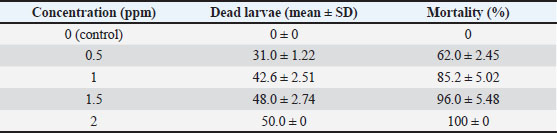
Table5. Mortality of first instar larvae after 24 hours (mean ± SD, n=5 replicates of 50 larvae).
First instar larvae showed the highest susceptibility, with mean mortality increasing from 62.0% ± 2.45% at 0.5 ppm to 85.2% ± 5.02% at 1 ppm and 96.0% ± 5.48% at 1.5 ppm, reaching complete mortality (100%) at 2 ppm after 24 hours. Second instar larvae exhibited slightly lower sensitivity, with mortality rising from 60.8% ± 4.60% at 0.5 ppm to 78.8% ± 1.78% at 1 ppm and 81.2% ± 1.78% at 1.5 ppm, before reaching 97.2% ± 4.14% at the highest concentration. Third instar mortality increased from 49.2% ± 9.24% to 98.0% ± 2.00% across the same concentration range, whereas fourth instar larvae showed comparatively greater tolerance at lower concentrations (54.4% ± 2.60% at 0.5 ppm) but similarly approached high mortality (98.0% ± 2.00%) at 2 ppm. The marked susceptibility of mosquito larvae in the early stages (first and second instars) may be explained by their weaker physiological defenses compared with those in the later stages. The greater resistance of the fourth instar may be due to the increased thickness of the cuticle and its ability to detoxify. Importantly, mortality was not observed in the control group under experimental conditions. The gradual increase in mortality across concentrations from 0.5 to 2 ppm emphasizes the need for careful concentration tuning in any potential larvicidal application, and this agrees with Alsoufi, 2024. A clear concentration-dependent dose–response relationship was observed for all developmental stages, indicating that silver nitrate exerts strong larvicidal activity even at relatively low concentrations. These findings are consistent with those of previous reports describing the insecticidal properties of silver-based compounds against mosquito larvae and other insects. The larvicidal efficacy of silver nitrate may be explained by the well-documented cytotoxic properties of silver ions. Silver disrupts membrane integrity, alters cellular permeability, inhibits essential enzymes, and interferes with metabolic and respiratory pathways, ultimately leading to cell death. In addition, silver exposure may induce oxidative stress through the generation of reactive oxygen species, causing protein denaturation and DNA damage. Such physiological disturbances can rapidly compromise larval survival and may explain the high mortality observed within 24 hours. The present results confirm that silver nitrate exhibits significant larvicidal activity against Culex pipiens, with mortality rates increasing with increasing concentration. The efficacy of silver nitrate is consistent with previous findings regarding its cytotoxic antibacterial properties, which are primarily attributed to its ability to disrupt cell membranes and interfere with enzymatic functions (Hanaa and Ibtisam, 2014). Stage-dependent differences in susceptibility were evident, with early instars being more vulnerable than those in later stages. This pattern may be attributed to the thinner cuticle, higher surface-area-to-volume ratio, and underdeveloped detoxification mechanisms of younger larvae, which likely facilitate faster penetration and accumulation of toxic ions. In contrast, older instars possess thicker cuticles and enhanced metabolic defenses that may reduce toxic uptake. Although the present results demonstrate strong laboratory efficacy, the potential environmental risks associated with silver compounds should be carefully considered. Silver may accumulate in aquatic systems and affect non-target organisms, highlighting the need for careful application and further ecological assessment. ConclusionSilver nitrate demonstrated significant larvicidal activity against all C. pipiens larval stages under laboratory conditions, with mortality increasing in a concentration-dependent manner and early instars showing the greatest susceptibility. These findings suggest that silver nitrate may serve as a promising larvicide alternative. However, additional studies evaluating longer exposure periods, environmental persistence, non-target safety, and field performance are required before practical application. Such investigations will be essential to ensure that mosquito control strategies are safe, effective, and sustainable. AcknowledgmentsThe authors thank the Department of Biology, College of Education for Pure Sciences Ibn Al-Haitham, University of Baghdad, for providing laboratory facilities. Conflict of interestThe authors declare that they have no conflict of interest. FundingThis research received no external funding. Authors’ contributionsH.Q.M. designed the study, performed the experiments, analyzed the data, and wrote the manuscript. Z.N.A.A. contributed to data analysis and manuscript revision. Data availabilityThe data supporting the findings of this study are available from the corresponding author upon reasonable request. ReferencesAbdel-Wahab AM Al. and -Deeb, H.I. 2022. Evaluation of larvicidal activities of Aloe vera and Ocimum basilicum extracts against Culex pipiens. Egypt. Academic. J. Biol. Sci. 14(4), 45–56. Al-Hamid M.A.M. and Al Mousawi, A.J. 2020. Physicochemical properties of Aloe vera gel and its utilization in preparing synbiotic fermented milk with Bifidobacterium lactis BB-12. Iraqi J. Agricult. Sci. 52, 823–835; doi:10.1016/j.ijas.2020.08.023 Al-Husayn, O.K. and Hatoor, N.A. 2014. Effect of silver nitrate incorporation into polymerized acrylic resin on some mechanical properties. J. Baghdad. Coll. Dentistry. 26(5), 85–90. Ali, H.M.N. and Ablas, H.A. 2012. Histological study of Culex pipiens larvae and adults infected with Beauveria bassiana. Baghdad. Sci. J. 9(2), 187–193. Aljaf, M.M., Sabr, A.J., Salman, Z.H. and Fezea, M.A. 2019. Review and description for Theretra alecto Boisduval 1827,(Lepidoptera: Sphingidae) in Iraq. J. Pharm. Sci. Res. 11(6), 2327–2332. Aljoboory, R.K. and Saber, A.J. 2022. A survey of the types of insects present on Medicago sativa. J. Pharm. Negative. Results. 13, 198–200. Al-Rawi, A.F. 2021. Anatomical and palynological study of Agave americana (Asparagaceae) growing in Iraq. Biochem. Cellular. Arch. 21, 297–294. Alsoufi, M.A. 2024. Using Aloe vera gel (Aloe barbadensis Mill.) as a preservative to increase the stability of vegetable storage. Irak. J. Sci. 65(7), 3692–3700. Alumairi, S., Shawkat, M., Al-Tayib. and M. 2023. Extraction of aloin from Aloe vera plant and its effect on micronucleus formation in acute lymphoid leukemia. Iraqi. J. Sci. 73, 56–71. Chiad, J.S., Majeed, M., Numan, M., Abdulhameed, H., Khaleel, R. and Qwaid, F. 2022. Study of the effect of Raphanus sativus, Urtica dioica and Curcuma longa plant extracts for pollution treatment by fish powder. Iraqi J. Sci. 57(2A), 909–901; doi:10.1016/j.ijs.2022 Govindarajan, M., Rajeswary, M., Veerakumar, K., Muthukumaran, U. and Hoti, S.L. 2016. Green synthesis and characterization of silver nanoparticles using Aloe vera plant extract and their larvicidal activity against dengue vector Aedes aegypti. Environ. Sci. Pollut. Res. 23, 13234–13243. Hanaa, S. and Ibtisam, S.Y. 2014. The effect of Aloe vera extract on immunity. J. Biotechnol. Res. Center 8(3), 1–12; doi:10.1016/j.jbrc.2014.01.012 M. A. M. Alhamid. and A. J. Al Mousawi. 2020. Physicochemical properties of Aloe vera gel and its utilization in preparing synbiotic fermented milk with Bifidobacterium lactis BB-12. Iraqi J. Agricult. Sci. 52, 823–835; doi:10.1016/j.ijas.2020.08.023. | ||
| How to Cite this Article |
| Pubmed Style Mahdi HQ, Al-azawii ZN. Larvicidal activity of silver nitrate against different larval instars of Culex pipiens under laboratory conditions. Open Vet. J.. 2026; 16(6): 3713-3716. doi:10.5455/OVJ.2026.v16.i6.43 Web Style Mahdi HQ, Al-azawii ZN. Larvicidal activity of silver nitrate against different larval instars of Culex pipiens under laboratory conditions. https://www.openveterinaryjournal.com/?mno=302256 [Access: June 26, 2026]. doi:10.5455/OVJ.2026.v16.i6.43 AMA (American Medical Association) Style Mahdi HQ, Al-azawii ZN. Larvicidal activity of silver nitrate against different larval instars of Culex pipiens under laboratory conditions. Open Vet. J.. 2026; 16(6): 3713-3716. doi:10.5455/OVJ.2026.v16.i6.43 Vancouver/ICMJE Style Mahdi HQ, Al-azawii ZN. Larvicidal activity of silver nitrate against different larval instars of Culex pipiens under laboratory conditions. Open Vet. J.. (2026), [cited June 26, 2026]; 16(6): 3713-3716. doi:10.5455/OVJ.2026.v16.i6.43 Harvard Style Mahdi, H. Q. & Al-azawii, . Z. N. (2026) Larvicidal activity of silver nitrate against different larval instars of Culex pipiens under laboratory conditions. Open Vet. J., 16 (6), 3713-3716. doi:10.5455/OVJ.2026.v16.i6.43 Turabian Style Mahdi, Harith Qasim, and Zeina Nabeel Al-azawii. 2026. Larvicidal activity of silver nitrate against different larval instars of Culex pipiens under laboratory conditions. Open Veterinary Journal, 16 (6), 3713-3716. doi:10.5455/OVJ.2026.v16.i6.43 Chicago Style Mahdi, Harith Qasim, and Zeina Nabeel Al-azawii. "Larvicidal activity of silver nitrate against different larval instars of Culex pipiens under laboratory conditions." Open Veterinary Journal 16 (2026), 3713-3716. doi:10.5455/OVJ.2026.v16.i6.43 MLA (The Modern Language Association) Style Mahdi, Harith Qasim, and Zeina Nabeel Al-azawii. "Larvicidal activity of silver nitrate against different larval instars of Culex pipiens under laboratory conditions." Open Veterinary Journal 16.6 (2026), 3713-3716. Print. doi:10.5455/OVJ.2026.v16.i6.43 APA (American Psychological Association) Style Mahdi, H. Q. & Al-azawii, . Z. N. (2026) Larvicidal activity of silver nitrate against different larval instars of Culex pipiens under laboratory conditions. Open Veterinary Journal, 16 (6), 3713-3716. doi:10.5455/OVJ.2026.v16.i6.43 |


