




| Case Report | ||
Open Vet. J.. 2026; 16(1): 754-757 Open Veterinary Journal, (2026), Vol. 16(1): 754-757 Case Report Suspected ammonium chloride toxicity causing increased mortality in layer chickens: A case reportHamzah Miftah Amir Othman 1*, Mohamed S Eljadar2 and Abdulrahman A. Aljali31Department of Pathology and Clinical Pathology, Faculty of Veterinary Medicine, Omar Al-Mukhtar University, Al Bayda, Libya 2Department of Veterinary Parasitology, Faculty of Veterinary Medicine, Omar Al-Mukhtar University, Al Bayda, Libya 3Department of Pharmacology, Toxicology & Forensic Medicine, Faculty of Veterinary Medicine, Omar Al-Mukhtar University, Al Bayda, Libya *Corresponding Author: Sarmad S. Salih Al Qassar. Department of Pedodontics, Orthodontics and Prevention, College of Dentistry, University of Mosul, Mosul, Iraq. Email: sarmadsobhi [at] uomosul.edu.iq Submitted: 04/10/2025 Revised: 15/12/2025 Accepted: 30/12/2025 Published: 31/01/2026 © 2025 Open Veterinary Journal
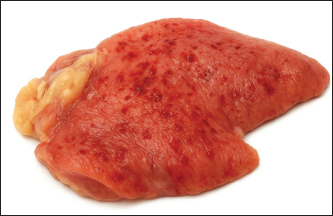
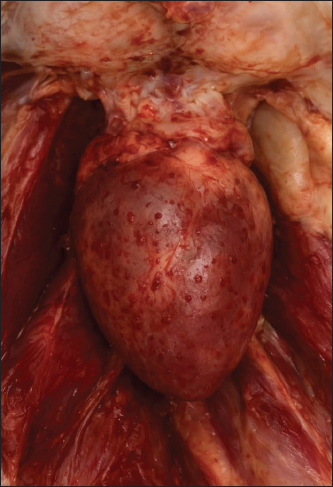
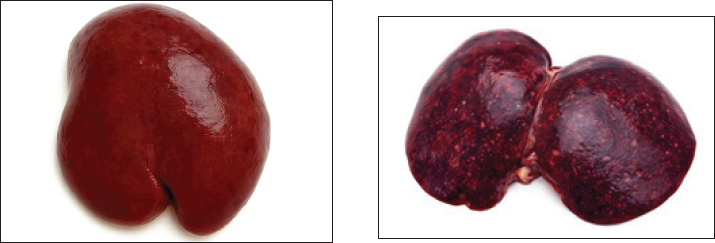
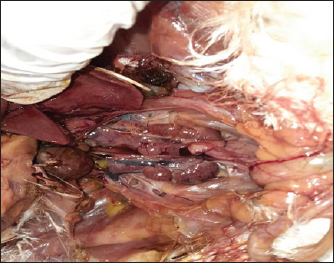
AbstractBackground: Ammonium chloride is widely used in poultry production to manage urinary and metabolic conditions; however, inappropriate dosing can lead to serious metabolic disturbances and increased mortality. This report describes a field outbreak linked to excessive ammonium chloride administration in layer chickens. Case Description: A commercial layer flock comprising 5,000 birds experienced elevated mortality, with 138 deaths (2.76%) recorded within a short period. The flock had received an estimated concentration of 5–7 g/l of a commercial ammonium chloride product (ASHIDUR) via drinking water. Clinical evaluation and laboratory findings were consistent with metabolic acidosis, evidenced by hyperchloremia, reduced bicarbonate levels, and significant elevations in hepatic and renal biochemical markers. Gross pathological examination revealed hepatomegaly, renal enlargement, visceral congestion, petechial hemorrhages, and air sacculitis. Mortality decreased markedly following corrective therapy with sodium bicarbonate. Conclusion: This case report underscores the risks associated with excessive or unsupervised use of ammonium chloride in layer chickens. Strict adherence to recommended dosing protocols and veterinary oversight is essential to prevent metabolic acidosis and associated organ damage. Keywords: Ammonium chloride, metabolic acidosis, toxicity, pathology, layers. IntroductionAmmonium chloride is widely used in poultry to acidify the system and modify electrolyte balance, especially in metabolic disorders (Olanrewaju et al., 2007; Chang et al., 2010). Excessive administration can cause severe metabolic acidosis and multi-organ dysfunction due to increased chloride ion load and bicarbonate depletion (Fudge, 2000; Ahmad et al., 2021). The clinical picture may resemble infectious diseases such as Newcastle disease and avian influenza (Alexander, 2001; Saif et al., 2008). Field cases are limited, and further reporting is essential. This case report documents clinical, pathological, and biochemical findings consistent with Ammonium chloride toxicity in layer chickens. Case DetailsA commercial flock of 5,000 layer hens (24 weeks old) experienced increased mortality after receiving an ammonium chloride–based product (ASHDUR) at an estimated dosage of 5–7 g/l for 2 days. High-dose ammonium salts disturb the acid–base balance in poultry (Khan et al., 2014 and Ahmad et al., 2021). Environmental conditions– Temperature: 22°C–24°C – Ventilation: excellent Mortality: Day 1: 11 birds Day 2: 11 birds Day 3: 25 birds Day 4: 35 birds Day 5: 56 birds Total mortality: 138 (2.76%) Clinical signs were nonspecific: depression, ruffled feathers, inappetence, and recumbency—findings typical of metabolic disturbances and toxic exposures (Al-Mayah and Al-Mayah, 2018). Gross pathological findings included the following: Intoxication with ammonium chloride can induce hepatic congestion, renal swelling, and muscular hemorrhages due to tissue acidosis (Figs. 1–4) (Farrag et al.,2015 and Abbas et al., 2017).
Fig. 1. Congested pectoral muscles with petechial hemorrhage.
Fig. 2. The pericardium and myocardial petechiae are thickened.
Fig. 3. Enlarged, dark reddish congested liver.
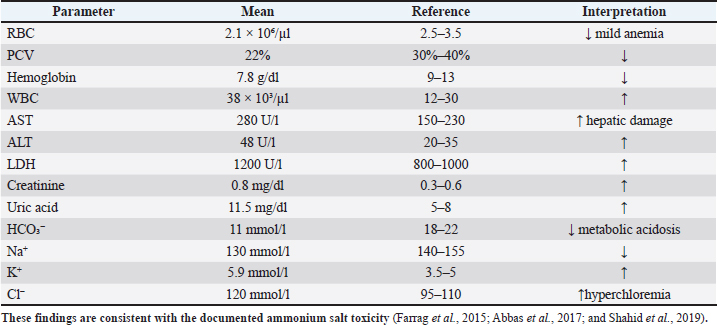
Fig. 4. Enlarged kidneys with marked congestion and swelling. Hematological and biochemical findingsTen affected birds were examined.The findings (Table 1) included anemia, leukocytosis, metabolic acidosis, hyperchloremia, elevated liver enzymes, and renal impairment—consistent with ammonium-induced toxicity (Shahid et al., 2019; Ahmad et al., 2021). Table 1. Hematological and biochemical alterations in poultry ammonium chloride toxicity.
TreatmentThe flock received 10 g/l sodium bicarbonate for 24 hours followed by 5 g/l sodium bicarbonate for 2 days. The supportive therapy included multivitamins and oxytetracycline. Sodium bicarbonate corrects metabolic acidosis by restoring bicarbonate levels (Farrag et al., 2015; Ahmad et al., 2021). Mortality decreased from 56 on day 5 to 4 the following day and ceased within 72 hours. DiscussionAmmonium chloride intoxication involves metabolic acidosis, (Saleh et al., 2020) hepatic congestion, renal enlargement, and muscular damage—findings supported by previous reports (Farrag et al., 2015; Abbas et al., 2017; Ahmad et al., 2021). The presentation may mimic infectious diseases such as Newcastle disease or avian influenza (Alexander, 2001; Saif et al., 2008), but such conditions were excluded due to the lack of characteristic lesions. The biochemical profile in this case matches previously described toxic changes, including electrolyte imbalance and elevated liver and kidney markers (Khan et al., 2014; and Shahid et al., 2019; Ahmad et al., 2021). The rapid response to sodium bicarbonate supports a metabolic origin rather than an infectious etiology. The absence of toxicological quantification is a limitation, a common issue in field cases (Al-Mayah and Al-Mayah, 2018). Future investigations should include confirmation of toxicology assays. ConclusionExcessive administration of ammonium chloride can cause severe metabolic acidosis and multi-organ pathology in poultry. Veterinary supervision and accurate dosing are essential for preventing toxicity and economic losses. Authors' contributionsAll authors contributed equally to this study. Conflict of interestThe authors declare that there is no conflict of interest. Data availabilityAll data were provided in the manuscript. ReferencesAbbas, R.Z., Khan, A., Liu, P. and Saleemi, M.K. 2017. Hematological and biochemical alterations induced by toxicants in poultry. World’s. Poultry. Sci. J. 73(2), 353–364. Ahmad, M.E., Smith, J.D., Brown, A.R. and Lee, S.K. 2021. Electrolyte and acid-base balance in poultry under different pathological conditions. J. Poultry Sci. 100(7), 101–125. Alexander, D.J. 2001. Newcastle disease. Br. Poultry Sci. 42(1), 5–22. Al-Mayah, A.A. and Al-Mayah, H.M. 2018. Biochemical markers of liver and muscle damage in intoxicated chickens. Iraqi. J. Vet. Sci. 32(1), 45–51. Chang, C.F., Chang, T.C. and Chang, S.S. 2010. Ammonium chloride intoxication in animals. Vet. Clin. Pathol. 39(1), 15–20. Farrag, F., Saleh, H.A., Mahmoud, A.M. and Youssef, S.A. 2015. Electrolyte changes and acid–base imbalance in chickens exposed to ammonium salts. Vet. Res. Forum. 6(3), 223–229. Fudge, A.M. 2000. Laboratory medicine: avian and exotic pets. Philadelphia, PA: WB Saunders. WB Saunders. Khan, M.Z., Hussain, I., Ali, S., Ahmed, R. and Saleemi, M.K. 2014. Hematobiochemical changes in toxicity. Pak. Vet. J. 34(3), 331–335. Olanrewaju, H.A., Thaxton, J.P., Dozier, W.A., Purswell, J.L., Roush, W.B. and Branton, S.L. 2007. A review of ammonia toxicity and its effects on poultry production. Poultry Sci. 86(6), 1141–1152. Saif , Y.M., Fadly, A.M., Glisson, J.R., McDougald, L.R., Nolan, L.K. and Swayne, D.E. 2008. Diseases of poultry. Saleh , A.A., El-Sayed, M., Hassan, R. and Mahmoud, F. 2020. Pathophysiological responses to ammonium chloride. J. Appl. Anim. Res. 48(1), 190–198. Shahid, R., Khan, A., Hussain, I., Malik, F. and Ahmed, M.U. 2019. Renal tests in broilers exposed to toxic agents. J. Vet. Diagnostic Invest. 31(5), 688–695.Abbas, R. Z., Khan, A., Liu, P. and Saleemi,M.K. 2017 Hematological and biochemical alterations induced by toxicants in poultry World’s Poultry Science Journal,73(2), pp.353–364. | ||
| How to Cite this Article |
| Pubmed Style Othman HMA, Eljadar MS, Aljali AA. Suspected ammonium chloride toxicity causing increased mortality in layer chickens: A case report. Open Vet. J.. 2026; 16(1): 754-757. doi:10.5455/OVJ.2026.v16.i1.72 Web Style Othman HMA, Eljadar MS, Aljali AA. Suspected ammonium chloride toxicity causing increased mortality in layer chickens: A case report. https://www.openveterinaryjournal.com/?mno=288245 [Access: June 26, 2026]. doi:10.5455/OVJ.2026.v16.i1.72 AMA (American Medical Association) Style Othman HMA, Eljadar MS, Aljali AA. Suspected ammonium chloride toxicity causing increased mortality in layer chickens: A case report. Open Vet. J.. 2026; 16(1): 754-757. doi:10.5455/OVJ.2026.v16.i1.72 Vancouver/ICMJE Style Othman HMA, Eljadar MS, Aljali AA. Suspected ammonium chloride toxicity causing increased mortality in layer chickens: A case report. Open Vet. J.. (2026), [cited June 26, 2026]; 16(1): 754-757. doi:10.5455/OVJ.2026.v16.i1.72 Harvard Style Othman, H. M. A., Eljadar, . M. S. & Aljali, . A. A. (2026) Suspected ammonium chloride toxicity causing increased mortality in layer chickens: A case report. Open Vet. J., 16 (1), 754-757. doi:10.5455/OVJ.2026.v16.i1.72 Turabian Style Othman, Hamzah Miftah Amir, Mohamed S Eljadar, and Abdulrahman A. Aljali. 2026. Suspected ammonium chloride toxicity causing increased mortality in layer chickens: A case report. Open Veterinary Journal, 16 (1), 754-757. doi:10.5455/OVJ.2026.v16.i1.72 Chicago Style Othman, Hamzah Miftah Amir, Mohamed S Eljadar, and Abdulrahman A. Aljali. "Suspected ammonium chloride toxicity causing increased mortality in layer chickens: A case report." Open Veterinary Journal 16 (2026), 754-757. doi:10.5455/OVJ.2026.v16.i1.72 MLA (The Modern Language Association) Style Othman, Hamzah Miftah Amir, Mohamed S Eljadar, and Abdulrahman A. Aljali. "Suspected ammonium chloride toxicity causing increased mortality in layer chickens: A case report." Open Veterinary Journal 16.1 (2026), 754-757. Print. doi:10.5455/OVJ.2026.v16.i1.72 APA (American Psychological Association) Style Othman, H. M. A., Eljadar, . M. S. & Aljali, . A. A. (2026) Suspected ammonium chloride toxicity causing increased mortality in layer chickens: A case report. Open Veterinary Journal, 16 (1), 754-757. doi:10.5455/OVJ.2026.v16.i1.72 |


