




| Case Report | ||
Open Vet. J.. 2025; 15(12): 6809-6813 Open Veterinary Journal, (2025), Vol. 15(12): 6809-6813 Case Report Improvement in coat condition observed in dogs with suspected alopecia X through combined supplementation with nutrients for the coat and skin: A case reportAtsuhiro Murayama1, Kentarou Tahara2 and Eiichi Hirano2*1Eva Veterinary Hospital, Osaka, Japan 2Department of Medical Affairs, Japan Bio Products Company Ltd., Tokyo, Japan *Corresponding Author: Eiichi Hirano. Department of Medical Affairs, Japan Bio Products Company Ltd., Tokyo, Japan. Email: ehirano [at] placenta-jbp.co.jp Submitted: 17/09/2025 Revised: 15/11/2025 Accepted: 26/11/2025 Published: 31/12/2025 © 2025 Open Veterinary Journal
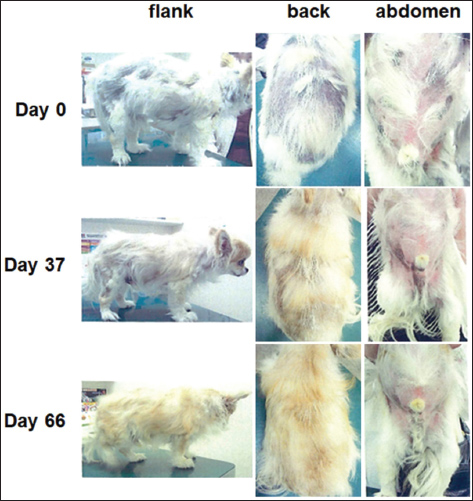
AbstractBackground: Alopecia X is characterized by non-inflammatory hair loss and is commonly observed in dogs with double coats and dense undercoats. The exact cause of alopecia X remains unknown, and its complex etiology and diverse responses to treatment make it challenging for veterinarians to manage. Case Description: An 8-year-old Chihuahua (male, unneutered, weight 4.1 kg) with significant hair loss presented to our clinic. The owner declined to provide a definitive diagnosis; consequently, based on a physical examination and a series of questions, a diagnosis of suspected alopecia was made. Horse placenta extract, taurine, and vitamin B complex (B1, B2, B5, and B6) were administered as nonpharmacological therapies. Following a 66-day supplementation regimen, a marked improvement in hair coat coverage was observed, with the back, sides, and abdomen exhibiting near-full-coat coverage. No adverse events were observed during the supplementation period. Supplementation was terminated following an enhancement in coat condition, and no hair loss was observed during a 76-week follow-up period. Conclusion: The combination of supplements from different categories may be a novel treatment option for owners who wish to pursue non-invasive treatment for alopecia in their dogs. Keywords: Alopecia X, Dog, Combination therapy, Nutrient supplementation. IntroductionAlopecia X is a non-inflammatory hair cycle disorder that is frequently observed in dogs with double coats and dense undercoats (Miller et al., 2012; Frank et al., 2005). From a clinical perspective, dogs may present with trunk alopecia and skin pigmentation. Histological analysis revealed the predominance of ketogenic and telogenic hair follicles (HFs), accompanied by sparse anagen follicles (Muntener et al., 2012). The results of pedigree analysis of affected dogs, coupled with the relatively young age of onset, suggest a genetic background (Mausberg et al., 2007; Mausberg et al., 2008). However, the genetic pattern and fundamental pathophysiological mechanism of hair growth disorders are yet to be elucidated. A plethora of treatment options for alopecia X have been documented, including various pharmacological agents such as growth hormones, melatonin, mitotane, trilostane, medroxyprogesterone, deslorelin, and microneedling, in addition to the spontaneous remission being observed in certain cases (Miller et al., 2012; Frank et al., 2005; Cerundolo et al., 2009). Nevertheless, a gold standard for treatment remains elusive, and alternative therapies are being considered as potential treatment options (Miller et al., 2012). Furthermore, the etiology of alopecia in canines is frequently multifactorial and arises from a combination of factors, including infection, allergies, endocrine disorders, immune disorders, malnutrition, and stress. Consequently, medication alone may not be sufficient to address all underlying causes. The efficacy of vitamins A, E, D, and zinc supplements in enhancing skin and coat conditions, preventing nutritional deficiencies, and as an adjunct to drug therapy has been well documented (Marchegiani et al., 2020). In this case study, a series of nutritional supplements was administered as a nonpharmacological intervention for a canine with significant hair loss. Consequently, the dog’s hair condition was enhanced, with the hair restored to its original full coat. Case DetailsSignalmentAn 8-year-old male Chihuahua (unneutered, weighing 4.1 kg) presented with alopecia as the primary complaint at our clinic. Medical historyIt was confirmed that hair loss had been observed for several years in this case period. Furthermore, the patient had a medical history marked by bilateral inguinal hernias, although no other significant medical conditions were reported. Clinical findingsSporadic hair loss was observed on the side between the posterior end of the last rib and the anterior end of the hind limb (Fig. 1, Day 0, flank). Hair loss was observed over a wider area on the back and abdomen than on the flank area (Fig. 1, Day 0, back and abdomen). No hair loss was observed on the head (data not shown). A range of other clinical findings, including pruritus, licking, erythema, erosion, crusting, seborrhea, and a seborrheic dermatitis odor. The absence of any abnormalities in appetite, vigor, feces, or urine was indicated by general findings.
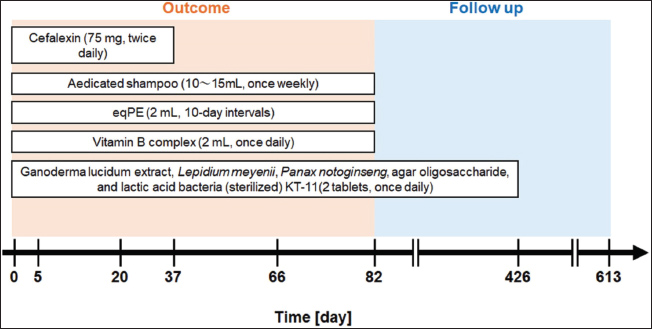
Fig. 1. Changes in hair appearance before and after taking nutritional supplements in cases suspected of alopecia. Day 0: Before supplementation. Day 37: The 37th day of supplement intake. Day 66: The 66th day of supplement intake. Diagnostic work-upThe preliminary diagnosis was alopecia X. However, due to the owner’s decision not to pursue a definitive diagnosis, further investigative procedures, such as blood tests, endocrine tests, skin scraping, fungal culture, and skin biopsy, were not conducted. Considering the aforementioned clinical findings, the patient was diagnosed with suspected alopecia X. TreatmentAt the initial visit (day 0), pruritus, erythema, crusting, seborrhea, and seborrheic odor were observed, leading to suspicion of bacterial pyoderma, Malassezia dermatitis, parasitic dermatitis, allergic dermatitis, and seborrhea. In view of the severe pruritus and seborrheic odor, a mixture of sulfadiazin (200 mg/ml) and trimethoprim (40 mg/ml) solution (0.4 ml administered via subcutaneous injection) was administered to exclude the possibility of an infectious or parasitic etiology. Prednisolone (0.4 mg administered via subcutaneous injection) was administered to treat pruritus. The prescription included cefalexin (tablet: 75 mg, twice daily) for the treatment of pyoderma and a mixture of chlorhexidine gluconate solution (20% solution) and a shampoo therapy consisting of a mixture of chlorhexidine gluconate solution (20% solution) and miconazole nitrate (2% solution) (10–15 ml, once weekly). The administration of equine placenta extract (eqPE) (2 ml, once every 10 days) and taurine (22.2 mg/ml) and a vitamin B complex comprising vitamin B1 (0.284 mg/ml), vitamin B2 (0.049 mg/ml), vitamin B5 (0.629 mg/ml), and vitamin B6 (0.123 mg/ml) facilitated the promotion of hair growth. This was administered at a daily dose of 2 ml. Compounds of Ganoderma lucidum extract, Lepidium meyenii, Panax notoginseng, agar oligosaccharide, and lactic acid bacteria (sterilized) KT-11 were administered in a daily dose of 2 tablets (Fig. 2).
Fig. 2. The timeline diagram for this case. eqPE: equine placenta extract. OutcomeOn the 5th day of examination, a reduction in pruritus and seborrheic dermatitis was observed. No adverse events or abnormalities in appetite, vigor, feces, or urine were observed. On the 20th day of examination, a reduction in dandruff and seborrheic odor was confirmed. Crusting was observed on the dorsal aspect of the craniocervical junction, right middle abdomen, and proximal tail. However, no specific treatment was administered for this. No adverse events or abnormalities in appetite, vigor, feces, or urine were observed. On the 37th day of examination, a substantial enhancement in hair growth was observed in the back region compared with that on the initial visit (Fig. 1, Day 37, back). However, no such enhancement was detected in the abdominal region (abdomen, Fig. 1, day 37). Furthermore, the pruritic sensation almost completely disappeared. Following the observed improvement in the seborrheic odor, the administration of cefalexin (tablet: 75 mg, twice daily) was discontinued, while topical therapy involving the use of the previously described medicated shampoo was continued (Fig. 1). 2 for details). No adverse events or abnormalities in appetite, vigor, feces, or urine were observed. On the 66th day of the examination, the hair loss on the back, sides, and abdomen had improved significantly, with almost full coverage observed in comparison to the 37th day (Fig. 1, flank, back, and abdomen, day 66). No adverse events or abnormalities in appetite, vigor, feces, or urine were observed. On the 82nd day of the examination, no reoccurrence of hair loss was observed, which led to discontinuation of the administration of a mixed solution of eqPE (2 ml), taurine (22.2 mg/ml), and vitamin B complex (as previously described) (2 ml, daily) (Fig. 2). No adverse events or abnormalities in appetite, vigor, feces, or urine were observed. Follow-upsThe treatment for hair loss was temporarily discontinued on day 82, as no recurrence of hair loss was observed, and the subject maintained normal appetite, vigor, and excretion. However, given the sporadic observation of scabs and swelling of the outer ear in this case, regular treatment visits were continued until day 562, separately from the hair loss treatment. Follow-up examinations revealed no recurrence of hair loss. The owner stated that the patient died on day 613. No recurrence of hair loss was observed between day 562 and the death date. Ethical approvalNo ethical approval was required for this study. DiscussionThe treatment of canine alopecia may encompass a range of therapeutic interventions, including adrenal cortex hormone adjustment medication (Cerundolo et al., 2004), oral hormone therapy (de Sousa Ferreira et al., 2022), medroxyprogesterone injections (Frank et al., 2013), epidermal microneedle stimulation (Stoll et al., 2015), and light therapy (Aoudj et al., 2025; Amado Martins et al., 2024). Supplements such as horse placenta extract and omega-3 fatty acids have been reported to improve intractable alopecia in dogs (Kumar et al., 2023; Combarros et al., 2020). In a randomized study of 30 dogs with nonspecific alopecia (excluding hormonal, infectious, and allergic causes) in India, approximately 67% of the group administered horse placenta extract showed moderate improvement after 2 months, and complete improvement was observed after 3 months (Kumar et al., 2023). Placenta extract can promote hair growth. This phenomenon has been attributed to the inhibition of glycogen synthase kinase 3β phosphorylation in HF cells, which in turn induces β-catenin expression (Kwon et al., 2015). Placenta extract was administered in this case, indicating that it was a contributing factor to the observed improvement in alopecia. Placenta extract contains 16 standard amino acids, except for glutamine, asparagine, tryptophan, and cysteine (data not shown). In a prospective randomized evaluator-blinded trial for human alopecia that lasted for 3 months, a supplement containing collagen, cysteine, methionine, taurine, vitamin B6, iron, selenium, and other ingredients was used, and significant improvements in the hair cycle (anagen/telogen ratio) and hair density were reported (Starace et al, 2023). Placenta extract and vitamin B complex were co-administered. Has there been any improvement in cases of canine alopecia due to the combination of amino acids and vitamin B complex? Furthermore, there have been no reports on the combination of G. lucidum extract, L. meyenii, P. notoginseng, agar oligosaccharide, or lactic acid bacteria (sterilized) KT-11. In this case, no adverse events were observed despite the combination being utilized for a period of approximately 3 months. This indicates that the combination is safe. Nevertheless, safety tests should be conducted, and decisions should be made based on blood chemical evaluations. The use of nutritional therapy for canine alopecia is advantageous because, compared with systemic drugs, nutritional supplements carry a reduced risk of severe adverse effects. This characteristic renders them a more suitable option for the long-term management of chronic cases, elderly animals, and those afflicted with underlying diseases. Furthermore, nutritional supplements characteristically exhibit a reduced number of drug interactions, thereby facilitating their use as ancillary components to existing drug therapies. It has been hypothesized that they may also be useful for dose reduction or as adjuncts to drug withdrawal. Numerous clinical cases and reviews have demonstrated the efficacy of initial nutritional interventions in cases of non-inflammatory alopecia where the cause is difficult to ascertain, suggesting that they are a practical clinical option (Marchegiani et al., 2020). Thus, this treatment can be prescribed even in cases of unknown etiology or chronic conditions, such as alopecia X. The combination of nutritional supplements used in this case may represent a new treatment option for alopecia. This case report has several limitations. A definitive diagnosis could not be obtained because the owner declined further diagnostic investigations. Consequently, the precise etiology of this alopecia case remains unclear. Furthermore, because multiple supplements were administered concurrently, the specific contribution of each intervention to the observed clinical improvement could not be ascertained. The therapeutic response was evaluated primarily based on clinical observations and the owner’s subjective evaluation. The absence of standardized or quantitative outcome measures may limit the objectivity and reproducibility of the findings. Moreover, given that this report details a solitary instance, the observations should be regarded as anecdotal and hypothesis-generating, as opposed to providing confirmatory evidence. Acknowledging the potential for bias in the identification of sources is imperative. Observer bias may have influenced both the clinician and the owner in their evaluation of hair regrowth. The potential for spontaneous remission or placebo effects cannot be discounted. Consequently, a causal relationship between supplementation and the observed enhancement of the hair coat cannot be established definitively. In future cases of this nature, pathological examinations should be conducted wherever possible to enhance the objectivity and reproducibility of the diagnosis. ConclusionCombined nutritional supplementation has been posited as a potentially useful adjunct or alternative to alopecia X management, particularly in cases where owners prefer nonpharmacological approaches. AcknowledgmentsWe would also like to thank Editage (www.editage.jp) for English language editing. Conflict of interestAtsuhiro Murayama has no competing interests to declare. Kentarou Tahara and Eiichi Hirano are employees of Japan Bio Products Company Ltd. FundingThis study received no financial support. Authors’ contributionsA.M.: conceived and designed the clinical study, analyzed and interpreted the data, and reviewed the manuscript. K.T.: partially interpreted the data. E.H.: interpreted the data and wrote the manuscript. All authors have approved the final draft of the manuscript. Data availabilityThe data supporting the findings of this study are available upon request from the corresponding author. ReferencesAmado Martins, F., Almeida Da Silva, G., Ligeiro De Oliveira, A.P., Gutierrez Duran, C.C., Constantin Baltatu, O., Labat Marcos, R., Ratto Tempestini Horliana, A.C., Regina Zamuner, S. and Antônio Silva Júnior, J. 2024. Comparison between melatonin versus melatonin and photobiomodulation versus photobiomodulation in the treatment of Alopecia X in German Spitz dogs: clinical, randomized, double-blind, parallel, non-inferiority protocol. PLos One. 19, 304605. Aoudj, D., Del Castillo, J.R.E., Bergeron, C.C., Brosseau, G., De Jaham, C., Benoit-Biancamano, M.O. and Pagé, N. 2025. Hair density response to photobiomodulation in canine alopecia X is measured reliably with an ordinal scale: a randomized, controlled, double-blind study. Am. J. Vet. Res. 1(aop), 1–11. Cerundolo, R., Lloyd, D.H., Persechino, A., Evans, H. and Cauvin, A. 2004. Treatment of canine Alopecia X with trilostane. Vet. Dermatol. 15, 285–293. Cerundolo. and R. 2009. Canine alopecia X. UK Vet. Companion Anim. 14, 47–52. Combarros, D., Castilla-Castaño, E., Lecru, L.A., Pressanti, C., Amalric, N. and Cadiergues, M. 2020. A prospective, randomized, double blind, placebo-controlled evaluation of the effects of an n-3 essential fatty acids supplement (Agepi® ω3) on clinical signs, and fatty acid concentrations in the erythrocyte membrane, hair shafts and skin surface of dogs with poor quality coats. Prostaglandins. Leukot. Essent. Fatty Acids 159, 10214. de Sousa Ferreira, M.A., de Carvalho, V.M., da Silva Dutra, M., Rodrigues, F. R.N., de Araújo Viana, D., and Ferreira, T.C. 2022. Alopecia X in dogs: report of seven cases. Research, Society and Development. 11, e159111032652. Frank, L.A. 2005. Growth hormone-responsive alopecia in dogs. J. Am. Vet. Med. Assoc. 226, 1494–1497. Frank, L.A. and Watson, J.B. 2013. Treatment of alopecia X with medroxyprogesterone acetate. Vet. Dermatol. 24, 624–e154. Kumar, K.S., Prasad, V.S., Kumar, V.A. and Mohanambal, K. 2023. Efficacy studies of equine placental extract on canine alopecia. Pharma Innov. 12, 1163–1167. Marchegiani, A., Fruganti, A., Spaterna, A., Dalle Vedove, E., Bachetti, B., Massimini, M., Di Pierro, F., Gavazza, A. and Cerquetella, M. 2020. Impact of nutritional supplementation on canine dermatological disorders. Vet. Sci. 7, 38. Mausberg, E.M., Drögemüller, C., Dolf, G., Leeb, T., Rüfenacht, S. and Welle, M. 2007. Evaluation of the CTSL2 gene as a candidate gene for alopecia X in Pomeranians and Keeshonden. Anim. Biotechnol. 18, 121–123. Mausberg, E.M., Drögemüller, C., Dolf, G., Rüfenacht, S., Welle, M. and Leeb, T. 2008. Exclusion of patched homolog 2 (PTCH2) as a candidate gene for alopecia X in Pomeranians and Keeshonden. Vet. Rec. 163, 206–e44. Miller, W.H., Griffin, C.E. and Campbell, K.L. 2012. Muller and Kirk’s Small Animal Dermatology. St. Louis, MI: Elsevier Health Sciences. Müntener, T., Schuepbach-Regula, G., Frank, L., Rüfenacht, S. and Welle, M.M. 2012. Canine noninflammatory alopecia: a comprehensive evaluation of common and distinguishing histological characteristics. Vet. Dermatol. 23, 206–e44. Starace, M., Cedirian, S., Bruni, F., Alessandrini, A.M., Quadrelli, F., Sechi, A. and Piraccini, B.M. 2023. Clinical study on the efficacy and tolerability of an oral supplement based on arginine, l-cystine, zinc and B6 vitamin (Cystiphane®) in patients with telogen effluvium. Ital. J. Dermatol. Venerol. 158, 255–261. Stoll, S., Dietlin, C. and Nett-Mettler, C.S. 2015. Microneedling as a successful treatment for alopecia X in two Pomeranian siblings. Vet. Dermatol. 26, 387–e88. | ||
| How to Cite this Article |
| Pubmed Style Murayama A, Tahara K, Hirano E. Improvement in coat condition observed in dogs with suspected alopecia X through combined supplementation with nutrients for the coat and skin: A case report. Open Vet. J.. 2025; 15(12): 6809-6813. doi:10.5455/OVJ.2025.v15.i12.60 Web Style Murayama A, Tahara K, Hirano E. Improvement in coat condition observed in dogs with suspected alopecia X through combined supplementation with nutrients for the coat and skin: A case report. https://www.openveterinaryjournal.com/?mno=284389 [Access: June 26, 2026]. doi:10.5455/OVJ.2025.v15.i12.60 AMA (American Medical Association) Style Murayama A, Tahara K, Hirano E. Improvement in coat condition observed in dogs with suspected alopecia X through combined supplementation with nutrients for the coat and skin: A case report. Open Vet. J.. 2025; 15(12): 6809-6813. doi:10.5455/OVJ.2025.v15.i12.60 Vancouver/ICMJE Style Murayama A, Tahara K, Hirano E. Improvement in coat condition observed in dogs with suspected alopecia X through combined supplementation with nutrients for the coat and skin: A case report. Open Vet. J.. (2025), [cited June 26, 2026]; 15(12): 6809-6813. doi:10.5455/OVJ.2025.v15.i12.60 Harvard Style Murayama, A., Tahara, . K. & Hirano, . E. (2025) Improvement in coat condition observed in dogs with suspected alopecia X through combined supplementation with nutrients for the coat and skin: A case report. Open Vet. J., 15 (12), 6809-6813. doi:10.5455/OVJ.2025.v15.i12.60 Turabian Style Murayama, Atsuhiro, Kentarou Tahara, and Eiichi Hirano. 2025. Improvement in coat condition observed in dogs with suspected alopecia X through combined supplementation with nutrients for the coat and skin: A case report. Open Veterinary Journal, 15 (12), 6809-6813. doi:10.5455/OVJ.2025.v15.i12.60 Chicago Style Murayama, Atsuhiro, Kentarou Tahara, and Eiichi Hirano. "Improvement in coat condition observed in dogs with suspected alopecia X through combined supplementation with nutrients for the coat and skin: A case report." Open Veterinary Journal 15 (2025), 6809-6813. doi:10.5455/OVJ.2025.v15.i12.60 MLA (The Modern Language Association) Style Murayama, Atsuhiro, Kentarou Tahara, and Eiichi Hirano. "Improvement in coat condition observed in dogs with suspected alopecia X through combined supplementation with nutrients for the coat and skin: A case report." Open Veterinary Journal 15.12 (2025), 6809-6813. Print. doi:10.5455/OVJ.2025.v15.i12.60 APA (American Psychological Association) Style Murayama, A., Tahara, . K. & Hirano, . E. (2025) Improvement in coat condition observed in dogs with suspected alopecia X through combined supplementation with nutrients for the coat and skin: A case report. Open Veterinary Journal, 15 (12), 6809-6813. doi:10.5455/OVJ.2025.v15.i12.60 |


