




| Research Article | ||
Open Vet. J.. 2026; 16(1): 231-240 Open Veterinary Journal, (2026), Vol. 16(1): 231-240 Research Article Effect of three forage species on the productive performance and carcass quality of the Kuri guinea pig on the northern coast of PeruCésar A. Piscoya Vargas1, Henrri Álvarez Barrantes1, Víctor Ravillet Suárez2, Luís Vílchez Muñoz2, Magaly Díaz García2, José Leiva Piedra2, José Reupo Periche3 and Juan R. Paredes-Valderrama4,5*1Department of Animal Production, Faculty of Veterinary Medicine, Pedro Ruíz Gallo National University, Lambayeque, Peru 2Department of Animal Nutrition and Feeding, Faculty of Veterinary Medicine, 3Bromatology Laboratory, Faculty of Biological Sciences, Pedro Ruíz Gallo National University, 4Animal Science Research Unit, Veterinary Medicine and Zootechnics Study Program, Faculty of Agricultural Sciences, Universidad Privada Antenor Orrego (UPAO), Trujillo, Peru 5Research Unit, Agricultural Production Studies Program, *Corresponding Author: Juan R. Paredes-Valderrama. Animal Science Research Unit, Veterinary Medicine and Zootechnics Study Program, Faculty of Agricultural Sciences, UPAO, Trujillo, Peru. Email: juanparedes1912 [at] hotmail.com Submitted: 21/08/2025 Revised: 12/12/2025 Accepted: 24/12/2025 Published: 31/01/2026 © 2025 Open Veterinary Journal
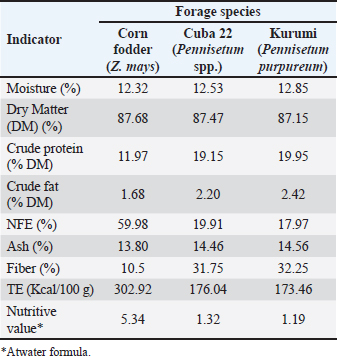
AbstractBackground: Improving the nutritional quality and productivity of guinea pigs is a priority in Peruvian livestock production, driving the search for sustainable feeding strategies. However, there is little evidence on the use of tropical grasses and their impact on the performance and carcass composition of Kuri guinea pigs. Aim: To evaluate the effect of three forage species on the productive performance and carcass nutritional value of Kuri guinea pigs. Methods: Forty-five weaned female guinea pigs, 15 days old, were randomly distributed into three treatments (15 animals per group): T1=corn fodder (Zea mays), T2=Cuba 22 (Pennisetum spp.), and T3=kurumi (Pennisetum purpureum). The forages were cultivated in the same experimental unit and chemically analyzed prior to the trial. Animals were housed individually and received the assigned forage plus a balanced concentrate. Feed intake, weight gain, and feed conversion ratio were recorded at 30, 45, 60, 75, and 90 days of age, respectively. At the end of the trial, the carcasses were analyzed for dry matter, moisture, protein, and fat content. Results: Guinea pigs fed with corn fodder showed higher weight gain (p < 0.05) than those fed with other treatments. However, no significant differences feed intake or feed conversion ratio were observed among the experimental groups. Regarding carcass composition, guinea pigs fed with kurumi grass showed significant differences (p < 0.05), with higher protein content and lower fat and moisture percentages compared with those fed corn fodder and Cuba 22. Conclusion: The corn fodder–based diet improved weight gain in Kuri guinea pigs; however, those fed with kurume grass exhibited better carcass nutritional quality. Keywords: Carcass, Feed conversion, Guinea pig, Weight gain, Tropical grass. IntroductionThe consumption of guinea pig meat (Cavia porcellus) is a deeply rooted tradition in Peru, especially in the Andean region. In recent years, national demand has grown, fostering the establishment of small- and medium-scale production enterprises. Similarly, countries such as Bolivia, Ecuador, and Colombia have maintained a long-standing preference for this product (Rosenfeld, 2008; Avilés et al., 2014; Donoso et al., 2025), forming a regional market with the potential to strengthen food security—particularly in rural and low-income areas—due to its ease of rearing and high nutritional value (NV) (Lammers et al., 2009; Sánchez-Macías et al., 2018). Moreover, recent studies report that guinea pig feces contain lactic acid bacteria with probiotic potential capable of improving productive indices and reducing pathogenic bacterial growth (Goicochea-Vargas et al., 2024), demonstrating its biotechnological and productive value. Despite these advantages, most research aimed at optimizing guinea pig production focuses on incorporating additives (commercial or natural probiotics) into balanced feed to improve feed conversion, weight gain, and meat safety (Cano et al., 2016; Guevara et al., 2016; Carcelén et al., 2021; Goicochea-Vargas et al., 2025). Other studies have evaluated the effects of non-conventional forages, such as Erythrina sp. or kudzu, and crop residues on weight gain and carcass quality (Cárdenas et al., 2018; Castro et al., 2018; Cuibin et al., 2020). However, studies addressing the use of tropical forages in feeding guinea pigs on the Peruvian coast remain scarce. In addition, the nutritional composition of guinea pig meat varies among breeds. For instance, the Perú breed contains 17.78% protein and 8.56% fat, whereas the Andina breed reaches 18.75% and 7.66% (Flores-Mancheno et al., 2017). These variations are likely related to the type of feeding system used (Herrera et al., 2022, 2024). To date, no information is available on the nutritional composition of Kuri guinea pig meat. Corn fodder is one of the most commonly used forages in guinea pig production as the main plant-based feed. However, because it is not a perennial grass and requires high labor input, its use is limited in certain areas. In recent years, perennial grasses such as kurumi and Cuba 22 have attracted attention owing to their high productivity and NV (Emile et al., 2018; Pinchao-Pinchao et al., 2024), although they are not yet widely used in guinea pig production. Currently, guinea pig meat production continues to be an important source of food and income for families in Latin America and Africa. In this context, the present study aimed to evaluate the productive parameters and carcass nutritional characteristics of female Kuri guinea pigs fed with corn fodder, kurume grass, and Cuba 22. Materials and MethodsStudy site and period of studyThe research was conducted at the “Bodegones” guinea pig farm in the province of Lambayeque (6°42′S, 79°54′W), northern Peru. This area has two well-defined seasons: autumn (April–November), with an average temperature of 19°C and relative humidity of 82%, and summer (December–March), with an average temperature of 33°C and relative humidity of 68%. The experimental phase with the animals was conducted from February to May 2025, while the forage cultivation and chemical analyses were conducted in the months preceding the trial. Cultivation and proximate forage species analysisThree forage species were used: corn fodder (Zea mays), Cuba 22 (Pennisetum spp.), and kurume (Pennisetum purpureum). These were planted in cultivation fields belonging to the same facility where the animal phase was conducted. Specific agronomic care was provided for each species in accordance with previous studies. Each pasture was planted at different times to ensure homogeneous cutting age at the moment of consumption, minimizing potential bias caused by nutritional variability due to forage maturity. The pastures were harvested according to scientific literature. Corn fodder was provided when the maize kernel was at the milky stage (approximately 75 days after planting) (Salama, 2019), while Cuba 22 and kurumi were harvested and fed to the guinea pigs between 55 and 65 days of growth (Rupay et al., 2023). Representative samples of each forage, corresponding to their optimal vegetative stage, were sent to the Bromatology Laboratory of the Faculty of Biological Sciences, Universidad Nacional Pedro Ruiz Gallo, for proximate composition analysis (Table 1). Table 1. NVs of corn fodder (Zea mays), Cuba 22 (Pennisetum spp.), and kurume (Pennisetum purpureum) according to proximate analysis.
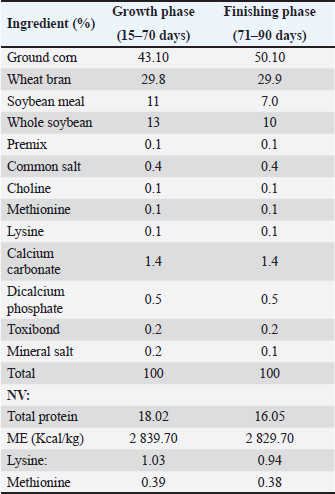
Study design, animals, and variablesThe study was experimental with a quantitative approach, employing a completely randomized design. A total of 45 15-day-old weaned female guinea pigs belonging to the Kuri breed and with similar body weights were used. Animals were randomly assigned to three treatments: T1=corn fodder (Zea mays), T2=Cuba 22 (Pennisetum spp.), and T3=kurume (Pennisetum purpureum). The sample size was determined based on a power analysis for a one-way analysis of variance (ANOVA) design (α=0.05). With this number of animals, the estimated statistical power to detect a large effect (Cohen’s f=0.40) was approximately 0.64, while achieving a power of 0.80 would require approximately 21 animals per group. Therefore, for ethical and logistical reasons, 15 animals per group were used—insufficient to detect large differences among treatments while ensuring responsible use of animals. The animals were housed individually, with each serving as an experimental unit. To meet the nutritional requirements, a daily supply of 200 g of forage corresponding to the assigned treatment was provided, along with a uniform ration of balanced feed (50 g/animal) across all groups (Table 2). The guinea pigs had ad libitum access to water via nipple drinkers. Table 2. Ingredients used in the formulation of the balanced feed and NV of rations used as a dietary supplement for all guinea pigs during growth and finishing phases.
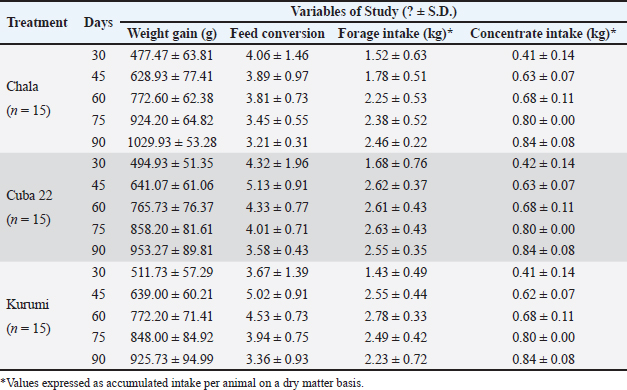
For each treatment, weight gain, feed intake, and feed conversion ratio were evaluated during the growth (weaning to 70 days of age) and finishing (71 to 90 days of age) phases. Data were collected at 30, 45, 60, 75, and 90 days of age. Bromatological analysis of the forageThe moisture content was determined using the gravimetric method. Five grams of the sample was weighed into a pre-dried and tared porcelain capsule, and the initial weight (P1) was recorded. Then, the sample was dried in an oven at 105°C for 4 hours, cooled in a desiccator, and reweighed (P2). The moisture content (%) was calculated using the following formula: % Moisture=[(P1 – P2) / sample] × 100. Dry matter was calculated as follows: DM=100%–% moisture. The protein content (%) was determined using the Micro Kjeldahl method. A 0.5 g dried sample was weighed into digestion tubes, and 10 ml of concentrated sulfuric acid and a catalyst mixture of potassium sulfate and copper sulfate were added. The mixture was digested until a clear emerald-green solution was obtained. The solution was then alkalinized with 40% sodium hydroxide, and the liberated ammonia was distilled and collected in a boric acid solution. Nitrogen was titrated with 0.1 N hydrochloric acid and converted to protein using a conversion factor of 5.70. The fat content was determined using the Soxhlet method. Two grams of dried sample were placed in extraction cartridges and processed in a Soxhlet apparatus for 6 hours using ethyl ether as solvent for 6 hours. The solvent was then evaporated, and the lipid residue was extracted from the extraction flask. The fat content was expressed as a percentage of the dry weight of the sample. The percentage difference in moisture, protein, fat, ash, and crude fiber (CF), relative to 100, determined the nitrogen-free extract (NFE). Direct incineration allowed the ash content to be determined. Approximately 3 g of dried sample was weighed into pretared porcelain crucibles. The samples were first carbonized directly over a flame and then incinerated in a muffle furnace at 525°C for 6 hours. After cooling in a desiccator, the inorganic residue was recorded as the total ash content. The CF was determined according to the AOAC 962.09 method. Two grams of the defatted, dried sample were placed in a digestion flask. Two hundred milliliters of 1.25% sulfuric acid was added, and the system was connected to a condenser and boiled for 30 minutes. The contents were filtered and washed thoroughly with hot water to remove any acid residues. The filtrate residue was then treated with 200 ml of 1.25% sodium hydroxide, and the process was repeated for 30 minutes. The residue was filtered and successively washed with hot water, ethanol, and acetone after alkaline digestion. The residue was dried to a constant weight in an oven at 105°C (recorded as the dry residue). It was then incinerated in a muffle furnace at 550°C for 2 hours, cooled in a desiccator, and weighed to obtain the ash content. CF (%) was calculated as follows: CF (%)=[(Weight of dry residue–Weight of ash)/Sample weight] × 100. The total energy (TE) was estimated using the Atwater method, applying conventional energy factors for macronutrients. Energy (kcal/100 g) was calculated using the following formula: TE=(4 × % protein) + (4 × % carbohydrates) + (9 × % fat), where 4 and 9 represent the kilocalories contributed by each gram of protein or carbohydrate and each gram of fat, respectively. The NV was determined by considering the energy contribution of the main macronutrients, according to a modified Atwater relationship: NV=(9 × % fat) + (4 × % carbohydrates) + (4 × % protein). Results were expressed in kcal/100 g. Slaughter and bromatological analysis of the carcassesAt 91 days of age, the animals were slaughtered after a 12-hour fasting period using a penetrating captive bolt pistol followed by bleeding, which is considered the most efficient and humane method (Limon et al., 2016; Cohen et al., 2020). Only trained personnel performed this procedure. Two samples of approximately 100 g were collected from each carcass: one from the hind limb (lean portion) and another from the rib region (higher intramuscular fat content). The moisture, dry matter, protein, and fat percentages were determined. The bromatological analyses were conducted at the Laboratory of Bromatology, Faculty of Biological Sciences, National University Pedro Ruiz Gallo, using the same bromatological methods employed for the forage analyses. Statistical analysisThe obtained data were organized and cleaned using Microsoft Excel 2019. Subsequently, the Shapiro–Wilk test was used to verify the statistical assumptions of residual normality and homogeneity of variances. Data analysis was performed using a mixed linear model to evaluate the effects of treatment, day, and the interaction between both factors. Differences between treatments were determined using the least significant difference post hoc test. Differences among treatments were analyzed by ANOVA, applying Tukey’s post hoc test for mean comparison. All statistical analyses were performed using GraphPad Prism software, version 8.0.2 (GraphPad Software, Inc., California, USA), considering a significance level of p < 0.05. Ethical approvalThe Bioethics Committee of the Faculty of Veterinary Medicine at Universidad Nacional Pedro Ruiz Gallo approved the study (Resolution No. 064-2025-D/FMV). All ethical standards for animal use in research were followed throughout the study to ensure welfare, health, and integrity. ResultsWeight gainAll three treatments showed a progressive increase in weight gain as the evaluation period progressed. The Chala maize treatment achieved the highest final weight gain at the end of the study (1,029.93 ± 53.28 g at 90 days), followed by the Cuba 22 (953.27 ± 89.81 g) and Kurumi (925.73 ± 54.99 g) treatments (Table 3). Table 3. Means and standard deviations of weight gain, feed conversion, and feed intake in female Kuri guinea pigs according to treatment.
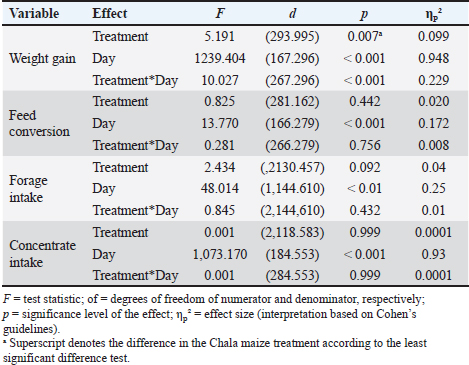
Table 4 shows that the effect of treatment on weight gain was significant (p < 0.05), indicating differences between at least two of the three groups evaluated, with greater weight gain observed in guinea pigs fed with Chala maize. Likewise, a marked variation in weight gain was recorded over time, with the day-to-day effect being highly significant (p < 0.001). The interaction between treatment and day was also significant (p < 0.001), showing that the pattern of weight gain over time differed among treatments. Table 4. Mixed linear model for weight gain, feed conversion, forage intake, and concentrate intake.
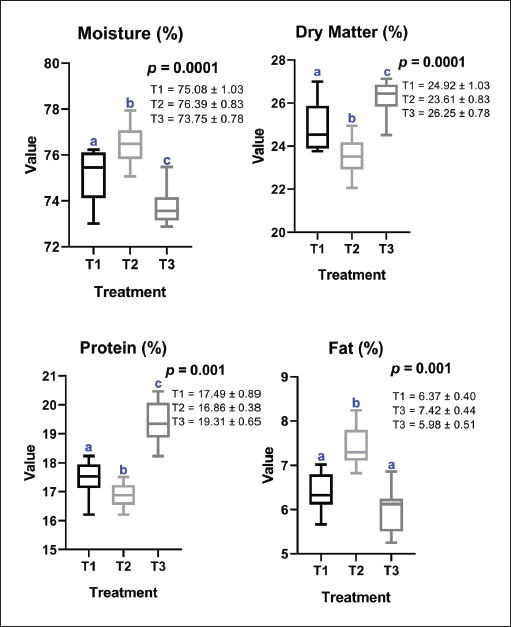
The effect size analysis showed that 9.9% of the variance in weight gain, which could not be explained by other model factors, could be attributed to the treatment effect, representing a moderate effect size. In contrast, 94.8% of the variance was associated with the effect of time (day), reflecting a huge effect. Finally, 22.9% of the variance in weight gain was attributed to the interaction between treatment and day, representing a large effect size and suggesting that treatment differences in weight gain varied significantly over time (Table 4). Feed conversionAs shown in Table 3, as time progressed, feed conversion exhibited a decreasing trend in all treatments, reflecting greater feed utilization efficiency as the guinea pigs reached a higher degree of maturity. At 90 days, the best efficiency was observed in the Chala maize treatment (3.21 ± 0.31), followed by Kurumi (3.36 ± 0.93) and Cuba 22 (3.58 ± 0.43), indicating that animals fed with Chala maize required less feed to produce one unit of weight gain. Table 4 shows that the effect of treatment was not statistically significant (p=0.442), indicating no differences in average feed conversion among the three groups evaluated and a small effect size. The effect of time was highly significant, with a large effect size (p < 0.001; ηP²=0.172), indicating that time strongly influenced feed conversion variations. Finally, the treatment-by-day interaction was not significant (p=0.756), indicating a negligible effect. Forage intakeForage intake gradually increased in all treatments as time passed. On average, guinea pigs fed with Chala maize recorded the highest intake at 90 days (2.46 ± 0.22 kg), followed by those fed with Cuba 22 (2.63 ± 0.43 kg) and Kurumi (2.23 ± 0.72 kg) (Table 3). The effect of treatment on forage intake was not significant (p > 0.05), although this factor explained approximately 4% of the total variance, representing a small effect size. In contrast, the effect of day was highly significant (p < 0.001), indicating that intake varied substantially over time, explaining approximately 25% of the total observed variation. The treatment-by-day interaction was not statistically significant (p > 0.05), indicating that the temporal intake pattern was similar among treatments (Table 4). Concentrate intakeThe concentration intake remained relatively stable throughout the experimental period, showing no marked variations among treatments. Values ranged from 0.41 to 0.84 kg, indicating that the type of forage offered did not significantly influence concentrate intake (Table 3). The effect of treatment on concentrate intake was not significant (p > 0.05) (Table 4). Similarly, the treatment-by-day interaction was not statistically significant (p > 0.05), indicating that the temporal intake pattern was similar across all treatments. However, intake varied significantly over time (p < 0.05), with a large effect size (ηp²=0.93), indicating that the time factor strongly influenced this variable. Nutritional characteristics of carcassesThe bromatological analyses showed that carcasses from treatment T2 had the highest moisture content (76.39% ± 0.83%), followed by T1 and T3, with values of 75.08% ± 1.03% and 73.75% ± 0.78%, respectively. Consequently, dry matter content exhibited the same trend in reverse order, with values of 23.61% ± 0.83%, 24.92% ± 1.03%, and 26.25% ± 0.78% for T2, T1, and T3, respectively. Regarding protein content, guinea pigs fed with Kurumi grass (T3) recorded the highest value (19.31% ± 0.65%), followed by T1 (corn fodder) and T2 (Cuba 22), with 17.49% ± 0.89% and 16.86% ± 0.38%, respectively. Significant differences were observed among treatments for all these parameters (p < 0.05). Similarly, fat content showed significant differences, although T1 (6.37% ± 0.40%) and T3 (5.98% ± 0.51%) exhibited comparable values. In contrast, carcasses from T2 had the highest fat content (7.42% ± 0.44%) (Fig. 1).
Fig. 1. Nutritional characteristics of guinea pig carcasses based on the bromatological analysis at the end of the study. Moisture (%), dry matter (%), protein (%), and fat (%) are shown for treatments T1=corn fodder (Zea mays), T2=Cuba 22 (Pennisetum spp.), and T3=kurumi (Pennisetum purpureum). ANOVA (p < 0.05). Tukey’s post hoc test is denoted by superscripts a,b, indicating differences between treatments when p < 0.05. DiscussionFeeding and nutrition directly influence the meat and reproductive productivity of guinea pigs, a species that is particularly sensitive to the quality of forage supplied (Bauer et al., 2009). However, studies on guinea pigs under the environmental conditions of Peru’s northern coast remain limited, especially regarding the use of alternative tropical forages. The nutritional composition of forages used in guinea pig feeding can vary considerably, depending on factors such as soil type and fertility, the plant part used, and cutting age (Castro-Bedriñana and Chirinos-Peinado, 2021). Specific nutritional requirements have been established for the Peru breed of guinea pigs to maintain vital functions and promote adequate weight gain (Tapie et al., 2025). However, similar studies for the Kuri breed have not yet been reported, preventing the precise determination of these parameters. Several authors have indicated that housing space affects feeding efficiency (Cáceres O. et al., 2004), which is why cage size was standardized in this study. To minimize sex-related variability and per-farm management policy, only females were used, as previous studies have shown significant zootechnical differences between males and females, especially when the former are castrated (Vega AH Pujada and Astocuri, 2012; de Figueiredo et al., 2020). Nevertheless, it is recognized that protein requirements during gestation and lactation do not significantly affect body weight according to sex (Bauer et al., 2009). Guinea pigs fed with corn fodder showed higher weight gain, consistent with the findings of Reyna-Reyes (2024), who evaluated different forages (corn fodder, forage sorghum, and purple elephant grass). The best productive and economic performance was observed with corn fodder, even though feed conversion did not differ significantly from sorghum. Other authors have reported that corn fodder combined with other forages increases carcass yield (Velis, 2017). Similarly, Espino-Huallpa and W (2024)highlighted a positive effect on feed conversion when broccoli residues were added to corn fodder without significant improvements in weight gain—an opposite effect to that observed with sugarcane tops (Urbina-Alegría and C, 2021). The favorable performance of corn fodder may also be attributed to its high digestible starch content in the cob, which is directly related to growth (Gao et al., 2023; Kussie et al., 2024). Soil characteristics and crop management practices can also influence soil nutritional quality (Buoso et al., 2023; Yeasmin et al., 2024). In this study, corn fodder was fertilized with decomposed guinea pig manure, a technique that, according to Meza-Campos and J (2024), does not produce significant nutritional differences compared with other fertilization methods. Bromatological analysis revealed that this forage provided the highest energy contribution (Kcal) among treatments, although it showed the lowest levels of crude protein, fat, and total fiber. The NV of kurumi grass from the bromatological analysis were consistent with those reported in the specialized literature (Pereira et al., 2021). However, its energy value was lower than that of corn fodder, which may explain its lower impact on growth and weight gain. Similar results have been observed in heifers fed with Kurumi grass, which showed lower weight gains compared with those fed with other legumes (Andrade et al., 2016), although other studies found no significant differences (Crestani et al., 2013). In the present study, a higher (less efficient) feed conversion ratio was also observed, possibly associated with the high palatability of P. purpureum, which can induce greater intake without proportional weight gain (Kampemba et al., 2017). The protein content of Cuba 22 grass was among the highest of the evaluated forages, consistent with the findings of Bacalla (2023). Animals fed with this grass showed productive results similar to those of the Kurumi group. Notably, all animals in this study consumed only the assigned forage. Molina-Portilla and A (2021) reported that the complete replacement of alfalfa with Cuba 22 in guinea pig diets produced comparable weight gains, even in high Andean regions with different climatic conditions. These results indicate that performance may depend more on nutritional content and forage quantity than on climatic factors. In this study, guinea pigs reached market-compatible weights (813 g), according to the standards established by Olivares-García and C (2024). Although factors such as temperature, humidity, and breed were not controlled in this study, they may influence the productive capacity of guinea pigs, even though the species is well adapted to diverse conditions (Sánchez-Macías et al., 2018). Scientific information on Kurumi and Cuba 22 grasses remains scarce and mostly limited to technical bulletins, with few validated studies assessing their impact on guinea pig productivity under field conditions. Other studies have emphasized the capacity of guinea pigs to adapt to dietary variations, partially mediated by efficient glucose absorption in the small intestine, facilitated by specific transporters (Anglas et al., 2012; Kohles, 2014). However, HEDs may reduce total feed intake, thereby improving feed conversion and economic performance (Morales et al., 2011; Quintana et al., 2013). Regarding the bromatological qualities of guinea pig carcasses, the fat content observed in this study was considerably lower than that reported by Huaman et al. (2016), who found that animals fed exclusively with green alfalfa reached 8.7% fat, whereas those fed a mixed diet (forage and concentrate) exceeded 15% fat. Although the animals in the present study also received a mixed diet, the average fat content did not exceed 7.42% in the group fed with Cuba 22 grass. However, this value was higher than that reported by Fuentes-López and J (2015)in guinea pigs fed only with alfalfa and oats. Significant differences in protein content were observed among treatments, with the highest value recorded in animals fed with Kurumi grass (19.39%). Although this value was lower than that reported for the Peru breed and Ecuadorian Creole guinea pigs, it exceeded that obtained for the Andean breed (Flores-Mancheno et al., 2017; Muñoz-Zambrano and Vargas-Zambrano, 2024). Conversely, the groups fed with corn chala and Cuba 22 showed substantially lower protein contents than those documented for the aforementioned breeds. Kurumi grass exhibited higher protein levels in the bromatological analysis, which may partially explain the increase in carcass protein content. However, the slaughter technique used may not influence fat or protein content in guinea pig carcasses (Fuentes-López and J, 2015). However, females slaughtered at 100 days of age reportedly show higher protein levels than those slaughtered at 90 or 80 days (Guevara-Ruíz, 2024), which could explain the lower values found in this study compared to specialized literature. The values obtained for carcass dry matter were slightly lower than those reported by Fuentes-López and J (2015) in guinea pigs fed with corn fodder and Cuba 22, except in the case of Kurumi grass. Because dry matter content is directly related to moisture, animals fed with Cuba 22 and corn fodder showed moisture levels similar to those described by Hinojosa et al. (2022). A possible explanation for these variations could be related to fasting time or water access before slaughter. Finally, a larger sample size might have increased the study’s statistical precision. Moreover, the use of a single breed, sex, and production stage limits the extrapolation of the results to other conditions. The findings could also vary under different management practices, temperatures, or water and forage availability levels. The bromatological composition of corn fodder and Kurumi grass may fluctuate depending on crop age, soil type, and fertilization, which could influence the reproducibility of the results. ConclusionThis study demonstrates that feeding with corn fodder promotes greater weight gain in female Kuri guinea pigs. However, Kurumi was associated with better carcass nutritional characteristics, showing higher protein content and lower levels of moisture and fat. Future studies are recommended to evaluate the optimization of productive performance and carcass quality through the combination of both forages, considering different guinea pig breeds, production systems, and larger sample sizes. AcknowledgmentsThe authors would like to thank the owners of the “Bodegones” guinea pig farm for providing their cultivation plots and animals for the execution of this work. Conflict of interestsThe authors have no conflicts of interest to declare. FundingThis study did not receive any specific grant. Authors’ contributionsCAPV, HÁB and VRS participated in the study design and conception. VRS, JVM, MDG, JLP, and JRP collected the required data. JRPV and JRP analyzed the collected data. CAPV and JRPV wrote the manuscript. All authors have read, reviewed, and approved the final version of the manuscript. Data availabilityData are available from the authors upon reasonable request and with the authorization of the Faculty of Veterinary Medicine, National University Pedro Ruiz Gallo. ReferencesAndrade, E.A., Almeida, E.X., Raupp, G.T., Miguel, M.F., De Liz, D.M., Carvalho, P.C.F., Bayer, C. and Ribeiro-Filho, H.M.N. 2016. Herbage intake, methane emissions and animal performance of steers grazing dwarf elephant grass v. dwarf elephant grass and peanut pastures. Animal 10(10), 1684–1688; doi:10.1016/j.animal.2010.09.010 Anglas, P.J., Cueva, M.S., Vásquez, C.M., Lira, M.B., Espinoza, B.J., Lucas, L.J. and Rodríguez, G.J. 2012. Identification and assessment of glucose transporters SGLT1 and GLUT2 and incretin glp-1 in the small intestine of guinea pigs (Cavia porcellus). Rev. Investig. Vet. Perú 23(4), 399–405. Avilés, D.F., Martínez, A.M., Landi, V. and Delgado, J.V. 2014. The guinea pig (Cavia porcellus): an Andean resource of interest as an agricultural food source. Anim. Genet. Resour. 55, 87–91. Bacalla, G.F. 2023. Effect of nitrogen fertilization and regrowth age on the nutritive quality of forage clones Pennisetum sp. B. S. thesis, UNTRM, Amazonas, Peru. Bauer, B., Dittami, J. and Huber, S. 2009. Effects of nutritional quality during early development on body weight and reproductive maturation of guinea pigs (Cavia aperea f. Porcellus). Gen. Comp. Endocrinol. 161(3), 384–389. Buoso, S., Lodovici, A., Salvatori, N., Tomasi, N., Arkoun, M., Maillard, A., Marroni, F., Alberti, G., Peressotti, A., Pinton, R. and Zanin, L. 2023. Nitrogen nutrition and xylem sap composition in Zea mays: effect of urea, ammonium, and nitrate on ionomic and metabolic profiles. Plant Sci. 336, 111825. Cáceres O., F., Jiménez A., R., Ara G., M., Huamán U., H. and Huamán C., A. 2004. Evaluación del espacio vital de cuyes criados en pozas. Rev. Investig. Vet. Perú 15(2), 100–112. Cano, W.J., Carcelén, C.F., Ara, G.M., Quevedo, G.W., Alvarado, S.A. and Jiménez, A.R. 2016. Effect of a probiotic mix supplementation on the productive performance of growing and finishing guinea pigs (Cavia porcellus). Rev. Investig. Vet. Perú 27(1), 51–58. Carcelén, F., López, M., Martín, F.S., Ara, M., Bezada, S., Ruiz-García, L., Sandoval-Monzón, R., López, S. and Guevara, J. 2021. Effect of probiotic administration at different levels on the fattening productivity parameters of guinea pigs (Cavia porcellus). Open Vet. J. 11(2), 222–227. Cárdenas, V.L., Sarmiento, C.V. and Ramos, Z.R. 2018. Características productions y tecnológicas de la carne de cup (Cavia porcellus) utilizando diets bahamas en pisana (Erythrina sp.). Rev. Investig. Altoandina. 20(4), 451–460. Castro, B.J., Chirinos, P.D. and Calderón, I.J. 2018. Nutritional quality of maca stubble (lepidium peruvianum chacón) in guinea pigs. Rev. Investig. Vet. Perú. 29(2), 410–418. Castro-Bedriñana, J. and Chirinos-Peinado, D. 2021. Nutritional value of some raw materials for guinea pigs (Cavia porcellus) feeding. Transl. Anim. Sci. 5, 1–11. Cohen, S., Kwok, M. and Huang, J. 2020. Humane euthanasia of guinea pigs (Cavia porcellus) with a penetrating spring-loaded captive bolt. Animals 10(8), 1356. Crestani, S., Filho, H.M.N.R., Miguel, M.F., De Almeida, E.X. and Santos, F.A.P. 2013. Steers performance in dwarf elephant grass pastures alone or mixed with Arachis pintoi. Health Prod. 45(6), 1369–1374. Cuibin, R., Zea, M.O., Palacios, P.G., Norabuena, M.E., Collazos, P.L. and Sotelo, M.A. 2020. Determination of digestibility and digestible energy of kudzu (Pueraria phaseoloides) meal in the guinea pig (Cavia porcellus). Rev. Investig. Vet. Perú 31(4), e19020; doi:10.1016/j.revpet.19020 De Figueiredo, L.B., De Souza, R.R., Santos, L.M., Costa, G.G., Da Silva, A.D., De Alencar, M.G., Ramos, O.T., Figueirêdo, N.A., Silva Junior, R.G. and Ávila, Q.M. 2020. Effect of sex on carcass yield and meat quality of guinea pig. Food Sci. Technol. 57(8), 3024–3030. Donoso, G., Galecio, J.S., Fuentes-Quisaguano, O.G. and Pairis-Garcia, M. 2025. Guinea pig meat production in South America: reviewing existing practices, welfare challenges, and opportunities. Anim. Welf. 34, e29. Emile, M., Fernand, T., Nathalie, M. N., Loïc, A. M. T., Paulette, N., and Etienne, T. P. 2018. Physiological features of pennisetum purpureum or panicum maximum consumption in guinea pigs (Cavia porcellus). J. Zool. Res. 1(1), 5–19. Espino-Huallpa, W. 2024. Rastrojo de broccoli (Brassica oleracea Itálica) y chala de mainz (Zea mays) en la tapa de engorge en cues en el distrito de Pacaycasa-Ayacucho. B. S. thesis, UNSCH, Ayacucho, Peru. Flores-Mancheno, C.I., Duarte, C. and Salgado-Tello, I.P. 2017. Characterization of the guinea pig (Cavia porcellus) meat for fermented sausage preparation. Rev. Cien. Agri. 14, 39–45. Fuentes-López, J. 2015. Influencia de métodos de sacrifices sobre la composición nutricional y calida sensorial de la carne de cup linea Perú (Cavia porcellus L.) INIA-Puno. B. S. tesis, UNAP, Puno, Peru. Gao, X., Yu, B., Yu, J., Mao, X., Huang, Z., Luo, Y., Luo, J., Zheng, P., Yan, H., He, J. and Chen, D. 2023. Effects of different starch structures on energy metabolism in pigs. J. Anim. Sci. Biotechnol. 14, 105. Goicochea-Vargas, J., Salvatierra-Alor, M., Acosta-Pachorro, F., Rondón-Jorge, W., Cajacuri-Aquino, J., Herrera-Briceño, A., Morales-Parra, E., Mialhe, E., Silva, M. and Ratto, M. 2025. Effects of oral administration of native lactic acid bacteria with probiotic potential on productive parameters and meat quality of fattening guinea pigs (Cavia porcellus). Open Vet. J. 15(4), 1576. Goicochea-Vargas, J., Salvatierra-Alor, M., Acosta-Pachorro, F., Rondón-Jorge, W., Herrera-Briceño, A., Morales-Parra, E. and Mialhe, E. 2024. Genomic characterization and probiotic potential of lactic acid bacteria isolated from guinea pig feces. Open Vet. J. 14(2), 716–729. Guevara, J., Tapia, N., Condorhuamán, C., Díaz, P., Carcelén, F., Bezada, S. and Abad, C. 2016. Production Inocua meat of guinea pigs supplemented with natural flora probiotic and commercial probiotic. J. Epidemiol. Public Health Rev. 1(1), 1–4. Guevara-Ruíz, M.E. 2024. Evaluación de las características fisicoquímicas de calidad en la carne fresca de cuy (Cavia porcellus) en función de su edad y sexo producido en la provincia de Chota. Cajamarca, Peru: UNACH. Herrera, E., Petrusan, J.I., Salvá-Ruiz, B., Novak, A., Cavalcanti, K., Aguilar, V., Heinz, V. and Smetana, S. 2022. Meat quality of guinea pig (Cavia porcellus) fed with black soldier fly larvae meal (Hermetia illucens) as a protein source. Sustainability 14(3), 1292. Herrera, H., Niño, J.A., Torrel, T. and Vargas-Rocha, L.A. 2024. Effect of alfalfa, concentrate and ryegrass diets on guinea pig production variables. Rev. Investig. Group. 50(3), 155–160. Hinojosa, B.R., León, L.C., Condori, R.G., Espinoza, Q.C. and Yzarra, A.A.Y. 2022. Dietary intake and carcass nutritive value in (Cavia porcellus). Rev. Alfa. 6(17), 346–356. Huaman., Zea, M.O., Gutiérrez, R.G. and Vílchez, P.C. 2016. Effect of three feeding systems on productive performance and on carcass fatty acid profile in guinea pigs. Rev. Investig. Vet. Perú 27(3), 486–494. Kampemba, F.M., Tshibangu, I.M., Nyongombe, N.U. and Hornick, J.L. 2017. Palatability of nine guinea pig fodder species (Cavia porcellus). Trop. Anim. Health Prod. 49(8), 1733–1739. Kohles, M. 2014. Gastrointestinal anatomy and physiology of select exotic companion mammals. Vet. Clin. N. Am. Exot. Anim. Pract. 17(2), 165–178. Kussie, B., Tadele, Y. and Asresie, A. 2024. Effect of intercropping maize (Zea mays l.) and cowpea (Vigna unguiculata l.) on agronomic performance, yield, and nutritional values of maize and cowpea under supplementary irrigation. Helicon 10(21), e39817. Lammers, P.J., Carlson, S.L., Zdorkowski, G.A. and Honeyman, M.S. 2009. Reducing food insecurity in developing countries through meat production: the potential of the guinea pig (Cavia porcellus). Renew. Agriculture Food Syst. 24(2), 155–162. Limon, G., Gonzales-Gustavson, E.A. and Gibson, T.J. 2016. Investigation into the humaneness of slaughter methods for guinea pigs (Cavia porcellus) in the Andean region. J. Appl. Anim. Welf. Sci. 19(3), 280–293. Meza-Campos, J. 2024. Efecto del estiercol y biol de cup en la producción de mainz chala (Zea mays L.) en Costa Central. Lima, Peru: UNAB. Molina-Portilla, A. 2021. Nivel de sustitución de la alfalfa (Medicago sativa) por forraje Cuba OM 22 (P. purpureum Cuba CT-169 x P. glaucum) en la alimentación de cuyes (Cavia porcellus) machos en la etapa de recría. B. S. tesis, UNAMBA, Apurímac, Peru. Morales, M.A., Carcelén, C.F., Ara, G.M., Arbaiza, F.T. and Chauca, F.L. 2011. Effect of two energy levels on the productive performance of guineapigs (Cavia porcellus) of the Peru breed. Rev. Investig. Vet. Perú. 22(3), 177–182. Muñoz-Zambrano, M. and Vargas-Zambrano, P. 2024. Parámetros físicos y químicos de la transformación de la carne de cup (Cavia porcellus). J. Sci. Res. 9(4), 1–13. Olivares-García, C. 2024. Implementación de un sistema de crianza tecnificada con la incorporación de forraje Cuba OM-22 para incrementar la ganancia de peso en cuyes en Valle del Río Negro, San Martín. B. S. tesis, UCSS, Lima, Peru. Pereira, A., Auad, A., Brigentí, A., Mittelmann, A., Gomide, C., Martín, C., Paciullo, D., Ledo, F., Oliveira, J., Leite, J., Machado, J., Matos, L., Morenz, M., Andrade, P., Bender, S. and Rocha, W. 2021. BRS Capiaçu and BRS Kurumi: cultivo y uso. Brasília, Brazil: Embrapa Press. Pinchao-Pinchao, Y., Serna-Cock, L., Osorio-Mora, O. and Tirado, D.F. 2024. Guinea pig breeding and its relation to sustainable food security and sovereignty in South America: nutrition, health, and production challenges. CyTA J. Food 22(1), 2392886. Quintana, M.E., Jiménez, A.R., Carcelén, C.F., San Martín, H.F. and Ara, G.M. 2013. Effect of diets based on alfalfa, barley zealand mineral block on the productive performance of guinea pigs. Rev. Investig. Vet. Perú. 24(4), 425–432; doi:10.1016/j.revpet.2014.09.010 Reyna-Reyes, M.R. 2024. Efecto de tres tips de gramíneas, en un system de alimentación mixta de cues en inicio, crecimiento-engorde, sobre el comportamento production y económico. B. S. thesis, UPAO, La Libertad, Peru. Rosenfeld, S.A. 2008. Delicious guinea pigs: seasonality studies and the use of fat in the pre-Columbian Andean diet. Quat. Int. 180(1), 127–134. Rupay, T.K., Ampuero, T.G., Vela, G.C., Angulo, V.C., Mathios, F.M. and Torres, S.R. 2023. Agronomic and nutritional assessment of cut-and-carry tropical grasses harvested at different intervals in Yurimaguas, Peruvian Amazon. Rev. Investig. Vet. Perú 34(5), e24461; doi:10.1016/j.revpet.2014.09.016 Salama, H.S. 2019. Yield and nutritive value of maize (Zea mays L.) forage as affected by plant density, sowing date, and harvest age. Ital. J. Agron. 14(2), 1383. Sánchez-Macías, D., Barba-Maggi, L., Morales-delaNuez, A. and Palmay-Paredes, J. 2018. Guinea pig for meat production: a systematic review of factors affecting the production, carcass, and meat quality of guinea pigs. Meat Sci. 143, 165–176. Tapie, W.A., Posada-Ochoa. and Rosero-Noguera. 2025. Net energy requirements for maintenance and weight gain in Peruvian male guinea pigs (Cavia porcellus). Livestock Sci. 295, 105700. Urbina-Alegría, C. 2021. Efecto de la sustitución del Zea mays “Maíz Chala” por Saccharum officinalis “Cogollo de caña de azúcar” sobre los parámetros production de cues en crecimiento – engorge. B. S. tesis, UNT, La Libertad, El Salvador. Vega AH Pujada. and Astocuri. 2012. Effect of chemical castration on the productive and behavioral performance of the guinea pig. Rev. Investig. Vet. Perú. 23(1), 52–57. Velis, F.G. 2017. Engorde de cuyes con dos dietas diferentes utilizando maíz chala y brócoli. B. S. tesis, UNALM, Lima, Peru. Yeasmin, S., Uddin, M.K., Chowdhury, M.A.H., Mohiuddin, K.M. and Saha, B.K. 2024. Poultry manure-urea fertilizer potentially influences nitrogen use efficiency, nutritional quality, and yield of baby corn (Zea mays L.). J. Agric. Food. Res. 4(4), 101409. | ||
| How to Cite this Article |
| Pubmed Style Vargas CAP, Barrantes HÃ, Suárez VR, Muñoz LV, García MD, Piedra JL, Periche JR, Paredes-valderrama JR. Effect of three forage species on the productive performance and carcass quality of the Kuri guinea pig on the northern coast of Peru. Open Vet. J.. 2026; 16(1): 231-240. doi:10.5455/OVJ.2026.v16.i1.21 Web Style Vargas CAP, Barrantes HÃ, Suárez VR, Muñoz LV, García MD, Piedra JL, Periche JR, Paredes-valderrama JR. Effect of three forage species on the productive performance and carcass quality of the Kuri guinea pig on the northern coast of Peru. https://www.openveterinaryjournal.com/?mno=278650 [Access: June 26, 2026]. doi:10.5455/OVJ.2026.v16.i1.21 AMA (American Medical Association) Style Vargas CAP, Barrantes HÃ, Suárez VR, Muñoz LV, García MD, Piedra JL, Periche JR, Paredes-valderrama JR. Effect of three forage species on the productive performance and carcass quality of the Kuri guinea pig on the northern coast of Peru. Open Vet. J.. 2026; 16(1): 231-240. doi:10.5455/OVJ.2026.v16.i1.21 Vancouver/ICMJE Style Vargas CAP, Barrantes HÃ, Suárez VR, Muñoz LV, García MD, Piedra JL, Periche JR, Paredes-valderrama JR. Effect of three forage species on the productive performance and carcass quality of the Kuri guinea pig on the northern coast of Peru. Open Vet. J.. (2026), [cited June 26, 2026]; 16(1): 231-240. doi:10.5455/OVJ.2026.v16.i1.21 Harvard Style Vargas, C. A. P., Barrantes, . H. Ã., Suárez, . V. R., Muñoz, . L. V., García, . M. D., Piedra, . J. L., Periche, . J. R. & Paredes-valderrama, . J. R. (2026) Effect of three forage species on the productive performance and carcass quality of the Kuri guinea pig on the northern coast of Peru. Open Vet. J., 16 (1), 231-240. doi:10.5455/OVJ.2026.v16.i1.21 Turabian Style Vargas, César A. Piscoya, Henrri Álvarez Barrantes, Víctor Ravillet Suárez, Luís Vílchez Muñoz, Magaly Díaz García, José Leiva Piedra, José Reupo Periche, and Juan R. Paredes-valderrama. 2026. Effect of three forage species on the productive performance and carcass quality of the Kuri guinea pig on the northern coast of Peru. Open Veterinary Journal, 16 (1), 231-240. doi:10.5455/OVJ.2026.v16.i1.21 Chicago Style Vargas, César A. Piscoya, Henrri Álvarez Barrantes, Víctor Ravillet Suárez, Luís Vílchez Muñoz, Magaly Díaz García, José Leiva Piedra, José Reupo Periche, and Juan R. Paredes-valderrama. "Effect of three forage species on the productive performance and carcass quality of the Kuri guinea pig on the northern coast of Peru." Open Veterinary Journal 16 (2026), 231-240. doi:10.5455/OVJ.2026.v16.i1.21 MLA (The Modern Language Association) Style Vargas, César A. Piscoya, Henrri Álvarez Barrantes, Víctor Ravillet Suárez, Luís Vílchez Muñoz, Magaly Díaz García, José Leiva Piedra, José Reupo Periche, and Juan R. Paredes-valderrama. "Effect of three forage species on the productive performance and carcass quality of the Kuri guinea pig on the northern coast of Peru." Open Veterinary Journal 16.1 (2026), 231-240. Print. doi:10.5455/OVJ.2026.v16.i1.21 APA (American Psychological Association) Style Vargas, C. A. P., Barrantes, . H. Ã., Suárez, . V. R., Muñoz, . L. V., García, . M. D., Piedra, . J. L., Periche, . J. R. & Paredes-valderrama, . J. R. (2026) Effect of three forage species on the productive performance and carcass quality of the Kuri guinea pig on the northern coast of Peru. Open Veterinary Journal, 16 (1), 231-240. doi:10.5455/OVJ.2026.v16.i1.21 |


