




| Short Communication | ||
Open Vet. J.. 2026; 16(1): 721-723 Open Veterinary Journal, (2026), Vol. 16(1): 721-723 Short Communication Evaluation of corneal sensitivity in 40 Pantaneiro horses using the Cochet–Bonnet esthesiometerEduardo Ferreira Faria1, Paulo Roberto Spiller1, Alice Mamede Costa Marques Borges2, Bruno Gomes de Castro3, Lianna Ghisi Gomes4* and Nathalie Moro Bassil Dower11Postgraduate Program in Animal Bioscience, University of Cuiabá (UNIC), Cuiabá, Brazil 2Self-employed Veterinarian, Dower Veterinary Ophthalmology, Cuiabá, Brazil 3Postgraduate Program in Health Sciences, Federal University of Mato Grosso (UFMT), Sinop, Brazil 4Postgraduate Program in Veterinary Sciences, Federal University of Mato Grosso (UFMT), Cuiabá, Brazil *Corresponding Author: Lianna Ghisi Gomes. Veterinary Hospital, Federal University of Mato Grosso. Avenida Fernando Côrrea da Costa, Cuiabá, Brazil. Email: liannaghisi [at] gmail.com Submitted: 23/07/2025 Revised: 17/11/2025 Accepted: 03/12/2025 Published: 31/01/2026 © 2025 Open Veterinary Journal
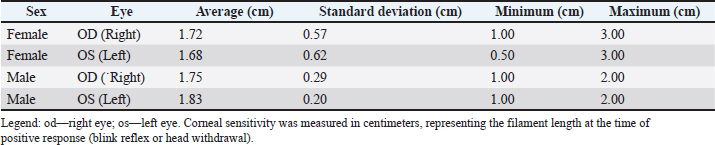
AbstractBackground: Corneal sensitivity is a crucial ophthalmic parameter for the protection and maintenance of ocular health in horses. Aim: This study aimed to evaluate the corneal sensitivity of 40 Pantaneiro horses using the Cochet–Bonnet esthesiometer, in order to establish reference values for this population. Methods: The animals were considered clinically healthy after a complete ophthalmic examination. Measurements were taken in both eyes, and the data were analyzed for mean, standard deviation, and potential differences between eyes, sex, and age groups. Results: The average corneal sensitivity measured by the Cochet-Bonnet esthesiometer in the evaluated Pantaneiro horse population was 1.72 cm ± 0.45 cm, with no differences found between eyes (p=0.745) or sexes (p=0.434). Conclusion: This study contributes to filling an important gap in the veterinary ophthalmic literature by providing normative data on corneal sensitivity in Pantaneiro horses, a breed still underrepresented in comparative ophthalmologic studies. Keywords: Horses, Cornea, Esthesiometry, Veterinary ophthalmology, Cochet-Bonnet. IntroductionThe cornea is the main refractive medium of the eye and the first structure exposed to physical, chemical, and infectious agents, playing critical roles in protection and vision (Brooks, 2013a,b). The integrity and function of the cornea depend on proper sensory innervation, mainly from the trigeminal nerve, whose activation is essential for protective reflexes such as blepharospasm and tear production (Belknap and Gilger, 1999 a,b). The Cochet–Bonnet esthesiometer is used to quantify corneal sensitivity by applying a nylon monofilament of variable length to the corneal surface; the longest filament length that elicits a blink or withdrawal response is recorded as the corneal touch threshold, with longer lengths indicating greater sensitivity (Cochet and Bonnet, 1960). In veterinary medicine, previous studies have shown variations in corneal sensitivity across species, breeds, and pathological conditions (Van Der Woerdt et al., 1997a,b; Clode and Gilger, 2005a,b). However, normative data on corneal sensitivity in Pantaneiro horses are scarce. This breed, adapted to the environmental conditions of the Brazilian Pantanal, presents specific phenotypic and physiological characteristics (Santos et al., 2009a,b), which may influence ophthalmic parameters. Therefore, this study aimed to evaluate the corneal sensitivity of Pantaneiro horses using the Cochet–Bonnet esthesiometer, contributing to the establishment of reference values for the species and breed. Materials and MethodsThe study was conducted on a rural property dedicated to beef cattle and Pantaneiro horse breeding, located in the Pantanal biome. Forty clinically healthy adult Pantaneiro horses of both sexes were included, selected after a complete ophthalmic examination, which included direct inspection, indirect ophthalmoscopy, applanation tonometry, and fluorescein staining. Corneal sensitivity was assessed using a Cochet–Bonnet esthesiometer (Luneau®, Paris, France). The monofilament was initially set to its maximum length (6.0 cm) and applied perpendicularly to the central cornea. If there was no response (blink reflex or head withdrawal), the filament length was reduced in 0.5 cm increments until a positive response was obtained. Three measurements were taken per eye, and the mean of the values was considered. Statistical analysis was performed using R software (version 4.2.0), adopting a significance level of 5%. Normality tests (Shapiro–Wilk) were applied, and depending on the case, paired Student’s t-test or Wilcoxon test was used to compare eyes. Ethical approvalThis study was approved by the Animal Ethics Committee (CEUA) of Universidade de Cuiabá (UNIC), under protocol number 009/2022 (October 28, 2022). Results and DiscussionThe average corneal sensitivity measured by the Cochet-Bonnet esthesiometer in the evaluated Pantaneiro horse population was 1.72 cm ± 0.45 cm, with no significant difference found between eyes when analyzing the entire population (p=0.745). The results categorized by eye and sex are described in Table 1. Table 1. Descriptive statistics of corneal sensitivity in clinically healthy pantaneira horses, assessed with a cochet-bonnet aesthesiometer on a property located in the pantanal biome.
None of the groups (OD and OS in females and males) showed normal distribution (p < 0.05); thus, non-parametric tests such as Wilcoxon and Mann–Whitney would be ideal. However, since the data are symmetric and the sample size (n=20) is reasonable, t-tests remain robust. There were no differences between eyes in females (p=0.834) or in males (p=0.163). As no difference was found between eyes, an average (OD + OS) was calculated for each sex, resulting in 1.66 cm for females and 1.78 cm for males. The result showed no significant difference between sexes (p=0.434). The results obtained in this study indicate that the average corneal sensitivity of clinically healthy Pantaneiro horses was similar between the right (OD) and left (OS) eyes, in both females and males, suggesting physiological symmetry of corneal innervation in this population. These findings are consistent with previous studies that report bilateral symmetry as a common characteristic of corneal sensitivity in healthy horses (Clode and Gilger, 2005a,b). The absence of differences between eyes is expected, given the relatively uniform distribution of nerve endings in the cornea originating from the ophthalmic division of the trigeminal nerve (Belknap and Gilger, 1999a,b). The analyses did not reveal significant differences between females and males. Although sex-related differences have been reported in other species and contexts (Van Der Woerdt et al., 1997a,b), our data does not support such influence in Pantaneiro horses. The overall mean corneal sensitivity obtained in this study (ranging from 1.68 cm to 1.83 cm among groups) was lower than that reported in European horse breeds, as observed by Brooks (2013a,b)who described average values above 2.5 cm in saddle horses maintained under controlled environmental conditions. This difference may be attributed to environmental and adaptive factors specific to the Pantaneiro breed, which is notably adapted to the harsh environment of the Pantanal, with extreme variations in humidity and intense sun exposure (Santos et al., 2009a,b). It is plausible that this adaptation influences physiological characteristics such as corneal thickness and nerve ending density, resulting in lower sensitivity values. The use of the Cochet-Bonnet esthesiometer proved to be appropriate for quantifying corneal sensitivity in this population, providing reproducible and non-invasive measurements, as previously reported in the literature (Cochet and Bonnet, 1960). However, it is important to consider that this technique, although widely accepted, has limitations related to the subjectivity of the response and the influence of factors such as ambient temperature, humidity, and animal behavior (Clode and Gilger, 2005a,b). Environmental variables are particularly important because they directly affect the stiffness of the nylon filament, making it essential to maintain stable conditions to prevent variations in the pressure applied during measurement (Lum and Murphy, 2018). ConclusionThis study contributes to filling an important gap in the veterinary ophthalmology literature by providing normative data on corneal sensitivity in Pantaneiro horses, a breed still underrepresented in comparative ophthalmologic studies. Standardizing these values is essential for more accurate diagnoses of corneal neuropathies and for the clinical monitoring of diseases that compromise ocular innervation. Future studies should include larger samples, different age groups, and comparisons among breeds and biomes to build a robust database for national equine ophthalmology. AcknowledgmentsThe authors gratefully acknowledge the invaluable support provided by Program in Animal Bioscience, University of Cuiabá (UNIC). Conflict of interest The authors have no competing interests to declare. FundingThis study was not funded by any party. Authors’ contributionsEFF, PRS, AMCMB, and NMBD conceived and designed the clinical study, analyzed and interpreted the data, and critically reviewed the manuscript. EFF, BGC, LGG, and NMBD contributed to data interpretation and manuscript writing. All authors contributed to the final version of the manuscript and approved its submission. Data availabilityAll data are provided in the revised manuscript. ReferencesBelknap, E.B. and Gilger, B.C. 1999a. Equine corneal disease. Vet. Clinics North Amer. Equine Pract. 15(3), 537–557. Belknap, E.B. and Gilger, B.C. 1999b. Equine ocular examination and diagnostic techniques. Vet. Clinics North Amer. Equine Pract. 15(3), 505–527. Brooks, D.E. 2013a. Diseases of the cornea and sclera.In Equine ophthalmology. Gilger, B.C St. Louis: Elsevier, pp: 167–231. Brooks, D.E. 2013b. Equine ophthalmology.In Veterinary ophthalmology. Ames, IA: Gelatt, K.N Wiley-Blackwell, 5, pp: 1529–609. Clode, A.B. and Gilger, B.C. 2005a. Equine keratitis. Vet. Clinics North Amer. Equine Pract. 21(3), 565–597. Clode, A.B. and Gilger, B.C. 2005b. Ocular pain and sensation: measurement and management in animals. Vet. Clinics. North. Amer. Small. Anim. Pract. 35(6), 1373–1389. Cochet, P. and Bonnet, R. 1960. L’esthésiométrie cornéenne. Documenta Ophthalmologica 14, 1–16. Lum, E. and Murphy, P.J. 2018. Effects of ambient humidity on the Cochet-Bonnet aesthesiometer. Eye 19(32), 1644–1651. Santos, S.A., Abreu, U.G.P., Comastri-Filho, J. A. and Soares, R.J. 2009a. Características morfológicas e funcionais de equinos Pantaneiros: implicações para conservação da raça. Revista. Brasileira. De. Zootecnia. 38(11), 2240–2246. Santos, S.A., Mcmanus, C., Louvandini, H., Martins, R.F. and Paiva, S.R. 2009b. Genetic diversity and population structure of the Pantaneiro horse. Genet. Mol. Res. 8(4), 1489–1495. Van Der Woerdt, A., Nasisse, M.P. and Davidson, M.G. 1997. Corneal sensitivity in dogs with diabetic keratopathy. Vet. Ophthalmology 6(1), 7–20. Van Der Woerdt, A., Wilkie, D.A., Myers, T.L. and Stephens, S.L. 1997. Corneal sensitivity in normal dogs measured by the Cochet-Bonnet esthesiometer. Prog. Vet. Comparative Ophthalmology 7(2), 75–78. Legend: od—right eye; os—left eye. Corneal sensitivity was measured in centimeters, representing the filament length at the time of positive response (blink reflex or head withdrawal). | ||
| How to Cite this Article |
| Pubmed Style Faria EF, Spiller PR, Borges AMCM, Castro BGD, Gomes LG, Dower NMB. Evaluation of corneal sensitivity in 40 Pantaneiro horses using the Cochet–Bonnet esthesiometer. Open Vet. J.. 2026; 16(1): 721-723. doi:10.5455/OVJ.2026.v16.i1.67 Web Style Faria EF, Spiller PR, Borges AMCM, Castro BGD, Gomes LG, Dower NMB. Evaluation of corneal sensitivity in 40 Pantaneiro horses using the Cochet–Bonnet esthesiometer. https://www.openveterinaryjournal.com/?mno=272825 [Access: June 26, 2026]. doi:10.5455/OVJ.2026.v16.i1.67 AMA (American Medical Association) Style Faria EF, Spiller PR, Borges AMCM, Castro BGD, Gomes LG, Dower NMB. Evaluation of corneal sensitivity in 40 Pantaneiro horses using the Cochet–Bonnet esthesiometer. Open Vet. J.. 2026; 16(1): 721-723. doi:10.5455/OVJ.2026.v16.i1.67 Vancouver/ICMJE Style Faria EF, Spiller PR, Borges AMCM, Castro BGD, Gomes LG, Dower NMB. Evaluation of corneal sensitivity in 40 Pantaneiro horses using the Cochet–Bonnet esthesiometer. Open Vet. J.. (2026), [cited June 26, 2026]; 16(1): 721-723. doi:10.5455/OVJ.2026.v16.i1.67 Harvard Style Faria, E. F., Spiller, . P. R., Borges, . A. M. C. M., Castro, . B. G. D., Gomes, . L. G. & Dower, . N. M. B. (2026) Evaluation of corneal sensitivity in 40 Pantaneiro horses using the Cochet–Bonnet esthesiometer. Open Vet. J., 16 (1), 721-723. doi:10.5455/OVJ.2026.v16.i1.67 Turabian Style Faria, Eduardo Ferreira, Paulo Roberto Spiller, Alice Mamede Costa Marques Borges, Bruno Gomes De Castro, Lianna Ghisi Gomes, and Nathalie Moro Bassil Dower. 2026. Evaluation of corneal sensitivity in 40 Pantaneiro horses using the Cochet–Bonnet esthesiometer. Open Veterinary Journal, 16 (1), 721-723. doi:10.5455/OVJ.2026.v16.i1.67 Chicago Style Faria, Eduardo Ferreira, Paulo Roberto Spiller, Alice Mamede Costa Marques Borges, Bruno Gomes De Castro, Lianna Ghisi Gomes, and Nathalie Moro Bassil Dower. "Evaluation of corneal sensitivity in 40 Pantaneiro horses using the Cochet–Bonnet esthesiometer." Open Veterinary Journal 16 (2026), 721-723. doi:10.5455/OVJ.2026.v16.i1.67 MLA (The Modern Language Association) Style Faria, Eduardo Ferreira, Paulo Roberto Spiller, Alice Mamede Costa Marques Borges, Bruno Gomes De Castro, Lianna Ghisi Gomes, and Nathalie Moro Bassil Dower. "Evaluation of corneal sensitivity in 40 Pantaneiro horses using the Cochet–Bonnet esthesiometer." Open Veterinary Journal 16.1 (2026), 721-723. Print. doi:10.5455/OVJ.2026.v16.i1.67 APA (American Psychological Association) Style Faria, E. F., Spiller, . P. R., Borges, . A. M. C. M., Castro, . B. G. D., Gomes, . L. G. & Dower, . N. M. B. (2026) Evaluation of corneal sensitivity in 40 Pantaneiro horses using the Cochet–Bonnet esthesiometer. Open Veterinary Journal, 16 (1), 721-723. doi:10.5455/OVJ.2026.v16.i1.67 |


