




| Review Article | ||
Open Vet. J.. 2025; 15(12): 6215-6223 Open Veterinary Journal, (2025), Vol. 15(12): 6215-6223 Review Article A comprehensive approach for controlling stray and homeless cats and dogs in the GCC CountriesKhalifa Khalaf Khatam Ali*Veterinary Surgery Specialist, Kuwait City, Kuwait *Corresponding Author: Khalifa Khalaf Khatam Ali. Veterinary Surgery Specialist, Kuwait City, Kuwait. Submitted: 25/07/2025 Revised: 26/10/2025 Accepted: 04/11/2025 Published: 31/12/2025 © 2025 Open Veterinary Journal
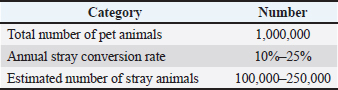
AbstractStray cats and dogs present serious challenges to public health, safety, animal welfare, and environmental balance in the Gulf region. This paper proposes a unified strategic framework that aligns with the shared climatic, cultural, and legislative characteristics of the Gulf Cooperation Council countries. Based on a proposed national plan, the document outlines the study's objectives, contributing factors to the phenomenon, estimated number of stray and homeless animals, expected stakeholders, targeted locations, control strategy, project timeline, required materials and supplies, estimated budget, workforce structure, operational system, animal monitoring methods, tracking mechanism, animal utilization (during life and post-mortem), success factors, and official regulatory forms. The strategy aims to establish an effective balance between population control and humane treatment in accordance with international veterinary and ethical standards. It proposes an integrated system involving monitoring, capture, sheltering, public awareness, and sustainable management solutions. Keywords: Stray animals, GCC, Animal welfare, Euthanasia, Regional strategy. IntroductionCats and dogs have accompanied humans for millennia, transitioning from wild species to domestic companions that became integral to daily life. However, neglect, abandonment, and unregulated breeding have contributed to the emergence of large free-roaming populations whose behaviors are often incompatible with urban and rural environments, posing significant risks to public safety, public health, and environmental stability. Stray animals—defined as unowned domestic dogs and cats—frequently live independently, reproduce unchecked, and may reach excessive numbers that generate nuisance and health concerns (Crowley et al., 2019; Sandøe et al., 2019). Globally, free-roaming dogs are believed to constitute the majority of the total dog population, estimated at roughly 700 million to 1 billion (WHO, 2013; WOAH, 2019). More recent evidence confirms that sterilization-based control efforts remain inconsistent, and outcomes vary across regions depending on implementation coverage, community participation, and policy enforcement (Hiby et al., 2023; Ho et al., 2024). In Bangkok, for instance, large-scale Capture–Neuter–Vaccinate–Return programs demonstrated reductions in free-roaming dogs, yet highlighted the limitations of partial implementation and the need for sustained coverage above 70% (Hiby et al., 2023; Thichumpa et al., 2025). These animals commonly suffer from malnutrition, infectious diseases, traffic injuries, and premature death, generating measurable impacts on communities and ecosystems (Fournier and Geller, 2004). They may also compete with native species, serve as reservoirs for zoonotic pathogens, or attract predators into residential areas (Jessup, 2004; Semiens, 2004). Given their high reproductive potential, accurate population estimation is difficult; a single fertile female and her offspring can produce dozens of juveniles in a short period, sustaining populations despite high mortality rates (Stoskopf and Nutter, 2004). Most reviews report reductions of approximately 60%–80% when comprehensive sterilization-based programs are implemented (Smith et al., 2019), though recent modeling confirms that populations rebound rapidly without long-term enforcement and public compliance (Thichumpa et al., 2025). The increasing frequency of human–animal encounters—particularly involving children—raises risks of injury, emotional trauma, and zoonotic transmission (Slater, 2001; Gerhold and Jessup, 2013). At the same time, public attitudes toward stray animals play a decisive role in determining the acceptance and success of management approaches, as demonstrated by a recent situational analysis in Australia (Rand et al., 2024). Addressing these challenges requires a sustainable, regionally adapted framework that integrates responsible ownership, public education, compulsory identification and registration, environmental management, and breeding control (WOAH, 2019). Importantly, such measures must be implemented within a robust legal system supported by multi-agency cooperation (Tasker, 2007) and tailored to the socio-cultural and environmental conditions of the Gulf Cooperation Council (GCC) Study objectivesThe objectives of this study are structured to address the multidimensional challenges posed by stray and homeless animals in the GCC countries. They are grouped into key domains to ensure clarity, focus, and measurable impact: Public health and safety• To reduce the number of stray and homeless animals in both urban and rural areas. • To limit the transmission of zoonotic and communicable diseases. • To reduce traffic accidents caused by stray animals crossing roads. • To minimize the risk of animal attacks, bites, or aggressive encounters—especially among children and vulnerable populations. • To replace harmful and unregulated practices (e.g., poisoning, shooting) with humane and scientifically validated control measures. Education and awareness• To enhance public knowledge through nationwide awareness campaigns promoting responsible ownership, vaccination, and sterilization. • To integrate animal welfare education into schools and public programs to foster empathy and responsibility among future generations. • To provide veterinary and medical students with structured, humane training opportunities in shelters and field programs. • To support and collaborate with animal welfare associations in advocacy, awareness, and community engagement. Infrastructure and governance• To establish sustainable sheltering facilities and infrastructure across the region for housing, treatment, and monitoring of stray animals. • To activate inter-governmental cooperation between municipalities, veterinary authorities, public health sectors, and law enforcement agencies. • To develop a unified legal framework enforcing registration, sterilization, and responsible ownership of domestic pets. • To strengthen monitoring and reporting systems, including the use of digital databases, microchipping, and modern detection technologies. Economic, environmental, and research benefits• To reduce environmental pollution caused by unmanaged carcasses, waste, and uncontrolled animal populations. • To lower long-term governmental expenditures related to stray animal incidents, such as healthcare costs and municipal complaints. • To create employment opportunities in shelter operations, animal care, logistics, and related support services. • To promote sustainable industries that utilize animal byproducts (e.g., organic fertilizers, biogas, and veterinary training materials) under strict ethical and regulatory frameworks. • To enable humane scientific research and training applications in compliance with international animal welfare standards. Factors contributing to the spread of stray and homeless animalsThe persistence and growth of stray and homeless animal populations in the GCC region can be attributed to a combination of legislative, social, environmental, and cultural factors: Abandonment of petsMany owners release animals into the streets when they are unable to provide adequate care or medical treatment. This practice directly fuels the increase in stray populations (Sandøe et al., 2019). Weak or absent legislationThe lack of strict and enforceable laws regarding breeding, sterilization, ownership, sale, and animal welfare is a key factor. Studies in Asia and the Middle East confirm that weak enforcement frameworks severely undermine long-term management programs (Saengthong et al., 2025). Environmental attractorsThe widespread presence of waste, debris, and abandoned buildings provides safe shelters and fertile breeding grounds. Poor urban waste management has also been strongly associated with increased stray dog and cat populations (Doherty et al., 2016). Low public awarenessInsufficient public knowledge and the absence of structured educational programs hinder progress. Similar gaps have been reported globally, limiting community participation in control efforts. Inadequate control programsThe lack of well-planned, continuous, and organized programs has allowed the phenomenon to grow annually. A recent assessment emphasized that the absence of standardized welfare guidelines remains a persistent challenge (Saengthong et al., 2025). High reproductive capacityCats and dogs reach sexual maturity at an early age and reproduce frequently, which accelerates population growth even in the face of high mortality rates (Stoskopf and Nutter, 2004). Climatic and geographic conditionsThe GCC’s moderate climate throughout most of the year enables animals to breed and remain active year-round, exacerbating the persistence of stray populations (Smith et al., 2019). Rodent and waste-linked proliferationThe absence of rodent control campaigns, coupled with outdated waste container systems, sustains animal populations and creates environments incompatible with public health standards (Gerhold and Jessup, 2013). Cross-border movementBorder regions may serve as entry points for stray animals, complicating national-level control efforts (WOAH, 2019). Feeding practices in public facilitiesUnregulated feeding of stray animals in public areas contributes to rapid population growth while attracting rodents, insects, and predators, which further disrupt urban environments (Crowley et al., 2019). Estimated number of stray animals in the State of KuwaitLocal veterinary-based estimationIn addition to international ratios and statistical models, local operational data from veterinary practices in Kuwait further support the significant presence of stray animals. As the author of this study and the owner of two veterinary clinics in Kuwait, with knowledge of approximately four specialized private hospitals for cats and dogs and about 12 veterinary clinics in total, I have observed that spaying and neutering procedures for cat’s average around 15 cases per day per facility. When multiplied across all hospitals and clinics, this results in roughly 240 surgeries per day, amounting to approximately 87,600 operations annually. Considering that such procedures are performed mainly on stray or unowned animals brought in through various channels, this figure reinforces the conclusion that Kuwait has a substantial stray animal population. These findings align with global conversion rates from owned pets to strays and provide a realistic local basis for the estimates presented in Table 1. Table 1. Estimated stray animal numbers based on 1 million pet owners in Kuwait.
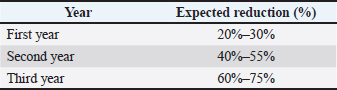
Population Breakdown in Kuwait: o Kuwaitis: 1.5 million o non-Kuwaitis: 3 million o Total population: 4.5 million Data sources and assumptionsAccording to the World Health Organization (WHO), the annual growth rate of stray animal populations is estimated at 3.75%. As per the Animal Welfare Board of India, the annual conversion rate of owned pets into strays ranges between 10% and 25%. The average lifespan of household cats is between 12 and 20 years, while stray cats live for 3 to 6 years (Animal Welfare Board of India). The average lifespan of household dogs is between 10 and 17 years, while stray dogs typically survive for 2–5 years AVMA—American Veterinary Medical Association. A single female dog or cat can produce dozens of offspring within 2 years, with sexual maturity being reached as early as 6 months (Journal of the American Veterinary Medical Association). Expected stakeholders in this project (Financial, Moral, or Advisory Support)World Organization for Animal Health (WOAH ( Food and Agriculture Organization (FAO) International Animal Rights Organizations Development and Project Support Funds Public Authority for Agriculture Affairs and Fish Resources (PAAF) Environment Public Authority (EPA) Ministries: Information, Finance, Health, Interior, Defense, and Municipality Medical and Veterinary Supply Companies Educational Institutions Veterinary Clinics Research Centers Livestock Companies Traders and the General Public Targeted locationsResidential areas Slaughterhouses Waste disposal sites Public facilities Remote regions and border zones Abandoned buildings and undeveloped lands Commercial establishments Farms and rural holdings Control strategyThe internationally recognized approach to dog population management emphasizes humane capture, identification, sterilization, vaccination, and responsible ownership (WOAH, 2019). While Trap–Neuter–Return (TNR) has been widely applied in many countries, cultural, environmental, and logistical conditions in Kuwait and the wider GCC require adaptation. Therefore, this study proposes a revised national model based on Trap–Neuter–Euthanize (TNE), implemented strictly under veterinary supervision and welfare guidelines (WOAH, 2019; AVMA, 2020). Justifications for TNEThey include (i) preventing animals from being returned to unsafe environments, (ii) reducing the re-emergence of stray populations in urban areas, (iii) minimizing the financial and logistical burden of long-term sheltering where adoption options are limited, and (iv) providing a humane solution for animals with incurable diseases, aggressive behavior, or permanent disability. Supporting rationaleEconomically, euthanasia using barbiturates is cost-effective and reduces the burden of prolonged care. From a public health perspective, timely removal of infected or aggressive animals reduces zoonotic risks and prevents the attraction of predators to human-populated areas. From a welfare perspective, euthanasia by trained personnel ensures a painless and dignified end, preventing chronic suffering and uncontrolled breeding cycles. Recent studies further highlight that population control programs succeed only when sterilization coverage exceeds 70% and welfare standards are consistently applied throughout capture and handling operations (Hiby et al., 2023; Saengthong et al., 2025). Ethics and welfare complianceAll capture, handling, sterilization, vaccination, and euthanasia procedures will be performed by trained staff under the supervision of an Official Veterinarian, in full accordance with WOAH and AVMA guidelines. Analgesia, humane endpoints, and post-procedure monitoring will be documented, ensuring transparency and alignment with international welfare standards. International and local references supporting euthanasiaThe World Health Organization: according to the WOAH Terrestrial Animal Health Code, Chapter 7.7, barbiturates are recommended for euthanasia because they induce smooth and humane death with minimal discomfort to the animal, and are relatively inexpensive compared to alternative agents. The AVMA Guidelines for the Euthanasia of Animals: according to the AVMA Guidelines for the Euthanasia of Animals (2020 edition), barbiturates—when administered properly—provide a method of euthanasia that is humane, painless, efficient, and cost-effective. Intravenous administration facilitates a smooth transition to unconsciousness with minimal discomfort, while the relatively low cost makes it a practical option for large-scale implementation. The World Organization for Animal Health: according to the World Organization for Animal Health, euthanasia may be used only as a humane last resort in dog and cat population management programs and must adhere strictly to animal welfare standards. Chapter 7.7 of the Terrestrial Animal Health Code emphasizes the goal of improving animal welfare, reducing stray populations, and promoting responsible ownership. Furthermore, operational guidelines in Chapter 7.6 require national contingency plans to include adequately trained personnel conducting euthanasia humanely under the supervision of an Official Veterinarian, with full compliance to biosecurity and welfare measures. Project timelinePhase one: Establishment (6 months)During this stage, preliminary data will be collected and areas with high concentrations of stray animals will be identified. Medical and field teams will be trained, and traps, supplies, and shelters will be prepared. Phase two: implementation (36 months)For 3 years, as seen in Table 2. Table 2. Expected reduction in stray animal cases and reports (Over 3 years)
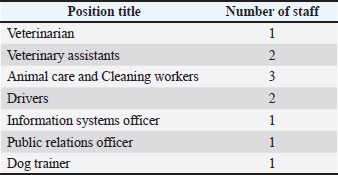
Phase three: evaluation and sustainabilityThis stage aims to maintain a control rate of no less than 70%, with a goal of reaching 80%, especially if permanent centers are established that comply with international standards (Table 3). Table 3. Staff and operational system (Per Shelter, Per Shift).
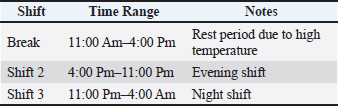
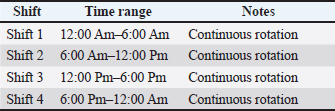
Most reviews report reductions of approximately 60%–80% when comprehensive sterilization-based programs are implemented (Smith et al., 2019). Work Schedule for the summer season can be seen in Table 4, and for winter season can be seen in Table 5. Table 4. Work schedule (Summer season).
Table 5. Work schedule (Winter season).
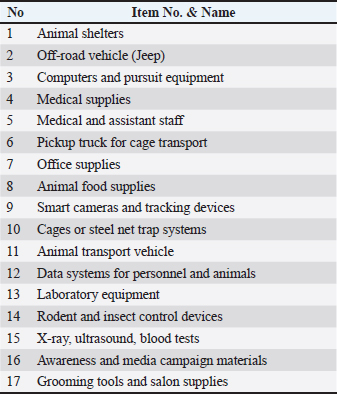
General requirements and project supplies can be seen in Table 6. Table 6. General requirements and project supplies.
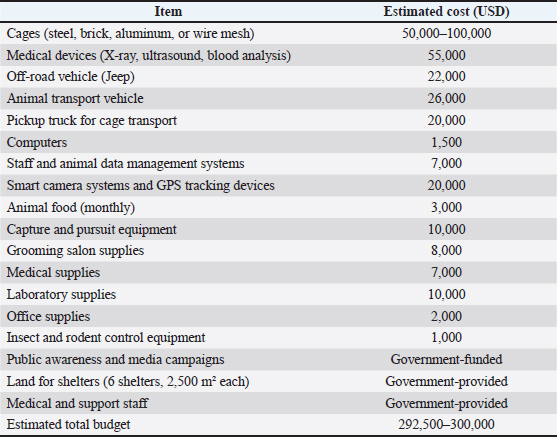
Estimated budget and operational costs (Note: Costs may vary depending on market conditions) can be seen in Table 7. Table 7. Construction and operational costs.
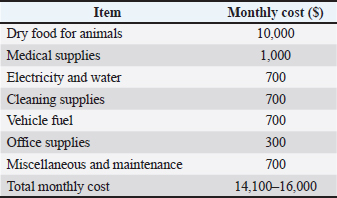
Estimated monthly operating cost per shelter (700 Animals) can be seen in Table 8. Table 8. Estimated monthly operating cost per shelter (700 Animals).
All forms can be seen in the Appendix. Animal detection methods
Detection protocol: two-phase operationPhase one: on-site monitoringPreserve the original site conditions (no object removal). Install fixed and mobile traps, smart cameras, and nets near the detection zone. Place attractants (food, scents) to reduce animal alertness. Add familiar items inside traps (e.g., leaves, boxes, rodent/bird models). For aggressive animals, use sedative-laced food (e.g., chicken, tuna, sausages). Operate primarily at night or early morning when animal activity peaks. Ensure quiet and natural team movement to avoid alarming animals. Use remote tranquilizer darts when physical capture is too risky. Phase two: post-capture proceduresCaptured animals are transported to a designated shelter. Upon arrival, the following steps are carried out:
Utilization of animalsA. During lifetimeAs pets and companions. For guarding, hunting, and scent-tracking. By civil defines teams. In veterinary and medical training institutions. For rodent detection and environmental monitoring. As support animals for people with special needs. In community adoption programs (e.g., farms, companies, institutions). For educational exhibitions in schools and public parks. B. After deathProcessed into animal feed. Used as organic fertilizer. Used as food for zoo animals. Converted into biogas (methane) for energy. Raw materials for animal feed and fertilizers. Tissue used for surgical suture production. Anatomical specimens for education and research. Raw material for leather, bone, and fat industries (e.g., pillows, soap, candles). Key success factors for the stray animal control projectLegal and legislative supportEnactment of a comprehensive animal welfare law and activation of enforcement mechanisms. Imposition of penalties on individuals who abandon or release animals indiscriminately. Mandatory sterilization and registration of domestic pets. Licensing requirements for pet stores and prohibition of unregulated sales. Integration of the project within a national animal welfare framework to ensure sustainability. Requirement for pet owners to implant tracking microchips. Obligation for veterinary clinics to reject treatment of animals lacking identification chips. Inter-governmental collaborationContinuous coordination between ministries and relevant agencies to streamline joint operations. Cooperation with municipalities for waste management and land allocation for shelters. Collaboration with the Environmental Authority to designate land for shelters and regulate population. Involvement of the Ministry of Information in public awareness and adoption campaigns. Community participation and educationOpening volunteer opportunities at shelters and in veterinary field patrols under official supervision. Launching a smart application for animal reporting, adoption, and volunteer registration. Partnerships with the private sector and NGOsEncouraging companies to sponsor shelter sections in exchange for promotional benefits or discounts. DiscussionAlthough existing literature provides valuable policy-level recommendations, there remains a critical gap in region-specific, operational frameworks applicable to the GCC region. For instance, Smith et al. (2019) synthesized findings from 45 sterilization-based programs such as TNR, yet their review highlighted wide inconsistencies in outcomes due to the absence of standardized procedures and sustainable logistical frameworks. Likewise, Tasker (2007) described control practices across Europe and Asia, with emphasis on legislation and public awareness, but without detailing mechanisms for implementation, resource allocation, or long-term sustainability. Such studies contribute important academic insights but largely remain conceptual, offering limited guidance for field-level execution. The present work extends beyond these limitations by combining a comprehensive review of international literature with applied evidence from veterinary and public health practice in the Gulf region. The analysis underscores persistent shortcomings—namely, the absence of comprehensive animal welfare legislation, weak enforcement of existing regulations, limited public awareness, and the scarcity of region-specific academic research. These gaps, compounded by environmental and cultural factors such as year-round breeding due to the Gulf climate and the lack of systematic waste management, have allowed stray populations to expand despite intermittent interventions. The proposed framework, therefore, moves beyond policy advocacy by outlining a fully integrated, field-ready operational model. It incorporates defined timelines, staffing structures, infrastructure specifications, animal detection methods, and utilization pathways that are directly compatible with the capacities and socio-political context of GCC states. Importantly, the approach addresses both theoretical and practical dimensions: it acknowledges the limitations of previous TNR-based strategies while adapting a TNE model as a humane, regionally feasible alternative. By embedding this strategy within the broader context of public health, environmental sustainability, and governance, the study provides a scalable solution that bridges the persistent divide between literature and practice. This framework is based on operational estimates from Kuwait and assumes comparable socio-environmental conditions across GCC states. Implementation outcomes will depend on municipal waste reforms, enforcement capacity, and public acceptance. Future studies should prospectively evaluate cost-effectiveness, welfare indicators, and community sentiment under varying TNE coverage levels, and compare TNE, TNR, and mixed models in controlled pilots. Conclusion and RecommendationsTo date, no published framework has incorporated a complete operational system—including animal identification, shelter infrastructure, workforce models, seasonal scheduling, euthanasia protocols, and inter-agency coordination—into a unified national plan specifically tailored to the GCC. This study fills that gap by offering an actionable, field-ready model that aligns with international standards while accommodating the unique environmental, legal, and demographic conditions of Kuwait and other Gulf countries. Unlike many previous works that relied mainly on theoretical or policy-level literature, this study integrates both academic evidence and practical experience. Drawing on more than twenty-two years of veterinary practice across Kuwait and other GCC countries, the framework reflects the realities of local environments and cultural conditions, as well as the existing gaps in legislation, enforcement, and public awareness. By addressing these limitations, the proposed TNE model provides a more pragmatic and humane alternative to conventional methods such as TNR, tailored to the region’s resources and socio-political context. The study strongly recommends that Gulf states enact and enforce comprehensive animal welfare legislation, establish permanent shelters supported by governments, promote multi-agency collaboration, and launch sustained public education campaigns. Furthermore, the absence of academic and applied studies in the region highlights the need for continued research that evaluates program effectiveness and adapts strategies to local realities. In conclusion, the proposed framework bridges the gap between literature and application. It offers a sustainable, scalable solution that can be rapidly deployed with minimal financial burden while ensuring significant benefits in public health, environmental safety, and animal welfare. If adopted, the model has the potential to reduce stray animal populations by more than 70% within three years, while creating a unified and humane strategy for the GCC region. AcknowledgmentsNone. FundingNone. Authors' contributionsThere is one author for this manuscript. Conflict of interestThe author declares that there is no conflict of interest. Data availabilityAll data were provided in the manuscript. No new data were generated or analyzed in this study. All information is based on previously published sources, expert field observations, and operational planning frameworks. ReferencesAmerican Veterinary Medical Association. (2020). AVMA guidelines for the euthanasia of animals: 2020 edition. Washington, DC: American Veterinary Medical Association. Crowley, S.L., Cecchetti, M. and Mcdonald, R.A. 2019. Hunting behaviour in domestic cats: an exploratory study of risk and responsibility among cat owners. People. Nature. 1(1), 18–30; doi:10.1002/pan3.6 Doherty, T.S., Glen, A.S., Nimmo, D.G., Ritchie, E.G. and Dickman, C.R. 2016. Invasive predators and global biodiversity loss. Proc. Nat. Acad. Sci. 113(40), 11261–11265; doi: 10.1073/pnas.1602480113 Fournier, A.K. and Geller, S.E. 2004. Behaviour analysis of companion-animal overpopulation: a conceptualization of the problem and suggestions for intervention. Behaviour Social Issues 13, 51–69; doi:10.5210/bsi.v13i1.35 Gerhold, R.W. and Jessup, D.A. 2013. Zoonotic diseases associated with free-roaming cats. Zoonoses Public Health 60(3), 189–195; doi:10.1111/j.1863-2378.2012.01522.x Hiby, E., Rungpatana, T., Izydorczyk, A., Rooney, C., Harfoot, M. and Christley, R. 2023. Impact assessment of free-roaming dog population management by CNVR in Greater Bangkok. Animals 13(11), 1726; doi:10.3390/ani13111726 Ho, Y.Y., Chang, H.W., Chang, G.M. and Yen, S.C. 2024. Effectiveness of the trap–neuter–return method for free-roaming dog management in an urban protected area: wildlife cannot wait. Global. Ecol. Conservation. 53, 2990; doi:10.1016/j.gecco.2024.e02990 Jessup, D.A. 2004. The welfare of feral cats and wildlife. J. Am. Vet. Med. Assoc. 225, 1377–1383; doi:10.2460/javma.2004.225.1377 Rand, J., Scotney, R., Enright, A., Hayward, A., Bennett, P. and Morton, J. 2024. A situational analysis of attitudes toward stray cats and preferences and priorities for their management. Animals 14(20), 2953; doi:10.3390/ani14202953 Saengthong, A., Brown, J.L., Nganvongpanit, K., Punyapornwittaya, V., Lampang, K.N., Pongsumpan, J. and Khonmee, J. 2025. Assessment of dog shelter management and welfare in Chiang Mai, Thailand: implications for behavior and health. Appl. Anim. Behaviour. Sci. 288, 106666; doi:10.1016/j.applanim.2025.106666 Sandøe, P., Jensen, J., Jensen, F. and Nielsen, S. 2019. Shelters reflect but cannot solve underlying problems with relinquished and stray animals—A retrospective study of dogs and cats entering and leaving shelters in Denmark from 2004 to 2017. Animals 9(10), 765; doi:10.3390/ani9100765 Semiens, A.M. 2004. Urban veterinary hygiene in developing countries. In Proceedings of the 29th Congress of the World Small Animal Veterinary Association, Available via https://www.vin.com/apputil/content/defaultadv1.aspx?pId=11181 Slater, M.R. 2001. The role of veterinary epidemiology in the study of free-roaming dogs and cats. Prev. Vet. Med. 48(4), 273–286; doi:10.1016/S0167-5877(00)00201-4 Smith, L.M., Hartmann, S., Munteanu, A.M., Dalla Villa, P., Quinnell, R.J. and Collins, L.M. 2019. The effectiveness of dog population management: a systematic review. Animals 9(12), 1020; doi:10.3390/ani9121020 Stoskopf, M.K. and Nutter, F.B. 2004. Analysing approaches to feral cat management—One size does not fit all. J. Am. Vet. Med. Assoc. 225, 1361–1364; doi:10.2460/javma.2004.225.1361 Tasker, L. 2007. Stray animal control practices (Europe). World Society for the Protection of Animals (WSPA) & RSPCA International. Available via http://www.stray-afp.org Thichumpa, W., Wiratsudakul, A., Lawpoolsri, S., Limpanont, Y., Thanapongtharm, W. and Smith, L.M. 2025. Optimizing dog population control strategies in Thailand: a mathematical model of dog dynamics and applied control strategies. PLos Neglected Trop. Dis. 19(7), 13202; doi:10.1371/journal.pntd.0013202 WOAH. 2019. Stray dog population control. Terrestrial animal health code (Ch. 7.7). World Organisation for Animal Health (WOAH). Available via: https://www.woah.org/fileadmin/Home/eng/Health_standards/tahc/2018/en_chapitre_aw_stray_dog.htm World Health Organization. 2013. WHO expert consultation on rabies: Second report (WHO Technical Report Series, No. 982). WHO Press. (See guidance and DPM context.) WHO Apps AppendixSample report form—stray animal data recordDate: ____ / ____ / ___________ Day: __________________ Time: ___________ Cage Number: ___________________________ Capture Location: ___________ Case File No.: ___________ Animal details:● Microchip No.: ____________________ ● Species: __________________________ ● Breed: ___________________________ ● Sex: _____________________________ ● Age: _____________________________ ● Color: ____________________________ ● Weight: ___________________________ ● Behavior: _________________________ Medical conditionRecommendations and observationsSample adoption agreement formFile Number: _______________ Date: ____ / ____ / ______ Day: _______________ Time: ___________ Adopter information● Name: ____________________________ Civil ID: _________________________________ ● Phone: ____________________________ Address: _________________________________ ● Email: ____________________________ Animal information● Microchip No.: _____________________________Species: ___________________ ● Breed: _____________________________________Sex: _____________________ ● Age: ______________________________________Color: ____________________ ● Weight: ___________________________________ Declaration and commitmentI hereby commit to providing full care for the adopted animal, including proper nutrition, shelter, and veterinary attention. I pledge to treat the animal humanely and not to relinquish it to any party without consulting the responsible government authority. I also agree to allow the center to conduct unannounced or scheduled visits to ensure the well-being of the animal. If negligence is confirmed, the center reserves the right to reclaim the animal without compensation. I accept full legal and financial responsibility for the animal after adoption. Adopter signature | ||
| How to Cite this Article |
| Pubmed Style Khalifa Khalaf Khatam Ali. A comprehensive approach for controlling stray and homeless cats and dogs in the GCC Countries. Open Vet. J.. 2025; 15(12): 6215-6223. doi:10.5455/OVJ.2025.v15.i12.5 Web Style Khalifa Khalaf Khatam Ali. A comprehensive approach for controlling stray and homeless cats and dogs in the GCC Countries. https://www.openveterinaryjournal.com/?mno=265331 [Access: June 26, 2026]. doi:10.5455/OVJ.2025.v15.i12.5 AMA (American Medical Association) Style Khalifa Khalaf Khatam Ali. A comprehensive approach for controlling stray and homeless cats and dogs in the GCC Countries. Open Vet. J.. 2025; 15(12): 6215-6223. doi:10.5455/OVJ.2025.v15.i12.5 Vancouver/ICMJE Style Khalifa Khalaf Khatam Ali. A comprehensive approach for controlling stray and homeless cats and dogs in the GCC Countries. Open Vet. J.. (2025), [cited June 26, 2026]; 15(12): 6215-6223. doi:10.5455/OVJ.2025.v15.i12.5 Harvard Style Khalifa Khalaf Khatam Ali (2025) A comprehensive approach for controlling stray and homeless cats and dogs in the GCC Countries. Open Vet. J., 15 (12), 6215-6223. doi:10.5455/OVJ.2025.v15.i12.5 Turabian Style Khalifa Khalaf Khatam Ali. 2025. A comprehensive approach for controlling stray and homeless cats and dogs in the GCC Countries. Open Veterinary Journal, 15 (12), 6215-6223. doi:10.5455/OVJ.2025.v15.i12.5 Chicago Style Khalifa Khalaf Khatam Ali. "A comprehensive approach for controlling stray and homeless cats and dogs in the GCC Countries." Open Veterinary Journal 15 (2025), 6215-6223. doi:10.5455/OVJ.2025.v15.i12.5 MLA (The Modern Language Association) Style Khalifa Khalaf Khatam Ali. "A comprehensive approach for controlling stray and homeless cats and dogs in the GCC Countries." Open Veterinary Journal 15.12 (2025), 6215-6223. Print. doi:10.5455/OVJ.2025.v15.i12.5 APA (American Psychological Association) Style Khalifa Khalaf Khatam Ali (2025) A comprehensive approach for controlling stray and homeless cats and dogs in the GCC Countries. Open Veterinary Journal, 15 (12), 6215-6223. doi:10.5455/OVJ.2025.v15.i12.5 |


