




| Research Article | ||
Open Vet. J.. 2025; 15(12): 6622-6634 Open Veterinary Journal, (2025), Vol. 15(12): 6622-6634 Research Article Publication trends in research on oral rabies vaccination in animals: A bibliometric analysisHeru Susetya1*, Morsid Andityas2 and Dian Meididewi Nuraini31Department of Veterinary Public Health, Faculty of Veterinary Medicine, Universitas Gadjah Mada, Yogyakarta, Indonesia 2Veterinary Technology Study Program, Department of Bioresources Technology and Veterinary, Vocational College, Universitas Gadjah Mada, Yogyakarta, Indonesia 3Department of Animal Science, Faculty of Animal Science, Universitas Sebelas Maret, Surakarta, Indonesia *Corresponding Author: Heru Susetya. Department of Veterinary Public Health, Faculty of Veterinary Medicine, Universitas Gadjah Mada, Yogyakarta, Indonesia. Email: herususetya [at] ugm.ac.id Submitted: 29/05/2025 Revised: 11/11/2025 Accepted: 28/11/2025 Published: 31/12/2025 © 2025 Open Veterinary Journal
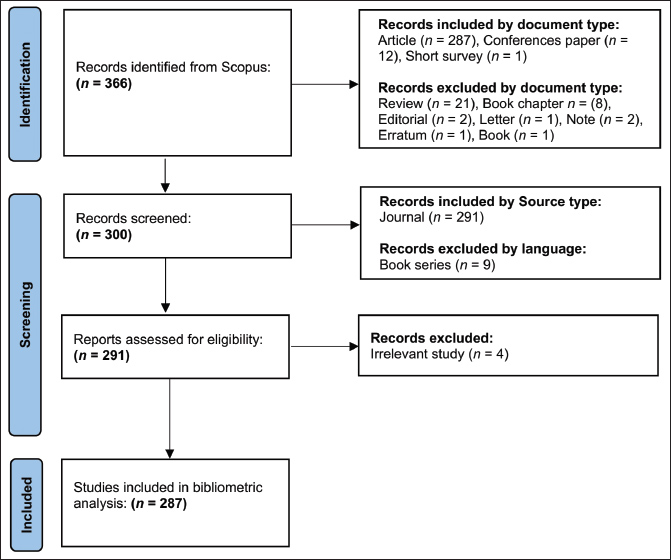
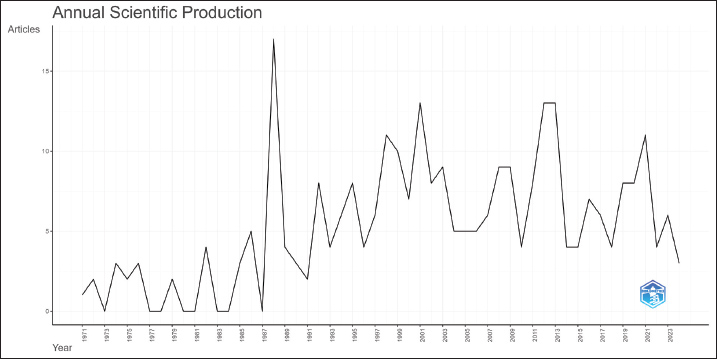
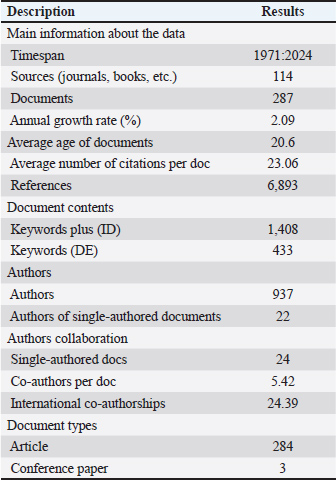
AbstractBackground: Rabies remains a serious global zoonotic disease, and the administration of an oral rabies vaccine (ORV) is a critical strategy for its control and eradication. Understanding the historical trajectory, key themes, and collaborative framework of ORV research is essential to guide future efforts. Aim: This study presents a comprehensive bibliometric analysis of animal oral rabies vaccination research from 1971 to 2024. The main objectives of this study were to assess research productivity, identify geographic centers, identify emerging research trends, and identify knowledge gaps on ORVs. Methods: Data for this analysis were carefully collected from the Scopus database, yielding 287 articles that met the inclusion criteria. Bibliometrix and VOSviewer were used to perform keyword occurrence analysis, map citation patterns, visualize collaborative networks, and analyze temporal trends. Results: The results showed a steady annual growth rate of 2.09%, with peak publications in 1988, 2001, 2012, and 2013. The United States led the list of countries in terms of productivity, followed by Germany and France, where the Journal of Wildlife Diseases was the leading publisher. Research trends showed a clear shift from early work on live attenuated vaccines (1988–2008) to the development of recombinant vaccines and advanced delivery methods (1990–2012), along with an increasing focus on immune responses and viral genetics. Keyword co-occurrence highlighted the following major topics: “rabies virus,” “rabies vaccine,” and “oral administration,” with a primary and secondary focus on wild and domestic animals, respectively. Conclusion: Research on ORVs in animals has made significant advances in vaccine technology, immunology, and wildlife applications. However, considerable knowledge gaps remain in evaluating the implementation of oral rabies vaccination programs. Furthermore, future research is expected to emphasize vaccine efficacy in different ecological contexts in wild animals and application in domestic animals to ensure that rabies control efforts are sustainable. Keywords: Bibliometric analysis, Oral rabies vaccine, Pet, Rabies, Wildlife. IntroductionRabies is a zoonotic disease that is a worldwide public health concern. Rabies is caused by a member of the genus Lyssavirus (Family Rhabdoviridae), which can cause encephalitis and death if left untreated. Rabies virus is transmitted through saliva or scratches from infected animals (Jeffries et al., 2013; de Melo et al., 2020). In addition, uncommon routes of transmission of rabies infection include exposure to infected nerve tissue and organ transplantation (Burnett, 2015). Dogs are the primary reservoir animal for rabies, but other animals, such as foxes, raccoons, and bats, also play a significant role in rabies transmission (Singh et al., 2017). The rabies virus that has entered the body replicates at the bite or infection site before traveling to the peripheral and central nervous systems (Mani and Murray, 2006). The virus reaches the brain through retrograde transneuronal transfer, leading to progressive encephalomyelitis (Linscott, 2012; de Melo et al., 2020). Clinical signs and symptoms will develop and progress rapidly to fatal encephalitis (de Melo et al., 2020). Rabies infection is estimated to cause 55,000 deaths annually, mainly in low- and middle-income countries (Šuric and Arh, 2013). The high mortality rate and lack of effective treatment for rabies infection necessitate an important emphasis on the prevention of this zoonotic disease (Mani and Murray, 2006). The prevention and control of rabies can be achieved through comprehensive and effective approaches, such as combining vaccination programs, education, and cross-sectoral collaboration. Vaccination is one of the keys to rabies control. For example, Japan has maintained its rabies-free status through mass dog vaccination (Takahashi-Omoe et al., 2008), and Sri Lanka has a national dog vaccination program (Kapurubandara et al., 2009). Oral rabies vaccines (ORVs) have also been reported to be effective in controlling wildlife populations, making them an effective way to overcome the limitations of injection vaccination (Wallace et al., 2020). In addition, ORV is being considered for dogs to maintain population immunity, especially in resource-limited settings (Wallace et al., 2020). ORV programs for rabies control in some areas have shown great success in reducing rabies cases, as practiced in countries from Europe and North America (Weyer et al., 2009; Horman et al., 2012; Wallace et al., 2020; Musto et al., 2022). These programs generally consist of bait-containing vaccine that will be consumed by raccoons and foxes. Vaccines used in integrated rabies control include live attenuated rabies virus vaccines and recombinant rabies vectored vaccines, the efficacy of which has been demonstrated in several species (Weyer et al., 2009; Cliquet et al., 2013; Müller and Freuling, 2020). Issues with bait acceptance by non-target species and vaccine stability under field conditions are challenges that must be overcome to improve rabies control campaigns (Hermann et al., 2011; Musto et al., 2022). Numerous publications related to ORV are evidence of a strong interest in this research. Specifically, there is limited understanding of specific trends and developments in ORV. A bibliometric analysis approach is needed to discuss the relationship between publications related to ORV. This analysis can map the landscape of scientific research by measuring and characterizing the volume of literature, identifying productive authors, institutions, and countries, and understanding the evolution of research topics over time (Rahim et al., 2021; Carvalho et al., 2024; Sengupta et al., 2024). Currently, bibliometric analysis is one of the research approaches that has an important role in formulating policies and clinical guidelines for various diseases (Yao et al., 2020). Previous studies have explored global rabies research (Alkan et al., 2023) and trends in rabies vaccine (Ahmad M Khan et al., 2021), but no bibliometric studies have specifically discussed ORV research. Therefore, this study aims to assess research productivity, identify geographic centers, and identify emerging research trends and knowledge gaps on ORV. Materials and MethodsData source and search strategyThis study searched the Scopus database and employed the Medical Subject Headings (MeSHs) term strategy to locate pertinent literature. The MeSH website (https://www.ncbi.nlm.nih.gov/mesh/) was used to identify synonyms relevant to this study, and these terms were then used in a free-text search chain in the Scopus database to ensure comprehensive coverage of the literature. The search strategy per database was specifically crafted to guarantee complete coverage of all relevant literature. Keywords and synonyms were devised for “rabies” and “oral vaccine” in the “animals” study area. With these terms, different combinations would be plugged into the search engine, and with the use of “AND,” “OR,” and “NOT,” the terms would either be added or disregarded to produce enhanced precision regarding the articles retrieved, streamlining the process. The keywords and synonyms were selected so that virtually every relevant term and iteration would be represented. In particular, the search string used to collect data from the Scopus database is (“oral vaccination” OR “oral vaccine” OR “oral vacc*”) AND (rabies OR lyssa* OR “Encephalitic Rabies” OR “Furious Rabies” OR hydrophobia OR “Paralytic Rabies”) NOT (human*). To effectively screen relevant topics, this search string is confined to the title, abstract, or keywords. The MeSH-based search strategy ensured comprehensive retrieval regardless of the terminology used. By applying these particular terms and operators, the investigation found all available publications regarding rabies vaccination in animals. The exclusion of human studies (NOT (human*)) was important in sustaining focus on the animal study domain, avoiding unrelated articles from inclusion in the examination. All data for this analysis were downloaded on July 28, 2024. The Scopus data used in this study can be downloaded from the Open Science Framework website link: https://osf.io/f5j2d. Eligibility criteria and screening workflowRelevant scientific articles, conference proceedings, and short surveys were included in the analysis. The exclusion criteria in this study explicitly excluded human-focused studies and document types such as reviews, book chapters, editorials, letters, and notes. Documents must focus on ORV in animals, limited by the search chain used on the title, abstract, or keywords. The screening process was conducted strictly through a workflow referring to the Preferred Reporting Items for Systematic Reviews and Meta-Analyses guidelines (Page et al., 2021). This screening workflow was performed in stages to ensure that only relevant studies were analyzed. These studies were identified based on an initial search strategy in Scopus, with strict filtering based on document type and topic. Deduplication was not performed because only a single data source was used. Data analysisThe Rayyan online platform (https://www.rayyan.ai/) was used to facilitate the document screening and evaluation process. Initially, we acquired all the data in RIS Manager format from the online database and then uploaded it to the Rayyan online platform. This software helped researchers filter relevant articles using predetermined keywords, such as rabies and oral vaccine, to find animal-focused studies. This facilitated the extraction of information pertinent to our research. For the bibliometric analysis, we carefully selected journal data relevant to our research from the Scopus database and then downloaded it in Microsoft Excel CSV format. Data were analyzed using VOSviewer (v1.6.15, Leiden University, Netherlands; https://www.vosviewer.com/) and R (v4.3.0, R Core Team; https://www.r-project.org/). The package used in this R software is the Bibliometrix package, with the code “library(bibliometrix)” and “biblioshiny(),” which generates a Shiny website from the execution of this code. The full counting method was used for keyword co-occurrence analysis, with a minimum threshold of five occurrences. The strength of association between terms was based on the number of co-occurrences, and the VOSviewer layout algorithm was used for network visualization. No specific thesaurus was used; instead, the analysis relied on the original keywords and “Keywords Plus” from Scopus. Author and affiliation disambiguation was performed manually to ensure that similar entities were correctly combined. Ethical approvalThis study used only secondary bibliometric data; hence, no ethical approval was required. ResultsA total of 287 articles from the Scopus database that met the inclusion and exclusion criteria were subjected to bibliometric analysis. Figure 1 presents the results from the flow diagram. This analysis covers the period from 1971 to 2024 and reveals a 2.09% annual growth rate. The average age of the documents is 20.6 years, with an average of 23.06 citations per document, totaling 6,893 references. Content analysis identified 1,408 unique plus keywords (ID) and 433 author keywords (DE) used throughout the documents. A total of 937 authors contributed to the research, with 22 of them writing single-author documents. On average, each document has 5.42 co-authors, and 24.39% of the documents result from international collaboration. The analysis revealed 284 articles and 3 conference papers. The annual scientific production of research articles on ORV in animals demonstrates notable fluctuations over the years, with a significant peak in 1988 with 17 articles and relatively high output in 2001, 2012, and 2013, each with 13 articles (Fig. 2). The 1988 peak can be attributed to the start of enormous ORV programs in Europe and North America throughout the late 1970s and 1980s. During this period, publications presumably concentrated on the preliminary outcomes of field projects and vaccine efficacy in natural environments. Subsequent peaks in 2001, 2012, and 2013 indicate changes in research emphasis and technical progress. Between 2007 and 2010, research focusing on recombinant vaccines and novel delivery techniques rose. The overall information data are shown in Table 1.
Fig. 1. The flow diagram for the identification and screening of articles.
Fig. 2. Annual scientific production of oral rabies vaccination in animals (1970–2023). The graph illustrates fluctuations in publication trends, with noticeable peaks in 1987, 2000, and 2012, reflecting periods of heightened research interest. Table 1. Data related to the ORV in animals.
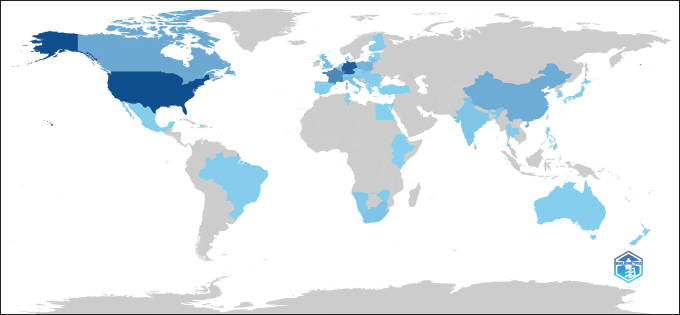
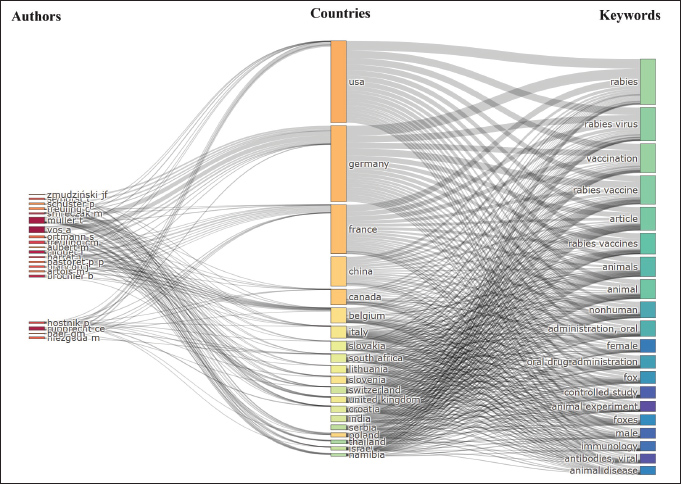
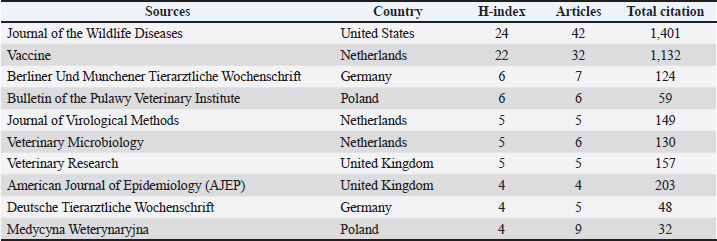
The Journal of Wildlife Diseases (United States) leads in research on ORV in animals, with an H Index of 24, 42 articles, and 1,401 citations, followed by Vaccine (Netherlands), Berliner Und Munchener Tierarztliche Wochenschrift (Germany), Veterinary Microbiology (Netherlands), and Veterinary Research (United Kingdom), reflecting the global and interdisciplinary nature of research in this field. Table 2 shows the ranking of the 10 most productive journals. The publication data on ORV research indicates that the United States leads the number of articles, followed by Germany, France, Canada, China, Poland, Belgium, Slovenia, Italy, the United Kingdom, and several other countries (Fig. 3). A Sankey diagram in Figure 4 illustrates the relationships between authors, countries, and keywords in a specific field of study. Authors on the left are linked to countries in the middle, which are then linked to relevant keywords on the right. This visualization shows the collaboration between authors from various countries and the specific topics or keywords associated with their research. The keywords provide insight into the primary research focus areas, with a strong emphasis on rabies, vaccination, and animal studies. The United States, Germany, and France are prominently featured countries in this research network.
Fig. 3. Global distribution of publications on oral rabies vaccination in animals. The countries shaded in darker blue represent higher research output.
Fig. 4. Collaboration network linking authors, countries, and research keywords in studies on oral rabies vaccination. Prominent authors and leading countries are shown in relation to frequently used keywords such as ‘rabies,’ ‘vaccination,’ ‘rabies-virus,’ and ‘oral administration.” Table 2. Ranking the 10 most productive journals.
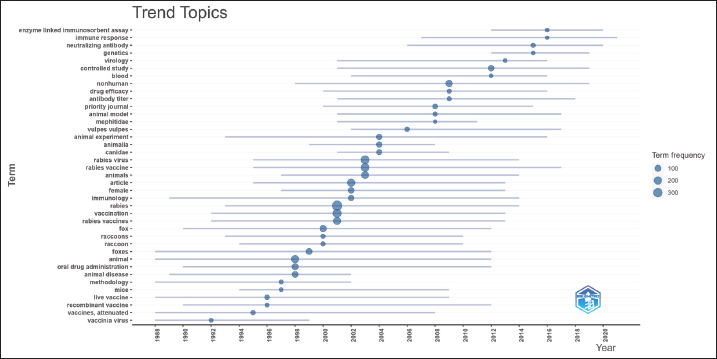
The trend analysis graph illustrates the frequency of use between 1986 and 2020 (Fig. 5). Each point represents a horizontal center line recorded over the years, with the dot indicating the number of times each point was used in a given year. Larger dots indicate higher frequencies, meaning that the dot size is proportional to the frequency. From immunology, virology, and various animals to specific vaccines and methodologies, a wide range of terms are available. Interest in these terms surged over time, especially in research on ORV against rabies, which underwent various critical themes over the years. Efforts have been directed toward enhancing the safety and efficacy of vaccine delivery, concentrating on live attenuated vaccines from 1988 to 2008 and subsequently shifting to recombinant vaccine development alongside sophisticated techniques for oral drug administration from 1990 to 2012. Investigations on several animal species, especially since 1988 and 2012, and maps between 1993 and 2010, reveal the intention to adapt the vaccine to the different animal reservoirs of rabies. In addition, recent studies on the importance of antibody titers (2001–2018), neutralizing antibody titers (2006–2020), and immune responses (2007–2021) have further increased the understanding of immunology, which is very important for the effectiveness of vaccines and the duration of protection. The analysis summarizes research trends in vaccine administration and efficacy evaluation from 1988 to 2019, highlights changes in virology research from 1995 to 2016, and analyzes rabies virus gene studies and new diagnostic techniques from 2012 to 2019. This work broadly describes the ongoing optimization efforts for vaccines against the rabies virus, considering basic immunology and improvements, and diverse ecological contexts.
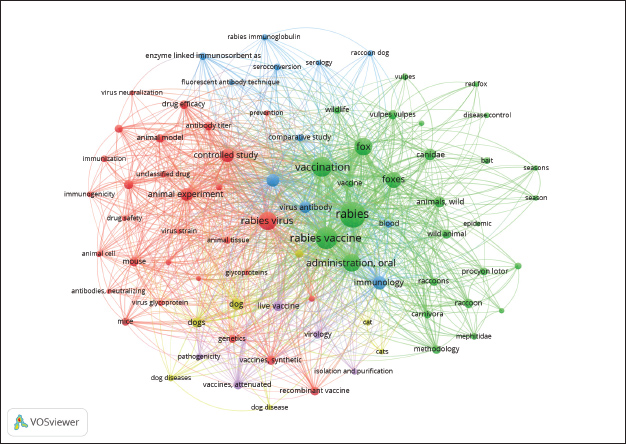
Fig. 5. Topics of interest in oral rabies vaccination research (1988–2020). The timeline shows the emergence and frequency of key terms, with the bubble size indicating the frequency of terms. The early focus was on vaccines and animal models, while later studies emphasized immunology, methodologies, and oral administration. The VOSviewer visualization of co-occurrence analysis in keywords displayed the relationship between rabies and ORV in animals. Connections between terms are depicted with clusters and lines indicating their interconnectedness. Important terms in the network include “controlled study,” “animal experiment,” “immunology,” “dog,” “fox,” and “live vaccine.” The foremost terms include ‘rabies virus’, ‘rabies vaccine’, and ‘oral administration,” which emphasizes their importance. This visualization exhibits the complex web of interrelationships among research topics that include rabies scientific information, ORV, laboratory and epidemiological studies, and preventive medicine. The primary subjects of research on rabies vaccinations are wild animals, followed by domestic animals such as dogs and cats. Figure 6 shows the co-occurrence network of keywords.
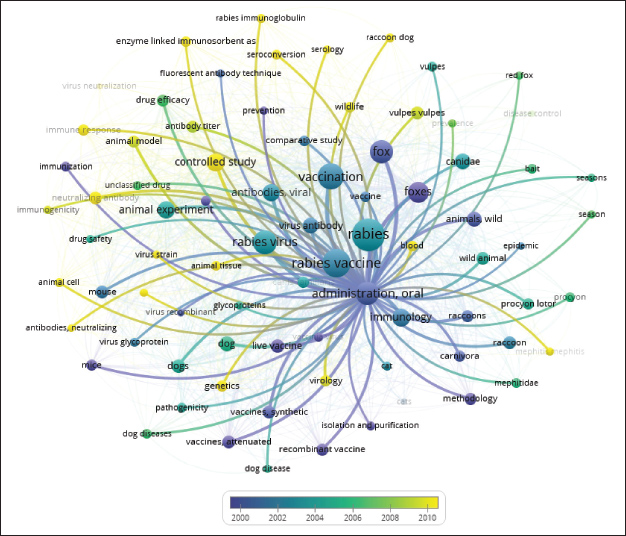
Fig. 6. Keyword co-occurrence network in oral rabies vaccination research. The map displays clusters of related terms, with node size representing keyword frequency and colors indicating thematic groupings. Central topics include ‘rabies,’ ‘rabies virus,’ ‘vaccination,’ and ‘rabies vaccine,” which are linked to subthemes such as animal experiments and immunology (red cluster), wildlife hosts such as foxes and raccoons (green cluster), and vaccine development, including recombinant and attenuated vaccines (purple cluster). The results of the bibliometric analysis demonstrated the interpretation of research trends between 2000 and 2010 (Fig. 7), which explains the shift in research coverage. Between 2000 and 2002, research mainly focused on the effectiveness of the rabies vaccine and immune responses. Animal models have been used in several studies to evaluate antibody production and vaccine efficacy. Between 2003 and 2006, research on ORV strategies to prevent rabies in wild animals, such as foxes and raccoons, along with research on disease epidemiology and vaccination-based control measures, significantly increased. Subsequently, between 2007 and 2010, greater emphasis was placed on the application of recombinant vaccines and innovative administration methods, as well as on more in-depth exploration of the genetic and pathogenic aspects of the rabies virus, reflecting significant advances in vaccine research and development methodologies.
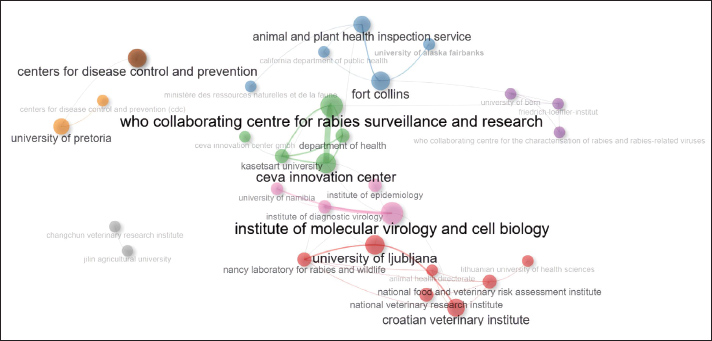
Fig. 7. Keyword co-occurrence overlay map of research on oral rabies vaccination. Node size reflects keyword frequency, and colors represent the average publication year, indicating a shift from an early focus on vaccines and animal experiments (blue) to more recent themes, such as immune response and wildlife (yellow/green). The network map timeline gradient showed the evolution of research themes over the years, projecting a changing timeline from 2000 to 2010, illustrating the changing focus and emphasis in rabies research throughout the decade. During this period, rabies emerged as a major focus theme, further indicating the core scope of research activities. Important connecting concepts such as rabies vaccine, oral administration, and rabies virus exemplify the importance of inoculation methods, virus drug delivery systems, and rabies virology. This rabies control thematic cluster focuses on prevention strategies that aim to manage the condition with immunization, neutralizing the virus, and understanding the virus’ pathogenesis. The network map reveals a range of interrelated terms that expand the ORV research domain beyond fundamental science. The phrases “antibodies,” “viruses,” “animal experiments,” and “wildlife” broadened the scope of immunology and rabies to include experimental research models and the impact of rabies on various species of wildlife. Moreover, certain studies involving rabies vaccinations also assessed the implications of rabies in canines. The collaboration map in Figure 8 shows the relationships between the various institutions and organizations involved in animal ORV research. The map displays several clusters, each representing a close collaboration between specific institutions. Prominent clusters include Fort Collins and the University of Alaska Fairbanks, which are linked to the Animal and Plant Health Inspection Service, the Ceva Innovation Center, and Kasetsart University. Another cluster features the WHO Collaborating Center for Rabies Surveillance and Research and the University of Pretoria, while another cluster centered on the University of Ljubljana is linked to institutions such as the Institute of Molecular Virology, Cell Biology, and “the Croatian Veterinary Institute.” These clusters illustrate how universities, health departments, and research institutes collaborate in a global network to advance research in this area.
Fig. 8. Co-occurrence network map of collaborating organizations in ORV research. Larger nodes represent institutions with higher collaboration frequency, with major hubs including the WHO Collaborating Center for Rabies Surveillance and Research, Institute of Molecular Virology and Cell Biology, and the University of Ljubljana. DiscussionOral rabies vaccination is a key strategy for managing and eliminating rabies in wildlife, and it has considerable potential for application in domestic animals. This bibliometric study examined trends in ORV in animals, offering more targeted insights than broader bibliometric analyses. In contrast to the work of Alkan et al. (2023), who reviewed 5,973 articles on global rabies research, and Ahmad M Khan et al. (2021), who analyzed 1,042 articles on rabies vaccines in general, our analysis focused specifically on ORV. ORV forms an integral component of the World Health Organization’s rabies-eradication framework aimed at achieving “Zero human rabies deaths by 2030” (Shen et al., 2023). Human rabies cases in Asia show a complex and non-uniform trend, with some countries reporting a significant increase, particularly in China, the Philippines, Vietnam, Malaysia, Indonesia, Nepal, and Pakistan, necessitating urgent attention and targeted public health interventions (Zhou et al., 2016; Jane Ling et al., 2023; Mubashar et al., 2023). Since 1957, Japan has maintained its rabies-free status since 1957 through a combination of stringent control measures, including mandatory annual dog vaccination and strict import quarantine (Kanda et al., 2023). However, a recent study highlights that owner characteristics, such as education level and engagement with veterinary clinics, significantly influence compliance with this vaccination (Amemiya et al., 2023). Our findings showed that ORV-related research in animals has increased at a modest annual rate of 2.09 % and displays a markedly uneven geographical distribution, revealing critical gaps that could hinder progress toward the Zero by 30 target. Moreover, scientific output substantially fluctuated between 1988 and 2024. Stronger international collaboration, enhanced surveillance and monitoring, and greater investment in research within underrepresented regions are essential to meet the 2030 goal. Despite these challenges, ORV has already proven effective in controlling wildlife rabies epidemics, particularly among canine reservoir hosts (Ertl, 2020; Gilbert and Chipman, 2020). A significant observation pertains to the geographical distribution of research output, with the United States leading the number of publications, followed by Germany, France, and Canada. This concentration of research reflects the established scientific infrastructure and dedicated funding in these regions, which have historically been at the forefront of rabies control efforts. The success of the ORV program requires support from all stakeholders, such as the European Union, which provides technical and financial resources to support the ORV program aimed at controlling and eradicating rabies (Robardet et al., 2019). Identifying and supporting these underrepresented nations would not only enhance efforts to control global rabies but also provide a more comprehensive understanding of the diverse approaches and challenges in ORV research. The prominence of the Journal of Wildlife Diseases (United States) as the most productive journal, boasting an H-index of 24 and a high volume of articles and citations, further emphasizes the critical role of wildlife ecology and disease management in ORV research. In Slovenia, the success of the ORV program has been demonstrated, which eliminated rabies using the ORV control program in foxes started in 1988 and declared the country free of rabies since 2016 (Černe et al., 2021). The success of ORV vaccination depends largely on bait acceptance by the target animal, which is strongly influenced by bait composition and palatability (Gibson et al., 2019). The current trend is for rabies vaccines to be developed using biotechnological approaches to trigger strong immune responses in various wildlife species (Müller and Freuling, 2020; Yale et al., 2022) . Post-vaccination monitoring and evaluation are also important in several programs to ensure the effectiveness of rabies control programs. The use of keywords in animal ORV research illustrates the key themes and interrelationships that define the field. The structure and relationships of the collected conditions clearly showed the relationships between the research topics. Emphasizing key concepts and emerging areas of interest, terms such as “rabies virus,” “rabies vaccine,” and “oral administration” are prominent, indicating their importance as a foundation for ORV research and practice. This important focus emphasizes the ongoing scientific effort to understand the causes, develop effective prevention tools, and improve vaccine delivery systems for wider use. In addition to these key concepts, the network places great importance on methodological rigor. Keywords such as “controlled study” and “animal experiment” appear frequently, indicating reliance on experimental methods and applications to confirm research results. The prominent appearance of the word “Immunity” reflects the in-depth study of the immune response, which is critical to vaccine effectiveness and safety. Furthermore, the image clearly shows the wild animals. In particular, “foxes” and “red foxes” are prominent groups in rabies vaccine research. Then, when combined with other words involving wild animals, such as “raccoon dog” and “red fox,” it also emphasizes the need for ecology to control rabies in natural habitats. Pets, such as dogs and cats, are also studied. Reflecting efforts to protect pets and prevent the spread of infection to humans. Research on rabies vaccines continues to develop dynamically, including research on ORV. Bibliometric analysis from 2000 to 2010 revealed important trends in rabies vaccine research, highlighting an initial focus on immune responses elicited by conventional vaccines, followed by a gradual focus on ORV strategies targeting wildlife. After 2006, research focused on innovative recombinant vaccines and advanced vaccination methodologies, with an emphasis on the rabies virus’s pathogenic nature and the need for effective measures to control wildlife populations. The development and testing of ORV began in the 1970s to overcome the limitations of application and improve the effectiveness of rabies vaccination programs, with a particular focus on rabies control in wildlife (Müller and Freuling, 2020). Since 1978, the program has been widely applied to several reservoirs (such as foxes) in Europe and the United States since 1978 (Yale et al., 2022). This trend continues with the advancement of technology from attenuated viruses to genetic engineering and recombinant results, which offer improved efficacy and safety (Müller and Freuling, 2020; Natesan et al., 2023). The development of the ORV application has been carried out with various methods of both manual and aerial distribution, which is expected to reach a wider range of rabies-susceptible animals (Černe et al., 2021). The success rate of ORV varies considerably owing to multiple factors, including the target animal population, geographic conditions with seasonal variations, bait distribution methods, bait types, and environmental conditions (Lupulovic et al., 2015; Sillero-Zubiri et al., 2016; Papatheodorou et al., 2018; Musto et al., 2022; Beasley et al., 2024; Robardet et al., 2024). For instance, ORV efforts targeting foxes in Serbia and Greece effectively diminished rabies infections owing to elevated seroprevalence rates (Lupulovic et al., 2015; Papatheodorou et al., 2018). Conversely, analogous operations aimed at raccoons in urban regions of North America were less effective due to elevated population densities and competition for bait from non-target species (Beasley et al., 2024). Moreover, meteorological conditions influence vaccination efficacy, as precipitation can hasten bait decomposition, while elevated temperatures may diminish bait acceptance rates (Musto et al., 2022; Robardet et al., 2024). Consequently, ongoing monitoring and assessment are crucial for refining methods and enhancing the efficacy of ORV programs (Robardet et al., 2024). Although a comprehensive bibliometric analysis highlights the breadth of research on ORV, a research gap exists regarding the variability and ecological specificity of vaccine efficacy across wildlife populations and domestic animals. While the analysis demonstrated significant research across animal species and the general efficacy of viral vaccines, achieving consistent and broad protection remains a challenge due to variable host immune responses, virus strain diversity, and complex environmental factors that influence vaccine uptake and distribution. Furthermore, limited exploration of specific topics related to “canine disease” or “cat disease” beyond the umbrella terms of “animal testing” or “vaccination,” despite the inclusion of pets in pet vaccination programs, suggests potential gaps in understanding the precise breed-specific responses or precise epidemiological impacts of pet vaccination programs on pet populations. This calls for more targeted veterinary research to address the context-dependent challenges of optimizing ORV strategies for maximum efficacy across diverse animal populations. This bibliometric analysis offers an in-depth investigation of ORV research trends in animals. This study recognizes that this methodology has numerous limitations. This study used a single database, Scopus, for data collection. Despite Scopus being an extensive database, reliance on a singular data source may omit pertinent papers mainly indexed in alternative databases, such as PubMed, Web of Science, and Google Scholar. Second, bibliometric investigations are fundamentally descriptive and quantitative. This analysis examines publishing patterns, collaborations, and keywords; however, it does not evaluate the methodological quality, internal validity, or efficacy (the extent of disease control effectiveness) of the vaccination programs addressed in each study. Thus, our findings should be regarded with prudence as a general assessment of research trends rather than as a measure of program efficacy. ConclusionThis study revealed global trends, productivity, and major contributors to animal ORV research. Despite the growing body of research, with an annual growth rate of 2.09%, significant gaps remain, particularly in understanding the ecological variability and specificity of vaccine efficacy across different wildlife populations and domestic animals. Although advancements in vaccine development have been notable, the findings suggest that greater international collaboration, particularly in underrepresented regions, is necessary to enhance rabies control efforts globally. To achieve the WHO’s “Zero human rabies deaths by 2030” goal, continued innovation in vaccine delivery, improved monitoring of vaccine efficacy, and addressing ecological challenges in animal populations are crucial. Thus, this study underscores the need for focused efforts to bridge these knowledge gaps and ensure the sustainability of rabies control programs worldwide. AcknowledgmentsThe authors would like to express their gratitude to Universitas Gadjah Mada for their facilities in producing this manuscript. Conflict of interestThe authors have no conflicts of interest to declare. FundingNo funding support was received for this study. Authors’ contributionsHeru Susetya: conceptualization, investigation, and original draft writing. Morsid Andityas: conceptualization, formal analysis, visualization, validation, writing, and review. Dian Meididewi Nuraini: conceptualization, methodology, and editing. Data availabilityAll data are provided in the manuscript. ReferencesAhmad M Khan., Murad M Baig., Murtaza H Harapan. and Hui. 2021. Research trends in rabies vaccine in the last 3 decades: a bibliometric analysis of global perspective. Vaccin. Immunother. 17(9), 3169–3177. Alkan, S., Önder, T. and Mızrakçı, S.O. 2023. Bibliometric analysis of global rabies research between 1992 and 2022. J. Zoonotic Dis. 7(1), 217–228. Amemiya, Y., Inoue, S., Maeda, K. and Nishiura, H. 2023. Epidemiological Associations between Rabies Vaccination and Characteristics of Dog Owners. Vaccines 11(2), 352. Beasley, E.M., Nelson, K.M., Slate, D., Gilbert, A.T., Pogmore, F.E., Chipman, R.B. and Davis, A.J. 2024. Oral rabies vaccination of raccoons (Procyon lotor) across a development intensity gradient in Burlington, Vermont, USA, 2015–2017. J. Wildl. Dis. 60(1), 1–13. Burnett, M.W. 2015. Rabies: 2015 Update. J. Spec. Oper. Med. 15(3), 105–107. Carvalho, A.R.B., Neto, A.R.S., Silva, M.D.F.D., Freitas, D.R.J. and Moura, M.E.B. 2024. Global research trends related to coronavirus disease 2019 and the elderly: a bibliometric analysis. Sao. Paulo Med. J. 142(2), p. Černe, D., Hostnik, P. and Toplak, I. 2013. The successful elimination of sylvatic rabies using oral vaccination of foxes in Slovenia. Viruses 13(3), 43. Cliquet, F., Robardet, E. and Picard Meyer, E. 2013. Genetic strain modification of a live rabies virus vaccine widely used in Europe for wildlife oral vaccination. Antivir. Res. 100(1), 84–89. de Melo, G.D., Parize, P., Jouvion, G., Dacheux, L., Chrétien, F. and Bourhy, H. 2020. Rabies.In Infections of the central nervous system: pathology and genetics. Keohane, K. and Francoise, G New Jersey, USA: John Wiley and Sons, pp: 121–9. Ertl. 2020. Rabies and Rabies Vaccines. Philadelphia, USA: springer. Philadelphia, USA: Springer. Gibson, A.D., Mazeri, S., Yale, G., Desai, S., Naik, V., Corfmat, J., Ortmann, S., King, A., Müller, T., Handel, I., Bronsvoort, B.M., Gamble, L., Mellanby, R.J. and Vos, A. 2019. Development of a non-meat-based, mass producible and effective bait for oral vaccination of dogs against rabies in Goa State, India. Infect. Dis. 4(3), 118. Gilbert, A.T. and Chipman, R.B. 2020. Rabies control in wild carnivores.In Rabies: scientific basis of the disease and its management. Fooks, A.R. and Jackson, A.C London, UK: Academic Press, pp: 605–38. Hermann, J.R., Fry, A.M., Siev, D., Slate, D., Lewis, C. and Gatewood, D.M. 2011. Stability of vaccinia-vectored recombinant oral rabies vaccine under field conditions: a 3-year study. Can. J. Vet. Res. 75(4), 278–284. Horman, J.T., Shannon, K.V., Simpson, E.M., Burja, T.M., Fey, R.H., Smith, J.J. and Phillips, F.B. 2012. Control of terrestrial animal rabies in Anne Arundel county, Maryland, after oral vaccination of raccoons (1998-2007). J. Anim. Vet. Med. Assoc. 241(6), 725–734. Jane Ling, M.Y., Halim, A.F.N.A., Ahmad, D., Ramly, N., Hassan, M.R., Syed Abdul Rahim, S.S., Saffree Jeffree, M., Omar, A. and Hidrus, A. 2023. Rabies in Southeast Asia: a systematic review of its incidence, risk factors, and mortality. BMJ. Open. 13(5), 66587. Jeffries, C.L., Banyard, A.C., Healy, D.M., Horton, D.L., Johnson, N. and Fooks, A.R. 2013. Rabies virus neurovirulence.In Neuroviral Infections: rNA Viruses and Retroviruses. Singh., SK. and Ruzek, D Boka Raton, USA: CRC Press, pp: 373–94. Kanda, K., Jayasinghe, A., Jayasinghe, C. and Yoshida, T. 2023. Maintenance of rabies-free status in Japan for 65 years and application of lessons learned to other countries working toward zero human deaths.In One health for dog-mediated rabies elimination in Asia: a collection of local experiences. Slack, V., Nadal, D., Yasobant, S., Cliquet, F., Ahmad, W., Pushpakumara, N. and Ghosh, S Oxfordshire, UK: CABI International, pp: 235–47. Kapurubandara, S., Kapurubandara, M. and Goonethilleke, V. Going digital with dog information. In Proceedings of the IADIS International Conference E-Health 2009, Part of the IADIS Multi Conference on Computer Science and Information Systems, MCCSIS 2009. Algarve, Portugal: IADIS Press, 2009 , pp 123–130. Linscott, A. J. (2012). Rabies. Clin. Microbiol. Newsl. 34(22), 177–180. Lupulovic, D., Maksimovic Zoric, J., Vaskovic, N., Bugarski, D., Plavsic, B., Ivanovic, N., Petrovic, T., Pusic, I., Marcic, D., Grgic, Z. and Lazic, S. 2015. First report on the efficiency of oral vaccination of foxes against rabies in Serbia. Publ. Health. 62(8), 625–636. Mani, C. S., and D. L. Murray. 2006. Rabies. Pediatr. Rev., 27(4), 129–136. Mubashar, B., Iqbal, S., Noor, A., Sarfraz, A. and Sarfraz, Z. 2023. Rabies in the SAARC region: an epidemiological study of disease burden and challenges. Trop. Doc. 53(4), 437–440; doi:10.1016/j.trdoc.2015.09.010 Müller, T. and Freuling, C.M. 2020. Rabies vaccines for wildlife.In Rabies and rabies vaccines. Ertl, H.C.J Philadelphia, USA: Springer, pp: 45–70. Musto, C., Cerri, J., Sentimenti, E.M. and Delogu, M. 2022. Evaluation of limiting factors of oral rabies vaccinations in wild canids: evidence from a field trial in Central Italy. Hystrix 33(2), 186–189. Natesan, K., Isloor, S., Vinayagamurthy, B., Ramakrishnaiah, S., Doddamane, R. and Fooks, A.R. 2023. Developments in rabies vaccines: the path from the pasteur to the modern era of immunization. Vaccines 11(4), e11040756. Page, M.J., McKenzie, J.E., Bossuyt, P.M., Boutron I Hoffmann., Mulrow, C., Shamseer, D., Tetzlaff, L., Akl, M., Brennan, A., Chou, E., Glanville, R., Grimshaw, J., Hr, M., óbjartsson A Lalu., Li, M., Loder, T., Mayo, W., -Wilson E McDonald., McGuinness, S., Stewart, A., Thomas, A., Tricco, J., Welch, C., Whiting, A. and Moher, D. 2021. The PRISMA 2020 statement: an updated guideline for reporting systematic reviews. BMJ372(1), n71. Papatheodorou, D.P., Tasioudi, K.E., Korou, L.M., Georgiou, V., Iliadou, P., Markantonatos, G., Kirtzalidou, A., Tzani, M., Chondrokouki, E. and Mangana-Vougiouka, O. 2018. First four oral rabies vaccination campaigns of the red foxes in Greece: evaluating factors and assessment. Vet. 2014. 111. E0027. Microbiol. 216. 111, 107–118. Rahim, F., Khakimova, A., Ebrahimi, A., Zolotarev, O. and Rafiei Nasab, F. 2021. Global scientific research on sars-cov-2 vaccines: a bibliometric analysis. Cell. J. 23(5), 523–531. Robardet, E., Bosnjak, D., Englund, L., Demetriou, P., Rosado Martín, P. and Cliquet, F. 2019. Zero endemic cases of wildlife rabies (Classical rabies virus, RABV) in the European Union by 2020: an achievable goal. Trop. Med. Inf. Dis. 4, e4040124. Robardet, E., Zdravkova, A., Ilieva, D., Hakmann, E., Georgopoulou, I., Tasioudi, K., Nokireki, T., Isomursu, M., Jankovic, I.L., Lojkic, I., Serzants, M., Zommere, Z., Masiulis, M., Jaceviciene, I., Vuta, V., Wasniewski, M. and Dilaveris, D. 2024. Retrospective analysis of sero-prevalence and bait uptake estimations in foxes after oral rabies vaccination programs at European level: lessons learned and paths forward. Vet. Microbiol. 57, e018. Sengupta, N., Sarode, G., Anand, R. and Sarode, S.C. 2024. Bibliometric analysis of highly cited papers on oral mucosal lesions in patients with COVID-19: trends and impact on medical literature. J. Oral. Biol. Craniofac. Res. 14(1), 72–78. Shen, T., Welburn, S.C., Sun, L. and Yang, G.J. 2023. Progress toward dog-mediated rabies elimination in pulmonary disease (PR) in China: a scoping review. Infect. Dis. Poverty 12(1), 19–35. Sillero-Zubiri, C., Marino, J., Gordon, C.H., Bedin, E., Hussein, A., Regassa, F., Banyard, A. and Fooks, A.R. 2016. Feasibility and efficacy of the oral rabies vaccine SAG2 in the management of endangered Ethiopian wolves. Vaccine 34(40), 4792–4798. Singh, R., Singh, K.P., Cherian, S., Saminathan, M., Kapoor, S., Manjunatha Reddy, G.B., Panda, S. and Dhama, K. 2017. Rabies: epidemiology, pathogenesis, public health concerns, and advances in diagnosis and control: A comprehensive review. Vet. Quar. 37(1), 212–251. Takahashi-Omoe, H., Omoe, K. and Okabe, N. 2008. Regulatory systems for prevention and control of rabies, Japan. Emer. Inf. Dis. 14(9), 1368–1374. Šuric, A. and Arh, J. 2013. Case report: a patient with suspicious rabies in Madagascar. Zdravniski. Vestnik. 82(6), 435–440. Wallace, R.M., Cliquet, F., Fehlner-Gardiner, C., Fooks, A.R., Sabeta, C.T., Setién, A.A., Tu, C., Vuta, V., Yakobson, B., Yang, D.K., Brückner, G., Freuling, C.M., Knopf, L., Metlin, A., Pozzetti, P., Suseno, P.P., Shadomy, S.V., Torres, G., Vigilato, M.A.N., Abela-Ridder, B. and Müller, T. 2020. Role of oral rabies vaccines in the elimination of dog-mediated human rabies deaths. Emerg. Infect. Dis. 26, E1–E9. Weyer, J., Rupprecht, C.E. and Nel, L.H. 2009. Poxvirus-vectored vaccines for rabies: a review. Vaccine 27(51), 7198–7201. Yale, G., Lopes, M., Isloor, S., Head, J.R., Mazeri, S., Gamble, L., Dukpa, K., Gongal, G. and Gibson, A.D. 2022. Review of oral rabies vaccination of dogs and its application in India. Viruses 14(1), 155. Yao, R.Q., Ren, C., Wang, J.N., Wu, G.S., Zhu, X.M., Xia, Z.F. and Yao, Y.M. 2020. Publication trends of research on sepsis and host immune response during 1999-2019: a 20-year bibliometric analysis. Int. J. Biol. Sci. 16(1), 27–37. Zhou, H., Vong, S., Liu, K., Li, Y., Mu, D., Wang, L., Yin, W. and Yu, H. 2016. Human rabies in China, 1960–2014: a descriptive epidemiological study. PLoS Negl. Trop. Dis. 10(8), e0004874. | ||
| How to Cite this Article |
| Pubmed Style Susetya H, Andityas M, Nuraini DM. Publication trends in research on oral rabies vaccination in animals: A bibliometric analysis. Open Vet. J.. 2025; 15(12): 6622-6634. doi:10.5455/OVJ.2025.v15.i12.44 Web Style Susetya H, Andityas M, Nuraini DM. Publication trends in research on oral rabies vaccination in animals: A bibliometric analysis. https://www.openveterinaryjournal.com/?mno=261473 [Access: June 26, 2026]. doi:10.5455/OVJ.2025.v15.i12.44 AMA (American Medical Association) Style Susetya H, Andityas M, Nuraini DM. Publication trends in research on oral rabies vaccination in animals: A bibliometric analysis. Open Vet. J.. 2025; 15(12): 6622-6634. doi:10.5455/OVJ.2025.v15.i12.44 Vancouver/ICMJE Style Susetya H, Andityas M, Nuraini DM. Publication trends in research on oral rabies vaccination in animals: A bibliometric analysis. Open Vet. J.. (2025), [cited June 26, 2026]; 15(12): 6622-6634. doi:10.5455/OVJ.2025.v15.i12.44 Harvard Style Susetya, H., Andityas, . M. & Nuraini, . D. M. (2025) Publication trends in research on oral rabies vaccination in animals: A bibliometric analysis. Open Vet. J., 15 (12), 6622-6634. doi:10.5455/OVJ.2025.v15.i12.44 Turabian Style Susetya, Heru, Morsid Andityas, and Dian Meididewi Nuraini. 2025. Publication trends in research on oral rabies vaccination in animals: A bibliometric analysis. Open Veterinary Journal, 15 (12), 6622-6634. doi:10.5455/OVJ.2025.v15.i12.44 Chicago Style Susetya, Heru, Morsid Andityas, and Dian Meididewi Nuraini. "Publication trends in research on oral rabies vaccination in animals: A bibliometric analysis." Open Veterinary Journal 15 (2025), 6622-6634. doi:10.5455/OVJ.2025.v15.i12.44 MLA (The Modern Language Association) Style Susetya, Heru, Morsid Andityas, and Dian Meididewi Nuraini. "Publication trends in research on oral rabies vaccination in animals: A bibliometric analysis." Open Veterinary Journal 15.12 (2025), 6622-6634. Print. doi:10.5455/OVJ.2025.v15.i12.44 APA (American Psychological Association) Style Susetya, H., Andityas, . M. & Nuraini, . D. M. (2025) Publication trends in research on oral rabies vaccination in animals: A bibliometric analysis. Open Veterinary Journal, 15 (12), 6622-6634. doi:10.5455/OVJ.2025.v15.i12.44 |


