



| Research Article | ||
Open Vet. J.. 2025; 15(8): 3848-3853 Open Veterinary Journal, (2025), Vol. 15(8): 3848-3853 Research Article Therapeutic potential of L-Carnitine in improving adenine-induced hematological abnormalities in rats: A preclinical pharmacological studyWaleed Khaled Y. Albahadly1*, Mohammed Jasim Jawad1, Mohammed Ibrahim Rasool1, Haider Falih ShamikhAl-Saedi2 and Asia Ali Hamza31Department of Pharmacology and Toxicology, College of Pharmacy, University of Karbala, Karbala, Iraq 2Department of Pharmacology, College of Pharmacy, University of Al-Ameed, Karbala, Karbala, Iraq 3Department of Clinical Laboratory Sciences, University of Al-kafeel, Karbala, Iraq *Corresponding Author: Waleed Khaled Y. Albahadly. Department of Pharmacology and Toxicology, College of Pharmacy, University of Karbala, Karbala, Iraq. Email: wk764486 [at] gmail.com Submitted: 14/05/2025 Revised: 02/07/2025 Accepted: 09/07/2025 Published: 31/08/2025 © 2025 Open Veterinary Journal
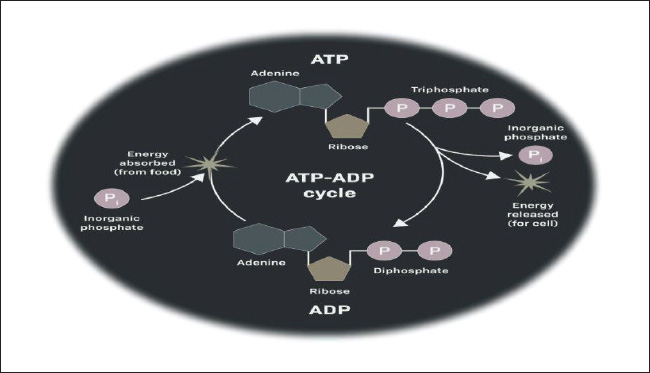
ABSTRACTBackground: Adenine is a naturally occurring purine essential for life, but its excess intake can cause metabolic disturbances leading to cardiovascular complications, renal stones, gout, fatigue, and anemia. Aim: This study aimed to investigate the potential hematological protective effects of L-Carnitine in rats subjected to adenine-induced toxicity. Methods: Twenty-four adult male Wistar rats were randomly assigned to four groups (n=6). Group 1 received 3 ml of normal saline orally. Group 2 received 100 mg/kg of adenine orally. Group 3 received oral administration of both adenine (100 mg/kg) and L-Carnitine (750 mg/kg). Group 4 received oral L-Carnitine (750 mg/kg) for 30 days. The hematological parameters were assessed using an automated hematology analyzer. Results: Rats treated with adenine alone showed a significant reduction in red blood cells, hemoglobin, packed cell volume, and platelet counts and a marked increase in white blood cell levels (p < 0.05). Co-administration of L-Carnitine significantly ameliorated these hematological alterations. Conclusion: L-Carnitine exhibited a hematoprotective effect against adenine-induced toxicity, highlighting its potential therapeutic role in managing metabolic disturbances associated with purine overload. Keywords: L-Carnitine, Hematology, Adenine. IntroductionAdenine is one of the primary nitrogenous bases in DNA and a component of adenosine triphosphate (ATP), essential for cellular metabolism. While it plays a vital role in physiological processes, excess adenine can be detrimental, especially when metabolized into uric acid—a risk factor for gout and renal complications. Chronic adenine administration induces renal damage and hematological changes in animal models, making it suitable for studying therapeutic interventions. Additionally, adenine is an essential component of ATP in Figure 1, a high-energy molecule that is critical for various cellular metabolic processes (Derrick, 2021; Song, 2024). Biochemically, adenine can be synthesized from inosine monophosphate using amino acid substrates such as glutamine, glycine, and aspartic acid through a specific metabolic pathway involving the tetrahydrofolate enzyme system (Lovászi et al., 2021). Being a purine base, adenine is metabolized into uric acid—a process that, if dysregulated, may lead to the accumulation of uric acid in the body. High-purine diets, rich in organ meats, red meat, legumes, mushrooms, and certain seafood, can contribute to elevated uric acid levels, potentially causing clinical conditions such as gout and nephrolithiasis (Kaneko et al., 2014; Aihemaitijiang et al., 2020). In experimental models, excessive adenine administration has been shown to induce renal dysfunction and related hematological abnormalities, primarily through the accumulation of toxic metabolites such as 2,8-dihydroxyadenine, formed via xanthine dehydrogenase-mediated oxidation (Derrick, 2021). This makes adenine a reliable agent for inducing chronic kidney injury in preclinical studies. On the other hand, L-Carnitine is an endogenous compound biosynthesized from L-lysine and L-methionine. L-Carnitine plays a critical role in the transport of long-chain fatty acids into the mitochondrial matrix for β-oxidation and energy production (Said et al., 2023). L-Carnitine is also obtained from dietary sources, particularly red meat, poultry, fish, and dairy products. Recent studies have highlighted its antioxidative and anti-inflammatory properties, suggesting its potential in ameliorating various pathological conditions, including cardiovascular disease and metabolic disorders (Elantary and Othman, 2024). Due to its biochemical profile, L-Carnitine has been proposed to exert protective effects on blood parameters by reducing oxidative stress and supporting cellular metabolism. Several nutritional components in L-Carnitine-rich foods—such as carotenoids, vitamins, and essential fatty acids—may further contribute to its hematological benefits (Kepka et al., 2020; Ennab et al., 2023). Therefore, the current study aimed to investigate the potential hematological protective effects of L-Carnitine in a rat model of chronic adenine-induced toxicity, focusing specifically on changes in blood.
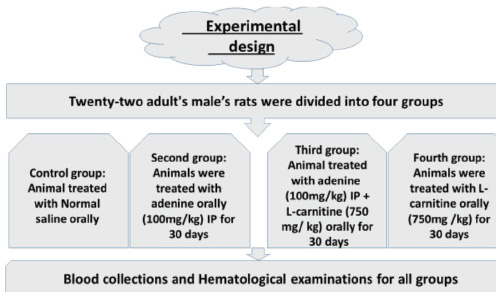
Fig. 1. Role of adenine in ATP synthesis and release of energy. Materials and MethodsExperimental protocolThe University of Karbala College of Pharmacy was the site of the study. The 24 adult male rats used in this study were split into four groups. Male rats were used to avoid the potential hormonal fluctuations associated with the estrous cycle in females, which can influence physiological and biochemical parameters and introduce variability in the experimental outcomes. Using males helps ensure more consistent and reproducible results, which were as follows: Control Group: Received 3 ml of normal saline orally once daily for 1 month. Second Group (Adenine Group): Received adenine at a dose of 100 mg/kg orally once daily for 1 month to induce renal failure. Third Group (Adenine + L-Carnitine Group): Both adenine (100 mg/kg) and L-Carnitine suspension (750 mg/kg) were orally administered once daily for 1 month. Fourth Group (L-Carnitine Group): Received L-Carnitine suspension alone at a dose of 750 mg/kg orally once daily for 1 month. Experimental designIn this study, 24 adult male rats were used, and they were divided into the following four groups in Figure 2. Animals included in the studyTwenty-four healthy adult male Wistar rats (Rattus norvegicus), weighing 200–250 g and aged 8–10 weeks, were obtained from the Animal House of Al-Nahrain University’s College of Science. The rats were acclimatized for 2 weeks in a standard laboratory environment at the College of Pharmacy, University of Karbala, maintained at 22°C–28°C with a 12-hour light/dark cycle. Blood collectionAt the end of the experiment, the male rats were anesthetized by placing them in a closed chamber containing cotton soaked with chloroform, after which they were sacrificed. A 10-ml disposable syringe was used to perform cardiac puncture, and approximately 6 ml of blood were slowly and gently collected. Hematological parameters were measured immediately after transferring 1 ml of blood into a heparinized tube. Following cardiac puncture and blood collection, a portion of the blood was placed in a gel-containing serum separator tube to facilitate serum extraction. Blood samples were left at room temperature for 30 minutes to allow clotting. Subsequently, the samples were centrifuged at 3,000 rpm for 15 minutes to separate the serum. The resulting serum was then preserved in Eppendorf tubes and stored at –20°C in a freezer (Aguwa et al., 2020).
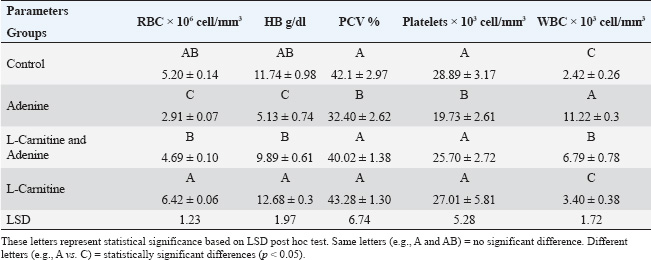
Fig. 2. Design of the experiment and dose groups of animals. Hematological analysisA hematological auto analysis (count 60) manufactured by the Genex company was used to perform the hematological parameters. Despite using a servicing reagent (just the instrument cleanser) and two reagents (Dilute and Lyse), this device also features a mechanical image with thermal paper inside. Hemoglobin (Hb), platelets, packed cell volume (PCV), red blood cells (RBC) count, and white blood cell (WBC) count were the hematological parameters detected by the device. ANOVA, post-hock Tukey test, and SSPS were used to analyze all data. A threshold of significance is reached at a p-value of 0.05 or less. Ethical approvalAll procedures involving the handling and euthanasia of rats were conducted in accordance with ethical guidelines for the use of animals in research and were approved by the Institutional Animal Care and Use Committee of the College of Pharmacy, University of Kerbala (Approval No: 2024An.7, dated February 7, 2024). ResultsEffects of adenine and L-Carnitine suspension on male rat biomarker blood indicesRegarding the adenine-induced impaired renal function group compared to both the untreated group and the treated groups, the overall levels of RBCs, Hb, PCV, and platelets were significantly lower (p ≤ 0.05), with values of 2.91 ± 0.07 (RBC), 5.13 ± 0.74 (Hb), 32.40 ± 2.62 (PCV), 19.73 ± 2.61 (platelets), and 11.22 ± 0.3, respectively. In contrast, the WBC count was significantly elevated in the adenine-induced group in Figure 3. However, treatment with L-Carnitine, either alone or in combination with adenine, mitigated the adverse hematological effects induced by adenine (Table 1). The platelet counts in the adenine group were significantly reduced compared with those in the control group, while the adenine + L-Carnitine powder group exhibited a significant increase in platelet count compared with that in the adenine-only group. Based on the adenine group and platelet count. Adenine-treated rats showed a significant (p ≤ 0.05) decrease in platelet count compared with the control and L-Carnitine groups. In Table 1, the WBC count demonstrated a significant increase (p ≤ 0.05). Male rats that received an intraperitoneal injection of adenine were compared to other control groups. When compared to the control group, the WBC value was significantly lower (p ≤ 0.05) in the L-Carnitine-treated group. DiscussionIn male rats, the impact of adenine on a selection hematological parameters. The adenine-induced chronic renal failure (CRF) in rats resulted in a significant (p ≤ 0.05) drop in Hb levels, PCV, and RBCs. Our findings confirm that chronic adenine administration results in hematological disturbances resembling anemia and leukocytosis, consistent with earlier studies (Fan et al., 2017; Rahman et al., 2018). These effects are likely mediated through inflammation and impaired erythropoietin (EPO) function. L-Carnitine supplementation significantly ameliorated these effects, possibly due to its antioxidative and anti-inflammatory actions (Said et al., 2023; Akhter et al., 2024).
Fig. 3. Values of groups of animals for hematological parameters and were shown to concerning this threshold (*p < 0.05 and **p ≤ 0.01; one way ANOVA). Table 1. The table presents hematological parameters (RBC, HB, PCV, Platelets, WBC) across four groups: Control, Adenine-treated, Adenine + L-Carnitine, and L-Carnitine only. The Adenine group showed significantly decreased RBC, HB, PCV, and platelets and elevated WBC, indicating anemia and inflammation. The L-Carnitine + Adenine group showed improvement in all parameters, suggesting a protective effect of L-Carnitine. L-Carnitine alone maintained or enhanced normal values, especially for RBC and HB, and reduced WBC, indicating anti-inflammatory and hematopoietic benefits.
Although we focused on hematological parameters, future studies should include histological and molecular analyses (e.g., qPCR for inflammatory markers) to confirm the mechanisms underlying L-Carnitine’s protective effects. All of these outcomes were compared with the control group. An overview of anemia associated with inflammatory conditions, including kidney damage, indicates a sharp decline in renal function and a decrease in the production of EPO, which is the primary hormone responsible for erythropoiesis (Portolés et al., 2021; Yugavathy et al., 2023). However, the inability to achieve and sustain normal blood indices may be attributed to EPO resistance or reduced responsiveness due to the presence of inflammatory mediators. No inflamed kidney may produce adequate EPO levels. This finding is consistent with reports by Santos et al. (2020) and Gnitecki et al. (2024), which state that the primary cause of renal anemia is EPO deficiency despite the diverse pathophysiology of renal anemia. The biological effects of EPO are also attenuated by inflammatory markers such as interleukin-6, hepcidin, and C-reactive protein (Canny et al., 2023). Hematological indices returned to normal following L-Carnitine and adenine treatment. The beneficial effects of L-Carnitine on blood parameters may be attributed to its rich composition of proteins, vitamins, fatty acids, essential amino acids, minerals, carotenoids, and other antioxidant molecules (Akhter et al., 2024). L-Carnitine is essential for maintaining metabolic functions and is a modified amino acid with vitamin-like properties. There is growing evidence that elevated L-Carnitine levels are beneficial in various pathological conditions. L-Carnitine participates in biosynthetic pathways, particularly in fatty acid metabolism, in the human body, using multiple amino acids, such as L-methionine and L-lysine, as substrates Longo et al., 2016). ConclusionSupplementing with L-Carnitine may be beneficial and have a positive effect on blood parameters in CRF caused by adenine. Since the body engages in various functions, each requiring strong clinical evidence, it is challenging to develop a strong substance. We believe that the results of this study will encourage further investigation into the therapeutic applications of L-Carnitine. AcknowledgmentsThe authors would like to thank the College of Pharmacy, University of Karbala, for their continuous support and cooperation. Conflicts of interestThe authors declare no conflict of interest. FundingThis research received institutional support from the College of Pharmacy, University of Karbala. No external funding was received. Authors’ contributionsWaleed Khaled Y. Albahadly, Mohammed Jasim Jawad, Mohammed Ibrahim Rasool, Haider Falih Shamikh Al-Saedi, and Asia Ali Hamza contributed to the drafting and writing of the manuscript. All authors participated in preparing and critically reviewing the content. All authors have read and approved the final version of the manuscript. Data availabilityAll data referenced in this manuscript are available from open-access sources and can be retrieved online. ReferencesAguwa, U.S., Eze, C.E., Obinwa, B.N., Okeke, S.N., Onwuelingo, S.F., Okonkwo, D.I., Ogbuokiri, D.K., Agulanna, A.E., Obiesie, I.J. and Umezulike, A.J. 2020. Comparing the effect of methods of rat euthanasia on the brain of Wistar rats: cervical dislocation, chloroform inhalation, diethyl ether inhalation and formalin inhalation. J. Adv. Med. Med. Res. 32(17), 8–16. Aihemaitijiang, S., Zhang, Y., Zhang, L., Yang, J., Chen, Y., Halimulati, M., Zhang, W. and Zhang, Z. 2020. The association between purine-rich food intake. Nutrients 12(12), 3835. Akhter, N., Jahan, I. and Ela, K.N. 2024. Beneficial role of L-carnitine on cardiorenal complications. Unpublished Report. Canny, S.P., Orozco, S.L., Thulin, N.K. and Hamerman, J.A. 2023. Immune mechanisms in inflammatory anemia. Annu. Rev. Immunol. 41, 405–429. Derrick, P. 2021. Biological function and chemical nature of adenine. Int. J. Microbiol. Res. Rev. 10(3), 1. Elantary, R. and Othman, S. 2024. Role of L-carnitine in cardiovascular health: literature review. Cureus 16(9), e70279. Ennab, W., Ye, N., Wu, H., Ullah, S., Hadi, T., Bassey, A.P., Mustafa, S., Jiang, J., Wei, Q. and Shi, F. 2023. The synergistic effects of the combination of L-carnitine and lycopene on the lycopene bioavailability and duodenal health of roosters. Animals 13(8), 1274. Fan, F., Jia, J., Li, J., Huo, Y. and Zhang, Y. 2017. White blood cell count predicts the odds of kidney function decline in a Chinese community-based population. BMC Nephrol. 18(1), 1–9. Gnitecki, S., Skwira, S., Badura, K. and Joanna, W. 2024. Anemia of chronic kidney disease — a narrative review. Unpublished Report, pp: 1–23. Kaneko, K., Aoyagi, Y., Fukuuchi, T., Inazawa, K. and Yamaoka, N. 2014. Total purine and purine base content of common foodstuffs for facilitating nutritional therapy for gout and hyperuricemia. Biol. Pharm. Bull. 37(5), 709–721. Kepka, A., Ochocinska, A., Borzym-Kluczyk, M., Skorupa, E., Stasiewicz-Jarocka, B., Chojnowska, S. and Waszkiewicz, N. 2020. Preventive role of L-carnitine and balanced diet in Alzheimer’s disease. Nutrients 12(7), 1987. Longo, N., Frigeni, M. and Pasquali, M. 2016. Carnitine transport and fatty acid oxidation. Biochim. Biophys. Acta 1863(10), 2422–2435. Lovászi, M., Németh, Z.H., Gause, W.C., Beesley, J., Pacher, P. and Haskó, G. 2021. Inosine monophosphate and inosine differentially regulate endotoxemia and bacterial sepsis. FASEB J. 35(11), e21862. Portolés, J., Martín, L., Broseta, J.J. and Cases, A. 2021. Anemia in chronic kidney disease: from pathophysiology and current treatments, to future agents. Front. Med. 8, 642296. Rahman, A., Yamazaki, D., Sufiun, A., Kitada, K. and Hitomi, H. 2018. Adenine-induced chronic kidney disease model. PLoS One 13(5), e0196550. Said, M., Mesallam, D., Abd-Elsamiee, E. and Ahmed Alaa El-Din, E. 2023. L-carnitine essential amino acid: beneficial health perspective. Zagazig Univ. Med. J. 30(1.5), 2137–2144. Santos, E.J.F., Dias, R.S.C., Lima, J.F.B., Filho, N.S. and Dos Santos, A.M. 2020. Erythropoietin resistance in patients with chronic kidney disease: current perspectives. Int. J. Nephrol. Renovasc. Dis. 13, 231–237. Song, J. 2024. Adenosine triphosphate: the primordial molecule that controls protein homeostasis and shapes the genome–proteome interface. Biomolecules 14(4), 500. Yugavathy, N., Abdullah, B.M., Lim, S.K., Abdul Gafor, A.H.B., Wong, M.G., Bavanandan, S., Wong, H.S. and Huri, H.Z. 2023. Precision medicine in erythropoietin deficiency and treatment resistance: a novel approach to management of anaemia in chronic kidney disease. Curr. Issues Mol. Biol. 45(8), 6550–6563. | ||

| How to Cite this Article |
| Pubmed Style Albahadly WKY, Jawad MJ, Rasool MI, Shamikhal-saedi HF, Hamza AA. Therapeutic potential of L-Carnitine in improving adenine-induced hematological abnormalities in rats: A preclinical pharmacological study. Open Vet. J.. 2025; 15(8): 3848-3853. doi:10.5455/OVJ.2025.v15.i8.50 Web Style Albahadly WKY, Jawad MJ, Rasool MI, Shamikhal-saedi HF, Hamza AA. Therapeutic potential of L-Carnitine in improving adenine-induced hematological abnormalities in rats: A preclinical pharmacological study. https://www.openveterinaryjournal.com/?mno=251149 [Access: June 26, 2026]. doi:10.5455/OVJ.2025.v15.i8.50 AMA (American Medical Association) Style Albahadly WKY, Jawad MJ, Rasool MI, Shamikhal-saedi HF, Hamza AA. Therapeutic potential of L-Carnitine in improving adenine-induced hematological abnormalities in rats: A preclinical pharmacological study. Open Vet. J.. 2025; 15(8): 3848-3853. doi:10.5455/OVJ.2025.v15.i8.50 Vancouver/ICMJE Style Albahadly WKY, Jawad MJ, Rasool MI, Shamikhal-saedi HF, Hamza AA. Therapeutic potential of L-Carnitine in improving adenine-induced hematological abnormalities in rats: A preclinical pharmacological study. Open Vet. J.. (2025), [cited June 26, 2026]; 15(8): 3848-3853. doi:10.5455/OVJ.2025.v15.i8.50 Harvard Style Albahadly, W. K. Y., Jawad, . M. J., Rasool, . M. I., Shamikhal-saedi, . H. F. & Hamza, . A. A. (2025) Therapeutic potential of L-Carnitine in improving adenine-induced hematological abnormalities in rats: A preclinical pharmacological study. Open Vet. J., 15 (8), 3848-3853. doi:10.5455/OVJ.2025.v15.i8.50 Turabian Style Albahadly, Waleed Khaled Y., Mohammed Jasim Jawad, Mohammed Ibrahim Rasool, Haider Falih Shamikhal-saedi, and Asia Ali Hamza. 2025. Therapeutic potential of L-Carnitine in improving adenine-induced hematological abnormalities in rats: A preclinical pharmacological study. Open Veterinary Journal, 15 (8), 3848-3853. doi:10.5455/OVJ.2025.v15.i8.50 Chicago Style Albahadly, Waleed Khaled Y., Mohammed Jasim Jawad, Mohammed Ibrahim Rasool, Haider Falih Shamikhal-saedi, and Asia Ali Hamza. "Therapeutic potential of L-Carnitine in improving adenine-induced hematological abnormalities in rats: A preclinical pharmacological study." Open Veterinary Journal 15 (2025), 3848-3853. doi:10.5455/OVJ.2025.v15.i8.50 MLA (The Modern Language Association) Style Albahadly, Waleed Khaled Y., Mohammed Jasim Jawad, Mohammed Ibrahim Rasool, Haider Falih Shamikhal-saedi, and Asia Ali Hamza. "Therapeutic potential of L-Carnitine in improving adenine-induced hematological abnormalities in rats: A preclinical pharmacological study." Open Veterinary Journal 15.8 (2025), 3848-3853. Print. doi:10.5455/OVJ.2025.v15.i8.50 APA (American Psychological Association) Style Albahadly, W. K. Y., Jawad, . M. J., Rasool, . M. I., Shamikhal-saedi, . H. F. & Hamza, . A. A. (2025) Therapeutic potential of L-Carnitine in improving adenine-induced hematological abnormalities in rats: A preclinical pharmacological study. Open Veterinary Journal, 15 (8), 3848-3853. doi:10.5455/OVJ.2025.v15.i8.50 |


