




| Research Article | ||
Open Vet. J.. 2026; 16(8): 5125-5134 !
Open Veterinary Journal, (2026), Vol. 16(8): 5125–5134 Research Article Livestock farmers’ knowledge, attitudes, and practices on the risk of foot-and-mouth disease entry and transmission in West Timor, IndonesiaPetrus Malo Bulu1*, Ewaldus Wera1, Victor Lenda1 and Theresia Nur Indah Koni21Animal Health Study Program, Kupang State Agricultural Polytechnic, Kupang, Indonesia 2Animal Feed Technology Study Program, Kupang State Agricultural Polytechnic, Kupang, Indonesia *Corresponding Author: Petrus Malo Bulu. Animal Health Study Program, Kupang State Agricultural Polytechnic, Kupang, Indonesia Email: pmalobulu [at] yahoo.com Submitted: 27/04/2026 Revised: 26/06/2026 Accepted: 07/07/2026 Published: 08/08/2026 © 2025 Open Veterinary Journal
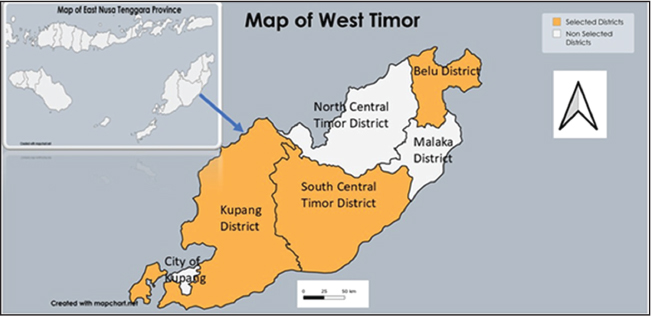
AbstractBackground: Foot-and-mouth disease (FMD) is a contagious viral disease of cloven-hoofed animals, causing significant economic losses to the livestock industry. The reemergence of FMD in Indonesia after a considerable disease-free period necessitates a comprehensive understanding of the behavioral factors of farmers. Aim: This study aimed to assess the knowledge, attitudes, and practices (KAP) of livestock farmers in West Timor regarding the risks of FMD introduction and transmission in East Nusa Tenggara Province (NTT), Indonesia. Methods: A cross-sectional survey of 290 livestock farmers was conducted using structured questionnaires. KAP indicators were assessed as absent (0), low, moderate, or high using a five-point Likert scale. Results: Low knowledge of FMD clinical signs and vaccination was observed in 48.6% and 52.8% of farmers, respectively. Education level was significantly associated with the KAP category (χ2=18.62, df=8, p=0.002). Farmers with secondary education or higher were more likely to demonstrate high KAP levels (odds ratio=2.47, 95% confidence interval: 1.31–4.65, p=0.005). Conclusion: Livestock farmers in West Timor generally exhibited low to moderate levels of FMD-related knowledge and preventive practices. This study provides one of the first empirical assessments of FMD-related KAP among cattle farmers in West Timor and identifies education as a key determinant of preventive behavior, providing evidence to support risk-based extension and disease control strategies. Keywords: Foot-and-mouth disease, Knowledge, Attitudes, Practices, Livestock farmers, West Timor. IntroductionFoot-and-mouth disease (FMD) is a severe, highly contagious viral disease of cloven-hoofed animals classified as one of the major transboundary animal diseases (TADs) worldwide (Brito et al., 2017). It leads to substantial economic losses in livestock keeping and livestock production. The estimated annual impact of FMD in terms of visible production losses and vaccination in endemic regions alone is between US$6.5 and 21 billion (Knight-Jones and Rushton, 2013). Foot-and-mouth disease virus is an aphthovirus belonging to the family Picornaviridae and the causative agent of one of the most contagious animal diseases (Domingo et al., 2002). Similar to their mothers, adult animals have low mortality; however, FMD outbreaks cause a severe economic burden related to animal production, their movements, and trade, as well as high costs of control and eradication (Knight-Jones and Rushton, 2013). FMD was eradicated in Indonesia for decades before its return in 2022 (Bulu, 2023). The event uncovered serious weaknesses in the level of preparedness for smallholder farmers at both national and subnational. However, the findings indicated that successful FMD control was also dependent on technical control options (e.g., vaccination and movement restrictions) and producer engagement in effectively responding to early detection of new outbreaks through reporting (Metwally et al., 2023). The eastern part of Indonesia, particularly East Nusa Tenggara province, is classified as a high-risk area due to its geographical challenges, limited capacity of veterinary services, and traditional animal production systems. West Timor is strategically located for cattle farming and animal trade between regions; therefore, the area is valuable for evaluating FMD risk. Therefore, veterinary services must be integrated into whole-of-society efforts to control infectious diseases in animals, prioritizing prevention and preparedness through key improvements, including strengthening capacity in risk assessment and value chain analysis, adapting strategies for resource-poor settings, enhancing multisectoral and cross-border cooperation, and applying systematic approaches to influence decisions on trade, public health, markets, and livelihoods at national and regional levels. Livestock production systems in West Timor are predominantly based on smallholders and are characterized by low levels of biosecurity. Other management practices, such as communal grazing, common water sources, and unofficial movement of animals, increase the risk of disease introduction and spread. The Food and Agriculture Organization stresses that these systems are significantly more susceptible to the entry and spread of TADs, especially when there is low farmer knowledge and biosecurity (Metwally et al., 2023). Moreover, the restricted availability of veterinary services and disease-related information hinders the successful application of preventive measures on the farm. Farmers are central to the prevention and control of FMD, as they are often the first to recognize clinical signs, make decisions regarding animal movement, and carry out daily husbandry practices (Osmani et al., 2021). The behavior, compliance, and reporting of farmers have been identified as important parameters in sustainable disease control (Nastis et al., 2019; Suit-B et al., 2020). In the Bhisti setting, knowledge, attitudes, and practices (KAP) assessment is widely applied in veterinary epidemiology to measure farmers’ disease awareness, risk perceptions, and uptake of preventive measures. Earlier reports have also shown that low level of farmers’ knowledge and poor biosecurity practices could impede the early detection of outbreaks and facilitate the spread of the disease (Jemberu et al., 2015). However, the strategic significance of farmer behavior in FMD control in eastern Indonesia has limited information on farmers’ KAP toward FMD. The majority of the prevalent works in Indonesia have focused on outbreak description and technical responses, with little focus on behavioral/sociodemographic determinants of infectious disease prevention. Absence of initial KAP at the farmer level can undermine the ability of veterinary services to plan targeted extension roll-outs that matches the progressive control pathway (PCP)-FMD process stages. This study aimed to evaluate the KAP levels regarding FMD risk and entry in West Timor, Indonesia. Specifically, the study also examined the KAP scores of farmers in relation to sociodemographic variables, identifying which groups are most likely to have a high level of KAP, using inferential statistics. Materials and MethodsStudy location and designThis is a cross-sectional study conducted in three districts in West Timor, East Nusa Tenggara Province, Indonesia, from August to September 2025 (Fig. 1). Study population and samplingThe study population consisted of farmers who were either owners or managers of livestock in the selected districts of West Timor. A total of 290 cattle farmers were recruited using purposive sampling and interviewed face-to-face. Farmers were eligible if they were actively involved in cattle farming during the study period, owned or managed at least one herd, resided in the selected study villages, provided informed consent, and were available at the time of the survey. Purposive sampling was adopted because the study aimed to identify potential risk factors for the introduction and spread of FMD in an FMD-free area rather than estimating disease prevalence. Accordingly, farms were deliberately selected to represent diverse cattle management practices and livestock movement patterns considered relevant to FMD risk assessment. The selection was independent of herd size, proximity to major roads, or previous access to livestock services.
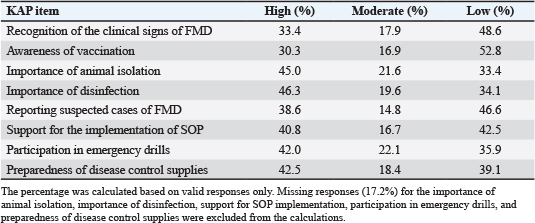
Fig. 1. Study area of the selected districts. Data collectionThe data were collected through face-to-face interviews using a structured questionnaire. The questionnaire included sections on farmer characteristics, livestock management, biosecurity practices and vaccination against FMD, disease reporting, and KAP indicators related to FMD-related issues (Supplementary Material S1). The questionnaire was developed using the published literature and expert input. Subsequently, it was pilot-tested with 10 cattle farmers (six men and four women) in Kupang to assess its clarity, relevance, and administration time and to identify and resolve any ambiguities before the main survey. Definition of the KAP indicatorsSOP support refers to farmers’ agreement to implement standard operating procedures for disease prevention and control. Drill participation refers to the willingness to participate in simulation exercises or emergency preparedness training. Stock preparedness refers to the maintenance of essential supplies for disease control, such as disinfectants, personal protective equipment, and emergency response materials. KAP assessmentThe KAP indicators were assessed on a five-point Likert scale (1=strongly disagree to 5=strongly agree). The scores were divided into low (1–2), moderate (3), and high (4–5). Data analysisThe questionnaire data were entered into Microsoft Excel 2021 (Microsoft Inc., Redmond, WA) before being imported into IBM SPSS Statistics version 25.0 (IBM Corp., Armonk, NY) for subsequent statistical analysis. In addition, the data were checked for completeness before analysis. A descriptive statistical analysis was used to describe sociodemographic characteristics and KAP with respect to FMD. Inferential statistics were used to determine the relationship between the sociodemographic characteristics of farmers and KAP levels. The relationship between education level and KAP category was tested using the chi-square (χ2) test. Variables with an association at bivariate analysis at a p-value <0.25 were entered into multivariable analysis. The low, moderate, and high KAP results were created as binary outcomes for logistic regression. Logistic regression was used to determine factors associated with high KAP levels, with the odds ratio (OR) and confidence intervals (CI) at a 95% CI. A p < 0.05 was considered statistically significant. Statistical analysis was performed using computer statistical programs. Ethical approvalThis study was not animal-based and did not require invasive methods. Information was obtained from a questionnaire-based survey and a structured interview with the livestock farmers. Thus, no ethical permission was needed for animal experimentation. ResultsLevels of KAPMost respondents demonstrated limited knowledge of FMD prevention. According to the results in Table 1, approximately 48.6% of participants had poor knowledge regarding the signs of disease, while approximately 52.8% did not recognize any benefits of vaccination. Awareness of isolation (37.2%), disinfection (38.3%), and reporting (38.6%) was slightly higher in contrast. KAP by education levelEducation level had a significant positive association with knowledge and attitude (Table 2). Farmers without primary education were all low, and the great majority of university graduates were medium or high. Table 1. Distribution of farmers’ KAP regarding FMD prevention and control (%).
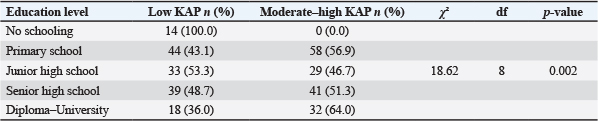
Association between education level and the KAP categoryThe chi-square test revealed that education level was significantly related to the total KAP category (χ2=18.62; df=8; p=0.002). The KAP scores among farmers with a high educational level were significantly higher in the moderate and high frequencies compared to farmers who had no education (Table 3). Factors associated with high KAP (logistic regression analysis)According to the multivariable logistic regression analysis, a predictor of high KAP status was education level (Table 4). Those with secondary and above education had more than 2 times higher odds of having high KAP compared with illiterates (OR=2.47; 95% CI: 1.31–4.65; p=0.005). Missing responsesFive questionnaire items (isolation importance, disinfection role, SOP support, drill participation, and stock preparedness) showed 17.2% missing responses. These items were located in the final section of the questionnaire, and some respondents did not complete the entire interview due to time constraints or interview interruptions. The percentages reported in Table 1 were calculated using the available responses for each item. DiscussionAwareness of FMD and perception of riskThe general knowledge of FMD among livestock farmers in West Timor was low to moderate (Table 1). Approximately half of the respondents reached a low level of FMD clinical signs knowledge (48.6%) compared with 33.4% who attained a high level of knowledge. Furthermore, knowledge of vaccination as a preventive practice was low in over half of the respondents (52.8%). Failure to recognize clinical signs such as vesicles in the mouth and feet, excessive salivation, or lameness can lead to delays in reporting the disease, which may result in the silent spread of the virus. It is crucial to rapidly monitor FMD in the field for early detection, especially in endemic or high-risk areas at the farmer level (Fejzić and Šerić-Haračić, 2011; Knight-Jones and Rushton, 2013). Similar results were also reported in the UK, Ethiopia, and Nigeria, where farmers’ poor knowledge significantly impacted the detection of outbreaks and the spread of diseases (Jemberu et al., 2015; J Olumade et al., 2020). Our study found that low awareness of vaccination indicates a lack of effective communication regarding FMD control programs. The willingness of farmers to vaccinate their livestock may be influenced by their perceptions of disease risk, the availability of vaccines, and their confidence in veterinary services (Nuvey et al., 2023). This highlights the need to improve communication between veterinary authorities and farmers, especially in post-FMD reemergence environments such as Indonesia. Attitudes regarding disease control and protectionFarmers’ perceptions about measures for disease control, such as the Standard Operating Procedures (SOPs), reporting, and emergency readiness, was moderate in most cases (Table 1). More than a third of the respondents had a positive perception of SOP adherence (33.8%) and drill readiness (34.8%). However, a large proportion of farmers continued to express less favorable attitudes toward these practices. Table 2. Distribution of KAP based on education (%).
Table 3. Association between education level and KAP category among livestock keepers,
Table 4. Logistic regression analysis of factors associated with livestock farmers with high KAP.
This intermediate profile of attitudes shows some acceptance of the principles controlling duration, but there is no total faith in their application. Behavior studies within veterinary epidemiology indicate that positive attitudes should be supported by material support, incentives, and sustained engagement to transfer into effective disease control behavior (Wang and Pang, 2022). The lack of infrastructure to support these producers may render biosecurity measures either unfeasible or a financial liability in the eyes of farmers. Similar trends have been recorded in African swine fever (ASF) investigations in Eastern Indonesia, with farmers recognizing disease risks but reporting little adherence to advocated biosecurity measures (Bulu et al., 2023). These findings suggest that attitudes toward disease control are largely influenced by local socioeconomic conditions and production context. Preventive practices and implementation of biosecurityThe preventive measures for controlling FMD were generally insufficient, with only 35.2% of practices categorized as high-quality preventive measures (Table 1). Specific actions, such as the segregation of sick animals, proper disinfectant storage, and emergency response preparation, were often inconsistent. Inadequate levels of biosecurity practices in smallholder systems have been extensively documented and are commonly linked with communal grazing, shared water points, informal animal trade, and restricted availability of veterinary inputs (Nyokabi et al., 2023; Moiane and Moiane, 2024). These ecological factors in West Timor offer an enabling environment for the spread of FMD, despite a lack of active outbreaks. The inherent disparity between knowledge, attitudes, and actual practices is characteristic of an established “knowledge-practice gap” in animal health behavior research. Farmers may have a limited understanding of disease, but may lack information, resources, institutional support, and interest to practice prevention continuously (Fejzić and Šerić-Haračić, 2011). Correlation between education level and KAPEducation level had a significant relationship with KAP performance in relation to livestock farmers (Table 2). All farmers with no school to primary school backgrounds were placed in the low KAP category, whereas those who attended secondary and higher grades showed more moderate and higher KAP. Education improves farmers’ capacity to appreciate the risk of disease, understand the advice of veterinarians, and implement prevention requirements. Analogous findings were found in other studies on FMD, avian influenza, and brucellosis, where the level of education was a major factor influencing biosecurity compliance (Ellis-Iversen et al., 2010; Bayantassova et al., 2023). However, the continued low levels of KAP among some educated farmers suggested that education in isolation is not adequate without ongoing veterinary extension and institutional support, or perhaps even national policy (Jemberu et al., 2015; Sieng et al., 2022). The chi-square test indicated an evident relationship between education level and the total KAP category (χ2=18.62; df=8; p=0.002). Farmers with formal education were significantly more likely to have moderate-to-high KAP than those without any education (Table 3). The strong association suggests that education is an influential factor in the behavior of farmers toward disease. Similar results have been recorded from FMD and avian influenza studies in which education positively impacted farmers’ compliance with biosecurity and reporting systems (Bayantassova et al., 2023). Factors associated with high KAPEducation remained significant, even after controlling for herd size and previous experience with diseases. This result indicates that education enhances the ability of farmers to recognize disease risks, understand veterinary advice, and implement preventive measures. Common determinants have been identified in studies on FMD and ASF in smallholder systems (Barnes et al., 2015). Both herd size and history of disease were positively associated with high KAP, but not to a significant extent. Farmers facing a higher disease risk may be more motivated to take preventive actions. From the veterinary epidemiological point of view, the association of education level with KAP indicates that educational influences would be a key leverage for FMD control (Osmani et al., 2021; Sieng et al., 2022; Zhang et al., 2025). Improved farmer knowledge and practices can enhance early detection, reduce risky animal movements, and strengthen community-based surveillance, all of which are key elements in the PCP for FMD (Byrne and Nichol, 2020; Jost et al., 2021; Metwally et al., 2023). Relevance to FMD control in West TimorThe high proportion of livestock farmers with low-to-moderate KAP levels suggests that the West Timor livestock production systems are at a high risk of FMD entry and spread. As part of public health efforts, it is crucial to prioritize farmer-focused veterinary extension initiatives, practical biosecurity training, and community-based surveillance. These approaches align with the PCP-FMD, which emphasizes farmer participation and behavior change as critical components of sustainable disease control (Knight-Jones and Rushton, 2013; Sieng et al., 2022). This study has several limitations. First, the use of purposive sampling may limit the generalizability of the findings to all livestock farmers in West Timor or other regions of Indonesia. Second, the study relied on self-reported responses, which may be subject to recall bias and social desirability bias, potentially leading respondents to overreport desirable disease prevention practices. Third, the cross-sectional design captures farmers’ KAP at a single point in time and therefore does not allow the establishment of causal relationships between sociodemographic factors and KAP outcomes. Despite these limitations, this study provides valuable baseline information on the preparedness and behavior of farmers regarding FMD prevention and control in an important livestock-producing region of eastern Indonesia. ConclusionIn West Timor, livestock farmers generally have a low-to-medium understanding of FMD and its associated preventive measures. The level of education among farmers significantly affects their KAP regarding FMD. It is essential to enhance the capacity of veterinary extension services and raise awareness of biosecurity measures to prevent the introduction and spread of FMD. AcknowledgmentsThe authors would like to thank the Provincial Livestock Service of East Nusa Tenggara and all livestock farmers who participated in this study. Conflict of interestThe authors have no conflicts of interest to declare. FundingThis research was funded under the Self-Funded Research Contract (Applied Research Scheme) supported by the Non-Tax State Revenue (PNBP) Funding of Politeknik Pertanian Negeri Kupang for the 2025 fiscal year, Contract Number: 03/P3M/SP DIPA-39.03.2.693484/2025, dated June 2, 2025. Authors’ contributionsPetrus Malo Bulu: conceptualization of the study, sample size calculation, data analysis, and manuscript writing. Ewaldus Wera: Data analysis. Victor Lenda and Theresia Nur Indah Koni: performed data entry. Data availabilityThe data that support the findings of this study are not openly available due to sensitivity reasons and are available from the corresponding author upon reasonable request. ReferencesBarnes, A.P., Moxey, A.P., Vosough Ahmadi, B. and Borthwick, F.A. 2015. The effect of animal health compensation on ‘positive’ behaviours towards exotic disease reporting and implementing biosecurity: a review, a synthesis and a research agenda. Prev. Vet. Med. 122, 42–52; doi:10.1016/J.PREVETMED.2015.09.003 Bayantassova, S., Kushaliyev, K., Zhubantayev, I., Zhanabayev, A., Kenzhegaliyev, Z., Ussenbayev, A., Paritova, A., Baikadamova, G., Bakishev, T., Zukhra, A., Terlikbayev, A., Akhmetbekov, N., Tokayeva, M., Burambayeva, N., Bauzhanova, L., Temirzhanova, A., Rustem, A., Aisin, M., Tursunkulov, S., Rametov, N. and Issimov, A. 2023. Knowledge, attitude and practice (KAP) of smallholder farmers on foot-and-mouth disease in Cattle in West Kazakhstan. Vet. Med. Sci. 9, 1417–1425; doi:10.1002/VMS3.1097 Brito, B.P., Rodriguez, L.L., Hammond, J.M., Pinto, J. and Perez, A.M. 2017. Review of the global distribution of foot-and-mouth disease virus from 2007 to 2014. Transboundary Emerg. Dis. 64(2), 316–332. Bulu, P.M. 2023. Review: epidemiologi, Penanggulangan dan Pemberantasan Penyakit Mulut dan Kuku (Pembelajaran dari Wabah PMK Indonesia 1887-1997). 28(1), 62–72; doi:10.35726/JP.V28I1.6840 Bulu , P.M., Paga, A., Lasakar, A.S. and Wera, E. 2023. Pig farm management and its contribution to the African Swine fever incidences in Kupang, Indonesia. Jurnal. Medik. Veteriner. 6(2), 155–161; doi:10.20473/JMV.VOL6.ISS2.2023.155-161 Byrne, A. and Nichol, B. 2020. A community-centred approach to global health security: implementation experience of community-based surveillance (CBS) for epidemic preparedness. Global Secur. Health. Sci. Policy 5, 71–84; doi:10.1080/23779497.2020.1819854 Domingo, E., Baranowski, E., Escarmís, C. and Sobrino, F. 2002. Foot-and-mouth disease virus. Comp. Immunol. Microbiol. Infect. Dis. 25, 297–308; doi:10.1016/S0147-9571(02)00027-9 Ellis-Iversen, J., Cook, A.J., Watson, E., Nielen, M., Larkin, L., Wooldridge, M. and Hogeveen, H. 2010. Perceptions, circumstances and motivators that influence implementation of zoonotic control programs on cattle farms. Prev. Vet. Med. 93(4), 276–285. Fejzić, N. and Šerić-Haračić, S. 2011. Economic and social impact of animal diseases: experiences, challenges and new approaches. Veterinaria 60, 205–215. Olumade, T.J., Adesanya, O.A., Fred-Akintunwa, I.J., Babalola, D.O., Oguzie, J.U., Ogunsanya, O.A., George, U.E., Akin-Ajani, O.D. and Osasona, D.G.. 2020. Infectious disease outbreak preparedness and response in Nigeria: history, limitations and recommendations for global health policy and practice. AIMS. Public. Health. 7, 736; doi:10.3934/PUBLICHEALTH.2020057 Jemberu, W.T., Mourits, M.C.M. and Hogeveen, H. 2015. farmers’ intentions to implement foot and mouth disease control measures in Ethiopia. PLoS One 10, 138363; doi:10.1371/JOURNAL.PONE.0138363 Jost, C.C., Machalaba, C., Karesh, W.B., Mcdermott, J.J., Beltran-Alcrudo, D., Bett, B., Tago, D., Wongsathapornchai, K., Plee, L., Dhingra, M.S. and Pfeiffer, D.U. 2021. Epidemic disease risks and implications for veterinary services. OIE. Revue. Sci. Tech. 40(2), 497–509; doi:10.20506/rst.40.2.3240 Knight-Jones, T.J.D. and Rushton, J. 2013. The economic impacts of foot and mouth disease – What are they, how big are they and where do they occur?. Prev. Vet. Med. 112, 161–173; doi:10.1016/J.PREVETMED.2013.07.013 Metwally, S., Wagner, B., Salman, M., Drewe, J.A., Ferrari, G., Mclaws, M. and Gonzales, J.L. 2023. Application of surveillance principles in the progressive control pathway for global control of foot-and-mouth disease. Agriculture 13, 5099–5094; doi:10.3390/AGRICULTURE13050994 Moiane, B. and Moiane, B. 2024. The role of biosecurity in promoting farm animal welfare in low- and middle-income countries. doi:10.5772/INTECHOPEN.114891 Nastis, S.A., Mattas, K. and Baourakis, G. 2019. Understanding farmers’ behavior towards sustainable practices and their perceptions of risk. Sustainability 11, 11; doi:10.3390/SU11051303 Nuvey, F.S., Fink, G., Hattendorf, J., Mensah, G.I., Addo, K.K., Bonfoh, B. and Zinsstag, J. 2023. Access to vaccination services for priority ruminant livestock diseases in Ghana: barriers and determinants of service utilization by farmers. Prev. Vet. Med. 215, 105919; doi:10.1016/J.PREVETMED.2023.105919 Nyokabi, N.S., Berg, S., Mihret, A., Almaw, G., Worku, G.G., Lindahl, J.F., Wood, J.L.N. and Moore, H.L. 2023. Adoption of biosecurity practices in smallholder dairy farms in Ethiopia. Transbound. Emerg. Dis. 2023, 2277409; doi:10.1155/2023/2277409 Osmani, A., Habib, I. and Robertson, I.D. 2021. Knowledge, attitudes, and practices (KAPs) of farmers on foot and mouth disease in Cattle in Baghlan Province, Afghanistan: a descriptive study. Animals 2021, 11; doi:10.3390/ANI11082188 Sieng, S., Patrick, I.W., Windsor, P.A., Walkden-Brown, S.W., Sar, C., Smith, R.G.B. and Kong, R. 2022. Knowledge, attitudes and practices of smallholder farmers on foot and mouth disease control in two Cambodian provinces. Transbound. Emerg. Dis. 69, 1983–1998; doi:10.1111/TBED.14182 Suit-B, Y., Hassan, L., Krauss, S.E., Ramanoon, S.Z., Ooi, P.T., Yasmin, A.R. and Epstein, J. 2020. Exploring the mental model of cattle farmers in disease prevention and control practices. Vet. Sci. 7, 27; doi:10.3390/VETSCI7010027 Wang, M.X. and Pang, J. 2022. The knowledge, attitudes and practices of hand, foot, and mouth disease prevention strategies amongst parents and educators of children under 5 years amidst COVID-19 pandemic: a cross-sectional study. Front. Public Health 10, 908004; doi:10.3389/FPUBH.2022.908004/TEXT Zhang, Z., Chen, C., Yao, L., Zhang, Q., Li, Q., Lin, Y., Liu, Z. and Fang, F. 2025. Study on the relationship with knowledge, attitudes, and practices for prevention control of hepatitis B among university students in Hubei Province, China. Crit. Public Health 35, doi:10.1080/09581596.2025.2519772 Supplementary material S1KAP questionnaire for FMD risk factors and risk analysis in the West Timor RegionQuestionnaire for farmersIntroduction: This questionnaire aims to improve understanding of pig farm management and the ASF disease situation in Kupang Regency. This research was conducted by the Kupang State Agricultural Polytechnic. Your answers will help us better understand the risk factors that may increase the likelihood of the introduction and spread of this disease in this region. A. Administration & Consent A1. Interview date: ___ / ___ / 2025 A2. Enumerator code: ______ A3. Farm/Respondent unique code: ______ A4. Village – Subdistrict – District: ____________________________ A5. Consent to participate Read the study summary, confidentiality statement, and the respondent’s right to refuse participation. □ Agree (1) □ Do not agree (0) → End interview _________________________________________________________________________ B. Respondent and farm characteristics B1. Respondent’s sex: □ Male (1) □ Female (2) → sex B2. Respondent’s age (years): ____ → age B3. Highest education level completed: □ Primary School (1) □ Junior High School (2) □ Senior High School/Vocational School (3) □ Diploma (4) □ Bachelor’s Degree or higher (5) → edu B4. Role on the farm: □ Owner (1) □ Manager (2) □ Worker (3) → role B5. Predominant production system: □ Intensive (1) □ Semi-intensive (2) □ Extensive/free-range (3) → system B6. Farm enterprise type: □ Fattening (1) □ Breeding (2) □ Mixed operation (3) → businesstype B7. Current cattle population (head): ____ → herd_size B8. Herd composition (number of animals): Calves ____ ; Heifers ____ ; Cows ____ ; Bulls ____ → calves, heifers, cows, bulls B9. Are there other animal species on the farm? □ Goats (1) □ Sheep (2) □ Pigs (3) □ Other (4) □ None (0) → other_species (multiple selection; create separate variables: goat, sheep, pig, other_sp; 0=No, 1=Yes) _________________________________________________________________________ C. Vaccination & Immunity C1. Have the cattle ever been vaccinated against FMD?□ Yes (1) □ No (0) → vax_any If No, skip to Section E. C2. Estimated vaccination coverage of the herd (%): ____ % → vax_cov C3. Date of the last vaccination (month/year): ____ / ____ → vax_last C4. Vaccination schedule followed: □ Primary 2-dose schedule (1) □ Annual booster (2) □ Incomplete schedule (3) → vax_scheme C5. Vaccine source: □ Government Veterinary Service (1) □ Self-procured (2) □ Other (3) → vax_source D. Animal movement (Inward/Outward) D1. Have any cattle entered the farm during the last 3 months? □ Yes (1) □ No (0) → move_in3m If Yes: D1a. Number of incoming cattle (head): ____ → in_n D1b. Origin: □ Within the village (1) □ Within the district (2) □ Between districts (3) □ Between provinces (4) □ Border area/Timor-Leste (5) → in_origin D1c. Were official documents provided (Animal Health Certificate/control card)? □ Yes (1) □ No (0) → in_docs D1d. Were animals quarantined/isolated upon arrival? □ Yes (1) □ No (0) → in_quarantine D2. Have any cattle left the farm during the last 3 months? □ Yes (1) □ No (0) → move_out3m If Yes: Number: ____ → out_n Destination: □ Local market (1) □ Slaughterhouse (2) □ Other farmer (3) □ Other (4)-------------------→ out_dest D3. Frequency of visits to livestock markets (per month): ____ → market_freq D4. Frequency of using third-party livestock transport services (per month): ____ → transporter_freq _________________________________________________________________________ E. Contact and networking E1. Do your cattle share grazing areas with other farmers’ livestock? □ Yes (1) □ No (0) → communal_grazing E2. Source of breeding bulls (natural mating): □ Own bull (1) □ Borrowed from neighbor (2) □ Mobile breeding service (3) □ Artificial insemination only (4) → breeding_source E3. Number of neighboring farms within approximately 1 km radius: ____ → neigh_1km E4. Is there frequent contact with wildlife/wild ruminants (e.g., buffalo, deer)? □ Yes (1) □ No (0) → wild_contact _________________________________________________________________________ F. Biosecurity & Hygiene F1. Is farm access controlled (fence/gate/checkpoint)? □ Yes (1) □ No (0) → gate_control F2. Is a disinfectant footbath available at farm entrances? □ Always (2) □ Sometimes (1) □ Not available (0) → footbath F3. Are hands and equipment cleaned before and after work? □ Always (2) □ Sometimes (1) □ No (0) → hygiene_tools F4. Are dedicated farm clothes/boots used? □ Always (2) □ Sometimes (1) □ No (0) → ppe_farm F5. Are livestock transport vehicles cleaned and disinfected after use? □ Always (2) □ Sometimes (1) □ No (0) → truck_disinf F6. Are visitors recorded and access restricted? □ Yes (1) □ No (0) → visitor_log F7. Are sick animals isolated from the herd? □ Yes (1) □ No (0) → isolate_sick ________________________________________________________________ G. KAP regarding FMD Likert Scale: Scale: 1=Strongly Disagree, 2=Disagree, 3=Neutral, 4=Agree, 5=Strongly Agree. G1. I know the main clinical signs of FMD. □1 □2 □3 □4 □5 G2. Vaccination is important for preventing FMD. □1 □2 □3 □4 □5 G3. Isolating sick animals can reduce FMD transmission. □1 □2 □3 □4 □5 G4. Disinfection of vehicles and visitors is necessary. □1 □2 □3 □4 □5 G5. I am prepared to report suspected FMD cases promptly. □1 □2 □3 □4 □5 G6. My farm has written biosecurity SOPs. □1 □2 □3 □4 □5 G7. An outbreak response drill has been conducted on my farm within the last 12 months. □1 □2 □3 □4 □5 G8. My farm maintains an adequate stock of disinfectants. □1 □2 □3 □4 □5 _________________________________________________________________________ Thank you for your participation. | ||


| How to Cite this Article |
| Pubmed Style Bulu PM, Wera E, Lenda V, Koni TNI. Livestock farmers’ knowledge, attitudes, and practices on the risk of foot-and-mouth disease entry and transmission in West Timor, Indonesia. Open Vet. J.. 2026; 16(8): 5125-5134. doi:10.5455/OVJ.2026.v16.i8.8 Web Style Bulu PM, Wera E, Lenda V, Koni TNI. Livestock farmers’ knowledge, attitudes, and practices on the risk of foot-and-mouth disease entry and transmission in West Timor, Indonesia. https://www.openveterinaryjournal.com/?mno=318853 [Access: August 08, 2026]. doi:10.5455/OVJ.2026.v16.i8.8 AMA (American Medical Association) Style Bulu PM, Wera E, Lenda V, Koni TNI. Livestock farmers’ knowledge, attitudes, and practices on the risk of foot-and-mouth disease entry and transmission in West Timor, Indonesia. Open Vet. J.. 2026; 16(8): 5125-5134. doi:10.5455/OVJ.2026.v16.i8.8 Vancouver/ICMJE Style Bulu PM, Wera E, Lenda V, Koni TNI. Livestock farmers’ knowledge, attitudes, and practices on the risk of foot-and-mouth disease entry and transmission in West Timor, Indonesia. Open Vet. J.. (2026), [cited August 08, 2026]; 16(8): 5125-5134. doi:10.5455/OVJ.2026.v16.i8.8 Harvard Style Bulu, P. M., Wera, . E., Lenda, . V. & Koni, . T. N. I. (2026) Livestock farmers’ knowledge, attitudes, and practices on the risk of foot-and-mouth disease entry and transmission in West Timor, Indonesia. Open Vet. J., 16 (8), 5125-5134. doi:10.5455/OVJ.2026.v16.i8.8 Turabian Style Bulu, Petrus Malo, Ewaldus Wera, Victor Lenda, and Theresia Nur Indah Koni. 2026. Livestock farmers’ knowledge, attitudes, and practices on the risk of foot-and-mouth disease entry and transmission in West Timor, Indonesia. Open Veterinary Journal, 16 (8), 5125-5134. doi:10.5455/OVJ.2026.v16.i8.8 Chicago Style Bulu, Petrus Malo, Ewaldus Wera, Victor Lenda, and Theresia Nur Indah Koni. "Livestock farmers’ knowledge, attitudes, and practices on the risk of foot-and-mouth disease entry and transmission in West Timor, Indonesia." Open Veterinary Journal 16 (2026), 5125-5134. doi:10.5455/OVJ.2026.v16.i8.8 MLA (The Modern Language Association) Style Bulu, Petrus Malo, Ewaldus Wera, Victor Lenda, and Theresia Nur Indah Koni. "Livestock farmers’ knowledge, attitudes, and practices on the risk of foot-and-mouth disease entry and transmission in West Timor, Indonesia." Open Veterinary Journal 16.8 (2026), 5125-5134. Print. doi:10.5455/OVJ.2026.v16.i8.8 APA (American Psychological Association) Style Bulu, P. M., Wera, . E., Lenda, . V. & Koni, . T. N. I. (2026) Livestock farmers’ knowledge, attitudes, and practices on the risk of foot-and-mouth disease entry and transmission in West Timor, Indonesia. Open Veterinary Journal, 16 (8), 5125-5134. doi:10.5455/OVJ.2026.v16.i8.8 |


