





| Research Article | ||
Open Vet. J.. 2026; 16(8): 5135-5139 !!
Open Veterinary Journal, (2026), Vol. 16(8): 5135–5139 Research Article Risk factors and anatomical distribution of feline fractures in Kuwait: A retrospective study of 325 casesKhalifah Khalaf Khatam Ali1*, Samir Rashed Nouh2, Mahmoud H. Elkammar2 and Howaida M. Abou-Ahmed21Gulf Pets Clinic, Kuwait City, Kuwait 2Faculty of Veterinary Medicine, Alexandria University, Alexandria, Egypt *Corresponding Author: Khalifah Khalaf Khatam Ali. Gulf Pets Clinic, Kuwait City, Kuwait. Email: vet-1 [at] live.com Submitted: 27/04/2026 Revised: 22/06/2026 Accepted: 03/07/2026 Published: 08/08/2026 © 2025 Open Veterinary Journal
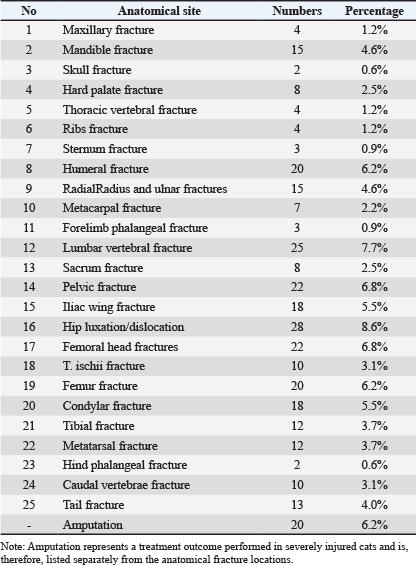
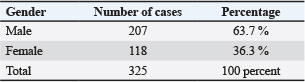
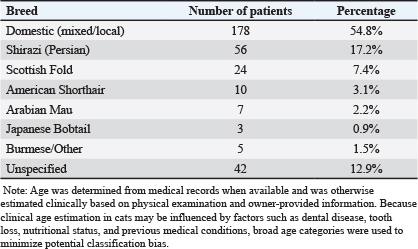
AbstractBackground: Cat fractures are common injuries in small animal practice. Although many studies have described fracture patterns in cats around the world, limited data are available from Kuwait and the surrounding region. Aim: This study aimed to investigate the risk factors and anatomical distribution of fractures in cats who presented to the Gulf Pets Clinic in the Capital Governorate of the State of Kuwait and to evaluate their association with age, sex, breed, and fracture location. Methods: A retrospective study was conducted using the medical records of 325 cats diagnosed with fractures at a veterinary clinic in Kuwait between October 2024 and October 2025. The collected data included age group, sex, breed, and the anatomical location of the fractures. The fractures were confirmed through clinical examination and radiographic evaluation. Descriptive statistics, including frequencies and percentages, were used to summarize the data. Fracture cases were analyzed according to the primary fracture diagnosis recorded in the medical records. Although some cats presented with multiple fractures, these cases represented only a minor proportion of the study population and were included according to their principal fracture classification. Therefore, the polytraumatized cases were not evaluated as a separate category. Results: A total of 325 cats with fractures were included in this study. Male cats accounted for 63.7% of cases, whereas cats aged 1–3 years accounted for the largest age group (31.4%). Domestic mixed-breed cats were most frequently affected (54.8%). The most common injuries involved the hip region (8.6%), lumbar vertebrae (7.7%), pelvis (6.8%), femoral head (6.8%), femur (6.2%), and humerus (6.2%). Conclusion: This study provides basic information regarding the risk factors and anatomical distribution of fractures in cats in Kuwait. Young male cats and domestic breeds were most affected, and several anatomical areas showed a higher frequency of fractures. These findings may help veterinarians better understand fracture patterns in cats and support future clinical and epidemiological studies in the region. Keywords: Epidemiology, Feline fractures, Kuwait, Risk factors, Trauma. IntroductionCat fractures represent an important part of the injuries encountered in veterinary practice and are often associated with pain, loss of mobility, and the need for intervention or surgical treatment. Dividing the fracture distribution is essential for improving preventive measures, facilitating early diagnosis, and achieving the best therapeutic outcomes in affected cats. A bone fracture is a medical condition in which there is a partial or complete break in the continuity of the bone. The clinical signs can vary according to the bone affected and may be characterized as lameness, swelling, or bleeding. Incidence in epidemiology is a measure of the probability of a given medical condition occurring in a population within a specified time. Bone fracture classification is based on individual animal information and anatomical system and may involve external risk factors (Newton and Nunamaker, 1985) . Bone fractures in dogs and cats are primarily caused by road traffic accidents, falling from heights, human abuse, animal biting, indoor trauma, and unknown trauma (Ali, 2013). Fractures are among the most common traumatic injuries in cats and are frequently encountered in veterinary medicine. These fractures are caused by traffic accidents, falls from heights, or severe contusions and sprains. Accurate clinical and radiographic diagnosis leads to proper treatment and restoration of near-normal limb function. Feline fractures are a significant cause of morbidity and impaired welfare in companion animals and frequently require prolonged medical or surgical management. The severity and outcome of these injuries depend on the anatomical location of the fracture, associated soft tissue damage, and the timeliness of diagnosis and treatment (Harasen, 2003; Beale, 2004). Long bone and pelvic fractures are frequently encountered in cats and represent a significant portion of traumatic injuries in veterinary practice (Johnson et al., 2011; Keosengthong et al., 2019). Several factors, including age, sex, and breed, have also been shown to influence the incidence and pattern of fractures in cats (Klein et al., 2022; Gregory et al., 2023). Understanding these factors is important for improving clinical management and developing preventive strategies. However, the published information describing the distribution of fracture risk factors in cats in Kuwait remains limited. Therefore, this study aimed to investigate the risk factors and anatomical distribution of fractures in cats. Materials and MethodsThis study was conducted at the Gulf Pets Clinic in the State of Kuwait’s Capital Governorate between October 2024 and October 2025. During this period, 325 cases of bone fractures were recorded and diagnosed through clinical examination and radiographic evaluation. The association between fracture occurrence and selected epidemiological factors, including age, sex, breed, and anatomical location of the fracture, was evaluated. Inclusion and exclusion criteriaCats were included in the study if a fracture was confirmed by clinical examination and radiographic evaluation and if sufficient medical record information, including age, sex, breed, and fracture location, was available. Cases originating from owned pets and rescue animals presented to the Gulf Pets Clinic during the study period. Patients with incomplete or insufficient medical records were excluded from the analysis. A few cases were omitted because essential epidemiological or fracture-related information was unavailable. All confirmed fracture cases were recorded regardless of treatment outcome; some animals died before therapeutic intervention, whereas the owners declined surgical treatment in other cases because of financial considerations. Statistical analysisThe data were summarized using descriptive statistics, including frequencies and percentages. Because the primary objective of this retrospective study was to describe the epidemiological characteristics and anatomical distribution of feline fractures, descriptive methods were considered appropriate for data presentation and interpretation. Ethical approvalThis retrospective study was based exclusively on clinical records and radiographic findings obtained from cats presented to Gulf Pets Clinic, Kuwait. No animals were subjected to additional procedures for research purposes. Patient confidentiality and data privacy were maintained throughout the study in accordance with institutional research and ethical guidelines. ResultsA total of 325 cats confirmed to have fractures were included in this study. The distribution of fracture cases according to the anatomical site is shown in Table 1. The most affected anatomical sites were hip luxation/dislocation (8.6%), lower back vertebrae (7.7%), pelvic fractures (6.8%), femoral head fractures (6.8%), femoral fractures (6.2%), and humeral fractures (6.2%). Less frequently reported fractures included the skull, tail phalanges, and thoracic vertebrae. The distribution of fracture cases by sex is shown in Table 2. Male cats constituted the majority of cases (63.7%), while female cats made up 36.3% of the cases. The age distribution of fracture cases is shown in Table 3. Most fractures occurred in cats under three years old. Cats aged 1–3 years formed the largest group (31.4%), followed by cats under six months old (29.5%). Breed distribution is presented in Table 4. Domestic and mixed-breed cats accounted for the largest proportion of cases (54.8%), followed by Persian (Shirazi) cats (17.2%) and Scottish Fold cats (7.4%). Other breeds represented a smaller percentage of fracture cases. The distribution of selected fracture locations according to age groups is presented in Table 5. Femur, pelvic, and lumbar vertebral fractures were observed across different age groups, with higher frequencies in younger animals. DiscussionThe current study provides an overview of fracture patterns and associated factors in cats presented to a veterinary clinic in Kuwait. Fractures are among the most common traumatic injuries in small animals and often result from traffic accidents, falls from heights, and other forms of trauma. Understanding the distribution and characteristics of these injuries is important for improving clinical management and developing preventive strategies. In the current study, male cats constituted the majority of fracture cases. This finding is consistent with previous reports indicating that male cats are more prone to trauma because of their more active behavior and wider roaming range. Similar observations have also been reported in other epidemiological studies of feline injuries. The analysis showed that most fracture cases occurred in young adult cats between 1 and 3 years of age. Young animals are generally more active and exploratory, which may increase their exposure to traumatic events. These findings are comparable to previous studies that evaluated injury patterns in cats (Gregory et al., 2023). Domestic mixed-breed cats accounted for the largest proportion of fracture cases in this study. This observation may be related to the higher population of domestic cats and their greater exposure to outdoor environments compared with some purebred breeds. Similar trends have been reported in previous epidemiological investigations of fractures in small animals (Keosengthong et al., 2019). Table 1. Distribution of feline fracture cases by anatomical site and injury type (n=325).
Table 2. Distribution of fracture cases in cats according to gender.
Regarding anatomical distribution, injuries were most frequently observed in the hip region, lumbar vertebrae, pelvis, femur, and humerus. Long-bone and pelvic fractures are commonly reported in cats and often require surgical intervention to restore limb function and mobility (Johnson et al., 2011; Klein et al., 2022). The findings of the present study partially agree with previous reports that identified the pelvic limb as the most commonly affected anatomical region in cats (Bennour et al., 2014). Similarly, and reported that femoral fractures were among the most frequently encountered fracture types in cats. Although femoral and pelvic injuries were common in the present study, hip luxation and lumbar vertebral injuries were also highly represented. These differences may be related to variations in trauma mechanisms, environmental conditions, animal management practices, and case selection among different geographical regions. Table 3. Distribution of fracture cases according to age in cats’ groups (n=325).
Table 4. Distribution of fracture cases in cats according to breed (n=325).
Table 5. Distribution of selected fracture locations according to age group.
ConclusionThis study provides basic information about the risk factors and anatomical distribution of fractures in cats in Kuwait. Young male cats and local breeds were the most affected. The most common fracture sites included the lumbar vertebrae, pelvis, femur, and humerus. These findings may contribute to a better understanding of fracture patterns in cats and support future clinical and epidemiological studies in the region. Conflicts of interestThe authors declare no conflicts of interest. FundingThis study received no external funding. Authors’ contributionsKhalifah Khalaf Khatam Ali contributed to the study design, data collection, clinical management of cases, data analysis, and manuscript preparation. Samir Rashed Nouh, Mahmoud H. Elkammar, and Howaida M. Abou-Ahmed contributed to data interpretation, manuscript revision, and scientific supervision. All authors read and approved the final manuscript. Data availabilityThe data supporting the findings of this study are available upon reasonable request from the corresponding author. ReferencesAli, L.B. 2013. Incidence, occurrence, classification and outcome of small animal fractures: a retrospective study (2005-2010). J. Anim. Vet. Sci. 7, 191–196. Beale, B.S. 2004. Techniques for the management of long bone fractures: orthopedic clinical techniques—Femoral fracture repair. Clin. Tech. Small. Anim. Pract. 19(3), 134–150. Bennour, E., Abushhiwa, M., Ben Ali, L., Sawesi, O., Marzok, M., Abuargob, O., Tmumen, S., Abdelhadi, J., Abushima, M. and Benothman, M. 2014. A Retrospective study on appendicular fractures in dogs and cats in Tripoli–Libya. J. Vet. Adv. 4, 425–431. Gregory, C.W., Davros, A.M., Cockrell, D.M. and Hall, K.E. 2023. Evaluation of outcome associated with feline trauma: a Veterinary Committee on Trauma registry study. J. Vet. Emerg. Crit. Care 33, 201–207. Harasen, G. 2003. Common long bone fractures in small animal practice—Part 1. Can. Vet. J. 44(4), 333–334. Johnson, A.L., Hulse, D.A. and Denny, H.R. 2011. Orthopedic surgery in small animals: techniques and outcomes. Wiley-Blackwell. Ames: Wiley-Blackwell. Keosengthong, A., Kampa, N., Jitpean, S., Seesupa, S., Kunkitti, P. and Hoisang, S. 2019. Incidence and classification of bone fracture in dogs and cats: a retrospective study at a veterinary teaching hospital (2013–2016). Vet. Integr. Sci. 17, 127–139. Klein, M.J., Uhl, E. and Brunnberg, L. 2022. Epidemiology and outcome of fractures in feline small animal patients: a retrospective clinical study. J. Feline Med. Surg. 24, 412–420. Newton, C.D., Nunamaker, D.M., 1985. Etiology, classification and diagnosis of bone fracture. In Newton, C.D., (Eds.) Textbook of small animal orthopaedics. Lippincott, Williams & Wilkins, New York. Rhangani, A.T., 2014. Incidence, Classification and Management Rochlitz, I. 2003. Study of factors that may predispose domestic cats to road traffic accidents: part 1. Vet. Rec. 153, 549–553. Rochlitz. and I. 2004. Clinical study of cats injured and killed in road traffic in Cambridgeshire, UK. Vet. Rec. 153, 590–592. | ||


| How to Cite this Article |
| Pubmed Style Ali KKK, Nouh SR, Elkammar MH, Abou-ahmed HM. Risk factors and anatomical distribution of feline fractures in Kuwait: A retrospective study of 325 cases. Open Vet. J.. 2026; 16(8): 5135-5139. doi:10.5455/OVJ.2026.v16.i8.9 Web Style Ali KKK, Nouh SR, Elkammar MH, Abou-ahmed HM. Risk factors and anatomical distribution of feline fractures in Kuwait: A retrospective study of 325 cases. https://www.openveterinaryjournal.com/?mno=318809 [Access: August 08, 2026]. doi:10.5455/OVJ.2026.v16.i8.9 AMA (American Medical Association) Style Ali KKK, Nouh SR, Elkammar MH, Abou-ahmed HM. Risk factors and anatomical distribution of feline fractures in Kuwait: A retrospective study of 325 cases. Open Vet. J.. 2026; 16(8): 5135-5139. doi:10.5455/OVJ.2026.v16.i8.9 Vancouver/ICMJE Style Ali KKK, Nouh SR, Elkammar MH, Abou-ahmed HM. Risk factors and anatomical distribution of feline fractures in Kuwait: A retrospective study of 325 cases. Open Vet. J.. (2026), [cited August 08, 2026]; 16(8): 5135-5139. doi:10.5455/OVJ.2026.v16.i8.9 Harvard Style Ali, K. K. K., Nouh, . S. R., Elkammar, . M. H. & Abou-ahmed, . H. M. (2026) Risk factors and anatomical distribution of feline fractures in Kuwait: A retrospective study of 325 cases. Open Vet. J., 16 (8), 5135-5139. doi:10.5455/OVJ.2026.v16.i8.9 Turabian Style Ali, Khalifah Khalaf Khatam, Samir Rashed Nouh, Mahmoud H. Elkammar, and Howaida M. Abou-ahmed. 2026. Risk factors and anatomical distribution of feline fractures in Kuwait: A retrospective study of 325 cases. Open Veterinary Journal, 16 (8), 5135-5139. doi:10.5455/OVJ.2026.v16.i8.9 Chicago Style Ali, Khalifah Khalaf Khatam, Samir Rashed Nouh, Mahmoud H. Elkammar, and Howaida M. Abou-ahmed. "Risk factors and anatomical distribution of feline fractures in Kuwait: A retrospective study of 325 cases." Open Veterinary Journal 16 (2026), 5135-5139. doi:10.5455/OVJ.2026.v16.i8.9 MLA (The Modern Language Association) Style Ali, Khalifah Khalaf Khatam, Samir Rashed Nouh, Mahmoud H. Elkammar, and Howaida M. Abou-ahmed. "Risk factors and anatomical distribution of feline fractures in Kuwait: A retrospective study of 325 cases." Open Veterinary Journal 16.8 (2026), 5135-5139. Print. doi:10.5455/OVJ.2026.v16.i8.9 APA (American Psychological Association) Style Ali, K. K. K., Nouh, . S. R., Elkammar, . M. H. & Abou-ahmed, . H. M. (2026) Risk factors and anatomical distribution of feline fractures in Kuwait: A retrospective study of 325 cases. Open Veterinary Journal, 16 (8), 5135-5139. doi:10.5455/OVJ.2026.v16.i8.9 |


