




| Research Article | ||
Open Vet. J.. 2026; 16(8): 5782-5793 !
Open Veterinary Journal, (2026), Vol. 16(8): 5782–5793 Research Article Production and profitability dynamics in small-scale broiler farming: Evidence from 30 production cycles in a tropical systemDjoko Seojono1, Soetriono Soetriono1, Dimas Bastara Zahrosa1, Ariq Dewi Maharani1, Amam Amam2,3 and Rico Anggriawan4*1Department of Agribusiness, Faculty of Agriculture, Universitas Jember, Jember, Indonesia 2Department of Animal Husbandry, Faculty of Agriculture, Universitas Jember, Jember, Indonesia 3Research Group of Agribusiness and Agroindustry of Animal Husbandry (A2P), Universitas Jember, Jember, Indonesia 4Department of Animal Husbandry, Faculty of Agriculture and Animal Husbandry, Universitas Kahuripan Kediri, Pare, East Java, Indonesia *Corresponding Author: Rico Anggriawan. Department of Animal Husbandry, Faculty of Agriculture and Animal Husbandry, Universitas Kahuripan Kediri, Pare, East Java, Indonesia. Email: rico_anggriawan [at] kahuripan.ac.id Submitted: 19/04/2026 Revised: 06/06/2026 Accepted: 14/06/2026 Published: 20/08/2026 © 2025 Open Veterinary Journal
AbstractBackground: Small-scale broiler farming plays a pivotal role in food security and rural livelihoods in developing countries. However, its performance is commonly evaluated using short-term or cross-sectional data that overlook temporal variability and system potential explanation. Aim: This study presents a longitudinal assessment of production and profitability dynamics across 30 consecutive production cycles (2021–2026) in a tropical smallholder broiler system in Indonesia. Methods: An integrated analytical framework was applied by combining biological indicators, feed conversion ratio (FCR), depletion rate, average body weight (ABW), harvest age, and performance index (PI) with economic metrics, including profit and return on investment (ROI). Pearson correlation analysis was conducted using SPSS version 26 after normality assessment using the Shapiro–Wilk test. Results: The results indicate that the proposed system is technically feasible but highly variable. The average FCR (1.75) and ABW (2.27 kg) reflect acceptable production performance, although the depletion rate (6.47%) exceeds the recommended thresholds, indicating persistent constraints related to environmental stress and flock health. Economically, the enterprise remains profitable on average (Indonesian Rupiah 19.62 million per cycle; ROI 8.18%) but exhibits substantial volatility, with several cycles generating financial losses. Pearson correlation analysis showed PI–profit (r=0.553; PI–ROI: r=0.563). External factors, such as feed price fluctuations, may contribute to profitability variability; however, climatic variables were not directly measured in this study. A near-perfect correlation between profit and ROI (r=0.995) confirms the sensitivity of investment efficiency to short-term financial performance. Conclusion: The longitudinal approach captures episodic peaks and declines, reflecting temporal variability across production cycles under changing production and market conditions. These findings highlight the need to emphasize improvements in feed efficiency, environmental management, and production stability to stabilize both biological and economic performance in smallholder broiler systems. Keywords: Broiler production, Economic performance, Longitudinal analysis, Tropical smallholder systems. IntroductionIn developing countries, small-scale broiler farming plays an important role in food systems by contributing to household income, employment opportunities, and animal protein supply (Amam et al., 2019a, 2019b, 2019c). Broiler production is widely adopted in tropical regions due to its low capital requirement and rapid production turnover (Gharib et al., 2023; Phiri et al., 2023). The sector has also become increasingly important for supporting food security during rapid population growth and urbanization (Mottet and Tempio, 2017; Henchion et al., 2021). Small-scale broiler farming exhibits substantial variability in production efficiency and profitability despite its economic importance. Farm management, disease pressure, and production environment strongly influence biological performance indicators such as feed conversion ratio (FCR), body weight, and mortality (Ali and Hossain, 2010; Adeyonu and Odozi, 2022). Fluctuating feed prices and operational inefficiencies may further reduce economic stability in smallholder broiler systems. Economic performance in small-scale broiler farming is complex and often volatile. Feed cost consistently represents the largest share of production expenses, accounting for approximately 56%–76% of total variable costs (Kamruzzaman et al., 2021; Balogun et al., 2023; Phiri et al., 2023). In addition to feed, the cost of day-old chicks (DOC), veterinary inputs, and labor significantly influence profitability. Although broiler production is generally profitable, fluctuations in input and output prices, disease outbreaks, and inefficiencies in farm management are highly sensitive to the margin (Kamruzzaman et al., 2021). Notably, econometric analyses have demonstrated that increased flock size does not necessarily guarantee higher profitability, as technical inefficiencies, particularly in poorly managed smallholder systems, can offset the benefits of economies of scale (Balogun et al., 2023). In tropical environments, production risks are further exacerbated by climatic stressors, particularly heat stress, which negatively affects feed intake, growth rate, immune response, and broiler chicken survival (Oke et al., 2024; Petisme and Ampode, 2026). Previous studies have suggested that high ambient temperature and humidity may negatively affect the biological efficiency of tropical broiler systems, often leading to reduced biological efficiency and increased mortality. Although technological interventions, such as closed-house systems, have shown promise in mitigating environmental stress, their adoption among small-scale farmers remains limited due to high investment costs (Atallah et al., 2021; Febrianto et al., 2026). Small-scale farmers still predominantly use open-house systems in many developing regions due to lower investment requirements (Gillespie et al., 2017; Atallah et al., 2021; Febrianto et al., 2026). Despite the growing body of broiler production literature, most existing studies rely on cross-sectional data or short-term observations, typically covering one or a few production cycles. While such approaches provide valuable snapshots of farm performance, they fail to capture the dynamic and cumulative nature of production and profitability over time (Szőllősi et al., 2021). Longitudinal analyses, including multi-cycle studies and time-series modeling, have been incorporated to better understand temporal variability and potential explanations in broiler farming systems (Adaszyńska-Skwirzyńska et al., 2025; Jainonthee et al., 2025). Despite recent advances, longitudinal evidence from independent small-scale tropical broiler farms remains scarce, particularly regarding the interaction between biological efficiency and economic performance across repeated production cycles. Recent studies have increasingly emphasized the importance of longitudinal datasets for understanding temporal variability in broiler production systems and improving decision-making under commercial farm conditions (Franzo et al., 2023; Quintana-Ospina et al., 2023). However, longitudinal evidence from independent small-scale tropical broiler farms remains limited, particularly regarding the interaction between biological efficiency and economic performance across repeated production cycles. Despite increasing interest in longitudinal broiler production studies, empirical evidence from independent small-scale tropical farms remains limited. Most previous studies focused primarily on short-term biological performance without simultaneously evaluating long-term economic variability across repeated production cycles. In addition, farm-level temporal fluctuations in productivity and profitability under open-house tropical systems remain insufficiently documented. Therefore, longitudinal farm-based assessments are needed to better understand production consistency and economic stability under commercial conditions. Given these gaps, this study aimed to analyze production and profitability dynamics in a small-scale broiler farm using longitudinal data from 30 consecutive production cycles under tropical production conditions. This study evaluated the temporal variability in biological performance indicators and economic outcomes across repeated cycles. This study provides a farm-level longitudinal assessment of broiler production consistency under practical commercial conditions by integrating production efficiency and profitability indicators. Materials and MethodsStudy design and locationThis study employed a quantitative longitudinal observational design to evaluate the production performance and profitability of a small-scale broiler farming system. Such an approach is widely used to evaluate both technical and economic efficiency in poultry production systems, allowing for the identification of relationships between biological performance indicators and financial outcomes (Balogun et al., 2023; Mdletshe and Obi, 2023). The study was conducted at Adhi Jaya Farm, a small-scale commercial broiler farm in Bondowoso Regency, East Java Province, Indonesia. Although the use of a single-farm longitudinal dataset limits broader generalizability, this study provides valuable insight into temporal production and profitability dynamics under real-world conditions for small-scale tropical farms. The farm operates under a tropical open-house production system characterized by high ambient temperature and humidity (Quintana-Ospina et al., 2023; Oke et al., 2024). The production system utilized an open-house housing model with a flock capacity of approximately 7,000 birds per cycle, with a flock capacity of approximately 7,000 birds per cycle (Febrianto et al., 2026). Data collection and the study periodThe dataset consisted of longitudinal observations from 30 consecutive production cycles from 2021 to 2026. The dataset comprised 30 consecutive production cycles recorded between 2021 and 2026 (Szőllősi et al., 2021; Adaszyńska-Skwirzyńska et al., 2025). All production cycles were conducted using commercial broiler strains (Cobb and Ross line, depending on chick availability) under consistent management conditions throughout the study period. Birds were reared in an open-house system with a similar stocking density (approximately 10–12 birds/m2), commercial feed formulation, routine vaccination programs, and standard farm management practices. Minor management adjustments were periodically implemented according to field conditions and farmer experience. Primary data, including input use, production outputs, mortality, feed consumption, and economic transactions, were collected directly from farm production and financial records. This approach ensures high data reliability and enables robust evaluation of both biological and economic performance indicators over time (Kamruzzaman et al., 2021). All production cycles used the same commercial broiler strain, open-house management system, vaccination program, and general feeding strategy throughout the observation period. Farm management practicesAll production cycles used the same commercial broiler strain, open-house production system, vaccination program, feeding phases, and general management protocols. Minor operational adjustments occurred naturally between cycles, but no formal experimental interventions were introduced. Production performance indicatorsProduction performance was evaluated using standard biological efficiency metrics widely recognized in poultry science, including FCR, depletion rate, average body weight (ABW), harvest age, and performance index (PI). These indicators are fundamentally associated with productivity and are strongly associated with farm profitability (Adaszyńska-Skwirzyńska et al., 2025; Febrianto et al., 2026). FCRFCR was used to measure feed efficiency, defined as the ratio of total feed consumed to total live weight produced. FCR was calculated as the ratio of total feed consumption to total live weight produced (Zampiga et al., 2021; Kamruzzaman et al., 2021)
Depletion rateDepletion represents the percentage of birds lost due to mortality and culling during the production cycle (Quintana-Ospina et al., 2023)
ABWABW reflects the average live weight of broilers at harvest and is a key indicator of growth performance (Adaszyńska-Skwirzyńska et al., 2025)
Harvest ageHarvest age was calculated as the average age of birds at market weight (Szőllősi et al., 2021)
PIThe PI integrates multiple biological indicators into a single metric to evaluate the overall production efficiency (Szőllősi et al., 2021)
Economic performance indicatorsEconomic performance was assessed using profit/loss analysis and return on investment (ROI), which are standard indicators in farm-level economic evaluations (Gittinger, 1982; Kamruzzaman et al., 2021; Gharib et al., 2023). Analysis of profit and lossProfit was calculated as the difference between total broiler sales revenue and total production costs, including feed, DOC, labor, and veterinary inputs (Kamruzzaman et al., 2021; Phiri et al., 2023). Profit=Total Revenue - Total Production cost ROIThe ROI was used to measure the efficiency of capital use in generating profit (Balogun et al., 2023)
Data analysisData were analyzed using descriptive statistics and correlational analysis to evaluate trends, variability, and relationships among production and economic variables across production cycles. Descriptive analysis was used to summarize central tendencies and variability, while correlational analysis was used to assess the strength and direction of relationships between key indicators, such as FCR, mortality, and profitability (Phiri et al., 2023). Temporal patterns across production cycles were evaluated using graphical and comparative trend observations. Trend regression analysis was performed to evaluate temporal changes across production cycles. Statistical analyses were performed using IBM SPSS Statistics version XX (IBM Corp., Armonk, NY). Data normality was evaluated using the Shapiro–Wilk test before the Pearson correlation analysis. Statistical significance was established at p < 0.05. Given the limited sample size and single-farm observational design, descriptive statistics and correlational approaches were considered appropriate for exploratory longitudinal evaluation. Descriptive longitudinal visualization and simple trend regression analyses were conducted to identify temporal patterns across production cycles, enabling the assessment of farm potential explanation and the identification of strategies. This approach aligns with recent advancements in poultry research, emphasizing the importance of temporal data analysis in understanding production dynamics (Adaszyńska-Skwirzyńska et al., 2025; Jainonthee et al., 2025). Ethical approvalEthical approval for this study was obtained from the Ethics Committee of the Faculty of Agriculture, University of Jember, under approval number 021/UN25.1.3/PS.S1.Peternakan/PS.8/2026. This study used observational production and financial records obtained from a commercial broiler farm. All farm data were analyzed anonymously and used solely for research. ResultsDescriptive statistics of the production performanceThe descriptive statistical analysis of key production variables—including FCR, depletion rate, ABW, and harvest age—is presented in Table 1. The mean FCR of 1.7488 indicates relatively efficient feed utilization, although it remains slightly above the optimal benchmark range of 1.51–1.62 reported in both tropical and temperate production systems (Adaszyńska-Skwirzyńska et al., 2025; Febrianto et al., 2026). This suggests that while feed efficiency is acceptable, there is still room for improvement, which is potentially linked to environmental and managerial constraints commonly observed in small-scale tropical systems (Quintana-Ospina et al., 2023; Oke et al., 2024). As widely established, lower FCR values correspond to more efficient conversion of feed into body mass (Zampiga et al., 2021; Kleyn and Ciacciariello, 2021; Korver, 2023). The average depletion rate of 6.47% exceeds the generally recommended threshold of 5%, indicating suboptimal flock health and management conditions. This finding aligns with evidence that biosecurity limitations and environmental stressors often elevate mortality rates in smallholder systems (Bouma et al., 2009; Fancher et al., 2020; Arsène et al., 2022; Bokhtiar et al., 2023). The highest depletion (12.81%) occurred during a specific production cycle, suggesting that episodic stress events are potentially linked to climatic fluctuations or disease outbreaks, which are known to significantly affect broiler survival in tropical environments (Oke et al., 2024). Table 1. Descriptive statistics of variables of production performance.
The mean ABW of 2.27 kg falls within the expected commercial range, reflecting satisfactory growth performance under the observed management conditions. However, variability in ABW (±0.1317) indicates inconsistencies across production cycles, which may be attributed to differences in feed quality, environmental temperature, and management practices (Quintana-Ospina et al., 2023). Similarly, the average harvest age of approximately 40 days is consistent with standard commercial broiler production cycles, indicating that, despite environmental and economic constraints, farmers aim to optimize turnover. Descriptive analysis of the production and financial performance of the companyTable 2 summarizes the descriptive statistics for PI, profit/loss, and ROI. The average PI of 305.967 indicates a generally good level of production efficiency, integrating key parameters such as FCR, body weight, survival rate, and harvest age. This result is consistent with previous findings that higher PI values reflect improved biological efficiency and production management (Szőllősi et al., 2021; Adaszyńska-Skwirzyńska et al., 2025). From an economic perspective, the average profit of Indonesian Rupiah (IDR) 19,621,347.17 demonstrates that broiler farming remains financially viable, although profitability is highly variable across cycles. The wide range between minimum and maximum profit values highlights the inherent economic risk associated with broiler production, particularly in small-scale systems (Kamruzzaman et al., 2021; Balogun et al., 2023). Fluctuations in feed costs, DOC prices, and market selling prices are also influenced by evolving consumer preferences and market segmentation in poultry products (Abbas et al., 2024; Abbasi et al., 2024). The mean ROI of 8.179% indicates a positive ROI, confirming the enterprise’s economic feasibility. However, the presence of negative ROI values (minimum −14.90%) suggests the production cycles resulted in financial losses. This finding supports previous studies showing that broiler farming is characterized by high volatility and susceptibility, including feed price increases and climate-related stress, despite overall profitability (Oke et al., 2024; Petisme and Ampode, 2026). Integrated interpretation of production and economic outcomesThe combined analysis of biological and economic indicators reveals a moderately efficient production system with significant cycle variability. While FCR and ABW values indicate acceptable technical performance, elevated depletion rates and fluctuating profitability indicate inefficiencies in management and environmental adaptation. These findings are consistent with the broader literature indicating that small-scale broiler systems in tropical regions often operate under constrained conditions, where climatic stress, limited technology access, and inconsistent management practices hinder optimal performance (Franzo et al., 2023; Wongtangtintharn et al., 2025). Moreover, the coexistence of a positive average ROI with substantial variability underscores the importance of risk management strategies, including improved housing systems, feed efficiency optimization, and recommended management practices. Overall, the results highlight the need for a more resilient and adaptive production approach, particularly under tropical conditions characterized by environmental variability and economic uncertainty. Dynamics of PI, profit–loss, and ROI across 30 production cyclesThe temporal dynamics of production and economic indicators were analyzed over 30 consecutive broiler production cycles to evaluate system stability, efficiency, and financial potential. The observed fluctuations in the PI, profit–loss, and ROI provide important insights into the variability of biological performance and economic outcomes under small-scale tropical production systems (Fig. 1). Dynamics of the PIThe PI exhibited substantial variability across production cycles, ranging from 243.17 to 446.66, with most values clustering between 280 and 340. A pronounced peak was observed in cycle 8 (446.66), indicating exceptionally efficient production characterized by optimal feed conversion, body weight, and survival. Conversely, the lowest PI values were observed in cycles 9 and 30, indicating periods of suboptimal management or environmental stress. Despite these fluctuations, most cycles maintained PI values above 300, which is generally considered indicative of good broiler system production performance. This pattern aligns with previous findings that PI is highly sensitive to variations in FCR, mortality, and growth rates, particularly under variable environmental and management conditions (Szőllősi et al., 2021; Febrianto et al., 2026). The observed variability also supports the notion that production efficiency in small-scale systems is not static but evolves dynamically due to cumulative learning effects and suggests practices over time (Phiri et al., 2023). However, intermittent declines—such as climatic stress or disease pressure—continue to disrupt performance consistency (Oke et al., 2024). Table 2. Descriptive statistics of performance index, profit/loss, and ROI.
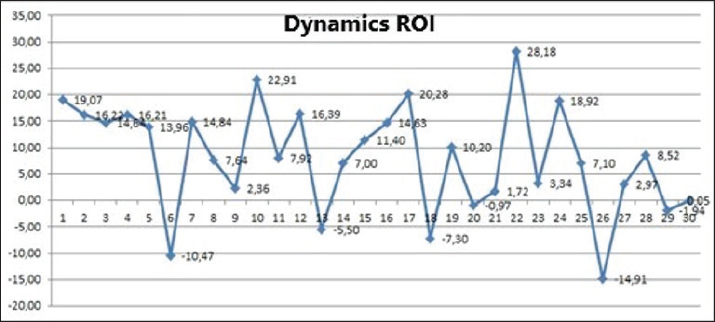
Fig. 1. Dynamics of performance index (PI) across 30 production cycles. Dynamics of profit–lossProfitability across the 30 production cycles showed significant volatility, with values ranging from Rp39,803,300 to Rp68,642,451. While the average profit remained positive, several cycles, notably cycles 6, 13, 18, and 26, recorded financial losses (Fig. 2). The highest profit was achieved in cycle 22 (Rp68,642,451), coinciding with strong production performance, indicating a direct relationship between biological efficiency and economic returns. Conversely, the largest loss occurred in cycle 26 (–Rp39,803,300), indicating substantial economic vulnerability during unfavorable production conditions. This fluctuation reflects the high-risk nature of broiler farming, where input costs—particularly feed—and market price variability heavily influence profitability (Kamruzzaman et al., 2021; Balogun et al., 2023). The results reinforce that even when the average profitability is positive, short-term financial instability remains a critical challenge for smallholder producers. In addition, the irregular profit pattern indicates that economies of scale alone do not guarantee consistent returns, especially when technical inefficiencies and external constraints are present (Balogun et al., 2023). Dynamics of ROIThe ROI values varied considerably, ranging from 14.91% to 28.18%, reflecting fluctuating investment efficiency throughout the production cycles. Positive ROI values dominated the dataset, indicating that the enterprise was generally profitable over time. However, several cycles (e.g., cycles 6, 13, 18, and 26) recorded negative ROI, corresponding with periods of financial loss (Fig. 3). The highest ROI (28.18%) occurred in cycle 22, aligning with peak profitability, while the lowest ROI (14.91%) was observed in cycle 26, confirming severe financial underperformance during that period. These findings demonstrate a strong association between ROI and both production efficiency and cost management. The variability in ROI highlights the sensitivity of investment returns to fluctuations in production performance, feed costs, and market conditions. Similar patterns have been reported in smallholder broiler systems, where the ROI is strongly influenced by input–output price dynamics and technical efficiency (Phiri et al., 2023; Petisme and Ampode, 2026). Integrated interpretation of production and economic dynamicsCollectively, the dynamic patterns of PI, profit–loss, and ROI indicate that while the broiler production system is generally viable and profitable, it is characterized by high temporal variability. Periods of high production efficiency tend to coincide with strong financial returns, whereas declines in biological performance are closely associated with economic losses. The results further support the emerging literature that emphasizes the need for longitudinal analysis in understanding farm performance, as cross-sectional data may fail to capture the true variability and potential explanation of small-scale broiler systems (Quintana-Ospina et al., 2023; Adaszyńska-Skwirzyńska et al., 2025). Overall, the longitudinal approach adopted in this study provides a comprehensive understanding of how production efficiency and economic performance evolve, highlighting both opportunities for optimization and inherent risks within smallholder broiler farming systems.
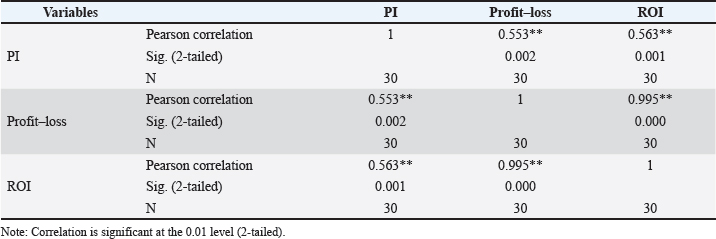
Fig. 2. Dynamics of profit–loss across 30 production cycles. Correlation analysis between PI, profit–loss, and ROITo further examine the relationship between biological performance and economic outcomes, a Pearson correlation analysis was conducted between the performance index (PI), profit–loss, and ROI. The results are presented in Table 3. Relationship between the PI and economic indicatorsThe results demonstrate a moderate positive correlation between the performance index and profit–loss (r=0.553, p < 0.01) and between the performance index and ROI (r=0.563, p < 0.01). These findings indicate that improvements in biological performance, reflected in better feed conversion, growth rate, and survivability, are associated with increased financial returns. This relationship is consistent with previous studies emphasizing that technical efficiency is a key factor associated with profitability in broiler production systems (Szőllősi et al., 2021; Phiri et al., 2023). Higher production efficiency typically reduces feed costs per unit of output and improves marketable weight, thereby enhancing economic performance (Zampiga et al., 2021). However, the strength of the correlation remains moderate, suggesting that factors beyond biological performance, such as feed price volatility, chick quality, and market fluctuations, also significantly influence profitability (Kamruzzaman et al., 2021; Balogun et al., 2023). Relationship between Profit–Loss and ROIA strong positive correlation was observed between profit–loss and ROI (r=0.995, p < 0.01), indicating an almost perfect linear relationship between these two variables. This result is expected, as ROI is directly derived from profit relative to investment costs. The near-perfect correlation confirms that changes in investment efficiency closely mirror variations in profitability. Similar findings have been reported in broiler enterprise analyses, where ROI serves as a reliable indicator of financial performance and business viability (Gharib et al., 2023; Petisme and Ampode, 2026).
Fig. 3. Dynamics of ROI across 30 production cycles. Table 3. Pearson correlation analysis between performance index, profit–loss ratio, and ROI.
Implications of the correlation patternsOverall, the correlation analysis highlights the following:
These findings reinforce the importance of integrated management strategies that simultaneously optimize production efficiency and cost control. Furthermore, they support the growing emphasis in the literature on combining biological and economic indicators for comprehensive evaluation of broiler farming performance, particularly in smallholder systems operating under variable environmental and economic conditions (Quintana-Ospina et al., 2023; Adaszyńska-Skwirzyńska et al., 2025). DiscussionProduction performance in small-scale tropical broiler systemsThe average FCR of 1.75 reflects efficient feed utilization; however, it remains above the optimal benchmark reported in commercial systems (1.51–1.62). This gap is consistent with previous findings indicating that broiler production under tropical small-scale conditions is often constrained by environmental stressors and managerial limitations (Quintana-Ospina et al., 2023; Anggriawan et al., 2024b; Adaszyńska-Skwirzyńska et al., 2025; Febrianto et al., 2026). In particular, heat stress may contribute to reduced biological efficiency in tropical production systems, although environmental variables that reduce feed intake efficiency and alter metabolic processes, ultimately leading to increased FCR values, were not directly measured in this study (Kassim et al., 2023; Oke et al., 2024). Moreover, nutritional inconsistencies and suboptimal feed formulation further exacerbate inefficiencies in feed conversion (Dersjant-Li et al., 2015; Cowieson et al., 2016; Carvalho et al., 2018; Anggriawan et al., 2026). In addition, the integration of alternative nutritional strategies, including probiotics and phytobiotics, has been widely reported to enhance feed efficiency and gut health, thereby alleviating some of these production constraints (Ramlucken et al., 2020; Bhogoju and Nahashon, 2022; Anggriawan et al., 2024a; Chung, 2025). These beneficial effects are primarily associated with improved intestinal microbiota balance and nutrient use (Al-Fataftah and Abdelqader, 2014; Abudabos et al., 2019). However, the effectiveness of such interventions remains highly dependent on farm-level management practices and environmental conditions, which are often heterogeneous in smallholder systems. The depletion rate observed in this study (6.47%) exceeded the recommended threshold of 5%, indicating suboptimal health management and environmental control. This finding aligns with previous studies demonstrating that mortality rates in small-scale broiler systems are often elevated due to inadequate biosecurity, limited veterinary interventions, and disease exposure (Phiri et al., 2023; Mdletshe and Obi, 2023; Pramuwidyatama et al., 2023; Anggriawan et al., 2024c). Furthermore, previous studies have reported that environmental variability, particularly fluctuations in temperature and humidity, may increase mortality risk in open-house broiler systems in tropical regions (Quintana-Ospina et al., 2023; Oke et al., 2024). However, this study did not directly measure environmental parameters such as temperature, relative humidity, temperature humidity index (THI), or seasonal variation. Therefore, climatic influences should be interpreted cautiously as potential contributing factors rather than directly verified determinants (Quintana-Ospina et al., 2023; Oke et al., 2024). Environmental management factors, including drinking water quality, microbial contamination, and waterline sanitation, may also contribute to reduced biological efficiency and elevated mortality in tropical open-house broiler systems. Water quality management and biofilm control are critical components for maintaining flock health, feed efficiency, and production stability under tropical conditions (El-Sabrout et al., 2026). Despite these limitations, the ABW (2.27 kg) and harvest age (~40 days) fall within acceptable commercial standards, indicating that growth performance remains resilient. This supports the notion that modern broiler genotypes possess strong genetic potential for growth, even under suboptimal environmental conditions (Avendaño et al., 2017; Neeteson et al., 2023; Adaszyńska-Skwirzyńska et al., 2025; Nassar, 2026). Nevertheless, environmental and managerial factors, including housing systems, nutrition, and disease control, strongly modulate the expression of this genetic potential (Leinonen and Kyriazakis, 2016; Atallah et al., 2021). Overall, these findings suggest that targeted improvements in environmental management, biosecurity, and nutritional strategies are essential to achieve optimal production efficiency in tropical small-scale systems, particularly in addressing environmental constraints such as heat stress and water availability limitations (El Sabry et al., 2023; Oke et al., 2024;). Economic performance and profitability dynamicsThe economic analysis indicates that broiler farming remains a viable enterprise, with an average profit exceeding Rp19 million per production cycle and a positive mean ROI of 8.18%. This is consistent with previous studies highlighting broiler production as a key income-generating activity in developing countries (Kamruzzaman et al., 2021; Gharib et al., 2023; Aroh et al., 2024). However, the substantial variability in profit and ROI across production cycles underscores the economic vulnerability of small-scale broiler systems. Feed cost remains the dominant component of production expenses, often accounting for more than half of total costs. Therefore, it is a critical component of profitability (Kamruzzaman et al., 2021; Balogun et al., 2023; Phiri et al., 2023). Fluctuations in feed prices, coupled with feed use inefficiencies, can significantly erode profit margins. In addition, input price volatility, particularly for DOC and feed ingredients, combined with unstable market prices for live birds, further contributes to financial uncertainty (Gharib et al., 2023; Aroh et al., 2024). Disease outbreaks and climate-related stress events negatively impact economic performance (Akunzule et al., 2009; Basuno et al., 2010; Oke et al., 2024; Petisme and Ampode, 2026). The occurrence of negative ROI values in several cycles highlights the inherent risk associated with broiler farming. This finding corroborates econometric analyses showing that profitability is determined not only by production scale but also by technical efficiency and risk management capacity (Balogun et al., 2023; Mdletshe and Obi, 2023). Therefore, improving economic potential requires not only cost control but also strategic adaptation to market and environmental uncertainties. Dynamics of PI, profit–loss, and ROIThis study’s longitudinal nature provides important insights into the dynamic behavior of broiler production systems. The observed fluctuations in PI indicate that production efficiency is not static but evolves in response to changing environmental conditions, management practices, and flock health status. This finding is consistent with those of longitudinal studies emphasizing the importance of temporal analysis in capturing the complexity of broiler production systems (Szőllősi et al., 2021; Adaszyńska-Skwirzyńska et al., 2025). Unlike cross-sectional studies, longitudinal data allow for the identification of patterns, such as performance improvement, through which farmers gradually refine their management practices (Phiri et al., 2023). The presence of performance peaks indicates successful adaptation during certain production cycles, whereas declines indicate exposure to external stressors. These temporal dynamics may indicate possible adjustments in farm management practices across production cycles. However, these interpretations should be considered exploratory rather than conclusive because adaptive management variables were not directly quantified in this study. Similarly, the variability in profit and ROI reflects the unstable nature of small-scale broiler enterprises. While higher PI values are generally associated with improved profitability, the relationship is not perfectly consistent due to the influence of external factors, such as feed price fluctuations and climatic stress (Quintana-Ospina et al., 2023; Wongtangtintharn et al., 2025). These findings support the growing emphasis on potential explanation-based production systems, where flexibility, adaptability, and risk mitigation are critical for sustaining long-term performance (Franzo et al., 2023; Castro et al., 2023; Bist et al., 2024). Relationship between production performance and economic outcomesThe correlation analysis further elucidates the relationship between biological and economic performance. The moderate positive correlation between the performance index and both profit (r=0.553) and ROI (r=0.563) confirms that production efficiency improvements contribute to enhanced economic outcomes. This is in line with previous studies identifying feed efficiency and overall technical performance as key drivers of profitability in broiler production (Zampiga et al., 2021; Szőllősi et al., 2021; Luo et al., 2025). However, the moderate strength of these correlations indicates that biological efficiency alone cannot fully explain economic variability. External associates, including input costs, market dynamics, and environmental conditions, play a substantial role in shaping financial outcomes (Kamruzzaman et al., 2021; Balogun et al., 2023; Gharib et al., 2023). A strong correlation between profit and ROI (r=0.995) is expected due to their direct mathematical relationship. This confirms that ROI is a robust indicator of financial performance and can be reliably used to assess investment efficiency in broiler farming systems (Mdletshe and Obi, 2023; Petisme and Ampode, 2026). Overall, the findings highlight the multifactorial nature of profitability in broiler production, emphasizing the need for integrated evaluation frameworks that combine biological performance indicators with economic and risk-related variables. Such an approach is essential for developing sustainable and resilient broiler production systems in smallholder tropical contexts. Study limitationsThis study has several limitations that should be acknowledged. First, the dataset originated from a single independent broiler farm, which limits the generalizability of the findings to broader tropical broiler production systems. Second, environmental variables such as temperature, humidity, and seasonal indicators were not directly measured during the study period. Third, although longitudinal observations were available, the study primarily employed exploratory descriptive and correlational analyses rather than advanced modeling approaches. Future multi-farm studies incorporating environmental monitoring and more robust longitudinal statistical frameworks are recommended. ConclusionThis longitudinal case study demonstrates that small-scale broiler farming under tropical open-house conditions remains economically feasible but exhibits considerable biological and financial variability across production cycles. Although FCR and body weight were generally within acceptable commercial ranges, elevated depletion rates and fluctuating profitability indicate persistent management and environmental challenges. The moderate association between production efficiency and economic performance further suggests that profitability is influenced not only by technical factors but also by external market and environmental conditions. The findings highlight the importance of integrated management strategies focusing on feed efficiency, biosecurity, housing management, and risk mitigation to improve production stability and economic resilience. However, because the study was based on a single independent farm, the results should be interpreted cautiously and require validation through broader multi-farm longitudinal studies under diverse tropical production conditions. AcknowledgmentsThe author would like to express his gratitude to all parties who have provided support and assistance during this research, whether in the form of facilities, manpower, or scientific input. This research was conducted independently without research grants from any funding agency. FundingThis study did not receive funding from any external parties. The authors covered all research costs and publication fees (Article Processing Charge/APC). Authors' contributionsDjoko Seojono: Conceptualization, supervision, project administration, and critical revision of the manuscript. Soetriono Soetriono: Methodology development, validation, and formal analysis. Dimas Bastara Zahrosa: Data curation, software, and visualization. Ariq Dewi Maharani: Investigation, data collection, and resources. Amam Amam: Writing – review and editing, supervision, and validation. Rico Anggriawan: Conceptualization, methodology, writing – original draft preparation, formal analysis, and corresponding author responsibilities. All authors have read and approved the final version of the manuscript. Conflicts of interestThe authors declare no conflicts of interest. Data availabilityAll data were provided in the manuscript. ReferencesAbbas, G., Arshad, M. and Imran, M., et al. 2024. Consumer preferences and market trends: customizing poultry products for customer-based poultry markets. Pak. J. Sci. 76, 396–415. Abbasi, I.A., Shamim, A. and Ashari, H. 2024. Factors influencing consumers’ purchase behavior toward indigenous chicken: insights from a cognitive affect behavior model. Br. Food J. 124, 1–21; doi: 10.1108/BFJ-06-2024-0575 Abdurofi, I., Ismail, M. M., Kamal, H. A. and Gabdo, B. H. 2017. Economic analysis of broiler production in Peninsular Malaysia. Int. Food Research J. 24(2), 761–766. Abudabos, A.M., Ali, M.H., Nassan, M.A., and Saleh, A.A. 2019. Ameliorative effect of Bacillus subtilis on growth performance and intestinal architecture in broiler infected with Salmonella. Animals 9, 190; doi: 10.3390/ani9040190 Adaszyńska-Skwirzyńska, M., Konieczka, P., Bucław, M., Majewska, D., Pietruszka, A., Zych, S. and Szczerbińska, D. 2025. Analysis of the production and economic indicators of broiler chicken rearing in 2020–2023: acase study of a Polish farm. Agriculture 15(2), 139; doi: 10.3390/ agriculture15020139 Adeyonu, A.G. and Odozi, J.C. 2022. Drivers of profitability of broiler farms in Nigeria. SAGE Open 12(1), 1–13; doi: 10.1177/21582440211071076 Akunzule, A.N., Koney, E.B.M., and Tiongco, M. 2009. Economic impact assessment of highly pathogenic avian influenza on the poultry industry in Ghana. World’s Poult. Sci. J. 65(3), 517–528; doi: 10.1017/S0043933909000385 Al-Fataftah, A.R. and Abdelqader, A. 2014. Effects of dietary Bacillus subtilis on heat-stressed broilers performance. Anim. Feed Sci. Technol. 198, 279–285; doi: 10.1016/j.anifeedsci.2014.10.012 Ali, M.S., and Hossain, M.M. 2010. Factors influencing broiler production performance in Bangladesh. World’s Poult. Sci. J. 66, 123–131. Amam, A., Fanani, Z., Hartono, B. and Nugroho, B.A. 2019a. Broiler livestock business based on partnership cooperation in Indonesia: the assessment of opportunities and business developments. Int. J. Entrep. 23(1 Special Issue), 1–11. Amam, A., Fanani, Z., Hartono, B. and Nugroho, B.A. 2019b. Idenfication of resources in the system broiler farming business. J. Ilmu Ternak Vet. 24(3), 135–142; doi: 10.14334/jitv.v24i3.1927 Amam, A., Fanani, Z., Hartono, B. and Nugroho, B.A. 2019c. The power of resources in independent livestock farming business in Malang District, Indonesia. In The Ist Animal Science and Food Technology Conference, Allied Business Academies, 372(1), 1–9; doi: 1088/1755-1315/372/1/012055 Anggriawan, R., Candra, D.A., Lestari, N.A., Amam, A., Prastiya, R.A. and Akmal, Y. 2026. Ideal protein concept in broiler chicken nutrition: advances in amino acid profiling and sustainable feed formulation. Lett. Anim. Biol. 6(1), 67–75; doi: 10.62310/liab.v6i1.329 Anggriawan, R., Lokapirnasari, W.P., Hidanah, S., Al-Arif, M.A., and Candra, D.A. 2024a. Performance of broiler chickens in open house cages with additional probiotic nutrition. Adv. Anim. Vet. Sci. 12(9), 1630–1639; doi: 10.17582/journal.aavs/2024/12.9.1630.1639 Anggriawan, R., Lokapirnasari, W. P., Hidanah, S., Al Arif, M.A. and Candra, D.A. 2024b. The role of probiotics as alternatives to antibiotic growth promoters in enhancing poultry performance. J. Anim. Health Prod. 12, 610–620; doi: 10.17582/journal.jahp/2024/12..4.610.620 Anggriawan, R., Lokapirnasari, W.P., Hidanah, S., Al Arif, M.A. and Candra, D.A. 2024c. Residue detection of tylosin antibiotics and enrofloxacin in broiler chickens. Adv. Anim. Vet. Sci. 12, 2195–2204; doi: 10.17582/journal. aavs/2024/12.11.2195.2204 Aroh, I.M., Agboje, A.C., Ogbonna, G.N., Anyanka, S.O., Macartan, B.P., Ohanehi, H.A. and Anigbogu, N.M. 2024. Sustainable poultry farming in developing nations: exploring cassava waste utilization for enhanced poultry production and economic viability. Anim. Res. One Health 2(3), 308–313; doi: 10.1002/aro2.50 Arsène , M.M.J., Davares, A.K.L. and Viktorovna, P.I., et al. 2022. Antibiotic residues in food and feed: causes and consequences. Vet. World 15(3), 662–671; doi: 10.14202/vetworld.2022.662-671 Atallah, S.T., El-Ktany, E.M., and Ragab, E.M. 2021. Evaluation of the economic impact of strain, housing systems and season on commercial broiler performance and profitability under Egyptian condition. Alex. J. Vet. Sci. 69(2), 39–48; doi: 10.5455/ajvs.69235 Balogun, O.L., Olumide, M.D., Ayantoye, K., Bolarinwa, A.M., and Agboola, T.O. 2023. Econometric analysis of profit efficiency of broiler farms in Ondo state, Nigeria. J. Indo. Trop. Anim. Agri., 48(3), 232–240; doi: 10.14710/jitaa.48.x.232-240 Basuno, E., Yusdja, Y., and Ilham, N. 2010. Socio-economic impacts of avian influenza outbreaks on small-scale producers in Indonesia. Transbound. Emerg. Dis., 57(1–2), 7–10; doi: 10.1111/j.1865-1682.2010.01121.x Bhogoju, S., and Nahashon, S.N. 2022. Advances in probiotic application in poultry nutrition. Agriculture 12(2), 304; doi: 10.3390/agriculture12020304 Bist, R.B., Bist, K., and Poudel, S. 2024. Sustainable poultry farming practices: acritical review. Poult. Sci. 103, 1–28; doi: 10.1016/j.psj.2024.104295 Bouma, A., Claassen, I., Natih, K., et al. 2009. Transmission parameters of H5N1 avian influenza in chickens. PLoS Pathogens 5(1), e1000281; doi: 10.1371/journal.ppat.1000281 Carvalho, L., Limão, V., Fagundes, N. S., and Fernandes, E. 2018. Trace mineral excretion in broilers fed organic minerals. Ciênc. Anim. Bras. 19, 1–8; doi: 10.1590/1809-6891v19e-33086 Castro, F.L.S., Chai, L., Arango, J., et al. 2023. Poultry industry paradigms and future challenges. J. Appl. Poult. Res. 32, 1–17; doi: 10.1016/j.japr.2022.100310 Chowdhury, M.A.H., Ashrafudoulla, M., Mevo, S.I.U., et al. 2023. Poultry health and food security interventions: a review. Compr. Rev. Food Sci. Food Saf. 22, 1555–1596; doi: 10.1111/1541-4337.13121 Chung, E.L.T. 2025. A brief review on phytobiotics for enhancing broiler health and sustainability in tropical production systems. In BIO Web of Conferences. EDP Sciences, Prancis. Cowieson, A.J., Ruckebusch, J.P., Knap, I., et al. 2016. Phytate-free nutrition in monogastric animals. Anim. Feed Sci. Technol. 222, 189; doi: 10.1016/j.anifeedsci.2016.10.016 Delabouglise, A., and Boni, M.F. 2020. Game theory of livestock disease management. Epidemics, 30, 100370. https://doi.org/10.1016/j.epidem.2019.100370 Dersjant-Li, Y., Awati, A., Schulze, H., and Partridge, G. 2015. Phytase in non-ruminant nutrition. J. Sci. Food Agric. 95(5), 878–896. El-Sabrout, K., Buonaiuto, G., Cavallini, D., and Mishra, B. 2026. Recent advancements to improve drinking water quality in poultry farms. Poult. Sci. 105, 106523. https://doi.org/10.1016/j.psj.2026.106523 El Sabry, M.I., Romeih, Z.U., and Stino, F.K.R. 2023. Water scarcity as a limitation in poultry production. Trop. Anim. Health Prod. 55, 215. Fancher, C.A., Zhang, L., Kiess, A.S., et al. 2020. Pathogenic bacteria challenges in antibiotic-free broiler production. Microorganisms 8(10), 1–27. Febrianto, N., Hidayati, N.N., Helmi, M., Akhiroh, P., Winarto, P.S., and Hartono, B. 2026. Comparative analysis of production performance and economic efficiency between open and closed house broiler systems under a partnership model in Malang Regency, Indonesia. In BIO Web of Conferences, EDP Sciences, Prancis, 218, 04010. https://doi.org/10.1051/bioconf/202621804010 Franzo, G., Legnardi, M., Faustini, G., Tucciarone, C.M., and Cecchinato, M. 2023. When everything becomes bigger: big data for big poultry production. Animals 13(11), 1804. https://doi.org/10.3390/ani13111804 Gharib, H.B., et al. 2023. Transformation and management in Egyptian family poultry production. Trop. Anim. Sci. J. 46(2), 261–268. https://doi.org/10.5398/tasj.2023.46.2.261 Gillespie, J., Nehring, R., and Hallahan, C. 2017. Broiler housing technology and profitability. J. Appl. Poult. Res. 26(1), 72–83. Gittinger , J.P. 1982. Economic analysis of agricultural projects (2nd ed.). North Charles Street, Baltimore: Johns Hopkins University Press. Henchion, M., Moloney, A.P., Hyland, J., et al. 2021. Future trends in animal protein consumption. Animal 15, 100287. Islam, M.A. 2004. Comparison between sex-linked dwarf and normal broiler breeder hens for fertility, hatchability and growth performances at hot-humid climate. Prog. Agric. 15(2), 61–66. Jainonthee, C., Sivapirunthep, P., Pirompud, P., Punyapornwithaya, V., Srisawang, S., and Chaosap, C. 2025. Modeling and forecasting dead-on-arrival in broilers using time series methods: a case study from Thailand. Animals 15(8), 1179. https://doi.org/10.3390/ani15081179 Kamruzzaman, M., Islam, S., and Rana, M.J. 2021. Financial and factor demand analysis of broiler production in Bangladesh. Heliyon 7(6), e07152. https://doi.org/10.1016/j.heliyon.2021.e07152 Kassim, N.A., Chung, E.L.T., Alghirani, M.M., et al. 2023. Effects of tropical feed supplementation on broiler health and performance. S. Afr. J Anim. Sci. 53(5), 667–677. Kleyn, F.J., and Ciacciariello, M. 2021. Future demands of the poultry industry. World’s Poult. Sci. J.77, 267–278. Korver D.R. 2023. Review: current challenges in poultry nutrition, health, and welfare. Animal 17 Suppl. 2, 100755. https://doi.org/10.1016/j.animal.2023.100755 Leinonen, I., and Kyriazakis, I. 2016. How can we improve the environmental sustainability of poultry production? Proc. Nutr. Soc. 75(3), 265–273. https://doi.org/10.1017/S0029665116000094 Luo, N., Liu, P., Wei, L., Wen, J., Zhao, G., and An, B. 2025. Identifying new loci and genes associated with feed efficiency in broilers. Int. J. Mol. Sci. 26(17), 8492. https://doi.org/10.3390/ijms26178492 Mdletshe, S.T.C., and Obi, A. 2023. Investigating the profitability of government-funded small-scale broiler projects in northern KwaZulu-Natal, South Africa. Agriculture 13(12), 2269. https://doi.org/10.3390/agriculture13122269 Mottet, A., and Tempio, G. 2017. Global poultry production outlook. World’s Poult. Sci. J. 73(2), 245–256. Nassar, F.S. 2026. Strategic role of poultry production sciences in shaping the future of global food security and strengthen sustainability. Poult. Sci. 105, 106617. https://doi.org/10.1016/j.psj.2026.106617 Neeteson, A. M., Avendaño, S., Koerhuis, A., et al. 2023. Advances in broiler breeding. Animals, 13, 3150. Neuman, W.L. 2014. Social research methods: qualitative and quantitative approaches. 7th ed., London, UK: Inggris, Pearson Education Limited. Oke, O.E., Akosile, O.A., Uyanga, V.A., Oke, F.O., Oni, A.I., Tona, K., and Onagbesan, O.M. 2024. Climate change and broiler production. Vet. Med. Sci. 10(3), e1416. https://doi.org/10.1002/vms3.1416 Petisme, A.G., and Ampode, K.M.B. 2026. Dietary L-tryptophan supplementation improves growth performance, economic traits, and thermoregulation in broiler chickens under heat stress conditions. Adv. Anim. Vet. Sci. 14(2), 228–237. https://dx.doi.org/10.17582/journal.aavs/2026/14.2.228.237 Phiri, P.T., Ruzhani, F., Madzokere, F., and Madududu, P. 2023. Factors affecting the profitability of smallholder broiler production in Mutare district, Manicaland Province, Zimbabwe: a quantile regression approach. Cogent Econ. Finance, 11(2), 2242660. https://doi.org/10.1080/23322039.2023.2242660 Pramuwidyatama, M.G., Indrawan, D., Boeters, M., Poetri, O.N., Saatkamp, H.W. and Hogeveen, H. 2023. Economic impact of highly pathogenic avian influenza outbreaks in Western Java smallholder broiler farms. Prevent. Vet. Med. 212, 105833. https://doi.org/10.1016/j.prevetmed.2022.105833 Quintana-Ospina, G.A., Alfaro-Wisaquillo, M.C., Oviedo-Rondon, E.O., Ruiz-Ramirez, J.R., Bernal-Arango, L.C., and Martinez-Bernal, G.D. 2023. Effect of environmental and farm-associated factors on live performance parameters of broilers raised under commercial tropical conditions. Animals 13(21), 3312. https://doi.org/10.3390/ani13213312 Ramlucken, U., Lalloo, R., Roets, Y., Moonsamy, G., van Rensburg, C.J. and Thantsha, M.S. 2020. Advantages of Bacillus-based probiotics in poultry production. Livestock Sci. 241, 104215. Szőllősi, L., Béres, E., and Szűcs, I. 2021. Effects of modern technology on broiler chicken performance and economic indicators – a Hungarian case study. Ital. J. Anim. Sci. 20(1), 188–194. https://doi.org/10.1080/1828051X.2021.1877575 Wongtangtintharn, S., Chakkhambang, S., Pootthachaya, P., Cherdthong, A., and Wanapat, M. 2025. Challenges and constraints to the sustainability of poultry farming in Thailand. Anim. Biosci. 38(4), 845–862. https://doi.org/10.5713/ab.24.0685 Zampiga, M., Calini, F., and Sirri, F. 2021. Importance of feed efficiency for sustainable intensification of chicken meat production. World's Poult. Sci. J. 77(3), 639–659; doi: 10.1080/00439339.2021.1959277 | ||










| How to Cite this Article |
| Pubmed Style Seojono D, Soetriono S, Zahrosa DB, Maharani AD, Amam A, Anggriawan R. Production and profitability dynamics in small-scale broiler farming: Evidence from 30 production cycles in a tropical system. Open Vet. J.. 2026; 16(8): 5782-5793. doi:10.5455/OVJ.2026.v16.i8.66 Web Style Seojono D, Soetriono S, Zahrosa DB, Maharani AD, Amam A, Anggriawan R. Production and profitability dynamics in small-scale broiler farming: Evidence from 30 production cycles in a tropical system. https://www.openveterinaryjournal.com/?mno=317937 [Access: September 04, 2026]. doi:10.5455/OVJ.2026.v16.i8.66 AMA (American Medical Association) Style Seojono D, Soetriono S, Zahrosa DB, Maharani AD, Amam A, Anggriawan R. Production and profitability dynamics in small-scale broiler farming: Evidence from 30 production cycles in a tropical system. Open Vet. J.. 2026; 16(8): 5782-5793. doi:10.5455/OVJ.2026.v16.i8.66 Vancouver/ICMJE Style Seojono D, Soetriono S, Zahrosa DB, Maharani AD, Amam A, Anggriawan R. Production and profitability dynamics in small-scale broiler farming: Evidence from 30 production cycles in a tropical system. Open Vet. J.. (2026), [cited September 04, 2026]; 16(8): 5782-5793. doi:10.5455/OVJ.2026.v16.i8.66 Harvard Style Seojono, D., Soetriono, . S., Zahrosa, . D. B., Maharani, . A. D., Amam, . A. & Anggriawan, . R. (2026) Production and profitability dynamics in small-scale broiler farming: Evidence from 30 production cycles in a tropical system. Open Vet. J., 16 (8), 5782-5793. doi:10.5455/OVJ.2026.v16.i8.66 Turabian Style Seojono, Djoko, Soetriono Soetriono, Dimas Bastara Zahrosa, Ariq Dewi Maharani, Amam Amam, and Rico Anggriawan. 2026. Production and profitability dynamics in small-scale broiler farming: Evidence from 30 production cycles in a tropical system. Open Veterinary Journal, 16 (8), 5782-5793. doi:10.5455/OVJ.2026.v16.i8.66 Chicago Style Seojono, Djoko, Soetriono Soetriono, Dimas Bastara Zahrosa, Ariq Dewi Maharani, Amam Amam, and Rico Anggriawan. "Production and profitability dynamics in small-scale broiler farming: Evidence from 30 production cycles in a tropical system." Open Veterinary Journal 16 (2026), 5782-5793. doi:10.5455/OVJ.2026.v16.i8.66 MLA (The Modern Language Association) Style Seojono, Djoko, Soetriono Soetriono, Dimas Bastara Zahrosa, Ariq Dewi Maharani, Amam Amam, and Rico Anggriawan. "Production and profitability dynamics in small-scale broiler farming: Evidence from 30 production cycles in a tropical system." Open Veterinary Journal 16.8 (2026), 5782-5793. Print. doi:10.5455/OVJ.2026.v16.i8.66 APA (American Psychological Association) Style Seojono, D., Soetriono, . S., Zahrosa, . D. B., Maharani, . A. D., Amam, . A. & Anggriawan, . R. (2026) Production and profitability dynamics in small-scale broiler farming: Evidence from 30 production cycles in a tropical system. Open Veterinary Journal, 16 (8), 5782-5793. doi:10.5455/OVJ.2026.v16.i8.66 |


