




| Research Article | ||
Open Vet. J.. 2026; 16(8): 5794-5801 !
Open Veterinary Journal, (2026), Vol. 16(8): 5794–5801 Research Article Hematological profile of male sheep raised on Rote Island during the rainy and dry seasonsYustinus Oswin Primajuni Wuhan1*, Michael Julian Usfunan2, Yohanes Timbun Raja Mangihut Ronael Simarmata1, Jayusman Arsiyanti Joesoef1, Yeremia Yobelanno Sitompul1, Maria Laurenci Fanny Permata Kale1 and I Putu Cahyadi Putra31Department of Clinic, Reproduction, Pathology and Nutrition, Faculty of Medicine and Veterinary Medicine, Universitas Nusa Cendana, East Nusa Tenggara, Indonesia 2Veterinary Medicine, Faculty of Medicine and Veterinary Medicine, Universitas Nusa Cendana, East Nusa Tenggara, Indonesia 3Laboratory of Veterinary Parasitology, Faculty of Veterinary Medicine, Udayana University, Denpasar, Indonesia *Corresponding Author: Yustinus Oswin Primajuni Wuhan. Department of Clinic, Reproduction, Pathology and Nutrition, Faculty of Medicine and Veterinary Medicine, Universitas Nusa Cendana, East Nusa Tenggara, Indonesia. Email: yustinus.wuhan [at] staf.undana.ac.id Submitted: 22/04/2026 Revised: 05/07/2026 Accepted: 22/07/2026 Published: 20/08/2026 © 2025 Open Veterinary Journal
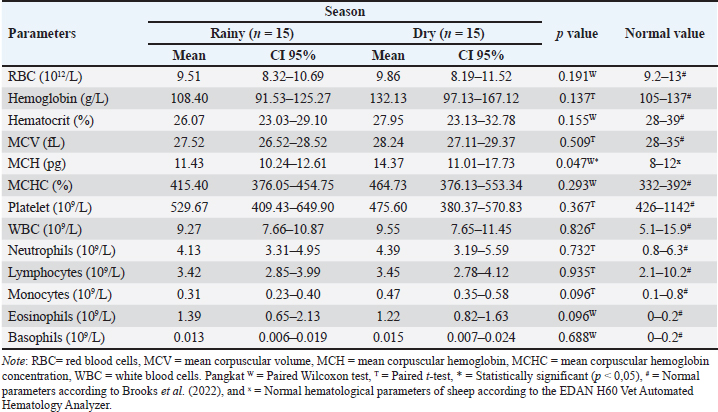
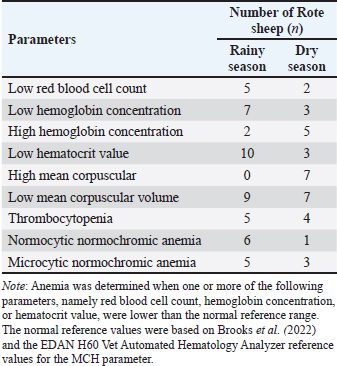
AbstractBackground: Seasonal changes in tropical dry regions, such as Rote Island, can affect livestock’s physiological condition, including hematological parameters that serve as important indicators of animal health. However, the hematological profile of Rote sheep raised in this area is still limited. Aim: To evaluate the hematological profile of male Rote sheep raised on Rote Island during the rainy and dry seasons. Methods: This study was conducted from June to November 2025 in Lekunik Village, Rote Ndao Regency, East Nusa Tenggara, Indonesia. A total of 15 clinically healthy male sheep (n=15) were used in a repeated-measures design, where blood samples were collected during both the rainy and dry seasons, resulting in a total of 30 samples. Approximately 2 mL of blood was collected from the jugular vein into ethylenediaminetetraacetic acid tubes. Hematological parameters, including erythrocyte counts, hemoglobin (Hb), hematocrit (HCT), erythrocyte indices, platelet count, total leukocytes, and differential leukocytes, were analyzed using an EDAN H60 Vet analyzer. Data were analyzed using the paired t-test or paired Wilcoxon test with a 95% confidence level. Results: Most hematological parameters did not differ significantly (p > 0.05) between seasons, except for the mean corpuscular hemoglobin (MCH), which was significantly higher during the dry season (p < 0.05). Higher anemia and hematological abnormalities were observed during the rainy season. Eosinophilia was the most dominant finding in both seasons, suggesting that chronic parasitic exposure may be associated with communal grazing systems and the absence of deworming programs. Conclusion: Overall, seasonal variation had limited effects on the hematological profile of male Rote sheep. These findings provide baseline hematological reference data for health evaluation and disease diagnosis in local Rote sheep. Keywords: Dry season, Eosinophilia, Hematology, Rainy season, Rote sheep. IntroductionSheep are small ruminant livestock species that play an important role in fulfilling the nutritional and animal protein needs of the Indonesian population (Rahmawati et al., 2025). In addition to cattle and poultry, sheep are an affordable source of protein with considerable economic value, particularly in areas with agroecosystem characteristics that support smallholder farming systems (Abrori et al., 2022). According to data from the Central Bureau of Statistics of East Nusa Tenggara Province in 2024, the sheep population in Rote Ndao Regency has reached 12,710 heads, indicating that this area has significant potential for supporting local food security and improving community livelihoods. Furthermore, the local Rote sheep has received national recognition as an Indonesian genetic resource. Based on Decree of the Minister of Agriculture Number 642/Kpts./HK.150/M/08/2025 dated August 5, 2025, Rote sheep were officially designated as a national livestock breed (OnlineNTT, 2025). This designation highlights the unique characteristics and importance of Rote sheep as a local livestock germplasm resource that should be preserved and further developed. Despite their considerable potential, environmental challenges, particularly seasonal changes, strongly influence the productivity and health of sheep on Rote Island. The transition between the rainy and dry seasons may affect sheep’s physiological conditions, stress levels, and disease susceptibility (Pratama and Ali, 2023). The prolonged dry season exposes animals to not only high environmental temperatures but also limited feed and water availability. The reduced availability of high-quality forage during this period may decrease nutrient intake and negatively affect the animals’ physiological condition (Pratama and Ali, 2023). High temperatures and nutritional limitations may increase the risk of heat stress in sheep (Al-Dawood, 2017). Heat stress is one of the major stress factors affecting ruminants in tropical regions and may result in reduced growth performance, reproductive disorders, impaired immune function, and alterations in blood components and metabolic processes (Abdelnour et al., 2019). Seasonal changes may also increase the incidence of infectious diseases in sheep. Ecthyma contagiosum (ORF) is one of the diseases commonly observed during the rainy season, whose prevalence tends to increase during this period (Spyrou and Valiakos, 2015). Gastrointestinal parasitic infections are more frequently observed during the rainy season because humid environmental conditions favor parasite development (Dewi and Supriyanto, 2020). Physiological and pathological disturbances caused by seasonal variation can be reflected through hematological profile changes (Turini et al., 2025). Hematological parameters are important indicators widely used to evaluate animal health status and assist in disease diagnosis. A comprehensive hematological evaluation generally includes erythrocyte, leukocyte, and platelet profiles, which provide important information regarding oxygen transport capacity, immune status, inflammatory responses, and hemostatic conditions in animals (Korelidou et al., 2026). Erythrocyte parameters, including red blood cell count (RBC), hemoglobin concentration (Hb), hematocrit value (HCT), mean corpuscular volume (MCV), mean corpuscular hemoglobin (MCH), and mean corpuscular Hb concentration (MCHC), are commonly used to assess erythropoietic activity and identify potential abnormalities, such as anemia (Brooks et al., 2022). Leukocyte parameters, including the total white blood cell (WBC) count and differential leukocyte counts (neutrophils, lymphocytes, monocytes, eosinophils, and basophils), provide insights into immune responses and inflammatory conditions. Platelet evaluation is essential for assessing blood coagulation capacity and overall health. Therefore, comprehensive hematological profiling can provide valuable baseline information for evaluating the physiological adaptations and health status of livestock exposed to environmental changes (Brooks et al., 2022; Korelidou et al., 2026). However, the hematological profile of sheep raised on Rote Island remains very limited. Consequently, the interpretation of health status and disease diagnosis in local sheep still relies on reference values derived from sheep raised under different environmental conditions. Therefore, this study was conducted to provide baseline hematological data for Rote Island sheep, which may serve as a reference for health evaluation and disease diagnosis in local sheep populations. Materials and MethodsStudy area and study periodThis study was conducted in Lekunik Village, Lobalain District, Rote Ndao Regency, East Nusa Tenggara, Indonesia (coordinates -10.7566, 123.0634). Blood samples were collected twice from the same sheep, once during the peak rainy season (June 2025) and once during the peak dry season (November 2025), with an interval of approximately five months between samplings. Experimental animals and study designThis study employed a repeated-measures design, in which repeated blood samples were collected from the same individuals during the rainy (June) and dry (November) seasons. This study used 15 Rote sheep raised by smallholder farmers in Lekunik Village, Lobalain Subdistrict, Rote Ndao Regency, East Nusa Tenggara. Sheep were selected by purposive sampling from a population of approximately 100 sheep raised at the study site. The purposive method was used to identify individuals who met the established inclusion criteria and could represent sheep-rearing conditions on Rote Island. The established inclusion criteria were as follows: (1) male Rote sheep aged 1–2 years; (2) sheep available for repeated sampling throughout the study period; (3) clinically healthy sheep based on physical examination, characterized by good coat condition, no diarrhea, no signs of respiratory distress, and active behavior without signs of lethargy; (4) a body condition score of 3 (on a scale of 1–5); (5) a body weight of 40–60 kg; and (6) the farmer’s permission to use the sheep in the study. None of the sheep used in this study received deworming treatment. Sheep were raised using a semi-intensive system, in which animals were grazed communally on pastures in the morning and then brought into pens in the afternoon. This system reflects the sheep-raising practices of smallholder farmers on Rote Island. Blood sample collectionBlood samples were collected from male sheep raised on Rote Island during the rainy and dry seasons. Fifteen sheep were sampled repeatedly in two different seasons, resulting in 30 blood samples. Blood sampling was conducted in the morning before the animals were released into the grazing field. Approximately ±2 mL of blood was collected from the jugular vein using sterile needles and vacutainers. The blood samples were then transferred into vacutainer tubes containing EDTA as an anticoagulant (Rosita et al., 2019). Hematological analysisHematological examination was performed using an automated hematology analyzer (EDAN H60 Vet, EDAN Instruments, Inc., China) (https://www.edan.com/). The parameters measured included RBC, Hb, HCT, MCV, MCH, and MCHC, platelet count, WBC, and differential leukocyte count (neutrophils, lymphocytes, monocytes, eosinophils, and basophils). Blood samples were gently homogenized before analysis to ensure accuracy. Data analysisDifferences in complete blood examination results between the rainy and dry seasons were analyzed using paired t-test or paired Wilcoxon test with a 95% confidence level. The statistical test used was based on the results of the Shapiro–Wilk normality test. If both paired datasets (rainy and dry seasons) were normally distributed (p > 0.05), the data were further analyzed using a paired t-test. However, if one or both datasets were not normally distributed (p < 0.05), a paired Wilcoxon test was performed. All statistical analyses were conducted using IBM SPSS Statistics version 26 software. The obtained hematological parameters were also compared with findings from several previous studies (Badawi and Al-Hadithy, 2014; Ahmadi-Hamedani et al., 2016; Sarmin et al., 2021; Brooks et al., 2022; Khalil et al., 2022; Khalil et al., 2022). All data are presented in table form. Ethical approvalPrior to the commencement of the study, ethical approval for all animal-related procedures was obtained from the Animal Ethics Commission, Faculty of Medicine and Veterinary Medicine, Universitas Nusa Cendana, Indonesia, as stated in approval document No. KEH/FKKH/NKEH/2025/006. ResultsHematological profile of Rote sheep during rainy and dry seasonsThe mean erythrocyte, leukocyte, and platelet parameters showed variations when compared with the normal reference values (Table 1). The mean values of RBC, Hb, HCT, MCV, and platelet counts during both the dry and rainy seasons remained within the reference range (Brooks et al., 2022). The mean MCHC values were higher than the normal reference range in both seasons. In addition, the mean MCH value during the dry season was higher than the normal reference value (Brooks et al., 2022). Among the leukocyte parameters, only eosinophil counts were elevated above the reference range during both the rainy season (1.39 × 10⁹/L) and the dry season (1.22 × 10⁹/L). However, eosinophil counts did not significantly differ between the two seasons (p > 0.05). Statistical analysis revealed a significant difference (p < 0.05) in the MCH values of male Rote sheep between seasons. The MCH value during the rainy season (11.43 pg) was lower than that observed during the dry season (14.37 pg). In contrast, the other hematological parameters showed no significant (p < 0.05) differences between the rainy and dry seasons (p > 0.05) (Table 1). Anemia and hematological abnormalities in Rote sheepThe results showed differences in hematological parameter patterns in sheep between the rainy and dry seasons (Table 2). During the rainy season, hematological abnormalities were more prevalent, as indicated by the high number of cases with low HCT values (10 sheep), followed by low MCV (9 sheep), low Hb (7 sheep), low RBC, and thrombocytopenia, each observed in 5 sheep. The most commonly identified type of anemia was normocytic normochromic anemia (6 sheep), followed by microcytic normochromic anemia (5 sheep). In contrast, during the dry season, the number of hematological abnormality cases was relatively lower, although increased Hb was observed in 5 sheep, and elevated MCH values were found in 7 sheep. Table 1. Comparison of complete blood examination values in male Rote sheep based on season on Rote Island, East Nusa Tenggara, Indonesia.
Table 2. Comparison of the occurrence of anemia and hematological abnormalities in Rote sheep between the rainy and dry seasons.
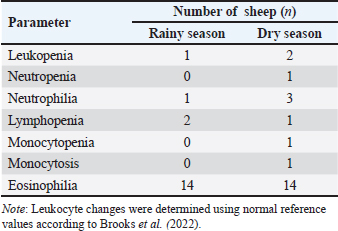
Changes in leukocyte pattern in Rote sheepThe leukocyte profile of male Rote sheep was relatively similar between the rainy and dry seasons (Table 3). Eosinophilia was the most dominant finding in both seasons (14 sheep), indicating consistent parasitic exposure throughout the year. A slight increase in neutrophilia was observed during the dry season, which may indicate responses to infection or stress. Other parameters, such as leukopenia, lymphopenia, and monocyte alterations, were found in small numbers and did not show significant differences. Overall, seasonal factors had minimal influence on the leukocyte profile. Comparison of the hematological profile of Rote sheep with other sheep breedsIn the present study, the erythrocyte profile of male Rote sheep showed hematological characteristics that were generally comparable to several regional sheep breeds, although some quantitative differences were observed (Table 4). The RBC value of Rote sheep (9.68 × 10¹²/L) was higher than that reported in Iranian fat-tailed sheep (Ahmadi-Hamedani et al., 2016) and Indonesian fat-tailed sheep (Sarmin et al., 2021) but slightly lower than that of Iraqi-Awassi sheep (Badawi and Al-Hadithy, 2014) and Naeemi sheep (Khalil et al., 2022). The Hb concentration (120.27 g/L) was higher than that reported in Iranian, Iraqi-Awassi, and Indonesian fat-tailed sheep and was comparable to that in Naeemi sheep. The HCT value (27.01%) was lower than those reported in Iraqi-Awassi, Indonesian fat-tailed sheep, and Naeemi sheep during summer but was similar to that in Iranian fat-tailed sheep. Table 3. Changes in leukocyte patterns in rote sheep between the rainy and dry seasons.
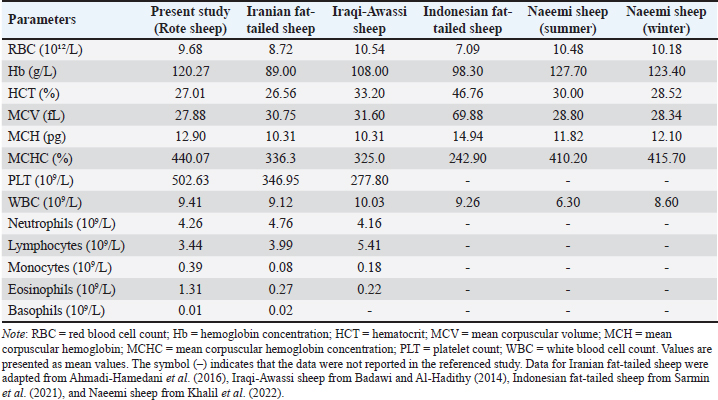
The MCV value of Rote sheep (27.88 fL) was among the lowest among the breeds compared and was markedly lower than that of Indonesian fat-tailed sheep. The MCH value was within the intermediate range, whereas the MCHC value (440.07%) was higher than that of all comparison breeds. The platelet count (502.63 × 10⁹/L) was also higher than that reported in Iranian fat-tailed sheep and Iraqi-Awassi sheep. Regarding the leukocyte profile, the total WBC count of Rote sheep (9.41 × 10⁹/L) was similar to those reported in Iranian fat-tailed sheep, Iraqi-Awassi sheep, and Indonesian fat-tailed sheep and slightly higher than that of Naeemi sheep. The neutrophil count (4.26 × 10⁹/L) was comparable to that of Iraqi-Awassi sheep but slightly lower than that of Iranian fat-tailed sheep. The lymphocyte count (3.44 × 10⁹/L) was lower than that reported in Iranian fat-tailed sheep and Iraqi-Awassi sheep. The monocyte count (0.39 × 10⁹/L) was higher than that reported in the comparison breeds. The eosinophil count (1.31 × 10⁹/L) was substantially higher than those reported in Iranian fat-tailed sheep and Iraqi-Awassi sheep, whereas the basophil counts remained low and comparable among breeds. DiscussionSeasonal variations in hematological parameters are not consistently observed across sheep breeds, as physiological responses to environmental changes depend on breed adaptation, geographical location, climatic conditions, nutritional availability, and study design (Korelidou et al., 2026). The observed difference was that the MCH value of male Rote sheep was lower during the rainy season than during the dry season, whereas RBC, Hb, HCT, MCV, and MCHC did not show significant differences between seasons (Table 1). Mohammed et al. (2014) reported similar findings: in Barbados Black Belly sheep in Central Trinidad, no differences in Hb, HCT, and MCHC values were observed between the dry and rainy seasons; however, other parameters were not examined. Hb, PCV, and MCHC values did not differ between seasons, likely because Cu deficiency occurred in both seasons, hydration status was relatively stable, and variations between physiological stages were more dominant than seasonal effects (Mohammed et al., 2014). Table 4. Comparison of the hematological profile of male Rote sheep with several breeds from several regions and international sheep.
However, contrasting seasonal patterns have been reported for other sheep breeds. Contradictory findings were reported by Olafimihan et al. (2025), who stated that HCT, Hb, MCV, and MCH values were higher during the rainy season, whereas RBC counts were higher during the dry season. The higher MCV and MCH values during the rainy season may be attributed to the abundance of nutrients. These differences can be explained by the fact that Olafimihan et al. (2025) used both male and female sheep of different breeds from various locations. The magnitude of changes in hematological parameters depends on the livestock breed, geographic location, and study design (Korelidou et al., 2026). MCH values may vary between dry and rainy seasons. Temperature and humidity conditions were more closely associated with MCH values. High temperatures and humidity result in a significant decrease in MCH values (0.52 %) in sheep due to heat stress (Autukaitė et al., 2020). Higher temperatures and humidity during the rainy season can also increase stress, which affects Hb metabolism and distribution in the blood (Costa et al., 2015; Autukaitė et al., 2020). The decrease in MCH values in heat-stressed sheep is caused by increased free radical attack on lipid-rich erythrocyte membranes, leading to red blood cell lysis. The hemodilution effect also plays a role during heat stress, as more water enters the circulatory system for evaporative cooling under hot and humid conditions (Autukaitė et al., 2020). The higher prevalence of hematological abnormalities during the rainy season indicates an increased incidence of anemia (Table 2). The prevalence of anemia during the rainy season is likely influenced by greater exposure to parasitic agents in humid environmental conditions (Fernandes et al., 2022). The relatively lower number of hematological abnormalities during the dry season indicates a more stable hematological status (Table 2). However, increased Hb concentrations and higher MCH values may indicate hemoconcentration, which is generally associated with dehydration due to reduced water availability and increased ambient temperatures (Ramadhani et al., 2015). However, the opposite was reported by Olafimihan et al. (2025), who stated that hypochromic microcytic anemia occurs due to poor feed quality and nutritional deficiencies, such as iron deficiency, characterized by HCT and Hb levels below the normal range during the dry season. During the rainy season, HCT and Hb levels were within the normal range, and anemia was less common. The discrepancy between this study and that of Olafimihan et al. (2025) may be related to differences in sheep breed, sex, and research location. The predominance of normocytic normochromic anemia (Table 2) may indicate anemia associated with chronic disease, parasitic infection, or early-stage anemia before significant changes in red blood cell size and Hb concentration occur (Grimes and Fry, 2015). Meanwhile, the presence of normochromic microcytic anemia (Table 2) may reflect erythropoiesis or iron deficiency. Absolute iron deficiency can result from chronic bleeding or a low-iron diet, accompanied by an increased red cell distribution width (Korelidou et al., 2026). Management of anemia in Rote sheep requires treatment of the underlying cause and a strategy for supplementing essential nutrients, such as iron and other micronutrients necessary for blood formation (Galbat et al., 2021). Abnormal WBC counts were observed in cases of eosinophilia during both seasons (Table 3). Eosinophils play a key role in the body’s defense against parasitic infections and contribute to the pathogenesis of type 1 hypersensitivity allergic reactions (Korelidou et al., 2026). No allergic reactions characterized by skin symptoms were observed in Rote sheep. Eosinophilia is most likely associated with endoparasitic infections because the sheep used in this study were not dewormed before or during the study. This condition allows the endoparasite population to persist and thrive within the host’s body over a long period of time. The decision not to deworm the sheep was intended to capture real-world field conditions that mirrored natural conditions without the intervention of a researcher. Several endoparasites, such as Fasciola spp. and Haemonchus contortus, are known to increase eosinophil counts in sheep (Escamilla et al., 2016; Toscan et al., 2017). Therefore, a parasitological study of endoparasites in Rote sheep is necessary to determine the cause of eosinophilia. Semi-intensive husbandry systems and communal grazing with other livestock species on the same pastureland can increase the risk of parasite transmission among animals (Mahlehla et al., 2021). Endoparasitic infections trigger chronic immune responses, resulting in elevated eosinophil counts (Huang and Appleton, 2016). This interpretation is supported by Dewi and Supriyanto (2020), who reported that deworming plays a crucial role in reducing or eliminating parasite populations in the digestive tract and body tissues of livestock. The relatively high RBC and Hb levels in Rote sheep indicate good erythropoietic capacity and adequate oxygen-carrying ability (Table 4). Variations in HCT levels among sheep breeds can be influenced by genetic background, nutritional status, environmental adaptation, and hydration status (Al-Thuwaini 2021). The lower MCV value indicates that Rote sheep have relatively smaller erythrocyte sizes than some other sheep breeds, although this value still falls within the range reported for Naeemi sheep (Khalil et al., 2022). The significantly higher MCHC value in Rote sheep may indicate an increased Hb concentration in erythrocytes; however, this finding should be interpreted with caution because differences in analytical methods and laboratory equipment may contribute to variations in the results across studies. The higher platelet count in Rote sheep than in Iranian fat-tailed sheep (Ahmadi-Hamedani et al., 2016) and Iraqi-Awassi sheep (Badawi and Al-Hadithy, 2014) may reflect a good hemostatic status. Similarly, the relatively comparable total WBC (leukocyte) counts among the different sheep breeds indicated that the general immune status of Rote sheep remained within the normal physiological range. The lower lymphocyte count in Rote sheep compared to Iranian fat-tailed sheep (Ahmadi-Hamedani et al., 2016) and Iraqi-Awassi sheep (Badawi and Al-Hadithy, 2014) may reflect differences in adaptive immune response, maintenance systems, environmental conditions, or antigen exposure levels. Conversely, a relatively high monocyte count may indicate increased phagocytic activity or a higher level of chronic inflammation. This study has several limitations. First, the absence of additional health-related parameters, such as serum biochemical profiles, hemoparasite examinations, and endoparasite (helminth) assessments, limited a more comprehensive evaluation of the effects of seasonal variation on animal health. Second, the relatively small sample size and purposive sampling approach may restrict the generalizability of the findings to the broader Rote sheep population. However, the repeated-measures design using the same animals across different seasons strengthens the ability to assess individual physiological changes associated with seasonal variation. To provide a more comprehensive understanding of the physiological responses of Rote sheep to seasonal variation, future studies should incorporate larger populations with more diverse sampling strategies and integrated assessments, including hematological, biochemical, parasitological, and zootechnical parameters. ConclusionThe effects of the rainy and dry seasons on the hematological profiles of male Rote sheep raised on Rote Island were relatively limited. Most hematological parameters did not significantly differ between the two seasons, except for the MCH, which was higher during the dry season. Nevertheless, the rainy season tended to show a higher occurrence of hematological abnormalities, particularly anemia, and decreased HCT values. Eosinophilia was the most dominant finding in both seasons and was suspected to be associated with chronic parasitic exposure due to the semi-intensive management system involving communal grazing and the absence of deworming programs. Overall, the findings of this study provide baseline hematological data for male Rote sheep that may serve as a reference for health evaluation and disease diagnosis in the local Rote sheep population. AcknowledgementsThe authors would like to thank the LPPM Universitas Nusa Cendana, Kupang, Indonesia, for funding the 2025 Competitive research with contract numbers: 243/UN15.22/PL/2025 and the Dean of the Faculty Medicine and Veterinary Medicine Universitas Nusa Cendana, who supported this research. FundingThe LPPM Universitas Nusa Cendana, Kupang, Indonesia, for funding the 2025 Competitive research with contract numbers: 243/UN15.22/PL/2025. Authors’ ContributionsYOPW, MJU, and IPCP designed the study and analyzed the data. YTRMRS, JAJ, and YYS contributed to data interpretation and manuscript review. MLFPK assisted in conducting the research and preparing the manuscript. Conflict of InterestThe authors declare no conflict of interest. Data AvailabilityAll data supporting this study’s findings are available within the manuscript. ReferencesAbdelnour, S.A., Abd El-Hack, M.E., Khafaga, A.F., Arif, M., Taha, A.E. and Noreldin, A.E. 2019. Stress biomarkers and proteomics alteration to thermal stress in ruminants: a review. J. Therm. Biol. 79, 120–134; doi:10.1016/j.jtherbio.2018.12.013 Abrori, A.S., Ali, U. and Rozi, A.F. 2022. Increasing growth, feed efficiency, and income in sheep fattening using fermented palm dust feed. Indones. J. Anim. Sci. 24(3), 270–280; doi:10.25077/jpi.24.3.270-280.2022 Ahmadi-Hamedani M, Ghazvinian, K., Atyabi, N., Khanalizadeh, P., Masoum, M.A. and Ghodrati, M.S. 2016. Hematological reference values of healthy adult Sangsari sheep (Iranian fat-tailed sheep) estimated by reference value advisor. Comp. Clin. Pathol. 25(2), 459–464; doi:10.1007/s00580-015-2211-z Al-Dawood, A. 2017. Heat stress management in small ruminants–a review. Ann. Anim. Sci. 1, 59–88; doi:10.1515/aoas-2016-0068 Al-Thuwaini, T.M. 2021. The relationship of hematological parameters with adaptation and reproduction in sheep: a review study. Iraqi J. Vet. Sci. 35(3), 575–580; doi:10.33899/ijvs.2020.127253.1490 Autukaitė, J., Poškienė, I., Juozaitienė, V., Antanaitis, R. and Žilinskas, H. 2020. The impact of temperature-humidity index on blood morphology and β-hydroxybutyrate in different sheep breeds. Acta Vet. Brno. 89(3), 247–254; doi:10.2754/avb202089030247 Badawi, N.M. and Al-Hadithy, H.A.H. 2014. The hematological parameters in clinically healthy Iraqi Awassi sheep. World Vet. J. 4(1), 1–5; doi:10.5455/wvj.20140237 Brooks, M.B., Harr, K.E., Seelig, D.M., Wardrop, K.J. and Weiss, D.J. 2022. Schalm’s veterinary hematology, 7th ed., Hoboken, NJ: John Wiley & Sons; doi:10.1002/9781119500537 Costa, W.P., Façanha, D.A.E., Leite, J.H.G.M., da Silva, R.C.B., de Souza, C.H., Chaves, D.F., de Vasconcelos, A.M., Soto-Blanco, B., do Vole, A.M. and Pimenta Filho, E.C. 2015. Thermoregulatory responses and blood parameters of locally adapted ewes under natural weather conditions of Brazilian semiarid region. Semina: Ciênc. Agrár. 36(6 Suppl. 2), 4589–4600; doi:10.5433/1679-0359.2015v36n6Supl2p4589 Dewi, D.A. and Supriyanto, S. 2020. Prevalence of nematodiasis in small ruminants in Yogyakarta. J. Pengemb. Penyul. Pertan. 17(31), 53–61; doi:10.36626/jppp.v17i31.418 Escamilla, A., Bautista, M.J., Zafra, R., Pacheco, I.L., Ruiz, M.T., Martínez-Cruz, S. and Pérez, J. 2016. Fasciola hepatica induces eosinophil apoptosis in the migratory and biliary stages of infection in sheep. Vet. Parasitol. 216, 84–88; doi:10.1016/j.vetpar.2015.12.013 Fernandes, M.A., Lima, P.de M.T., do Amarante, A.F.T., Abdalla, A.L. and Louvandini, H. 2022. Hematological, biochemical alterations and methane production in sheep submitted to mixed infection of Haemonchus contortus and Trichostrongylus colubriformis. Small Rumin. Res. 216, 106798; doi:10.1016/j.smallrumres.2022.106798 Galbat, S.A., Abdallah, A.M., Mahmoud, M.A. and El-Zeftawy, M. 2021. Clinical study on the impact of nutritional deficiency on the health status of the sheep in New Valley Governorate. Assiut Vet. Med. J. 67(171), 143–157; doi:10.21608/avmj.2021.204893 Grimes, C.N. and Fry, M.M., 2015. Nonregenerative anemia: mechanisms of decreased or ineffective erythropoiesis. Vet. Pathol. 52, 298–311; doi:10.1177/0300985814529315 Huang, L. and Appleton, J.A. 2016. Eosinophils in helminth infection: defenders and dupes. Trends Parasitol. 32(10), 798–807; doi:10.1016/j.pt.2016.05.004 Khalil, F., Yapati, H., Al Blallam, Z. and Jose, R. 2022. Seasonal effects on growth, physiology, hematology and biochemical profiles of Naeemi sheep breed. Adv. Anim. Vet. Sci. 10(10), 2161–2170; doi:10.17582/journal.aavs/2022/10.10.2160.2170 Korelidou V, Simitzis P, Massouras, T. and Gelasakis, A.I. 2026. Hematological parameters in sheep: variability, determinants, and applications in flock health management. Animals 16(9), 1295; doi:10.3390/ani16091295 Mahlehla, M.E.A., Molapo, S.M.O., Phoofolo, M.W., Matebesi, P.A., Phalatsi, M. and Moiloa, M.J. 2021. Awareness and control methods of gastrointestinal parasites of Merino sheep among farmers from different agro-ecological zones of Lesotho. Vet. World, 14(9), 2554–2560; doi:10.14202/vetworld.2021.2554-2560 Mohammed, A., Campbell, M. and Youssef, F.G. 2014. Serum copper and hematological values of sheep of different physiological stages in the dry and wet seasons of Central Trinidad. Vet. Med. Int. 2024(1), 1-7; 972074; doi:10.1155/2014/972074 Olafimihan, B.J., Yusuf, A.O., Arotiba, E.O., Ibrahim, O.W., Akpowu, O.M. and Ogunmefun, F.T. 2025. Effect of seasonal variation on hematology and serum biochemical parameters of West African Dwarf sheep reared semi-intensively. Trop. Anim. Prod. Investig. 28(1), 01–06; doi:10.1007/s00501-020-0298-1 OnlineNTT. 2025. The local Rote sheep was officially designated as a national livestock breed by the Minister of Agriculture of the Republic of Indonesia. [Domba lokal Rote resmi ditetapkan sebagai rumpun ternak nasional oleh Menteri Pertanian RI]. Available via https://www.onlinentt.com/Indeks/10614/domba-lokal-rote-resmi-ditetapkan-sebagai-rumpun-ternak-nasional-oleh-menteri-pertanian-ri/ Pratama, M.A. and Ali, U. 2023. The effectiveness of forage silage utilization on goat performance (literature review) [Efektifitas pemanfaatan silase hijauan terhadap performa kambing (literature review)]. Dinamika Rekasatwa. 6(2), 253–268. Rahmawati, W.D., Azzizah, I.N. and Darmawan, M.A. 2025. Evaluation of Garut sheep fattening management and business feasibility analysis at Somo Farm, Bantul Regency, Yogyakarta. J. Appl. Agric. Health Technol. 4(2), 24–33; doi:10.20961/jaht.v4i2.3058 Ramadhani, S., Hasan, M., Daud, R. and Asmilia, N. 2015. Correlation of dehydration and total plasma protein, hemoglobin, and packed cell volume on Kacang goat aged 10-14 days. J. Med. Vet. 9(1), 1–4; doi:10.21157/j.med.vet.v9i1.298 Rosita, L, Pramana, A.A.C. and Arfira, F.R. 2019. Basic hematology [Hematologi Dasar] Yogyakarta: Universitas Islam Indonesia. ISBN: 978-602-450-370-3 Sarmin, W.S., Hana, A., Astuti, P. and Airin, C.M. 2021. Profiles of Indonesian fat-tailed sheep under different physiological conditions. Trop. Anim. Health Prod. 53(6), 523; doi:10.1007/s11250-021-02961-3 Spyrou, V. and Valiakos, G. 2015. Orf virus infection in sheep or goats. Vet. Microbiol. 181(1–2), 178–182. Toscan, G., Cadore, G.C., Limana, J.F.T., Weber, A., Palma, H.H., Duarte, M.M.F., Sangioni, L.A. and Vogel, F.S.F. 2017. Immune response of sheep naturally infected with Haemonchus spp. on pastures with two different nutritional conditions. Semina: Ciênc. Agrár. 38(2), 809–820; doi:10.5433/1679-0359.2017v38n2p809 Turini, L., Foggi, G., Mantino, A., Gasparoni, E., Vichi, F., Silvi, A., Armenia, G., Sala, G., Bonelli, F. and Sgorbini, M. 2025. Changes in hematological and hematochemical parameters in lactating dairy sheep according to different pasture management and heat stress risk: a longitudinal study. Vet. Anim. Sci. 27, 100419; doi:10.1016/j.vas.2024.100419 | ||
| How to Cite this Article |
| Pubmed Style Wuhan YOP, Usfunan MJ, , Joesoef JA, Sitompul YY, Kale MLFP, Putra IPC. Hematological profile of male sheep raised on Rote Island during the rainy and dry seasons. Open Vet. J.. 2026; 16(8): 5794-5801. doi:10.5455/OVJ.2026.v16.i8.67 Web Style Wuhan YOP, Usfunan MJ, , Joesoef JA, Sitompul YY, Kale MLFP, Putra IPC. Hematological profile of male sheep raised on Rote Island during the rainy and dry seasons. https://www.openveterinaryjournal.com/?mno=317705 [Access: September 04, 2026]. doi:10.5455/OVJ.2026.v16.i8.67 AMA (American Medical Association) Style Wuhan YOP, Usfunan MJ, , Joesoef JA, Sitompul YY, Kale MLFP, Putra IPC. Hematological profile of male sheep raised on Rote Island during the rainy and dry seasons. Open Vet. J.. 2026; 16(8): 5794-5801. doi:10.5455/OVJ.2026.v16.i8.67 Vancouver/ICMJE Style Wuhan YOP, Usfunan MJ, , Joesoef JA, Sitompul YY, Kale MLFP, Putra IPC. Hematological profile of male sheep raised on Rote Island during the rainy and dry seasons. Open Vet. J.. (2026), [cited September 04, 2026]; 16(8): 5794-5801. doi:10.5455/OVJ.2026.v16.i8.67 Harvard Style Wuhan, Y. O. P., Usfunan, . M. J., , Joesoef, . J. A., Sitompul, . Y. Y., Kale, . M. L. F. P. & Putra, . I. P. C. (2026) Hematological profile of male sheep raised on Rote Island during the rainy and dry seasons. Open Vet. J., 16 (8), 5794-5801. doi:10.5455/OVJ.2026.v16.i8.67 Turabian Style Wuhan, Yustinus Oswin Primajuni, Michael Julian Usfunan, Yohanes Timbun Raja Mangihut Ronael Simarmata, Jayusman Arsiyanti Joesoef, Yeremia Yobelanno Sitompul, Maria Laurenci Fanny Permata Kale, and I Putu Cahyadi Putra. 2026. Hematological profile of male sheep raised on Rote Island during the rainy and dry seasons. Open Veterinary Journal, 16 (8), 5794-5801. doi:10.5455/OVJ.2026.v16.i8.67 Chicago Style Wuhan, Yustinus Oswin Primajuni, Michael Julian Usfunan, Yohanes Timbun Raja Mangihut Ronael Simarmata, Jayusman Arsiyanti Joesoef, Yeremia Yobelanno Sitompul, Maria Laurenci Fanny Permata Kale, and I Putu Cahyadi Putra. "Hematological profile of male sheep raised on Rote Island during the rainy and dry seasons." Open Veterinary Journal 16 (2026), 5794-5801. doi:10.5455/OVJ.2026.v16.i8.67 MLA (The Modern Language Association) Style Wuhan, Yustinus Oswin Primajuni, Michael Julian Usfunan, Yohanes Timbun Raja Mangihut Ronael Simarmata, Jayusman Arsiyanti Joesoef, Yeremia Yobelanno Sitompul, Maria Laurenci Fanny Permata Kale, and I Putu Cahyadi Putra. "Hematological profile of male sheep raised on Rote Island during the rainy and dry seasons." Open Veterinary Journal 16.8 (2026), 5794-5801. Print. doi:10.5455/OVJ.2026.v16.i8.67 APA (American Psychological Association) Style Wuhan, Y. O. P., Usfunan, . M. J., , Joesoef, . J. A., Sitompul, . Y. Y., Kale, . M. L. F. P. & Putra, . I. P. C. (2026) Hematological profile of male sheep raised on Rote Island during the rainy and dry seasons. Open Veterinary Journal, 16 (8), 5794-5801. doi:10.5455/OVJ.2026.v16.i8.67 |


