




| Research Article | ||
Open Vet. J.. 2026; 16(8): 5169-5178
Open Veterinary Journal, (2026), Vol. 16(8): 5169–5178 Research Article Utilization of nanotechnology and histological measurements to compare the effects of raw and nanocurcumin on productive performance and blood Profile in AwassiMohammed G.W. Mohammed and Safwan L. Shihab*Department of Animal Production, College of Agriculture and Forestry, University of Mosul, Mosul, Iraq *Corresponding Author: Safwan L. Shihab. Department of Animal Production, College of Agriculture and Forestry, University of Mosul, Mosul, Iraq. Email: Safwan.l.s [at] uomosul.edu.iq Submitted: 09/04/2026 Revised: 20/06/2026 Accepted: 29/06/2026 Published: 08/08/2026 © 2025 Open Veterinary Journal
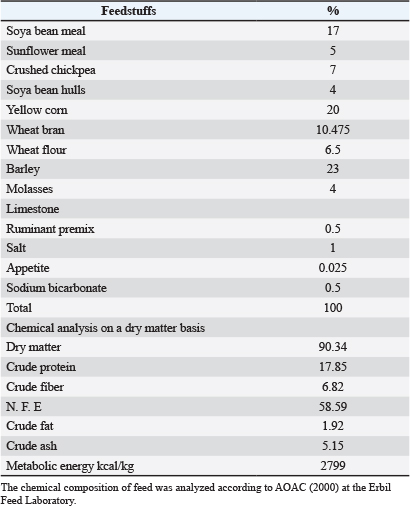
AbstractBackground: Curcumin, a bioactive compound, widely used in animals like ruminants in raw form, while nanoform powder solution formulation has not been used in lambs, despite its properties recently receiving special attention from researchers. Aim: This study explains the effects of nanocurcumin (NC) compared to its natural form and its potential to improve lamb health, depending on serum biochemistry, histomorphometry, and histochemistry results, on weight gain, meat composition, and quality. Methods: In this study conducted at the field of College of Agriculture and forestry, University of Mosul, using 15 Awassi lambs with an average body weight of (28.80 + 1.40) kg and aged 3.5–4 months, lambs were randomly gathered and arranged in three groups: the first group is G1 control, fed standard rations, G2 was fed the standard ration and orally drained with 80 mg/lamb/day of raw curcumin; while the third group was fed standard ration with drainage NC at 40 mg/lamb/day Results: The results revealed a significant increase (p≤ 0.05) in final body weight G1 and G2 (47.95 and 47.80 kg, respectively) compared with G1 (47.20 kg). Weight gain was significantly higher in lambs supplemented with NC (19.30 kg) compared to the other groups (18.40–18.05 kg). Rib eye area improved significantly (p ≤ 0.05) in carcasses of lambs fed turmeric (14.50–15.20 cm2) compared with the G1 group (13.70 cm2). On the other side, subcutaneous fat thickness decreased in the curcumin-supplemented groups (1.24–1.18 cm2) compared to G1 (1.52 cm2). A similar trend showed for total fat percentage reaching (22.43%–23.91%) compared with (26.71%) in G1. Regarding histomorphological characteristics, G3 showed clear improvements in villus height, width, and depth (499.18, 201.28, and 322.23 mm), and G1 (467.45, 169.52, and 301.74 mm), along with improvements in the thickness of layers of the intestine. Conclusion: Evident improvements were observed in the histological characteristics of the intestine, including increased villus height and width, deeper crypts, and thicker intestinal wall layers, indicating enhanced nutrient absorption efficiency and, consequently, improved productive performance. Keywords:Awassi lambs, Blood, Curcumin, Nanotechnology, Productive performance. IntroductionSheep require special care to reach peak production in milk and meat and to minimize disease incidence. Lambs need supplements that are necessary for meet nutritional needs, which are required for health improvement and better productive performance. On the other hand, lambs after the weaning period require supplements to improve ruminal development and microflora to facilitate the consuming of solid feed (Slukwa, 2014; Zhang et al., 2019; Shihab and Alalaf, 2026). However, a new type and form of feed additive, like a natural additive, is used to accomplish this goal, such as curcumin (Ciria et al., 2009). Curcumin, a natural bioactive additive extracted from turmeric plants (Curcuma longa), has anti-inflammatory, antioxidant, and immunostimulatory properties (Johannah et al., 2018; Ghiamati Yazdi et al., 2019). According to these properties, curcumin is used in the feed of lambs due to its highly safe and non-toxic effects for animals and humans, even at high doses of supplementation in feed (Shaikh et al., 2009). Although there are advantages to curcumin, it has several challenges, like low availability, low water solubility, the rapid elimination (Wang et al., 2009), high light sensitivity, and rapid degradability (Joung et al., 2016). Researchers reported that native curcumin bioaccumulation in the liver and hepatic tissue is very low due to rapid elimination of curcumin from the body (Jaguezeski et al., 2019); to solve this problem, nanotechnology techniques are designed to improve the efficacy of curcumin to increase absorption in the gut and reduce doses with slow release of the ingredient (Kharat et al., 2019). Different forms of nanocurcumin (NC) exist, such as microemulsions, macroemulsions, nanoemulsions, and micelles (Moniruzzaman et al., 2021). Last, previous studies reported that when NC is added to pig feeds, it causes an increase in feed intake and, finally, an increase in body weight and weight gains (Moniruzzaman et al., 2021). In poultry, it was recorded that nanoencapsulated curcumin (10 mg/kg of feed) can improve egg quality of quails using three times less than native curcumin (30 mg/kg of feed) under cold stress conditions (Alagawany et al., 2021; Abdel-Tawwab et al., 2022). Curcumin in nanoform is important to improve growth, immunity, and increase production in farm animals (Jaguezeski et al., 2019). Furthermore, information on the efficacy of nanocurcumin as an additive in the feed of lambs is poor. Therefore, this study explains the effects of NC in different forms and sizes (90 nm) compared to the natural form of curcumin. It then demonstrates improved lamb health depending on serum biochemistry and histochemistry results, and productive performance based on the results of physical inventory, weight gain, meat composition and quality, and histological sections of the liver and intestinal mucosa. Material and MethodsAnimal management and experimental designThis study was conducted at the farm of the College of Agriculture and Forestry in university of Mosul. Fifteen (15) Awassi lambs with an average initial body weight (28.80 ± 1.40 kg) and average ages of 3.5–4 months, were divided into three groups depending on the average body weight using a Randomized Complete Block Design (RCBD) Table 1. G1 served as the control (CON) and resaved feed without NC supplementation, G2 was deranged with CN at about 80 mg/lamb/day, andG3 was deranged with CN at 40 Mg/lamb/day one diet (basal diet productid by Erbil feed) was provided to all groups, feed was supplied twice daily at 7 a.m. and 7 p.m., and the amount of feed was adjusted weekly according to the last weight of the lambs. The CN solution was mixed with a stainless steel mixer. All lambs were housed in standard pens of 4 × 5 m, supplied with straw bedding for comfort and hygiene; each pen was provided with a feeding system and a drinking water system, which were cleaned daily. Lighting and air supply systems were adequate, and the temperature was controlled at 28°C; all lambs were tagged with a number to facilitate easy sampling and data collection. Table 1. Chemical composition and nutrient proportions of the feed.
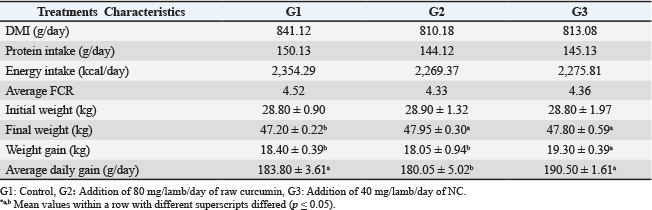
Curcumin nanospheresNC has specific physicochemical properties were descripted by researchers (Kim et al., 2020; Kim et al., 2021; Moniruzzaman et al., 2021) the protocol for production of NC begin with natural curcumin minced into powder. Then, taken 200 mg NCP is mixed with 40 ml of toluene this mixture is added to 2 l of clean water, after which the mixture is sonicated at 50 KHz for 4 hours (Rep, Korea). After the sonication period, a rotary evaporator (Germany) is used to completely evaporate the toluene from the mixture at 40°C the concentrated liquid is put into a freeze dryer for 72 hours to obtain of curcumin powder in nanoforms (Kanwal et al., 2023; Gayathri et al., 2023). Serum biochemistrySerological analysis can obtain 5 ml of whole blood sample collected from the jugular vein from each lamb using a syringe gage 10 ml and stored in a tube (plastic tube without anticoagulant). Collected samples were taken in early morning on day (90), the whole blood samples were left at room temperature for 10 minutes then centrifugated at 3500 ×g at 4°C for 15 minutes, the whole blood was participated, while the serum supernatant obtained using micropipette then stored in an Eppendorf tube at −20° C, then sent to laboratory to further analysis serological parameters [total protein, albumin, blood urea, cholesterol, triglyceride, HDL, LDL, VLDL using a kit set from (Biolabo, France)]. Hepatic and intestinal histomorphologyHistomorphological studies of finishing lambs how fed with or without NC using a standard protocol (Tian et al., 2020), a small section 5 cm of jejunum (it is middle parts of intestine) from eviscerated lambs of each treatment group (five lambs in each pen) washed with distilled water to remove intestinal contains and blood, then fixed with formal aldehyde 4% for 24 hours at 4°C. Samples were sent to the histological laboratory to obtain tissue sections by passing through different concentrations of alcohol to infiltrate and dehydrate. Tissue section were made using paraffin cube sliced 4 mmin thickness using a microtome with a sharp cutter (China), and hematoxylin and Eosin (H&E) stain for the gut section. Slides were monitored by using a light microscope (Japan) attached with a digital camera (China) to capture the tissue image. This image was examined with ImageJ, operating layer, goblet cell per villus; at least six images were taken from each slide for all groups. Statistical analysisData were analyzed using ANOVA within an RCBD to evaluate the effect of treatments (raw curcumin, NC, and control) on the measured variables, including body weight, weight gain, carcass traits, blood parameters, and histological characteristics. The statistical model used was: Yij=μ + Ti + eij Mean comparisons were performed using Duncan’s multiple range test to determine significant differences at (p ≤ 0.05). Ethical approvalThis project was approved by the Animal Welfare and Ethics Committee of the College of Veterinary Medicine at the University of Mosul (UM.VET.2026.019 Mosul, Iraq). ResultsProduction performanceTable 2 showed the effect of curcumin in raw and nanoforms on the production performance of Awassi Lambs; the results refer to no significant differences in DMI in all groups (841.12, 810.18, 813.18 g/day), protein intake (150.13, 144.12, 145.13 g/day), and gross energy or metabolizable energy intake (2,354.29, 2,269.37, 2,275.8 kcal/day). The feed conversion ratio has no significant effect on the value (4.52, 4.33, 4.36 kg) of feed intake/kg total weight Figures 1–3. On the other side significant of final body weight increased p ≤ 0.05 in G2, G3 lambs supplemented with raw and NC (47.95, 47.80 kg), respectively, compared to (47.20 kg) in control, total weight were significantly higher (p ≤ 0.05) in the G3 (19.30 kg) compared to the CON and G2 (18.40, 18.05 kg), however, the average daily gain average decreased in lambs supplemented with raw curcumin (180.05 g/day) compared to (183.80, 190.50 g/day) in control and G3, respectively. Table 2. Effect of adding raw and NC on the productive performance of lambs.
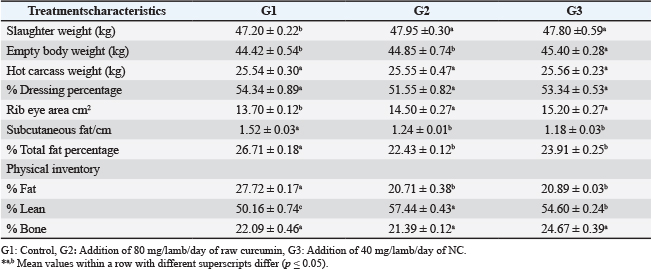
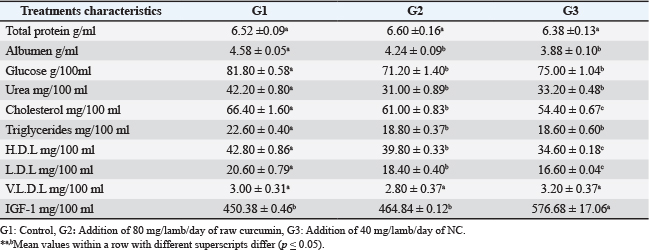
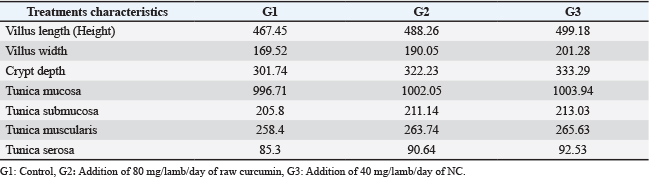
Carcass characteristicsAccording to the results of Table 3, the supplemented groups with raw and NC have different effects on carcass characterization. The body weight of slaughtered lambs significantly increased (p ≤ 0.05) in G2 and G3 (47.95, 47.80 kg) compared with the control (47.20 kg). On the other side, the empty body weight is observed significant increased (p ≤ 0.05) in the G3 (45.40 kg) compared to control and G2 (44.42, 44.85 kg) respectively, while Hot carcass weight showed no significant differences, in contrast to the other groups (25.54,25.55,25.56) kg or dressing percentage (54.34%, 51.55%, 53.34%). Rib eye area showed significantly increased (p ≤ 0.05) reached (14.50, 15.20 cm2) in G2, G3, respectively, differs from CON (13.70 cm2) while decrease in sub cutaneous fat thickness (1.24, 1.18 cm) and total fat percentage (22.43%, 23.91%) compared with control group (1.52 cm) and (26.71%) on the other side the physical dissection The results indicated that supplementation with both raw and nanoform turmeric significantly enhanced the percentage lean proportion appear significantly increased in percentage of lean (p ≤ 0.05) in G2, G3 (57.44%, 54.60%) compared with control (50.16%) while the fat percentage was decreased significantly (20.71%, 20.89%) compared (27.72%) in control and no significant differences were recorded in bone percentage (22.09%, 21.39%, 24.67%) in all groups. Blood biochemical analysisTable 4 showed the total protein concentration not affected by dietary supplements (6.52, 6.60, 6.38 g/100 ml) in all group respectively while albumin level decreased significantly (p ≤ 0.05) in the groups supplemented with raw and NC (4.24, 3.88 g/100ml) compared with CON (4.58 g/100ml), blood glucose level decreased in G2, G3 supplemented with raw and NC (71.20, 75.00 g/100 ml) while in CON (76.80 g/100 ml). On the other side, blood urea, total cholesterol, triglycerides, HDL, and LDL levels significantly decreased (p ≤ 0.05) in curcumin-supplemented groups (31.00, 33.20, 61.00, 54.40, 18.80, 18.60, 39.80, 34.60, 18.40, 16.60 mg/100 ml) compared with CON (42.20, 66.40, 22.60, 42.80, 20.60 mg/100 ml). While VLDL did not significantly influence (3.00, 2.80, 3.20 mg/100 ml) respectively, insulin-like growth factor-1 (IGF-1) level was significantly increased (p ≤ 0.05) in the nanosupplemented group (576.68 ng/ml) compared with CON and raw curcumin groups (450.38, 464.84 ng/ml), respectively. Histomorphology and histomorphometryTable 5: Results of histological section of intestine showing the difference between all groups. G3 40 mg/lambs/day supplemented with NC recorded the highest value in length, width, and depth of villi reached (499.18, 201.28, 333.29 µm) compared to the second group (488.22, 190.05, 322.23 µm), while CON recorded the lowest value reached (467.45, 169.52, 301.74 µm) respectively. In addition, an increase in thickness of intestinal layer like Tunica Mucosa, Tunica Submucosa, Tunica Muscularis, Tunica Serosa in NC reached (1003.94, 213.03, 265.63, 92.53 µm) while in CON (996.71, 205.8, 258.4, 85.3 µm), respectively. DiscussionThe finding revealed that supplementation with nanocurcumin have improved production parameters performance including final body weight, weight gain this might be attributed to the enhancement of ruminal function microbial activity fiber digestion and the increase of volatile fatty acid (VFAs) which metabolized to the primary source of energy, Bokharaeian et al. (2024). mentioned similar results as authors found that NC has a relationship in growth performance in lambs with the physiological mechanisms, such as enhanced ruminal fermentation increased VFA production and improved fiber digestion. Furthermore, Marcon et al. (2021) reported that supplementation with 2 mg of nanoencapsulated curcumin/kg of concentrate had a greater average daily gain (ADG) than the control group. On the other side, curcumin enhanced the absorption and decreased oxidative stress following growth metabolic activity. This might be attributed to the increase in the amino acids absorption which is essential for muscle protein synthesis. These findings were consistent with those of Molosse et al. (2019), Marcon et al. (2021), Odhaib et al. (2021), Sultan (2022), and Bokharaeian et al. (2024), who reported that lambs fed raw and NC. Significant improvement in the rib eye muscle compared with the control group. This improvement corresponds to the advantage of curcumin to improve absorption of intestinal villi, special amino acids lead to an increase in the capacity of protein original muscle synthesis, then an increase in rib eye area (Gopi et al., 2014; Shihab et al., 2023). In addition, the IGF-1-like growth hormone increases protein synthesis and cell proliferation to enhance tissue to stimulating IGF-1, which corresponds with the results of the level of serum IGF-1, as agreed with the study of Taengthong et al. (2022). On the other hand, curcumin and NC reduced the lipogenesis pathways by reducing the activity of key enzymes such as acetyl-CoA carboxylase and fatty acid synthase, which are responsible for fatty acid synthesis in the liver. Curcumin enhances fatty acid oxidation, promoting their utilization as an energy source rather than storage results reduction in fat percentage in the carcass (Sun et al., 2026). These findings are consistent with those reported by Morteza et al. (2010), Karami et al. (2011), El-Tarabany and Habeeb (2019), Marcon et al. (2021), and Sultan (2022).
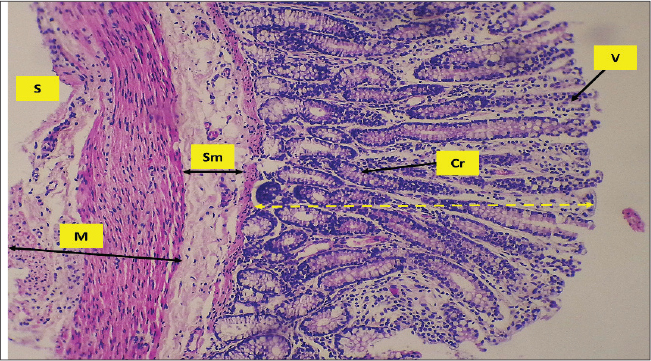
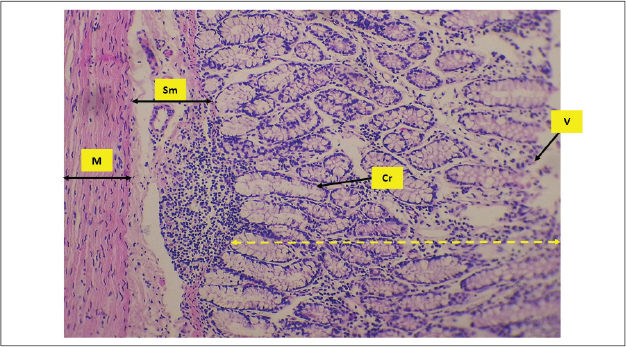
Fig. 1. Control group. Photomicrograph illustrating the normal microstructure of the small intestine, showing the villi (V), intestinal crypts (Cr) within the mucosa (dashed lines), submucosa (Sm), muscularis (M), and serosa.
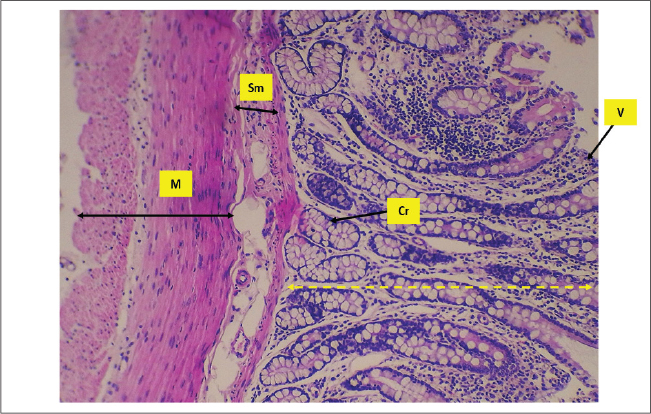
Fig. 2. Small intestine of lambs treated with raw curcumin at a dose of 80 mg/lamb/day. Light photomicrograph showing the preservation of the normal histological organization of the small intestine, illustrating the intestinal villi (V), intestinal crypts/glands (Cr) located within the mucosa (dashed lines), tunica submucosa (Sm), and tunica muscularis (M) (H&E staining, ×100 magnification).
Fig. 3. Histological examination of the small intestine of lambs supplemented with nanoturmeric (40 mg/lamb/day). Light photomicrograph demonstrating the preserved normal intestinal structure, including the villi (V), intestinal crypts (Cr) within the mucosal layer (dashed lines), tunica submucosa (Sm), and tunica muscularis (M) (H&E staining, ×100). Table 3. Effect of adding raw and NC on carcass characteristics of lambs.
Serum blood glucose decreased in lambs supplemented with raw and NC refer to the role of IGF-1 in enhancing glucose uptake and increasing insulin sensitivity, leading to greater glucose utilization in tissues and a reduction serum glucose levels compared to the control group (El-Bahr, 2013) The results of the present study are agreement with those of Hernandez-Garcia (2025), who reported a reduction in blood glucose levels in sheep that supplemented with curcumin, moreover curcumin supplemented group showed reduced in certain bacteria and protozoa lead to reduce in ammonia concentration then lower blood urea levels. This effect is linked to the role of curcumin in enhancing nitrogen retention in the rumen and its utilization in microbial protein synthesis (Tian et al., 2023; Shihab, 2024). This study agreement with the findings of Al-Azazi (2017) and Bokharaeian et al. (2024) regarding with Jiang et al. (2019), Marcon et al. (2021), and Sartip et al. (2023) corresponding with this study reported reductions in cholesterol and triglyceride reduced attributed to the antioxidant and anti-inflammatory properties of curcumin, as well as its ability to reduce free radical accumulation, thereby improving the balance between high-density and low-density lipoproteins (HDL and LDL) through decrease hepatic lipid synthesis exhibited a greater capacity to reduce cholesterol levels, likely due to its improved bioavailability and more effective regulation of lipid metabolic pathways (Bokharaeian et al., 2024; Alalaf and Alnuaimy, 2025) however, IGF-1 physiological indicator of improve growth and tissue development through regulating cell proliferation and stimulating protein synthesis. (Tian et al., 2023; Hasan et al., 2024) showed that lambs supplemented with curcumin activated IGF-1 receptors, increasing body weight and production performance, and hormonal pathways regulating growth. However, the improvement in histological layer as a result of bioactive compound of curcumin that reduces the oxidative stress and enhances cell proliferation and differentiation leads to increased absorption of then finally increases body weight and productive performance (Aggarwal et al., 2007; Ghosh et al., 2018). Table 4. Effect of adding raw and NC on blood parameters of lambs.
Table 5. Effect of adding raw and NC on intestinal villus measurements and intestinal wall layers.
ConclusionThe results of the present study demonstrated that the supplementation of lamb diets with curcumin, whether in its raw or nanoform, had significant positive effects on productive performance, carcass traits, and physiological indicators. Curcumin supplementation led to a significant increase in final body weight and daily weight gain, along with improvements in carcass characteristics, including increased rib eye area, reduced fat thickness and percentage, and a higher proportion of lean tissue. In addition, curcumin enhanced metabolic efficiency by lowering blood urea and lipid levels, accompanied by an increase in IGF-1, reflecting stimulation of growth and tissue development. Moreover, clear improvements were observed in the histological characteristics of the intestine, including increased villus height and width, deeper crypts, and thicker intestinal wall layers, indicating enhanced nutrient absorption efficiency and, consequently, improved productive performance. AcknowledgmentThe authors thank the staff of the Animal Production Department, College of Agriculture and Forestry, University of Mosul, for their support and encouragement. FundingThe costs of the study were totally covered by the authors. Authors’ contributionsM.G.: Investigation, Resources, Data Curation. S.S.: Conceptualization, Methodology, Formal Analysis, Visualization, Writing – Original Draft. M.G. and S.S.: Writing – Review & Editing. All authors have read and approved the final version of the manuscript. Conflict of interestThe authors declare that they have no conflict of interest. Data availabilityThe authors confirm that the data of this study are available within the article. ReferencesAbdel-Tawwab, M., Eissa, E.S.H., Tawfik, W.A., Abd Elnabi, H.E., Saadony, S., Bazina, W.K. and Ahmed, R.A. 2022. Dietary curcumin nanoparticles promoted the performance, antioxidant activity, and humoral immunity, and modulated the hepatic and intestinal histology of Nile tilapia fingerlings. Fish. Physiol. Biochem. 48(3), 585–601; doi: 10.1007/s10695-022-01066-4 Aggarwal, B.B., Sundaram, C., Malani, N., and Ichikawa, H. 2007. Curcumin: the Indian solid gold. The molecular targets and therapeutic uses of curcumin in health and disease, Springer, Vol. 595, 1–75. doi: 10.1007/978-0-387-46401-5_1. Alagawany, M., Farag, M.R., Abdelnour, S.A., Dawood, M.A.O., Elnesr, S.S. and Dhama, K. 2021. Curcumin and its different forms: a review on fish nutrition. Aquaculture 532, 736030; doi: 10.1016/j.aquaculture.2020.736030 Alalaf, A.S. and Alnuaimy, R. 2025. Evaluating the influence of vitamin E and selenium on the uterine health of adult female goats: a histological study. Egypt. J. Vet. Sci. 56(8), 1745–1753. Al-Azazi, S.H. 2017. Effect of turmeric powder (Curcuma Longa) on selected rumen and blood serum constituents in sheep. Vet. Med. J. (Giza). 63(3), 81–88; doi: 10.21608/vmjg.2017.355068 Bokharaeian, M., Toghdory, A. and Ghoorchi, T. 2024. Evaluating the dose‐dependent effects of curcumin nano‐micelles on rumen fermentation, nitrogen metabolism, and nutrient digestibility in heat‐stressed fattening lambs: implications for climate change and sustainable animal production. J. Anim. Physiol. Anim. Nutr. 108(5), 1231–1242; doi: 10.1111/jpn.13971 Ciria, J.C., Martín, B.A., Romera, J. and Ruiz, J.L.C. 2009. Alimentación del cordero: lactancia y cebo. In Ovinotecnia. Producción y economía en la especie ovina: homenaje al profesor Isidro Sierra Alfranca. Prensas de la Universidad de Zaragoza, pp: 201–10. Available via: https://dialnet.unirioja.es/servlet/articulo?codigo=3043445 El-Bahr, S.M. 2013. Curcumin regulates gene expression of insulin like growth factor, B-cell CLL/lymphoma 2 and antioxidant enzymes in streptozotocin induced diabetic rats. BMC Complement. Alter. Med. 13(1), 368; doi: 10.1186/1472-6882-13-368 Gayathri, K., Bhaskaran, M., Selvam, C. and Thilagavathi, R. 2023. Nano formulation approaches for curcumin delivery—a review. J. Drug Deliv. Sci. Technol. 82, 104326; doi: 10.1016/j.jddst.2023.104326 Ghiamati Yazdi, F., Soleimanian-Zad, S., Van Den Worm, E. and Folkerts, G. 2019. Turmeric extract: potential use as a prebiotic and anti-inflammatory compound? Plant Foods For Hum. Nutr. 74(3), 293–299; doi: 10.1007/s11130-019-00733-x Ghosh, S.S., He, H., Wang, J., Gehr, T.W. and Ghosh, S. 2018. Curcumin-mediated regulation of intestinal barrier function: the mechanism underlying its beneficial effects. Tissue Barriers 6(1), e1425085; doi: 10.1080/21688370.2018.1425085 Gopi, M., Karthik, K., Manjunathachar, H.V., Tamilmahan, P., Kesavan, M., Dashprakash, M., ... and Purushothaman, M.R. 2014. Essential oils as a feed additive in poultry nutrition. Adv. Anim. Vet. Sci. 2(1), 1–7; doi: 10.14737/journal.aavs/2014.2.1.1.7 Habeeb, A.A.M. and El Tarabany, A.A. 2012. Effect of Nigella sativa or curcumin on daily body weight gain, feed intake and some physiological functions in growing Zaraibi goats during hot summer season. pp: 60–78. Hasan, A., Altaey, O. and Hasso, A. 2024. Analysis of Chukar partridge wing morphology and morphometry and their implications in flight pattern and behavior. Egypt. J. Vet. Sci. 55(7), 1961–1974. Hernández-García, P.A., Godina-Rodríguez, J.E., Granados-Rivera, L.D., Orzuna-Orzuna, J.F. and Vázquez-Silva, G. 2025. Growth performance, antioxidant status, and serum metabolites of growing lambs supplemented with dietary curcumin: a meta-analysis. Small Ruminant Res. 252, 107602; doi: 10.1016/j.smallrumres.2025.107602 Jaguezeski, A.M., Gündel, S.S., Favarin, F.R., Gündel, A., Souza, C.F., Baldissera, M.D., Cazarotto, C.C., Volpato, A., Fortuoso, B.F., Ourique, A.F. and Da Silva, A.S. 2019. Low‐dose curcumin‐loaded Eudragit L‐100‐nanocapsules in the diet of dairy sheep increases antioxidant levels and reduces lipid peroxidation in milk. J. Food. Biochem. 43(8), e12942; doi: 10.1111/jfbc.12942 Jiang, Z., Wan, Y., Li, P., Xue, Y., Cui, W., Chen, Q., Chen, J., Wang, F. and Mao, D. 2019. Effect of curcumin supplement in summer diet on blood metabolites, antioxidant status, immune response, and testicular gene expression in Hu sheep. Animals 9(10), 720; doi: 10.3390/ani9100720 Johannah, N.M., Joseph, A., Maliakel, B. and Im, K. 2018. Dietary addition of a standardized extract of turmeric (TurmaFEEDTM) improves growth performance and carcass quality of broilers. J. Anim. Sci. Technol. 60(1), 8; doi: 10.1186/s40781-018-0167-7 Joung, H.J., Choi, M.J., Kim, J.T., Park, S.H., Park, H.J. and Shin, G.H. 2016. Development of food‐grade curcumin nanoemulsion and its potential application to food beverage system: antioxidant property and in vitro digestion. J. Food Sci. 81(3), N745–N753; doi: 10.1111/1750-3841.13224 Kanwal, Q., Ahmed, M., Hamza, M., Ahmad, M., Atiq-Ur-Rehman., Yousaf, N., Javaid, A., Anwar, A., Khan, I.H. and Muddassar, M. 2023. Curcumin nanoparticles: physicochemical fabrication, characterization, antioxidant, enzyme inhibition, molecular docking and simulation studies. RSC. Adv. 13(32), 22268–22280; doi: 10.1039/D3RA01432K Karami, M., Alimon, A.R., Sazili, A.Q., Goh, Y.M. and Ivan, M. 2011. Effects of dietary antioxidants on the quality, fatty acid profile, and lipid oxidation of longissimus muscle in Kacang goat with aging time. Meat Sci. 88(1), 102–108. Kharat, M. and Mcclements, D.J. 2019. Recent advances in colloidal delivery systems for nutraceuticals: a case study–delivery by design of curcumin. J. Colloid Interface Sci. 557, 506–518; doi: 10.1016/j.jcis.2019.09.045 Kim, J.Y., Lee, Y.M., Kim, D.W., Min, T. and Lee, S.J. 2020. Nanosphere loaded with curcumin inhibits the gastrointestinal cell death signaling pathway induced by the foodborne pathogen Vibrio vulnificus. Cells 9(3), 631. Kim, J.Y., Min, T. and Lee, S.J. 2021. Nanospheres loaded with curcumin promote gut epithelial motility through F-actin-related migration signaling events. J. Nutritional. Biochem. 88; doi: 10.1016/j.jnutbio.2020.108555 Marcon, H., Griss, L.G., Molosse, V.L., Cecere, B.G.O., Alba, D.F., Leal, K.W., Galli, G.M., Souza, C.F., Baldissera, M.D., Gundel, S., Bassotto, V.A., Ourique, A.F., Vedovatto, M. and Da Silva, A.S. 2021. Dietary supplementation with curcumin-loaded nanocapsules in lambs: nanotechnology as a new tool for nutrition. Anim. Nutr. 7(2), 521–529; doi: 10.1016/j.aninu.2020.06.014 Molosse, V.L., Milarch, C.F., Baldissera, M.D., Glombowsky, P., Galli, G.M., Campigotto, G., Stefani, L.M., Machado, G. and Da Silva, A.S. 2019. Diet supplemented with curcumin for nursing lambs improves animal growth, energetic metabolism, and performance of the antioxidant and immune systems. Small Ruminant Res. 170, 74–81; doi: 10.1016/j.smallrumres.2018.11.014 Moniruzzaman, M., Kim, H., Shin, H., Kim, H., Kim, N., Chin, S., Karthikeyan, A., Choi, H., Kim, G. and Min, T. 2021. Evaluation of dietary curcumin nanospheres in a weaned piglet model. Antibiotics 10(11), 1280; doi: 10.3390/antibiotics10111280 Morteza Karami, M.K., Abd Razak Alimon, A.R.A., Goh YongMeng, G.Y., Awis Qurni Sazili, A.Q.S. and Ivan, M. 2010. Effects of dietary herbal antioxidants supplemented on feedlot growth performance and carcass composition of male goats. Odhaib, K.J., Ali, N.M.J., Abdulameer, H.A. and Khudhair, N.A. 2021. Influence of graded levels of turmeric (Curcuma longa) as feed additives alternatives to promote growth and enhance health status in lambs. Biochem. Cell. Arch. 21(2), 3025–3032; doi: 10.35124/bca.2021.21.2.3025 Sartip, S., Aziz, N. and Al-Sherwany, D.A.O. 2023. Effect of curcumin supplementation on production performance and blood metabolite parameters of sheep. Sciences 12(2), 437–445; doi: 10.32649/ajas.2023.181871 Shaikh, J., Ankola, D.D., Beniwal, V., Singh, D. and Kumar, M.N.V.R. 2009. Nanoparticle encapsulation improves oral bioavailability of curcumin by at least 9-fold when compared to curcumin administered with piperine as absorption enhancer. Eur. J. Pharm. Sci. 37(3–4), 223–230; doi: 10.1016/j.ejps.2009.02.019 Shihab, S.L. 2024. Impact of partial and total replacement of urea nitrogen instead of soybean meal protein on reproductive performance of Awassi lambs. Bulgarian J. Agri. Sci. 30(2), 341–345; https://www.agrojournal.org/30/02-19.html Shihab, S.L. and Alalaf, A.S. 2026. Microplastics in edible tissues of Awassi Sheep in Nineveh Governorate, Iraq: quantitative analysis and implications for food safety and public health. Open Vet. J. 16(4), 2449. Shihab, S.L., Mohammed, O.D. and Ahmed, F.H. 2023. Effect of feeding soybean and sesame seed meal on semen and blood plasma traits in Awassi rams. In IOP Conference Series: Earth and Environmental Science. Bristol, UK: IOP Publishing, Vol. 1213(1), p. 012076; doi: 10.1088/1755-1315/1213/1/012076 Slukwa, M.A. 2014. Efecto del destete precoz y engorde a corral sobre la calidad de res en corderos. Revista. Veterinaria. 25(2), 135–139; doi: 10.30972/vet.252509 Sultan, K.H. 2022. Effect of Curcuma longa supplementation in post-weaning lambs ration on performance, carcass and meat quality. J. Anim. Feed Sci. 31(2), 175–181; doi: 10.22358/jafs/149003/2022 Sun, D., Wang, J., Li, X., Peng, J. and Wang, S. 2026. Advances and perspectives in curcumin regulation of systemic metabolism: a focus on multi-organ mechanisms. Antioxidants 15(1), 109; doi: 10.3390/antiox15010109 Taengthong, P., Phoungpetchara, I., Khongsombat, O. and Tunsophon, S. 2022. Synergistic effects of curcumin and gamma-oryzanol solid dispersions ameliorate muscle atrophy by upregulating Nrf2 and IGF1/Insulin-Akt-mTOR activities in middle-aged rats. J. Funct. Foods 99, 105318; doi: 10.1016/j.jff.2022.105318 Tian, G., Zhang, X., Hao, X. and Zhang, J. 2023. Effects of curcumin on growth performance, ruminal fermentation, rumen microbial protein synthesis, and serum antioxidant capacity in housed growing lambs. Animals 13(9), 1439; doi: 10.3390/ani13091439 Wang, Y., Lu, Z., Lv, F. and Bie, X. 2009. Study on microencapsulation of curcumin pigments by spray drying. Eur. Food. Res. Technol. 229(3), 391–396; doi: 10.1007/s00217-009-1064-6 Zhang, Q., Li, C., Niu, X., Zhang, Z., Li, F. and Li, F. 2019. The effects of milk replacer allowance and weaning age on the performance, nutrients digestibility, and ruminal microbiota communities of lambs. Anim. Feed. Sci. Technol. 257, 114263; doi:10.1016/j.anifeedsci.2019.114263. | ||
| How to Cite this Article |
| Pubmed Style Mohammed MG, Shihab SL. Utilization of nanotechnology and histological measurements to compare the effects of raw and nanocurcumin on productive performance and blood Profile in Awassi. Open Vet. J.. 2026; 16(8): 5169-5178. doi:10.5455/OVJ.2026.v16.i8.13 Web Style Mohammed MG, Shihab SL. Utilization of nanotechnology and histological measurements to compare the effects of raw and nanocurcumin on productive performance and blood Profile in Awassi. https://www.openveterinaryjournal.com/?mno=316896 [Access: August 08, 2026]. doi:10.5455/OVJ.2026.v16.i8.13 AMA (American Medical Association) Style Mohammed MG, Shihab SL. Utilization of nanotechnology and histological measurements to compare the effects of raw and nanocurcumin on productive performance and blood Profile in Awassi. Open Vet. J.. 2026; 16(8): 5169-5178. doi:10.5455/OVJ.2026.v16.i8.13 Vancouver/ICMJE Style Mohammed MG, Shihab SL. Utilization of nanotechnology and histological measurements to compare the effects of raw and nanocurcumin on productive performance and blood Profile in Awassi. Open Vet. J.. (2026), [cited August 08, 2026]; 16(8): 5169-5178. doi:10.5455/OVJ.2026.v16.i8.13 Harvard Style Mohammed, M. G. & Shihab, . S. L. (2026) Utilization of nanotechnology and histological measurements to compare the effects of raw and nanocurcumin on productive performance and blood Profile in Awassi. Open Vet. J., 16 (8), 5169-5178. doi:10.5455/OVJ.2026.v16.i8.13 Turabian Style Mohammed, Mohammed G.w., and Safwan L. Shihab. 2026. Utilization of nanotechnology and histological measurements to compare the effects of raw and nanocurcumin on productive performance and blood Profile in Awassi. Open Veterinary Journal, 16 (8), 5169-5178. doi:10.5455/OVJ.2026.v16.i8.13 Chicago Style Mohammed, Mohammed G.w., and Safwan L. Shihab. "Utilization of nanotechnology and histological measurements to compare the effects of raw and nanocurcumin on productive performance and blood Profile in Awassi." Open Veterinary Journal 16 (2026), 5169-5178. doi:10.5455/OVJ.2026.v16.i8.13 MLA (The Modern Language Association) Style Mohammed, Mohammed G.w., and Safwan L. Shihab. "Utilization of nanotechnology and histological measurements to compare the effects of raw and nanocurcumin on productive performance and blood Profile in Awassi." Open Veterinary Journal 16.8 (2026), 5169-5178. Print. doi:10.5455/OVJ.2026.v16.i8.13 APA (American Psychological Association) Style Mohammed, M. G. & Shihab, . S. L. (2026) Utilization of nanotechnology and histological measurements to compare the effects of raw and nanocurcumin on productive performance and blood Profile in Awassi. Open Veterinary Journal, 16 (8), 5169-5178. doi:10.5455/OVJ.2026.v16.i8.13 |


