




| Research Article | ||
Open Vet. J.. 2026; 16(8): 5215-5229 !
Open Veterinary Journal, (2026), Vol. 16(8): 5215–5229 Research Article Use of Galleria mellonella as an in vivo model to evaluate the efficacy of tocosh (Solanum tuberosum) against Campylobacter coliAshly Chagua1, Paula Cristobal1, Miguel Rojas2, Carlos Conte3 and César Lázaro1*1Laboratorio de Farmacología y Toxicología Veterinaria, Facultad de Medicina Veterinaria, Universidad Nacional Mayor de San Marcos, Lima, Perú 2Laboratorio de Inmunología, Facultad de Medicina Veterinaria, Universidad Nacional Mayor de San Marcos, Lima, Perú 3Departamento de Bioquímica, Instituto de Química, Universidade Federal do Rio de Janeiro; Av. Athos da Silveira Ramos, Cidade Universitária, Rio de Janeiro, Brazil *Corresponding Author: César Lázaro. Laboratorio de Farmacología y Toxicología Veterinaria, Facultad de Medicina Veterinaria, Universidad Nacional Mayor de San Marcos, Lima, Perú. Email: clazarod [at] unmsm.edu.pe Submitted: 27/03/2026 Revised: 11/06/2026 Accepted: 23/06/2026 Published: 08/08/2026 © 2025 Open Veterinary Journal
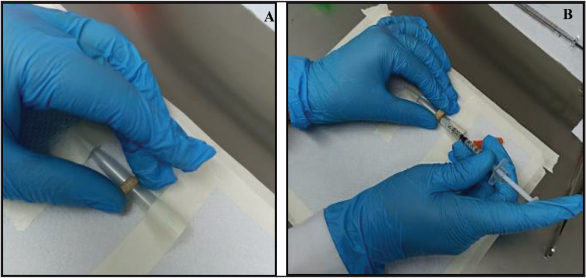
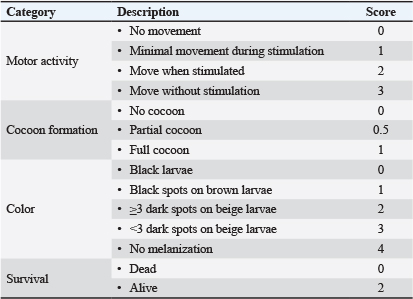
AbstractBackground: Galleria mellonella larvae (GML) are an alternative model for evaluating the in vivo antimicrobial activity of several medicinal plants. Tocosh, a traditional Peruvian food made from fermented potatoes, has been shown to have in vitro antibacterial properties; however, its in vivo effects remain unknown. Antibiotic-resistant Campylobacter coli is a bacterium implicated in gastrointestinal diseases in humans. Aim: In this study, GML were used as an in vivo model to evaluate the efficacy of ethanolic extract of tocosh (EET) against C. coli. Methods: Three trials were conducted on GML: (i) Evaluation of the safety of EET (3.50, 2.63, 1.75, and 0.88 mg/larva); (ii) Determination of lethal dose 50 (LD50) with different C. coli concentrations (1–8 Log CFU/ml); and (iii) Effect of the safety dosage of EET on GML infected with the LD50. In all trials, larval mortality was evaluated over 96 hours. Results: Dosage of 1.75 and 0.88 mg/larva of EET from both brands was harmless to GML. The LD50 was 7 Log CFU/ml for the SM19 strain and 6 Log CFU/ml for the American Type Culture Collection (ATCC) strain. GML inoculated with the SM19 strain and treated with the EET (0.88 mg/larva) showed a survival rate >70%, while those inoculated with the ATCC strain and treated with the EET (1.75 and 0.88 mg/larva) showed a survival rate >75%. Conclusion: The results obtained support the use of GMLs as an alternative experimental model for studies of the efficacy of tocosh against C. coli, with potential applications in veterinary medicine, clinical, and food microbiology. Keywords: Antimicrobial activity,Campylobacter coli, Galleria mellonella, Medicinal plants, Tocosh. IntroductionCampylobacter jejuni and Campylobacter coli represent the main causes of bacterial gastroenteritis (campylobacteriosis) in the human population (Myintzaw et al., 2023). These bacteria are associated with chronic gastrointestinal diseases (Barrett’s esophagus and colorectal cancer), as well as extra-gastrointestinal diseases (Guillain-Barré syndrome, severe demyelinating neuropathy, Miller Fisher syndrome, brain abscesses, meningitis, lung infections, bacteremia, and reactive arthritis) (Igwaran and Okoh, 2019; Ma et al., 2022). Campylobacter spp. are found in the intestines of chickens; however, it can reach humans primarily through sanitary deficiencies in slaughter and marketing, affecting ~550 million people each year, according to data from the World Health Organization. This situation results in high healthcare costs and economic losses totaling billions of dollars worldwide (Shen et al., 2018). Although campylobacteriosis is a self-limiting disease, children under 5 years of age, older adults, and people with compromised immune systems may require antibiotic treatment (Erythromycin, ciprofloxacin, and tetracycline) (Schiaffino et al., 2019; Zhang et al., 2023). However, resistance to different antibiotics has been reported in Campylobacter spp. isolated from chicken meat; this fact is largely due to the indiscriminate use of antibiotics not only in animals but also in humans (Luangtongkum et al., 2009; Shen et al., 2018; Anampa et al., 2020; Choi et al., 2021; Benites et al., 2022; Takeuchi et al., 2022). To address the growing risk of bacterial resistance worldwide, alternatives to conventional antimicrobials are being sought. Tocosh, a traditional Peruvian product made from fermenting potatoes (Solanum tuberosum) and known in popular culture for its antibiotic properties, is effective against Staphylococcus aureus American Type Culture Collection (ATCC 25923), Streptococcus mutans (ATCC 25175), and Streptococcus mitis (ATCC 49456) in vitro (Mayta-Tovalino et al., 2019; Enciso et al., 2020; Velasco-Chong et al., 2020); however, its effectiveness in in vivo models is limited. Research in animal models is fundamental for understanding host–pathogen interactions and the effects of antibiotics (Ménard et al., 2021). Galleria mellonella larvae (GML), an insect of the order Lepidoptera and the family Pyralidae (Marquina-Bazán and Carbajal De Wilson, 2017), have been proposed as an alternative invertebrate model for studies of microbial pathogenesis and preclinical antimicrobial trials. This model has proven sensitive to experimental infections with various bacterial and fungal pathogens. It possesses an innate immune system functionally analogous to that of mammals, composed of phagocytic hemocytes, melanin production, and antimicrobial peptides; furthermore, it offers significant advantages over vertebrate models, such as ease of handling, low cost, rapid reproduction, the possibility of incubation at 37°C, and the absence of strict ethical considerations (Desbois and Coote, 2011; Tsai et al., 2016; Ménard et al., 2021). Currently, several studies have proposed different therapeutic strategies using G. mellonella as an in vivo model (Cutuli et al., 2019). This research aimed to provide evidence for the use of G. mellonella as a valid and reproducible experimental model to evaluate the effect of tocosh (S. tuberosum) against C. coli, thereby facilitating the design of innovative strategies for pharmacological evaluation and antimicrobial surveillance. Materials and MethodsPreparation of the ethanolic extract of tocoshTwo commercial brands of tocosh flour (T1 and T2), produced in the regions of Junín (12° 2’ 34.457” S 75° 13’ 48.860” W) and Huánuco (9° 47’ 54.992” S 76° 21’ 25.281” W) in the highlands of Peru, were used. Packaged flours (airtight aluminum bag) with information of sanitary registration, production, and expiration date, and place of production were purchased from natural health stores (Cortez et al., 2025). Ethanolic extract of tocosh (EET) was prepared in amber bottles using 35 g of tocosh flour in 100 ml of 96% ethanol (Merck, Germany). Maceration was carried out for 7 days at room temperature (21°C) with manual shaking periods of 2 minutes once a day. Thereafter, the solution was filtered twice using circular filter paper No. 1 (Macherey Nagel, Germany), and the alcoholic solvent was evaporated using a rotary vacuum evaporator (DLab, China) at 60°C and 100 rpm. After dryness, the resulting white-beige paste (1.4 g) was collected, diluted in 4 ml of distilled water to obtain a solution of 350 mg/ml, and stored in amber tubes. The extraction yield was 4%. In order to in vivo evaluation in GML, four concentrations of EET (350, 262.5, 175, and 87.5 mg/ml) were prepared from that solution (Pesantes, 2015; Coaquira et al., 2020; Enciso et al., 2020). To compare the results with tocosh and an antibiotic, different concentrations of tetracycline hydrochloride (Sigma-Aldrich, Germany) were prepared in distilled water. All solutions (tocosh or tetracycline) were used within five days of preparation. Obtaining, conditioning, and handling of GMLA total of 3,000 larvae corresponding to the seventh-instar of 5-week-old (45-day-old) were selected by length (2–2.5 cm), weight (220–330 mg), and color (beige without melanization) from the Biocontrol Unit of the Servicio Nacional de Sanidad Agraria in Lima, Peru. Each week, 200 larvae were taken to the Veterinary Pharmacology and Toxicology Laboratory at the Universidad Nacional Mayor de San Marcos. GMLs were kept fasted for 24 hours at room temperature (21°C) before use in the assays (Chinivasagam, 2015). Larvae were randomly distributed in groups of 10, placed in Petri dishes (90 × 15 mm) with circular filter paper No. 1 (Macherey-Nagel, Germany). To facilitate handling during injection procedures, the Petri dish containing GMLs was placed on an ice pack (1°C) for 5 minutes. Subsequently, each immobilized larva was placed on a micropipette tip (1,000 µl), the last left protuberance was disinfected with a swab soaked in 70% alcohol (Fig. 1A) (Chinivasagam, 2015; Bojanić et al., 2020) and 10 µl was injected (Fig. 1B) with a 0.3-ml insulin syringe with a 31G hypodermic needle (BD Ultra-Fine, USA) at a 20° angle below the cuticle, reaching the hemocoel (Fredericks et al., 2020). After injection, the larvae were kept under fasting conditions at 37°C for 96 hours (Bojanić et al., 2020; Li et al., 2020). Determination of G. mellonella larval mortalityLarval mortality was determined using the health index by assigning a score of 0 or 1 (Table 1) according to motor activity, pupal formation, coloration, and survival (Tsai et al., 2016). Larval mortality was evaluated at 1, 5, 24, 48, 72, and 96 hours after application in all trials. Three replicates were performed for each group. Preparation of Campylobacter spp. solutions for injectionA tetracycline-resistant C. coli SM19 strain, previously isolated from chicken carcasses (GenBank accession number MT338511), and a C. coli ATCC-33559 reference strain (Microbiologics, USA) were used for the experiment. For reactivation, the cryovial with the strain was thawed, and the contents were transferred to a tube with 5 ml of brain heart infusion (BHI) broth, and incubated in jars (Oxoid®, UK) with a microaerophilic medium generation sachet (CampyGen™, Thermo Scientific, USA) at 42°C for 24 hours. Afterward, the BHI tube was centrifuged at 8,000 g for 10 minutes. The supernatant was discarded, and the precipitated pellet containing the bacteria was retained. The pellet was washed three times with 1 ml of phosphate-buffered saline (PBS at pH 7.4). Bacterial solution was determined by optical density at 600 nm for bacterial concentration of 8 Log CFU/ml, equivalent to 0.5 on the McFarland scale (Butcher and Stintzi, 2017). From this solution, seven 10-fold serial dilutions in sterile PBS were performed. These dilutions were used for the lethal dose 50 (LD50) determination assays.
Fig. 1. Positioning of the G. mellonella larvae on a 1,000 μl micropipette tip to visualize the last left protuberance (A). Procedure for holding the G. mellonella larvae and inoculation with a 0.3 ml insulin syringe (B). Table 1. Scoring scale for assessing the health status of G. mellonella larvae. Adapted from Tsai et al. (2016).
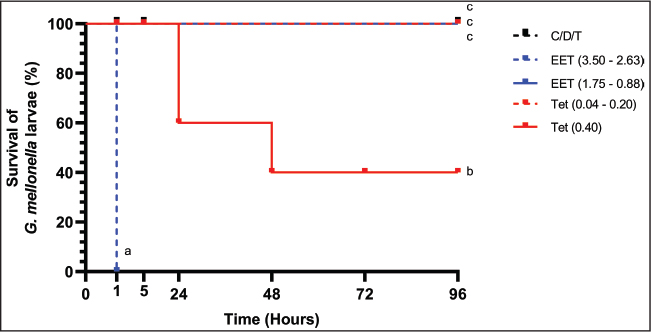
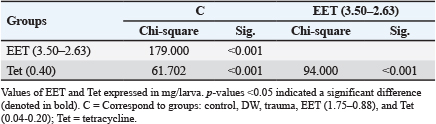
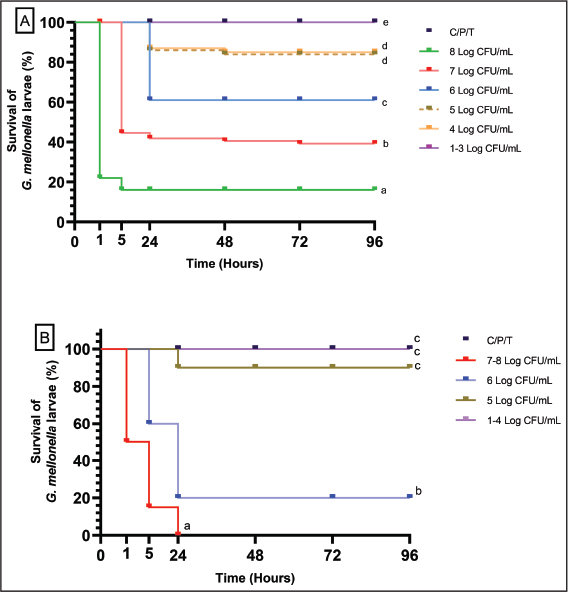
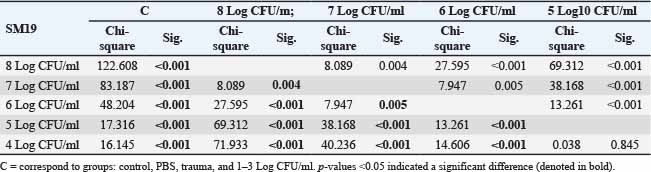
Trial 1: Effect of tocosh on uninfected larvaeTo ensure the safety of EET (350, 262.5, 175, and 87.5 mg/ml), 10 μl of each concentration was injected into GML, corresponding to a dosage of 3.50, 2.63, 1.75, and 0.88 mg/larva. In the same way, a tetracycline group, which was injected with 10 μl of tetracycline hydrochloride (Sigma-Aldrich, Germany) at concentrations of 4, 8, 12, 15, 20, and 40 mg/ml, corresponding to dosages of 0.04, 0.08, 0.12, 0.15, 0.20, and 0.40 mg/larva, was formed. Additional groups were formed: control, which received no inoculation; trauma, which was injured with a hypodermic needle; and Distilled water (DW) group, which received 10 μl of distilled water. Trial 2: Determining a C. coli LD50 for GMLSM19 and ATCC-33559 strains were inoculated at concentrations ranging from 1 to 8 Log CFU/ml in GML. The LD50 was calculated from these data and defined as the bacterial concentration that causes 50%–80% larval mortality. The larvae were inoculated with 10 μl of bacterial solution. Control, trauma, and PBS groups were formed. Trial 3: Effect of tocosh on larvae infected with C. coliBased on results regarding the EET safety and the LD50 for C. coli strains, the effect of tocosh on GML infected with C. coli was evaluated. For this purpose, groups of larvae inoculated with the LD50 of C. coli (SM19 and ATCC-33559) were treated with the dose of EET that proved safe in trial 1. Larvae inoculated with C. coli and treated with a safe dosage of tetracycline were also evaluated. Treatments (tocosh or tetracycline) were applied 15 minutes post-inoculation with C. coli. Control, Trauma, PBS, and DW groups were also formed. Statistical analysisKaplan–Meier survival curves were generated using GraphPad Prism version 8.4.3 (San Diego, CA), and differences in survival were analyzed using the Mantel-Cox log-rank test for multiple comparisons with SPSS version 27.0.1.0 (New York, USA). Differences were considered significant at p < 0.05. The LD50 was determined using probit analysis in SPSS at a 95% confidence level. Ethical approvalNot needed for this study. ResultsTrial 1: Effect of tocosh on uninfected larvaeGroups that received the EET at 3.50 and 2.63 mg/larva exhibited 100% mortality 1-hour post-application (Fig. 2). The larvae were observed to be immobile, unresponsive to stimuli, and melanized. In contrast, the larvae that received 1.75 and 0.88 mg/larva showed 100% survival throughout the 96-hour experiment. In these groups, the larvae remained active, some with partial or complete cocoon formation. These results were observed for both commercial brands of tocosh (T1 and T2). A survival of 100% was observed in larvae inoculated with tetracycline (0.04, 0.08, 0.12, 0.15, and 0.20 mg/larva). Larvae that received 0.40 mg/larva of tetracycline showed a survival of 57.6% (95% confidence interval [CI], 29.1–86.1) at 48 hours and remained constant throughout the experiment with a significant difference (p < 0.05) compared with other groups (Fig. 2, Table 2). Therefore, EET (1.75 and 0.88 mg/larva), as well as tetracycline (0.04, 0.08, 0.12, 0.15, and 0.20 mg/larva), were harmless to the larvae. Accordingly, these concentrations were selected for subsequent assays involving larvae inoculated with C. coli strains. Trial 2: Determining a C. coli LD50 for GMLThe results for the challenge with strain SM19 show that larvae inoculated with 8 Log CFU/mL exhibited a survival of 36.9% (95% CI, 29.6–44.3) at 5 hours and remained at this level until 96 hours. On the other hand, larvae treated with 7 Log CFU/ml showed a survival of 53.7% (95% CI, 45.9–61.5) at 96 hours. Larvae inoculated with 6 Log CFU/ml showed a survival of 67.9% (95% CI, 61.0–74.8) at 24 hours, which remained unchanged until 96 hours. The groups inoculated with 5 and 4 Log CFU/ml showed survival rates of 84.9% (95% CI, 79.9–89.9) and 85.7% (95% CI, 80.8–90.5), respectively, at 96 hours. The survival trend in all groups showed statistical difference (p < 0.05) with the exception of 4 and 5 Log CFU/ml. Finally, the groups inoculated with concentrations of 1, 2, and 3 Log CFU/ml, as well as the control, PBS, and trauma groups, showed 100% survival at 96 hours (Fig. 3A, Table 3).
Fig. 2. Kaplan–Meier survival of G. mellonella larvae inoculated with dosage of EET (3.50, 2.63, 1.75, and 0.88 mg/larva) and tetracycline (0.04, 0.08, 0.12, 0.15, 0.20, and 0.40 mg/larva). Larvae were kept fasted at 37°C for 96 hours. Different letters on the trend lines indicate a significant difference (p < 0.05) according to the Log-rank test. C/D/T: control, DW, and trauma larval groups that were not inoculated with the bacterial agent or treated with EET or tetracycline. EET from two commercial brands of tocosh flour. Tet=tetracycline. Table 2. Pairwise comparison of tocosh and tetracycline effect on G. mellonella larvae survival (Kaplan–Meier survival analysis with log-rank Mantel–Cox).
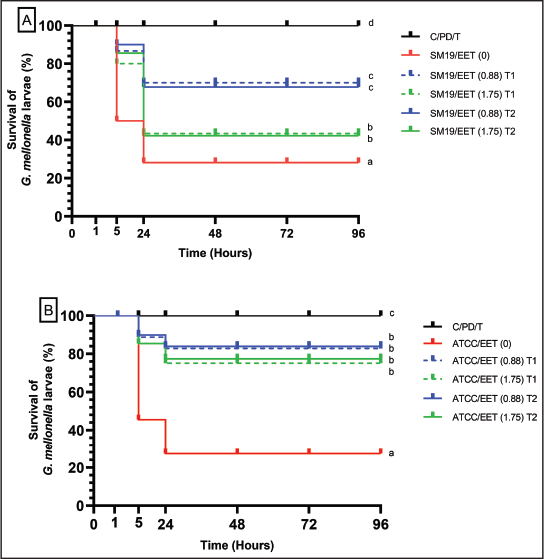
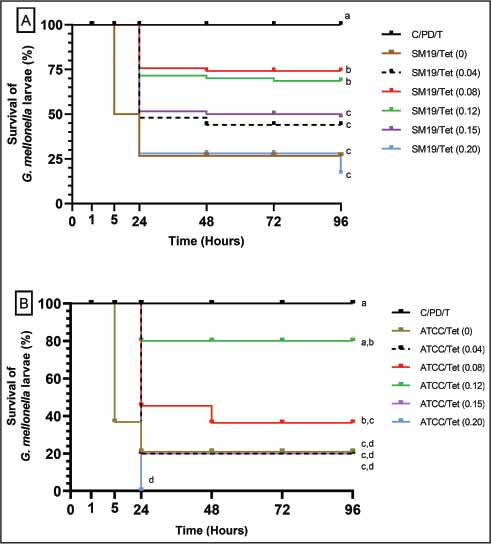
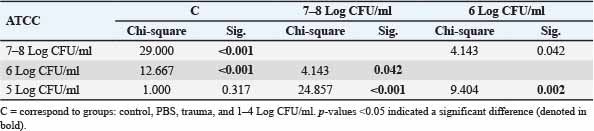
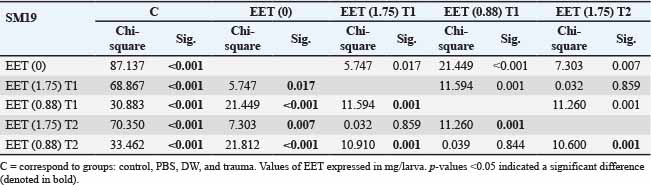
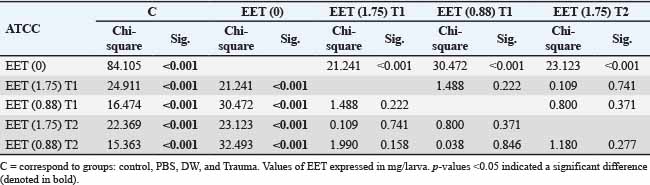
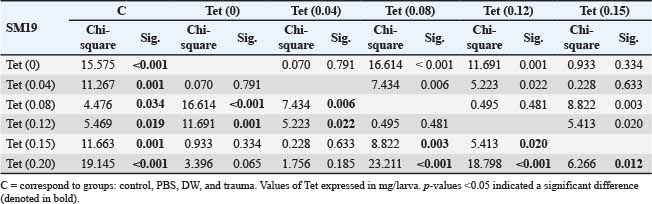
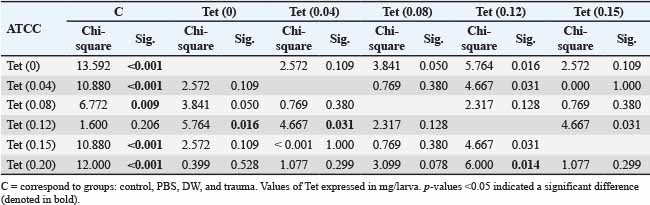
In larvae infected with the C. coli ATCC-33559 strain, the 6 Log CFU/ml concentration showed a survival of 38.4% (95% CI, 20.6–56.3) at 24 hours post-inoculation, and remained at this level until the end of the 96 hours. This trend was a significant difference (p < 0.05) compared with the other groups. On the other hand, concentrations of 7 and 8 Log CFU/ml resulted in a mortality of 100% at 24 hours. Finally, larvae receiving a concentration of 5 Log CFU/ml showed a survival of 88.8% (95% CI, 75.4–102.2) (Fig. 3B, Table 4). The control, PBS, trauma, and 1–4 Log CFU/ml groups showed no mortality over 96 hours. Probit analysis of the mortality/survival results of GML inoculated with field strains of C. coli revealed that the LD50 was projected to be 6.46 Log CFU/ml for strain SM19. In comparison, for strain ATCC-33559, LD50 was 5.61 Log CFU/ml. Based on these results, concentrations of 7 Log CFU/ml for strain SM19 and 6 Log CFU/mL for strain ATCC-33559 were selected for use in the evaluation of EET. Trial 3: Effect of tocosh on larvae infected with C. coliLarvae inoculated with the SM19 strain and not treated had a 39.8% (95% CI, 27.5–52.0) survival rate at 96 hours. In the case of GML treated with the EET at 0.88 mg/larva, survival rates were 73.2% (95% CI, 65.8–80.4) to brand T1 and 71.9% (95% CI, 64.7–79.1) to brand T2 at 96 hours. On the other hand, larvae treated with 1.75 mg/larva had survival rates of 53.4% (95% CI, 45.7–61.1) to brand T1 and 53.1% (95% CI, 45.5–70.7) to brand T2 at 96 hours. Regardless of the brand, EET of 0.88 mg/larva resulted in the highest GML survival rate with significant differences (p < 0.05) compared with the concentration of 1.75 mg/larva. The control, PBS, DW, and trauma groups showed no mortality over 96 hours (Fig. 4A, Table 5). In larvae inoculated with the ATCC-33559 strain and not treated, 38.7% (95% CI, 24.0–53.5) of survival was achieved at 96 hours. GML that received EET at 0.88 mg/larva, survival rates were 82.6% (95% CI, 76.5–88.8) to brand T1 and 83.5% (95% CI, 77.5–89.5) to brand T2 at 96 hours, while larvae that received EET at 1.75 mg/larva had survival rates of 76.8% (95% CI, 69.8–83.8) to brand T1 and 78.4% (95% CI, 71.6–85.2) to brand T2 at 96 hours. Despite these differences between the two dosages, they were not statistically significant (p > 0.05). These results show that both dosages ensured larval survival. Control, PBS, DW, and trauma groups had 100% survival over the 96 hours (Fig. 4B, Table 6 ). Results showed that larvae infected with the SM19 and treated with tetracycline (Fig. 5A, Table 7) expressed a highest survival with dosage of 0.08 and 0.12 mg/larva, with percentages of 77.8% (95% CI, 70.3–85.3) and 74.5% (95% CI, 66.7–82.3), respectively, at 96 hours, while larvae that received 0.15 mg/larva of tetracycline had a survival rate of 60.4% (95% CI, 51.2–69.6) at 96 hours. Larvae subjected to 0.04 and 0.20 mg/larva of tetracycline had survival rates of 56.6% (95% CI, 42.8–70.4) and 44.2% (95% CI, 31.2–57.2), respectively, at 96 hours. Furthermore, the group infected with the SM19 strain but not treated with tetracycline achieved a 54.1% (95% CI, 46.2–61.9) at 96 hours. In contrast, the control, PBS, DW, and trauma groups had 100% survival throughout the experiment. Tetracycline dosage of 0.08 and 0.12 mg/larva resulted in the best survival rates, which were significantly different (p < 0.05) from those at the other concentrations. On the other hand, larvae infected with C. coli ATCC strain (Fig. 5B, Table 8) and treated with 0.12 mg/larva of tetracycline presented a survival of 81.6% (95% CI, 56.4–106.8); on the other hand, GML treated with 0.08 mg/larva of tetracycline achieved at 48.0% (95% CI, 28.0–67.9) of survival at 96 hours. Larvae treated with 0.04 and 0.15 mg/larva showed a 38.4% (95% CI, 9.1–20.6) survival rate at 96 hours. Finally, larvae infected with the ATCC strain without any treatment had a 36% survival rate at 5 hours, which decreased to 27.2% (95% CI, 10.9–43.4) at 24 hours and remained at that level until 96 hours. The control, PBS, DW, and trauma groups had 100% survival throughout the experiment. The tetracycline dosage of 0.12 mg/larva showed the highest survival rate (p < 0.05) compared to the other concentrations.
Fig. 3. Kaplan–Meier survival in G. mellonella larvae inoculated with different concentrations (1–8 Log CFU/ml) of C. coli, strain SM19 (A) and strain ATCC-33559 (B). Larvae were kept fasted at 37°C for 96 hours. Different letters in the trend lines indicate a significant difference (p < 0.05) in the Log-rank test. C/P/T indicate control, PBS, and trauma larval groups, which were not inoculated with the bacterial agent. DiscussionWhen evaluating the effect of EET on GML, dosages of 3.50 and 2.63 mg/larva resulted in 100% mortality. The potato, from which tocosh is obtained, contains various components that can be toxic to GML. Adamski et al. (2014) evaluated the effect of α-solanine (0.13, 0.39, and 0.79 mg/100 g), one of the most important glycoalkaloids of potato, in GML diets and demonstrated that as the dose increases, larval survivor decreases; a similar result was observed by Büyükgüzel et al. (2013). Other factors such as variations in environmental conditions, the kind of potato, and the procedure of production (principally artisanal) must also be considered to final quality of tocosh in research (Gálvez-Ranilla, 2025). It is important to note that all GML trials involving plants must evaluate the toxic effects of compounds present in the extracts. Lalita et al. (2018) determined that acetone extracts from leaves and stems of six plants (Plantago psyllium, Hordeum sativum, Raphanus sativus, Linum usitatissimum, Cucurbita moschata, and Vicia sativa) caused mortality in GML. There are no reports of tocosh use in GML; however, Velasco-Chong et al. (2020) evaluated a tocosh flour in the diet of rats (1,000 mg/kg), once daily for 28 days, and reported no adverse effects or mortality. Table 3. Pairwise comparison of C. coli strain SM19 (CFU/ml) on G. mellonella larvae survival (Kaplan–Meier survival analysis with log-rank Mantel–Cox).
Fig. 4. Kaplan–Meier survival of G. mellonella larvae inoculated with C. coli, strain SM19 at a concentration of 7 Log CFU/ml (A) and strain ATCC-33559 at a concentration of 6 Log CFU/ml (B). Groups were treated with EET at dosages of 1.75 and 0.88 mg/larva. Larvae were maintained under fasting conditions at 37°C for 96 hours. Different letters on the trend lines indicate a significant difference (p < 0.05) in the Log-rank test. C/PD/T: control, PBS-DW, and trauma larval groups, which were not inoculated with the bacterial agent. T1 and T2=commercial brands of tocosh flour.
Fig. 5. Kaplan–Meier survival of G. mellonella larvae inoculated with C. coli field strain SM19 at a concentration of 7 Log CFU/ml (A) and strain ATCC-33559 at a concentration of 6 Log CFU/ml (B) treated with tetracycline (Tet) at dosages of 0.04, 0.08, 0.12, 0.15, and 0.20 mg/larva. Larvae were maintained under fasting conditions at 37°C for 96 hours. Different letters in the trend lines indicate a significant difference (p < 0.05) in the Log-rank test. C/PD/T=control, PBS-DW, and trauma larval groups, which were not inoculated with the bacterial agent. Furthermore, GML has been used to analyze the toxic effects of other natural compounds. Arsene et al. (2021) observed that ethanolic extracts of medicinal plants such as Azadirachta indica (leaves) and Cinchona officinalis (bark) presented an LD50 of 120.65 and 4.87 mg/ml in GMLs, respectively. The toxic effect could be related to the variety of active compounds in these plants, especially to the part used in the preparation of the extract. In another study, Siriyong et al. (2018) extracted alkaloids from the bark of the Holarrhena antidysenterica and demonstrated that a dose of 200 mg/kg injected into GML did not cause mortality. Regarding the evaluation of the effect of tetracycline, it was observed that dosages of 0.04, 0.08, 0.12, 0.15, and 0.20 mg/larva did not cause mortality in the GML; only the dosage of 0.40 mg/larva presented mortality. Ignasiak and Maxwell (2017) determined that doses up to 2,000 mg/kg of tetracycline (60 mg/ml approximately), dissolved in Dimethylsulfoxide, did not cause toxicity in GMLs. In our experiment, 0.40 mg/larva of tetracycline, dissolved in distilled water, produced 42.4% mortality. The toxic effect of high doses of antibiotics in GML has also been reported by Büyükgüzel and Kalender (2007). They administered increasing concentrations of penicillin (0.001, 0.01, 0.1, and 1.0 g per 100 g of diet) to GML and found that the higher concentrations increased malondialdehyde levels and produced alterations in antioxidant enzymes, indicating that the upper dose had a negative impact on larvae. It is likely associated with the antibiotic’s potential to predispose to immune response activation and generate stress in GML. This finding highlights the need for toxicological studies before proposing therapeutic regimens in alternative models (Tsai et al., 2016). In our experiment, GML mortality was accompanied by signs such as intense melanization (black larvae), loss of motility, and absence of cocoon formation. These signs have already been described as indicators of septicemia and/or immunosuppression in larvae infected by microorganisms (Champion et al., 2018). Mortality assessment using the larval health index is a reliable method for this invertebrate animal model and can also serve as an early indicator of bacterial infection (Loh et al., 2013). Table 4. Pairwise comparison of C. coli strain ATCC (CFU/ml) on G. mellonella larvae survival (Kaplan–Meier survival analysis with log-rank Mantel–Cox).
Table 5. Pairwise comparison of tocosh (mg/larva) on G. mellonella larvae inoculated with C. coli field strain SM19 (7 Log CFU/ml) (Kaplan–Meier survival analysis with log rank Mantel–Cox).
Table 6. Pairwise comparison of tocosh (mg/larva) on G. mellonella larvae inoculated with C. coli strain ATCC-3359 (6 Log CFU/ml) (Kaplan–Meier survival analysis with log-rank Mantel–Cox).
Control, PBS, and trauma groups showed 100% survival. This finding indicates that neither injection trauma nor the vehicle used (PBS) in the preparation of the bacterial inoculum has adverse effects on larval survival. This fact supports the validity of the inoculation procedures, as it does not compromise mortality in this model, allowing for a clear distinction between the effects induced by the pathogens and those of the tocosh extracts and tetracycline. The use of an appropriate needle gauge is also relevant to avoid stress responses in the larvae. Asai et al. (2019) recommended using 25G needles; however, in the present experiment, 31G needles were used, which resulted in less damage to the larva. The results in the control, PBS, and trauma groups were similar to those reported by Harding et al. (2013). Table 7. Pairwise comparison of tetracycline (mg/larva) on G. mellonella larvae inoculated with C. coli field strain SM19 (7 Log CFU/ml) (Kaplan–Meier survival analysis with log-rank Mantel–Cox).
Table 8. Pairwise comparison of tetracycline (mg/larva) on G. mellonella larvae inoculated with C. coli strain ATCC-33559 (6 Log CFU/ml) (Kaplan–Meier survival analysis with log-rank Mantel–Cox).
Larvae inoculated with the highest concentrations of C. coli strains showed higher mortality. This trend of reduced survival in larvae inoculated with higher bacterial concentrations has also been reported in Actinobacillus pleuropneumoniae (Pereira et al., 2015), Enterobacter cloacae (Yang et al., 2017), Clostridium perfringens (Kay et al., 2019), Mycobacterium tuberculosis (Asai, 2022), and Legionella pneumophila (Harding et al., 2013). These studies support our findings, which show that the number of viable infectious bacteria is negatively correlated with GML survival (Entwistle and Coote, 2018). A concentration of 7 Log CFU/ml of C. coli SM19 strain and 6 Log CFU/ml of C. coli ATCC strain was selected to evaluate the effect of tocosh extracts. According to Tsai et al. (2016) the LD50 is defined as the concentration that causes 50%–80% mortality of the larvae. Similarly, Li et al. (2020) inoculated 7 Log CFU/ml of S. aureus, achieving 100% mortality, whereas with 6 Log CFU/ml, mortality ranged from 70% to 90%. These bacterial concentrations were selected as the inoculum for the model efficacy experiments, similar to those used in our study. Concentrations above 7 Log CFU/ml have been referenced as lethal doses, even achieving 100% mortality post-inoculation of Escherichia coli (Andrea et al., 2019). Choosing sublethal concentrations is a common strategy in studies with G. mellonella to evaluate the impact of antibiotic treatment without interference from early mortality (Desbois and Coote, 2011; Ignasiak and Maxwell, 2017). Several reports suggest variations in the concentration of bacteria used to infect GML. Champion et al. (2010) used 6 Log CFU/ml of three different strains of C. jejuni, isolated from humans, to infect GML and obtained survival rates of 36%, 25%, and 46% at 24 hours post-inoculation. On the other hand, Kay et al. (2019) evaluated strains of C. perfringens (field and ATCC 13124), finding a 73% survival rate in larvae inoculated with 5 Log CFU/larva from the field strains; however, the 7 Log CFU/larva inoculum of the ATCC strain did not cause mortality. Pereira et al. (2015) reported differences in the likelihood of infection by A. pleuropneumoniae inoculated into GML; these differences may be related to the increased inoculum concentration. They also indicated that the larval immune system might have inhibited larvae inoculated with low-virulence strains. A similar finding was reported by Bojanić et al. (2020) who determined that C. upsaliensis and C. helveticus had lower pathogenic potential than C. jejuni, attributed to the rapid clearance of the bacterial load from the hemolymph and the inability of these strains to survive in hemocytes. These results suggest that, in addition to the concentration of bacteria in the inoculum, GML mortality is influenced by strain virulence, which can vary. It reinforces the importance of determining the LD50 for each bacterial strain to be evaluated using the GML model, especially in research aimed at testing the efficacy of antimicrobial treatments. Our work is the first study to evaluate the effect of tocosh on GML infected with C. coli strains. However, the in vitro effect of tocosh extract against C. coli was evaluated by Cortez et al. (2025). They observed a reduction in bacterial growth with MIC values ranging from 43.75 to 87.5 mg/ml. These results are important because the next step was to evaluate the tocosh in in vivo models. Other in vitro studies have reported antimicrobial effects of tocosh. Mayta-Tovalino et al. (2019) developed a toothpaste containing a 20% tocosh-based ethanolic extract that showed activity against S. aureus and S. mutans. Yabar Villanueva et al. (2019) determined that 20% traditional-prepared tocosh and 25% laboratory-prepared tocosh inhibit the growth of S. aureus and E. coli, respectively. Enciso et al. (2020) determined that the hydroalcoholic extract of tocosh at 100, 75%, 50%, and 25% formed inhibition halos (ranging from 33 to 20 mm) against S. mutans; this reduction was proportional to the tocosh concentration. Huayhua Mamani et al. (2022) tested the effect of an aqueous extract of tocosh (29–39 mg) against Salmonella enterica subspecies enterica serovar Typhimurium. The variety of tocosh effect on bacteria may be associated with some chemical properties of the potato. Bártová et al. (2019) suggested that potato proteins (Potide-G, AFP-J, Potamin-1, or PG-2) could exhibit antimicrobial activity against S. aureus, Listeria monocytogenes, and E. coli. Amanpour et al. (2015) showed that ethanolic extracts of potato peel exhibited different inhibition halos, being more effective (14 mm) in Gram-positive (S. aureus) than Gram-negative (Pseudomonas aeruginosa) (8 mm). The authors indicate that this effect is attributable to the phenolic compounds, anthocyanins, and flavonoids present in potato peel. Helmi et al. (2024) also evaluated potato peel from two types of extraction (aqueous and infrared-assisted), obtaining inhibition halos of <14 mm for L. monocytogenes, Proteus sp., and Salmonella sp.; they also found that the most present phenolic compounds in the extracts were catechin and chlorogenic acid. The antimicrobial mechanism of chlorogenic acid in Gram-positive and Gram-negative bacteria is based on destroying the cell membrane and interfering with the metabolism and cell cycle (Wang et al., 2022). Chlorogenic acid and other phenolic compounds showed an anti-Campylobacter activity in antibiotic-susceptible/-resistance C. coli and C. jejuni strains isolated from poultry, pig, human, and water (Klančnik et al., 2012). Not all compounds in natural products are safe for G. mellonella. According to Adamski et al. (2014) there is a negative correlation between the high dosage of α-solanine (glycoalkaloid present in potato) and the reduction of GML survival. This explains why the better effect in GML survival of the EET at 0.88 mg/larva instead of 1.75 mg/larva. Variations in antibiotic response depend on several factors, including the microorganism’s resistance. Pereira et al. (2015) evaluated the effect of tetracycline (6 mg/kg) on GML exposed to a lethal dose (104 CFU/larva) of tetracycline-resistant A. pleuropneumoniae strain. They found that larvae had a survival rate of less than 10% at 96 hours post-treatment. On the other hand, Kay et al. (2019) applied a dose of 64 mg/kg (16 µg/larva) to GMLs infected with C. perfringens (107 CFU/ml), resulting in a 79% survival rate, attributing this to the bacteriostatic capacity and broad spectrum of this antibiotic. It could also be an argument in our study, since Benites et al. (2022) and Cáceres-Bautista et al. (2025) reported 100% tetracycline resistance and MICs above 256 µg/ml in several C. coli strains from chickens in Peru, one of them (SM19), was employed in our experiment. Other antibiotics were also tested on GML. Yang et al. (2017) evaluated the impact of piperacillin (100 mg/kg), ciprofloxacin (10 mg/kg), amikacin (15 mg/kg), imipenem (50 mg/kg), and cefotaxime (150 mg/kg) on GML infected with two different strains of E. cloacae and found that these antibiotics prolonged larval survival inoculated only for one E. cloacae strain. It reinforces the importance of conducting trials with field strains rather than extrapolating results to the bacterial species. Li et al. (2020) observed that GML inoculated with S. aureus and treated with the combination of linezolid and fosfomycin inhibited bacterial growth in the larval hemolymph for 24 hours, compared with infected, untreated GML, which showed an approximate load of 11 Log CFU/ml at 24 hours. The GML model can be used to evaluate the antimicrobial effects of natural products, such as tocosh, against C. coli strains, demonstrating that it can be implemented in conventional microbiology laboratories. This model has gained popularity in recent years as a useful tool in medical and veterinary microbiology due to its low cost, ease of use, lack of ethical restrictions, and innate immune response that surprisingly resembles that of mammals in terms of cellular and humoral functions (Desbois and Coote, 2011; Tsai et al., 2016). Galleria mellonella will not replace a mammalian model, but it can be used to transition from in vitro results to an initial in vivo model. The major disadvantage of this model is the lack of standardized protocols for experimental procedures; efforts to improve it provide reproducible protocols and accurate results. In this work, the model’s ability to discriminate between bacterial strains with different levels of virulence and to respond differently to various concentrations of tocosh extracts and tetracycline enabled an efficient preliminary evaluation to determine a possible therapeutic dose. ConclusionExperimental infection of GML with a load of 6–7 Log CFU/ml of C. coli allowed the evaluation of the antimicrobial effect of the EET, with dosages of 1.75 and 0.88 mg/larva, which were effective in reducing mortality. Although tocosh would have an effect against C. coli, it is not possible to extrapolate this to other groups of bacteria, not only for variations in bacterial virulence but also for a lack of standardization in tocosh production. Further research is necessary to evaluate the antimicrobial effect of tocosh in other bacteria; likewise, the identification, isolation, and evaluation of chemical compounds such as phenolic acids and peptides in tocosh must be the next step to establish its antimicrobial chemical properties. In addition, variations in the selection of GML and how tocosh is made/extracted represent the major troubles in the use of this model in natural products. AcknowledgmentsNone. FundingThis research was funded by CONCYTEC-PROCIENCIA in the framework of the call “Tesis de Pregrado y Postgrado en Ciencia, Tecnología e Innovación Tecnológica - Concurso E073-2024-01; PE501089669-2024”, and by Universidad Nacional Mayor de San Marcos in the framework of the call “Proyectos de Investigación con Financiamiento para Grupos de Investigación” [Code: A23080991 and A24080391] and Programa de Proyectos Interdisciplinarios para el fomento de la Cooperación Interinstitucional en Investigación e Innovación - Política Nacional de Educación Superior Técnico Productiva 2021 (Code: A2108001i). Conflict of interestThe authors declare that there are no conflicts of interest. FundingNone. Authors’ contributionsConceptualization, C.L.; methodology, A.C., P.C., C.L., and M.R.; formal analysis, C.L. and M.R.; investigation, A.C. and P.C.; resources, A.C. and C.L.; writing—original draft preparation, C.L.; writing—review and editing, C.L., A.C., P.C., M.R., and C.C.; visualization, C.L.; supervision, C.L. and C.C.; project administration, C.L. and A.C.; funding acquisition, C.L. and A.C. All authors have read and agreed to the published version of the manuscript. Data availabilityAll data supporting the findings of this study are available within the manuscript. ReferencesAdamski, Z., Marciniak, P., Ziemnicki, K., Büyükgüzel, E., Erdem, M., Büyükgüzel, K., Ventrella, E., Falabella, P., Cristallo, M., Salvia, R., Bufo, S.A. and Scrano, L. 2014. Potato leaf extract and its component, and alpha;-solanine, exert similar impacts on development and oxidative stress in Galleria mellonella L. Arch. Insect Biochem. Physiol. 87(1), 26–39; doi:10.1002/arch.21177 Amanpour, R., Abbasi-maleki, S., Neyriz-naghadehi, M. and Asadi-samani, M. 2015. Antibacterial effects of Solanum tuberosum peel ethanol extract in vitro. J. HerbMed. Pharmacol. 4(2), 45–48. Anampa, D., Benites, C., Lázaro, C., Espinoza, J., Angulo, P., Díaz, D., Manchego, A. and Rojas, M. 2020. Detección del gen ermB asociado a la resistencia a macrólidos en cepas de Campylobacter aisladas de pollos comercializados en Lima, Perú. Rev. Panam. Salud Publica. 44, e60; doi:10.26633/RPSP.2020.60 Andrea, A., Krogfelt, K.A. and Jenssen, H. 2019. Methods and challenges of using the greater wax moth (Galleria mellonella) as a model organism in antimicrobial compound discovery. Microorganisms 7(3), 85; doi:10.3390/microorganisms7030085 Arsene, M., Viktorovna, P. and Davares, A. 2021. Galleria mellonella (greater wax moth) as an eco-friendly in vivo approach for the assessment of the acute toxicity of medicinal plants: application to some plants from Cameroon. Open. Vet. J. 11(4), 651; doi:10.5455/OVJ.2021.v11.i4.15 Asai, M. 2022. Galleria mellonella: an infection model for the Mycobacterium tuberculosis complex. PhD thesis, Imperial College, London, UK. doi: 10.25560/96932 Asai, M., Li, Y., Khara, J.S., Gladstone, C.A., Robertson, B.D., Langford, P.R. and Newton, S.M. 2019. Use of the invertebrate Galleria mellonella as an infection model to study the Mycobacterium tuberculosis Complex. J. Vis. Exp. 148(148), e59703. Bártová, V., Bárta, J. and Jarošová, M. 2019. Antifungal and antimicrobial proteins and peptides of potato (Solanum tuberosum L.) tubers and their applications. Appl. Microbiol. Biotechnol. 103(14), 5533–5547; doi:10.1007/s00253-019-09887-9 Benites, C., Anampa, D., Torres, D., Avalos, I., Rojas, M., Conte, C. and Lázaro, C. 2022. Prevalence, tetracycline resistance and Tet(O) gene identification in pathogenic Campylobacter strains isolated from chickens in retail markets of Lima, Peru. Antibiotics 11(11), 1158; doi:10.3390/antibiotics11111580 Bojanić, K., Acke, E., Roe, W.D., Marshall, J.C., Cornelius, A.J., Biggs, P.J. and Midwinter, A.C. 2020. Comparison of the pathogenic potential of Campylobacter jejuni, C. upsaliensis and C. helveticus and limitations of using larvae of Galleria mellonella as an infection model. Pathogens 9(9), 1–15; doi:10.3390/pathogens9090713 Butcher, J. and Stintzi, A. 2017. Campylobacter jejuni. Methods and protocols. New York, NY: Springer. Büyükgüzel, E. and Kalender, Y. 2007. Penicillin-induced oxidative stress: effects on antioxidative response of midgut tissues in instars of Galleria mellonella. J. Econ. Entomol. 100(5), 1533–1541; doi:10.1093/jee/100.5.1533 Büyükgüzel, E., Büyükgüzel, K., Erdem, M., Adamski, Z., Adamski, Z., Marciniak, P., Ziemnicki, K., Ventrella, E., Scrano, L. and Bufo, S.A. 2013. The influence of dietary α-solanine on the waxmoth Galleria mellonella. Arch. Insect. Biochem. Physiol. 83(1), 15–24. Cáceres-Bautista, K.N., Arroyo-Acevedo, J.L., Justil-Guerrero, H.J., Tinco-Jayo, J.A., Enciso-Roca, E.C., Aguilar-Felices, E.J., Rojas-Montes, M.A., Diaz-Coahila, D. and Lázaro-de La Torre, C.A. 2025. Determination of antibiotic resistance using three phenotypic methods in Campylobacter coli strains isolated from commercial chicken meat in Lima, Peru. Rev. Peru. Med. Exp. Salud. Publica. 42(2), 147–155; doi:10.17843/rpmesp.2025.422.14330 Champion, O.L., Karlyshev, A.V., Senior, N.J., Woodward, M., La Ragione, R., Howard, S.L., Wren, B.W. and Titball, R.W. 2010. Insect infection model for Campylobacter jejuni reveals that O-methyl phosphoramidate has insecticidal activity. J. Infect. Dis. 201(5), 776–782; doi:10.1086/650494 Champion, O.L., Titball, R.W. and Bates, S. 2018. Standardization of G. mellonella larvae to provide reliable and reproducible results in the study of fungal pathogens. J. Fungi 4(3), 108; doi:10.3390/jof4030108 Chinivasagam, H.N. 2015. Development of an insect model to assess phage/Campylobacter interactions. Proyect report. Australia Poultry CRC. Choi, J.H., Moon, D.C., Mechesso, A.F., Kang, H.Y., Kim, S.J., Song, H.J., Yoon, S.S. and Lim, S.K. 2021. Antimicrobial resistance profiles and macrolide resistance mechanisms of Campylobacter coli isolated from pigs and chickens. Microorganisms 9(5), 1077; doi: 10.3390/microorganisms9051077 Coaquira, S., Quispe, R., Coaquira Machaca, S. and Quispe Mamani, R.V. 2020. Estudio comparativo del efecto antibacteriano de tres marcas del tocosh (Solanum tuberosum) frente a Staphylococcus aureus ATCC 25923 Arequipa-2019, Bachelor thesis, Universidad Privada Autónoma del Sur, Arequipa, Perú. Cortez, R., Arroyo, A., Justil, G., Aguilar, F., Enciso, R., Tinco, J., Díaz, C., Angulo, H. and Lázaro, T. 2025. Actividad antimicrobiana de la harina de tocosh (Solanum tuberosum L.) en cepas de Campylobacter coli aisladas de carne de pollo. Rev. Investig. Vet. Del Perú 36(3), 28266; doi:10.15381/rivep.36i3.28266 Cutuli, M.A., Petronio Petronio, G., Vergalito, F., Magnifico, I., Pietrangelo, L., Venditti, N. and Di Marco, R. 2019. Galleria mellonella as a consolidated in vivo model hosts: new developments in antibacterial strategies and novel drug testing. Virulence 10(1), 527–541; doi:10.1080/21505594.2019.1621649 Desbois, A.P. and Coote, P.J. 2011. Wax moth larva (Galleria mellonella): an in vivo model for assessing the efficacy of antistaphylococcal agents. J. Antimicrob. Chemother. 66(8), 1785–1790; doi:10.1093/jac/dkr198 Enciso, S., Medina, J., Mauricio, F., Mauricio-Vilchez, C., Alvitez-Temoche, D., Vilchez, L. and Mayta-Tovalino, F. 2020. Antibacterial effectiveness of four concentrations of the hydroalcoholic extract of Solanum tuberosum (Tocosh) against Streptococcus mutans ATCC 25175 TM: a comparative in vitro study. Int. J. Dent. 1, 1–5; doi:10.1155/2020/8856382 Entwistle, F.M. and Coote, P.J. 2018. Evaluation of greater wax moth larvae, Galleria mellonella, as a novel in vivo model for non-tuberculosis Mycobacteria infections and antibiotic treatments. J. Med. Microbiol. 67(4), 585–597; doi:10.1099/jmm.0.000696 Fredericks, L.R., Lee, M.D., Roslund, C.R., Crabtree, A.M., Allen, P.B. and Rowley, P.A. 2020. The design and implementation of restraint devices for the injection of pathogenic microorganisms into Galleria mellonella. PLos One 15(7), 1–11; doi:10.1371/journal.pone.0230767 Gálvez-Ranilla, L. 2025. Traditional andean potato-based fermented foods and their potential for health. In Fermentation Biotechnology for Functional Foods. Shetty, K. and Gálvez Ranilla, L Boca Ratón, FL: CRC Press, pp: 396–413. https://doi.org/10.1201/9781003605300-25 Harding, C.R., Schroeder, G.N., Collins, J.W. and Frankel, G. 2013. Use of Galleria mellonella as a model organism to study Legionella pneumophila infection. J. Vis. Exp. 81, 1–10; doi:10.3791/50964 Helmi, L., Al Khatib, A., Rajha, H.N., Debs, E., Jammoul, A., Louka, N. and El Darra, N. 2024. Valorization of potato peels (Solanum tuberosum) using infrared-assisted extraction: a novel sprouting suppressant and antibacterial agent. Foods 13(21), 3445; doi:10.3390/foods13213445 Huayhua Mamani, H.J., García Castro, R.A. and Llapa Medina, M.P. 2022. Efecto antibacteriano del tocosh de papa (Solanum tuberosum Var. Hualash) sobre Salmonella enterica subespecie enterica serovar Typhimurium ATCC 13311. Rev. Lasallista. Investig. 19(2), 49–62; doi:10.22507/RLI.V19N2A4 Ignasiak, K. and Maxwell, A. 2017. Galleria mellonella (greater wax moth) larvae as a model for antibiotic susceptibility testing and acute toxicity trials. BMC. Res. Notes. 10(1), 1–8; doi:10.1186/s13104-017-2757-8 Igwaran, A. and Okoh, A.I. 2019. Human Campylobacteriosis: a public health concern of global importance. Heliyon 5(11), 2814; doi:10.1016/J.HELIYON.2019.E02814 Kay, S., Edwards, J., Brown, J. and Dixon, R. 2019. Galleria mellonella infection model identifies both high and low lethality of Clostridium perfringens toxigenic strains and their response to antimicrobials. Front. Microbiol. 10, 1281; doi:10.3389/fmicb.2019.01281 Klančnik, A., Možina, S.S. and Zhang, Q. 2012. Anti-Campylobacter activities and resistance mechanisms of natural phenolic compounds in Campylobacter. PLos One 7, e51800; doi:10.1371/journal.pone.0051800 Lalita, Kumar, Y. and Yadav, S. 2018. Effectiveness of different plant extracts against Galleria mellonella larvae in laboratory. Arch. Agric. Environ. Sci. 3(1), 64–67; doi:10.26832/24566632.2018.030109 Li, L., Chen, H., Liu, Y., Xu, S., Wu, M., Liu, Z., Qi, C., Zhang, G., Li, J. and Huang, X. 2020. Synergistic effect of linezolid with fosfomycin against Staphylococcus aureus in vitro and in an experimental Galleria mellonella model. J. Microbiol. Immunol. Infect. 53(5), 731–738; doi:10.1016/J.JMII.2018.12.007 Loh, J.M., Adenwalla, N., Wiles, S. and Proft, T. 2013. Galleria mellonella larvae as an infection model for group A Streptococcus. Virulence 4(5), 419–428; doi:10.4161/viru.24930 Luangtongkum, T., Jeon, B., Han, J., Plummer, P., Logue, C.M. and Zhang, Q. 2009. Antibiotic resistance in Campylobacter: emergence, transmission and persistence. Future Microbiol. 4(2), 189–200. Ma, L., Feng, J., Zhang, J. and Lu, X. 2022. Campylobacter biofilms. Microbiol. Res. 264(2022), 127149; doi:10.1016/j.micres.2022.127149 Marquina-Bazán, R. and Carbajal De Wilson, A. 2017. Efecto de la temperatura en el ciclo de desarrollo de Galleria mellonella (Lepidóptera: pyralidae). REBIOL 37(2), 63–69. Mayta-Tovalino, F., Sedano-Balbin, G., Romero-Tapia, P., Alvítez-Temoche, D., Álvarez-Paucar, M., Gálvez-Calla, L. and Sacsaquispe-Contreras, S. 2019. Development of new experimental dentifrice of peruvian Solanum tuberosum (Tocosh) fermented by water stress: antibacterial and cytotoxic activity. J. Contemp. Dent. Pract. 20(10), 1206–1211; doi:10.5005/jp-journals-10024-2681 Ménard, G., Rouillon, A., Cattoir, V. and Donnio, P.Y. 2021. Galleria mellonella as a suitable model of bacterial infection: past, present and future. Front. Cell. Infect. Microbiol. 11, 782733; doi:10.3389/fcimb.2021.782733 Myintzaw, P., Jaiswal, A.K. and Jaiswal, S. 2023. A review on Campylobacteriosis associated with poultry meat consumption. Food Rev. Int. 39(4), 2107–2121; doi:10.1080/87559129.2021.1942487 Pereira, M.F., Rossi, C.C., Vieira De Queiroz, M., Martins, G.F., Isaac, C., Bossé, J.T., Li, Y., Wren, B.W., Terra, V.S., Cuccui, J., Langford, P.R. and Bazzolli, D.M.S. 2015. Galleria mellonella is an effective model to study Actinobacillus pleuropneumoniae infection. Microbiology 161(2), 387–400; doi:10.1099/mic.0.083923-0 Pesantes, P. 2015. Efecto antibacteriano in vitro de Solanum tuberosum (papa fermentada) en cepas de Escherichia coli comparado con gentamicina y ceftriaxona. Bachelor thesis, Universidad privada Atenor Orrego, Trujillo, Perú. Schiaffino, F., Platts-Mills, J. and Kosek, M.N. 2019. A One Health approach to prevention, treatment, and control of Campylobacteriosis. Curr. Opin. Infect. Dis. 32(5), 453–460; doi:10.1097/QCO.0000000000000570 Shen, Z., Wang, Y., Zhang, Q. and Shen, J. 2018. Antimicrobial resistance in Campylobacter spp. Microbiol. Spectr. 6(2); doi: 10.1128/microbiolspec.arba-0013-2017 Siriyong, T., Voravuthikunchai, S.P. and Coote, P.J. 2018. Steroidal alkaloids and conessine from the medicinal plant Holarrhena antidysenterica restore antibiotic efficacy in a Galleria mellonella model of multidrug-resistant Pseudomonas aeruginosa infection. BMC Complement. Altern. Med. 18(1), 285; doi:10.1186/s12906-018-2348-9 Takeuchi, M.G., De Melo, R.T., Dumont, C.F., Peixoto, J.L.M., Ferreira, G.R.A., Chueiri, M.C., Iasbeck, J.R., Timóteo, M.F., De Araújo Brum, B. and Rossi, D.A. 2022. Agents of Campylobacteriosis in different meat matrices in Brazil. Int. J. Environ. Res. Public. Health. 19(10), 6087; doi:10.3390/ijerph19106087 Tsai, C.J.Y., Loh, J.M.S. and Proft, T. 2016. Galleria mellonella infection models for the study of bacterial diseases and for antimicrobial drug testing. Virulence 7(3), 214–229; doi:10.1080/21505594.2015.1135289 Velasco-Chong, J.R., Herrera-Calderón, O., Rojas-Armas, J.P., Hañari-Quispe, R.D., Figueroa-Salvador, L., Peña-Rojas, G., Andía-Ayme, V., Yuli-Posadas, R.A., Yepes-Perez, A.F. and Aguilar, C. 2020. Tocosh flour (Solanum tuberosum L.): a Toxicological Assessment of traditional Peruvian fermented potatoes. Foods 9(6), 719; doi:10.3390/foods9060719 Wang, L., Pan, X., Jiang, L., Chu, Y., Gao, S., Jiang, X., Zhang, Y., Chen, Y., Luo, S. and Peng, C. 2022. The biological activity mechanism of chlorogenic acid and its applications in food industry: a review. Front. Nutr. 9, 943911; doi:10.3389/fnut.2022.943911 Yabar Villanueva, E., Reyes De La Cruz, V. and Casas Vásquez, J. 2019. Evaluación de la actividad antioxidante y antibacteriana del tocosh de papa (Solanum tuberosum). J. Agri-food. Sci. 1(1), 47–52. Yang, H.F., Pan, A.J., Hu, L.F., Liu, Y.Y., Cheng, J., Ye, Y. and Li J Bin. 2017. Galleria mellonella as an in vivo model for assessing the efficacy of antimicrobial agents against Enterobacter cloacae infection. J. Microbiol. Immunol. Infect. 50(1), 55–61; doi:10.1016/J.JMII.2014.11.011 Zhang, Q., Beyi, A.F. and Yin, Y. 2023. Zoonotic and antibiotic-resistant Campylobacter: a view through the One Health lens. One. Heal. Adv. 1(1), 1–9; doi:10.1186/s44280-023-00003-1 | ||
| How to Cite this Article |
| Pubmed Style Chagua A, Cristobal P, Conte-junior C, Rojas M, Chagua CLA, Cristobal P, Rojas M, Conte C, Lázaro C. Use of Galleria mellonella as an in vivo model to evaluate the efficacy of tocosh (Solanum tuberosum) against Campylobacter coli. Open Vet. J.. 2026; 16(8): 5215-5229. doi:10.5455/OVJ.2026.v16.i8.17 Web Style Chagua A, Cristobal P, Conte-junior C, Rojas M, Chagua CLA, Cristobal P, Rojas M, Conte C, Lázaro C. Use of Galleria mellonella as an in vivo model to evaluate the efficacy of tocosh (Solanum tuberosum) against Campylobacter coli. https://www.openveterinaryjournal.com/?mno=315439 [Access: August 08, 2026]. doi:10.5455/OVJ.2026.v16.i8.17 AMA (American Medical Association) Style Chagua A, Cristobal P, Conte-junior C, Rojas M, Chagua CLA, Cristobal P, Rojas M, Conte C, Lázaro C. Use of Galleria mellonella as an in vivo model to evaluate the efficacy of tocosh (Solanum tuberosum) against Campylobacter coli. Open Vet. J.. 2026; 16(8): 5215-5229. doi:10.5455/OVJ.2026.v16.i8.17 Vancouver/ICMJE Style Chagua A, Cristobal P, Conte-junior C, Rojas M, Chagua CLA, Cristobal P, Rojas M, Conte C, Lázaro C. Use of Galleria mellonella as an in vivo model to evaluate the efficacy of tocosh (Solanum tuberosum) against Campylobacter coli. Open Vet. J.. (2026), [cited August 08, 2026]; 16(8): 5215-5229. doi:10.5455/OVJ.2026.v16.i8.17 Harvard Style Chagua, A., Cristobal, . P., Conte-junior, . C., Rojas, . M., Chagua, . C. L. A., Cristobal, . P., Rojas, . M., Conte, . C. & Lázaro, . C. (2026) Use of Galleria mellonella as an in vivo model to evaluate the efficacy of tocosh (Solanum tuberosum) against Campylobacter coli. Open Vet. J., 16 (8), 5215-5229. doi:10.5455/OVJ.2026.v16.i8.17 Turabian Style Chagua, Ashly, Paula Cristobal, Carlos Conte-junior, Miguel Rojas, César Lázaro Ashly Chagua, Paula Cristobal, Miguel Rojas, Carlos Conte, and César Lázaro. 2026. Use of Galleria mellonella as an in vivo model to evaluate the efficacy of tocosh (Solanum tuberosum) against Campylobacter coli. Open Veterinary Journal, 16 (8), 5215-5229. doi:10.5455/OVJ.2026.v16.i8.17 Chicago Style Chagua, Ashly, Paula Cristobal, Carlos Conte-junior, Miguel Rojas, César Lázaro Ashly Chagua, Paula Cristobal, Miguel Rojas, Carlos Conte, and César Lázaro. "Use of Galleria mellonella as an in vivo model to evaluate the efficacy of tocosh (Solanum tuberosum) against Campylobacter coli." Open Veterinary Journal 16 (2026), 5215-5229. doi:10.5455/OVJ.2026.v16.i8.17 MLA (The Modern Language Association) Style Chagua, Ashly, Paula Cristobal, Carlos Conte-junior, Miguel Rojas, César Lázaro Ashly Chagua, Paula Cristobal, Miguel Rojas, Carlos Conte, and César Lázaro. "Use of Galleria mellonella as an in vivo model to evaluate the efficacy of tocosh (Solanum tuberosum) against Campylobacter coli." Open Veterinary Journal 16.8 (2026), 5215-5229. Print. doi:10.5455/OVJ.2026.v16.i8.17 APA (American Psychological Association) Style Chagua, A., Cristobal, . P., Conte-junior, . C., Rojas, . M., Chagua, . C. L. A., Cristobal, . P., Rojas, . M., Conte, . C. & Lázaro, . C. (2026) Use of Galleria mellonella as an in vivo model to evaluate the efficacy of tocosh (Solanum tuberosum) against Campylobacter coli. Open Veterinary Journal, 16 (8), 5215-5229. doi:10.5455/OVJ.2026.v16.i8.17 |


