




| Research Article | ||
Open Vet. J.. 2026; 16(8): 5266-5274 !
Open Veterinary Journal, (2026), Vol. 16(8): 5266–5274 Research Article Peripartum physiological and behavioral indicators associated with imminent lambing time in Garut ewesRangga Setiawan1*, Erin Anindya1, Anhar Sodikin1, Aprilianna Putri Zahara Nafsina Luvita Sari1, Rini Widyastuti1, Novi Mayasari2, An An Nurmeidiansyah1, Pradita Iustitia Sitaresmi3 and Atsushi Asano41Department of Animal Production, Faculty of Animal Husbandry, Universitas Padjadjaran, Bandung-Sumedang, Indonesia 2Department of Animal Nutrition and Technology, Faculty of Animal Husbandry, Universitas Padjadjaran, Bandung-Sumedang, Indonesia 3Research Center of Animal Husbandry, Organizational Research of Food and Agriculture, National Research and Innovation Agency (BRIN), Bogor, Indonesia 4Faculty of Life and Environmental Sciences, University of Tsukuba, Tsukuba, Japan *Corresponding Author: Rangga Setiawan. Department of Animal Production, Faculty of Animal Husbandry, Universitas Padjadjaran, Bandung-Sumedang, Indonesia. Email: rangga.setiawan [at] unpad.ac.id Submitted: 09/03/2026 Revised: 11/06/2026 Accepted: 29/06/2026 Published: 08/08/2026 © 2025 Open Veterinary Journal
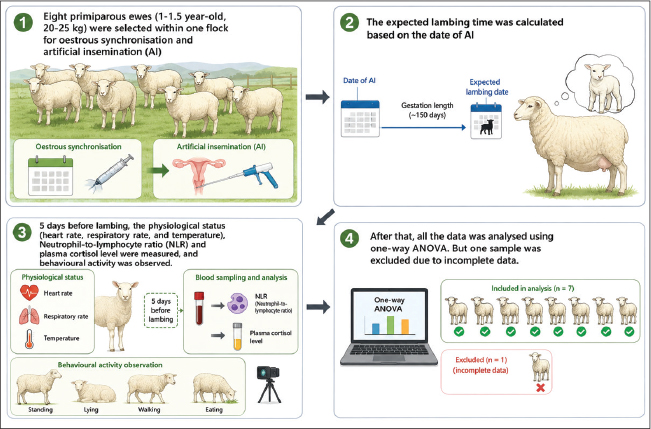
AbstractBackground: Parturition is one of the most critical and economically important phases in ewe production systems. Aim: This study evaluated physiological and behavioral changes in sheep during the peripartum period to identify practical indicators associated with impending lambing. Methods: Seven primiparous sheep were monitored for physiological parameters, including heart rate, respiratory rate, rectal temperature, plasma cortisol concentration, and neutrophil-to-lymphocyte ratio (NLR), before lambing. Behavioral activities, including eating, lying, standing with or without rumination, and urination frequency, were continuously recorded. The data were analyzed to determine temporal changes relative to lambing time. Results: The heart rate steadily increased, reaching a notable high on the day of lambing (D-0; 100.1 bpm; p < 0.05), and the respiratory rate was also elevated on that day. Meanwhile, the body temperature showed a significant drop as lambing approached. The NLR remained consistent until D-2 but saw a sharp rise on D-1 and D-0, reaching 2.18. Cortisol levels were significantly elevated on D-0 (45.8 ng/mL; p=0.0012). Feeding time notably decreased as lambing approached, while lying behavior increased, peaking with rumination at D−0 (34.1%; p < 0.05). Other behaviors showed no significant changes. Conclusion: Increased heart rate, respiratory rate, cortisol concentration, and NLR, together with reduced body temperature, eating activity, and altered rumination behavior, were associated with impending lambing in sheep. These indicators may support closer monitoring and timely intervention during the peripartum period. Keywords: Lambing prediction, Peripartum behavior, Cortisol, Sheep, Stress indicators. IntroductionParturition is one of the most critical and economically important phases in ewe production systems. Complications during lambing, particularly dystocia, can reduce flock productivity, increase veterinary and management costs, and result in morbidity or mortality of both lambs and ewes (Bintara et al., 2024). Successful parturition is essential to ensure offspring survival, replacement stock availability, and overall farm profitability. Impaired lambing performance represents a major animal welfare concern in addition to its economic implications (Herdis et al., 2026). Appropriate management during the periparturient period, including timely monitoring and lambing assistance, is essential to minimize complications and production losses. Parturition involves complex endocrine, physiological, and behavioral mechanisms that prepare the ewe for delivery and facilitate fetal and placental expulsion. Myometrial contractions, fetal expulsion, and placental expulsion generally occur in three stages (Zakar and Mitchell, 1998; Uvnäs-Moberg, 2024). During parturition initiation, fetal and maternal cortisol concentrations increase, stimulating placental enzymes responsible for converting progesterone to estradiol. This hormonal shift decreases progesterone concentrations while increasing estradiol levels, thereby promoting uterine prostaglandin synthesis and enhancing myometrial activity associated with parturition onset (Kota et al., 2013). Estimating parturition timing in ewes during late gestation remains challenging under practical farming conditions. Several studies have investigated physiological and behavioral parameters that may assist in identifying the approaching onset of parturition (Milani et al., 2020; Siena et al., 2022; Magalhaes et al., 2024). Accelerometer-based monitoring systems have been increasingly used to evaluate behavioral changes during the prepartum period, including transitions between grazing, standing, lying, and ruminating behaviors (Gurule et al., 2021; Sohi et al., 2022). These behavioral alterations may provide useful information regarding imminent lambing; however, previous studies reported variable levels of sensitivity and specificity, indicating that behavioral monitoring alone may not always provide consistent estimates of lambing time (Szenci, 2022). Previous studies have highlighted the importance of physiological stress-related indicators during periparturition. Heart rate variability (HRV) analysis has been used to evaluate changes in maternal autonomic regulation and stress responses in periparturient ewes (Trenk et al., 2015; Nagel et al., 2016; Rodriguez et al., 2020). Alterations in the neutrophil-to-lymphocyte ratio (NLR) have been associated with physiological stress responses and inflammatory adaptation around parturition (Bezerra et al., 2017; Yaqub et al., 2021). These physiological changes, together with behavioral alterations, may contribute to a better understanding of lambing progression. The relevance of monitoring behavioral changes around parturition in cattle has also been demonstrated. Nabenishi et al. (2021) described practical approaches to evaluate prepartum activity patterns using camera image analysis. Changes in eating behavior, rumination activity, and lying behavior are associated with the proximity of calving time (Borchers et al., 2017; Nabenishi et al., 2021). For example, decreased lying with rumination and increased standing with rumination were observed within 24 hours before calving (Kojima et al., 2024). Similarly, the frequency of lying behavior and duration of rumination may reflect the animal’s comfort and stress status during the periparturient period (Hendriks et al., 2019). However, information regarding combined physiological and behavioral changes associated with ewes’ approaching parturition remains limited. Therefore, this study investigated physiological and behavioral changes during the periparturient period as baseline information that may contribute to the assessment of lambing time and support improved ewe management practices. Materials and MethodsExperimental animalsEight clinically healthy primiparous (1st pregnancy) pregnant Garut ewes that lambed within the same week were included in this study. Animals were selected based on age (1–1.5 years) and body weight (20–25 kg) to minimize biological variation among individuals. The number of animals used in this study was limited by the availability of primiparous Garut ewes under the same management conditions. Therefore, this study should be considered a preliminary observational study. Figure 1 illustrates the research scheme. The ewes were housed individually in pens measuring 1.2 × 1.2 m approximately one month before the expected lambing date to facilitate individual observation and behavioral recording. The study was conducted under the same management and environmental conditions throughout the observation period. The housing facility had natural ventilation and lighting, with daily monitoring of ambient temperature and humidity to minimize environmental variation among observation days. The animals were fed concentrate and corn silage twice daily at approximately 08:00 and 16:00, while water was provided ad libitum to meet nutrient requirements. The concentrate consisted of commercially formulated feed containing energy, protein, minerals, and vitamins appropriate for late-gestation ewes. Because all ewes were maintained in the same facility and lambed within a relatively similar period, environmental influences, such as ambient temperature and humidity, were considered comparable among animals. Measurements of heartbeat and respiration ratePhysiological measurements were initiated 5 days before the expected lambing date. Measurements were conducted once daily in the morning, before feeding, to reduce the variation associated with feeding and circadian rhythms. Each parameter was measured by the same trained person to minimize variation. Each ewe underwent cardiac auscultation using a conventional stethoscope (Majestic Stethoscope Dual Head Type, Indonesia). The stethoscope was placed on the left side of the elbow. The heart rate was measured for 15 seconds and then multiplied by four to determine BPM (dos Reis and White, 2022). Furthermore, the respiration rate was determined by visual observation of abdominal fluctuations. The respiratory rate was determined by counting exhalations and inhalations per minute. A full breath consisted of one exhale and one inhale. Neutrophil-to-lymphocyte ratio and body temperature measurementsThe NLR was used as an indicator of physiological stress response during the prepartum period. Blood samples were collected daily at the same time each morning, before feeding, to minimize physiological variation associated with feed intake. Blood samples were extracted from the jugular vein using a 5-mL syringe equipped with a 21-G needle. A drop of the extracted sample was placed on a glass slide and air-dried. The samples were fixed in absolute methanol and air-dried. Then, they were soaked in Giemsa stain (1:20, v/v) for 20 minutes and then washed in buffered water for 5 minutes. Differential leukocyte counting was performed using Giemsa-stained blood smears according to standard hematological procedures (Gürağaç and Demirer, 2016). The NLR was calculated by dividing the neutrophil count by the lymphocyte count. An infrared thermometer was placed in the ear canal to measure body temperature.
Fig. 1. Illustration of the research scheme. This figure was generated using BioRender AI (accessed May 2026 via BioRender. com) to illustrate the research scheme. 1. Animal preparations; 2. Determination of expected lambing time; 3. Observations; and 4. Data analysis. Behavioral observationsA security camera (Turbo HD DVR; HIKVISION, Hangzhou, China) was used to continuously record prepartum activities. The video camera was positioned approximately 3 m above each animal. Behavioral recording began 5 days before the expected lambing date. The recorded videos were reviewed retrospectively to identify behavioral changes observed during the prepartum period and to determine the exact lambing time. The observed behaviors included eating (feed and water consumption), lying and standing with or without rumination, and urination. Quantification of plasma cortisolBlood samples for plasma cortisol analysis were collected once daily in the morning, before feeding, to reduce variation associated with feeding and diurnal cortisol fluctuations. Blood (3 ml) was collected through the venipuncture of the jugular vein of the ewe. Blood was then stored in collection tubes containing heparin (GP Vacuum Tube, GP030LH, PT Endo, Surabaya, Indonesia) and centrifuged at 3,500 rpm for 10 minutes at 4°C. The plasma samples were stored at −20°C until further analysis. Plasma cortisol concentrations were quantified using an enzyme-linked immunosorbent assay kit (EIA-1887; DRG International, Inc., USA). The absorbance was measured at a wavelength of 450 nm using a microplate reader (Multiskan SKY-S1119700DP, Thermo Scientific Inc., USA). Statistical analysisThe heart rate, respiration, and temperature were measured three times each. The study specifically focused on changes occurring during late gestation; therefore, no non-pregnant control group was included. This limitation should be considered when interpreting whether the observed changes were exclusively associated with the prepartum period. Data were tested for normality and homogeneity of variance before statistical analysis. For multiple comparisons, one-way analysis of variance (ANOVA) was used for repeated measurements, followed by Tukey’s honest significant difference test when significant differences were detected. Results were expressed as mean ± standard deviation, and differences were considered statistically significant at p < 0.05. No data transformation was required because the data fulfilled normality and homogeneity assumptions. Ethical approvalAll procedures involving animals in this study were approved by the Research Ethics Committee of Universitas Padjadjaran (No. 601/UN6/KEP/EC/2025). All ewes were maintained by trained workers under regular husbandry circumstances, with particular focus on avoiding stress during the prepartum period.
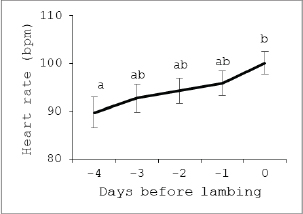
Fig. 2. Heart rate (bpm) during the last 5 days before lambing. Data are presented as the mean ± standard error of the mean (n=7). a,b Different letters above the columns indicate significant differences (p < 0.05).
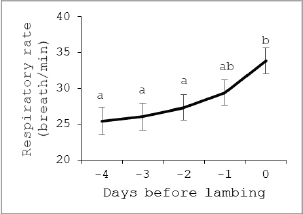
Fig. 3. Respiratory rate (breaths per minute) during the 5 days before lambing. Data are presented as mean ± standard error of the mean (n=7). a-b Different letters indicate significant differences above each column (p < 0.05). ResultsThe heart rate tended to increase during the prepartum period (Fig. 2). The mean heart rate increased from 89.7 ± 7.9 bpm on D-4 to 92.7 ± 7.2 bpm, 94.2 ± 6.5 bpm, and 95.8 ± 6.3 bpm on D-3, D-2, and D-1, respectively. The heart rate on the day of lambing (D-0) reached 100.1 ± 5.9 bpm and was significantly higher than that on D-4 (p < 0.05). However, the differences among the intermediate prepartum days were not statistically significant. Changes in the respiratory rate during the prepartum period are shown in Figure 3. The respiratory rate increased numerically toward lambing; however, significant differences were observed only between D-0 and D-2 (p < 0.05). The respiratory rate on D-1 was higher than that on D-2, although the difference was not statistically significant (p=0.2934). No other significant differences were observed between the prepartum days before lambing.
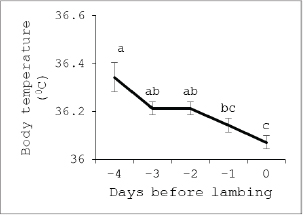
Fig. 4. Body temperature (°C) during the 5 days before lambing (mean ± SEM). The temperature decreased significantly toward lambing, with the lowest value observed on the day of lambing. Different superscripts (a–c) indicate significant differences between days (p < 0.05)
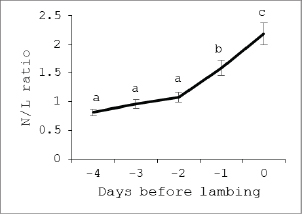
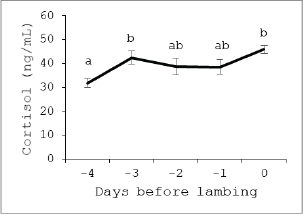
Fig. 5. The N/L ratio increased during the last 5 days before lambing. Data are expressed as the mean ± standard error of the mean (n=7). a–c Significant differences are presented with different letters above the columns (p < 0.05). Changes in body temperature are presented in Figure 4. Body temperature gradually declined during the prepartum period. The mean body temperature on D-0 (36.01°C ± 0.07°C) was significantly lower than that from D-4 to D-2 (from 36.34°C ± 0.14°C to 36.21°C ± 0.06°C, respectively; p < 0.05), but did not differ significantly from D-1 (36.14°C ± 0.07°C). Figure 5 illustrates the changes in the NLR. No significant differences were observed between D-4 and D-2 (D-4: 0.81 ± 0.13; D-3: 0.95 ± 0.17; D-2: 1.07 ± 0.21). However, the NLR increased markedly on D-1 (1.59 ± 0.32) and D-0 (2.18 ± 0.46) before lambing. The increase observed on D-0 was significantly higher than that on the earlier prepartum days (p < 0.05). Similarly, plasma cortisol levels increased during the prepartum period (Fig. 6). The highest cortisol concentration was observed on D-0 (45.8 ± 4.2 ng/ml), which was significantly higher than that on D-4 (31.8 ± 4.9 ng/ml; p=0.0012). No significant differences were detected between D-0 and D-3 (42.5 ± 6.6 ng/ml), D-2 (38.7 ± 8.4 ng/ml), or D-1 (38.5 ± 7.4 ng/ml) (p > 0.05). The previous mention of D-5 has been corrected to D-4 in accordance with the study timeline. Figure 7 presents the allocation of 24-hour behavioral time during the prepartum period. As lambing approached, the proportion of time allocated to eating behavior decreased progressively, declining from 22.9% ± 1.9% on D-4 to 20.1% ± 2.0% on D-2 (p=0.0021) and 17.9% ± 1.1% on D-0 (p=0.0001). This decrease was accompanied by reduced standing with rumination behavior, in which D-0 (14.8% ± 2.0%) was significantly lower than D-2 (19.7% ± 4.7%; p=0.033) and D-4 (19.6% ± 3.2%; p=0.038). On the contrary, the proportion of time spent lying increased toward lambing. Lying with rumination increased from 25.9% ± 4.8% on D-4 to 34.1% ± 0.5% on D-0, with the value on D-0 being significantly higher than that on D-4 (p=0.038). However, the frequency of standing without rumination and urination did not differ significantly among the observation days before lambing (p > 0.05).
Fig. 6. Cortisol concentration increased in the last 5 days before lambing. Data are presented as the mean ± standard error of the mean (n=7). Significant differences (p < 0.05) are highlighted with distinct letters above each column. DiscussionThis study demonstrated that several physiological and behavioral parameters in Garut ewes changed progressively during the immediate prepartum period. These changes likely reflect the combined effects of endocrine adaptation, increased fetal demand, altered maternal metabolism, and behavioral adjustment associated with parturition onset. However, because the present study used a limited sample size and lacked a non-pregnant control group, the findings should be interpreted cautiously and considered preliminary. As lambing approached, the heart rate increased gradually, with the highest values observed on D-0. This increase is likely associated with increased maternal cardiovascular demand during late gestation and parturition. During the prepartum period, maternal circulation undergoes substantial adaptation to maintain uteroplacental perfusion and fetal oxygen supply. Increased sympathetic nervous system activity, elevated circulating catecholamines, and heightened metabolic requirements may contribute to the observed increase in heart rate. In addition, uterine contractions and increased oxygen consumption during labor further increase cardiac workload and output. Previous studies have reported that cardiac output may increase markedly during the first and second stages of labor because of increased venous return, catecholamine release, and redistribution of blood flow toward reproductive tissues and vital organs (Soma-Pillay et al., 2016). Similar increases in maternal HR before parturition have also been observed in cattle (Kojima et al., 2021; Kitajima et al., 2021; Hamangau et al., 2023). Although heart rate changes may indicate approaching lambing, routine field application may be limited because accurate measurements require repeated handling and monitoring of animals. The respiratory rate also increased as lambing approached, although significant differences were observed only on selected observation days. Therefore, the present findings suggest a tendency toward increased respiratory activity rather than a consistently significant prepartum response. Increased respiratory activity during late gestation may occur due to reduced thoracic capacity caused by fetal growth and increased maternal oxygen demand (Gangakhedkar and Kulkarni, 2021). Hormonal alterations before parturition may also influence respiratory regulation by modifying metabolic rate and oxygen utilization (Condon et al., 2003; Melaku, 2022). However, the relatively inconsistent statistical differences observed in the present study indicate that respiratory rate alone may not be sufficiently robust as a practical indicator of imminent lambing.
Fig. 7. Behavioral changes for 5 days before lambing. Eating time decreased, but lying and lying with rumination increased in the 5 days before lambing. Data are expressed as the mean ± standard error of the mean (n=7). a–c Significant differences (p < 0.05) are indicated by different letters above each column. The body temperature gradually decreased before lambing, reaching the lowest value on D-0. This decline may be associated with endocrine changes during luteolysis and with the reduction in circulating progesterone concentrations before parturition. Progesterone exerts thermogenic effects; therefore, declining progesterone concentrations before lambing may contribute to reduced maternal body temperature. Previous studies have reported similar decreases in body temperature before parturition in cattle and wildlife species (Nabenishi and Yamazaki, 2017; Ricci et al., 2018; Græsli et al., 2022). Compared with hormonal assays or hematological analysis, body temperature monitoring may offer greater practical applicability under field conditions because it is relatively simple, rapid, and minimally invasive. Plasma cortisol concentrations and the neutrophil-to-lymphocyte ratio increased toward lambing, particularly on D-0. Cortisol plays a critical role in initiating the endocrine cascade associated with parturition and is also widely recognized as a physiological stress marker (Nagel et al., 2019; Zahorec, 2021; Lazarosony et al., 2023; Yuce, 2023). Therefore, the increased cortisol concentration observed near lambing may reflect both the activation of the hypothalamic–pituitary–adrenal axis and maternal adaptation to labor-associated stress. Elevated cortisol levels induce neutrophilia and lymphopenia, thereby increasing the NLR (Zahorec, 2021; Lazarosony et al., 2023; Yuce, 2023). Although cortisol and hematological measurements showed detectable prepartum changes, their routine application under farm conditions may be constrained by the need for blood collection, laboratory processing, specialized equipment, and additional costs. Behavioral observations demonstrated reductions in eating behavior and standing with rumination, accompanied by increased lying with rumination before lambing. These behavioral changes during late gestation may indicate reduced feed intake, altered comfort-related behavior, or adaptive energy conservation. However, behavioral changes should be interpreted cautiously because environmental conditions, feeding management, handling stress, and individual variation may also influence feeding activity, rumination, and lying behavior. Reduced feed intake before parturition has also been reported in dairy cattle and is generally associated with reduced rumen capacity and altered metabolic demand during late gestation (Lucy, 2019). Increased lying behavior near parturition has been interpreted as a behavioral adjustment associated with discomfort, fatigue, or preparation for labor (Mainau and Manteca, 2011). On the contrary, standing without rumination and urination frequency did not show significant changes before lambing, suggesting that these parameters may have limited value as indicators of imminent parturition under the present study conditions. Therefore, not all behavioral variables evaluated in this study demonstrated consistent applicability for predicting lambing time. Several limitations should be acknowledged in this study. First, the number of animals was relatively small, which may limit the statistical power and reduce the generalizability of the findings. Second, the absence of a non-pregnant or non-prepartum comparison group limited the ability to distinguish between changes specifically associated with impending lambing and normal physiological variation. Third, some physiological measurements, particularly cortisol and hematological analyses, may be less practical for routine on-farm application because they are invasive, time-consuming, and require laboratory support. Further studies involving larger animal populations, continuous monitoring systems, and comparative groups are needed to validate the usefulness of these physiological and behavioral parameters under commercial farming conditions. ConclusionIn conclusion, this study shows the coordinated physiological and behavioral responses of sheep before lambing. The practical indicators of impending parturition are an increase in heart and respiratory rates, a decline in body temperature, elevation of cortisol and the N/L ratio, shifts in lying and rumination behaviors, and a decline in eating activity. The application of these parameters in flock management can improve lambing time prediction and support timely intervention to reduce dystocia-related complications. AcknowledgmentsNot applicable. FundingThis study received no specific grant. Authors’ contributionConceptualization: RS, NM; Investigation: EA, AS, APZNLS; Formal analysis: RW, PIS; Methodology: RS, N, AAN; Validation: RS, NM; Writing–original draft: RS; Writing–review & editing: RS, AA. All authors have read and approved the final version of the manuscript. Conflict of interestThe authors declare no conflict of interest regarding the publication of this article. Data availabilityThe manuscript includes all data supporting the findings of the study. ReferencesBezerra, L.R., Oliveira, W.D.C., Silva, T.P.D., Torreão, J.N.C., Marques, C.A.T., Araújo, M.J. and Oliveira, R.L. 2017. Comparative hematological analysis of Morada Nova and Santa Inês ewes in all reproductive stages. Pesq. Vet. Bras. 37(04), 408–414; doi:10.1590/S0100-736X2017000400017 Bintara, S., Maharani, D., Tavares, L. and Sitaresmi, P.I. 2024. Comparison various level ascorbic acid and lycopene additions in semen diluent enhanced sperm quality of Sapudi ram. J. Anim. Sci. Technol. 66(5), 891–904; doi:10.5187/jast.2023.e54 Borchers, M.R., Chang, Y.M., Proudfoot, K.L., Wadsworth, B.A., Stone, A.E. and Bewley, J.M. 2017. Machine-learning-based calving prediction from activity, lying, and ruminating behaviors in dairy cattle. J. Dairy Sci. 100, 5664–5674. doi:10.3168/jds.2016-11526 Condon, J.C., Jeyasuria, P., Faust, J.M., Wilson, J.W. and Mendelson, C.R. 2003. A decline in the levels of progesterone receptor coactivators in the pregnant uterus at term may antagonize progesterone receptor function and contribute to the initiation of parturition. Proc. Natl. Acad. Sci. U. S. A. 100, 9518–9523; doi:10.1073/pnas.1633616100 dos Reis, B.R. and White, R.R. 2022. Brief research report: Evaluation of photoplethysmographic heart rate monitoring for sheep under heat-stressed conditions. Front. Anim. Sci. 3, 1–5; doi:10.3389/fanim.2022.1046557 Gangakhedkar, G.R. and Kulkarni, A.P. 2021. Physiological changes in pregnancy. Indian J. Crit. Care Med. 25, S189–S192; doi:10.5005/jp-journals-10071-24039 Græsli, A.R., Thiel, A., Fuchs, B., Stenbacka, F., Neumann, W., Malmsten, J., Singh, N.J., Ericsson, G., Arnemo, J.M. and Evans, A.L. 2022. Body temperature patterns during pregnancy and parturition in moose. J. Therm. Biol. 109, 103334; doi:10.1016/j.jtherbio.2022.103334 Gürağaç, A. and Demirer, Z. 2016. The neutrophil-to-lymphocyte ratio in clinical practice. J. Can. Urol. Assoc. 10, 141; doi:10.5489/cuaj.3587 Gurule, S.C., Tobin, C.T., Bailey, D.W. and Hernandez Gifford, J.A. 2021. Evaluation of the tri-axial accelerometer to identify and predict parturition-related activities of Debouillet ewes in an intensive setting. Appl. Anim. Behav. Sci. 237, 105296; doi:10.1016/j.applanim.2021.105296 Hamangau, M.R., Suartha, I.N. and Trilaksana, I.G.N.B. 2023. Status praesen sapi Bali betina pada kebuntingan trimester Ke-III. Buletin Veteriner Udayana 780; doi:10.24843/bulvet.2023.v15.i05.p11 Hendriks, S.J., Phyn, C.V.C., Turner, S.A., Mueller, K.M., Kuhn-Sherlock, B., Donaghy, D.J., Huzzey, J.M. and Roche, J.R. 2019. Lying behavior and activity during the transition period of clinically healthy grazing dairy cows. J. Dairy Sci. 102, 7371–7384; doi:10.3168/jds.2018-16045 Herdis, H., Priyanto, L., Santoso, S., Pamungkas, F.A., Anwar, R.I., Mahari, D.A., Lupitasari, F.B.I., Azizah, N., Hafid, A., Amalia, R., Tumbelaka, L.I., Amrozi, A. and Sitaresmi, P.I. 2026. Comparative analysis of delayed ovulation and associated ovarian patterns in the Ongole crossbred cattle. Open Vet. J. 16(3), 1716–1724. doi:10.5455/OVJ.2026.v16.i3.29 Kitajima, K., Oishi, K., Kojima, T., Uenishi, S., Yasunaka, Y., Sakai, K., Kumagai, H. and Hirooka, H. 2021. An assessment of stress status in fattening steers by monitoring heart rate variability: a case of dietary vitamin A restriction. Front. Anim. Sci. 2, 799289; doi:10.3389/fanim.2021.799289 Kojima, T., Huang, C.Y. and Yayou, K.I. 2024. Heart rate variability and behavioral alterations during prepartum period in dairy cows as predictors of calving: a preliminary study. Anim. Biosci. 37, 944–951; doi:10.5713/ab.23.0391 Kota, S.K., Gayatri, K., Jammula, S., Kota, S.K., Krishna, S.V.S. and Meher, L.K. 2013. Review article endocrinology of parturition. Indian J. Endocrinol. Metab. 17, 50–59; doi:10.4103/2230-8210.107841 Lazarosony, N.R., Putra, I.W.A., Mulyana, R.S., Darmayasa, I.M., Manuaba, I.B.G.F., Winata, I.G.S. and Budiana, I.N.G. 2023. High neutrophils to lymphocytes ratio in maternal blood serum as risk factor for preterm premature rupture of membrane. Int. J. Soc. Serv. Res. 3, 2376–2381; doi:10.46799/ijssr.v3i9.518 Lucy, M.C. 2019. Stress, strain, and pregnancy outcome in postpartum cows. Anim. Reprod. 16, 455–464; doi:10.21451/1984-3143-AR2019-0063 Magalhaes, H.B., Colombo, I., Spencer, K.M., Podico, G. and Canisso, I.F. 2024. Conductivity of mammary gland secretions is a sensitive and specific predictor of parturition in mares. Equine Vet. J. 56, 719–725; doi:10.1111/evj.14070 Mainau, E. and Manteca, X. 2011. Pain and discomfort caused by parturition in cows and sows. Appl. Anim. Behav. Sci. 135, 241–251; doi:10.1016/j.applanim.2011.10.020 Melaku, L. 2022. Physiological changes in the pregnancy and anesthetic implication during labor, delivery, and postpartum. Open Anesth J. 16:e258964582207130. Milani, C., Artusi, E., Drigo, M., Mateus, L., Siena, G., Gelli, D., Falomo, M.E. and Romagnoli, S. 2020. Ultrasonographic analysis of fetal gastrointestinal motility during the peripartum period in the dog. Anim. Reprod. Sci. 219, 106514; doi:10.1016/j.anireprosci.2020.106514 Nabenishi, H., Negishi, N. and Yamazaki, A. 2021. Predicting the start of calving in japanese black cattle using camera image analysis. J. Reprod. Dev. 67, 53–58; doi:10.1262/jrd.2020-087 Nabenishi, H. and Yamazaki, A. 2017. Decrease in body surface temperature before parturition in ewes. J. Reprod. Dev. 63, 185–190; doi:10.1262/jrd.2016-097 Nagel, C., Aurich, C. and Aurich, J. 2019. Stress effects on the regulation of parturition in different domestic animal species. Anim. Reprod. Sci. 207, 153–161; doi:10.1016/j.anireprosci.2019.04.011 Nagel, C., Aurich, J., Trenk, L., Ille, N., Drillich, M., Pohl, W. and Aurich, C. 2016. Stress response and cardiac activity of term and preterm calves in the perinatal period. Theriogenology, 86; doi:10.1016/j.theriogenology.2016.05.008 Ricci, A., Racioppi, V., Iotti, B., Bertero, A., Reed, K.F., Pascottini, O.B. and Vincenti, L. 2018. Assessment of the temperature cut-off point by a commercial intravaginal device to predict parturition in Piedmontese beef cows. Theriogenology 113, 27–33; doi:10.1016/j.theriogenology.2018.02.009 Rodriguez, G.K.M., Santos, C.V.J., Uscategui, R.R.A., Mariano, G.R.S., Simões, R.A.P., da Silva, D.A.P., Maronezi, M.C., Padilha-Nakaghi, L.C., Avante, L.M., Bartlewski, M.P. and Feliciano, R.M.A. 2020. Maternal and fetal ultrasonographic characteristics, vulvar temperature, and vaginal mucous impedance as variables associated with the onset of parturition in term and induced pre-term ewes. Anim. Reprod. Sci. 223, 106647; doi:10.1016/j.anireprosci.2020.106647 Siena, G., Romagnoli, S., Drigo, M., Contiero, B., di Nardo, F. and Milani, C. 2022. Ultrasonographic changes in fetal gastrointestinal motility during the last ten days before parturition in dogs. Front. Vet. Sci. 9, 1000975; doi:10.3389/fvets.2022.1000975 Sohi, R., Almasi, F., Nguyen, H., Carroll, A., Trompf, J., Weerasinghe, M., Bervan, A., Godoy, B.I., Ahmed, A., Stear, M.J., Desai, A. and Jois, M. 2022. Determination of ewe behaviour around lambing time and prediction of parturition 7 days prior to lambing by tri-axial accelerometer sensors in an extensive farming system. Anim. Prod. Sci. 62, 1729–1738; doi: doi:10.1071/AN21460 Soma-Pillay, P., Nelson-Piercy, C., Tolppanen, H. and Mebazaa, A. 2016. Physiological changes in pregnancy. Cardiovasc. J. Afr. 27, 89–94; doi:10.5830/CVJA-2016-021 Szenci, O. 2022. Accuracy to predict the onset of calving in dairy farms by using different precision livestock farming devices. Animals; doi:10.3390/ani12152006 Trenk, L., Kuhl, J., Aurich, J., Aurich, C. and Nagel, C. 2015. Heart rate and heart rate variability in pregnant dairy cows and their fetuses determined by fetomaternal electrocardiography. Theriogenology 84, 1405–1410; doi:10.1016/j.theriogenology.2015.07.027 Uvnäs-Moberg, K. 2024. The physiology and pharmacology of oxytocin in labor and in the peripartum period. Am. J. Obstet. Gynecol. 230, S740–S758; doi:10.1016/j.ajog.2023.04.011 Yaqub, L.S., Ayo, J.O., Habibu, B., Kawu, M.U. and Rekwot, P.I. 2021. Haematological responses and erythrocyte osmotic fragility in pregnant Yankasa ewes and their lambs. Small Ruminant Res. 198, 106352; doi:10.1016/j.smallrumres.2021.106352 Yuce, E. 2023. Neutrophil-to-lymphocyte ratio (NLR) and platelet-to-lymphocyte ratio (PLR) can predict spontaneous preterm birth? J. Inflamm. Res. 16, 2423–2429; doi:10.2147/JIR.S414305 Zahorec, R. 2021. Neutrophil-to-lymphocyte ratio, past, present and future perspectives. Bratislava Med. J. 122, 474–488; doi:10.4149/BLL_2021_078 Zakar, T. and Mitchell, B.F. 1998. Chapter 9 the endocrinology of late pregnancy and parturition. Principles of Medical Biology 12, 167–182; doi:10.1016/S1569-2582(98)80101-3 | ||

| How to Cite this Article |
| Pubmed Style Setiawan R, Anindya E, Sodikin A, , Widyastuti R, Mayasari N, Nurmeidiansyah AA, Sitaresmi PI, Asano A. Peripartum physiological and behavioral indicators associated with imminent lambing time in Garut ewes. Open Vet. J.. 2026; 16(8): 5266-5274. doi:10.5455/OVJ.2026.v16.i8.21 Web Style Setiawan R, Anindya E, Sodikin A, , Widyastuti R, Mayasari N, Nurmeidiansyah AA, Sitaresmi PI, Asano A. Peripartum physiological and behavioral indicators associated with imminent lambing time in Garut ewes. https://www.openveterinaryjournal.com/?mno=313162 [Access: August 08, 2026]. doi:10.5455/OVJ.2026.v16.i8.21 AMA (American Medical Association) Style Setiawan R, Anindya E, Sodikin A, , Widyastuti R, Mayasari N, Nurmeidiansyah AA, Sitaresmi PI, Asano A. Peripartum physiological and behavioral indicators associated with imminent lambing time in Garut ewes. Open Vet. J.. 2026; 16(8): 5266-5274. doi:10.5455/OVJ.2026.v16.i8.21 Vancouver/ICMJE Style Setiawan R, Anindya E, Sodikin A, , Widyastuti R, Mayasari N, Nurmeidiansyah AA, Sitaresmi PI, Asano A. Peripartum physiological and behavioral indicators associated with imminent lambing time in Garut ewes. Open Vet. J.. (2026), [cited August 08, 2026]; 16(8): 5266-5274. doi:10.5455/OVJ.2026.v16.i8.21 Harvard Style Setiawan, R., Anindya, . E., Sodikin, . A., , Widyastuti, . R., Mayasari, . N., Nurmeidiansyah, . A. A., Sitaresmi, . P. I. & Asano, . A. (2026) Peripartum physiological and behavioral indicators associated with imminent lambing time in Garut ewes. Open Vet. J., 16 (8), 5266-5274. doi:10.5455/OVJ.2026.v16.i8.21 Turabian Style Setiawan, Rangga, Erin Anindya, Anhar Sodikin, Aprilianna Putri Zahara Nafsina Luvita Sari, Rini Widyastuti, Novi Mayasari, An An Nurmeidiansyah, Pradita Iustitia Sitaresmi, and Atsushi Asano. 2026. Peripartum physiological and behavioral indicators associated with imminent lambing time in Garut ewes. Open Veterinary Journal, 16 (8), 5266-5274. doi:10.5455/OVJ.2026.v16.i8.21 Chicago Style Setiawan, Rangga, Erin Anindya, Anhar Sodikin, Aprilianna Putri Zahara Nafsina Luvita Sari, Rini Widyastuti, Novi Mayasari, An An Nurmeidiansyah, Pradita Iustitia Sitaresmi, and Atsushi Asano. "Peripartum physiological and behavioral indicators associated with imminent lambing time in Garut ewes." Open Veterinary Journal 16 (2026), 5266-5274. doi:10.5455/OVJ.2026.v16.i8.21 MLA (The Modern Language Association) Style Setiawan, Rangga, Erin Anindya, Anhar Sodikin, Aprilianna Putri Zahara Nafsina Luvita Sari, Rini Widyastuti, Novi Mayasari, An An Nurmeidiansyah, Pradita Iustitia Sitaresmi, and Atsushi Asano. "Peripartum physiological and behavioral indicators associated with imminent lambing time in Garut ewes." Open Veterinary Journal 16.8 (2026), 5266-5274. Print. doi:10.5455/OVJ.2026.v16.i8.21 APA (American Psychological Association) Style Setiawan, R., Anindya, . E., Sodikin, . A., , Widyastuti, . R., Mayasari, . N., Nurmeidiansyah, . A. A., Sitaresmi, . P. I. & Asano, . A. (2026) Peripartum physiological and behavioral indicators associated with imminent lambing time in Garut ewes. Open Veterinary Journal, 16 (8), 5266-5274. doi:10.5455/OVJ.2026.v16.i8.21 |


