





| Case Report | ||
Open Vet. J.. 2026; 16(8): 5874-5880
Open Veterinary Journal, (2026), Vol. 16(8): 5874–5880 Case Report First report of tail bifurcation in the Grenada bush anole (Anolis aeneus) from Grenada, West IndiesManuel Fuertes-Recuero1,2, Teresa Encinas Cerezo1,3 and Pablo Morón-Elorza3,4*1Complutense Veterinary Teaching Hospital, Complutense University of Madrid, Madrid, Spain 2Department of Animal Medicine and Surgery, Veterinary Medicine School, Complutense University of Madrid, Madrid, Spain 3Department of Pharmacology and Toxicology of the Faculty of Veterinary Medicine, Complutense University of Madrid, Madrid, Spain 4Fundación Oceanografic de la Comunitat Valenciana, Carrer d’Eduardo Primo Yúfera, Valencia, Spain *Corresponding Author: Pablo Morón-Elorza. Fundación Oceanografic de la Comunitat Valenciana, Carrer d’Eduardo Primo Yúfera, Valencia, Spain. Email: pmoron01 [at] ucm.es Submitted: 19/01/2026 Revised: 30/05/2026 Accepted: 16/06/2026 Published: 20/08/2026 © 2025 Open Veterinary Journal
AbstractBackground: Caudal autotomy and subsequent regeneration are widespread defensive strategies among lizards. However, abnormal regenerative outcomes, such as tail bifurcation, remain rare and poorly documented in many species, including Anolis spp. Case Description: In this case report, we present, to the best of the authors’ knowledge, the first documented observation of tail bifurcation in the Grenada bush anole (Anolis aeneus), an arboreal lizard endemic to Grenada and the Lesser Antilles. An adult individual with a regenerated, bifurcated tail was observed in a secondary tropical rainforest and agroforestry landscape in central Grenada. High-resolution field photographs allowed a detailed morphological assessment to be conducted. The tail regenerated from a proximal autotomy plane and subsequently bifurcated into two well-developed distal branches, displaying typical regenerated scalation and colouration. No external signs of recent injury, infection, or locomotor impairment were observed. Conclusion: The morphology of the anomaly is consistent with abnormal caudal regeneration following trauma or incomplete autotomy, rather than a congenital defect. This report adds to the list of Anolis species known to exhibit tail bifurcation, contributing to our understanding of lizard populations’ diversity and plasticity of regenerative responses in lizard populations. Keywords: Caribbean reptiles, Conservation, Insular lizards, Regenerative anomalies, Tail shedding. IntroductionCaudal autotomy is a commonly observed anti-predatory adaptation in Lepidosauria reptiles. The reptile voluntarily sheds part of its tail along existing fracture planes in the caudal vertebrae during this process and then regenerates the lost portion; this regenerative capacity in lizards is largely restricted to the tail and does not generally occur in other body parts (Clause and Capaldi, 2006; Bateman and Fleming, 2009; Barr et al., 2020; Gordeev et al., 2020). The detached tail segment then exhibits reflexive movements that distract predators and facilitate escape (Castilla et al., 1999; Clause and Capaldi, 2006; Tyler et al., 2016). In lizards, the regenerating tail typically develops as a cartilaginous structure surrounded by reorganized muscles and connective tissues rather than true vertebrae. This structure is morphologically similar to the original tail (Maginnis, 2006; Fisher et al., 2012; Gilbert et al., 2013; Barr et al., 2020). Although caudal regeneration often restores a single, functional tail, the process can differ from that of the standard pattern. Abnormal caudal regeneration, including the development of supernumerary tails, has been reported across multiple lizard families (Maginnis, 2006; Barr et al., 2020; Baum and Kaiser, 2020). Such anomalies are collectively referred to as tail furcations and include bifurcation, trifurcation, and higher-order branching (Passos et al., 2016; Caicedo-Martínez et al., 2022). Although tail furcations are generally rare at the population level, some studies have suggested that they are phylogenetically widespread and may have under-appreciated ecological consequences, such as altered locomotor performance, modified visual signaling, and potential changes in survival or reproductive output (Barr et al., 2020; Baum and Kaiser, 2020; Nunes and Carretero, 2024). Tail bifurcation, defined as the presence of two distinct terminal branches arising from a single tail base, is the most frequently reported form of abnormal caudal regeneration in lizards (Barr et al., 2020; Baum and Kaiser, 2020). Proposed mechanisms for tail bifurcation include incomplete autotomy, traumatic injury without complete detachment, and simultaneous activation of multiple regenerative centers within the post-autotomy blastema (Clause and Capaldi, 2006; Barr et al., 2020). Histological and radiographic studies suggest that supernumerary branches typically comprise regenerated cartilaginous tissue with reduced or absent vertebral segmentation, which is consistent with a regenerative rather than congenital origin (Barr et al., 2020; Bassett et al., 2021; Reyes-Olivares et al., 2023; Nunes and Carretero, 2024). Environmental stressors, repeated sublethal predation attempts, and intraspecific aggression have been identified as potential triggers of these atypical regenerative responses (Maginnis, 2006; Passos et al., 2016; Caicedo-Martínez et al., 2022; Reyes-Velázquez and Gómez-Benitez, 2025). Abnormal tail regeneration, including bifurcation, has been observed in many reptile species. These examples include the African rainbow lizard (Agama picticauda), the African spiny-tailed lizard (Uromastyx spp.), several lacertids such as the sand lizard (Lacerta agilis) and the common lizard (Zootoca vivipara), the Madeira wall lizard (Teira dugesii), the western fence lizard (Sceloporus occidentalis), the common house gecko (Hemidactylus frenatus), and the black-and-white tegu (Salvator merianae) (Passos et al., 2016; Ofori et al., 2018; Baum and Kaiser, 2020; Hoefer and Robinson, 2020; Caicedo-Martínez et al., 2022; Nunes and Carretero, 2024). These reports show that tail furcation occurs in both arboreal and terrestrial taxa, in tropical and temperate environments, and in species that occupy a variety of ecological niches. Despite extensive research on anole ecology, behavior, and autotomy, tail furcations were historically considered extremely rare within the genus Anolis (Tyler et al., 2016; Hoefer and Robinson, 2020). The first documented case of caudal bifurcation in an anole involved the Cuban green anole (Anolis porcatus) (Iturriaga and Olcha, 2016). Subsequent reports have described bifurcated tails in the panther anole (Anolis bimaculatus) (Najbar and Skawiński, 2018), the brown anole (Anolis sagrei) (Hoefer and Robinson, 2020), the Colombian endemic (Anolis antonii) (Caicedo-Martínez et al., 2022), and the microendemic Acapulco anole (Anolis taylori) (Reyes-Velázquez and Gómez-Benitez, 2025). In addition, an Anolis cristatellus individual with an abnormal regenerated tail bearing a secondary branch was reported (Tyler et al., 2016). Cases of this phenomenon have been reported across the Greater and Lesser Antilles, Mexico, and northern South America. This suggests that tail bifurcation may be more prevalent in Anolis species than previously thought (Barr et al., 2020; Caicedo-Martínez et al., 2022; Reyes-Velázquez and Gómez-Benitez, 2025). Anolis aeneus (Gray, 1840), commonly known as the Grenada bush or bronze anole, is a small- to medium-sized arboreal lizard endemic to Grenada and the Lesser Antilles (Germano et al., 2003; Daudin and de Silva, 2007). The species inhabits a wide range of natural and anthropogenically altered environments, including forest edges, secondary woodlands, plantations, gardens, and areas surrounding buildings and other man-made structures, wherever vertical vegetation structure is present. As a diurnal insectivore, A. aeneus typically uses shrubs, tree trunks, and low branches as perching and resting sites. Males typically exhibit brown to bronze dorsal coloration with subtle patterning and a conspicuous yellow–orange dewlap, whereas females are generally smaller and often show more understated patterning. The species inhabits several habitats, including coastal vegetation, agricultural areas, and moist or montane forests (Germano et al., 2003). On Grenada, Anolis aeneus co-occurs with the larger Anolis richardii (Dumeril and Bibron, 1837) and, in some areas, the recently introduced A. sagrei (Dumeril and Bibron, 1837), which appears unable to persist in the presence of native Grenadian anoles and is consequently restricted to isolated populations in open fields or sparsely disturbed habitats (Germano et al., 2003). Anolis aeneus can be readily distinguished from these congeners primarily by its relatively small size, slender body, narrow head, and long tail, features that contrast markedly with the more robust build and greater overall size of A. richardii, as well as by differences in habitat use, coloration, and dewlap morphology relative to A. sagrei (Germano et al., 2003). To the best of our knowledge, tail bifurcation has not been previously reported in A. aeneus. Here, we document the first case of tail bifurcation in this species, which was observed in a suburban area of Grenada, West Indies. Case DetailsThe individual was recorded on November 26, 2025, in Lance Aux Épines, a suburban area in southern Grenada (WGS84; 11.988519°N, 61.761182°W) (Fig. 1). The lizard was perched approximately 1.5 m above the ground on a low artificial structure adjacent to vegetation, a microhabitat commonly used by A. aeneus in peri-domestic environments (Harris et al., 2004). The observation occurred at 11:30 a.m. under overcast but dry conditions. At the time of observation, the weather was warm (26°C–30°C), and the meteorological conditions were typical of the late wet season in Grenada’s tropical maritime climate (Lugo et al., 2023). No body measurements or tissue samples were obtained. The dewlap was not extended, and no other clear secondary sexual characteristics were evident. The sex of the observed individual could not be reliably determined. Therefore, the description relies on high-resolution field photographs and detailed field notes. Furthermore, no radiographic or computed tomographic (CT) examination of the caudal skeleton and internal soft tissues could be performed. In A. aeneus, males tend to be larger with a more robust head and a conspicuous yellow–orange dewlap, whereas females are generally smaller and often have a more subdued dewlap and coloration (Uetz et al., 2026). However, in this case, the dewlap was not clearly visible in the photographs. No morphometric data or direct comparison with conspecifics were available, and the general body proportions and color pattern were compatible with either sex. Therefore, the specimen is conservatively referred to as an adult A. aeneus of undetermined sex.
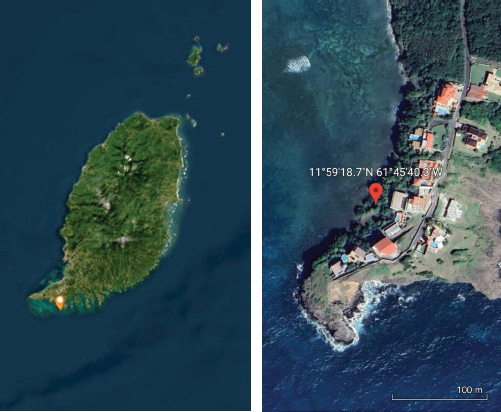
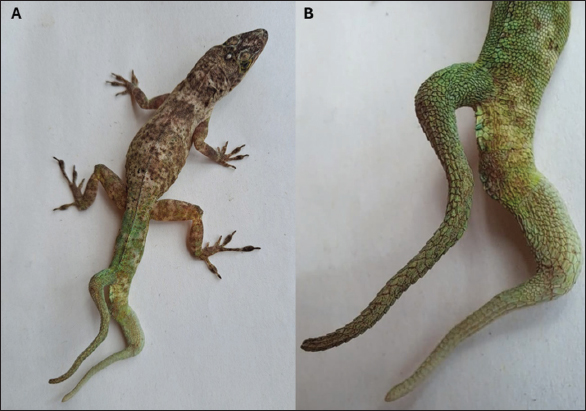
Fig. 1. Detail of the location, where A. aeneus with a bifurcated tail was detected (orange and red marks) in Grenada Island (West Indies). Source: ArcGIS (left) and Google Earth (right) satellite imagery. Based on the field observation and photographic evidence, the estimated snout-vent length was approximately 55–65 mm. Dorsal coloration was predominantly bronze-brown with subtle darker mottling along the flanks, while the lateral regions of the head appeared slightly paler (Germano et al., 2003; Daudin and de Silva, 2007; Uetz et al., 2026). The tail appeared to have been fully regenerated from a point in the proximal third of the original tail. At this level, a single regenerated segment extended distally before bifurcating into two well-formed branches (Fig. 2). The bifurcation originated approximately one-third of the visual tail length distal to the presumed autotomy plane. Both branches extended distally in a roughly parallel orientation, diverging at an angle of 25°–35°, and were similar in diameter at the point of bifurcation. Distally, the two branches were slightly unequal in length, with the longer branch extending an estimated 15%–20% beyond the shorter one. Both branches exhibited the smooth, uniform scalation and altered texture typical of regenerated anole tails (Fisher et al., 2012; Barr et al., 2020), with no obvious constriction or scarring at their tips. The coloration of the regenerated segment and both branches was slightly more homogeneous and paler than that of the proximal, presumably original, tail section, which is consistent with regenerated tissue Fernández-Rodríguez and Braña (2022b). No evidence of recent injury, infection, or obvious deformity was visible externally. During the observation period, the individual exhibited normal posture and locomotion, with no apparent behavioral abnormalities or impairment aside from the caudal bifurcation. Ethical approvalThis observational study did not require ethical approval. DiscussionThe observed individual was identified as A. aeneus based on its morphology, dorsal coloration, dewlap characteristics, and known distribution in Grenada (Germano et al., 2003; Uetz et al., 2026). To the best of our knowledge, tail bifurcation has not been previously reported in A. aeneus. The absence of previous reports for this species was verified through a comprehensive review of the relevant scientific literature and available herpetological databases, which revealed no prior documented cases of tail bifurcation in this taxon. The formation of a bifurcated tail in the observed A. aeneus is most plausibly interpreted as the result of abnormal caudal regeneration following trauma or incomplete autotomy, although direct evidence of the initiating event is unavailable. Experimental and field studies indicate that partial tail injury or incomplete autotomy can activate regenerative processes at the wound site, and if the original tail stump remains, multiple growth centers may develop, potentially yielding a bifurcated configuration (Barr et al., 2020; Clause and Capaldi, 2006; Nain et al., 2016). The configuration of our specimen is consistent with the 'bifurcated regeneration originating from the original tail' classification proposed (Barr et al., 2020; Nunes and Carretero, 2024). However, the regenerative origin of the bifurcation remains inferential in the absence of histological examination. As in other reported cases, the absence of visible scarring or recent injury suggests that the event that caused this occurred several weeks or months before observation, allowing time for substantial regenerative growth (Hoefer and Robinson, 2020; Reyes-Velázquez and Gómez-Benitez, 2025).
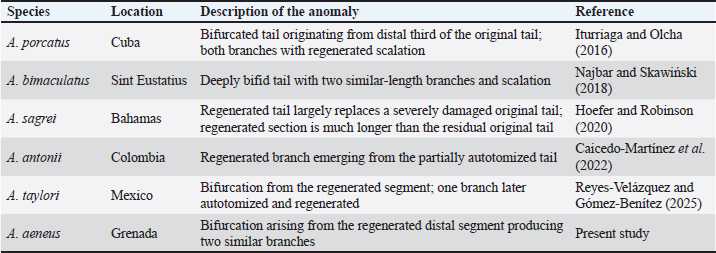
Fig. 2.Adult Grenada bush anole A. aeneus exhibiting a bifurcated regenerated tail. (A) Dorsolateral view in life showing a single proximal caudal segment that bifurcates distally into two similarly sized branches. (B) Close-up view of the caudal region, highlighting the origin of the bifurcation and the homogeneous scalation and color pattern typical of regenerated tail tissue. For a control image of a normal tail, please refer to Uetz et al. (2026), available at https://reptile-database.reptarium.cz/Anolis/aeneus. The potential causes of initial trauma in A. aeneus include failed predation attempts by birds, cats, snakes, or larger lizards; accidental mechanical damage, for example, from falling branches or human-made structures; and intraspecific aggression, such as male–male combat (Arnold, 1988; Bateman and Fleming, 2009; Barr et al., 2020). Furthermore, theoretical and empirical studies suggest that repeated autotomy, sublethal injury, and environmental stress can alter regenerative dynamics, increasing the likelihood of anomalous growth patterns (Maginnis, 2006; Passos et al., 2016; Caicedo-Martínez et al., 2022; Fernández-Rodríguez and Braña, 2022a–c). Although the exact causal event is unclear in this case, the overall morphology strongly indicates a regenerative rather than congenital origin of the bifurcation. Comparison with previously reported Anolis cases revealed both similarities and differences (Table 1). In A. porcatus from Cuba, a study described a bifurcated tail in which the supernumerary branch originated from the distal third of the original tail, with both branches showing regenerated scalation; the lizard was captured and examined in hand, but no imaging was performed (Iturriaga and Olcha, 2016). In A. bimaculatus from Sint Eustatius, a case report showed a deeply bifid tail with two branches of nearly equal length and similar scalation, again interpreted as the result of incomplete autotomy or tail injury, and based on a captured, measured specimen (Najbar and Skawiński, 2018). In A. sagrei from the Bahamas, a case was documented in which the regenerated tail appeared to have replaced and largely displaced a severely damaged original tail, producing an unusual configuration where the new tail was nearly twice as long as the original residual segment; the individual was easily captured and examined in hand (Hoefer and Robinson, 2020). Another case report described an abnormal caudal regeneration in A. antonii from Colombia, in which a regenerated branch arose from a partially autotomized tail. They also highlighted that Anolis tail anomalies in the Neotropics may be under-reported (Caicedo-Martínez et al., 2022). More recently, a study described the first case of a bifurcated tail in the microendemic A. taylori from the Acapulco region of Mexico (Reyes-Velázquez and Gómez-Benitez, 2025). They classified this as a case of bifurcated regeneration originating from the original tail, where one branch subsequently underwent autotomy and re-regeneration. Our observation of A. aeneus is similar to those of A. bimaculatus, A. porcatus, and A. taylori in that the bifurcation arises from an apparently regenerated segment and yields two branches that are broadly similar in diameter and scalation. This suggests the occurrence of a single autotomy or trauma event, followed by the establishment of two growth centers. On the contrary, the A. sagrei case report shows a more extreme disparity between the original and regenerated components, with the regenerated branch effectively replacing the original, damaged tail (Hoefer and Robinson, 2020). Table 1. Reported cases of tail bifurcation or abnormal caudal regeneration in Anolis spp.
As in previous reports of tail bifurcation in Anolis, advanced imaging techniques were not obtained. However, radiographic and three-dimensional imaging approaches are valuable in distinguishing between duplicated vertebral structures and regenerated cartilaginous branches in other species, as well as in assessing the extent of tail duplication (Passos et al., 2016; Barr et al., 2020; Baum and Kaiser, 2020). As this study is based on a single field observation documented through photographs, genetic analyses were beyond the scope of this study; however, this limitation and the potential value of future genetic investigations to better understand the mechanisms underlying such anomalies are acknowledged. Despite these limitations, our report contributes an additional data point to the still scarce literature on abnormal caudal regeneration in Anolis. Tail furcations are increasingly recognized as a useful natural experiment for understanding the constraints and plasticity of regenerative processes, as well as the ecological costs and benefits of maintaining supernumerary structures (Maginnis, 2006; Barr et al., 2020; Fernández-Rodríguez and Braña, 2022a–c; Nunes and Carretero, 2024). From a biogeographical perspective, the occurrence of a bifurcated tail in A. aeneus extends the list of Anolis species with documented tail furcations to at least seven (including A. porcatus, A. cristatellus, A. bimaculatus, A. sagrei, A. antonii, A. taylori, and A. aeneus), spanning the Greater and Lesser Antilles, Mexico, and mainland South America (Iturriaga and Olcha, 2016; Najbar and Skawiński, 2018; Hoefer and Robinson, 2020; Caicedo-Martínez et al., 2022; Reyes-Velázquez and Gómez-Benitez, 2025). In conclusion, the present case report from Grenada provides a geographically and taxonomically novel record of tail bifurcation. Future studies of tail anomalies in Grenadian anoles would benefit from the systematic application of non-invasive imaging techniques, ideally complemented by histological analyses when specimens become available, as previously described in other lizard species. AcknowledgmentsThe authors would like to thank veterinarian Miguel Naranjo de Torres and herpetologists Luis Fernando Navarrete Sánchez and José Alessandro Contreras del Cane for their insights and information regarding this observation. FundingThe authors declare that no funds, grants, or other support were received during the preparation of this manuscript. Authors’ contributionsAll authors contributed to the study conception and design. Material preparation, data collection, and analysis were performed using MFR, TEC, and PME. MFR and PME wrote the first draft of the manuscript, and all authors commented on previous versions of the manuscript. All authors have read and approved the final version of the manuscript. Conflict of interestThe authors declare no conflicts of interest. Data availabilityNo datasets were generated or analyzed during this study. ReferencesArnold, E.N. 1988. Caudal autotomy as a defense. In Biology of the Reptilia. Gans, C. and Huey, R.B New York: Alan R. Liss, Volume 16: Ecology B, Defense and Life History, pp: 235–73. Barr, J.I., Somaweera, R., Godfrey, S.S., Gardner, M.G. and Bateman, P.W. 2020. When one tail isn’t enough: abnormal caudal regeneration in lepidosaurs and its potential ecological impacts. Biol. Rev. 95, 1479–1496; doi:10.1111/brv.12625 Bassett, L., Zughaiyir, F. and Forstner, M. 2021. Description of an abnormal tail bifurcation in Gehyra oceanica (Lesson, 1830). Herpetological. Notes. 14, 588–589. Bateman, P.W. and Fleming, P.A. 2009. To cut a long tail short: a review of lizard caudal autotomy studies carried out over the last 20 years. J. Zool. 277, 1–14; doi:10.1111/j.1469-7998.2008.00484.x Baum, T.J. and Kaiser, H. 2020. Tail furcations in lizards: a revised summary and the second report of tail duplication in the Western Fence Lizard, Sceloporus occidentalis Baird & Girard, 1852. Herpetological Notes 17, 459–475. Caicedo-Martínez, L.S., Mejia-Fontecha I yuliani., Rojas-Morales, J.A., Caicedo-Portilla, J.R. and Ramírez-Chaves, H.E. 2022. Tail abnormalities in four lizard species (Anolis Hemidactylus, Iguana Kentropyx) from Colombia. Herpetological Notes 15, 797–803. Castilla, A.M., Gosá, A., Galán, P. and Pérez-Mellado, V. 1999. Green tails in lizards of the genus Podarcis: do they influence the intensity of predation?. Herpetologica 55, 530–537. Clause, A.R. and Capaldi, E.A. 2006. Caudal autotomy and regeneration in lizards. J. Exp. Zoolog. A. Comp. Exp. Biol. 305, 965–973; doi:10.1002/jez.a.346 Daudin, J. and De Silva, M. 2007. An annotated checklist of the amphibians and terrestrial reptiles of the Grenadines with notes on their local natural history and conservation. Appl. Herpetol. 163–175. Fernández-Rodríguez, I. and Braña, F. 2022. Behavioral patterns in the early-stage antipredator response change after tail autotomy in adult wall lizards. J. Exp. Zool. Part. Ecol. Integr. Physiol. 337, 250–257; doi:10.1002/jez.2562 Fernández-Rodríguez, I. and Braña, F. 2022a. Allocation costs of regeneration: tail regeneration constrains body growth under low food availability in juvenile lizards. Oecologia 198, 853–864; doi:10.1007/s00442-021-05084-6 Fernández-Rodríguez, I. and Braña, F. 2022b. Short-term and long-term consequences of regeneration on the reproductive investment of a multivoltine lizard. J. Zool. 317, 56–56; doi: 10.13039/100011941 Fisher, R.E., Geiger, L.A., Stroik, L.K., Hutchins, E.D., George, R.M., Denardo, D.F., Kusumi, K., Rawls, J.A. and Wilson-Rawls, J. 2012. A histological comparison of the original and regenerated tail in the green anole, Anolis carolinensis. Anat. Rec. 295, 1609–1619; doi:10.1002/ar.22537 Germano, J.M., Sander, J.M., Henderson, R.W. and Powell, R. 2003. Herpetofaunal communities in Grenada: a comparison of altered sites, with an annotated checklist of grenadian amphibians and reptiles. Caribb. J. Sci. 4, 68–76. Gilbert, E.A.B., Payne, S.L. and Vickaryous, M.K. 2013. The anatomy and histology of caudal autotomy and regeneration in lizards. Physiol. Biochem. Zool. 86, 631–644; doi:10.1086/673889 Gordeev, D.A., Ananjeva, N.B. and Korost, D.V. 2020. Autotomy and regeneration in squamate reptiles (Squamata, Reptilia): defensive behavior strategies and morphological characteristics (Using Computer Microtomography Methods). Biol. Bull. 47, 389–398; doi:10.1134/S1062359020040068 Harris, B., Yorks, D., Bohnert, C., Parmerlee, J. and Powell, R. 2004. Population densities and structural habitats in lowland populations of Anolis lizards on Grenada. Caribb. J. Sci. 40, 32–40. Hoefer, S. and Robinson, N.J. 2020. Tail bifurcation in a Brown Anole, Anolis sagrei (Duméril & Bibron, 1837). Herpetol. Notes 13, 333–335. Iturriaga, M. and Olcha, M. 2016. Reporte de bifurcación de la cola en Anolis porcatus (Squamata: dactyloidae). Rev. Cuba. Cienc. Biológicas 5(2), 1–4. Lugo, A.E., Kurta, A. and Durán, A.R. 2023. Climate, People, and Vegetation of the West Indies. Bats of the West Indies. A natural history and field guide. London, United Kingdom: 1, pp: 17–30. Maginnis, T.L. 2006. The costs of autotomy and regeneration in animals: a review and framework for future research. Behav. Ecol. 17, 857–872; doi:10.1093/beheco/arl010 Nain, Z., Islam, M.A., Chowdhury, S.H., Afroza, S. and Hussain, I. 2016. Current understanding on tail regeneration in green anoles (Anolis carolinensis). Cell Biol. 4, 9–17; doi:10.11648/j.cb.20160402.11 Najbar, A. and Skawiński, T. 2018. Anolis bimaculatus (Panther anole). Tail bifurcation. Herpetol. Rev. 49, 325. Nunes, S.F. and Carretero, M.A. 2024. Insights into tail bifurcation and regeneration rates in the Madeira wall lizard Teira dugesii from Azores. North-Western J. Zool. 20, 168–171. Ofori, B., Martey, P., Musah, Y. and Attuquayefio, D. 2018. Tail bifurcation in the African rainbow lizard from Ghana, West Africa. Herpetological. Notes. 11, 843–845. Passos, D.C., Fonseca, P.H.M., Vivar, P.R.R.D., Kanayama, C.Y., Teixeira, V.P.A. and Martinelli, A.G. 2016. Tail trifurcation in the lizard Salvator merianae (Squamata: teiidae) investigated by computer tomography. Phyllomedusa J. Herpetol. 15, 79–83; doi:10.11606/issn.2316-9079.v15i1p79-83 Reyes-Olivares, C., Campos-Cifuentes, F. and Penna, M. 2023. Observation of the growth of a bifurcated tail in the Chilean Marked Gecko, Garthia gaudichaudii (Squamata, Phyllodactylidae). Gayana. Concepción. 87, 82–85; doi:10.4067/S0717-65382023000100082 Reyes-Velázquez, E. and Gómez-Benitez, A. 2025. Tail Bifurcation in the Microendemic Acapulco Anole, Anolis taylori (Squamata Dactyloidae). Sonoran Herpetologist 38(2), 96–98. Tyler, R.K., Winchell, K.M. and Revell, L.J. 2016. Tails of the City: caudal Autotomy in the Tropical Lizard, Anolis cristatellus, in Urban and Natural Areas of Puerto Rico. J. Herpetol. 50, 435–441; doi:10.1670/15-039 Uetz, P., Freed, P. and Hošek, J. 2026. Anolis aeneus Gray, 1840. Reptile Database. Available via https://reptile-database.reptarium.cz/Anolis/aeneus | ||
| How to Cite this Article |
| Pubmed Style Fuertes-recuero M, Cerezo TE, Morón-elorza P. First report of tail bifurcation in the Grenada bush anole (Anolis aeneus) from Grenada, West Indies. Open Vet. J.. 2026; 16(8): 5874-5880. doi:10.5455/OVJ.2026.v16.i8.75 Web Style Fuertes-recuero M, Cerezo TE, Morón-elorza P. First report of tail bifurcation in the Grenada bush anole (Anolis aeneus) from Grenada, West Indies. https://www.openveterinaryjournal.com/?mno=307349 [Access: September 04, 2026]. doi:10.5455/OVJ.2026.v16.i8.75 AMA (American Medical Association) Style Fuertes-recuero M, Cerezo TE, Morón-elorza P. First report of tail bifurcation in the Grenada bush anole (Anolis aeneus) from Grenada, West Indies. Open Vet. J.. 2026; 16(8): 5874-5880. doi:10.5455/OVJ.2026.v16.i8.75 Vancouver/ICMJE Style Fuertes-recuero M, Cerezo TE, Morón-elorza P. First report of tail bifurcation in the Grenada bush anole (Anolis aeneus) from Grenada, West Indies. Open Vet. J.. (2026), [cited September 04, 2026]; 16(8): 5874-5880. doi:10.5455/OVJ.2026.v16.i8.75 Harvard Style Fuertes-recuero, M., Cerezo, . T. E. & Morón-elorza, . P. (2026) First report of tail bifurcation in the Grenada bush anole (Anolis aeneus) from Grenada, West Indies. Open Vet. J., 16 (8), 5874-5880. doi:10.5455/OVJ.2026.v16.i8.75 Turabian Style Fuertes-recuero, Manuel, Teresa Encinas Cerezo, and Pablo Morón-elorza. 2026. First report of tail bifurcation in the Grenada bush anole (Anolis aeneus) from Grenada, West Indies. Open Veterinary Journal, 16 (8), 5874-5880. doi:10.5455/OVJ.2026.v16.i8.75 Chicago Style Fuertes-recuero, Manuel, Teresa Encinas Cerezo, and Pablo Morón-elorza. "First report of tail bifurcation in the Grenada bush anole (Anolis aeneus) from Grenada, West Indies." Open Veterinary Journal 16 (2026), 5874-5880. doi:10.5455/OVJ.2026.v16.i8.75 MLA (The Modern Language Association) Style Fuertes-recuero, Manuel, Teresa Encinas Cerezo, and Pablo Morón-elorza. "First report of tail bifurcation in the Grenada bush anole (Anolis aeneus) from Grenada, West Indies." Open Veterinary Journal 16.8 (2026), 5874-5880. Print. doi:10.5455/OVJ.2026.v16.i8.75 APA (American Psychological Association) Style Fuertes-recuero, M., Cerezo, . T. E. & Morón-elorza, . P. (2026) First report of tail bifurcation in the Grenada bush anole (Anolis aeneus) from Grenada, West Indies. Open Veterinary Journal, 16 (8), 5874-5880. doi:10.5455/OVJ.2026.v16.i8.75 |


