




| Research Article | ||
Open Vet. J.. 2026; 16(5): 2839-2848 Open Veterinary Journal, (2026), Vol. 16(5): 2839-2848 Research Article Outbred mice as an appropriate model for evaluating the immunogenicity of vaccines against porcine circovirus 2Vitor Barbosa Fialho Martins1, Guilherme de Brito Viana1, Emylli Teles de Melo Zocarato1, Karen Ferraz Faria1*, Marina Caporusso Garcia da Silva1, Taís Fukuta da Cruz2, Igor Renan Honorato Gatto1, Marcus Antonio Martins Buso1, Ferdinando Nielsen de Almeida , and Hélio José Montassier21Veterinary Research Center, Ourofino Saúde Animal, Cravinhos, SP 2School of Agricultural and Veterinarian Sciences, São Paulo State University (UNESP), São Paulo, Brazil *Corresponding Author: Karen Ferraz Faria. Veterinary Research Center, Ourofino Saúde Animal, Cravinhos, SP. Submitted: 22/12/2025 Revised: 15/03/2026 Accepted: 26/03/2026 Published: 34/05/2026 © 2025 Open Veterinary Journal
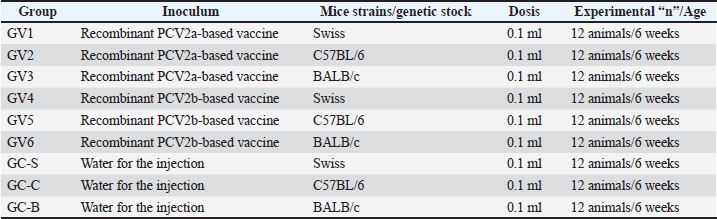
AbstractBackground: Porcine circovirus type 2 (PCV2) is the causative agent of porcine circovirus-associated diseases, leading to substantial economic losses in global swine production. Although various commercial vaccines exist, an appropriate and translational animal model is essential for evaluating vaccine-induced immune responses. Inbred mouse strains are traditionally preferred due to their genetic uniformity; however, outbred animals may reflect a broader immunological variability than the natural target species. The number of comparative studies assessing outbred mice for PCV2 vaccine immunogenicity remains limited. Aim: This study aimed to determine whether outbred mice represent an appropriate model for assessing the immunogenicity of PCV2 vaccines by comparing them with two commonly used inbred strains, C57BL/6 and BALB/c. Methods: A total of 108 6-week-old female mice from three genetic backgrounds (Swiss, C57BL/6, and BALB/c) were immunized with recombinant PCV2a- or PCV2b-based vaccines or inoculated with water for injection as controls. Vaccinations were administered on days 0 and 14, and blood samples were collected on days 0 and 28. Humoral immune responses were assessed using an in-house enzyme-linked immunosorbent assay to determine seroconversion rates and end point antibody titers. Statistical analysis was performed using one-way analysis of variance, with a significance threshold of p < 0.05. Results: All vaccinated animals were seroconverted at 28 days post-vaccination, whereas the control groups remained negative. High antibody titers, ranging from 1:25,600 to 1:102,400, were observed in all immunized groups, ranging from 1:25,600 to 1:102,400 depending on strain and vaccine genotype. No statistically significant differences were detected among the vaccinated groups (p=0.0631), indicating that the humoral immune responses of Swiss outbred mice were comparable to those of the inbred strains. Conclusion: Outbred Swiss mice exhibited robust antibody responses equivalent to those of C57BL/6 and BALB/c mice following immunization with the PCV2a and PCV2b vaccines. These findings support the suitability of Swiss mice for assessing total IgG humoral responses in immunogenicity studies and PCV2 vaccine quality-control assays. Keywords: Antibody, Circovirus, Immunobiological, Immunogenicity, Mice. IntroductionPCV2 is a member of the family Circoviridae, genus Circovirus, containing a single-stranded DNA genome surrounded by a protein capsid, and its 17nm diameter makes it one of the smallest known DNA viruses in mammals. From 1997~1998, it has been recognized as one of the most important and widely spread pathogens in pig farms worldwide (Karuppannan et al., 2017; Ouyang et al., 2019). The PCVs were divided into 2 species (PCV1 and PCV2), described in the 1970s and 1990s, respectively. More recently, two other species have been identified, and in addition to PCV1 and PCV2, PCV3 (2016) and PCV4 (2019) have been recognized (Zhai et al., 2019; Opriessnig et al., 2020). Because of the high mutation rate, PCV2 strains were divided into genotypes based on an ORF2 or complete genome nucleotide sequence scheme. Currently, PCV2 is classified into nine genotypes: PCV2a to PCV2i (Grau-roma et al., 2008; Segalés et al., 2008; Franzo and Segalés et al., 2018; Franzo et al., 2016; Wang et al., 2020). PCV2 is the primary etiological agent of porcine circovirus-associated diseases, including Postweaning multisystemic wasting syndrome, porcine dermatitis, Porcine dermatitis and nephropathy syndrome, and reproductive disorders, which collectively impose a substantial economic burden on the global swine industry. Losses are attributed to increased mortality, reduced growth performance, impaired reproductive efficiency, and additional costs related to vaccination and biosecurity measures, with estimates reaching millions of dollars annually (Koppu et al., 2023). Despite the widespread use of PCV2a-based vaccines, the virus remains endemic, and its high evolutionary rate has led to the emergence of multiple genotypes, notably PCV2b and PCV2d, which are now predominant in several regions (Franzo et al., 2024; Eddicks et al., 2025). Although cross-protection among genotypes has been documented, vaccine efficacy may vary depending on the antigenic match between the vaccine strain and circulating genotype, raising concerns about the long-term effectiveness of current immunization strategies (Franzo and Segalés et al., 2020; Bandrick et al., 2022). Currently, several vaccines are commercially available, most of which are based on the circovirus genotype a (PCV2a), and cross-protection with other PCV2 genotypes has been reported (Opriessnig et al., 2017). However, a vaccine based on the PCV2b genotype demonstrated greater effectiveness in providing immunity for pigs with PCV2b viremia or associated PCV2a/PCV2b viremia than a vaccine based on PCV2a (Opriessnig et al., 2013a). As several mechanisms of pathogenesis and the virus-host interaction of circovirosis still need to be better understood, more effective vaccines against currently circulating genotypes must be developed, as well as more accessible in vivo models that elucidate these issues are necessary (Ouyang et al., 2019). Mice have been widely studied and used as a model of swine circovirus infection because immunization with inactivated virus, proteins, or (vírus-like particles) elicits both humoral and cellular immune responses comparable to those of the target species (Opriessnig et al., 2009; Li et al., 2010; Liu et al., 2018). Mice enable reproducible and ethically appropriate preliminary vaccine screening (Liu et al., 2018; Wu et al., 2022). In addition, mouse models are used in the development of a vaccine, as well as for potency studies that aim to release commercial batches of the product after its registration with the regulatory authority (Craveiro, 2008). These animals have been widely used as a model for studies involving PCV2, among which the immunogenicity of vaccines and vaccine candidates against this virus has been evaluated (Kiupel et al., 2001; Li et al., 2010; Sylla et al., 2014; Liu et al., 2018; Ouyang et al., 2019). Regarding inbred strains and genetic stocks of mice (outbred stocks) available, BALB/c mice are the most commonly used for the study of PCV2 (Silva Junior, 2005; Aravindaram et al., 2009; Fan et al., 2015; Zhang et al., 2015; Li et al., 2016; Ouyang et al., 2019). However, C57BL/6 mice have been used in several other experiments involving immune responses and vaccine evaluation and are even a model for vaccines against PCV2 (Zhang et al., 2017). Besides isogenic strains, the use of mice with heterogeneous genetic stocks has been proposed as models for the development and testing of vaccines against various infectious diseases. This is based on the assumption that the immunological repertoire of isogenic strains is more restricted than that observed in heterogeneous animals. In addition, heterogeneous mice have a superior immunological diversity, which is more similar to the reality of the target host population in which the vaccine will be used (Sunagar et al., 2018). However, no study has comparatively evaluated the immune responses to PCV2 in inbred and outbred mice. The use of inbred mouse strains is traditionally justified by their low genetic variability, which is assumed to reduce experimental noise, improve statistical power, and potentially decrease the number of animals required per group. However, both earlier and more recent studies challenge this assumption, suggesting that reduced genetic variability does not necessarily translate into greater reproducibility or efficiency (Tuttle et al., 2018). In this context, some research groups have advocated the heterogenization of experimental populations through the use of genetically diverse, outbred strains to obtain more robust, generalizable, and representative results (Hsieh et al., 2017; Voelkl et al., 2020). Inbred mice constitute genetically homogeneous populations, whereas outbred stocks, such as Swiss mice, exhibit greater interindividual genetic diversity. This increased variability may result in more heterogeneous immune responses, whereas inbred strains, such as C57BL/6 and BALB/c, typically exhibit more uniform immunological profiles. Therefore, the specific objectives of the study and the nature of the immune response under investigation should guide the selection of inbred or outbred mice (Moreira, 2015). Furthermore, as in translational medicine from the animal model to the human species (Sunagar et al., 2018), the results obtained in models used for the evaluation of veterinary vaccines will later be transferred to the target species, which is not composed of inbred animals and with the genetic stability observed in the strains of mice. This study aimed to demonstrate that outbred mice can be used as a model for evaluating veterinary vaccines, specifically those against PCV2, based on the humoral immune response. Materials and MethodsA total of 108 6-week-old female mice, of which 36 from the Swiss genetic stock, 36 from the C57BL/6 strain and 36 from the BALB/c strain were selected, randomized and acclimated in sterile cages in an ABSL-2 facility, to evaluate the immunogenicity of the vaccines. Swiss mice had a conventional health status, whereas C57BL/6 and BALB/c mice were specific pathogen-free. Two commercial recombinant vaccines against PCV2 were used, one vaccine construct based on the “a” genotype (PCV2a) and the other on the “b” genotype (PCV2b). The mice were divided into 9 groups of 12 animals each, with groups 1, 2 and 3 consisting of the Swiss, C57BL/6 and BALB/c animals, respectively, which were immunized with the vaccine based on PCV2a (groups GV1, GV2 and GV3); while groups 4, 5 and 6 composed by the Swiss, C57BL/6 and BALB/c animals, respectively, were immunized with the vaccine based on PCV2b (groups GV4, GV5 and GV6); and groups 7, 8 and 9, composed by Swiss, C57BL/6 and BALB/c, were maintained as negative controls of each genetic stock or inbred strain and inoculated with water for injection (groups GC-S, GC-C, and GC-B), according to Table 1. Table 1. Experimental groups for the evaluation of the immunogenicity and effect of the recombinant vaccine strain against PCV2.
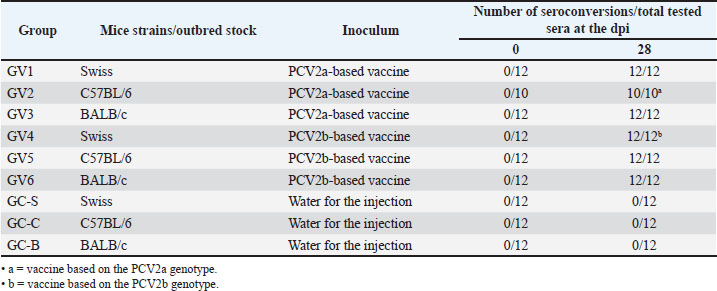
The mice were inoculated intraperitoneally with 0.1 ml of commercial vaccine or water for injection according to their respective groups at D0 and D14 of the study. At D0, before the first immunization, approximately 150 µl of blood was collected from the animals through the submandibular plexus, and at D28 1,000 µl of blood was collected from each animal through cardiac puncture. For both blood collections, the animals were anesthetized by inhalation of isoflurane at a rate of 3%–5%. After D28 blood collection, all animals were euthanized using thiopental (150 mg/kg) by the intracardiac route, with the animals under isoflurane anesthesia. The collected blood was centrifuged and stored at −20ºC until the analysis. To perform an in-house Enzyme-Linked Immunosorbent Assay (ELISA), NUNC plates were coated with 100 µl (100 µg/well) of purified PCV2b capsidial protein (batch 81020118B, Cambivac Limited UK) and kept at 2°C–8°C, overnight. After coating, the plates were washed and blocked by adding 200 µl/well of phosphate buffered saline (PBS)-albumin Grade V 1% solution and incubated at 37°C for 1 hour. After the blocking and washing of the plates, the serum sample, negative control, positive control, and blank control (wells containing all reagents except serum) were added to the wells in triplicate as the primary antibody at dilutions of 1:100 to 1:102,400 in PBS-Tween 20-albumin Grade II 1%. Then, 100 µl of each test and control sera was added to the microplate wells, and the reaction mixture was incubated at 37°C for 1 hour. The plates were washed again and 100 µl of the conjugated anti-mouse IgG (whole molecule)–peroxidase antibody produced in goat (Sigma-Aldrich, catalog A8924, 3050 Spruce Street, Saint Louis, MO 63103, USA) in 1:8000 dilution in PBS buffer—Tween 20-albumin Grade II 1%, was added as a secondary antibody in all wells of the plate, and the reaction was incubated at 37°C for 1 hour. After washing, the reaction was revealed by adding 100 µl of the substrate solution for peroxidase (OPD + H2O2), which was kept at room temperature for 15 minutes, protecting it from light. The reaction was stopped by adding 50 µl of 3N sulfuric acid solution. The results were then read within a maximum period of 30 minutes, with the absorbance reading being performed on a 492-nm filter. Seroconversion values were obtained by the quotient between the average absorbance of post-vaccinated and pre-vaccinated mice sera [O.D. day 28 (O.D. day 0*4)] in 1:200 dilution. Seroconversion was considered positive when increased 4 times (Zhang et al., 2017). The end-point titer was calculated using the reciprocal value of the highest sera dilution that gave a positive result in terms of absorbance, that is, this parameter should be greater than or equal to the O.D. mean of negative sera plus 3 times the standard deviation for the O.Ds read for the set of negative sera and was established as a cut-off: mean + 3 times the standard deviation (Sunagar et al., 2018). Statistical analysis was performed using GraphPad Prism version 9.1.0 for Windows (GraphPad Software, Inc., La Jolla, California, USA). One-way ANOVA was conducted with Bartlett’s test for homogeneity of variances, and the Brown–Forsythe test was applied when variances were unequal. A p value of < 0.05 was considered statistically significant. Ethical approvalThe animals were obtained from certified suppliers, and their use was authorized by the Ethics Committee for the Use of Animals (CEUA-OF) under protocol number 139/2019. The ethical approval date for this study is 08 November 2019. ResultsHumoral immune response to PCV2 in vaccinated miceAccording to the applied formula, all animals of each inbred strain or outbred genetic stock evaluated and inoculated with the vaccines based on PCV2a or PCV2b (groups GV1 to GV6) were seroconverted 28 days after the first vaccination, whereas the animals of the control groups maintained unchanged levels of anti-PCV2 antibodies compared to D0 (Table 2). Table 2. Seroconversion to PCV2 antibodies in vaccinated and control mice.
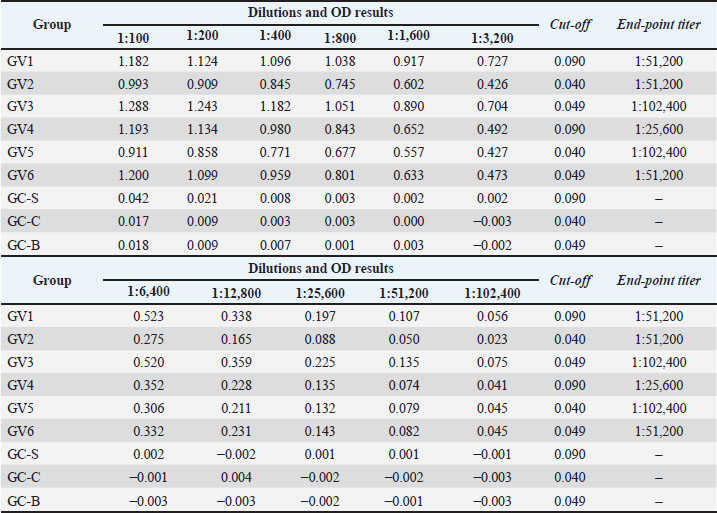
The end-point titers were defined for the experimental groups from the formula used to establish the cut-off points in each of the inbred strains/outbred stock evaluated, as shown in Table 3. Table 3. Average of O.D.s in each dilution per experimental group, applied cut-offs, and end-point titers established in the vaccinated groups.
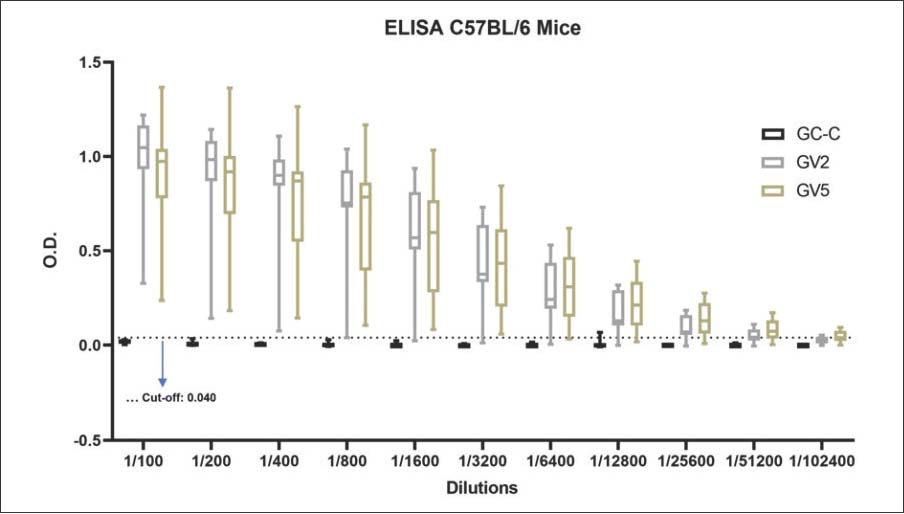
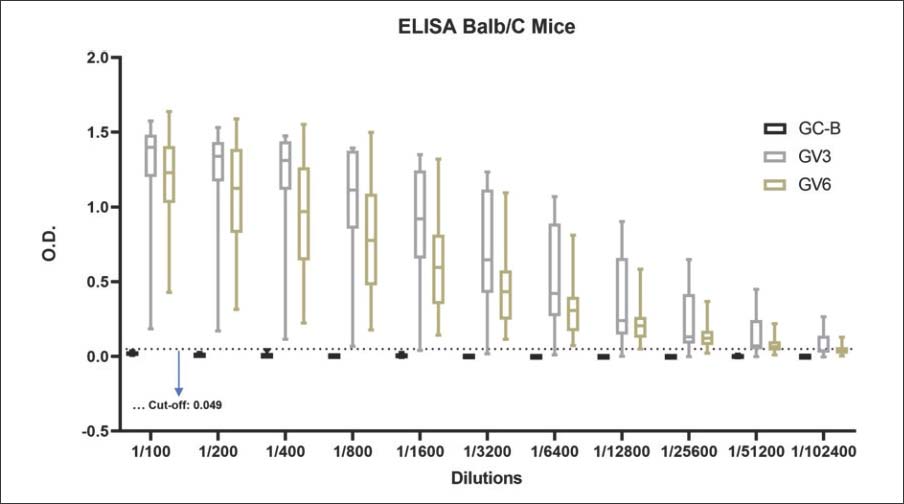
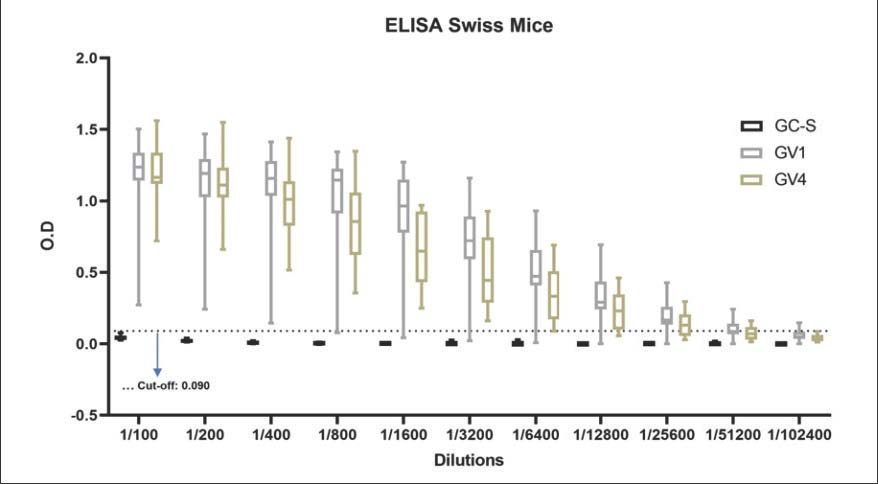
Antibody titers for PCV2The outbred stock (Swiss) and the two inbred mouse strains (C57BL/6 and BALB/c) tested showed an increase in antibody titer after vaccination, so that groups GV1 and GV2 kept all animals above the cut-off until the dilution of 1:400, while this condition was observed until the dilution of 1:800 in the GV3 group. In groups GV4 and GV5, all animals remained above the cut-off until the dilution of 1:3,200, whereas in group GV6, this condition was detected until the dilution of 1:12,800, according to the data shown in Figures 1–3.
Fig. 1. Absorbance data to outbred stock Swiss in all used dilutions on the GC-S, GV1, and GV4 groups.
Fig. 2. Absorbance data to C57BL/6 strain in all used dilutions on the GC-C, GV2, and GV5 groups.
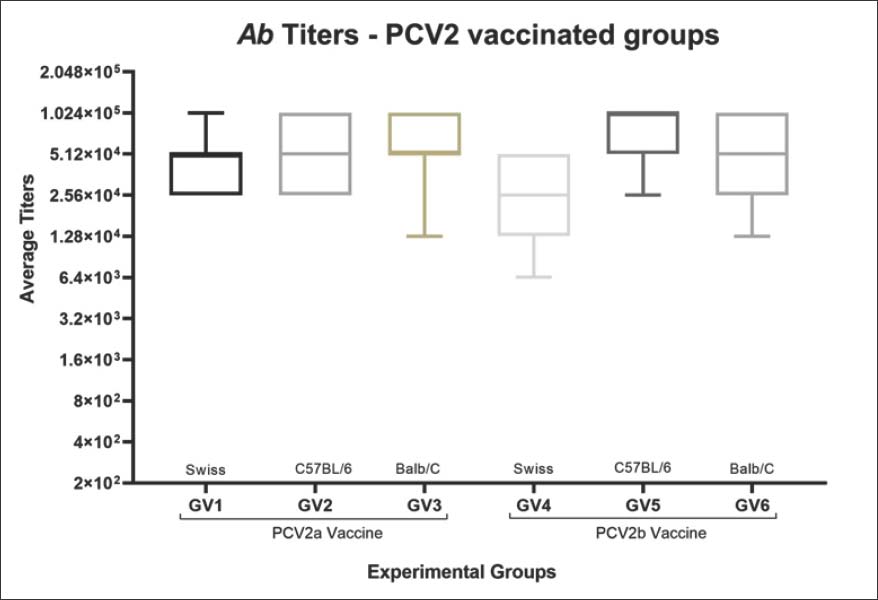
Fig. 3. Absorbance data to BALB/c strain in all used dilutions on the GC-B, GV3, and GV6 groups. Despite this, all vaccinated groups showed high mean antibody titers in the tested dilutions, whereas the control groups maintained titers below the cut-off points established for each inbred strain/genetic stock. The average titers ranged from 1:25,600 in the GV4 group to 1:51,200 in the GV1, GV2, and GV6 groups, whereas the titers remained at the maximum dilution (1:102,400) in the GV3 and GV5 groups (Fig. 4).
Fig. 4. Average antibody titers of each strain or outbred stock and vaccines tested. When comparing the mean titers of the vaccinated groups, no statistically significant difference (p= 0.0631) was observed in the anti-PCV2 antibody titers between the mouse inbred strains and the outbred stock tested, both for the PCV2a and the PCV2b vaccinated animals. DiscussionIn this study, we aim to demonstrate that the limitation in the choice of mouse models for humoral response studies in vaccines, more specifically vaccines against PCV2, may be related to the absence of studies that demonstrate the possibility of choice rather than the results that these models provide. For a long time, inbred mouse strains have been preferred over outbred stocks, with particular strains, such as C57BL/6 and BALB/c, being extensively used in a wide range of biomedical applications. The choice for an experimental animal model already described and mostly based on inbred animals is cited by Festing (2014) as being the “easiest” choice because conducting a study to compare them is laborious and makes the process slower. The establishment of cut-offs and end-point titers revealed that the BALB/c strain presented a greater number of serum dilutions above the cut-off of antibody detection in ELISA in all animals, both in the GV3 and GV6 groups, whereas the strain C57BL/6 and the Swiss outbred stock had this condition similar to each other, but in lower dilutions than that observed for the BALB/c strain. The increase in anti-PCV2 antibodies in BALB/c mice observed in the present study is in line with previous studies that used this mouse strain to test the humoral immune response for several vaccine constructions with PCV2 (Aravindaram et al., 2009; Fan et al., 2015; Zhang et al., 2015; Li et al., 2016; Ouyang et al., 2019). In addition, a similar increase in the levels of anti-PCV2 antibodies observed in the C57BL/6 strain in this study was found by Zhang et al. (2015). However, studies assessing the immune response to PCV2 vaccines using the Swiss mouse outbred stock as a model have not been found in previous publications. The results of seroconversion and antibody titers found in the present study demonstrated that there was no significant difference between the inbred strains of mice and in the comparison of these with outbred stock, which is consistent with previous studies in which no differences were found between inbred and outbred stocks of mice (Tuttle et al., 2018). Although no statistically significant differences were observed between Swiss mice and the inbred strains, a certain degree of variability in antibody titers was noted among Swiss animals across the different vaccination assays. This finding is expected considering the genetic heterogeneity inherent to outbred stocks, which may contribute to broader dispersion of humoral responses compared with inbred strains (Martin et al., 2017; Enriquez et al., 2020; Cruz et al., 2024). Such variability does not necessarily represent a limitation but rather reflects a population-based immune response profile that may more closely resemble the genetic diversity found in target livestock populations. Therefore, the variation observed in Swiss mice reinforces their potential applicability as an experimental model, particularly in studies aiming to capture inter-individual differences in vaccine-induced antibody responses. Swiss mice presented a conventional health status, whereas C57BL/6 and BALB/c mice were maintained under specific pathogen-free conditions. The inclusion of animals with distinct microbiological backgrounds allows the evaluation of vaccine-induced immune responses across different immune maturation contexts, reflecting both controlled and environmentally experienced conditions. Differences in microbial exposure and microbiota composition are recognized modulators of humoral and cellular immunity; however, their presence in this study contributes to a broader assessment of immunogenicity and supports the robustness and translational relevance of the comparative analysis among mouse strains (Hong, 2023; Ponziani et al., 2023). The absence of statistical differences between the vaccinated groups indicates that the mouse inbred strains and genetic stock used are capable of producing increments of antibodies 28 days after two doses of the commercial recombinant vaccines against PCV2a and PCV2b, regardless of the vaccine construction and base PCV2 genotypes used for immunization, which can be used as a model for evaluating the humoral responses for vaccines against PCV2. Although handling and injection procedures can induce stress responses capable of affecting immune parameters (Preez et al., 2020; Assenmacher et al., 2022), all experimental groups were subjected to the same standardized protocol to minimize this potential confounding factor. Thus, while baseline handling-related stress may have occurred, it was equivalent across groups and is therefore unlikely to have influenced or contributed to the immunological differences observed. The results are in line with previous research, which concludes that the findings of this study support a wider adoption of outbred mice, and the authors conclude that outbred stocks from heterogeneous backgrounds are appropriate for a broad range of research applications. The potency of PCV2 vaccines based on seroconversion and humoral immune responses against this virus can be assessed in Swiss mice. Although additional studies are needed to correlate the data in this study with the vaccine efficacy in the target host species, as vaccines already approved for commercialization by the regulatory authority and previously submitted to the most diverse tests were used, outbred mouse models as used in this study are promising in allowing a better translation of the immunological data obtained in this model for the species to which the veterinary vaccine will be destined, both in the research and development phase, as well as for the quality control of vaccines against PCV2. AcknowledgmentsThe authors would like to thank the Faculty of Agricultural and Veterinary Sciences, São Paulo State University (FCAV/UNESP), and Ourofino Saúde Animal for their support. Conflict of interestThe authors have no conflicts of interest to declare. FundingThis study received no external funding. Authors' contributionsVM, TC, and HM drafted the manuscript. VA, GV, KF, MC, and EZ revised and edited the manuscript. VM, TC, and HM prepared and critically checked the manuscript. VM, GV, KF, and EZ edited the references. All authors have read and approved the final version of the manuscript. Data availabilityAll data supporting this study’s findings are available within the manuscript. ReferencesAravindaram, K., Kuo, T.Y., Lan, C.W., Yu, H.H., Wang, P.H., Chen, Y.S., Chen, G.H.C. and Yang, N.S. 2009. Protective immunity against porcine circovirus 2 in mice induced by a gene-based combination vaccination. J. Gene Med. 11, 288–301. Assenmacher, C.A., Lanza, M., Tarrant, J.C., Gardiner, K.L., Blankemeyer, E. and Radaelli, E. 2022. Postmortem study on the effects of routine handling and manipulation of laboratory mice. Animals 12(23), 3234. Bandrick, M., Balasch, M., Heinz, A., Taylor, L., King, V., Toepfer, J. and Foss, D. 2022. A Bivalent Porcine Circovirus Type 2 (PCV2), PCV2a–PCV2b, Vaccine Offers Biologically Superior Protection Compared to Monovalent PCV2 Vaccines. Vet. Res. 53(12), 12. Craveiro, A.M. 2008. Biotecnologia e Biossegurança na Produção de Vacinas e Kits Diagnóstico. Ciênc. Vet. Tróp. 11, 123–125. Cruz Cisneros, M.C., Anderson, E.J., Hampton, B.K., Parotti, B., Sarkar, S., Taft-Benz, S., Bell, T.A., Blanchard, M., Dillard, J.A., Dinnon, K.H., Hock, P., Leist, S.R., Madden, E.A., Shaw, G.D., West, A., Baric, R.S., Baxter, V.K., Pardo-manuel De Villena, F., Heise, M.T. and Ferris, M.T. 2024. Host genetic variation impacts SARS-CoV-2 vaccination response in the diversity outbred mouse population. Vaccines 12(1), 103. Du Preez, A., Law, T., Onorato, D., Lim, Y.M., Eiben, P., Musaelyan, K., Egeland, M., Hye, A., Zunszain, P.A., Thuret, S., Pariante, C.M. and Fernandes, C. 2020. The type of stress matters: repeated injection and permanent social isolation stress in male mice have a differential effect on anxiety-and depressive-like behaviours, and associated biological alterations. Translational. Psychiatry. 10(1), 325. Eddicks, M., Ladurner Avilés, S., Frauscher, S., Krejici, R., Reese, S., Fux, R. and Ritzmann, M. 2025. Update on the Prevalence of the PCV2 Major Genotypes PCV2a, PCV2b, and PCV2d in German Fattening Farms. Vet. Sci. 12, 717. Enriquez, J., Mims, B.M.D., Trasti, S., Furr, K.L. and Grisham, M.B. 2020. Genomic, microbial and environmental standardization in animal experimentation limiting immunological discovery. BMC. Immunol. 21(1), 50. Fan, Y., Guo, L., Hou, W., Guo, C., Zhang, W., Ma, X., Ma, L. and Song, X. 2015. The Adjuvant Activity of Epimedium Polysaccharide-Propolis Flavone Liposome on Enhancing Immune Responses to Inactivated Porcine Circovirus Vaccine in Mice. Evidence-Based Complementary Alternative Med. 2015, 972083. Festing, M.F.W. 2014. Evidence Should Trump Intuition by Preferring Inbred Strains to Outbred Stocks in Preclinical Research. ILAR J. 55, 399–404. Franzo, G., Tucciarone, C.M., Legnardi, M., Drigo, M. and Segalés, J. 2024. An updated pylogeography and population dynamics of porcine circovirus 2 genotypes. Front. Microbiol. 15, 1500498. Franzo, G. and Segalés, J. 2018. Porcine Circovirus 2 (PCV-2) Genotype update and proposal of a new genotyping methodology. PLos One 13(12), 208585. Franzo, G. and Segalés, J. 2020. Porcine circovirus 2 genotypes, immunity and vaccines: multiple genotypes but one single serotype. Pathogens 9, 1049. Franzo, G., Tucciarone, C.M., Cecchinato, M. and Drigo, M. 2016. Porcine circovirus type 2 (PCV2) evolution before and after the vaccination introduction: a large scale epidemiological study. Sci. Rep. 6, 39458. Grau-Roma, L., Crisci, E., Sibila, M., López-Soria, S., Nofrarias, M., Cortey, M., Fraile, L., Olvera, A. and Segalés, J. 2008. A proposal on porcine circovirus type 2 (PCV2) genotype definition and their relation with postweaning multisystemic wasting syndrome (PMWS) Occurrence. Vet. Microbiol. 128, 23–35. Hong. and S. 2023. Influence of microbiota on vaccine effectiveness: “Is the microbiota the key to vaccine-induced responses?”. J. Microbiol. 61(5), 483–494. Hsieh, L.S., Wen, J.H., Miyares, L., Lombroso, P.J. and Bordey, A. 2017. Outbred CD1 mice are as suitable as Inbred C57BL/6J mices in performing social tasks. Neurosci. Lett. 637, 142–147. Karuppannan, A. and Opriessnig, T. 2017. Porcine Circovirus Type 2 (PCV2) Vaccines in the context of current molecular epidemiology. Viruses 9, 99. Kiupel, M., Stevenson, G.W., Choi, J., Latimer, K.S., Kanitz, C.L. and Mittal, S.K. 2001. Viral Replication and Lesions in BALB/c Mice Experimentally Inoculated with Porcine Circovirus Isolated from a Pig with Postweaning Multisystemic Wasting Disease. Vet. Pathol. 38, 74–82. Koppu, V., Poloju, D., Mudasir, M.R., Vemula, S., Ratna, S. and Sudhir, S. 2023. Porcine circovirus type 2 (PCV-2) and its economic implications: a brief review. Pharma. Innov. J. 12(7), 2692–2697. Li, D.L., Huang, Y., Chang, L.L., Du, Q., Chen, Y., Wang, T.T., Luo, X.M., Zhao, X.M. and Tong, D.W. 2016. Modified Recombinant Adenoviruses Increase Porcine Circovirus 2 Capsid Protein Expression and Induce Enhanced Immune Responses in Mice. Acta Virol. 60, 271–280. Li, J., Yuan, X., Zhang, C., Miao, L., Wu, J., Shi, J., Xu, S., Cui, S., Wang, J. and Ai, H. 2010. A mouse model to study infection against porcine circovirus type 2: viral distribution and lesions in mouse. Virol. J. 7, 158. Liu, X., Ouyang, T., Ma, T., Ouyang, H., Pang, D. and Ren, L. 2018. Immunogenicity evaluation of inactivated virus and purified proteins of porcine circovirus type 2 in mice. BMC. Vet. Res. 14, 137. Martin, M.D., Danahy, D.B., Hartwig, S.M., Harty, J.T. and Badovinac, V.P. 2017. Revealing the complexity in CD8 T cell responses to infection in inbred C57B/6 versus outbred Swiss mice. Front. Immunol. 8, 1527. Moreira, V.B. 2015. Eficiência reprodutiva e comportamento parental de camundongos isogênicos e heterogênicos produzidos em ambiente modificado. Opriessnig, T., Karuppannan, A.K., Castro, A.M.M.G. and Xiao, C.T. 2020. Porcine Circoviruses: current Status, Knowledge Gaps and Challenges. Virus Res. 286, 198044. Opriessnig, T., O’Neill, K., Gerber, P.F., De Castro, A.M.M.G., Gimenéz-Lirola, L.G., Beach, N.M., Zhou, L., Meng, X.J., Wang, C. and Halbur, P.G. 2013. A PCV2 Vaccine Based on Genotype 2b Is More Effective Than a 2a-Based Vaccine to Protect Against PCV2b or Combined PCV2a/2b Viremia in Pigs with Concurrent PCV2, PRRSV and PPV Infection. Vaccine 31, 487–494. Opriessnig, T., Patterson, A.R., Jones, D.E., Juhan, N.M., Meng, X.J. and Halbur, P.G. 2009. Limited Susceptibility of Three Different Mouse (Mus musculus) Lines to Porcine Circovirus-2 Infection and Associated Lesions. Can. J. Vet. Res. 9, 81–86. Opriessnig, T., Xiao, C., -T.., Halbur, P.G., Gerber, P.F., Matzinger, S.R., Meng, X. and -J. 2017. A Commercial Porcine Circovirus (PCV) Type 2a-Based Vaccine Reduces PCV2d Viremia and Shedding and Prevents PCV2d Transmission to Naive Pigs Under Experimental Conditions. Vaccine 35, 248–254. Ouyang, T., Liu, X.H., Ouyang, H.S. and Ren, L.Z. 2019. Mouse Models of Porcine Circovirus 2 Infection. Anim. Models. Exp. Med. 1, 23–28. Ponziani, F.R., Coppola, G., Rio, P., Caldarelli, M., Borriello, R., Gambassi, G., Gasbarrini, A. and Cianci, R. 2023. Factors influencing microbiota in modulating vaccine immune response: a long way to go. Vaccines 11(10), 1609. Segalés, J., Olvera, A., Grau‐Roma, L., Charreyre, C., Nauwynck, H., Larsen, L., Dupont, K., Mccullough, K., Ellis, J., Krakowka, S., Mankertz, A., Fredholm, M., Fossum, C., Timmusk, S., Stockhofe‐Zurwieden, N., Beattie, V., Armstrong, D., Grassland, B., Baekbo, P. and Allan, G. 2008. PCV-2 Genotype Definition and Nomenclature. Vet. Rec. 162, 867–868. Silva Junior, A. 2005. Circovírus Suíno Tipo 2 (PCV2): Caracterização Molecular e Construção de Vetores para Expressão da Proteína do Capsídeo. Master’s Thesis, Universidade Federal de Viçosa, Viçosa-MG. Sunagar, R., Kumar, S., Namjoshi, P., Rosa, S.J., Hazlett, K.R.O. and Gosselin, E.J. 2018. Evaluation of an Outbred Mouse Model for Francisella tularensis Vaccine Development and Testing. PLos One 13, 207587. Sylla, S., Cong, Y.L., Sun, Y.X., Yang, G.L., Ding, X.M., Yang, Z.Q., Zhou, Y.L., Yang, M.N., Wang, C.F. and Ding, Z. 2014. Protective Immunity Conferred by Porcine Circovirus 2 ORF2-Based DNA Vaccine in Mice. Microbiol. Immunol. 58, 398–408. Tuttle, A.H., Philip, V.M., Chesler, E.J. and Mogil, J.S. 2018. Comparing phenotypic variation between inbred and outbred mice. Nat. Methods 15, 994–996. Voelkl, B., Altman, N.S., Forsman, A., Forstmeier, W., Gurevitch, J., Jaric, I., Karp, N.A., Kas, M.J., Schielzeth, H., Van De Casteele, T. and Würbel, H. 2020. Reproducibility of animal research in light of biological variation. Nat. Rev. Neurosci. 21, 384–393. Wang, Y., Noll, L., Lu, N., Porter, E., Stoy, C., Zheng, W., Liu, X., Peddireddi, L., Niederwerder, M. and Bai, J. 2020. Genetic Diversity and Prevalence of Porcine Circovirus Type 3 (PCV3) and Type 2 (PCV2) in the Midwest of the USA during 2016–2018. Transbound. Emerg. Dis. 67, 1284–1294. Wu, K., Hu, W., Zhou, B., Li, B., Li, X., Yan, Q., Chen, W., Li, Y., Ding, H., Zhao, M., Fan, S., Yi, L. and Chen, J. 2022. Immunogenicity and Immunoprotection of PCV2 Virus-like Particles Incorporating Dominant T and B Cell Antigenic Epitopes Paired with CD154 Molecules in Piglets and Mice. Int. J. Mol. Sci. 23(22), 14126. Zhai, S.L., Lu, S.S., Wei, W.K., Lv, D.H., Wen, X.H., Zhai, Q., Chen, Q.L., Sun, Y.W. and Xi, Y. 2019. Reservoirs of porcine circoviruses: a mini review. Front. Vet. Sci. 6, 319. Zhang, C., Zhu, S., Wei, L., Yan, X., Wang, J., Quan, R., She, R., Hu, F. and Liu, J. 2015. Recombinant Flagellin–porcine circovirus type 2 cap fusion protein promotes protective immune responses in Mice. PLos One 10, 129617. Zhang, G., Jia, P., Cheng, G., Jiao, S., Ren, L., Ji, S., Hu, T., Liu, H. and Du, Y. 2017. Enhanced immune response to inactivated porcine circovirus type 2 (PCV2) vaccine by conjugation of Chitosan Oligosaccharides. Carbohydr. Polym. 166, 64–72. | ||
| How to Cite this Article |
| Pubmed Style Martins VBF, Viana GDB, Zocarato ETDM, Faria KF, Silva MCGD, Cruz TFD, Gatto IRH, Buso MAM, Almeida FND, Montassier HJ. Outbred mice as an appropriate model for evaluating the immunogenicity of vaccines against porcine circovirus 2. Open Vet. J.. 2026; 16(5): 2839-2848. doi:10.5455/OVJ.2026.v16.i5.26 Web Style Martins VBF, Viana GDB, Zocarato ETDM, Faria KF, Silva MCGD, Cruz TFD, Gatto IRH, Buso MAM, Almeida FND, Montassier HJ. Outbred mice as an appropriate model for evaluating the immunogenicity of vaccines against porcine circovirus 2. https://www.openveterinaryjournal.com/?mno=304099 [Access: June 26, 2026]. doi:10.5455/OVJ.2026.v16.i5.26 AMA (American Medical Association) Style Martins VBF, Viana GDB, Zocarato ETDM, Faria KF, Silva MCGD, Cruz TFD, Gatto IRH, Buso MAM, Almeida FND, Montassier HJ. Outbred mice as an appropriate model for evaluating the immunogenicity of vaccines against porcine circovirus 2. Open Vet. J.. 2026; 16(5): 2839-2848. doi:10.5455/OVJ.2026.v16.i5.26 Vancouver/ICMJE Style Martins VBF, Viana GDB, Zocarato ETDM, Faria KF, Silva MCGD, Cruz TFD, Gatto IRH, Buso MAM, Almeida FND, Montassier HJ. Outbred mice as an appropriate model for evaluating the immunogenicity of vaccines against porcine circovirus 2. Open Vet. J.. (2026), [cited June 26, 2026]; 16(5): 2839-2848. doi:10.5455/OVJ.2026.v16.i5.26 Harvard Style Martins, V. B. F., Viana, . G. D. B., Zocarato, . E. T. D. M., Faria, . K. F., Silva, . M. C. G. D., Cruz, . T. F. D., Gatto, . I. R. H., Buso, . M. A. M., Almeida, . F. N. D. & Montassier, . H. J. (2026) Outbred mice as an appropriate model for evaluating the immunogenicity of vaccines against porcine circovirus 2. Open Vet. J., 16 (5), 2839-2848. doi:10.5455/OVJ.2026.v16.i5.26 Turabian Style Martins, Vitor Barbosa Fialho, Guilherme De Brito Viana, Emylli Teles De Melo Zocarato, Karen Ferraz Faria, Marina Caporusso Garcia Da Silva, Taís Fukuta Da Cruz, Igor Renan Honorato Gatto, Marcus Antonio Martins Buso, Ferdinando Nielsen De Almeida, and Hélio José Montassier. 2026. Outbred mice as an appropriate model for evaluating the immunogenicity of vaccines against porcine circovirus 2. Open Veterinary Journal, 16 (5), 2839-2848. doi:10.5455/OVJ.2026.v16.i5.26 Chicago Style Martins, Vitor Barbosa Fialho, Guilherme De Brito Viana, Emylli Teles De Melo Zocarato, Karen Ferraz Faria, Marina Caporusso Garcia Da Silva, Taís Fukuta Da Cruz, Igor Renan Honorato Gatto, Marcus Antonio Martins Buso, Ferdinando Nielsen De Almeida, and Hélio José Montassier. "Outbred mice as an appropriate model for evaluating the immunogenicity of vaccines against porcine circovirus 2." Open Veterinary Journal 16 (2026), 2839-2848. doi:10.5455/OVJ.2026.v16.i5.26 MLA (The Modern Language Association) Style Martins, Vitor Barbosa Fialho, Guilherme De Brito Viana, Emylli Teles De Melo Zocarato, Karen Ferraz Faria, Marina Caporusso Garcia Da Silva, Taís Fukuta Da Cruz, Igor Renan Honorato Gatto, Marcus Antonio Martins Buso, Ferdinando Nielsen De Almeida, and Hélio José Montassier. "Outbred mice as an appropriate model for evaluating the immunogenicity of vaccines against porcine circovirus 2." Open Veterinary Journal 16.5 (2026), 2839-2848. Print. doi:10.5455/OVJ.2026.v16.i5.26 APA (American Psychological Association) Style Martins, V. B. F., Viana, . G. D. B., Zocarato, . E. T. D. M., Faria, . K. F., Silva, . M. C. G. D., Cruz, . T. F. D., Gatto, . I. R. H., Buso, . M. A. M., Almeida, . F. N. D. & Montassier, . H. J. (2026) Outbred mice as an appropriate model for evaluating the immunogenicity of vaccines against porcine circovirus 2. Open Veterinary Journal, 16 (5), 2839-2848. doi:10.5455/OVJ.2026.v16.i5.26 |


