




| Research Article | ||
Open Vet. J.. 2026; 16(5): 2696-2703 Open Veterinary Journal, (2026), Vol. 16(5): 2696-2703 Research Article Coumaphos residues in Kosovar honey: Implications for food safety and public healthAdem Rama1, Beqe Hulaj2*, Imer Haziri3, Klaus Wallner4, Birigit Fritz4, Arben Sinani3 and Ibrahim Okene Abdulazeez11Faculty of Health Sciences, Higher Colleges of Technology, Sharjah, United Arab Emirates 2Food and Veterinary Agency Food and Veterinary Laboratory, Prishtina, Kosovo 3Agriculture and Veterinary Faculty, University of Prishtina, Prishtina, Kosovo 4State Institute of Bee Science, University of Hohenheim, Berlin, Germany *Corresponding Author: Beqe Hulaj. Kosovo Veterinary Agency Food and Veterinary Laboratory, Prishtina, Kosovo. Submitted: 12/12/2025 Revised: 04/04/2026 Accepted: 17/04/2026 Published: 31/05/2026 © 2025 Open Veterinary Journal
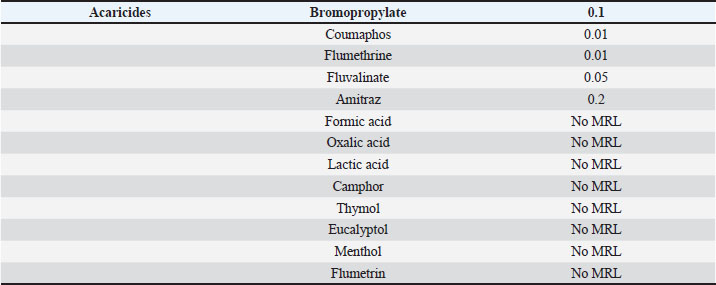
AbstractBackground: The rampant occurrence of Varroa mites in honeybee hives has resulted in the significant application of chemical acaricides, prompting concerns regarding pesticide residue contamination in honey and its effects on food safety and public health. Aim: This study aimed to examine the presence and concentrations of coumaphos pesticide residues in honey produced by individual beekeepers in the Peja area of Kosovo. Method: Forty honey samples were gathered and examined using gas chromatography with an electron capture detector. The method validation showed acceptable performance, with recovery rates ranging from 78.2% to 98.0%. The detection limits varied between 0.001 and 0.168 µg/kg, whereas the quantification limits were 0.003 µg/kg for flumethrin and 0.005 µg/kg for coumaphos. Results: Pesticide residues were found in 11 (27.5%) of 40 samples. Coumaphos was the sole found pesticide, with levels ranging from 3.4 to 39.1 µg/kg. Among the contaminated samples, 35.3% surpassed the European Union Maximum Residue Levels, indicating possible hazards to honey safety and adherence to regulations. Conclusion: Acaricides used inside hives are the main cause of pesticide contamination in honey. Ongoing evaluation of pesticide residues and focused educational initiatives for beekeepers regarding suitable hive management techniques are recommended to improve honey safety and safeguard consumer health. Keywords: Honey, Pesticide residues, Coumaphos, GC-ECD, Varroa mite, Acaricides, Kosovo. IntroductionApiculture is a notable agricultural practice in Kosovo, particularly in the Peja region. This area benefits from a suitable climate, varied plant life, and established beekeeping methods, which facilitate honey production. The Peja region in western Kosovo encompasses numerous rural and semi-rural locations with a high concentration of small-scale apiaries (Rysha et al., 2022). Locally produced honey is a common food item that supports both the family’s finances and the regional food system. In Kosovo, beekeeping plays a crucial role in agricultural practices, enhancing rural livelihoods and the local food economy. Recent agricultural statistics indicate that Kosovo generated approximately 1,765 tons of honey in 2022, with an estimated per capita consumption of approximately 1.1 kg of honey each year, and local production fulfilling close to 88% of the national requirement (Ministry of Agriculture, Forestry and Rural Development, 2023). Despite this noteworthy production level, the gap between what is produced and what is consumed has necessitated the import of approximately 250 tons of honey during the same year to meet domestic needs. These statistics highlight the crucial need for upholding the quality and safety of honey, as most of the honey consumed is sourced locally and is commonly used by households throughout the nation (Ministry of Agriculture, Forestry and Rural Development, 2023). Honey production in this region faces growing challenges due to parasitic infestations, particularly those caused by the V. destructor mite. Varroa destructor is an ectoparasitic mite that is widely recognized as one of the most significant threats to honey bee (Apis mellifera) colonies globally (Rosenkranz et al., 2010; Dietemann et al., 2013). The mite feeds on the fat body tissues of adult bees and developing brood, resulting in reduced vitality, impaired immune responses, transmission of viral pathogens, and increased mortality. Varroa infestation can result in significant colony losses and economic damage for beekeepers if left untreated (Rosenkranz et al., 2010). In the Peja region, beekeepers commonly report persistent Varroa infestations, necessitating routine chemical control measures to maintain colony survival and productivity. Beekeepers mainly rely on chemical acaricides, specifically synthetic options like formamidines, pyrethroids, and organophosphates, to manage V. destructor populations. A common choice is coumaphos, an organophosphorus insecticide favored for its effectiveness and convenient application through hive strips (CalatayudVilches et al., 2018 ). However, because coumaphos is highly fat-soluble, it frequently accumulates in beeswax and can eventually leach into honey, especially during periods of excessive or incorrect application (Albero et al., 2023). This leads to the persistent presence of residues within hive products long after the end of the active treatment period (Luna et al., 2023). Residues of coumaphos in honey raise concerns not only for bee health but also for food safety and public health in Kosovo (Hulaj et al., 2024). Honey is frequently consumed by sensitive population groups, including children, and is perceived as a natural and residue-free product. (Eissa and Taha, 2023). Organophosphorus pesticide residues may pose potential health risks if their concentrations exceed regulatory limits or if chronic exposure occurs (Rani et al., 2021). Recent studies have emphasized the importance of monitoring pesticide residues in honey to ensure compliance with maximum residue limits and protect consumer health (Surma et al., 2023; Saad et al., 2024). However, data on coumaphos contamination in honey from Kosovo are limited, and regional variations within production areas have not been sufficiently investigated. The detection of coumaphos residues in honey has significant implications for apicultural vitality, food safety standards, and broader public health in Kosovo (Hulaj et al., 2024). Honey is frequently consumed by sensitive population groups, including children, and is often perceived as a natural and residue-free product (Eissa and Taha, 2023). The presence of organophosphorus contaminants presents a toxicological risk, particularly through chronic exposure or when concentrations surpass established maximum residue limits (MRLs) (Rani et al., 2021). While contemporary research emphasizes the need for rigorous monitoring to ensure consumer protection and regulatory compliance (Surma et al., 2023; Saad et al., 2024), a critical dearth of empirical data regarding coumaphos contamination levels and regional distribution patterns, specifically within the Kosovo honey market, remains. Under Kosovar law, specific MRLs have been established for acaricides and antibiotics to control the presence of veterinary drug residues in food products and safeguard public health (Table 1). Table 1. Maximum Residue Limits (MRL) for acaricides and antibiotics established by Kosovar law.
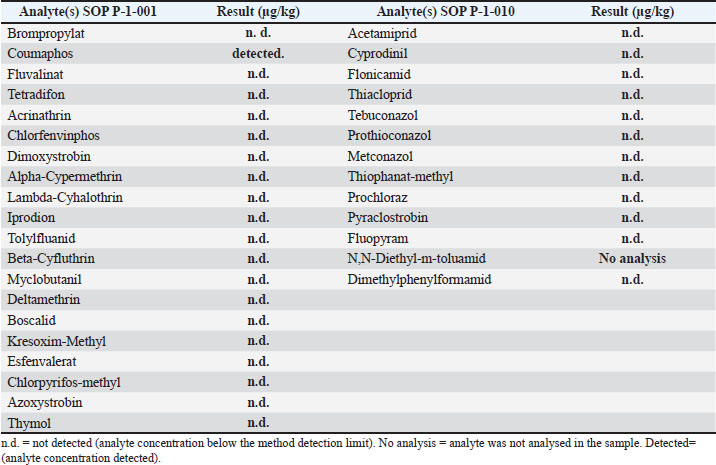
Given the widespread use of acaricides for Varroa control in the Peja region and the lack of published residue data, systematic monitoring is essential. Therefore, this study aimed to determine the occurrence and concentration of coumaphos residues in honey samples collected from different areas within the Peja region of Kosovo during August 2024. The study further aimed to compare contamination levels among regions and assess whether statistically significant differences exist, thereby providing baseline data relevant to beekeeping practices, food safety, and public health. The implementation of systematic monitoring protocols is imperative due to the pervasive application of acaricides for Varroa management within the Peja region, coupled with a notable absence of empirical residue documentation. Furthermore, the study sought to evaluate the spatial variations in contamination levels and determine the statistical significance of these differences. This investigation aims to establish critical baseline data essential for refining apicultural management, ensuring food safety, and safeguarding public health. Materials and MethodsStudy area and sampling sites and sampling collection, sample handling, and storageIn August 2024, 40 honey specimens were collected from four distinct local apiaries in the Peja Region of Kosovo: Dubovik, Leshan, Vitomirice, and Raushiq. Every sample underwent a comprehensive screening for 33 distinct organochlorine and organophosphorus pesticide residues; Table 2 details the specific analytes targeted in this study. Each participating apiculturist provided approximately 500 g of honey, which was secured in sterile, contaminant-free containers. Table 2. Organochlorine and organophosphorus pesticide compounds (n=33) analyzed in the study locally produced honey.
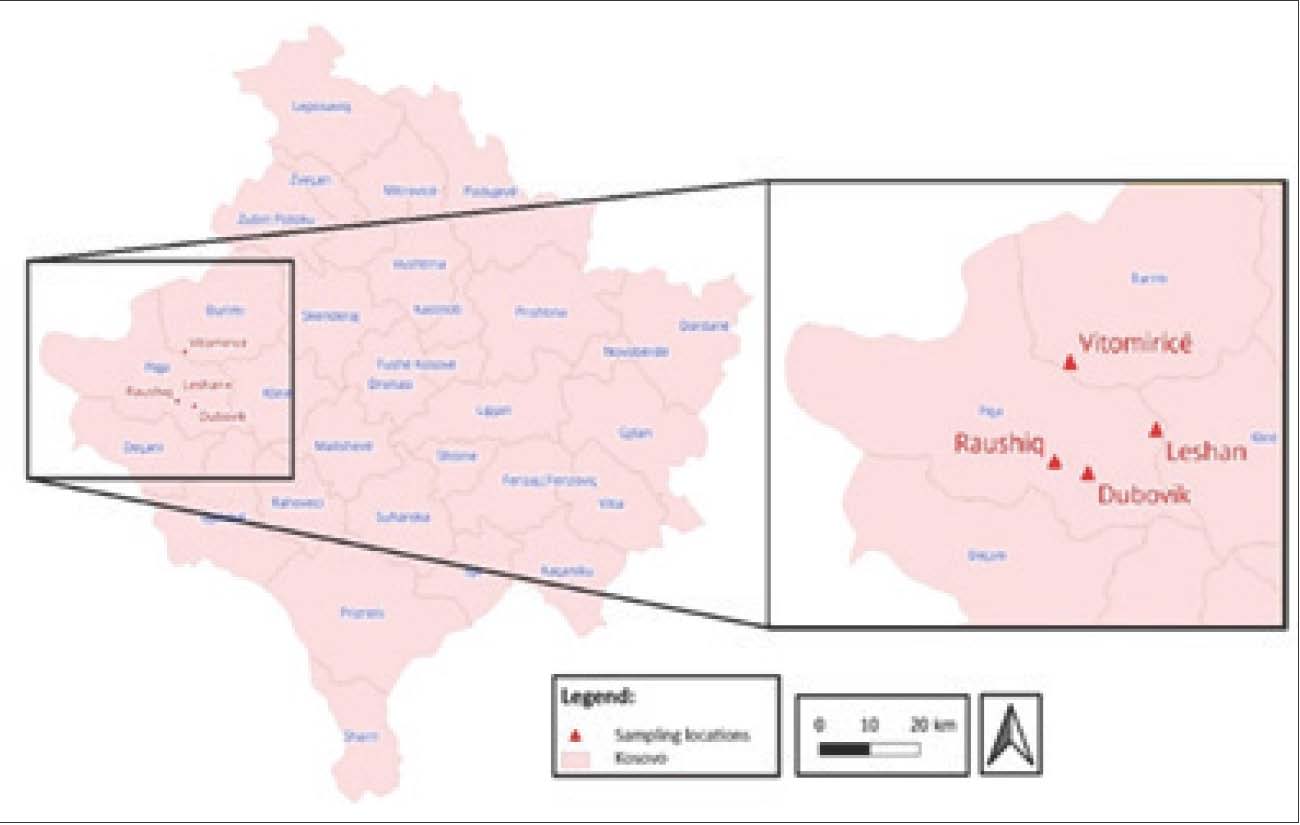
To facilitate a representative geographic overview, the selection of these specific study areas within the Peja district was predicated on their established apicultural productivity and spatial distribution (Fig. 1). Within these designated sectors, apiaries were identified using a convenience sampling methodology, prioritized by logistical accessibility, beekeepers’ informed consent, and availability of active, viable colonies during the sampling window. Only apiaries that practiced conventional beekeeping and had no recent honey harvesting before sampling were included. Honey samples were collected directly from beehives from each selected apiary following standard hygienic procedures. Efforts were made to include apiaries of similar size and management practices to minimize variability related to colony number and production scale.
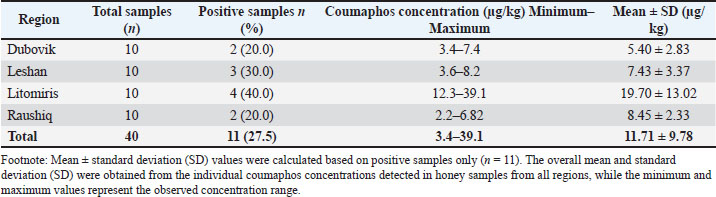
Fig. 1. Sampling sites within the local apiaries of the Peja region. All honey samples were stored in their original glass containers to prevent cross-contamination. The samples were maintained at room temperature in a dark, dry environment until extraction and analysis. The inclusion criteria were restricted to apiaries employing conventional management practices that had not performed a honey harvest immediately before the sampling period. Specimens were extracted directly from the hives at each site, strictly following established hygienic protocols to ensure sample integrity. To reduce confounding variables associated with colony density and production volume, apiaries characterized by comparable scales of operation and management techniques were prioritized. All honey specimens were maintained in their original glass receptacles to mitigate the risk of cross-contamination. These samples were preserved at ambient temperature within a desiccated, light-shielded environment until the laboratory extraction and chemical analysis. MaterialsThe pesticides used (fipronil, thiamethoxam, acetamiprid, acrinathrin, metamidophos, dimetoathe, diazinon, chlorpyrifos, methidathion, profenophos, azinphos methyl, and coumaphos) had a purity of ≥ 98% (Sigma-Aldrich ®, St. Louis, MO, USA). All solvents were of residue analysis grade (Merck®, Darmstadt, Germany). Triphenyl phosphate and Pentachloronitrobenzene (PCNB) (Sigma-Aldrich®, St. Louis, MO, USA) were used as internal standards for gas chromatography with flame photometric detection and gas chromatography with electron capture detection (GC-ECD), respectively. Stock solutions were prepared in acetonitrile (1 g/l). The working standard solutions were diluted with acetonitrile for spiking purposes. Clean-up® unbonded silica (15 ml, 2 g). Clean-up® carbon graphitized non-porous (6 ml, 0.5 g) and Enviro-clean® florisil (15 ml, 2 g) solid phase extraction cartridges and Selectrasorb® bulk sorbent end-capped C18 for matrix solid-phase dispersion were provided by UCT ® (Bristol, PA, USA). Gas chromatography–electron capture detector systemAn Agilent (Santa Clara, CA, USA) model 7890B ® gas chromatograph equipped with an automatic injector and an ECD was employed for GC-ECD. An HP-5 capillary column (30m × 0.32 mm i.d., 0.25 m film thickness) was used. Argon-methane (99.995%) mixture was selected as the carrier gas. Halogenated pesticides were separated and determined under the following conditions: injector temperature, 250°C.; detector temperature, 320°C.; column temperature program, 120°C held for 1 minutes, increased at 15◦/ minute up to 190°C, increased at 8◦/minute up to 230°C, increased at 20◦/minute up to 280◦C held for 6 minutes. A 1-l volume of the extract was injected in the splitless mode (1 minute purge). The carrier gas flow in the column was 1.3 ml/minute. The mixture of 33 pesticides and the internal standard PCNB was well resolved in 20 minutes. The chromatographic analysis was performed using spiked extracts of free residues of honeybee as a matrix-matched standard (Herrera et al., 2005; Abd Al-Rahman, 2008). The study quantitatively screened honey samples using GC-ECD, the sample analysis was done by the Universität Hohenheim, Landesanstalt für Bienenkunde, Germany. The Institute has elaborated on the methods used to analyze honey to combine sensitivity, speed, and repeatability. The recovery rate ranged from 78.2% to 98.0%. The method provided LODs in the range of 0.001–0.168 µg/kg. The limit of quantification (LOQ) was 0,003 µg/kg only for flumethrin 0,005 µg/kg). Extraction procedureHoney samples (5 g) were weighed into glass vessels and mixed with 50 ml of distilled water, followed by magnetic stirring for 10 minutes to ensure homogenization. Simultaneously, 0.5 g of C18 sorbent was introduced into a 1009 mm ID glass chromatography column with a coarse frit No. 2 and covered with a plug of salinized glass wood at the top. The solid phase was preconditioned by passing 10 ml of methanol and 10 ml of water through a vacuum pump to avoid dryness. The sample was passed through the solid phase, after which the retained pesticides were eluted by passing the first 10 ml of ethyl acetate, followed by 4 ml of methanol, and then 1 ml of dichloromethane. The eluate was evaporated to 0.5 ml using a gentle steam of nitrogen and transferred quantitatively with methanol into a 1-ml volumetric flask to obtain a final extract in 100% methanol. For the analysis, 5 μl was injected into the Liquid Chromatography–Mass Spectrometry system and one μl into the GC-MS system. To determine the LOQs, recovery, and precision, samples of honey were "pesticide-free" and different from the samples studied. We performed recovery experiments by spiking 5 g honey samples with 50–100 μl of pesticide working mixtures prepared in methanol at appropriate concentrations. Before sample analysis using the proposed method, the spiked samples were left to stand at room temperature for 3 hours to achieve solvent evaporation and pesticide distribution in the honey. Recovery, precision, and LOQ determinationMethod performance was evaluated using pesticide-free honey samples, which were distinct from the study samples obtained from the Peja region. The study conducted recovery experiments to evaluate the method by spiking 5 g aliquots of honey with 50–100 µl of pesticide working solutions at appropriate concentrations. Spiked samples were allowed to stand at room temperature for 3 hours to allow solvent evaporation and uniform distribution of analytes within the honey matrix. Recoveries, LOQs, and precision parameters were determined using the complete extraction and analytical workflow described above. Statistical analysisDescriptive statistical metrics, encompassing mean concentrations and associated standard deviations, were derived exclusively from the subset of samples with positive detections. Owing to the low frequency of positive results across the various sampling locales, spatial disparities in coumaphos concentrations were evaluated using the non-parametric Kruskal–Wallis H test. All computational analyses were executed using SPSS version 28.0 (IBM Corp., Armonk, NY, USA). The aforementioned non-parametric test was specifically employed to investigate regional variations in analyte levels, restricted to samples with concentrations exceeding the detection limit. Ethical approvalNot needed for this study. ResultsAnalysis revealed that pesticide residues were present in a significant fraction of the honey specimens, with 11 (27.5%) of the 40 samples yielding positive detections (Table 3). The mean concentration of coumaphos among these contaminated samples was 11.71 ± 9.78 µg/kg. The detected levels exhibited considerable variability, with concentrations ranging from a minimum of 3.4 µg/kg to a maximum of 39.1 µg/kg. Table 3. Occurrence and concentration of coumaphos in Peja honey samples (August 2024).
The results show that the Vitomirica district exhibited the highest frequency of contamination, with coumaphos residues spanning a range of 12.3–39.1 µg/kg. Disparities in mean concentrations were noted across the sampling locales, with Vitomirica recording the most elevated mean level (19.70 ± 13.02 µg/kg), followed by Raushiq (8.45 ± 2.33 µg/kg), Leshan (7.43 ± 3.37 µg/kg), and Dubovik (5.40 ± 2.83 µg/kg), as detailed in Table 4. Table 4. Distribution of coumaphos-positive honey samples across regions of the Peja area in 2024.
Despite the ostensibly higher residue burden identified in Vitomirica, the Kruskal-Wallis analysis indicated that these regional variations were not statistically significant (p > 0.05). This lack of statistical divergence is likely attributable to the constrained sample size of positive detections within each individual subregion, which may have limited the power of the test to identify spatial differences. DiscussionThis study examined coumaphos residues in honey from the Peja region of Kosovo. The observation that all samples fell below the MRL of 100 µg/kg indicates that Peja honey is legally compliant and generally safe for public consumption. However, the detection frequency of 27.5% highlights the non-negligible prevalence of coumaphos in the apicultural environment. Environmental factors and apiary management practices may contribute to the higher incidence and mean concentration of coumaphos residues observed in the Vitomirica area. Differences in beekeeping practices, particularly the frequency and dosage of acaricide application for Varroa mite control, could contribute to elevated residue levels. Areas with higher Varroa infestation pressure may require more intensive chemical treatment, thereby increasing the likelihood of residue persistence. While Vitomirica recorded higher average concentrations, the absence of significant regional variation indicates that coumaphos contamination is likely associated with local management practices rather than general regional trends. In comparison with the worldwide literature, our findings align with the mid-range of documented coumaphos contamination levels. For instance, (Kasiotis et al., 2021) examined 109 honey samples gathered from 2015 to 2020 and found coumaphos in 26% of the samples, at significantly lower levels (0.0013–0.785 µg/kg) compared with those in our research. Similarly, (Oymen et al., 2022) analyzed 100 honey samples from Northern Cyprus and discovered coumaphos in 29% of the samples, with just two surpassing the 0.2 mg/kg MRL, indicating generally improved residue management compared to Kosovo. In comparison, multiple studies have indicated significantly increased levels of contamination (K.M et al., 2021) conducted research on 320 honeybee samples from Greece (2014–2018) found 70 pesticide compounds, including coumaphos, with concentrations between 1.4 µg/g and 166 µg/g, situating the coumaphos levels observed in our investigation at the lower to moderate range of this scale. Similarly, (Kasiotis and Machera, 2018) examined 200 honeybee samples in Greece (2014–2017) and identified a remarkably high contamination rate of 76%, with residues varying from 1 ng/g to 160,000 ng/g, significantly surpassing the levels noted in Kosovo and suggesting greater pesticide exposure and possible poisoning incidents. Additional comparisons revealed significant regional differences. In a study conducted in Uruguay, (Luna et al., 2023) found that the coumaphos levels in propolis reaching 1,000 µg/kg, which was notably higher than the contamination levels we detected. In Egypt, (Eissa et al., 2014) discovered pesticide residues in 55.6% of honey samples, with 81.8% exceeding European Union Maximum Residue Levels—significantly above the 35.3% exceedance rate found in our study. Similarly, (Kasiotis et al., 2023) documented widespread contamination in 72 honeybee colonies, reporting that 86% contained coumaphos and amitraz metabolites, indicating extensive acaricide use. Meanwhile, (Kamel and Al-Ghamdi, 2006) detected coumaphos in 42.9% of samples in Saudi Arabia, although concentration details were not provided. On the lower end of the contamination spectrum, (Fernandez Muino et al., 1997) reported that 72.3% of 101 honey samples from Spain were free of acaricide residues, and none contained detectable coumaphos, indicating stricter practices than in Kosovo. Findings from Kosovo reflect global trends of acaricide contamination in honey, with levels lower than those in Greece and Uruguay but higher than those in Spain and Northern Cyprus. This proposes a more stringent acaricide management and possibly tighter regulatory supervision in comparison with that in Kosovo. In general, the coumaphos concentrations found in this study indicate a global trend of acaricide pollution in beekeeping products. Kosovo’s outcomes are below those noted in Greece, Egypt, and Uruguay, yet above those recorded in Spain and Northern Cyprus. These discrepancies may be affected by diverse beekeeping methods, frequency of acaricide use, regulatory measures, climatic conditions, and the occurrence of V. destructor, a significant factor influencing acaricide application. ConclusionThe results of this research emphasize a major issue regarding the existence of pesticide residues, especially coumaphos, in honeybee products from the Peja area. The identification of residues in more than a quarter of samples highlights the need for enhanced monitoring initiatives and stricter regulatory measures to guarantee food safety and protect consumers. The global differences in contamination levels indicate that honey safety is affected by various factors, such as local regulations, beekeeping methods, acaricide usage techniques, and environmental conditions. The findings underscore the necessity of implementing balanced and sustainable V. destructor management strategies that reduce chemical residues in hive products. Using safer and more specific mite control options, combined with the correct use of approved acaricides, can greatly lower contamination risks and enhance honey quality. The extensive finding of coumaphos in honey in numerous countries, including Kosovo, signifies an immediate need for better monitoring systems and increased education of beekeepers. While acaricides are vital for ensuring colony health, their accidental presence in honey highlights essential concerns for the beekeeping industry: minimizing dependence on synthetic substances, enhancing residue monitoring, and encouraging eco-friendly apiculture practices. Ongoing research is crucial for enhancing risk assessment methods, improving sustainable mite management tactics, and aiding evidence-based policy development. Guaranteeing food safety and preserving consumer trust will necessitate collaborative efforts from beekeepers, regulatory bodies, and research institutions. Enhancing monitoring and education can greatly reduce the dangers of pesticide contamination, leading to safer honeybee products and more sustainable beekeeping. AcknowledgmentsThe authors highly value the support provided by the Food and Veterinary Agency. Conflict of interestThe authors have no conflicts of interest to declare. FundingThis study received no specific funding. Authors’ contributionsThe authors contributed equally to the success of this scientific paper. Data availabilityData are available when requested via the corresponding author. ReferencesAbd Al-Rahman, S.H. 2008. Determination of pesticide residues in honey by using different extraction methods and gas chromatography with electron-capture detection. Arab. Univ. J. Agric. Sci. 16(2), 503–509. Albero, B., Miguel, E. and García-Valcárcel, A.I. 2023. Acaricide residues in beeswax: implications in honey, brood and honeybee. Environ. Monit. Assess. 195(4), 454; doi:10.1007/s10661-023-11047-6 Bischoff, K., Baert, N. and Mcart, S. 2023. Pesticide contamination of beeswax from managed honeybee colonies in New York State. J. Vet. Diag. Investment. 35, 617–624; doi:10.1177/10406387231199098 Calatayud-Vernich, P., Calatayud, F., Simó, E. and Picó, Y. 2018. Pesticide residues in honey bees, pollen and beeswax: assessing beehive exposure. Environ. Pollut. 241, 106–114; doi:10.1016/j.envpol.2018.05.062 Dietemann, V., Nazzi, F., Martin, S.J., Anderson, D.L., Locke, B., Delaplane, K.S., Wauquiez, Q., Tannahill, C., Frey, E., Ziegelmann, B., Rosenkranz, P. and Ellis, J.D. 2013. Standard methods for Varroa research. J. Apic. Res. 52, 1–54; doi:10.3896/IBRA.1.52.1.09 Eissa, F. and Taha, E.K.A. 2023. Contaminants in honey: an analysis of EU RASFF notifications from 2002 to 2022. J. Consum. Prot. Food Saf. 18, 393–402; doi:10.1007/s00003-023-01460-x Eissa, F., El Sawi, S. and Zidan, N.E. 2014. Determining pesticide residues in honey and their potential risk to consumers. Pol. J. Environ. Stud. 23(5), 1573–1580. Fernandez Muino, M.A., Sancho, M.T., Simal-Gandara, J., Creus-Vidal, J.M., Huidobro, J.F. and Simal-Lozano, J. 1997. Acaricide residues in honeys from Galicia (N. W. Spain) in 1997. J. Food. Prod. 60, 78–80; doi:10.4315/0362-028X-60.1.78 Herrera, A., Pérez-Arquillue, C., Conchillo, P., Bayarri, S., Lázaro, R. and Yagüe, C. 2005. 2005. Determination of pesticides and PCBs in honey by solid-phase extraction cleanup followed by gas chromatography with electron-capture and nitrogen-phosphorus detection. Anal. Bioanal. Chem. 381(3), 695–701; doi:10.1007/s00216-004-2924-3 Hulaj, B., Granato, A., Bordin, F., Goga, I., Merovci, X., Caldon, M., Cana, A., Zulian, L., Colamonico, R. and Mutinelli, F. 2024. Emergent and known honey bee pathogens through passive surveillance in the Republic of Kosovo. Appl. Sci. 14(3), 987; doi:10.3390/app14030987 Kamel, A. and Al-Ghamdi, A. 2006. Determination of acaricide residues in Saudi Arabian honey and beeswax using solid phase extraction and gas chromatography. J. Environ. Sci. Health. 41, 159–165; doi:10.1080/03601230500364492 Kasiotis, K.M. and Machera, K. 2018. Pesticide and metabolites residues in honeybees: A 2014-2017 Greek compendium. Hazards of pesticides to bees: 13th International Symposium of the ICP-PR Bee Protection Group;18—20. València (Spain)— Proceedings—Julius-Kühn-Archiv, 2017; doi: 10.5073/jka.2018.462.058 Kasiotis, K.M., Zafeiraki, E., Kapaxidi, E., Manea-Karga, E., Antonatos, S., Anastasiadou, P., Milonas, P. and Machera, K. 2021. Pesticides residues and metabolites in honeybees: a Greek overview exploring Varroa and Nosema potential synergies. Sci. Total. Environ. 769, 145213; doi:10.1016/j.scitotenv.2021.145213 Kasiotis, K.M., Zafeiraki, E., Manea-Karga, E., Anastasiadou, P. and Machera, K. 2023. Pesticide residues and metabolites in Greek honey and pollen: bees and human health risk assessment. Foods 12(4), 706; doi: 10.3390/foods12040706 Luna, A., Flores, J.M., Miguel, E., Fernández-Alba, A.R. and Hernando, M.D. 2023. Coumaphos residue transfer to honey bee brood (Apis mellifera) in realistic scenarios. Res. Vet. Sci. 159, 106–124. Ministry of Agriculture, Forestry and Rural Development. 2023. Green report: Agriculture and rural development in Kosovo. Prishtina, Kosovo: Ministry of Agriculture, Forestry and Rural Development. Available via https://www.mbpzhr-ks.net/repository/docs/Green_Report_2023.pdf Oymen, B., Aşır, S., Türkmen, D. and Denizli, A. 2022. Determination of multi-pesticide residues in honey with a modified QuEChERS procedure followed by LC-MS/MS and GC-MS/MS. J. Apic. Res. 61, 530–542; doi:10.1080/00218839.2021.2017540 Pareja, L., Colazzo, M., Pérez-Parada, A., Niell, S., Carrasco-Letelier, L., Besil, N., Cesio, M.V. and Heinzen, H. 2011. Detection of pesticides in active and depopulated beehives in Uruguay. Int. J. Environ. Res. Public Health 8(10), 3844–3858; doi:10.3390/ijerph8103844 Rani, L., Thapa, K., Kanojia, N., Sharma, N., Singh, S., Grewal, A.S., Srivastav, A.L. and Kaushal, J. 2021. An extensive review on the consequences of chemical pesticides on human health and environment. J. Clean. Prod. 283, 124657; doi:10.1016/j.jclepro.2020.124657 Rosenkranz, P., Aumeier, P. and Ziegelmann, B. 2010. Biology and control of Varroa destructor. J. Invertebrate Pathol. 103, 96–119; doi:10.1016/j.jip.2009.07.016 Rysha, A., Kastrati, G., Biber, L., Sadiku, V., Rysha, A., Zogaj, F. and Kabashi-Kastrati, E. 2022. Evaluating the physicochemical properties of some Kosovo’s and imported honey samples. Appl. Sci. 12(2), 629; doi:10.3390/app12020629 Saad, S., Fatthalla, M., Abd-Ellah, H., Hagag, E.S., Taha, S.M., Mahrous, A. and Shahba, M.A. 2024. Antibiotics, pesticides, and heavy metals contaminants of honey as affected by antibiotics usage and agricultural practices in different Egyptian environments. Egypt. Pharm. J. 23(3), 555–564; doi:10.4103/epj.epj_5_24 Surma, M., Sadowska-Rociek, A. and Draszanowska, A. 2023. Levels of contamination by pesticide residues, polycyclic aromatic hydrocarbons (PAHs), and 5-hydroxymethylfurfural (HMF) in honeys retailed in Europe. Arch. Environ. Contam. Toxicol. 84(2), 165–178; doi:10.1007/s00244-022-00970-3 | ||

| How to Cite this Article |
| Pubmed Style Rama A, Hulaj B, Haziri I, Wallner K, Fritz B, Sinani A, Abdulazeez IO. Coumaphos residues in Kosovar honey: Implications for food safety and public health. Open Vet. J.. 2026; 16(5): 2696-2703. doi:10.5455/OVJ.2026.v16.i5.12 Web Style Rama A, Hulaj B, Haziri I, Wallner K, Fritz B, Sinani A, Abdulazeez IO. Coumaphos residues in Kosovar honey: Implications for food safety and public health. https://www.openveterinaryjournal.com/?mno=302908 [Access: June 26, 2026]. doi:10.5455/OVJ.2026.v16.i5.12 AMA (American Medical Association) Style Rama A, Hulaj B, Haziri I, Wallner K, Fritz B, Sinani A, Abdulazeez IO. Coumaphos residues in Kosovar honey: Implications for food safety and public health. Open Vet. J.. 2026; 16(5): 2696-2703. doi:10.5455/OVJ.2026.v16.i5.12 Vancouver/ICMJE Style Rama A, Hulaj B, Haziri I, Wallner K, Fritz B, Sinani A, Abdulazeez IO. Coumaphos residues in Kosovar honey: Implications for food safety and public health. Open Vet. J.. (2026), [cited June 26, 2026]; 16(5): 2696-2703. doi:10.5455/OVJ.2026.v16.i5.12 Harvard Style Rama, A., Hulaj, . B., Haziri, . I., Wallner, . K., Fritz, . B., Sinani, . A. & Abdulazeez, . I. O. (2026) Coumaphos residues in Kosovar honey: Implications for food safety and public health. Open Vet. J., 16 (5), 2696-2703. doi:10.5455/OVJ.2026.v16.i5.12 Turabian Style Rama, Adem, Beqe Hulaj, Imer Haziri, Klaus Wallner, Birigit Fritz, Arben Sinani, and Ibrahim Okene Abdulazeez. 2026. Coumaphos residues in Kosovar honey: Implications for food safety and public health. Open Veterinary Journal, 16 (5), 2696-2703. doi:10.5455/OVJ.2026.v16.i5.12 Chicago Style Rama, Adem, Beqe Hulaj, Imer Haziri, Klaus Wallner, Birigit Fritz, Arben Sinani, and Ibrahim Okene Abdulazeez. "Coumaphos residues in Kosovar honey: Implications for food safety and public health." Open Veterinary Journal 16 (2026), 2696-2703. doi:10.5455/OVJ.2026.v16.i5.12 MLA (The Modern Language Association) Style Rama, Adem, Beqe Hulaj, Imer Haziri, Klaus Wallner, Birigit Fritz, Arben Sinani, and Ibrahim Okene Abdulazeez. "Coumaphos residues in Kosovar honey: Implications for food safety and public health." Open Veterinary Journal 16.5 (2026), 2696-2703. Print. doi:10.5455/OVJ.2026.v16.i5.12 APA (American Psychological Association) Style Rama, A., Hulaj, . B., Haziri, . I., Wallner, . K., Fritz, . B., Sinani, . A. & Abdulazeez, . I. O. (2026) Coumaphos residues in Kosovar honey: Implications for food safety and public health. Open Veterinary Journal, 16 (5), 2696-2703. doi:10.5455/OVJ.2026.v16.i5.12 |


