




| Research Article | ||
Open Vet. J.. 2026; 16(5): 2929-2938 Open Veterinary Journal, (2026), Vol. 16(5): -2938 Research Article Seminal plasma protein profiles and their association with semen quality parameters in Aceh bulls: A comparative studyEdy Sophian1, Hikmayani Iskandar1, Tulus Maulana1, Syahruddin Said1, Mohamad Agus Setiadi2, Raden Iis Arifiantini2, Erni Damayanti3, and Hendri Hendri4*1Research Center for Applied Zoology, National Research and Innovation Agency (BRIN), Bogor, Indonesia 2Division of Veterinary Reproduction and Obstetrics, School of Veterinary Medicine and Biomedical Sciences, IPB University, Bogor, Indonesia 3Department of Animal Production, Faculty of Animal Science, Universitas Hasanuddin, Makassar, Indonesia 4Department of Animal Production Technology, Faculty of Animal Science, Universitas Andalas, Padang, Indonesia *Corresponding Author: Hendri Hendri. Department of Animal Production Technology, Faculty of Animal Science, Universitas Andalas, Padang, Indonesia. Email: hendri [at] ansci.unand.ac.id Submitted: 08/11/2025 Revised: 22/03/2026 Accepted: 03/04/2026 Published: 31/05/2026 © 2025 Open Veterinary Journal
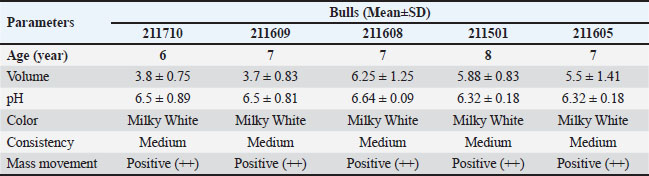
ABSTRACTBackground: Semen quality is a crucial determinant of male fertility, and seminal plasma proteins play an essential role in the regulation of sperm function, protection, and fertilization ability. Profiling these proteins can provide insights into fertility-associated markers in livestock, particularly in indigenous cattle such as the Aceh bull. Aim: This study aimed to determine the seminal plasma protein profile of Aceh bulls and analyze its relationship with semen quality parameters. Methods: Semen was collected once a week using an artificial vagina. The collected samples were evaluated both macroscopically and microscopically. Macroscopic evaluation included volume, color, pH, and consistency, while microscopic evaluation assessed mass movement, motility, viability, morphology, membrane integrity (MI), and acrosome integrity using an Olympus BX51 microscope. Sperm concentration was measured using an (SDM 6, Minitube, Tiefenbach, Germany). Seminal plasma proteins were analyzed using one-dimensional sodium dodecyl sulfate-polyacrylamide gel electrophoresis (1D SDS-PAGE). Results: Aceh bull semen had an average volume of 6.25 ± 1.25 ml, a pH of 6.7 ± 0.04, a milky white color, and medium viscosity. Microscopic evaluations revealed motility of 76.30% ± 3.79%, concentration of 1541 ± 79.9 × 10⁶/ml, viability of 76.44% ± 3.21%, MI of 79.77% ± 4.59%, morphology of 88.04% ± 4.65%, and intact acrosome integrity of 93.58% ± 0.2%. The protein concentration ranged from 151.38 to 158.34 µg/ml. The seminal plasma protein concentration ranged from 151.38 to 158.34 µg/ml. 1D SDS-PAGE revealed distinct banding patterns based on the molecular weight (MW). Bulls with sperm motility >75% exhibited nine protein bands, whereas those with motility <75% displayed ten bands. Higher MW bands were absent in some individuals, particularly within the range of 270–176 kDa. The protein MW distribution was negatively correlated with sperm motility (r=−0.48), concentration (r=−0.18), viability (r=−0.47), MI (r=−0.46), morphology (r=−0.46), and acrosome integrity (r=−0.47). No significant differences in sperm concentration, viability, morphology, or acrosome integrity were observed between bulls, whereas MI differed among individuals. Conclusion: The seminal plasma protein profiles of Aceh bulls showed a negative correlation with semen quality parameters. Lower MW proteins were associated with higher semen quality, indicating their potential as fertility assessment biomarkers in Aceh bulls. Keywords: Aceh bulls, Fertility, Protein profile, Semen quality, Seminal plasma. IntroductionThe breeding of Aceh bulls (Bos indicus) can be done through natural mating or artificial insemination (AI) technology, which can significantly increase livestock population and genetic quality (Mahyun et al., 2021). However, accelerating the livestock population and genetic quality depends on the availability of quality frozen semen. A rigorous selection of prospective bulls is required to obtain superior bulls or high-quality frozen semen. The Lembang and Singosari artificial insemination centers (AICs) are the only institutions that currently produce frozen semen of Aceh bulls. Government institutions produce frozen semen from genetically superior bulls in accordance with established standards. The Regulation of the Minister of Agriculture of the Republic of Indonesia (Number 10/Permentan/PK.210/3/2016) governs the frozen semen production process, while the Indonesian National Standard for Bovine Frozen Semen (SNI 4869) defines its quality requirements (BSN, 2021). Varying fertility rates can affect livestock reproductive effectiveness. Semen quality assessment is used to identify factors affecting sperm performance and diagnose infertility (Santolaria et al., 2023). Bull fertility can be predicted by assessing physical performance, libido, health status, ability to mate successfully, and semen quality (Indriastuti et al., 2022; Iskandar et al., 2022a,b). Semen quality is generally evaluated based on several factors, including sperm concentration (Kirkman-Brown and Björndahl, 2009), motility (Van Der Horst, 2020), viability (Samplaski et al., 2015), plasma membrane integrity (Morrell et al., 2017; Indriastuti et al., 2020), acrosome integrity (Morrell et al., 2017; Rickard et al., 2022), and sperm abnormalities (Enciso et al., 2011; Morrell et al., 2017). Analyzing the production potential of Aceh bulls is essential, as they are one of the local cattle breeds officially recognized by the government through Decree of the Minister of Agriculture No. 2907/Kpts/OT.140/6/2011. This breed has a native geographical distribution in Aceh Province and has been cultivated for generations. Local farmers primarily raise Aceh bulls for meat production (Rotua et al., 2017). Semen comprises sperm and seminal plasma. Seminal plasma is a complex mixture of secretions derived from the testes, epididymis, and additional sex glands that contain factors that influence sperm in the fertilization process (Karunakaran and Devanathan, 2017). Some proteins present in semen can alter its function and affect fertility rates (Moura and Memili, 2016). Based on molecular weight, seminal plasma proteins have been identified as potential fertility markers in Simmental bulls (Baharun et al., 2020), Bali bulls (Iskandar et al., 2022a,b), and Holstein bulls (Rosyada et al., 2020). Some proteins present in sperm can also serve as indicators of the characteristics, quality, and fertility level of bulls (Moura and Memili, 2016; Karunakaran et al., 2019). Research related to the plasma protein profile of semen from Aceh bulls is still limited. Therefore, this study aimed to identify the seminal plasma protein profile of Aceh bull semen and its correlation with sperm quality. Materials and MethodsExperimental animalsFresh semen samples were collected from Aceh bulls maintained at the AICs in Lembang, Bandung, and Singosari, East Java, Indonesia. The bulls were managed in accordance with standard operational procedures at each AIC and were routinely supervised by a veterinarian to ensure compliance with established animal welfare principles. Five Aceh bulls aged 6–8 years from the Singosari AIC, East Java, Indonesia, were included in the study. The bulls were fed fresh forage and concentrate at 1% of body weight twice daily in the morning and evening, with ad libitum access to water. For analytical purposes, the bulls were classified into two groups based on sperm motility (≥70% and <70%). Semen collection was conducted between April and September 2023. Fresh semen collection and evaluationSemen samples from Aceh bulls were routinely collected twice a week in the morning using an artificial vagina. Semen samples were transported to the laboratory for comprehensive macroscopic and microscopic evaluations immediately after collection. Macroscopic assessment included determination of semen volume, color, consistency, and pH. Subsequently, microscopic analyses were performed to evaluate sperm quality. Sperm viability and general morphology were assessed using eosin–nigrosin staining by mixing 20 µl of semen with 80 µl of stain on a glass slide, followed by examination under a light microscope (Olympus® CX43) at 400× magnification. Sperm concentration was determined using an SDM 6 Photometer (Minitub®, Tiefenbach, Germany). The hypo-osmotic swelling test was used to evaluate plasma MI by incubating 20 µl of semen with 1 ml of hypo-osmotic solution (0.7 g sodium citrate and 0.3 g fructose dissolved in 100 ml distilled water) in a water bath at 37°C for 30 minutes. Detailed sperm morphology was further assessed using diff-quick staining according to the method described by Agarwal et al. (2016). Briefly, 10 µl of fresh semen was smeared onto glass slides, air-dried, and sequentially stained with Diff-Quick Fix, Diff-Quick I, and Diff-Quick II solutions according to the manufacturer’s instructions. The stained slides were rinsed, dried, and examined under a light microscope at 400× magnification, and morphological abnormalities were evaluated based on the criteria proposed by Arifiantini (2012). Acrosome integrity was assessed using fluorescein isothiocyanate–peanut agglutinin (FITC-PNA) staining as described by Rajabi-Toustani et al. (2019). Air-dried sperm smears were fixed in 96% ethanol for 10 minutes at room temperature, incubated with 30 µl PNA lectin solution (100 µg/ml) at 37°C for 30 minutes, and subsequently counterstained with 5 µl propidium iodide (1 µg/µl; Sigma, St. Louis, MO) for 5 minutes. The slides were washed three times with phosphate-buffered saline to remove excess stain before evaluation. Determination of seminal plasma protein using 1D SDS-PAGE Semen was collected for 30 minutes, and the supernatant was stored in liquid nitrogen (Iskandar et al., 2022a,b). Protein characterization using sodium dodecyl sulfate-polyacrylamide gel electrophoresis based on protein MW. The gels were stained with coomassie brilliant blue (CBB) stain, and the molecular mass was determined by molecular weight marker (Karunakaran et al., 2019). Seminal plasma protein concentration was determined using Bradford’s method (Bradford, 1976). The Bradford protocol was analyzed according to the Coomassie Protein Kit Usage Guide. Data were analyzed using Thermo Skanlt RE software, Multiskan Go, Version 3.2. 1D SDS-PAGE analysis was performed to determine the protein profile based on MW, visualized as bands on the gel. Protein separation was conducted using precast gel SDS-PAGE (ExpressPlus, Genscript Biotech Corp., Hong Kong; M01210) with a 12% polyacrylamide gel containing SDS under 140 V and 75 mA for 55 minutes. The gel was stained with CBB. A Broad Multi-Color Pre-Stained Protein Standard (Genscript Biotech Corp., Hong Kong; M00624) with a MW range of ~5–270 kDa was used as the marker. The differential intensity of each protein band was analyzed using ratio analysis with ImageJ software (National Institutes of Health, USA) (Schneider et al., 2012). Statistical analysisData obtained from each stage of the study were statistically analyzed using one-way analysis of variance at the 95% real stage and continued with the Fisher LSD method test. Data are presented in the form of means ± standard error of the mean. The correlation of protein MW with sperm quality was analyzed using Pearson’s correlation coefficient. All statistical analyses were performed using Minitab statistical software version 18. Ethical approvalThe Animal Ethics Commission of the National Research and Innovation Agency of Indonesia (BRIN) reviewed and approved all experimental procedures (approval no. 094/KE.02/SK/05/2023). ResultsQuality of fresh semenThe evaluation of fresh semen from Aceh bulls included macroscopic parameters—such as volume, pH, color, and consistency—and microscopic parameters, including mass movement, motility, concentration, viability, plasma MI, morphology, and acrosome integrity. Table 1 presents the results of the macroscopic evaluation. The semen volume of the five Aceh bulls in this study ranged from 3.7 to 6.25 ml per ejaculate. The highest volume was observed in bull ID 211608 (6.25 ± 1.25 ml), while the lowest was observed in bull ID 211609 (3.7 ± 0.83 ml). Table 1. Macroscopic evaluation of the fresh semen quality of Aceh bulls.
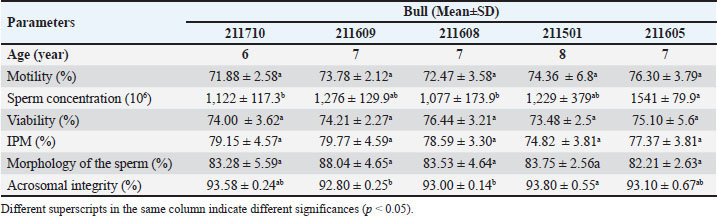
The acidity (pH) of Aceh bull semen in this study varied across individuals, with the highest average in bull ID 211608 (pH 6.64 ± 0.81) and the lowest in bulls ID 211501 and ID 211605 (pH 6.32 ± 0.18). Motility assessment revealed significant variations among the five bulls studied. The highest motility was observed in bull ID 211605 (76.30% ± 3.79%), while the lowest was observed in bull ID 211710 (71.88% ± 2.58%). The highest sperm concentration was shown in bull ID 211608, with a mean value of 5,923 ± 1.3 million sperm/ml, while the lowest concentration was shown in bull ID 211501 at 2,662 ± 2.78 million sperm/ml. In this study, the highest MI value was shown in bull ID 211608, with a mean of 79.77% ± 4.59%, while the lowest was shown in bull ID 211501 at 74.82% ± 3.81%. Morphological analysis, an essential indicator of sperm normality, revealed that bulls ID 211609 and ID 211608 had the highest percentage of morphologically normal sperm (87.60% ± 5.02% and 87.60% ± 4.80%, respectively), whereas bull ID 211710 had the lowest (82.40% ± 4.76%). The highest viability was shown in bull ID 211608, with a mean value of 76.84% ± 3.21%, while the lowest was shown in bull ID 211501 at 73.48% ± 2.50%, with an overall viability range of 70.00% to 83.00% (Table 2). Table 2. Microscopic evaluation of the fresh semen quality of Aceh bulls.
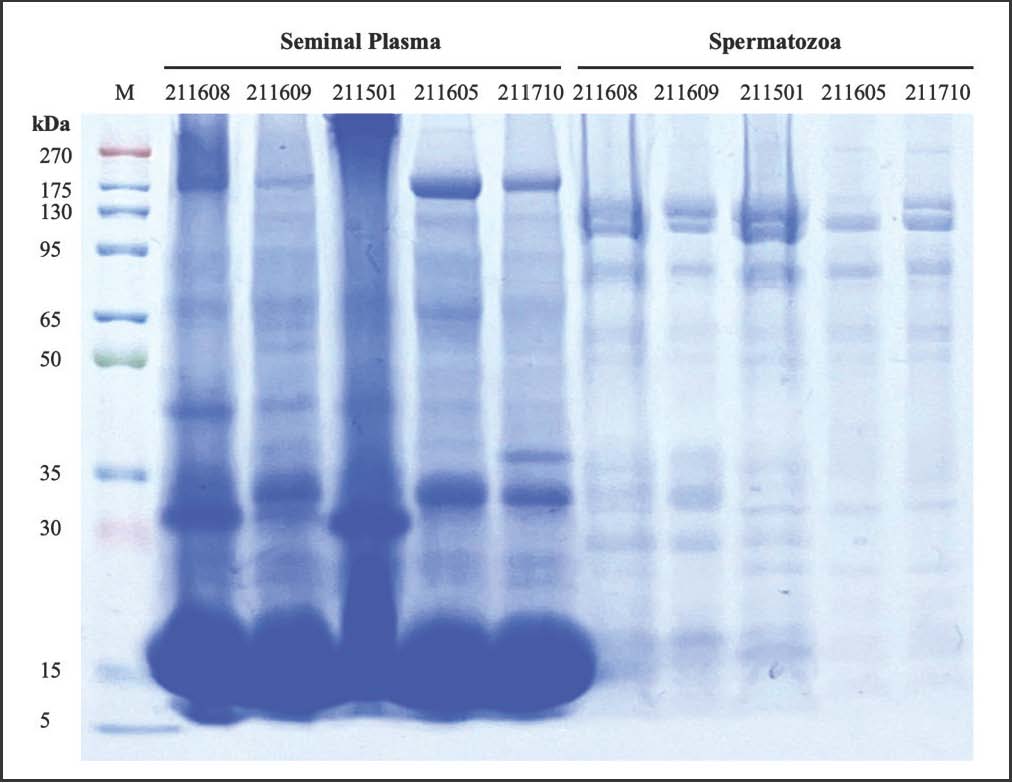
The results were categorized into two groups: sperm with green-stained acrosomes were classified as having intact acrosomes, whereas sperm with red-stained acrosomes were classified as having damaged acrosomes. Among the bulls evaluated, the highest percentage of intact acrosomes was shown in bull ID 211501 (93.80% ± 0.55%), while bull ID 211609 had the lowest percentage (92.80% ± 0.25%). Seminal plasma protein of Aceh bullsThe concentration of seminal plasma protein in each sample ranged from 151.38–158.34 µg/ml, with the highest concentration observed in bull ID 211608 and the lowest in bull ID 211605 (Table 3). Furthermore, Aceh bulls with a motility greater than 75% exhibited 9 protein bands (Fig. 1), whereas bulls with a motility less than 75% showed 10 protein bands.
Fig. 1. Seminal plasma protein profile of bulls in Aceh M: marker. Table 3. Protein concentration (µg/ml) of the seminal plasma and spermatozoa of Aceh bulls.
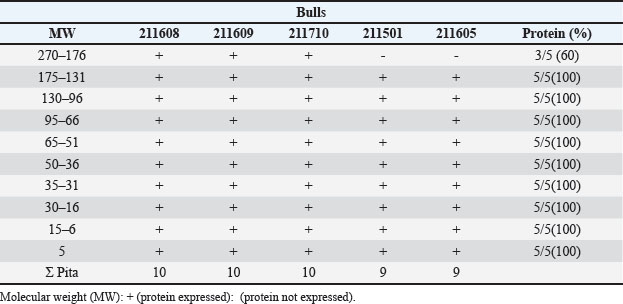
In this study, 10 protein bands were identified in the seminal plasma of Aceh bulls, distributed across MW ranges of 270–176, 175–131, 130–96, 95–66, 65–51, 50–36, 30–16, 15–6, and 5 kDa. Of these, nine bands (175–131, 130–96, 95–66, 65–51, 50–36, 30–16, 15–6, and 5 kDa) were consistently expressed across all bulls (100%). In contrast, proteins within the 270–174 kDa range were absent in 70% of the samples, indicating variability in protein expression among individuals (Table 4). Table 4. Determination of the concentration of seminal plasma protein using 1D SDS-PAGE.
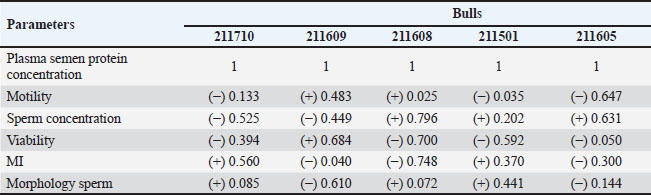
Correlation between seminal plasma protein levels and sperm motility in Aceh bullsCorrelation analysis between plasma semen protein concentration and sperm quality parameters revealed significant individual variation among the five bulls, indicating distinct physiological responses (Table 5). Bull 211609 was strongly positively correlated with motility (r=0.483) and viability (r=0.684), indicating a potential role of plasma proteins in enhancing sperm function. In contrast, bull 211608 exhibited a markedly positive correlation with sperm concentration (r=0.796) and negative associations with viability (r=−0.700) and MI (r=−0.748), indicating a trade-off between sperm quantity and quality. Notably, bulls 211710, 211501, and 211605 predominantly show negative correlations across key parameters, particularly motility and viability, implying that elevated plasma protein levels may adversely affect sperm function in certain individuals. Table 5. Correlation between the seminal plasma and spermatozoa protein levels of Aceh bulls.
DiscussionQuality of fresh semenA recent study by Hafizuddin et al. (2023) reported a lower semen volume in Aceh bulls (2.90 ± 0.53 ml), which is comparable to the lowest volume shown in this study. Similarly, Zulyazaini et al. (2016) reported an average semen volume of 3.82 ± 0.47 ml in Aceh bulls aged 3–3.5 years. Compared to other breeds, the semen volume of Ongole crossbred (PO) bulls (5.64 ± 3.35 ml) was slightly higher (Budiyanto et al., 2021), whereas Bali bulls had a comparable semen volume of 6.53 ± 0.25 ml (Iskandar et al., 2022a,b). The highest semen volume was reported in Pasundan bulls, reaching 8.20 ± 1.23 ml per ejaculate (Santoso et al., 2021). However, semen volume alone does not necessarily determine fertilizing capacity, as fertility is more closely related to functional sperm parameters and molecular. Hafizuddin et al. (2023) reported an average pH of 6.50 ± 0.17 in Aceh bulls. However, in this study, the pH values were generally lower than those reported by Zulyazaini et al. (2016) (pH 6.84 ± 0.17). In comparison, Pasundan bulls exhibited a pH of 6.46 ± 0.02 (Santoso et al., 2021), whereas Bali bulls exhibited a significantly lower pH of 5.24 ± 1.33 (Prastowo et al., 2014). Semen color is an important parameter in sperm quality assessment before microscopic evaluation. Importantly, pH alterations can affect sperm membrane stability and enzyme activity, potentially influencing motility and fertilizing potential. The semen color of all five observed bulls was consistently milky white. This differs from previous reports, where Zulyazaini et al. (2016) reported the semen of Aceh bulls as whitish beige and Hafizuddin et al. (2023) reported a creamy color. Meanwhile, Santoso et al. (2021) found that Pasundan bulls had milky white semen, similar to the findings of this study. Sperm consistency is an indicator of semen viscosity, which is assessed by tilting the collection tube and observing the movement of semen as it returns to its original position. Semen can be classified as dilute (rapid movement to the bottom), medium (moderate movement), or thick (slow movement) based on this assessment. The results of this study indicate that the seminal plasma of Aceh bulls exhibited medium viscosity. Fresh semen was microscopically evaluated to assess key parameters, including motility, sperm concentration, viability, MI, morphology, and acrosomal integrity. These findings are consistent with those of Hafizuddin et al. (2023) who reported an average motility of 76.67 ± 2.89% in Aceh bulls, and Zulyazaini et al. (2016) who reported a slightly higher value of 77.28% ± 3.17%. The motility values obtained in this study were higher than those reported for Bali bulls (<70%) by Iskandar et al. (2022a,b). Conversely, significantly lower motility was reported in Madura bulls (60.14% ± 4.45%) (Koko et al., 2016). The motility of PO bulls, reported at 69.24% ± 0.73% (Suyadi et al., 2020), was lower than the values obtained in the present study. However, the motility of Sumba Ongole (SO) bulls, reported at 75% ± 2.58% (Agasi et al., 2020), was comparable to the highest value reported in the present study (ID 211605). Sperm concentration, defined as the number of spermatozoa per insemination dose (0.25 ml mini straw), is regulated by the Indonesian National Standard No. 4869-1:2021 for frozen bovine semen. The sperm concentration values obtained in this study are comparable to those reported by Zulyazaini et al. (2016) who reported a concentration of 1,194.00 ± 52.25 × 10⁶ sperm/ml in Aceh bulls. In contrast, lower sperm concentrations were reported in Bali bulls (1.518.50 ± 424.05 million/ml; Febiang et al., 2018) and Madura bulls (1,070.84 ± 85.73 million/ml; Koko et al., 2016). Similarly, the sperm concentration of Sumba Ongole bulls, as reported by Awang et al. (2022) was 1,237.40 million/ml, whereas that of Ongole Crossbred (PO) bulls exhibited a concentration of 1,220.3 ± 9.34 million/ml (Suyadi et al., 2020). The highest sperm concentrations were observed in bulls with PO at 3 years of age. Sperm viability, a critical parameter in assessing semen quality, varied among the Aceh bulls in this study. The viability values obtained in this study are lower than those previously reported for Aceh bulls by Zulyazaini et al. (2016) with an average viability of 86.76% ± 2.87% with a range of 81.40%–91.00%. Similarly, higher viability rates have been reported in other local breeds, including Sumba Ongole bulls (Awang et al., 2022), Ongole bulls (Nugraha CDN Widodo et al., 2021), and Pasundan bulls (Santoso et al., 2021). However, the viability shown in this study is higher than that reported for Bali bulls (Iskandar et al., 2022a,b). The highest sperm viability among Indonesian local breeds has been reported in Madura bulls, reaching 96.00% (Azizah et al., 2023). Therefore, even moderate reductions may have biological implications, particularly during semen preservation and cryopreservation processes. These findings highlight the importance of integrating molecular markers with conventional semen evaluation to better understand subtle differences in fertility among bulls. Sperm MI is a crucial parameter for evaluating sperm quality and viability. These values are lower than those reported by Zulyazaini et al. (2016) who reported an abnormal sperm rate of 5.98% ± 1.77%, ranging from 3.52% to 8.40%. Comparatively, sperm MI in Bali bulls was reported to be higher at 94.53% ± 0.32% (Iskandar et al., 2022a,b), while Sumba Ongole exhibited a lower MI value of 70% ± 6.20% (Agasi et al., 2020). In addition, Santoso et al. (2021) reported MI of 79.07% ± 2.52% in Pasundan bulls. Seminal plasma protein concentrations in acetylated bullsThe results of this study indicate a high concentration of seminal plasma proteins compared with that reported in Simmental bulls. According to Baharun et al. (2020) Simmental bulls exhibit seminal plasma protein concentrations of 47.28 mg/ml, with an average of 45.66–47.28 mg/ml in bulls with sperm motility exceeding 70% and 49.33 mg/ml in bulls with sperm motility below 70%. Seminal plasma protein concentration plays a crucial role in fertilization potential and sperm quality. Variations in total protein concentration may reflect functional adaptations rather than merely quantitative differences. Bull ID 211608 exhibited the highest seminal plasma protein concentration at 158.35 µg/ml, which was associated with a sperm motility rate of >70% and the production of 248 straws per ejaculate. Previous studies, such as Montanholi et al. (2016) have reported that the concentration of seminal plasma protein is influenced by several factors, including reproductive organ maturity, age, nutrition, and overall body condition. In Gyr bulls, the total protein concentration in seminal plasma during the peripubertal period ranges between 18.62 and 57.75 mg/ml (Souza et al., 2021). Seminal protein concentration in Aceh bulls The concentration of dissolved seminal plasma in each sample tested in each male protein concentration ranged from 72.10 to 127.95 (μg/ml), with the highest in bull with a protein concentration of 127.59 (μg/ml) and the lowest 72.10 (μg/ml) in 211605 ID bulls, as shown in Table 3. The concentration of semen protein in this study was lower than that in Pesisir bulls (Bos indicus), which was 1.78 (mg/ml-1), as reported by Ananda et al. (2025). Rafeeque et al. (2022) reported that Indian Frieswal bulls (Bos indicus) had a higher concentration of semen protein with an average of 0.39 mg/ml. Molecular weight profile of seminal plasma proteinsComparative analyses with previous studies reveal variations in seminal plasma protein profiles across different cattle breeds. Iskandar et al. (2022a,b) reported the presence of proteins within the 15–180 kDa range in Bali bulls, while Baharun et al. (2023) reported the absence of 35–50 kDa proteins in the seminal plasma of Pasundan bulls, which was associated with lower fresh semen quality. Furthermore, Hafizuddin et al. (2023) identified 16 distinct protein bands in seminal plasma, with MWs ranging from 11 to 180 kDa. Notably, the 15.24 kDa protein band was more prominently expressed in Aceh bulls, potentially indicating its functional significance in sperm physiology and fertility. Variations in sperm motility quality (>75% vs. <75%) were associated with differences in the number of protein bands, with bulls exhibiting >75% motility expressing nine protein bands and those with motility <75% expressed ten bands. These differences may be attributed to factors such as age, management conditions, and dietary composition. Differences in specific MW bands between bulls with motility >75% and <75% suggest that qualitative protein composition may influence sperm performance. Proteins within the 270–174 kDa range were absent in bulls with sperm motility >75%, indicating a potential relationship between specific protein expression and motility performance. Several key proteins were consistently identified across all bulls, including complement factor H at ~150 kDa, serum albumin at ~70 kDa, platelet-activating factor acetylhydrolase, and nucleobindin 1 at ~60 kDa, clusterin preproprotein at ~37 kDa, seminal plasma protein binder of sperm proteins (BSP)-30 kDa (BSP5) at ~27 kDa, BSP1 at ~15 kDa, and BSP3 at ~14 kDa. The presence of spermadhesin 1 in this study aligns with the findings of Druart et al. (2013) who reported that proteins within the 15–30 kDa range are classified as BSP1, BSP3, and BSP5. Similarly, Diansyah et al. (2022) identified several reproductive-quality proteins in the seminal plasma of Bali-polled and Bali-horned bulls, including IGF-1, AKAP3, AKAP4, arylsulfatase-A, N-acetyl-β-glucosaminidase, BSP-A1/A2, BSP-A3, BSP-30 (BSP1, BSP3, and BSP5), and aSFP. Additionally, Azizah et al. (2023) demonstrated that proteins with MWs of 110 and 91 kDa were significantly correlated with PMI, with the 110 kDa protein exhibiting a negative correlation with sperm concentration (p < 0.05). The absence of high MW proteins (270–174 kDa) in bulls with motility >75% may indicate that certain proteins negatively affect sperm dynamics or reflect differences in accessory gland secretion patterns. However, further functional validation is required to determine whether these proteins exert inhibitory or regulatory roles. Correlation between seminal plasma protein levels and sperm motility in Aceh bullsThese findings differ from those reported in Bali bulls, where the MW of seminal plasma protein showed a positive but weak correlation with semen quality (Iskandar et al., 2022). Similarly, in Simmental bulls, the MW of seminal plasma protein was positively correlated with semen quality, with a strong association observed in the 42–68 kDa range (Baharun et al., 2021). Furthermore, Hafizuddin et al. (2023) reported that seminal plasma proteins in Aceh bulls are positively correlated with fertility and could serve as additional parameters for evaluating semen quality and selecting superior breeding bulls. Limitations of the studyDespite providing baseline information on semen quality and seminal plasma protein band patterns in Aceh bulls, this study has several limitations that should be considered when interpreting the findings. First, the limited number of bulls included in the study may reduce statistical power and restrict the generalizability of the results to the broader Aceh cattle population. Therefore, individual biological variation among bulls could have influenced the observed semen quality parameters and protein profiles. Second, environmental and management factors, such as subtle differences in nutrition, housing conditions, semen collection frequency, and physiological status, may have contributed to variability in semen characteristics and seminal plasma composition. In addition, protein profiling was performed using 1D SDS-PAGE, which provides only a qualitative overview based on MW and does not allow precise identification of individual proteins or discrimination of protein isoforms. Consequently, the protein bands discussed in this study should be interpreted as putative MW ranges rather than definitively identified proteins. Furthermore, the absence of functional validation and field fertility data, such as conception rates, limits the ability to directly link SPPs with actual reproductive performance. Therefore, the associations observed in this study should be regarded as preliminary. Future studies employing larger sample sizes, controlled management conditions, advanced proteomic techniques (e.g., LC-MS/MS), and field fertility validation are necessary to confirm the biological significance of the observed protein profiles and their potential application in bull fertility assessment. Future studies should validate the identified seminal plasma proteins as potential semen quality biomarkers in larger Aceh bull populations. Integrative multi-omics approaches and functional assays are needed to clarify their biological roles in sperm physiology. Such efforts may facilitate the development of reliable molecular tools for fertility assessment and selection in Aceh cattle breeding programs. ConclusionThis study identified an association between specific protein expression patterns and variations in bull sperm quality parameters. Bulls with a higher number of protein bands exhibited lower sperm motility than those with fewer bands. However, no significant differences in sperm concentration, viability, morphology, or acrosome integrity were observed. The negative correlation among these parameters indicates a regulatory role of protein expression in sperm function and provides insight into the molecular mechanisms underlying bull fertility. AcknowledgmentsThe authors would like to thank the Deputy for Human Resources, Science and Technology, National Research and Innovation Agency, Director of Talent Management, and Head of the Biological and Environmental Research Organization, as well as the Head of the BRIN Applied Zoology Research Center. Conflict of interestThe authors declare no competing interests. FundingNone. Authors’ contributionsConceptualization: E.S., H.I., and T.M. Data curation and investigation: E.S., E.D., and T.M. Methodology: E.S., H.H., and S.S. Resources: E.S., H.I., and T.M. Supervision: M.A.S., R.I.I., and S.S. Writing–original draft: E.S., H.I., T.M., and S.S. All authors have read and approved the final version of the manuscript. Data availabilityAll data were provided in the manuscript. ReferencesAgarwal, A., Gupta, S. and Sharma, R. 2016. Sperm morphology stain (Diff-Quik®). Androl. Eval. Male. Infer. 79–83; doi:10.1007/978-3-319-26797-5_9 Agasi, F.A., Yusuf, M., Said, S. and Toleng, A.L. 2020. The quality of Sumba Ongole sperms after sexing using bovine serum albumin column in Bracket Oliphant extender at different temperatures. IOP Conf. Ser. Earth Environ. Sci. 492, 12066; doi:10.1088/1755-1315/492/1/012066 Ananda, A., Gusdinal, H., Ramadhan, R., Abimanyu, A.A., Ningsih, W.H. and Jaswandi, J. 2025. Impacts of cryopreservation on semen quality and sperm protein profiles of Pesisir bulls. Tropi. Ani. Sci. J. 48(3), 189–198; doi:10.5398/tasj.2025.48.3.189 Arifiantini, I. 2012. Teknik Koleksi Dan Evaluasi Semen Pada Hewan. Bogor, Indonesia: IPB Press. Awang, M.T.L., Kaka, A. and Pati, D.U. 2022. Kualitas spermatozoa sapi sumba ongole dalam pengencer tris kuning telur yang disimpan pada suhu ruang. J. Peter Sabana 1(1), 19–23; doi:10.58300/jps.v1i1.224 Azizah, N., Susilowati, S., Utomo, B., Kusumaningrum, D., Kostaman, T., Muttaqin, Z. and Arrazy, A. 2023. Seminal plasma protein profiles and testosterone levels as biomarker semen quality of candidate Madura bulls. J. Appl. Vet. Res. 10(3), 429–436; doi:10.5455/javar.2023.j696 Badan Standadisasi Nasional. 2021. SNI Semen Beku-Bagian 1: Sapi SNI 4869.1-2021. Jakarta, Indonesia: Badan Standardisasi Nasional. Baharun, A., Arifiantini, R.I., Karja, N.W.K. and Said, S. 2021. Seminal plasma protein profile based on molecular weight and the correlation with semen quality of Simmental bull. J. Indo. Trop. Anim. Agric. 46, 20–28; doi:10.14710/jitaa.46.1.20-28 Baharun, A., Rahmi, A., Handarini, R., Maulana, T., Said, S., Iskandar, H., Darussalam, I., Nalley, W. and Arifiantini, R. 2023. Semen quality and frozen semen production in Pasundan bulls: a molecular weight perspective on seminal plasma and spermatozoa protein. J. Adv. Vet. Ani. Res. 10(4), 730–737; doi:10.5455/javar.2023.j728 Bradford, M.M. 1976. Rapid and sensitive method for the quantification of microgram quantities of protein utilizing theprinciple of protein-dye binding. Anal. Biochem. 72, 248–254; doi:10.1016/0003-2697(76)90527-3 Budiyanto, A., Makruf, A., Mandala, P.W.A., Rifia, T.F., Ardian, F.H., Brian, W., Kharisma, M.I. and Migi, H. 2021. Effect of age and breed on the quality of bull semen in the regional artificial insemination center. Acta Vet. Indonesia, 2021, 132–136; doi:10.29244/1vi…132-136 Diansyah, A.M., Yusuf, M., Toleng, A.L., Dagong, M.I.A. and Maulana, T. 2022. The expression of plasma protein in Bali-polled Bulls using 1D-SDS-PAGE. World’s. Vet. J. 12(3), 316–322; doi:10.54203/scil.2022.wvj40 Druart, X., Rickard, J.P., Mactier, S., Kohnke, P.L., Kershaw-Young, C.M., Bathgate, R., Gibb, Z., Crossett, B., Tsikis, G., Labas, V., Harichaux, G., Grupen, C.G. and De Graaf, S.P. 2013. Proteomic characterization and cross species comparison of mammalian seminal plasma. J. Proteomics 91, 13–22; doi:10.1016/j.jprot.2013.05.029 Enciso, M., Cisale, H., Johnston, S.D., Sarasa, J., Fernández, J.L. and Gosálvez, J. 2011. Major morphological sperm abnormalities in the bull are related to sperm DNA damage. Theriogenology 76, 23–32; doi:10.1016/j.theriogenology.2010.12.034 Febiang, L., Takdir, S. and La Ode, B. 2018. Kualitas dan fertilitas spermatozoa sapi Bali hasil sexing dengan menggunakan metode swim-down. J. Ilmu Tek. Pedagogical. Res. 5(2), 24–33; doi:10.33772/jitro.v5i2.4665 Hafizuddin, T.Z., Riady, G., Husnurrizal, M., Akmal, M., Gholib, S.F., Santosa, S.F., Yusmadi, Y., Muhtar.., Jauhari.., Munzir.., Azmi, Z. and Subekti, D.T. 2023. Protein profiles of seminal plasma and their correlation with semen quality in Aceh bulls (Bos indicus). Vet. Zoo. 81(1), 51–55. Indriastuti, R., Pardede, B.P., Gunawan, A., Ulum, M.F., Arifiantini, R.I. and Purwantara, B. 2022. Sperm transcriptome analysis accurately reveals male fertility potential in livestock. Animals 12, 2955; doi:10.3390/ani12212955 Indriastuti, R., Ulum, M.F., Arifiantini, R.I. and Purwantara, B. 2020. Individual variation in fresh and frozen semen of Bali bulls (Bos sodaicus). Vet. World 13, 840–846; doi:10.14202/vetworld.2020.840-846 Iskandar, H., Sonjaya, H., Arifiantini, R.I. and Hasbi, H. 2022a. Correlation between semen quality, libido, and testosterone concentration in Bali bulls. J. Ilmu. Tern. Vet. 27(2), 57–64; doi:10.14334/jitv.v27i2.2981 Iskandar, H., Sonjaya, H., Arifiantini, R.I. and Hasbi, H. 2022b. The quality of fresh and frozen semen and its correlation with molecular weight of seminal plasma Protein in Bali bulls. Trop. Ani. Sci. J. 45(4), 405–412; doi:10.5398/tasj.2022.45.4.405 Karunakaran, M. and Devanathan, T.G. 2017. Evaluation of bull semen for fertility-associated protein, in vitro characters and fertility. J. Appl. Anim. Res. 45(1), 136–144; doi:10.1080/09712119.2015.1129343 Karunakaran, M., Gajare, V.C., Mandal, A., Mondal, M., Das, S.K., Ghosh, M.K., Rai, S. and Bahera, R. 2019. Electrophoretic of seminal proteins and their correlation with in vitro sperm characters in Black Bengal buck semen. Vet. World. 12, 621–628; doi:10.14202/vetworld.2019.621-628 Kirkman-Brown, J. and Björndahl, L. 2009. Evaluation of a disposable plastic Neubauer counting chamber for semen analysis. Fertil. Steril. 91, 627–631; doi:10.1016/j.fertnstert.2007.11.076 Koko, W.P., Hakim, L., Maylinda, S. and Ani, N.V.M. 2016. Effect of genetic and environmental factors on semen production and quality of Madura bulls in Indonesia. Indian J. Ani. Res. 476, 1–5; doi:10.18805/ijar.v0iOF.4548 Mahyun, J.C., Poli, Z., Lomboan, A. and Ngangi, L.R. 2021. Artificial insemination (AI) successful rate under the mandatory pregnant cattle program (SIWAB) in Sangkub Regency. Zootec 41(1), 122–130; doi:10.35792/zot.41.1.2021.32340 Montanholi, A.B.P., Fontoura, M., Diel De Amorim, R.A., Foster, T., Chenier, S.P. and Miller, M. 2016. Seminal plasma protein concentrations vary with feed efficiency and fertility-related measures in young beef bulls. Res. Biol. 16(2), 147–156; doi:10.1016/j.repbio.2016.04.002 Morrell, J.M., Nongbua, T., Valeanu, S., Lima Verde, I., Lundstedt-Enkel, K., Edman, A. and Johannisson, A. 2017. Sperm quality variables as indicators of bull fertility may be breed dependent. Anim. Reprod. Sci. 185, 42–52; doi:10.1016/j.anireprosci.2017.08.001 Moura, A.A. and Memili, E. 2016. Functional aspects of seminal plasma and sperm proteins and their potential as molecular markers of fertility. Anim. Reprod. 13(3), 191–199; doi:10.21451/1984-3143-AR884 Nugraha CDN Widodo, Kuswati. and Suyadi, S. 2021. Potential semen quality rate of Ongole Crossbred bulls at bulls breeding station (UPT PT & HMT) Tuban—Indonesia. In IOP Conf Series: Earth and Environmental Science. IOP Science. 788 012135, Makassar, Indonesia; doi:10.1088/1755-1315/788/1/012135 Prastowo, S., Sucedona, M., Kusuma, T., Widyas, N., Ratriyanto, A., Pramono, A., Adie, I. and Setyawan. 2014. Seasonal effects on semen production and quality parameters in Indonesian Bali bulls (Bos javanicus). AIP Conf. Proc. 020005, 20005; doi:10.10631.5054409 Rafeeque, A., Alyethodi, R., Ajayvir, S.S., Karthik, S., Tyagi, S., Sharma, A., Muniswamy, K. and Kundu, A. 2022. Association of bull semen protein estimates and SDS-PAGE profiles on semen freezability. Indian J. Biochem. Biophys. 59(8), 854–859; doi:10.56042/ijbb/v59i8.60056 Rajabi-Toustani, R., Akter, Q.S., Alamadaly, E.A., Hoshino, Y., Adachi, H., Mukoujima, K. and Murase, T. 2019. Methodological improvement of fluorescein isothiocyanate peanut agglutinin (FITC-PNA) acrosomal integrity staining for frozen-thawed Japanese Black bull sperm. J. Vet. Med. Sci. 181(5), 694–702; doi:10.1292/jvms.18-0560 Rickard, J.P., Pool, K., De Graaf, S.P., Portas, T., Rourke, N., Wiesner, M., Hildebrandt, T.B., Göritz, F. and Hermes, R. 2022. Increasing the yield and cryosurvival of spermatozoa from Rhinoceros ejaculates using the enzyme papain. Biology 11(2), 154; doi:10.3390/biology11020154 Rosyada, Z.N.A., Ulum, M.F., Tumbelaka, L.I.T.A. and Purwantara, B. 2020. Sperm protein markers for Holstein bull fertility at National Artificial Insemination Centers in Indonesia. Vet. World 13(5), 947–955; doi:10.14202/vetworld.2020.947-955 Rotua, N., Ferasyi, T.R., Iskandar, C.D., Zuhrawati, Z., Herrialfian, H. and Helmi, T.Z. 2017. Prediction of protein and fat content of Aceh bulls using near infrared reflectance spectroscopy applications (NIRS). JIMVE 1(4), 666–673. Samplaski, M.K., Dimitromanolakis, A., Lo, K.C., Grober, E.D., Mullen, B., Garbens, A. and Jarvi, K.A. 2015. The relationship between sperm viability and DNA fragmentation rates. Reprod. Biol. Endocrinol. 13, 42; doi:10.1186/s12958-015-0035-y Santolaria, P., Rickard, J.P. and Pérez-Pe, R. 2023. Understanding sperm quality for improved reproductive performance. Biology 12(7), 980. Santoso, S., Herdis, H., Arifiantini, R.I., Gunawan, A. and Sumantri, C. 2021. Characteristics and potential production of frozen semen of Pasundan bull. Trop. Anim. Sci. J. 44(1), 24–31; doi:10.5398/tasj.2021.44.1.24 Schneider, C.A., Rasband, W.S. and Eliceiri, K.W. 2012. NIH Image to ImageJ: 25 years of image analysis. Nature. Methods. 9(7), 671–675; doi:10.1038/nmeth.2089 Souza, F.A., Martins, J.A.M., Emerick, L.L., Laskoski, L.M., Perez-Osorio, J., De Souza, F.F., Paredes Cañon, A.L. and Do Vale Filho, V.R. 2021. Seminal plasma insulin-like growth factor I and total protein concentration in peripubertal period of the Gyr bulls. Reprod. Domest. Anim. 56(10), 1279–1285; doi:10.1111/rda.13987 Suyadi, S., Purwantara, B., Furqon, A., Septian, W.A., Novianti, I., Nursita, I.W., Nugraha, C.D., Putri, R.F., Pratiwi, H. and Herwiyati, E. 2020. Influences of bull age and season on sperm motility, sperm concentration, and ejaculate volume of Ongole Grade bulls in Singosari National Artificial Insemination Center. J. Indo. Trop. Anim. Agric. 45(4), 261–267; doi:10.14710/jitaa.45.4.261-267 Van Der Horst, G. 2020. Computer aided sperm analysis (CASA) in domestic animals: current status, three D tracking and flagellar analysis. Ani. Repro. Sci. 220, 106350. Zulyazaini, Dasrul, S., Wahyuni, M., Akmal. and Abdullah, M.A.N. 2016. The characteristics of semen and chemical composition of the seminal plasmaof Aceh cattle maintained in BIBD Saree Aceh Besar. Agripet 16(2), 121–130; doi:10.17969/agripet.v16i2.5803 | ||

| How to Cite this Article |
| Pubmed Style Sophian E, Iskandar H, Maulana T, Said S, Setiadi MA, Arifiantini RI, Damayanti E, Hendri H. Seminal plasma protein profiles and their association with semen quality parameters in Aceh bulls: A comparative study. Open Vet. J.. 2026; 16(5): 2929-2938. doi:10.5455/OVJ.2026.v16.i5.35 Web Style Sophian E, Iskandar H, Maulana T, Said S, Setiadi MA, Arifiantini RI, Damayanti E, Hendri H. Seminal plasma protein profiles and their association with semen quality parameters in Aceh bulls: A comparative study. https://www.openveterinaryjournal.com/?mno=295335 [Access: June 26, 2026]. doi:10.5455/OVJ.2026.v16.i5.35 AMA (American Medical Association) Style Sophian E, Iskandar H, Maulana T, Said S, Setiadi MA, Arifiantini RI, Damayanti E, Hendri H. Seminal plasma protein profiles and their association with semen quality parameters in Aceh bulls: A comparative study. Open Vet. J.. 2026; 16(5): 2929-2938. doi:10.5455/OVJ.2026.v16.i5.35 Vancouver/ICMJE Style Sophian E, Iskandar H, Maulana T, Said S, Setiadi MA, Arifiantini RI, Damayanti E, Hendri H. Seminal plasma protein profiles and their association with semen quality parameters in Aceh bulls: A comparative study. Open Vet. J.. (2026), [cited June 26, 2026]; 16(5): 2929-2938. doi:10.5455/OVJ.2026.v16.i5.35 Harvard Style Sophian, E., Iskandar, . H., Maulana, . T., Said, . S., Setiadi, . M. A., Arifiantini, . R. I., Damayanti, . E. & Hendri, . H. (2026) Seminal plasma protein profiles and their association with semen quality parameters in Aceh bulls: A comparative study. Open Vet. J., 16 (5), 2929-2938. doi:10.5455/OVJ.2026.v16.i5.35 Turabian Style Sophian, Edy, Hikmayani Iskandar, Tulus Maulana, Syahruddin Said, Mohamad Agus Setiadi, Raden Iis Arifiantini, Erni Damayanti, and Hendri Hendri. 2026. Seminal plasma protein profiles and their association with semen quality parameters in Aceh bulls: A comparative study. Open Veterinary Journal, 16 (5), 2929-2938. doi:10.5455/OVJ.2026.v16.i5.35 Chicago Style Sophian, Edy, Hikmayani Iskandar, Tulus Maulana, Syahruddin Said, Mohamad Agus Setiadi, Raden Iis Arifiantini, Erni Damayanti, and Hendri Hendri. "Seminal plasma protein profiles and their association with semen quality parameters in Aceh bulls: A comparative study." Open Veterinary Journal 16 (2026), 2929-2938. doi:10.5455/OVJ.2026.v16.i5.35 MLA (The Modern Language Association) Style Sophian, Edy, Hikmayani Iskandar, Tulus Maulana, Syahruddin Said, Mohamad Agus Setiadi, Raden Iis Arifiantini, Erni Damayanti, and Hendri Hendri. "Seminal plasma protein profiles and their association with semen quality parameters in Aceh bulls: A comparative study." Open Veterinary Journal 16.5 (2026), 2929-2938. Print. doi:10.5455/OVJ.2026.v16.i5.35 APA (American Psychological Association) Style Sophian, E., Iskandar, . H., Maulana, . T., Said, . S., Setiadi, . M. A., Arifiantini, . R. I., Damayanti, . E. & Hendri, . H. (2026) Seminal plasma protein profiles and their association with semen quality parameters in Aceh bulls: A comparative study. Open Veterinary Journal, 16 (5), 2929-2938. doi:10.5455/OVJ.2026.v16.i5.35 |


