Open Veterinary Journal, (2026), Vol. 16(5): 3166-3177
Research Article
Development and evaluation of a duplex recombinase polymerase amplification assay for rapid detection of Streptococcus agalactiae and Klebsiella pneumoniae in bovine mastitis
Jingjing Li1,2, Xujie Zhao1,2, Qianlei Zhu1,2, Jiahui Fu1,2, Mingzhu Zhou1,2,
Yilin Bai3, Xiaobing Wei1,2, Meinan Chang1,2, Yueyu Bai4, Jianhe Hu1,2, Ke Ding1,2,*
and Xiaojing Xia1,2,*
1College of Animal Science and Veterinary Medicine, Henan Institute of Science and Technology, Xinxiang, China
2Ministry of Education, Key Laboratory for Animal Pathogens and Biosafety, Zhengzhou, China
3Laboratory of Indigenous Cattle Germplasm Innovation, School of Agricultural Sciences, Zhengzhou University, Zhengzhou, China
4Animal Health Supervision of Henan Province, Bureau of Animal Husbandry of Henan Province, Zhengzhou, China
*Corresponding Author: Ke Ding and Xiaojing Xia. College of Animal Science and Veterinary Medicine, Henan Institute of Science and Technology, Xinxiang, China. Email: keding2023 [at] 163.com; quik500 [at] 163.com
Submitted: 11/10/2025 Revised: 28/02/2026 Accepted: 11/03/2026 Published: 31/05/2026
© 2025 Open Veterinary Journal
This is an Open Access article distributed under the terms of the Creative Commons Attribution-Non Commercial-No Derivatives License (http://creativecommons.org/licenses/by-nc-nd/4.0/), which permits non-commercial re-use, distribution, and reproduction in any medium, provided the original work is properly cited, and is not altered, transformed, or built upon in any way.
ABSTRACT
Background: Bovine mastitis caused by Streptococcus agalactiae (GBS) and Klebsiella pneumoniae (KP) causes severe economic losses in the dairy industry. The rapid, accurate, and on-site detection of these pathogens is essential for timely diagnosis and control.
Aim: This study aimed to develop and validate a duplex recombinase polymerase amplification (RPA) assay for the simultaneous, rapid, and sensitive detection of GBS and KP in bovine mastitis.
Methods: Conserved cfb (GBS) and rcsA (KP) genes were targeted, and specific primer pairs were designed for duplex RPA assay development. The reaction conditions, including amplification temperature, time, and primer ratios, were optimized. Analytical sensitivity was assessed using serial dilutions of genomic DNA, and specificity was evaluated against 6 non-target bacterial species. Clinical applicability was determined by testing 35 milk samples from cows with mastitis using duplex RPA and conventional polymerase chain reaction (PCR).
Results: The optimized duplex RPA assay was completed within 30 minutes at 39°C with balanced primer concentrations, enabling the simultaneous detection of GBS and KP. The assay exhibited high specificity with no cross-reactions. The detection limit was 10−5 ng/μl, exceeding the sensitivity of PCR (10−3 ng/μl). Among the clinical samples, duplex RPA identified 14.3% GBS-positive, 8.6% KP-positive, and 8.6% co-infected cases. The overall PCR concordance was 97.1%, with a Kappa coefficient of >0.75.
Conclusion: Duplex RPA enabled the rapid, specific, and sensitive detection of GBS and KP in bovine mastitis, with superior analytical sensitivity compared with PCR.
Keywords: Bovine mastitis, Streptococcus agalactiae, Klebsiella pneumoniae, RPA, Duplex detection.
Introduction
Streptococcus agalactiae (GBS) and Klebsiella pneumoniae (KP) are the major pathogens responsible for bovine mastitis. They cause substantial economic losses to the dairy industry and pose potential public health risks through milk-borne transmission (Martin and Bachman, 2018; Fitzpatrick et al., 2024). GBS is a major causative agent of both subclinical and clinical mastitis, reducing milk yield and quality, often leading to chronic infections and herd-level spread, complicating prevention and treatment (Tamba et al., 2022). Cases of mastitis caused by KP are increasing in many regions, particularly environmental mastitis. As an opportunistic pathogen, KP typically enters the mammary gland via bedding materials, feces, or contaminated environments and is associated with high mortality and acute mastitis. Its increasing antimicrobial resistance is a growing concern (Abegewi et al., 2022; Sugiyama et al., 2022). Co-infection with both pathogens can occur, further complicating disease progression and diagnosis. Therefore, accurate, rapid, and cost-effective detection methods are crucial for mastitis diagnosis, surveillance, and control.
Conventional diagnostic methods, such as bacterial culture and biochemical identification, remain the gold standard; however, they are time-consuming, have limited sensitivity, and are unsuitable for on-site detection (Emon et al., 2024). Many pathogens share similar morphology and induce comparable clinical symptoms, making it difficult to identify mixed or secondary infections. Molecular techniques such as polymerase chain reaction (PCR) offer high specificity and sensitivity but require sophisticated laboratory infrastructure, limiting field applicability (Zhao et al., 2014 ; Chakraborty et al., 2019). Timely and accurate pathogen detection is critical for effective treatment; however, delays can hinder therapeutic interventions.
Recently, isothermal amplification technologies have emerged as promising tools for rapid on-site diagnosis. Recombinase polymerase amplification (RPA) operates at constant low temperatures (37°C–42°C) without thermocyclers. RPA uses recombinase-primer complexes, single-stranded DNA-binding proteins, and strand-displacing polymerases to achieve exponential amplification within 20–30 minutes, making it suitable for point-of-care testing under resource-limited farm conditions (Tan et al., 2022; Zhang et al., 2025). RPA tolerates inhibitors and can be applied directly to complex samples, such as milk (Li et al., 2021; Cheng et al., 2023). It has been widely used for detecting clinical pathogens, monitoring food safety, and diagnosing plant and animal diseases (Li and Macdonald, 2015; Zhang et al., 2023). To enhance sensitivity and specificity, RPA can be combined with fluorescence probes, lateral flow dipsticks, or CRISPR/Cas systems. These advancements highlight the great potential of RPA for rapid pathogen detection in clinical, food safety, and agricultural contexts (Li et al., 2021; Cheng et al., 2023).
The capsule is a major virulence factor of KP and is encoded by the cycles per second operon. Among these genes, rcsA is highly conserved across KP strains, providing a reliable molecular detection target (Dong et al., 2015; Li et al., 2024). In GBS, the cfb gene encodes the Christie–Atkins–Munch-Petersen factor, which is a highly conserved and species-specific marker (Ye et al., 2011). PCR-based detection methods targeting cfb have been developed (Wang et al., 2011), but most RPA assays focus on single pathogens (Ruegg, 2017). However, dual detection methods capable of simultaneously identifying both GBS and KP are limited, hampering the early diagnosis and effective control of coinfections in dairy herds.
In this study, a dual Basic-RPA assay targeting GBS cfb and KP rcsA genes was developed. Primer screening and reaction optimization were conducted, and sensitivity, specificity, and practical applicability were systematically evaluated. Performance was validated using clinical mastitis samples to assess diagnostic potential under farm conditions. The dual RPA system enables rapid, sensitive, and simultaneous detection of two major mastitis pathogens, offering a valuable tool for early diagnosis, surveillance, and control.
Materials and Methods
Strains and reagents
KP (BNCC102997) and GBS (ATCC51487) were purchased from BNCC Bio (Zhengzhou, China). Salmonella (CVCC541), Listeria monocytogenes (L. monocytogenes, isolated strain), Streptococcus uberis (S. uberis, isolated strain), Pasteurella multocida (Pm, C44-1), Staphylococcus aureus (S. aureus, ATCC49525), and enteropathogenic Escherichia coli (EPEC, isolated strain) were preserved by the Department of Preventive Veterinary Medicine at Henan Institute of Science and Technology.
The bacterial genomic DNA kit were obtained from Absin (Shanghai) Biotechnology Co., Ltd., and the TwistAmp Basic kit was obtained from TwistDx (UK). Sangon Biotech (Shanghai) supplied PCR Master Mix, plasmid DNA extraction kit, and 4S GelRed nucleic acid stain. The gel recovery kit was obtained from Servicebio Biotechnology (Wuhan). 20% TBE-PAGE gel solution was purchased from Coolaber Technology (Beijing, China). Brain Heart Infusion (BHI), tryptic soy broth, and Luria–Bertani (LB) media were obtained from Solarbio (Beijing). Tris–Acetate–EDTA (50×) was obtained from Beyotime (Shanghai), 1,000 bp DNA marker from BaKaRa Medical Biology Technology (Beijing), and LAR AGAROSE/agarose from Baygene Biotechnology (Shanghai).
Bacterial culture and DNA extraction
The BHI, LB, and Tryptic Soy Broth (TSB) media were prepared as liquid and solid formulations and sterilized at 121°C for 20 minutes. The solid media were poured into the Petri dishes, solidified at room temperature, and stored at 4°C. Bacterial strains preserved at −80°C were thawed and handled in a UV-sterilized biosafety cabinet. Streak plating was performed on selective media according to strain type: GBS and L. monocytogenes on BHI; KP, Salmonella, S. aureus, and EPEC on LB; and Pm on TSB. After incubation at 37°C, single colonies were inoculated into corresponding liquid media and cultured overnight at 37°C with shaking. Genomic DNA was extracted using the Absin kit according to the manufacturer’s instructions. DNA quality and concentration were assessed using 1% agarose gel electrophoresis and spectrophotometry (A260/280). High-quality DNA samples were stored at −20°C. A total of 35 raw milk samples were randomly collected from dairy farms in Henan Province. Samples were pretreated to remove casein and fat, and total DNA was extracted using a commercial kit. Samples were stored at −20°C until analysis.
Primer design and screening
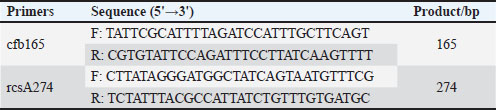
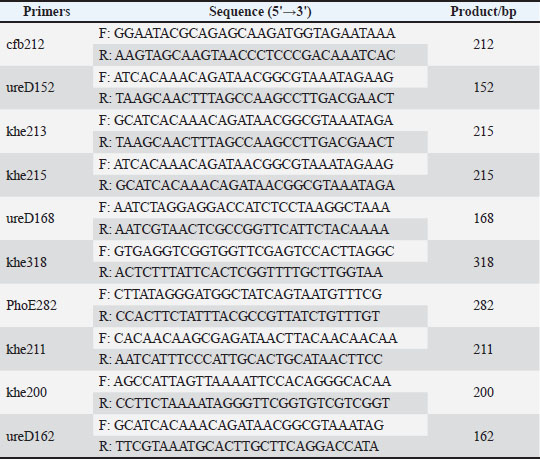
We selected the conserved cfb gene of GBS (Accession: JQ289582.1) as the molecular target. The conserved genes ureD (L07039.1), khe (KX842080), rcsA (AY059955.1), and phoE (MF630995.1) were considered as candidates for KP. Primer pairs were designed using Primer 5.0 according to the guidelines of the TwistAmp Basic kit. Potential cross-reactivity with host or common bacterial sequences was excluded using the National Center for Biotechnology Information Basic Local Alignment Search Tool. Initial screening was performed under the recommended RPA conditions, and the amplification products were analyzed on 2% agarose gels. Primers were evaluated based on their clarity, absence of nonspecific bands, and minimal background. Optimal primer pairs were selected for duplex RPA (Table 1; Supplementary Table 1).
Table 1. Primers for GBS and KP.
Basic RPA assay setup and optimization
The 50 μl single-tube reaction included 29.5 μl resuscitation solution, 6.4 μl ddH2O, 2.4 μl each of GBS forward/reverse primers, 2.4 μl each of KP forward/reverse primers, and 2 μl template DNA. Mg²+ (2.5 μl) was added to the tube cap, briefly centrifuged to mix, and incubated at 39°C for 30 minutes. After the reaction, DNA extraction reagent was added, the samples were centrifuged at 10,000 rpm for 5 minutes, and 5 µl supernatant was mixed with 1 µl 6× loading buffer for 2% agarose gel electrophoresis.
The reaction time was optimized at 39°C for 10, 20, 25, 30, and 35 minutes. Temperature optimization was performed at 25°C, 30°C, 35°C, 37°C, 39°C, and 45 °C for 30 minutes. Primer ratios were optimized for dual-target amplification using 7 combinations (GBS:KP, μl): 0.9:2.4, 1.4:2.4, 1.9:2.4, 2.4:2.4, 2.4:1.9, 2.4:1.4, and 2.4:0.9. After reactions under optimized conditions, the products were diluted 1:5 and analyzed on 2% agarose gels. Experiments were repeated at least 3 times.
Evaluation of sensitivity and specificity
GBS and KP DNA (10 ng/μl each) were mixed and serially diluted 100–10–8 ng/μl for duplex RPA to determine the limit of detection. For specificity, a mixed DNA template served as a positive control; single-target templates confirmed individual amplification. Nuclease-free water was used as the negative control. The specificity of DNA from six non-target bacteria (L. monocytogenes, Salmonella, S. uberis, S. aureus, Pm, and EPEC) was tested.
Validation of duplex RPA assay
The optimized duplex RPA assay was first applied to 70 clinical bovine milk samples previously identified in our laboratory as single-positive for GBS, single-positive for KP, or coinfected to assess practical applicability. Thirty-five raw milk samples were processed under aseptic conditions. Duplex RPA was performed using optimized primers and conditions in 50 µl reactions, with DNA from milk samples as templates; ddH2O served as the no-template control. The conventional PCR was conducted in parallel. The detection results of RPA and PCR were compared for sensitivity, specificity, and diagnostic performance.
Ethical approval
All milk samples used in this study were collected from commercial dairy farms in Henan Province, China, with the prior consent of the farm owners. The sampling procedures were non-invasive and did not cause any harm or discomfort to the animals. No additional governmental or institutional ethical approval was required for the collection and use of such samples in accordance with local and national regulations.
Results
Design and screening of primers
GBS DNA was a positive control; ddH2O negative. Two primer pairs (Cfb165F/R and Cfb212F/R) were tested. Cfb165F/R generated a single 165-bp band with no nonspecific amplification, whereas Cfb212F/R generated nonspecific bands. Cfb165F/R was selected (Fig. 1A). Eight candidate primer pairs were tested for KP; rcsA274F/R produced a distinct single band in the positive control and no amplification in the negative control, and was selected (Fig. 1B; Supplementary Fig. 1A–G).
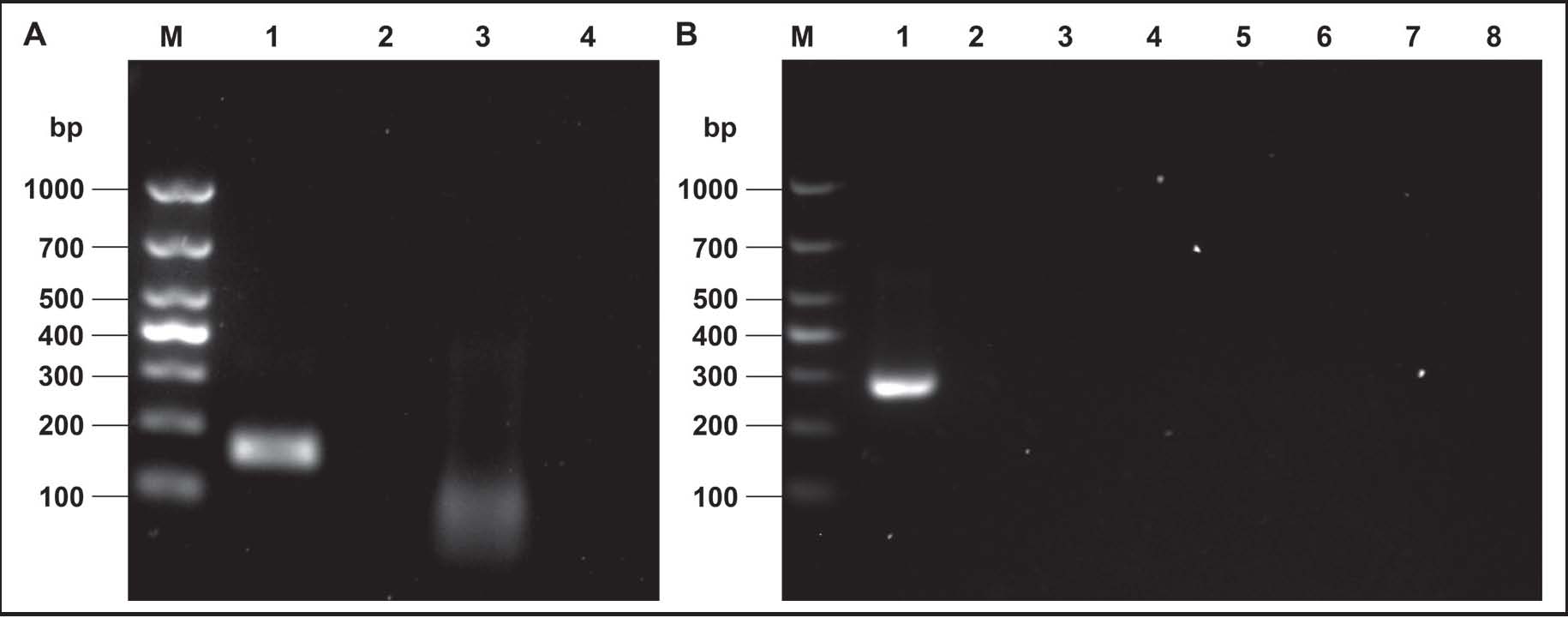
Fig. 1. RPA primer screening and validation for GBS and KP. (A): Primer screening for GBS. M: DL1000 DNA Marker; 1: Cfb165F/Cfb165R primer; 2: Negative control; 3: Cfb212F/Cfb212R primer; 4: Negative control. (B): Primer screening for KP. 1: KP (rcsA274F/R), 2: L. monocytogenes, 3: Salmonella, 4: S. uberis, 5: S. aureus, 6: Pm, 7: EPEC, 8: negative control.
Optimization of duplex basic-RPA
Duplex RPA amplification was detectable at all time points (10–35 minutes); plateau occurred after 20 minutes. Considering the amplification efficiency and signal stability, 30 minutes was selected (Fig. 2A). Amplification occurred at 25°C–45°C; the strongest and most consistent signals were observed at 37°C–39°C. For practical on-site application, 39°C was chosen (Fig. 2B). Seven primer combinations were evaluated. Both primers at 2.4 μl each produced the strongest, balanced target bands with minimal background noise (Fig. 2C), selected as optimal.
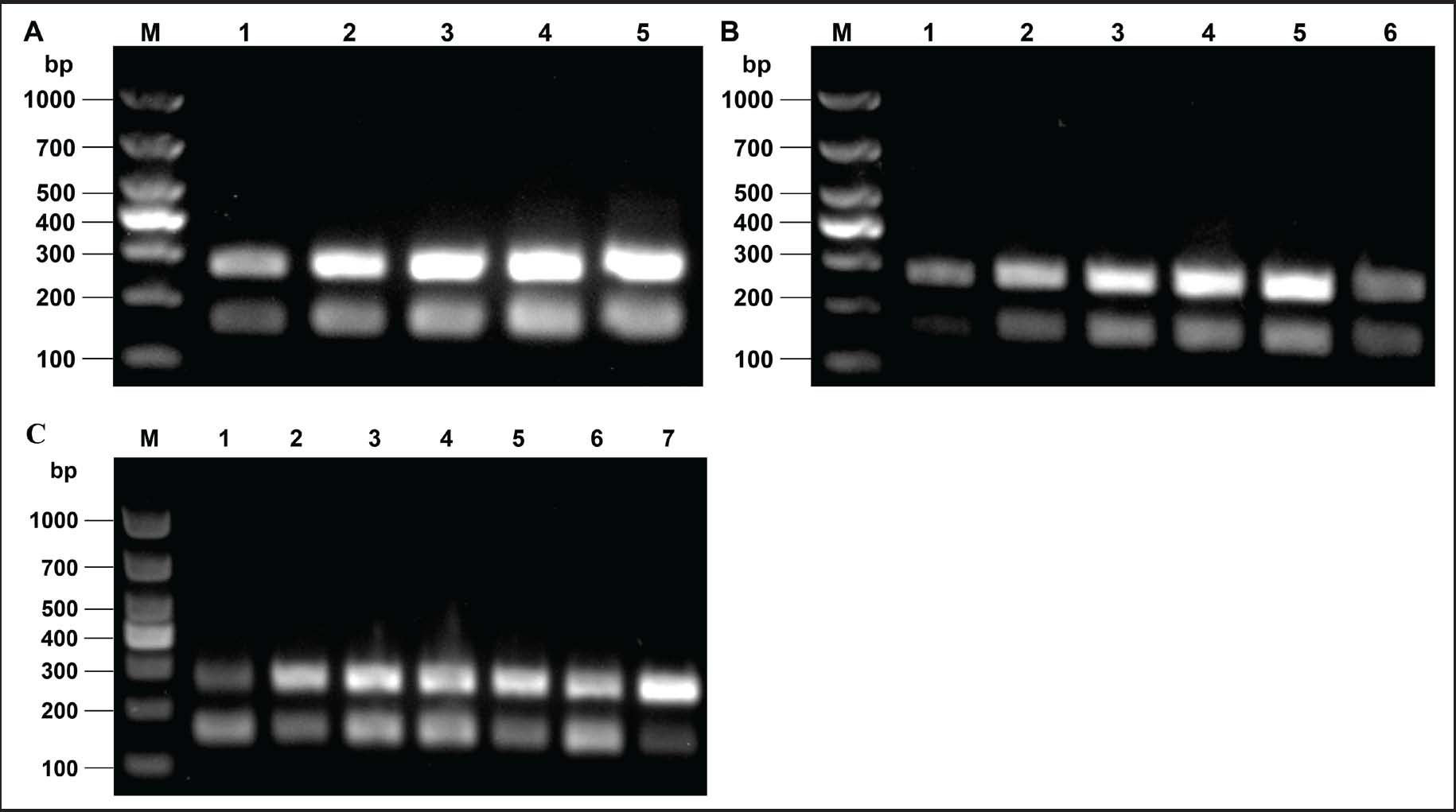
Fig. 2. Optimization of dual basic RPA. (A): Optimization of time. M: DL1000 DNA Marker. 1 to 5: 10, 20, 25, 30, and 35 minutes, respectively. (B): Optimization of temperature; M: DL1000 DNA Marker; 1 to 6: 25°C, 30°C, 35°C, 37°C, 39°C, and 45°C. (C): Optimization of the optimal primer. M: DL1000 DNA Marker. 1–7: The ratios of RPA-cfb165F/R and RPA-rcsA274F/R were 0.9:2.4, 1.4:2.4, 1.9:2.4, 2.4:2.4, 2.4:1.9, 2.4:1.4, and 2.4:0.9, respectively.
Evaluation of the specificity and sensitivity of duplex basic-RPA
Duplex RPA amplified only the target DNA. The mixed templates produced 2 bands corresponding to GBS and KP, whereas the single-target templates produced only the corresponding band. Nontarget bacterial DNA and negative control showed no amplification. PCR confirmed specificity, demonstrating high species specificity and simultaneous detection of both pathogens (Fig. 3A). Serial dilutions showed that duplex RPA detected DNA down to 10-5 ng/μl; PCR detected faint bands at 10-³ ng/μl, failing at 10-4 ng/μl. Therefore, duplex RPA exhibited higher sensitivity (Fig. 3B).
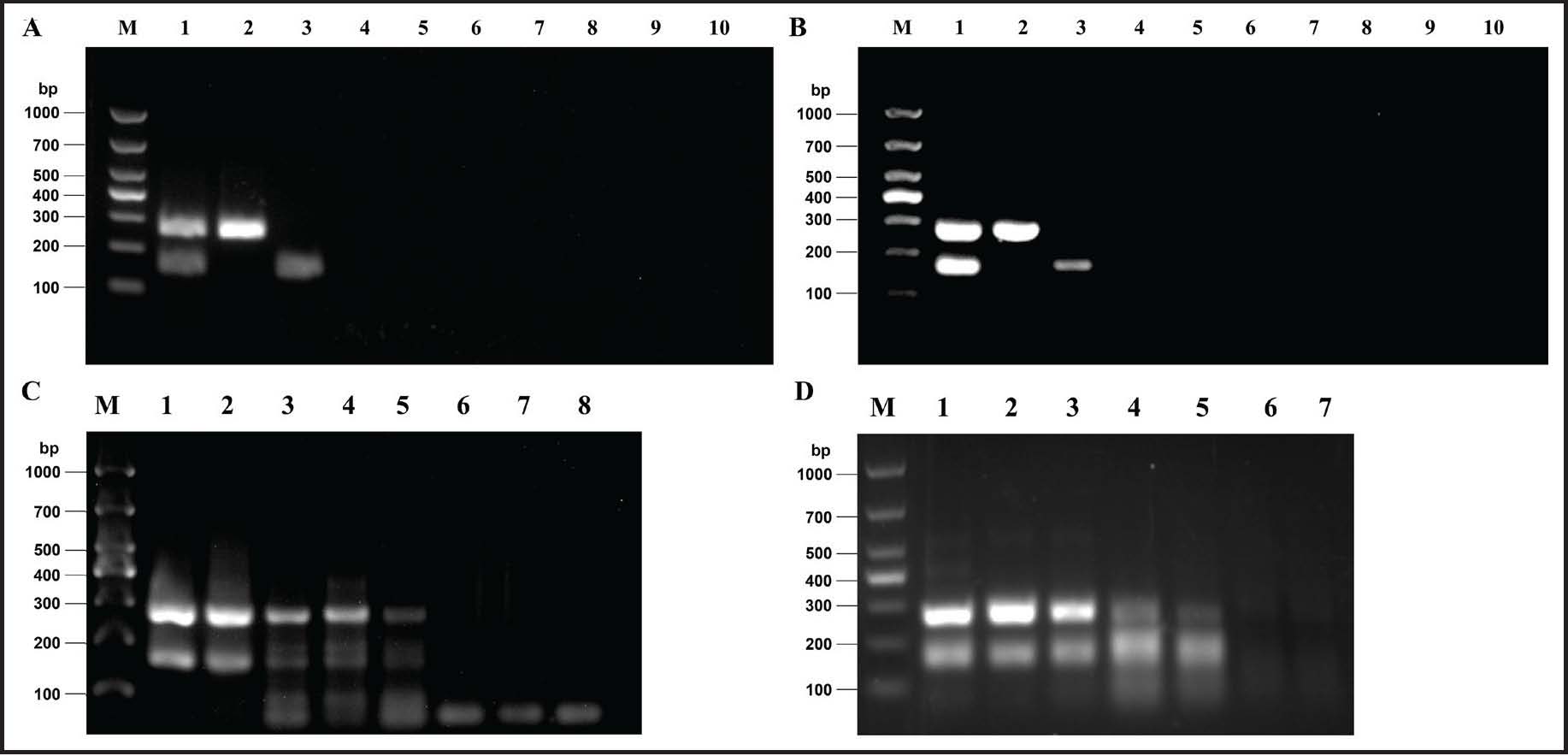
Fig. 3. Analysis of the specificity and sensitivity of Dual Basic-RPA. (A): Specificity of PCR. (B): Specificity of the RPA. M: DL1000 DNA Marker. 1–9 are GBS and KP, GBS, KP, L. monocytogenes, Salmonella, S. uberis, S. aureus, Pm, and EPEC, respectively. 10: Negative control. (C): Sensitivity of PCR detection; The concentrations of template DNA from 1 to 8 are 1 × 10¹, 1 × 100, 1 × 10–¹, 1 × 10–², 1 × 10–³, 1 × 10⁻⁴, 1 × 10⁻⁵ ng/μl respectively, and the negative control. (D): Sensitivity of basic RPA detection M: DL1000 DNA Marker; the concentrations of template DNA from 1 to 7 are 1 × 10–¹, 1 × 10–², 1 × 10–³, 1 × 10⁻⁴, 1 × 10⁻⁵, 1 × 10⁻⁶ ng/μl respectively, and the negative control.
Validation of duplex RPA assay
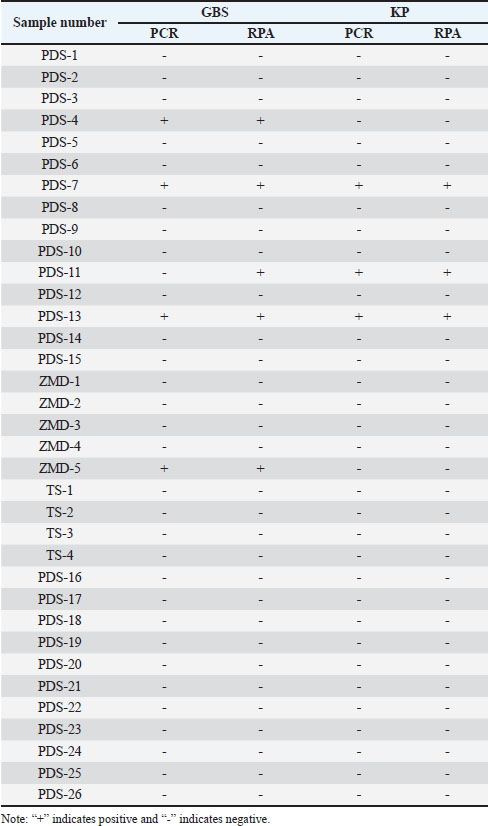
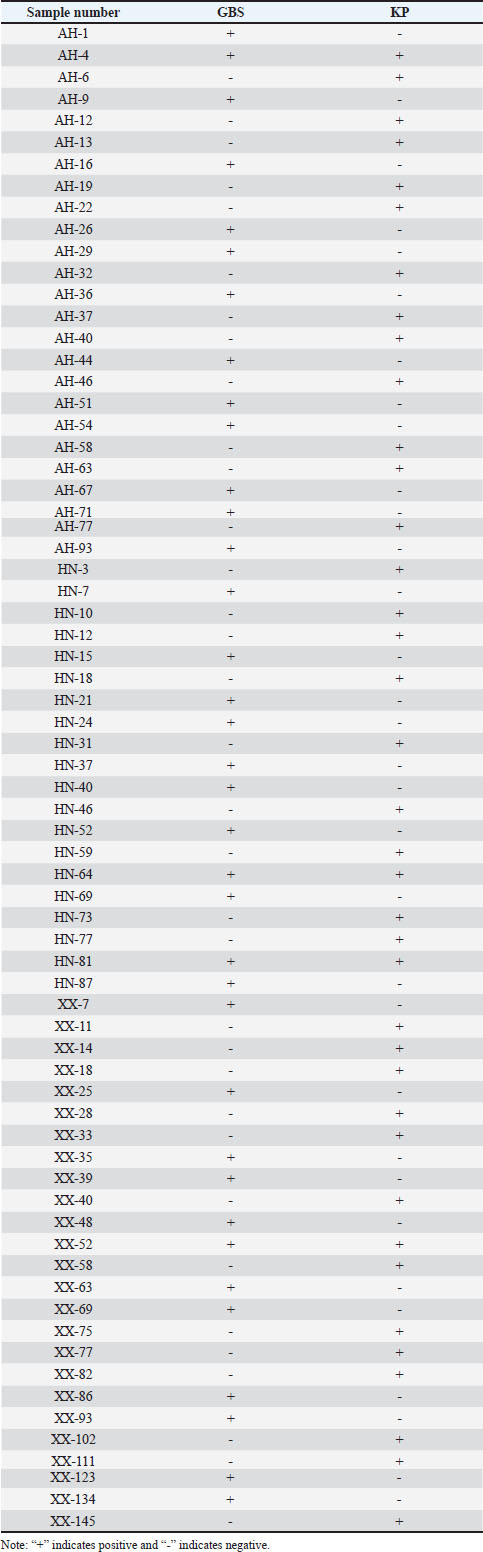
All previously identified positive samples tested positive by the established duplex RPA assay (Supplementary Table 2), providing preliminary evidence for the duplex RPA’s practical applicability. Among the 35 milk samples, PCR detected 4 GBS-positive (11.4%), 3 KP-positive (8.6%), and 2 dual-positive (5.7%). Duplex RPA detected 5 GBS-positive (14.3%), 3 KP-positive (8.6%), and 3 dual-positive (8.6%) (Table 2; Supplementary Table 3). The overall agreement between methods was 97.1%, with a Kappa value of >0.75, indicating strong concordance and higher sensitivity of duplex RPA in clinical samples.
Table 2. Application of different methods for the detection of actual samples.

Discussion
Mastitis is one of the most prevalent and impactful diseases affecting dairy cows worldwide (Guimarães et al., 2017). Despite advances in prevention and control strategies, none can fully prevent or eradicate the disease, and its incidence remains high (Liu et al., 2022). Over 100 bacterial species can cause mastitis, and unclear etiology often results in indiscriminate antibiotic use, treatment prolongation, increased costs, antimicrobial resistance promotion, and drug residues that threaten food safety (Ruegg, 2017; Yang et al., 2023). Therefore, rapid and accurate diagnostic methods targeting major pathogens are urgently needed.
GBS cfb and KP rcsA genes were selected to establish a duplex Basic-RPA isothermal amplification system capable of simultaneous detection. Compared with previously reported single-target RPA assays that typically detect one pathogen at a time (Li et al., 2021; Cheng et al., 2023), the duplex system in this study enables parallel amplification of two major mastitis pathogens within the same reaction, thereby improving detection efficiency and reducing assay cost.
Compared with conventional culture and biochemical identification methods, RPA offers substantial advantages in terms of turnaround time and operational simplicity. Traditional methods typically require several days for pathogen isolation and identification, whereas RPA accomplishes nucleic acid amplification within 30 minutes at a nearly constant temperature, thereby enabling rapid diagnosis of acute infections (Piepenburg et al., 2006; Daher et al., 2016). Unlike PCR, RPA does not require thermal cycling equipment, thereby reducing the need for expensive instruments and highly trained personnel. The short reaction time and simplified workflows of RPA make it particularly suitable for rapid screening in resource-limited or on-site screening (Lobato and O’Sullivan, 2018; Zhang et al., 2025).
In this study, the dual-target RPA system simultaneously amplified both targets at 39°C for 30 minutes, with a detection limit of 10-5 ng/µl, higher than PCR (10−3 ng/µl), demonstrating its advantage for low-copy-number samples. RPA also demonstrates strong tolerance to inhibitors and can be directly applied to complex matrices such as blood and milk, enhancing its practical value in clinical and field detection (Li et al., 2021; Cheng et al., 2023).
A balanced primer dosage is critical for dual-target amplification (Li et al., 2018). Systematic screening identified 2.4 μl of each species-specific primer as optimal, balancing signal strength and background. Reactions were stable within 37°C–39°C, reaching a plateau within 20–30 minutes. The designed primers, which targeted conserved pathogen-specific genes, demonstrated high specificity. Duplex RPA amplified GBS and KP DNA without cross-reactivity with 6 non-target bacterial strains, confirming robust specificity. Sensitivity tests showed a detection rate as low as 10–5 ng/μl.
Among 35 milk samples, duplex RPA detected 3 positive cases compared with 2 detected by PCR, indicating higher sensitivity and potential for earlier diagnosis. RPA is suitable for on-site molecular screening in dairy farms because of its low instrument dependence and rapid turnaround, facilitating timely interventions and targeted therapy (Tan et al., 2022; Zhang et al., 2025).
The duplex RPA system demonstrated a detection limit 100-fold higher than PCR, completing the simultaneous identification of GBS and KP within 30 minutes at 39°C. This sensitivity advantage is particularly valuable for early diagnosis in dairy farms, where the bacterial load is often low. The simplicity and speed of the assay suggest strong potential for field application using portable devices.
This study has some limitations. RPA requires a stringent primer design, and nonspecific amplification or primer-dimer formation may affect accuracy (Lobato and O’Sullivan, 2018). High Guanine–Cytosine content or complex secondary structures in templates may reduce amplification efficiency. The sample size was limited; therefore, evaluation in larger cohorts is warranted to further assess sensitivity, specificity, and reproducibility.
In conclusion, this study successfully developed and optimized a dual Basic-RPA system for the simultaneous detection of GBS and KP, providing a rapid, sensitive, and practical tool for the diagnosis, surveillance, and control of mastitis in dairy cows.
Acknowledgments
We thank the reviewers for their insightful and constructive comments.
Conflict of interest
The authors have no conflicts of interest to declare.
Funding
This work was supported by the National Natural Science Foundation of China (32473070, 32302798, and 32172876), the Natural Science Foundation of Henan (232300421031), the joint fund of science and technology research and development plan in Henan province (225200810044), and the Central Plains Thousand Talents Program-Central Plains Science and Technology Innovation Youth Top Talent.
Authors’ contributions
J.L., X.Z., Q.Z., J.F., and M.Z. performed the experiments and wrote the manuscript. J.F., M.Z., Y.B., and X.W. participated in the study design and coordination and helped draft the manuscript. M.C., Y.B. (Yueyu Bai), J.H., K.D., and X.X. reviewed and revised the manuscript. K.D. and X.X. were responsible for conceptualization, supervision, writing review, and acquisition of funding. All authors have contributed to the study and approved the submitted version.
Data availability
The raw data generated during the current study are available upon reasonable request from the corresponding authors.
References
Abegewi, U.A., Esemu, S.N., Ndip, R.N. and Ndip, L.M. 2022. Prevalence and risk factors of coliform-associated mastitis and antibiotic resistance of coliforms from lactating dairy cows in North West Cameroon. PLoS One 17(7), e0268247; doi:10.1371/journal.pone.0268247
Chakraborty, S., Dhama, K., Tiwari, R., Iqbal Yatoo, M., Khurana, S.K., Khandia, R., Munjal, A., Munuswamy, P., Kumar, M.A., Singh, M., Singh, R., Gupta, V.K. and Chaicumpa, W. 2019. Technological interventions and advances in the diagnosis of intramammary infections in animals with emphasis on bovine population-a review. Vet. Q. 39(1), 76–94; doi:10.1080/01652176.2019.1642546
Cheng, R., Li, L., Zhen, S., Liu, H., Wu, Z., Wang, Y. and Wang, Z. 2023. Rapid detection of Staphylococcus aureus in milk and pork via immunomagnetic separation and recombinase polymerase amplification. Microbiol. Spectr. 11(2), 224922; doi:10.1128/spectrum.02249-22
Daher, R.K., Stewart, G., Boissinot, M. and Bergeron, M.G. 2016. Recombinase polymerase amplification for diagnostic applications. Clin. Chem. 62(7), 947–958; doi:10.1373/clinchem.2015.245829
Dong, D., Liu, W., Li, H., Wang, Y., Li, X., Zou, D., Yang, Z., Huang, S., Zhou, D., Huang, L. and Yuan, J. 2015. Survey and rapid detection of Klebsiella pneumoniae in clinical samples targeting the rcsA gene in Beijing, China. Front. Microbiol. 6, 519; doi:10.3389/fmicb.2015.00519
Emon, A.A., Hossain, H., Chowdhury, M.S.R., Rahman, M.A., Tanni, F.Y., Asha, M.N., Akter, H., Hossain, M.M., Islam, M.R. and Rahman, M.M. 2024. Prevalence, antimicrobial susceptibility profiles and resistant gene identification of bovine subclinical mastitis pathogens in Bangladesh. Heliyon 10(14), e34567; doi:10.1016/j.heliyon.2024.e34567
Fitzpatrick, K.J., Rohlf, H.J., Phillips, G., Macaulay, R.B., Anderson, W., Price, R., Wood, C., James, A., Langhorne, C., Te Brake, B., Gibson, J.S. and Koo, K.M. 2024. Point-of-need mastitis pathogen biosensing in bovine milk: from academic sample preparation novelty to industry prototype field testing. Talanta 277, 126424; doi:10.1016/j.talanta.2024.126424
Guimarães, J.L.B., Brito, M.A.V.P., Lange, C.C., Silva, M.R., Ribeiro, J.B., Mendonça, L.C., Mendonça, J.F.M. and Souza, G.N. 2017. Estimate of the economic impact of mastitis: a case study in a Holstein dairy herd under tropical conditions. Prev. Vet. Med. 142, 46–50; doi:10.1016/j.prevetmed.2017.04.011
Li, J. and Macdonald, J. 2015. Advances in isothermal amplification: novel strategies inspired by biological processes. Biosens. Bioelectron. 64, 196–211; doi:10.1016/j.bios.2014.08.069
Li, J., Macdonald, J. and Von Stetten, F. 2018. Review: a comprehensive summary of a decade development of the recombinase polymerase amplification. Analyst 144(1), 31–67; doi:10.1039/c8an01621f
Li, R., Wang, J., Sun, X., Liu, L., Wang, J. and Yuan, W. 2021. Direct and rapid detection of Mycoplasma bovis in bovine milk samples by recombinase polymerase amplification assays. Front. Cell. Infect. Microbiol. 11, 639083; doi:10.3389/fcimb.2021.639083
Li, Z., Zhu, Y., Zhang, W. and Mu, W. 2024. Rcs signal transduction system in Escherichia coli: composition, related functions, regulatory mechanism, and applications. Microbiol. Res. 285, 127783; doi:10.1016/j.micres.2024.127783
Liu, D., Zhang, S., Xu, H., Xu, X. and Zhang, Q. 2022. Establishment and preliminary application of a multiplex PCR assay for detecting four pathogenic bacteria in cows with mastitis. Progress in Veterinary Medicine. 43(07), 14–18; doi:10.16437/j.cnki.1007-5038.2022.07.003
Lobato, I.M. and O’Sullivan, C.K. 2018. Recombinase polymerase amplification: basics, applications and recent advances. Trends Analyt. Chem. 98, 19–35; doi:10.1016/j.trac.2017.10.015
Martin, R.M. and Bachman, M.A. 2018. Colonization, infection, and the accessory genome of Klebsiella pneumoniae. Front. Cell. Infect. Microbiol. 8, 4; doi:10.3389/fcimb.2018.00004
Piepenburg, O., Williams, C.H., Stemple, D.L. and Armes, N.A. 2006. DNA detection using recombination proteins. PLoS Biol. 4(7), 204; doi:10.1371/journal.pbio.0040204
Ruegg, P.L. 2017. A 100-year review: mastitis detection, management, and prevention. J. Dairy Sci. 100(12), 10381–10397; doi:10.3168/jds.2017-13023
Sugiyama, M., Watanabe, M., Sonobe, T., Kibe, R., Koyama, S. and Kataoka, Y. 2022. Efficacy of antimicrobial therapy for bovine acute Klebsiella pneumoniae mastitis. J. Vet. Med. Sci. 84(7), 1023–1028; doi:10.1292/jvms.21-0617
Tamba, M., Rocca, R., Prosperi, A., Pupillo, G., Bassi, P., Galletti, G., Martini, E., Santi, A., Casadei, G. and Arrigoni, N. 2022. Evaluation of control program against Streptococcus agalactiae infection in dairy herds during 2019-2021 in Emilia-Romagna Region, Northern Italy. Front. Vet. Sci. 9, 904527; doi:10.3389/fvets.2022.904527
Tan, M., Liao, C., Liang, L., Yi, X., Zhou, Z. and Wei, G. 2022. Recent advances in recombinase polymerase amplification: principle, advantages, disadvantages and applications. Front. Cell. Infect. Microbiol. 12, 1019071; doi:10.3389/fcimb.2022.1019071
Wang, J., Wang, K., Xiao, D., Huang, J., Fu, X., Wang, H., Chen, D., Geng, Y. and Yang, T. 2011. Development of double PCR for rapid detection of Streptococcus agalactiae isolated from tilapia. Chin. Vet. Sci. 41(05), 496–502; doi:10.16656/j.issn.1673-4696.2011.05.020
Yang, F., Shi, W., Meng, N., Zhao, Y., Ding, X. and Li, Q. 2023. Antimicrobial resistance and virulence profiles of staphylococci isolated from clinical bovine mastitis. Front. Microbiol. 14, 1190790; doi:10.3389/fmicb.2023.1190790
Ye, X., Li, J., Lu, M., Deng, G., Jiang, X., Tian, Y., Quan, Y. and Jian, Q. 2011. Identification and molecular typing of Streptococcus agalactiae isolated from pond-cultured tilapia in China. Fisheries Sci. 77(4), 623–632; doi:10.1007/s12562-011-0365-4
Zhang, S., Duan, M., Li, S., Hou, J., Qin, T., Teng, Z., Hu, J., Zhang, H. and Xia, X. 2023. Current status of recombinase polymerase amplification technologies for the detection of pathogenic microorganisms. Diagn. Microbiol. Infect. Dis. 108(1), 116097; doi:10.1016/j.diagmicrobio.2023.116097
Zhang, Y., Liu, X., Luo, J., Liu, H., Li, Y., Liu, J., Zhu, L., Wang, J. and Zeng, H. 2025. Dual recombinase polymerase amplification system combined with lateral flow immunoassay for simultaneous detection of Staphylococcus aureus and Vibrio parahaemolyticus. J. Pharm. Biomed. Anal. 255, 116621; doi:10.1016/j.jpba.2024.116621
Zhao, X., Lin, C.W., Wang, J. and Oh, D.H. 2014. Advances in rapid detection methods for foodborne pathogens. J. Microbiol. Biotechnol. 24(3), 297–312; doi:10.4014/jmb.1310.10013
Supplementary Materials
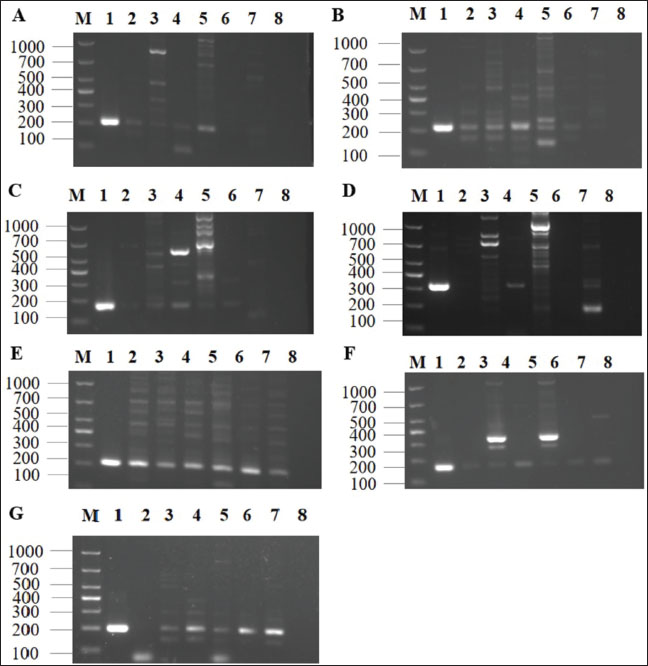
Supplementary Fig. 1. Screening of primers for KP and GBS. (A): khe213F/R. (B): khe215F/R. (C): ureD168F/R. (D): khe318F/R. (E): khe200F/R. (F): ureD162F/R. (G): khe211F/R. 1. KP. 2. L. monocytogenes. 3. Salmonella. 4. S. uberis. 5. S. aureus. 6. P. multocida. 7. Enteropathogenic E. coli. 8. Negative control.
Supplementary Table 1. Primer screening for GBS and KP.
Supplementary Table 2. Detection results of previously identified positive samples using the established duplex RPA assay.
Supplementary Table 3. Statistics of clinical detection results.