Open Veterinary Journal, (2026), Vol. 16(5): 3218-3228
Research Article
10.5455/OVJ.2026.v16.i5.61
Development of a multiplex polymerase chain reaction assay for the detection of Piroplasma (Babesia spp. and Theileria spp.), Anaplasma spp., and Trypanosoma evansi in cattle
Jiravich Methawiroon1, Piangjai Chalermwong1, Ornarin Boonjint1, Piangdow Chiawvitkan1,
Sakulchit Wichianchot1, Chanapath Thabthimsri2, Preeyanuch Thongpoo3, Ketsarin Kamyingkird4, Sathaporn Jittapalapong2,5 and Eukote Suwan1,6*
1Department of Veterinary Technology, Faculty of Veterinary Technology, Kasetsart University, Bangkok, Thailand
2Faculty of Veterinary Technology, Kasetsart University, Bangkok, Thailand
3Program of Science (Biology), Faculty of Science and Technology, Phuket Rajabhat University, Phuket, Thailand
4Department of Parasitology, Faculty of Veterinary Medicine, Kasetsart University, Bangkok, Thailand
5Center for Advanced Studies in Nanotechnology for Chemical, Food and Agricultural Industries, KU Institute for Advanced Studies, Kasetsart University, Bangkok, Thailand
6Kasetsart Vaccines and Bio-Product Innovation Center (KU-V-BIC), Kasetsart University, Bangkok, Thailand
*Corresponding Author: Eukote Suwan. Department of Veterinary Technology, Faculty of Veterinary Technology, Kasetsart University, Bangkok, Thailand. Email: cvteks [at] ku.ac.th
Submitted: 10/10/2025 Revised: 03/03/2026 Accepted: 11/03/2026 Published: 31/05/2026
© 2025 Open Veterinary Journal
This is an Open Access article distributed under the terms of the Creative Commons Attribution-Non Commercial-No Derivatives License (http://creativecommons.org/licenses/by-nc-nd/4.0/), which permits non-commercial re-use, distribution, and reproduction in any medium, provided the original work is properly cited, and is not altered, transformed, or built upon in any way.
ABSTRACT
Background: Blood parasites cause serious drawbacks in the livestock industry. The detection methods rely on microscopic examination and polymerase chain reaction (PCR), which requires an expert person, labor, time, and cost.
Aim: In this study, a multiplex PCR has been developed for hemoparasites consisting of Piroplasma (Babesia spp. and Theileria spp.), Anaplasma spp., and Trypanosoma evansi detections.
Methods: Blood parasite infections in cattle were investigated using three different methods: microscopic examination, single PCR, and multiplex PCR. The Anaplasma 16s rRNA gene, Babesia 18s rRNA gene, Theileria major piroplasm surface protein gene, and Trypanosome ITS1 gene have been used to detect Anaplasma spp., Babesia spp., Theileria spp., and T. evansi, respectively, using molecular methods. The sensitivity and specificity of multiplex PCR were evaluated. Multiplex PCR results were compared with microscopic examination and single PCR.
Results: Multiplex PCR assay revealed a limit of detection of 0.01–10 pg of parasite DNA. According to the evaluation of 60 bovine blood samples, blood smear, single PCR, and multiplex PCR revealed 50.0%, 18.3%, and 26.7% of single infections, and 40.0%, 81.7%, and 50.0% of co-infections, respectively. The comparative analysis between multiplex PCR with microscopic examination and single PCR revealed that triple infection, Babesia spp., Theileria spp., and T. evansi, showed 50.0% sensitivity, 100% specificity, and positive predictive value, 98% negative predictive value, and substantial agreement indicated by a Cohen’s Kappa value of 0.659.
Conclusion: The multiplex PCR assay developed in this study may be helpful for improved hemoparasite prevention and control when combined with farmer education, proper hygiene practices, and effective environmental management.
Keywords: Hemoparasites, Multiplex PCR, Piroplasma, Trypanosoma evansi.
Introduction
Ticks are hematophagous ectoparasites of livestock in tropical and subtropical areas (Eskezia, 2016). Ticks transmit various pathogens, such as viruses, bacteria, and protozoa (Baneth, 2014). The cattle tick, Rhipicephalus microplus, is the most important tick affecting more than 80% of the cattle population worldwide and causes severe economic losses due to both direct (tick bites) and indirect (pathogen transmission) effects (Benavides and Romero, 2001; Hurtado and Giraldo-Ríos, 2019). Anaplasma, Babesia, and Theileria species are bovine tick-borne pathogens that cause tick fever (Anaplasma spp. and Babesia spp.) and piroplasmosis (Babesia spp. and Theileria spp.). These diseases show mild to severe symptoms, such as fever, hemolytic anemia, anorexia, abortion, and death, and in some cases lead to meat and milk production decrements, which impact the livestock industry worldwide (Suarez and Noh, 2011; Zhou et al., 2016; Abdela and Bekele, 2016). Trypanosoma evansi is one of the blood parasites that cause surra and has a major impact on animal health in Southeast Asia (Suwan et al., 2023). Co-infections of blood parasites are common, causing virulence, infectivity, and transmissibility of pathogens, leading to morbidity and mortality in animals (Gomez-Chamorro et al., 2021).
Blood parasite diagnosis relies on the presence of intra/inter erythrocytic bodies under microscopic examination of blood smears, but requires bare observation under subclinical or low parasitemia conditions, and requires an experienced and skillful person. In addition, it was difficult to distinguish when co-infected blood parasites occurred (Ananyutthawongse et al., 1999; Peng et al., 2020; Kumar et al., 2021). The serological assays also showed drawbacks of cross-reactivity, lack of sensitivity, and discrimination between present and previous infections (Bilgiç et al., 2013; Kundave et al., 2018). The molecular method of polymerase chain reaction (PCR) has shown promising sensitivity and specificity in detecting the presence and/or low parasitemia (Parodi et al., 2021). However, when diagnosing large or coinfected blood parasite samples, individual PCR is expensive and time-consuming (Bilgiç et al., 2013; Kumar et al., 2021). Multiplex PCR has been developed for simultaneous detection of multiple pathogens in a single reaction without additional reagents or DNA template requirements (Kundave et al., 2018; Hao et al., 2019; Peng et al., 2020) and has been used to detect many bovine hemoparasites (Ananyutthawongse et al., 1999; Bilgiç et al., 2013; Kundave et al., 2018; Peng et al., 2020; Kumar et al., 2021; Parodi et al., 2021). The challenge of multiplex PCR development is primer design, which requires specificity and sensitivity when the number of pathogen detections increases (Peng et al., 2020).
This study aimed to develop a multiplex PCR for the detection of hemoparasites consisting of Piroplasma (Babesia spp. and Theileria spp.), Anaplasma spp., and T. evansi. Multiplex PCR reactions and conditions were optimized to detect these blood parasites. Sensitivity and specificity were evaluated. Statistical methods were used to indicate the agreement between the results of multiplex PCR and microscopic examination and single PCR.
Materials and Methods
Sample preparation
A licensed veterinarian collected 60 blood samples from the jugular vein of dairy cattle in June 2024 in Sakonnakhon province, Thailand. Blood samples (3 ml) were stored in sterile ethylene-diamine-tetraacetic acid tubes and transported within 24 hours to the Faculty of Veterinary Technology, Kasetsart University, Bangkok, Thailand. All blood samples were subjected to microscopic and molecular examinations. For microscopic examination, a Giemsa-stained thin blood smear was used to detect blood parasites under a light microscope. For molecular examination, 250 µl of blood sample was used to extract genomic DNA (gDNA) using the E.Z.N.A. Blood DNA Mini Kit (Omega Bio-tek, Georgia) according to the manufacturer’s instructions. The gDNA concentration was measured using a NanoDrop Lite Spectrophotometer (Thermo Fisher Scientific Inc., USA) and kept at −20°C until use. Light microscopic examination was performed to detect hemoparasites, including Anaplasma sp., Babesia sp., Theileria sp., and T. evansi. The gDNA of positive blood samples was prepared as described above and used as a template for positive controls.
Primer design
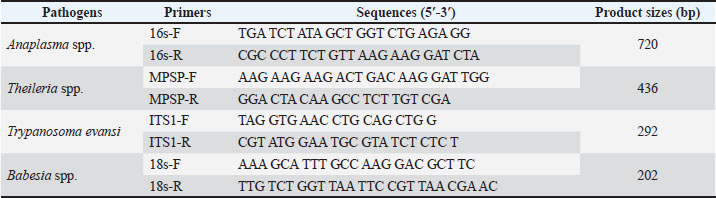
The primers of Theileria spp. and Trypanosoma spp. were designed based on specific genes, including major piroplasm surface protein (MPSP) (Rakwong et al., 2022) and internal transcribed regions (ITS)1 (Suwan et al., 2023), respectively. Primers for Anaplasma spp. and Babesia spp. were designed from 16S and 18S ribosomal RNA, respectively (Table 1).
Table 1. List of primers used in multiplex PCR.
Cloning of the positive controls
PCR was performed using an individual primer for each blood parasite. The PCR reaction comprised of 1× of ExcelTaq™, 5X PCR Master Mix (SMOBIO, Taiwan), 1 µM of each forward and reverse primer, and 100 ng of positive blood sample gDNA. The PCR conditions were 95°C for 5 minutes of pre-denaturation followed by 35 cycles of 95°C for 3 minutes, 50°C for 1 minute of annealing, 72°C for 1 minute of extension, and 72°C for 10 minutes of post-extension. The target genes of each blood parasite were cloned into pGEM®-T Easy Vector (Promega, USA) and transformed into Escherichia coli DH5α. Positive plasmids were extracted using the GeneJET Plasmid Miniprep Kit (Thermo Fisher Scientific Baltics UAB, Vilnius, Lithuania). Target genes were confirmed by sequencing (U2bio, Thailand).
Single and multiplex PCR optimizations
A single PCR was performed using an individual primer for each blood parasite. The PCR reaction comprised 1× of ExcelTaq™, 5X PCR Master Mix (SMOBIO, Taiwan), 1 µM of each specific forward and reverse primer, and 100 ng of positive plasmid. The PCR conditions were 95°C pre-denaturation for 5 minutes, followed by 35 cycles of 95°C denaturation for 3 minutes, 50°C annealing for 1 minute, 72°C extension for 1 minute, and 72°C post-extension for 10 minutes. The PCR product was verified using 1.5% agarose gel electrophoresis.
The multiplex PCR reaction comprised 1× of ExcelTaq™, 5X PCR Master Mix (SMOBIO, Taiwan), 0.5–2 µM of each forward and reverse primer, and 100 ng of each positive control. The PCR conditions were 95°C pre-denaturation for 5 minutes, followed by 35 cycles of 95°C denaturation for 3 minutes, 55°C annealing for 1 minute, 72°C extension for 1 minute of extension, and 72°C post-extension for 10 minutes. The PCR product was verified using 1.5% agarose gel electrophoresis.
Validation of the multiplex PCR
Positive controls were serially diluted 10-fold and used as a template. The sensitivity and specificity of multiplex PCR were evaluated. For specificity, 1 ng of each individual positive control was used as a template. For sensitivity, 0.00001–10 ng of the individual positive control was used as the template. The PCR reaction comprised of 1× of ExcelTaq™, 5X PCR Master Mix (SMOBIO, Taiwan), 0.5 µM of Theileria MPSP and Babesia 18s RNA, 1 µM of Anaplasma 16s RNA, and 2 µM of Trypanosome ITS forward and reverse primers, and template. The PCR conditions were 95°C pre-denaturation for 3 minutes, followed by 35 cycles of 95°C denaturation for 1 minute, 55°C annealing for 1 minute, 72°C extension for 1 minute, and 72°C post-extension for 10 minutes. The PCR product was verified using 1.5% agarose gel electrophoresis.
Field sample detection
gDNA from field blood samples was used as a template. The multiplex PCR reaction comprised 1× of ExcelTaq™, 5× PCR Master Mix (SMOBIO, Taiwan), 0.5 µM of Theileria MPSP and Babesia 18s RNA, 1 µM of Anaplasma 16s RNA, and 2 µM of Trypanosome ITS forward and reverse primers, and 1 ng of gDNA. The PCR conditions were 95°C pre-denaturation for 5 minutes, followed by 35 cycles of 95°C denaturation for 3 minutes, 55°C annealing for 1 minute, 72°C extension for 1 minute, and 72°C post-extension for 10 minutes. The PCR product was verified using 1.5% agarose gel electrophoresis.
The positive PCR products were randomly selected, and their DNA was extracted from agarose gel using the PureDireX PCR Clean-Up & Gel Extraction Kit (BIO-HELIX, Taiwan) according to the manufacturer’s instructions. The extracted DNA samples were sent for sequencing (U2bio (Thailand)). The sequencing results were searched against the National Center for Biotechnology Information (https://www.ncbi.nlm.nih.gov/) using the Basic Local Alignment Search Tool (https://blast.ncbi.nlm.nih.gov/Blast.cgi) (Altschul et al., 1990).
Statistical analysis
All statistical analyses were conducted using R version 4.5.1 (R Core Team, 2025). The results of multiplex PCR were compared with those of microscopic examination and single PCR in terms of sensitivity, specificity, positive predictive value (PPV), and negative predictive value (NPV) using the “epiR” package in R. The degree of agreement was evaluated using Cohen’s Kappa coefficient via the “fmsb” package in R, and the strength of agreement was interpreted according to the guidelines of Landis and Koch (1977).
Ethical approval
This study was approved by the Ethics Committee of Kasetsart University, Bangkok, Thailand (Approval no. R-ACVTN-65-002).
Results
Construction of positive controls and optimization of single and multiplex PCR
Plasmids harboring target genes of blood parasites were constructed, sequenced, and used as positive controls. Single and multiplex PCRs were performed (Fig. 1). The single PCR showed 720, 202, 436, and 292 bp PCR products corresponding to the Anaplasma 16s rRNA gene, Babesia 18s rRNA gene, Theileria MPSP gene, and Trypanosome ITS1 gene, respectively. Multiplex PCR showed the PCR products when the template concentrations in the range of 0.002–200 ng/µl of each positive control were used.
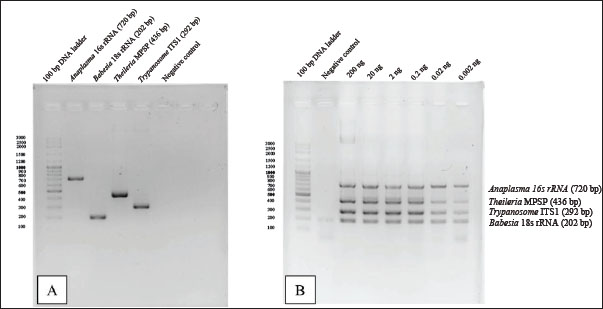
Fig. 1. Single (A) and multiplex (B) PCR. The PCR products of the Anaplasma 16s rRNA gene, Babesia 18s rRNA gene, Theileria MPSP gene, and Trypanosome ITS1 gene were 720, 202, 436, and 292 bp, respectively.
Specificity and sensitivity of multiplex PCR
Multiplex PCR showed specific bands corresponding to each blood parasite sample (Fig. 2A). The sensitivity showed a limit of detection of each blood parasite, which was 0.00001 ng/µl of Anaplasma 16s rRNA and Babesia 18s rRNA, 0.01 ng/µl of Theileria MPSP, and 0.0001 ng/µl of Trypanosome ITS1, which corresponded to 0.01 pg, 0.1 pg, and 10 pg of DNA for Anaplasma spp., Babesia spp., Theileria spp., and T. evansi, respectively (Fig. 2B–E).
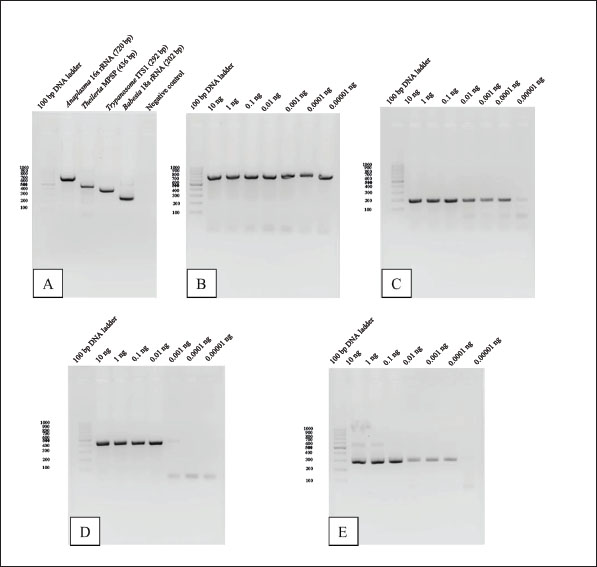
Fig. 2. Specificity (A) and sensitivity (B–E) of multiplex PCR. The PCR product of the Anaplasma 16s rRNA gene (B), Babesia 18s rRNA gene (C), Theileria MPSP gene (D), and Trypanosome ITS1 gene (E).
Field sample detection
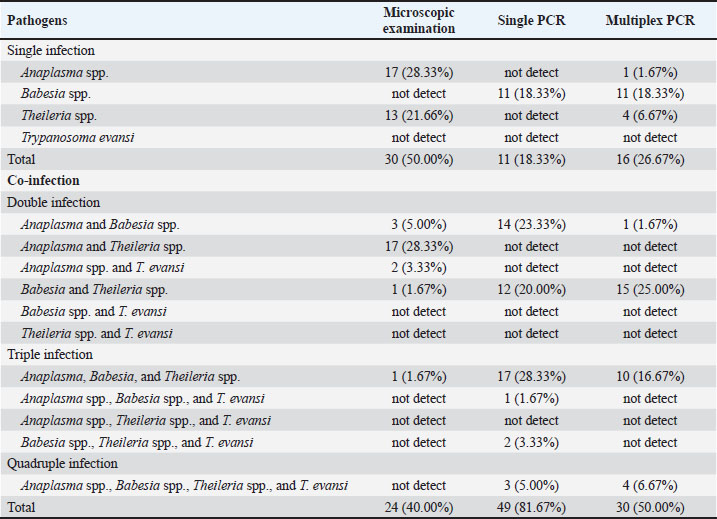
Blood parasites, including Anaplasma spp., Babesia spp., Theileria spp., and T. evansi., were detected in 60 bovine blood samples by microscopic examination, single PCR, and multiplex PCR (Table 2). According to light microscopy, 17 out of 60 (28.33%) and 13 out of 60 (21.66%) showed single infections of Anaplasma spp. and Theileria spp., respectively. Twenty – three samples showed double infection, which were 3 (5.00%), 17 (28.33%), 2 (3.33%), and 1 (1.67%) of Anaplasma spp. and Babesia spp., Anaplasma spp. and Theileria spp., Anaplasma spp. and T. evansi, and Babesia spp. and Theileria spp., respectively. Only one triple infection (1.67%), Anaplasma spp., Babesia spp., and Theileria spp., was observed. For molecular detection, 11 out of 60 (18.33%) showed single infection of Babesia spp. from single PCR, while multiplex PCR showed 1 out of 60 (1.67%) of Anaplasma spp., 11 out of 60 (18.33%) of Babesia spp., and 4 out of 60 (6.67%) of Theileria spp. Single and multiplex PCR results showed coinfection with double-, triple-, and quadruple hemoparasite infections. For double infection, single and multiplex PCR showed 14 (23.33%) and 1 (1.67%) of Anaplasma spp. and Babesia spp., respectively, and 12 (20.00%) and 15 (25.00%) of Babesia spp. and Theileria spp. Single PCR showed triple infection with Anaplasma spp., Babesia spp., and Theileria spp. (17/60, 28.33%), Anaplasma spp., Babesia spp., and T. evansi (1/60, 1.67%), and Babesia spp., Theileria spp., and T. evansi 2 (3.33%). Three samples (50.00%) showed quadruple infection. Multiplex PCR showed that 10 out of 60 (16.67%) patients had triple infection with Anaplasma spp., Babesia spp., and Theileria spp., and 4 out of 60 (6.67%) had quadruple infection.
Table 2. Hemoparasite detection of 60 bovine blood samples using microscopic examination, single PCR, and multiplex PCR.
Comparative analysis of multiplex PCR with microscopic and single PCR methods
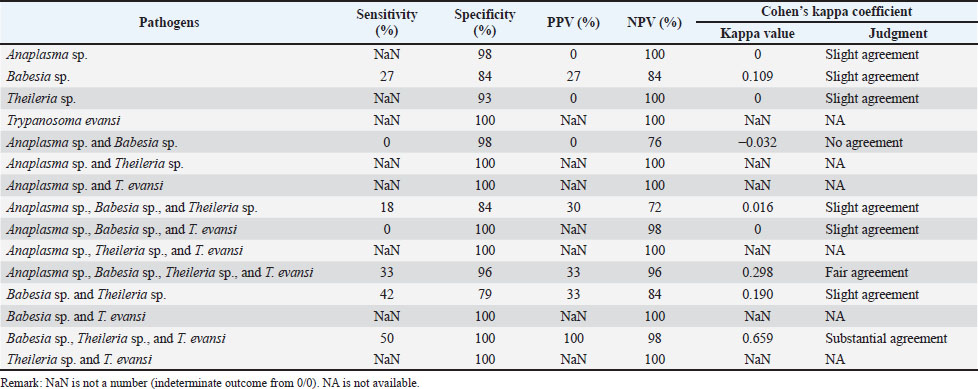
Tables 3 and 4 show the sensitivity, specificity, PPV, NPV, and Cohen’s Kappa coefficient of the multiplex PCR results compared with microscopic examination and single PCR, respectively.
Table 3. Sensitivity, specificity, PPV, NPV, and Cohen’s kappa coefficient of multiplex PCR when using microscopic examination as a reference test.
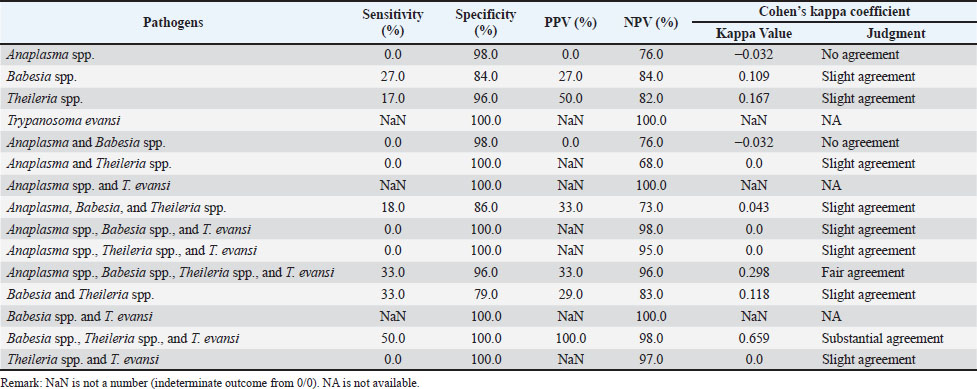
Table 4. Sensitivity, specificity, PPV, NPV, and Cohen’s kappa coefficient of multiplex PCR when using single PCR as a reference test.
For multiplex PCR and microscopic examination comparison, triple infection, Babesia spp., Theileria spp., and T. evansi, showed the highest sensitivity (50.0%), with 100% specificity and PPV, 98% NPV, and Cohen’s Kappa value of 0.659 with substantial agreement. Single infection (T. evansi), double infection (Anaplasma spp. and Theileria spp., Anaplasma spp. and T. evansi, Babesia spp. and T. evansi, and Theileria spp. and T. evansi), and triple infection (Anaplasma spp. and Babesia spp. and T. evansi, Anaplasma spp. and Theileria spp. and T. evansi, and Babesia spp. and Theileria spp. and T. evansi) showed 100% specificity. The highest PPV (100.0%) was observed in Babesia spp., Theileria spp., and T. evansi, whereas T. evansi, Anaplasma spp., and T. evansi, and Babesia spp., and T. evansi showed 100% NPV.
For multiplex PCR and single PCR comparison, the highest sensitivity (50.0%) was observed in triple infection (Babesia spp., Theileria spp., and T. evansi) with 100% specificity and PPV, 98% NPV, and substantial agreement indicated by a Cohen’s Kappa value of 65.9. Notably, the highest specificity (100.0%) was found in the same samples as found in the comparison of multiplex PCR and microscopic examination. Babesia spp., Theileria spp., and T. evansi also showed the highest PPV (100.0%). The highest NPV (100.0%) was found in single infection (Anaplasma spp., Theileria spp., and T. evansi), double infection (Anaplasma spp. and Theileria spp., Anaplasma spp. and T. evansi, Babesia spp. and T. evansi, and Theileria spp. and T. evansi), and triple infection (Anaplasma spp. and Theileria spp. and T. evansi). In addition, the quadruple infection showed fair agreement (Cohen’s kappa value of 29.8) between the two comparisons.
Positive PCR products were randomly selected and sequenced. Sequencing revealed that the Anaplasma 16s rRNA gene shared 99.86% sequence identity with the Anaplasma marginale 16S ribosomal RNA (accession no. MH020201.1). The Theileria MPSP gene shared 99.31% sequence identity with T. orientalis major piroplasm surface protein (accession no. JX648208.1), the Trypanosome ITS1 gene shared 100.00% sequence identity with ITS1 (accession no. MT225627.1), while the Babesia 18s rRNA gene shared 99.50%, 99.50%, and 99.00% sequence identities with Cytauxzoon sp. 18S ribosomal RNA (accession no. KT361079.1), Theileria sp. small subunit ribosomal RNA (accession no. OP023828.1), and B. microti 18S ribosomal RNA (accession no. AB243680.1), respectively.
Discussion
Blood parasites in cattle, such as Anaplasma spp., Piroplasma (Babesia spp. and Theileria spp.), and T. evansi, affect livestock health and production in tropical and subtropical areas (Eskezia, 2016; Jirapattharasate et al., 2017; Koonyosying et al., 2022; Suwan et al., 2023). The gold standard for the detection of these pathogens is microscopic examination, which requires expert observation and may be misinterpreted due to subjective observations or co-infections (Kumar et al., 2021). PCR-based diagnosis has been introduced with sensitivity and specificity via species-specific primers such as 16S rRNA, major surface proteins (msp), and groEL for Anaplasma spp. (Junsiri et al., 2020; Nantiya et al., 2020; Seerintra et al., 2023; Teja et al., 2023), 18S rRNA, ITS, and merozoite surface antigens for Babesia spp. (Iseki et al., 2010; Liu et al., 2014; Calchi et al., 2024), 18s rRNA, msp, and MPSP for Theileria spp. (Kaewhom and Srikijkasemwat, 2022; Rakwong et al., 2022), and ITS-1, Ro Tat 1.2 VSG, and ESAG6/7 for T. evansi (Dyah et al., 2015; Suwan et al., 2023). However, the increase in vector-borne diseases and coinfections has been reported in the Southeast Asian region, leading to the requirement of multiple PCR diagnoses (Kumar et al., 2021; Koonyosying et al., 2022).
Co-infections of hemoparasites in livestock have been reported, such as double infections of Anaplasma spp. and Babesia spp. (Canever et al., 2014; Pradeep et al., 2019; Parodi et al., 2021), Piroplasma (Babesia spp. and Theileria spp.) (Jirapattharasate et al., 2016; Silveira et al., 2016; Nahal and Ben Said, 2024; Seerintra et al., 2024; Saad et al., 2025), triple infections of Anaplasma spp. and Piroplasma (Bilgiç et al., 2013; Zhou et al., 2016; Jirapattharasate et al., 2017; Kundave et al., 2018; Zhou et al., 2019; Kumar et al., 2021; Koonyosying et al., 2022; Adjou Moumouni et al., 2023) and Babesia spp., Theileria spp. and T. evansi (Charaya et al., 2021), quadruple infections of Theileria spp., Babesia spp., T. evansi. and Setaria sp., and quintuple infections of A. marginale, T. evansi, B. bovis, B. bigemina and Theileria spp. (Ananyutthawongse et al., 1999) and Trypanosoma spp., Microfilariae, Anaplasma spp., Babesia spp., and Theileria spp. (Bohman et al., 2024). However, most reports have relied on microscopic examination and single- or nested PCR.
Multiplex PCR have been employed for multiple detection with various sensitivity and specificity, such as Parodi et al. (2021) using species-specific gene primers, rap-1a for B. bovis and B. bigemina, and msp-5 for A. marginale, with 94.2% and 97.1%, and 95.2% and 92.7% of sensitivity and specificity for Babesia sp. and A. marginale detections. Kundave et al. (2018)demonstrated multiplex PCR using a set of primers, Tams1, 18S rRNA, and 16S rRNA for T. annulata, B. bigemina, and A. marginale with a limit of detection 0.1, 10, and 0.1 pg, respectively. While Bilgiç et al. (2013) used a set of primers, cytochrome b, msp-1b and VESA–1a for T. annulata, A. marginale, and B. bovis with a limit of detection of 10−8, 10−7, and 10−5 DNA template dilutions, respectively. In Thailand, multiplex PCR for A. marginale, T. evansi, B. bovis, B. bigemina, and Theileria sp. detections have been developed by Ananyutthawongse et al. (1999) using a set of primers, msp for A. marginale, repetitive nucleotide sequences for T. evansi, carbamoyl phosphate synthetase II for B. bovis, and small subunit ribosomal RNA for B. bigemina and Theileria spp., with a limit of detection of 10 pg of parasite DNA, except T. evansi was able to detect at 1 pg of parasite DNA.
In this study, multiplex PCR for quadruple infections, Piroplasma (Babesia spp. and Theileria spp.), Anaplasma spp., and T. evansi, were developed using 18S rRNA, MPSP, 16s rRNA, and ITS1 primers, respectively. This multiplex PCR showed a limit of detection of 0.01 pg of Anaplasma and Babesia DNA, 0.1 pg of Theileria DNA, and 10 pg of T. evansi DNA. DNA sequencing revealed that randomly selected PCR products belonged to A. marginale, T. orientalis, and T. evansi when using 16s rRNA, MPSP, and ITS1 primers, respectively. Unfortunately, the PCR product of the 18s rRNA primer showed conserved 18s rRNA sequences among piroplasma species, including Cytauxzoon sp., Theileria sp., and Babesia microti. According to the results, 16s rRNA, MPSP, and ITS1 primers can detect blood parasites, including Anaplasma spp., Theileria spp., and T. evansi. The 18s rRNA primer could be used for Piroplasma detection, such as Babesia spp., Theileria spp., and Cytauxzoon sp., in which this gene is highly conserved and commonly used for Babesia spp. detection with accurate diagnosis, but it is difficult to distinguish among Piroplasma when the amplified DNA fragment is small (Calchi et al., 2024). The piroplasm can be classified by small subunit ribosomal RNA and MPSP sequencing (Özübek and Aktaş, 2019). More than 11 distinct T. orientalis genotypes have been identified by MPSP sequences, of which types 1 (Chitose) and 2 (Ikeda) are associated with high theileriosis morbidity and mortality in cattle (Gebrekidan et al., 2020). In this study, we used the MPSP primer to distinguish between Babesia spp. and Theileria spp. and found 34 out of 60 (56.67%) and 33 out of 60 (55.00%) from single and multiplex PCR of Theileria infection, respectively. In addition, the MPSP could be used not only for detection but also to provide virulence and clinical-associated information in different T. orientalis strains (Seerintra et al., 2024).
The multiplex PCR assay developed in this study can detect the presence of 0.01–10 pg of parasite DNA. This method may be helpful for hemoparasite screening in cattle by minimizing time, cost, and labor consumption. It can also be used for veterinary blood parasite monitoring to prevent and control parasites. It can also be combined with farmer education, good hygiene, and environmental management.
Acknowledgments
The authors gratefully acknowledge Kasetsart University for providing financial assistance through the Kasetsart University’s Academic Development Promotion Project (KU-ADPP-66).
Conflict of interest
The authors declare no conflicts of interest.
Funding
This project was supported by the Academic Development Promotion Project (KU-ADPP-66) of Kasetsart University.
Authors’ contributions
All authors contributed to the study conception and design. Conceptualization: Eukote Suwan and Sathaporn Jittapalapong; Data curation: Eukote Suwan, Piangjai Chalermwong, Preeyanuch Thongpoo, Jiravich Methawiroon, Ornarin Boonjint, Piangdow Chiawvitkan, Sakulchit Wichainchot, and Chanapath Thabthimsri; formal analysis: Eukote Suwan, Piangjai Chalermwong, Ornarin Boonjint, and Piangdow Chiawvitkan; Investigation: Eukote Suwan, Preeyanuch Thongpoo, Jiravich Methawiroon, Piangjai Chalermwong, Ornarin Boonjint, Piangdow Chiawvitkan, Sakulchit Wichainchot, and Chanapath Thabthimsri; methodology: Eukote Suwan, Piangjai Chalermwong, Preeyanuch Thongpoo and Sathaporn Jittapalapong; project administration: Ketsarin Kamyingkird and Sathaporn Jittapalapong; resources: Ketsarin Kamyingkird and Sathaporn Jittapalapong; software: Eukote Suwan and Piangjai Chalermwong; validation: Eukote Suwan, Jiravich Methawiroon, Piangjai Chalermwong, Ornarin Boonjint, Piangdow Chiawvitkan, and Preeyanuch Thongpoo; writing - original draft: Eukote Suwan; writing-review and editing: Eukote Suwan, Piangjai Chalermwong, Preeyanuch Thongpoo, Jiravich Methawiroon, Ornarin Boonjint, Piangdow Chiawvitkan, Sakulchit Wichainchot, and Chanapath Thabthimsri, Ketsarin Kamyingkird and Sathaporn Jittapalapong.All authors have read and approved the published version of the manuscript.
Data availability
Data sets generated during and/or analyzed during the current study are available upon reasonable request from the corresponding author.
References
Abdela, N. and Bekele, T. 2016. Bovine theileriosis and its control: a review. ABR 10(4), 200–212; doi:10.5829/idosi.abr.2016.10.4.103107
Adjou Moumouni, P.F., Galon, E.M., Tumwebaze, M.A., Byamukama, B., Ngasaman, R., Tiwananthagorn, S., Kamyingkird, K., Inpankaew, T. and Xuan, X. 2023. Tick-borne pathogen detection and its association with alterations in packed cell volume of dairy cattle in Thailand. Animals 13(18), 2844; doi:10.3390/ani13182844
Altschul, S.F., Gish, W., Miller, W., Myers, E.W. and Lipman, D.J. 1990. Basic local alignment search tool. J. Mol. Biol. 215(3), 403–410; doi:10.1016/S0022-2836(05)80360-2
Ananyutthawongse, C.T., Saengsombut, K., Sukhumsirichat, W., Uthaisang, W., Sarataphan, N. and Chansiri, K. 1999. Detection of bovine hemoparasite infection using multiplex polymerase chain reaction. Sci. Asia 25, 85–90.
Baneth, G. 2014. Tick-borne infections of animals and humans: a common ground. Int. J. Parasitol. 44(9), 591–596; doi:10.1016/j.ijpara.2014.03.011
Benavides, E. and Romero, A. 2001. Consideraciones para el control integral de parásitos externos del ganado. Carta Fedegan 70, 64–86.
Bilgiç, H.B., Karagenç, T., Simuunza, M., Shiels, B., Tait, A., Eren, H. and Weir, W. 2013. Development of a multiplex PCR assay for simultaneous detection of Theileria annulata, Babesia bovis and Anaplasma marginale in cattle. Exp. Parasitol. 133(2), 222–229; doi:10.1016/j.exppara.2012.11.005
Bohman, W., Chooruang, N., Sakuna, K., Jarujareet, W., Areekit, K. and Chantip, D. 2024. Prevalence of hemoparasitic infections and influencing factors among fighting bulls in Southern Thailand: a retrospective analysis. Open Vet. J. 14(10), 2587–2598; doi:10.5455/OVJ.2024.v14.i10.8
Calchi, A.C., Moore, C.O., Bartone, L., Kingston, E., André, M.R., Breitschwerdt, E.B. and Maggi, R.G. 2024. Development of multiplex assays for the identification of zoonotic Babesia species. Pathogens 13(12), 1094; doi:10.3390/pathogens13121094
Canever, M.F., Vieira, L.L., Reck, C., Richter, L. and Miletti, L.C. 2014. First evaluation of an outbreak of bovine babesiosis and anaplasmosis in Southern Brazil using multiplex PCR. Korean J. Parasitol. 52(5), 507–511; doi:10.3347/kjp.2014.52.5.507
Charaya, G., Rakha, N.K., Kumar, A., Maan, S. and Goel, P. 2021. End point multiplex PCR for diagnosis of haemoprotozoan diseases in cattle. Acta. Parasitol. 66(1), 91–97; doi:10.1007/s11686-020-00259-2
Dyah, H.S., Wardhana, A.H., Wibowo, H., Sadikin, M. and Ekawasti, F. 2015. Molecular identification technique of Trypanosoma evansi by multiplex polymerase chain reaction. IJAVS 20(4), 297–307; doi:10.14334/jitv.v20i4.1248
Eskezia, B.G. 2016. Impact of ticks on livestock health and productivity. J. Biol. Agric. Healthc. 6, 1–7.
Gebrekidan, H., Perera, P.K., Ghafa, A., Abbas, T., Gasser, R.B. and Jabbar, A. 2020. An appraisal of oriental theileriosis and the Theileria orientalis complex with an emphasis on diagnosis and genetic characterization. Parasitol. Res. 119, 11–22.
Gomez-Chamorro, A., Hodžić, A., King, K.C. and Cabezas-Cruz, A. 2021. Ecological and evolutionary perspectives on tick-borne pathogen co-infections. Curr. Res. Parasitol. Vector. Borne. Dis. 1, 100049; doi:10.1016/j.crpvbd.2021.100049
Hao, X., Liu, R., He, Y., Xiao, X., Xiao, W., Zheng, Q., Lin, X., Tao, P., Zhou, P. and Li, S. 2019. Multiplex PCR methods for detection of several viruses associated with canine respiratory and enteric diseases. PLoS One 14(3), 213295; doi:10.1371/journal.pone.0213295
Hurtado, J.B. and Giraldo-Ríos, C. 2019. Economic and health impact of the ticks in production animals. In Ticks and tick-borne pathogens. Eds., Abubakar, M. and P.K. Perera. IntechOpen, Vol. 81167, pp: 2–3; doi: 10.5772/intechopen
Iseki, H., Zhou, L., Kim, C., Inpankaew, T., Sununta, C., Yokoyama, N., Xuan, X., Jittapalapong, S. and Igarashi, I. 2010. Seroprevalence of Babesia infections of dairy cows in northern Thailand. Vet. Parasitol. 170(3-4), 193–196; doi:10.1016/j.vetpar.2010.02.038
Jirapattharasate, C., Adjou Moumouni, P.F., Cao, S., Iguchi, A., Liu, M., Wang, G., Zhou, M., Vudriko, P., Changbunjong, T., Sungpradit, S., Ratanakorn, P., Moonarmart, W., Sedwisai, P., Weluwanarak, T., Wongsawang, W., Suzuki, H. and Xuan, X. 2016. Molecular epidemiology of bovine Babesia sp. and Theileria orientalis parasites in beef cattle from northern and northeastern Thailand. Parasitol. Int. 65(1), 62–69; doi:10.1016/j.parint.2015.10.005
Jirapattharasate, C., Adjou Moumouni, P.F., Cao, S., Iguchi, A., Liu, M., Wang, G., Zhou, M., Vudriko, P., Efstratiou, A., Changbunjong, T., Sungpradit, S., Ratanakorn, P., Moonarmart, W., Sedwisai, P., Weluwanarak, T., Wongsawang, W., Suzuki, H. and Xuan, X. 2017. Molecular detection and genetic diversity of bovine Babesia sp., Theileria orientalis, and Anaplasma marginale in beef cattle in Thailand. Parasitol. Res. 116(2), 751–762; doi:10.1007/s00436-016-5345-2
Junsiri, W., Watthanadirek, A., Poolsawat, N., Kaewmongkol, S., Jittapalapong, S., Chawengkirttikul, R. and Anuracpreeda, P. 2020. Molecular detection and genetic diversity of Anaplasma marginale based on the major surface protein genes in Thailand. Acta. Trop. 205, 105338; doi:10.1016/j.actatropica.2020.105338
Kaewhom, P. and Srikijkasemwat, K. 2022. A molecular survey of Theileria sp. in Ruminants in the Thailand-Cambodia border region. IJAT 18(1), 205–214.
Koonyosying, P., Rittipornlertrak, A., Chomjit, P., Sangkakam, K., Muenthaisong, A., Nambooppha, B., Srisawat, W., Apinda, N., Singhla, T. and Sthitmatee, N. 2022. Incidence of hemoparasitic infections in cattle from central and northern Thailand. PeerJ 10, e13835; doi:10.7717/peerj.13835
Kumar, P., Kumar, A., Sarma, K., Sharma, P., Kumari, R.R. and Kumar, M. 2021. Development of novel multiplex PCR for rapid diagnosis of coinfected hemo-parasites in cattle. Indian J. Anim. Res. 55(12), 1504–1509; doi:10.18805/IJAR.B-4695.
Kundave, V.R., Ram, H., Banerjee, P.S., Garg, R., Mahendran, K., Ravikumar, G.V.P.P.S. and Tiwari, A.K. 2018. Development of multiplex PCR assay for concurrent detection of tick borne hemoparasitic infections in bovines. Acta. Parasitol. 63(4), 759–765; doi:10.1515/ap-2018-0090
Landis, J.R. and Koch, G.G. 1977. The measurement of observer agreement for categorical data. Biometrics 33(1), 159.
Liu, J., Guan, G., Liu, A., Li, Y., Yin, H. and Luo, J. 2014. PCR method targeting internal transcribed spacers: the simultaneous detection of Babesia bigemina and Babesia bovis in cattle. Acta. Parasitol. 59(1), 132–138; doi:10.2478/s11686-014-0222-6
Nahal, A. and Ben Said, M. 2024. Systematic review and meta-analysis on Piroplasma sp. infection and co-infection with Anaplasma marginale in domestic Ruminants from Algeria. Acta. Parasitol. 69(1), 135–151; doi:10.1007/s11686-023-00768-w
Nantiya, S., Simking, P., Saengow, S., Morand, S., Desquesnes, M., Stich, R.W. and Jittapalapong, S. 2020. Patial and seasonal variation in the prevalence of Anaplasma marginale among beef cattle in previously flooded regions of Thailand. J. Southeast. Asian. Res. Netw. (JST-ANR). 54(4), 355–362; doi:10.34044/j.anres.2020.54.4.03
Özübek, S. and Aktaş, M. 2019. Genetic diversity of Theileria orientalis from cattle in Turkey. Comp. Immunol. Microbiol. Infect. Dis. 65(65), 132–136.
Parodi, P., Corbellini, L.G., Leotti, V.B., Rivero, R., Miraballes, C., Riet-Correa, F., Venzal, J.M. and Armúa-Fernández, M.T. 2021. Validation of a multiplex PCR assay to detect Babesia sp. and Anaplasma marginale in cattle in Uruguay in the absence of a gold standard test. J. Vet. Diagn. Invest. 33(1), 73–79; doi:10.1177/1040638720975742
Peng, Y., Zhao, S., Wang, K., Song, J., Yan, Y., Zhou, Y., Shi, K., Jian, F., Wang, R., Zhang, L. and Ning, C. 2020. A multiplex PCR detection assay for the identification of clinically relevant Anaplasma species in field blood samples. Front. Microbiol. 11, 606; doi:10.3389/fmicb.2020.00606
Pradeep, R.K., Nimisha, M., Sruthi, M.K., Vidya, P., Amrutha, B.M., Kurbet, P.S., Kumar, K.G.A., Varghese, A., Deepa, C.K., Dinesh, C.N., Chandrasekhar, L., Juliet, S., Pradeepkumar, P.R., Ravishankar, C., Ghosh, S. and Ravindran, R. 2019. Molecular characterization of South Indian field isolates of bovine Babesia sp. and Anaplasma sp. Parasitol. Res. 118(2), 617–630; doi:10.1007/s00436-018-6172-4
R Core Team. 2025. R: a language and Envir. Vienna, Austria: R Foundation for Statistical Computing.
Rakwong, P., Keawchana, N., Ngasaman, R. and Kamyingkird, K. 2022. Theileria infection in bullfighting cattle in Thailand. Vet. World 15(12), 2917–2921; doi:10.14202/vetworld.2022.2917-2921
Saad, A.S.A., Hegab, A.A. and Osman, M.M. 2025. Insights into some tick-borne pathogens in cows. J. Vet. Res. 15(3), 320–324.
Seerintra, T., Krinsoongnern, W., Thanchomnang, T. and Piratae, S. 2024. Molecular occurrence and genetic identification of Babesia sp. and Theileria sp. in naturally infected cattle from Thailand. Parasitol. Res. 123(8), 287; doi:10.1007/s00436-024-08299-7
Seerintra, T., Saraphol, B., Thanchomnang, T. and Piratae, S. 2023. Molecular prevalence of Anaplasma sp. in cattle and assessment of associated risk factors in Northeast Thailand. Vet. World 16(8), 1702–1707; doi:10.14202/vetworld.2023.1702-1707
Silveira, J.A.G., De Oliveira, C.H.S., Silvestre, B.T., Albernaz, T.T., Leite, R.C., Barbosa, J.D., Oliveira, C.M.C. and Ribeiro, M.F.B. 2016. Molecular assays reveal the presence of Theileria sp. and Babesia sp. in Asian water buffaloes (Bubalus bubalis, Linnaeus, 1758) in the Amazon region of Brazil. Trop. Parasitic Dis. 7(5), 1017–1023; doi:10.1016/j.ttbdis.2016.05.009
Suarez, C.E. and Noh, S. 2011. Emerging perspectives in the research of bovine babesiosis and anaplasmosis. Vet. Parasitol. 180(1-2), 109–125; doi:10.1016/j.vetpar.2011.05.032
Suwan, E., Chalermwong, P., Choocherd, S., Wichainchot, S., Thabthimsri, C., Saengsawang, P., Desquesnes, M., Wachoom, W., Wongpanit, K. and Jittapalapong, S. 2023. Prevalence of Trypanosoma evansi infections in buffaloes, beef and dairy cattle in Sakon Nakhon province using molecular and serological assays. ANRES 57(5), 809–816. Available via https://li01.tci-thaijo.org/index.php/anres/article/view/261291
Teja, M.M.S., Mamatha, G.S., Lakkundi, J.N., Chandranaik, B.M., Murthy, C.M.K. and Gomes, A.R. 2023. Multiplex PCR for detection of Anaplasma marginale, A. bovis and A. platys in cattle. J. Parasit. Dis. 47(3), 659–663; doi:10.1007/s12639-023-01606-6
Zhou, M., Cao, S., Sevinc, F., Sevinc, M., Ceylan, O., Moumouni, P.F.A., Jirapattharasate, C., Liu, M., Wang, G., Iguchi, A., Vudriko, P., Suzuki, H. and Xuan, X. 2016. Molecular detection and genetic identification of Babesia bigemina, Theileria annulata, Theileria orientalis and Anaplasma marginale in Turkey. Ticks Tick. Borne. Dis. 7(1), 126–134; doi:10.1016/j.ttbdis.2015.09.008
Zhou, Z., Li, K., Sun, Y., Shi, J., Li, H., Chen, Y., Yang, H., Li, X., Wu, B., Li, X., Wang, Z., Cheng, F. and Hu, S. 2019. Molecular epidemiology and risk factors of Anaplasma sp., Babesia sp. and Theileria sp. infection in cattle in Chongqing, China. PLoS One 14(7), 221359.