




| Short Communication | ||
Open Vet. J.. 2026; 16(8): 5509-5516 !
Open Veterinary Journal, (2026), Vol. 16(8): 5509–5516 Short Communication Stress assessment in guide dog puppies: An exploratory study of salivary cortisol and behavioral responses to training sessionsPaola Pepe1, Alessia Mariacher1*, Antonino Barone1, Olga Lai1, Ziad Mezher1, Isabella Palmas1, Antonella Nardoni1, Lorenza Dionisi1, Monica Cocco1, Serena Giovannini1, Enrico Loretti2, Carlo Ciceroni2, Martina Benedetti1 and Andrea Lombardo11Istituto Zooprofilattico Sperimentale del Lazio e della Toscana “M. Aleandri”, Rome, Italy 2Azienda Sanitaria Locale Toscana Centro, Unità Funzionale Aziendale Igiene Urbana Veterinaria, Florence, Italy *Corresponding Author: Alessia Mariacher. Istituto Zooprofilattico Sperimentale del Lazio e della Toscana “M. Aleandri”, Rome, Italy. Email: alessia.mariacher [at] izslt.it Submitted: 08/10/2025 Revised: 11/06/2026 Accepted: 23/06/2026 Published: 08/08/2026 © 2025 Open Veterinary Journal
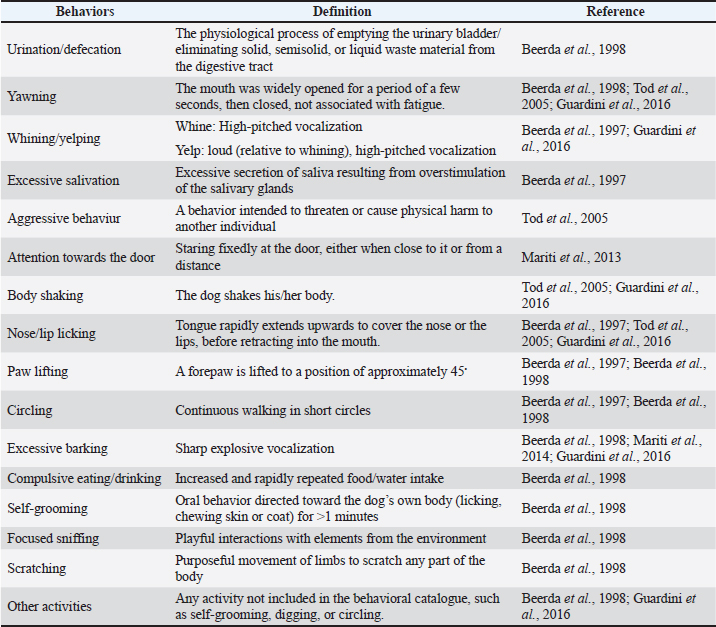
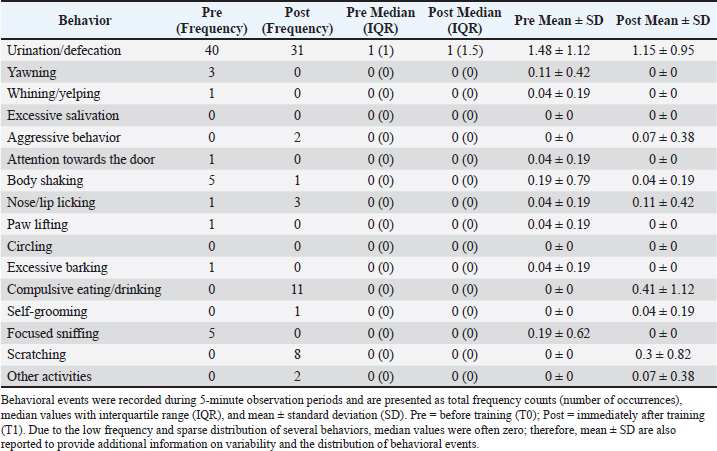
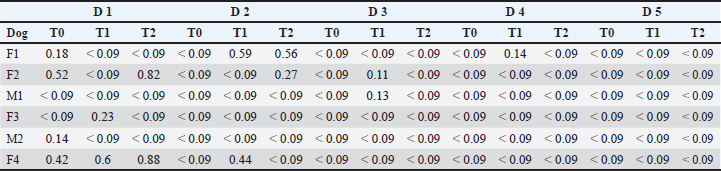
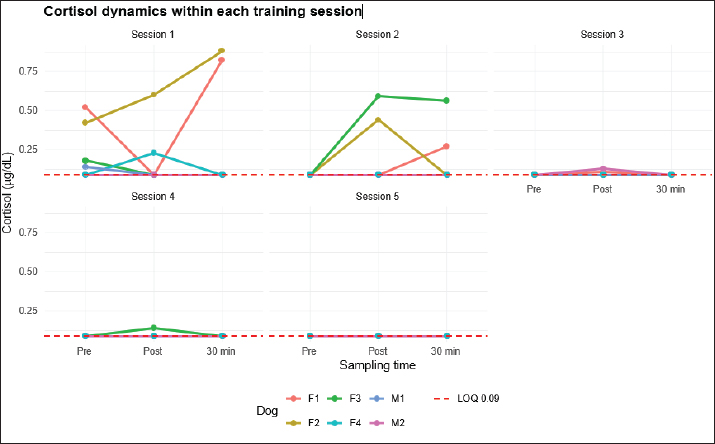
AbstractBackground: Stress assessment in working dogs requires a multidimensional approach combining physiological and behavioral indicators. Salivary cortisol is widely used as a non-invasive biomarker of acute stress, while behavioral observations provide complementary information on coping responses. Aim: The present exploratory study aimed to assess whether training sessions at the National Training School for Guide Dogs (Florence, Italy) induced measurable stress in guide dog puppies, by evaluating salivary cortisol concentrations and stress-related behaviors at different stages of the training program. Methods: The study included six Labrador Retrievers from the same litter who were monitored from four to 22 months of age between September 2022 and March 2024. Five study days were identified to represent potentially stressful stages of the training program. On each day, three saliva samples from each dog were collected: before training (T0), immediately after (T1), and 30 minutes later (T2). Cortisol concentrations were measured using the radioimmunoassay method. Concurrently, two trained observers recorded stress-related behaviors during 5-minute sessions at T0 and T1, according to ethograms adapted from previous studies. Results: Most cortisol values were below the limit of quantification (81.3%; 61/75), with occasional higher values in isolated cases. Behavioral observations showed that stress-related behaviors were rare, with overall very low frequencies throughout the study. No consistent pattern of variation across sampling times (T0–T2) was observed. Conclusion: No clear behavioral or measurable endocrine responses to training sessions were detected. The results support the hypothesis that the training methods used, based on positive reinforcement and play, do not adversely affect canine welfare under such conditions. Nevertheless, the limitations of salivary cortisol as a stress biomarker highlight the need for future studies to integrate additional physiological indicators to provide a more comprehensive evaluation of guide dog welfare. Keywords: Assistance dogs, Canine behavior, Saliva, Stress biomarkers, Welfare assessment. IntroductionAnimal-assisted interventions (AAI) are defined as structured, goal-oriented interactions between humans and animals, incorporated into a patient’s treatment plan by health professionals to improve patient outcomes (Fine, 2010; Miller et al., 2022). AAI are used in a variety of healthcare and therapeutic settings to support patients in improving psychological, emotional, and physical outcomes (Friesen, 2009; Linder et al., 2018). These interventions represent a suitable expression of integrated medicine, according to the One Health approach (Menna et al., 2019), since the animal is a crucial component of the treatment process (Corsetti et al., 2019). AAI can be carried out by professionals or volunteers in a great variety of settings and for multiple purposes (Kruger and Serpell, 2010), with animals actively participating in all activities (Corsetti et al., 2019). Different animal species, including dogs, horses, cats, donkeys, and rabbits, can be involved in AAI (De Santis et al., 2018); nevertheless, dogs are the main species involved, probably due to the proficiency in training, the relatively low cost of care, the wide availability, their variable sizes, and the close relationship with humans (Glenk, 2017; Linder et al., 2018). For the interventions to be effective and ethically sound, participating dogs must engage voluntarily and without distress; for this reason, training programs should emphasize positive reinforcement and play-based activities (Corsetti et al., 2019; Serpell et al., 2020). Guide dogs for visually impaired people represent a specific and widely established field of dog training (Bray et al., 2021). The training of guide dogs is extensive and highly structured, but over the past two decades, public concern has emerged regarding the potential welfare implications of prolonged training and repeated exposure to challenging tasks (Salmon et al., 2022). Therefore, stress and welfare assessment in working dogs has become a growing area of research interest (Haverbeke et al., 2008; Rooney et al., 2016). As a result, several studies have been carried out to assess how much the training sessions actually impact the guide dogs’ health and welfare, taking into account the most indicative stress indicators, such as cortisol, oxytocin, and behavioral patterns (Corsetti et al., 2019; Glenk et al., 2014; Ogi et al., 2020), while prioritizing minimally invasive sampling methods. Cortisol is the most common glucocorticoid, whose primary role is the regulation of energy and energy stores (Busch and Hayward, 2009), although it is broadly used as a negative-related stress indicator in animals (Miller et al., 2022). It is known that high cortisol levels reflect the effects of stress, whether acute or chronic (Adam et al., 2017), as well as stress resulting from persistently or repeatedly experienced low-to-moderate stressors (Cobb et al., 2025), where stressors are considered as “factors with the potential to directly challenge homeostasis” (Lu et al., 2021). Although cortisol and oxytocin are often associated with blood samples, they can also be quantified through non-invasive approaches such as saliva collection (Mârza et al., 2024; Ogi et al., 2020). Saliva collection is considered the most practical and least invasive sampling method, compared with blood, urine, or faecal sampling (van der Laan et al., 2022). The validity of salivary cortisol measurement in dogs has been demonstrated by its correlation with serum cortisol (Beerda et al., 1996; Giannetto et al., 2014; Vincent and Michell, 1992). This approach avoids the stress potentially induced by blood sampling and allows repeated measurements over time (Dreschel and Granger, 2009; Hellhammer et al., 2009). In addition to endocrine measures, behavioral observation is essential for a comprehensive evaluation of stress and welfare, as it reflects the animals’ immediate coping strategies (Mariti et al., 2012; Rooney et al., 2007). Combining both physiological and behavioral indicators can therefore provide a robust framework to assess the impact of guide dog training on welfare. The present exploratory study aimed to assess whether training sessions at the National Training School for Guide Dogs (Florence, Italy) induced measurable stress in guide dog puppies, by evaluating salivary cortisol concentrations and stress-related behaviors at different stages of the training programme. Materials and MethodsAnimalsThe National Training School for Guide Dogs (Scandicci, Florence, Italy) is a national association whose aim is to train dogs to assist visually impaired people. The training program follows the standardized guidelines of the International Guide Dog Federation (2024). Puppies enter the program at two months of age and are placed with carefully selected foster families until 20 months of age. When they are between two and five months, they attend a monthly puppy class with their caregivers. From five to 20 months, they spend one week each month at the school. At 12 months of age, all dogs undergo a behavioral test; two months later, only suitable dogs continue with a six-month formal training period. During this phase, each dog works with its assigned trainer for 40–50 minutes daily and undergoes two further behavioral assessments, at mid-training and at the end of the program. Experimental designThe present study was designed as an exploratory observational assessment based on the cohort of puppies available at the time within the training programme. Six Labrador Retriever dogs were enrolled: all dogs were born from the same litter, clinically healthy, and four months old at the start of the study. The cohort included four females and two males. The study lasted over an 18-month period, between September 2022 and March 2024. Five study days (D1–D5) were selected to represent key transitional phases of the programme, during which dogs were expected to encounter potential stressors: D1: at four months of age, immediately after placement with foster families; D2: at nine months of age, during the transition from family to training school; D3: at 15 months of age, during settlement at school; D4: at 17 months of age, during the intensive training phase; D5: at 22 months of age, during the final training session with the future visually impaired owner. On each day, three saliva samples and two behavioral observations were collected at three distinct time points, starting from 9:00 AM: T0 (pre-training): 9:00 AM, immediately before the beginning of the one-hour training session, T1 (post-training): 10:00 AM, immediately after the conclusion of the training session, T2 (30 min post-training): 10:30 AM, 30 minutes after the session, with no further external stimuli during this period. At each session, two 5-minute behavioral observations were carried out, respectively at T0 and T1, before saliva sampling. Before observation, dogs were given 5 minutes to explore the environment to minimize arousal linked to novelty. The short time period (five minutes) was selected in order not to disrupt the animals’ normal routine and to minimize the bias due to the experimental design. Saliva specimens were taken from the back of the tongue and the cheek pouches of each dog using Salivette® swabs (Sarstedt, Rommelsdorft, Germany). At each sampling time point, one Salivette® swab was used per dog. Both the observation sessions and the saliva collection were conducted within the National Training School for Guide Dogs, during their scheduled free-time exercise with their trainers, adhering to their normal activity schedule and without altering or influencing their daily routine. The dogs were not forced, manipulated, or confined in any way for behavioral observation or sample collection. All samples were immediately transported on ice to the laboratory of the Istituto Zooprofilattico Sperimentale del Lazio e della Toscana “M. Aleandri”. Saliva samples were centrifuged at 1,500 g × 15 minutes, the supernatant was collected and stored at −20°C until analysis. The average time from collection to centrifugation was 90 minutes; average storage duration was 72 hours. Cortisol concentrations were determined in duplicate using a commercial radioimmunoassay kit (Asbach Medical Products 80-R71200), following the manufacturer’s instructions. The detection limit of the assay was 0.09 µg/dL. Samples with concentrations below the LOQ were retained in descriptive analyses but excluded from inferential comparisons. Behavioral data were collected by two trained observers (A.B. and A.L.). According to previously reported ethograms (Kartashova et al., 2021; Mariti et al., 2012; Ogi et al., 2020; Pirrone et al., 2017), a behavioral sheet (BS) was developed. The BS included operational definitions for each behavior, with corresponding references provided in Table 1. Observers were trained prior to the study using the defined ethogram. Stress-related indicators were recorded as frequency of occurrence at T0 and T1. Observers were not blinded to time points due to the nature of the study design. Inter-observer reliability was not formally assessed. Ethical approvalThe study was conducted under a formal agreement between the Tuscany Region and the Istituto Zooprofilattico Sperimentale del Lazio e della Toscana “M. Aleandri” (Deliberation IZSLT no. 101/2021), in compliance with the Italian legislation (D. Lgs. 26/2014, national implementation of EU Directive 2010/63/EU on the protection of animals used for scientific purposes). Ethical approval was obtained from the Animal Welfare Body of the Istituto Zooprofilattico Sperimentale del Lazio e della Toscana “M. Aleandri” and the University of Tor Vergata, protocol number 0000004/26. Results and DiscussionBehavioral observations recorded before and after training sessions have been summarised in Table 2. Behaviors related to stress were infrequent and occurred only sporadically across the observation days. Behaviors such as yawning, whining, body shaking, lip licking, or excessive barking, which are commonly associated with stress, were seldom observed, with low total frequencies. Some behaviors like excessive salivation and circling were not observed at all. Patterns of increasing or decreasing behavioral indicators were not consistently detected between pre and post-training observations. The five-minute duration of each observation, being short, may have limited the detection of low-frequency behaviors. However, this approach was adopted to minimise interference with the animals' everyday routine and to maintain the normal conditions of the setting. For this exploratory study, behavioral indicators were considered collectively as a composite measure of stress-related responses with no differential scoring. This represents a simplification, as individual behaviors may reflect different emotional states or levels of arousal, and therefore, the resulting findings should be interpreted with caution. Salivary cortisol concentrations for each sampling day (D1–D5) and time point (T0, T1, T2) are reported in Table 3 and Figure 1. The cortisol levels remained within a comparable range throughout the study period, with no consistent pattern of variation across sampling times. However, a high proportion of samples (81.3%; 61/75) were below the limit of quantification (LOQ), precluding the adoption of inferential statistical analysis; therefore, cortisol data were only analysed descriptively. Stress can be a common experience for working dogs that are exposed to a range of environmental, social, and emotional challenges during their training programs. Behavioral responses are often the most immediate way for animals to cope and recover for homeostasis (Moberg, 2000). However, the correspondence between behavioral and physiological indicators of stress is not always consistent, as evidenced by previous literature (Blackwell et al., 2010; Rooney et al., 2007). In the present study, the low occurrence of stress-associated behaviors, along with the absence of a straightforward shift in salivary cortisol concentrations, suggests that no consistent training-induced behavioral or measurable endocrine responses were detected in the six monitored puppies. However, these findings should be interpreted with caution in light of the limitations described below. Salivary cortisol was selected as a physiological marker due to its non-invasive nature and widespread use in previous studies of canine behavioral research. The study confirms that the sampling procedure was well tolerated, with dogs often cooperating during saliva collection by spontaneously licking the swabs, consistent with previous studies that already demonstrated the minimal welfare impact of this approach (Perkins et al., 2021; Treder-Rochna et al., 2025; van der Laan et al., 2022). Nevertheless, the high proportion of values below the LOQ indicates that, in this case, salivary cortisol had limited utility as a physiological marker in this specific context. These findings are consistent with recent evidence suggesting that cortisol concentrations in puppies may be physiologically low and poorly sensitive to behavioral external stressors, highlighting more precisely that the use of this indicator in young dogs lacks specificity (Ferrans et al., 2025). Table 1. Behavioral sheet developed for recording the frequency of occurrence of behavioral data at T0 and T1 on study days D1–D5.
Several factors may explain the low cortisol concentrations observed in this study, including age-related characteristics of the hypothalamic-pituitary-adrenal (HPA) axis, the low intensity of the training sessions, and the above-mentioned limitations that are intrinsic to salivary cortisol as a biomarker of stress. Also, cortisol fluctuations do not exclusively correlate with negative stress; they may also increase in response to positive or anticipatory events, which complicates their interpretation as a welfare indicator (Cobb et al., 2025; Lensen et al., 2019). Furthermore, variability related to circadian rhythms, the dogs’ developmental stage, and possible individual differences may have further influenced the results. The use of a homogeneous cohort (a single litter) of dogs belonging to the most commonly used breed for AAI allowed consistent within-subject comparisons across different training stages by reducing genetic, age, season, and developmental-related variability. However, this also limits the overall generalisability of the findings to other breeds, age groups, or differently structured training programmes. Also, the absence of an untrained control group prevents the separation of training-related effects from normal developmental adaptations. This limitation was due to the difficulty of identifying a comparable group of puppies that could share identical management conditions but were not subjected to the same training programme. Table 2. Descriptive statistics of behavioral indicators observed before and after training sessions.
Table 3. Salivary cortisol measurements (µg/dL) for each dog at every study day and observation time.
The timing of post-training sampling (T2=30 minutes after training) was selected to evaluate the short-term recovery, while at the same time minimising the possible disruption to daily routine daily activities. Although no increase in cortisol concentrations was observed at this time point, this interval may not fully capture potential peaks in cortisol responses, which are typically reported to occur earlier following acute stress. Overall, the exploratory nature of the study, the small sample size, the lack of a control group, and the limited detectability of salivary cortisol are all factors that limit the strength of the conclusions. Despite these constraints, the absence of consistent changes in both behavioral indicators and cortisol concentrations suggests that, at least under the conditions of this study, training sessions for this specific AAI were not associated with clear signs of stress in the monitored puppies. A plausible explanation is that the training programme, which is based on positive reinforcement and play, promotes the gradual adaptation of puppies to interactions with trainers and their spontaneous engagement (Corsetti et al., 2019). Furthermore, studies involving larger and more diverse populations would be required to confirm the present findings. It would also be advisable, for future research, to integrate additional physiological markers such as hair cortisol, heart rate variability, or salivary alpha-amylase, along with a broader range of behavioral indicators, to provide a more comprehensive assessment of the welfare of dog puppies undergoing training to become a guide dog.
Fig. 1. Individual salivary cortisol concentrations across training sessions in guide dog puppies. Salivary cortisol values are shown for each dog (F1, F2, F3, M1, M2, and F4) across five training sessions (Sessions 1–5), measured at three time points: before training (Pre, T0), immediately after training (Post, T1), and 30 minutes post-training (30 minutes, T2). Each panel represents a different training session. The dashed horizontal line indicates the limit of quantification (LOQ; 0.09 μg/dl). A high proportion of samples fell below the LOQ, particularly in later sessions, resulting in overlapping values at the detection threshold. ConclusionThis study combined behavioral and physiological measures to assess the welfare of guide dog puppies during key stages of their training. Within the methodological limits of the study, no consistent behavioral or endocrine responses to training sessions were observed. However, the high proportion of cortisol values below the limit of quantification of the analytical method limits the interpretability of this biomarker in this context. Under these conditions, the findings suggest that the play-based training adopted by the National Training School for Guide Dogs does not appear to adversely affect the welfare of the enrolled puppies. These results should be interpreted with caution, and further studies involving larger cohorts and additional physiological indicators would be required to draw more robust conclusions. From a One Health perspective, ensuring the welfare of working dogs is essential to support both ethical standards and the efficacy of their assistance role. AcknowledgmentsThe authors acknowledge the operators of the National Training School for Guide Dogs (Florence, Italy) and Dr. Massimo Bugianelli for logistic support during sampling. Conflict of interestThe authors declare that there is no conflict of interest. FundingThe present study received funding from the Local Authority of the Tuscany Region (Deliberation IZSLT no. 101/2021). Authors' contributionsConceptualization, O.L., C.C., and A.L; investigation: P.P., A.B.,O.L., A.N., L.D., M.C., S.G., C.C., and A.L.; formal analysis: Z.M. and I.P; Writing - original draft preparation: P.P., A.M., and A.L.; Writing - review and editing: P.P., A.M., A.B., O.L., Z.M., I.P., A.N., L.D., M.C., S.G., E.L.,C.C., M.B., and A.L. All authors have read and agreed to the published version of the manuscript. Data AvailabilityAll data supporting the findings of this study are available within the manuscript. ReferencesAdam, E. K., Quinn, M. E., Tavernier, R., McQuillan, M. T., Dahlke, K. A. and Gilbert, K. E. 2017. Diurnal cortisol slopes and mental and physical health outcomes: A systematic review and meta-analysis. Psychoneuroendocrinology, 83, 25–41. Beerda, B., Schilder, M. B. H., Janssen, N. S. C. R. M. and Mol, J. A. 1996. The use of saliva cortisol, urinary cortisol, and cateoholamine measurements for a noninvasive assessment of stress responses in dogs. Hormones and Behaviour., 30(3), 272–279. Beerda, B., Schilder, M. B., van Hooff, J. A. & de Vries, H. W. 1997. Manifestations of chronic and acute stress in dogs. Appl. Anim. Behaviour. Sci., 52(3–4), 307–319. Beerda, B., Schilder, M. B., Van Hooff, J. A., De Vries, H. W., & Mol, J. A. 1998. Behavioural, saliva cortisol and heart rate responses to different types of stimuli in dogs. Appl. Anim. Behaviour. Sci., 58(3–4), 365–381. Blackwell, E. J., Bodnariu, A., Tyson, J., Bradshaw, J. W. S. and Casey, R. A. 2010. Rapid shaping of behaviour associated with high urinary cortisol in domestic dogs. Appl. Anim. Behaviour. Sci., 124(3–4), 113–120. Bray, E. E., Otto, C. M., Udell, M. A. R., Hall, N. J., Johnston, A. M. and MacLean, E. L. 2021. Enhancing the Selection and Performance of Working Dogs. Front. Vet. Sci., 8(May). Busch, D. S., Hayward, L. S. 2009. Stress in a conservation context: A discussion of glucocorticoid actions and how levels change with conservation-relevant variables. Biolog. Conservation., 142(12), 2844–2853. Cobb, M. L., Jiménez, A. G., & Dreschel, N. A. 2025. Beyond Cortisol Physiological indicators of welfare for dogs: Deficits, misunderstandings and opportunities. J. Appl. Anim. Wel. Sci., 1–30. Corsetti, S., Ferrara, M., Natoli, E. 2019. Evaluating stress in dogs involved in animal-assisted interventions. Animals, 9(10), 1–19. De Santis, M., Contalbrigo, L., Simonato, M., Ruzza, M., Toson, M., & Farina, L. 2018. Animal assisted interventions in practice: Mapping Italian providers. Veterinaria Italiana, 54(4), 323–332. Dreschel, N. A., Granger, D. A. 2009. Methods of collection for salivary cortisol measurement in dogs. Hormones and Behaviour, 55(1), 163–168. Ferrans, M., Salomons, H., Moore, K., White, P., Hare, B., Gruen, M. E. 2025. Salivary cortisol is an unreliable correlate of serum cortisol in adult pet dogs and assistance dog puppies. Scientific Reports, 15(1), 1–11. Fine, A. H. 2010. Handbook on Animal-Assisted Therapy: Theoretical Foundations and Guidelines for Practice. Handbook on Animal-Assisted Therapy: Theoretical Foundations and Guidelines for Practice, 1–588. Friesen, L. 2009. How a therapy dog may inspire student literacy engagement in the elementary language arts classroom. Learning landscapes, 3(1), 105–122. Giannetto, C., Fazio, F., Assenza, A., Alberghina, D., Panzera, M., Piccione, G. 2014. Parallelism of circadian rhythmicity of salivary and serum cortisol concentration in normal dogs. J. Applied. Biomed., 12(4), 229–233. Glenk, L. M. 2017. Current perspectives on therapy dog welfare in animal-assisted interventions. Animals, 7(2). Glenk, L. M., Kothgassner, O. D., Stetina, B. U., Palme, R., Kepplinger, B., Baran, H. 2014. Salivary cortisol and behaviour in therapy dogs during animal-assisted interventions: A pilot study. Journal of Veterinary Behaviour: Clinical Appl. Res., 9(3), 98–106. Guardini, G., Mariti, C., Bowen, J., Fatjó, J., Ruzzante, S., Martorell, A., Sighieri, C., Gazzano, A. 2016. Influence of morning maternal care on the behavioural responses of 8-week-old Beagle puppies to new environmental and social stimuli. Appl. Anim. Behaviour. Sci., 181, 137–144. Haverbeke, A., Diederich, C., Depiereux, E. and Giffroy, J.M. 2008. Cortisol and behavioural responses of working dogs to environmental challenges. Physiol. Behaviour 93(1–2), 59–67. Hellhammer, D.H., Wüst, S. and Kudielka, B.M. 2009. Salivary cortisol as a biomarker in stress research. Psychoneuroendocrinology 34(2), 163–171. International Guide Dog Federation. 2024. International Guide Dog Federation Summary of Standards 2024. Available from https://www.igdf.org.uk/wp-content/uploads/2022/08/IGDF-Standards-2024-Summary.pdf. Accessed 10 september 2025. Kartashova, I. A., Ganina, K. K., Karelina, E. A. and Tarasov, S. A. 2021. How to evaluate and manage stress in dogs – A guide for veterinary specialist. Applied Animal Behaviour Science, 243(August), 105458. Kruger, K. A., Serpell, J. A. 2010. Animal-assisted interventions in mental health: definitions and theoretical foundations. In: Handbook on Animal-Assisted Therapy: Theoretical Foundations and Guidelines for Practice, 33–48. Lensen, R. C., Moons, C. P., & Diederich, C. 2019. Physiological stress reactivity and recovery related to behavioral traits in dogs (Canis familiaris). PloS one, 14(9), e022258. Linder, D. E., Mueller, M. K., Gibbs, D. M., Alper, J. A. and Freeman, L. M. 2018. Effects of an Animal-Assisted Intervention on Reading Skills and Attitudes in Second Grade Students. Early Childhood Edu. J., 46(3), 323–329. Lu, S., Wei, F., & Li, G. 2021. The evolution of the concept of stress and the framework of the stress system. Cell stress, 5(6), 76. Mariti, C., Carlone, B., Ricci, E., Sighieri, C., & Gazzano, A. 2014. Intraspecific attachment in adult domestic dogs (Canis familiaris): Preliminary results. Appl. Anim. Behaviour. Sci., 152, 64–72. Mariti, C., Gazzano, A., Moore, J. L., Baragli, P., Chelli, L. and Sighieri, C. 2012. Perception of dogs’ stress by their owners. J. Vet. Behaviour.: Clinical Appl. Res., 7(4), 213–219. Mariti, C., Ricci, E., Carlone, B., Moore, J. L., Sighieri, C., & Gazzano, A. 2013. Dog attachment to man: A comparison between pet and working dogs. J. Vet. Behavior., 8(3), 135–145. Mârza, S.M., Munteanu, C., Papuc, I., Radu, L., Diana, P. and Purdoiu, R.C. 2024. Behavioural, Physiological, and Pathological Approaches of Cortisol in Dogs. Animals 14(23), 3536. Menna, L. F., Santaniello, A., Todisco, M., Amato, A., Borrelli, L., Scandurra, C. and Fioretti, A. 2019. The human-animal relationship as the focus of animal-assisted interventions: A one health approach. International J. Environ. Res. Public Health, 16(19), 1–10. Miller, S.L., Serpell, J.A., Dalton, K.R., Waite, K.B., Morris, D.O., Redding, L.E., Dreschel, N.A. and Davis, M.F. 2022. The Importance of Evaluating Positive Welfare Characteristics and Temperament in Working Therapy Dogs. Front. Vet. Sci. 9:844252. Moberg, G. P. 2000. Biological response to stress: implications for animal welfare. The Biology of Animal Stress: Basic Principles and Implications for Animal Welfare., 1–21. Ogi, A., Mariti, C., Baragli, P., Sergi, V. and Gazzano, A. 2020. Effects of stroking on salivary oxytocin and cortisol in guide dogs: preliminary results. Animals 10(4), 708. Perkins, H., Higgins, M., Marcato, M., Galvin, P. and Teixeira, S.R. 2021. Immunosensor for assessing the welfare of trainee guide dogs. Biosensors 11(9), 327. Pirrone, F., Ripamonti, A., Garoni, E. C., Stradiotti, S., Albertini, M. 2017. Measuring social synchrony and stress in the handler-dog dyad during animal-assisted activities: A pilot study. Journal of Veterinary Behaviour: Clinical Appl. Res., 21, 45–52. Rooney, N. J., Clark, C. C. A., Casey, R. A. 2016. Minimizing fear and anxiety in working dogs: A review. J. Vet. Behaviour.: Clinical Appl. Res., 16, 53–64. Rooney, N. J., Gaines, S. A. and Bradshaw, J. W. S. 2007. Behavioural and glucocorticoid responses of dogs (Canis familiaris) to kennelling: Investigating mitigation of stress by prior habituation. Physiol. Behaviour., 92(5), 847–854. Salmon, A., Driscoll, C., Paterson, M. B. A., Harpur, P. and Pachana, N. A. 2022. Issues Regarding the Welfare of Assistance Dogs. Animals, 23. Serpell, J. A., Kruger, K. A., Freeman, L. M., Griffin, J. A. and Ng, Z. Y. 2020. Current Standards and Practices Within the Therapy Dog Industry: Results of a Representative Survey of United States Therapy Dog Organizations. Front. Vet. Sci., 7(February), 1–12. Tod, E., Brander, D. and Waran, N. 2005. Efficacy of dog appeasing pheromone in reducing stress and fear related behaviour in shelter dogs. Appl. Anim. Behaviour. Sci. 93(3–4), 295–308. Treder-Rochna, N., Chruściel, E., Gajewska, M. A., Dziadosz-Brzezińska, A., Grzelec, L., & Żadkowska, M. 2025. Assessing stress in dogs during saliva sampling in socio-psychological research: Preliminary development of animal-friendly practical procedures. Appl. Anim. Behaviour. Sci., 106868. van der Laan, J. E., Vinke, C. M. and Arndt, S. S. 2022. Evaluation of hair cortisol as an indicator of long-term stress responses in dogs in an animal shelter and after subsequent adoption. Scientific Reports, 12(1), 1–10. Vincent, I. C., Michell, A. R. 1992. Comparison of cortisol concentrations in saliva and plasma of dogs. Res. Vet. Sci., 53(3), 342–345 | ||
| How to Cite this Article |
| Pubmed Style Pepe P, Mariacher A, Barone A, Lai O, Mezher Z, Palmas I, Nardoni A, Dionisi L, Cocco M, Giovannini S, Loretti E, Ciceroni C, Benedetti M, Lombardo A. Stress assessment in guide dog puppies: An exploratory study of salivary cortisol and behavioral responses to training sessions. Open Vet. J.. 2026; 16(8): 5509-5516. doi:10.5455/OVJ.2026.v16.i8.43 Web Style Pepe P, Mariacher A, Barone A, Lai O, Mezher Z, Palmas I, Nardoni A, Dionisi L, Cocco M, Giovannini S, Loretti E, Ciceroni C, Benedetti M, Lombardo A. Stress assessment in guide dog puppies: An exploratory study of salivary cortisol and behavioral responses to training sessions. https://www.openveterinaryjournal.com/?mno=288965 [Access: August 08, 2026]. doi:10.5455/OVJ.2026.v16.i8.43 AMA (American Medical Association) Style Pepe P, Mariacher A, Barone A, Lai O, Mezher Z, Palmas I, Nardoni A, Dionisi L, Cocco M, Giovannini S, Loretti E, Ciceroni C, Benedetti M, Lombardo A. Stress assessment in guide dog puppies: An exploratory study of salivary cortisol and behavioral responses to training sessions. Open Vet. J.. 2026; 16(8): 5509-5516. doi:10.5455/OVJ.2026.v16.i8.43 Vancouver/ICMJE Style Pepe P, Mariacher A, Barone A, Lai O, Mezher Z, Palmas I, Nardoni A, Dionisi L, Cocco M, Giovannini S, Loretti E, Ciceroni C, Benedetti M, Lombardo A. Stress assessment in guide dog puppies: An exploratory study of salivary cortisol and behavioral responses to training sessions. Open Vet. J.. (2026), [cited August 08, 2026]; 16(8): 5509-5516. doi:10.5455/OVJ.2026.v16.i8.43 Harvard Style Pepe, P., Mariacher, . A., Barone, . A., Lai, . O., Mezher, . Z., Palmas, . I., Nardoni, . A., Dionisi, . L., Cocco, . M., Giovannini, . S., Loretti, . E., Ciceroni, . C., Benedetti, . M. & Lombardo, . A. (2026) Stress assessment in guide dog puppies: An exploratory study of salivary cortisol and behavioral responses to training sessions. Open Vet. J., 16 (8), 5509-5516. doi:10.5455/OVJ.2026.v16.i8.43 Turabian Style Pepe, Paola, Alessia Mariacher, Antonino Barone, Olga Lai, Ziad Mezher, Isabella Palmas, Antonella Nardoni, Lorenza Dionisi, Monica Cocco, Serena Giovannini, Enrico Loretti, Carlo Ciceroni, Martina Benedetti, and Andrea Lombardo. 2026. Stress assessment in guide dog puppies: An exploratory study of salivary cortisol and behavioral responses to training sessions. Open Veterinary Journal, 16 (8), 5509-5516. doi:10.5455/OVJ.2026.v16.i8.43 Chicago Style Pepe, Paola, Alessia Mariacher, Antonino Barone, Olga Lai, Ziad Mezher, Isabella Palmas, Antonella Nardoni, Lorenza Dionisi, Monica Cocco, Serena Giovannini, Enrico Loretti, Carlo Ciceroni, Martina Benedetti, and Andrea Lombardo. "Stress assessment in guide dog puppies: An exploratory study of salivary cortisol and behavioral responses to training sessions." Open Veterinary Journal 16 (2026), 5509-5516. doi:10.5455/OVJ.2026.v16.i8.43 MLA (The Modern Language Association) Style Pepe, Paola, Alessia Mariacher, Antonino Barone, Olga Lai, Ziad Mezher, Isabella Palmas, Antonella Nardoni, Lorenza Dionisi, Monica Cocco, Serena Giovannini, Enrico Loretti, Carlo Ciceroni, Martina Benedetti, and Andrea Lombardo. "Stress assessment in guide dog puppies: An exploratory study of salivary cortisol and behavioral responses to training sessions." Open Veterinary Journal 16.8 (2026), 5509-5516. Print. doi:10.5455/OVJ.2026.v16.i8.43 APA (American Psychological Association) Style Pepe, P., Mariacher, . A., Barone, . A., Lai, . O., Mezher, . Z., Palmas, . I., Nardoni, . A., Dionisi, . L., Cocco, . M., Giovannini, . S., Loretti, . E., Ciceroni, . C., Benedetti, . M. & Lombardo, . A. (2026) Stress assessment in guide dog puppies: An exploratory study of salivary cortisol and behavioral responses to training sessions. Open Veterinary Journal, 16 (8), 5509-5516. doi:10.5455/OVJ.2026.v16.i8.43 |


