




| Research Article | ||
Open Vet. J.. 2026; 16(3): 1619-1627 Open Veterinary Journal, (2026), Vol. 16(3): 1619-1627 Research Article Comprehensive assessment of morphology and productivity of Assaf sheep in the northern West BankMedhat Wild Ali1, Ikram Bensouf1, Angham Bani Owdeh2, Muayad Salman1* and Nacuer M’Hamdi11Laboratory of Animal, Genetic, and Feed Resources (LRGAA), National Agronomic Institute of Tunisia, University of Carthage, Carthage, Tunisia 2Aquatic Ecosystems and Resources Laboratory, National Institute of Agricultural Sciences, University of Carthage, Tunis, Tunisia *Corresponding Author: Muayad Salman. Animal and Food Resources Laboratory, National Agronomic Institute of Tunisia, University of Carthage, Tunis, Tunisa. Email: moayednas [at] yahoo.com Submitted: 29/09/2025 Revised: 29/01/2026 Accepted: 12/02/2026 Published: 31/03/2026 © 2026 Open Veterinary Journal
AbstractBackground: Assaf sheep are a major source of meat and milk in the northern West Bank, Palestine. However, limited information exists regarding their phenotypic and morphometric characteristics under local management conditions. Understanding these traits is essential for improving productivity, reproductive performance, and breeding strategies. Aim: This study aimed to investigate the morphology, productive traits, and reproductive performance of Assaf sheep raised in four governorates of the northern West Bank. Methods: A total of 580 adult sheep (520 ewes and 60 rams) across Jenin, Tulkarm, Nablus, and Jericho were evaluated for both qualitative and quantitative traits. Morphometric measurements, live weights, milk yield, prolificacy, lamb birth weight, and udder dimensions were recorded. Multivariate analysis was used to assess the variability within the population and identify traits associated with productivity improvement. Results: Pronounced sexual dimorphism was observed, with males exhibiting higher average live weights (113.0 kg) and body lengths (116.9 cm) than females (72.7 kg and 85.5 cm, respectively). Productive traits varied by region and management practices, with the highest milk yield in Tulkarm (407 ± 19 kg/lactation) and the lowest in Jericho (255 ± 17 kg/lactation). Prolificacy increased with parity, averaging 1.15 and 1.61 lambs in the first parity and 1.61 lambs in the third. Lamb birth weights reflected regional differences, with Tulkarm lambs reaching the highest average (4.69 ± 0.07 kg), and singletons (4.72 kg) were heavier than multiples (4.30 kg). Morphometric traits associated with productivity were evident in udder measurements, with an average udder length and depth of 21.4 and 15.1 cm, respectively. Conclusion: The study highlights significant variability in the phenotypic and productive traits of Assaf sheep across regions. These findings provide essential information for breeding programs and management strategies to improve sheep productivity and reproductive performance in the northern West Bank. Keywords: Assaf sheep, Sexual dimorphism, Morphometric traits, Milk production, Reproductive performance. IntroductionSheep farming is a cornerstone of livestock production in Palestine, contributing substantially to household income, rural livelihoods, and national food security. The Assaf breed has gained prominence in the northern West Bank due to its superior milk production, reproductive efficiency, and growth potential. The breed developed through the crossbreeding of Awassi and East Friesian sheep (Rosov and Gootwine, 2013; Gutiérrez et al., 2007; Gootwine and Rozov, 2006) has demonstrated remarkable adaptability under diverse environmental and management systems (Legaz et al., 2011; Abdallah and Abo Omar, 2017). Despite its increasing agricultural and economic importance, comprehensive information on the phenotypic and morphometric characteristics of Assaf sheep in this region remains scarce (Worku and Melesse, 2019; Yakubu, 2013). Morphological traits, which encompass both qualitative and quantitative features, are essential for characterizing genetic resources, supporting breed differentiation, and guiding breeding programs aimed at enhancing productivity and sustainability (Deribe et al., 2021; Asamoah-Boaheng and Sam, 2016; Tibbo et al., 2006). Morphometric measurements, such as body dimensions, live weight, and udder characteristics, are critical productivity indicators that correlate with milk yield, reproductive performance, and growth traits (Gootwine et al., 2008, Abd-Allah et al., 2018; Aljumaah et al., 2025). These traits also provide insight into genetic diversity and facilitate the identification of adaptations specific to regions (Legaz et al., 2008; Tabba, 1998). Previous studies have emphasized the importance of sexual dimorphism and regional variation in sheep morphometry. For example, research on Awassi sheep in the West Bank highlighted key traits linked to milk production and reproductive performance (Pollott and Gootwine, 2004a,b; Rovai et al., 2008; Abdallah and Abo Omar, 2017; Salman et al., 2024). Similarly, correlations between body and udder morphology and production efficiency have been demonstrated in international studies on breeds such as Lacaune, Wallachia, and Pelibuey sheep, emphasizing the relevance of morphometric analyses for breeding programs and conservation strategies (Panayotov et al., 2018; Álvarez et al., 2020; Milerski et al., 2020). Multivariate statistical approaches, including principal component analysis, discriminant analysis, and Mahalanobis distance analysis, have proven effective in assessing phenotypic variability and identifying important traits within livestock populations (Asamoah-Boaheng and Sam, 2016; Abdallah and Abo Omar, 2017). These methods provide a comprehensive framework for quantifying variability, detecting key morphological traits, and supporting DS strategies. In this context, the present study systematically characterizes the phenotypic and morphometric traits of Assaf sheep in the northern West Bank, focusing on body dimensions, udder morphology, milk yield, reproductive performance, and regional variations. This study aims to (i) quantify morphometric and productive traits, (ii) evaluate the effects of sex, parity, and regional origin, and (iii) employ multivariate analyses to identify key traits for improving productivity and supporting sustainable breed management. The findings are expected to inform breeding and conservation strategies that enhance productivity while maintaining genetic diversity, contributing to sustainable livestock development in Palestine and similar agro-ecological systems. Materials and MethodsStudy area and animal samplingThis study was conducted in the northern West Bank, Palestine, between January and May 2024. A multistage sampling strategy combining purposive and random sampling was applied to ensure representative coverage of the population of Assaf sheep. The four governorates (Jenin, Tulkarm, Nablus, and Jericho) were selected due to their high prevalence of Assaf sheep. Within each governorate, districts were randomly selected, followed by the random selection of farms. A total of 580 adult Assaf sheep (520 ewes and 60 rams) from 26 farms were included in this study. On each farm, approximately 20 ewes and 2–3 rams aged 1.5 to 6 years were sampled. Selection criteria included the following: (i) purebred Assaf sheep, confirmed via phenotypic traits and farm records; (ii) clinically healthy animals; (iii) nonpregnant ewes at various lactation stages; and (iv) farms maintaining ≥50 sheep with complete management records. The geographical coordinates of the farms were recorded, and a map of the study area was prepared to illustrate the sampling sites. Data collectionFarm and animal informationFarm characteristics, including location, production system (intensive, semi-intensive, or extensive), flock size, and management practices, were obtained using a structured questionnaire. Individual animal information, identification, age (determined via dentition and records), parity, and reproductive history, were recorded. Morphological and productive traits were collected following standardized FAO procedures (Abdallah and Abo Omar, 2017; Kouri et al., 2019). To ensure consistency and accuracy, measurements were performed by trained personnel. Morphological traitsThe morphological characterization included both qualitative and quantitative traits. Qualitative traits were assessed visually and included body conformation, structural features, coat color (white, brown, black, or spotted), face and leg pigmentation, facial profile (straight, convex, or concave), nose shape (Roman or straight), ear size (small, medium, large, pendulous, or rudimentary), horn presence (horned, scurred, or polled), horn length (cm), and tail type (fat-tailed, thin-tailed, or fat-rumped) and length (cm). The udder and teat characteristics, including condition, teat shape, and teat position, were also evaluated. Quantitative traits comprised direct measurements of body dimensions using standardized instruments. Head measurements included length, width, and ear dimensions. Body traits measured included body length, height at withers, heart girth, chest depth, shoulder width, rump height, rump width, and cannon circumference. Udder and teat measurements included length, width, depth/height, diameter, and circumference. In the rams, the scrotal circumference was measured at the widest point. Live body weight was determined using a calibrated scale, and the body condition score (BCS) was recorded on a scale of 1–5. The morphometric measurements adhered to the FAO (2012) guidelines and protocols from previous studies (Capote et al., 2006; Ángeles Pérez-Cabal et al., 2013; Abdallah and Abo Omar, 2017). Production and reproductionThe production and reproductive data were obtained from farm records and direct measurements. Milk yields of lactating ewes were recorded bi-monthly following ICAR (2018) protocols, with morning and evening yields summed for daily production. The parameters included lactation length (days in milk), average daily milk yield, and total milk yield per lactation. Reproductive traits included age and body weight at first lambing, litter size, lambing interval, prolificacy, and parity. Lamb growth traits included birth weight (within 24 hours of birth), weaning weight (at 60 days), and marketing weight (at six months). Data collection followed established dairy sheep methodologies (Ángeles Pérez-Cabal et al., 2013; Salman et al., 2024b). Statistical analysisData were entered into SPSS v22 (IBM Corp., Armonk, NY) for analysis. The descriptive statistics (means, SD, frequencies, and percentages) were calculated. ANOVA was used to compare morphometric and productive traits across sex, age, and location. Multivariate analyses, including principal component and discriminant analyses, were used to assess population structure and identify discriminating traits (Martínez et al., 2011; Abdallah and Abo Omar, 2017). Significance was set at p < 0.05. Formulas for descriptive statisticsThe coefficient of variation (CV) was calculated as follows: CV=(σ/μ) × 100 (1) where σ is the standard deviation, and μ is the mean. The frequencies of qualitative traits were calculated as follows: fi=(ni/N) × 100 (2) Here, fi is the frequency of qualitative traits, ni is the number of animals in category i, and N is the total sample size. Means for quantitative traits (e.g., body weight and milk yield) were calculated as follows:
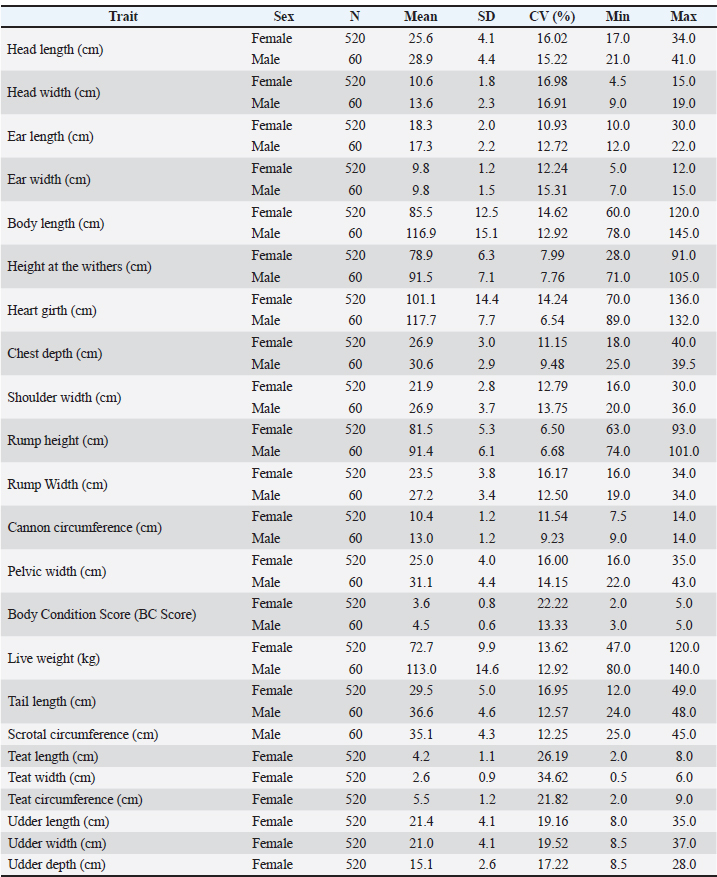
where x̅ is the mean of the quantitative trait (e.g., body weight and milk yield). Model for fixed effectsThe effect of fixed factors was analyzed using the general linear model (GLM) as follows: Yijklm=μ + Li + Aj + Wk + Pl + Sm + β1(X1) + β2(X2) + ... + βn(Xn) + eijklm where Yijklm is the observed trait (e.g., milk yield, lamb weight at 2 months), μ is the population mean, Li is location (Jenin, Tulkarm, Nablus, Jericho), Aj is age at first lambing, Wk is weight at first lambing, Pl is parity, Sm is litter size, and β terms represent regression coefficients for covariates (e.g., prolificacy, DIM, total milk yield, and lamb weights). The error term eijklm accounted for residual variation. Pairwise comparisons of least-square means for fixed effects (location, parity, and age at first lambing) were performed using the least significant difference (LSD) method, with significance set at p < 0.05. Ethical approvalThe authors confirm that the study lacked access to a formal ethical approval body in the West Bank, Palestine, as no institutions in the region are responsible for issuing such certificates for scientific research. Nonetheless, the research practices adhered to internationally recognized standards for animal research ethics, including careful monitoring of animal health and welfare throughout the study period. We trust this declaration will suffice as ethical approval for this study, given the absence of institutions capable of providing such documentation within the study region. ResultsMorphometric measurements and sexual dimorphismTable 1 presents the quantitative morphometric data for Assaf sheep, including sexual dimorphism. Males generally exhibited higher values than females for most body measurements, except trait-specific ones, such as udder and teat dimensions. Live weight, body length, and height-related parameters were significantly different, reflecting pronounced sexual dimorphism. Table 1. Quantitative morphometric traits of Assaf sheep by sex.
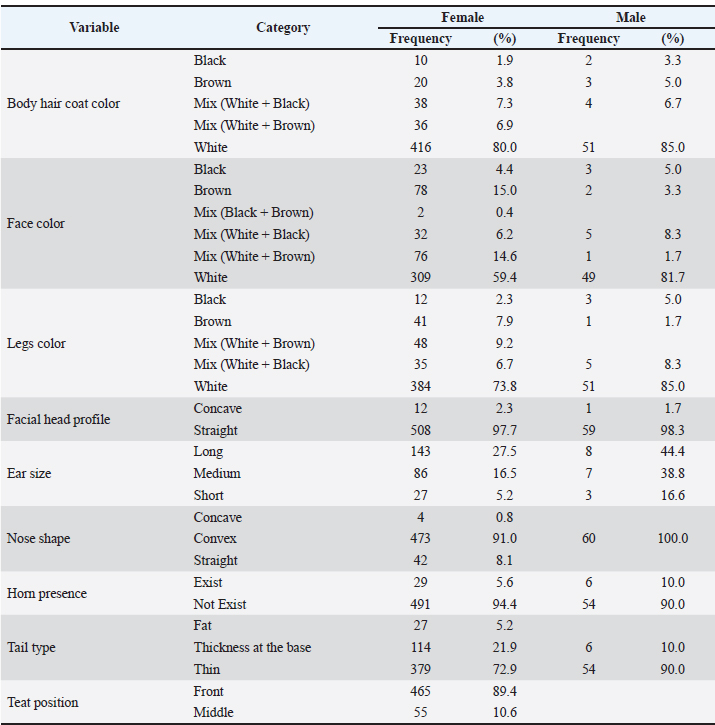
Males had greater head length (28.9 ± 4.4 cm) than females (25.6 ± 4.1 cm), with CV of 15.22% and 16.02%, respectively. Live weight averaged 113.0 ± 14.6 kg in males and 72.7 ± 9.9 kg in females. Heart girth, shoulder width, and rump width also showed significant differences between the sexes. Cannon circumference, an indicator of skeletal robustness, averaged 13.0 ± 1.2 cm in males versus 10.4 ± 1.2 cm in females. The pelvic width and scrotal circumference further confirmed the expected reproductive dimorphism. Qualitative morphometric traitsTable 2 presents the distribution of qualitative morphometric traits in Assaf sheep. The results indicate clear sex-based variation and breed-specific characteristics. Differences were observed in body coat color, face color, and leg color, with males exhibiting a slightly higher frequency of certain phenotypes, such as a white coat, than females. Table 2. Qualitative morphometric traits of Assaf sheep by sex.
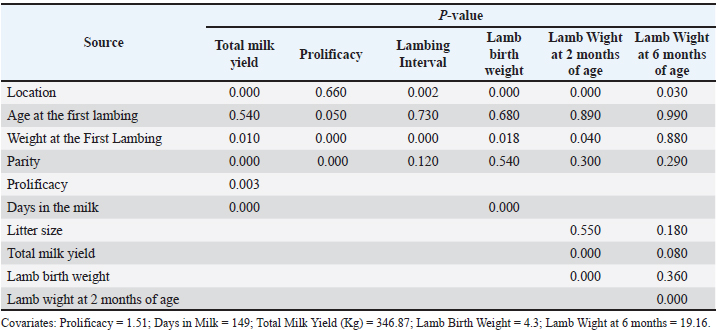
Sex-specific traits, including facial profile, ear size, nose shape, horn presence, tail type, and teat position, were also observed. Factors affecting milk production, reproduction, and lamb growthTable 3 summarizes the influence of fixed factors and covariates on productive and reproductive traits in Assaf sheep. The results indicate that the total milk yield was significantly affected by location, parity, weight at first lambing, and days in milk. Prolificacy was influenced by weight, parity, and age at first lambing. Table 3. P-value of factors (fixed and covariates) used in the milk, reproduction, and lamb weight traits statistical model in Assaf sheep.
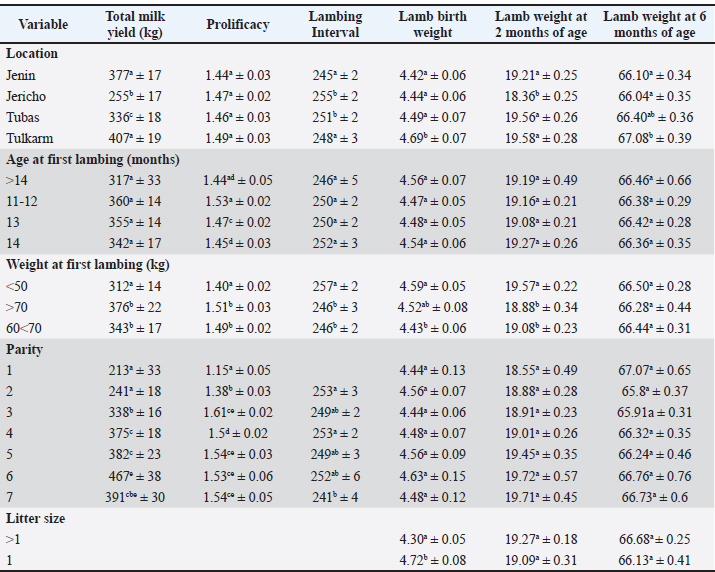
Lamb growth, including birth weight and postnatal development at 2 and 6 months, was primarily determined by location, total milk yield, and milking days. Trait variability by variablesTable 4 presents the mean values and standard errors for milk production, reproductive traits, and lamb weights across key variables. Considerable variability was observed among the study locations. The highest total milk yield was recorded in Tulkarm (407 ± 19 kg), whereas the lowest was observed in Jericho (255 ± 17 kg). Table 4. Mean and SE of milk, reproduction, and lamb weight traits in Assaf sheep by variables.
Prolificacy increased with parity, averaging 1.15 at the first parity and reaching 1.61 at the third parity. Lamb birth weight was influenced by litter size, with singletons averaging 4.72 ± 0.08 kg compared to 4.30 ± 0.05 kg with multiple births. In addition, age and weight at first lambing significantly affected reproductive performance, with older and heavier ewes demonstrating higher prolificacy and shorter lambing intervals. DiscussionQuantitative morphometric traitsThis study evaluated sexual dimorphism in Assaf sheep raised in the northern West Bank. The results indicate that rams had significantly higher mean live weights (113.0 kg) than ewes (72.7 kg), resulting in an assigned male at birth (AMAB) weight ratio of 1.55. This ratio is higher than the 1.13 reported for Spanish Assaf sheep (Legaz et al., 2011). Body length exhibited the most pronounced sexual dimorphism among the morphometric traits, with males measuring 116.9 cm against 85.5 cm in females (ratio 1.37). Height at the withers (91.5 vs. 78.9 cm; ratio 1.16) and rump height (91.4 vs. 81.5 cm; ratio 1.12) also showed significant sex-based differences, consistent with previous reports in Egyptian Assaf (Abd-Allah et al., 2018) and Indian sheep (Singh et al., 2013). The heart girth was similarly higher in males (117.7 cm) than in females (101.1 cm; ratio 1.16), in agreement with the findings in Awassi sheep in Palestine (Abdallah and Abo Omar, 2017). The chest depth and shoulder width were 14% and 23% greater in males, respectively, reflecting overall male superiority in body dimensions. Craniometric measurements further confirmed dimorphism, with larger head length (28.9 vs. 25.6 cm) and head width (13.6 vs. 10.6 cm) in males. The ear length was slightly greater in females (18.3 vs. 17.3 cm), whereas the ear width was identical (9.8 cm). The tail length also demonstrated sexual dimorphism (36.6 vs. 29.5 cm; ratio 1.24), indicating variation across breeds and environments. Cannon circumference, a proxy for skeletal robustness, was larger in males (13.0 cm) than in females (10.4 cm; ratio 1.25), consistent with previous studies (Legaz et al., 2011; Mavule et al., 2013). Female-specific traits, such as udder and teat dimensions, are essential for dairy production. The mean teat length, width, and circumference were 4.2, 2.6, and 5.5 cm, respectively, aligning with earlier reports (Ángeles Pérez-Cabal et al., 2013). The average scrotal circumference in rams was 35.1 cm, which is within the range reported for Awassi rams (Kridli et al., 2006), indicating normal reproductive development. Compared with indigenous breeds such as Awassi in Palestine, Assaf sheep generally have larger body measurements, reflecting their dual-purpose selection for meat and milk. The CV ranged from moderate to high across traits, demonstrating substantial phenotypic diversity. For example, the body length CV was 14.6% in females and 12.9% in males, whereas the heart girth CV ranged from 14.2% in females to 6.5% in males, consistent with previous studies on Spanish Assaf (Legaz et al., 2011) and Zulu sheep (Mavule et al., 2013). Qualitative morphometric traitsQualitative traits analysis of Assaf sheep revealed clear breed- and sex-specific patterns (Table 4). White coat color was the most prevalent color in both sexes, observed in 85% of males and 80% of females. Darker or mixed pigmentation rarely occurred, consistent with the breed’s origin as a cross between East Friesian and Awassi sheep, which aimed to improve dairy performance and morphological uniformity (Legaz et al., 2011). The presence of horns was uncommon, detected in only 10% of males and 5.6% of females, contrasting with ancestral Awassi sheep. This likely reflects deliberate selection of hornless animals to facilitate handling and improve safety (Legaz et al., 2011). Genetic studies on the RXFP2 gene indicate that horn development is under genetic control, and the reduced expression in Assaf sheep aligns with these artificial selection pressures (Seroussi et al., 2017). Facial profiles were predominantly straight (>97%), which may reflect selection for udder conformation and milk yield, traits influenced by East Friesian ancestry (Legaz et al., 2011). The tail morphology was mostly thin, occurring in 90% of males and 72.9% of females, differing from the fat-tailed Awassi. Female udder traits, particularly front teat placement (89.4% of females), were consistent with machine milking requirements and were consistent with observations in Spanish Assaf flocks (Legaz et al., 2011). Variability was noted in peripheral traits, such as ear length, with 27.5% of females displaying long ears and 91%–100% exhibiting convex profiles. These features highlight the hybrid origin of the breed, with convex nasal profiles that reflect East Friesian influence. Peripheral traits, such as ear size, may also play a role in thermoregulation or represent random genetic variation, and they often show limited correlation with core morphometric traits, suggesting a minimal impact on standardization (Mavule et al., 2013). Qualitative morphometric traitsQualitative morphometric analysis of Assaf sheep revealed clear sex- and breed-specific patterns (Table 4). White coat color predominated in both males (85%) and females (80%), whereas darker or mixed pigmentation was rare. This distribution reflects the breed’s origin as a cross between East Friesian and Awassi sheep, selected for improved dairy performance and morphological uniformity (Legaz et al., 2011). The limited pigmentation diversity in the Afec-Assaf strain further indicates the impact of selective breeding aimed at achieving uniformity in intensive production systems (Seroussi et al., 2017). Horned animals were uncommon, occurring in 10% of males and 5.6% of females. This contrasts with ancestral Awassi sheep and likely results from deliberate selection for hornless animals to enhance management efficiency and safety (Legaz et al., 2011). Studies of the RXFP2 gene suggest that horn development is under genetic control, and its reduced expression in Assaf sheep is consistent with artificial selection practices (Seroussi et al., 2017). Facial profiles were predominantly straight (>97%), which may reflect selection for udder conformation and milk yield, traits influenced by East Friesian ancestry (Legaz et al., 2011). Tail morphology was mainly thin (90% of males and 72.9% of females), differing from that of the fat-tailed Awassi breed and supporting adaptation to dairy-oriented production systems. Female udder traits, particularly front teat placement, were observed in 89.4% of ewes, which is comparable to the requirements for machine milking in Spanish Assaf flocks (Legaz et al., 2011). Variations in ear length and nasal profile highlighted the hybrid nature of the breed. Long ears were observed in 27.5% of females, and convex nasal profiles were observed in 91%–100% of animals, reflecting East Friesian influence. Ear size may affect thermoregulation or result from genetic drift, and peripheral traits such as ear length typically show low correlation with other morphometric characteristics, suggesting limited functional relevance in standardization (Mavule et al., 2013). ConclusionThis study demonstrated pronounced sexual dimorphism in Assaf sheep, with males exhibiting significantly greater body size, weight, and morphometric traits than females. Regional differences were also evident, with Tulkarm showing the highest milk yield, while other locations displayed distinct patterns in lamb growth, likely influenced by local management practices. Prolificacy increased with parity and higher body weight at first lambing, whereas variations in lambing intervals and lactation traits reflected the genetic efficiency of the breed under local environmental conditions. Morphological variability, including thin-tailed traits and functional udder characteristics, highlighted the breed’s adaptability and its mixed East Friesian and Awassi ancestry. AcknowledgmentsNone. FundingNot available. Authors’ contributionsAll authors contributed equally. Conflict of interestThe authors declare no conflict of interest. Data availabilityAll related data are included in the manuscript. ReferencesAbdallah, J.M. and Abo Omar, J. 2017. Multivariate analysis of morphological characteristics of Awassi sheep in the West Bank, Palestine. J. Anim. &. Plant. Sci. 27(4), 1115–1125. Abd-Allah, S., Shoukry, M.M., Mohamed, M.I., Abd-el Rahman, H.H. and Abedo, A.A. 2018. Descriptive characteristics and linear body measurements of Assaf sheep reared in southern Sinai, Egypt. Bioscience. Res. 15(3), 1679–1687. Aljumaah, A. K., Tabbaa, M. J., Al-Atyat, R. M., and Titi, H. 2025. Phenotypic characteristics and factors associated with Assaf lamb body weight and morphology. Qeios. https://doi.org/10.32388/QZ3J92.2 Álvarez, R., Domínguez, R., Morantes, M. and Martínez, A. 2020. Udder measurements and their relationship with milk yield in dairy Pelibuey ewes. Animals 10(3), 518; doi:10.3390/ani10030518 Ángeles Pérez-cabal, M., Legaz, E., Cervantes, I., De La Fuente, L.F., Martínez, R., Goyache, F. and Gutiérrez, J.P. 2013. Association between morphological traits of the body and udder and dairy performance in Spanish Assaf sheep. Arch. Anim. Breeding 56(1), 430–442; doi:10.7482/0003-9438-56-042 Asamoah-Boaheng, M. and Sam, E.K. 2016. Morphological characterization of sheep breeds: a discriminant analysis approach. SpringerPlus 5, 8; doi:10.1186/s40064-016-1669-8 Capote, J., Argu., Ello, A., Castro, N., Lo., pez, J.L. and Caja, G. 2006. Short communication: correlations between udder morphology, milk yield, and milking ability in dairy goats with different milking frequencies. J. Dairy. Sci. 89(6), 2076–2079. Deribe, B., Beyene, D., Dagne, K., Getachew, T., Gizaw, S. and Abebe, A. 2021. Morphological diversity of fat-tailed and thin-tailed indigenous sheep breeds of northeastern Ethiopia. Helicon 7(7), 7472; doi:10.1016/j.heliyon.2021.e07472 FAO. 2012. Phenotypic characterization of genetic resources in animals FAO Animal Production and Health Guidelines No. 11. Rome, Italy. Retrieved from https://www.fao.org. Gootwine, E., Braw-Tal, R., Bor, A., Goot, H., Shalhevet, D. and Zenou, A. 1992. Lamb and milk production in Awassi, Assaf, Booroola-Awassi and Booroola-Assaf sheep in Israel. Proc. N. Zeal. Soc. Anim. Prod. 52, 203–206. Gootwine, E. and Rozov, A. 2006. Effects of season on the birth weight of lambs born to prolific ewes maintained under intensive management. Livestock. Sci. 105(1-3), 277–283; doi:10.1016/j.livsci.2006.06.018 Gootwine, E., Reicher, S. and Rozov, A. 2008. Prolificacy and lamb survival at birth in Awassi and Assaf sheep carrying the FecB (Booroola) mutation. Anim. Reprod. Sci. 108(3-4), 402–411; doi:10.1016/j.anireprosci.2007.09.009 Gutiérrez, J.P., Legaz, E. and Goyache, F. 2007. Genetic parameters affecting 180-day standardized milk yield, test-day milk yield and lactation length in Spanish Assaf (Assaf. E) dairy sheep. Small. Ruminant. Res. 70(2–3), 233–238; doi:10.1016/j.smallrumres.2006.03.009 International Committee for Animal Recording (ICAR). 2018. Section 16 Guidelines for performance recording in dairy sheep and dairy goats (Version February 2018). ICAR. Retrieved from https://www.icar.org Kouri, F., Charallah, S., Kouri, A., Amirat, Z. and Khammar, F. 2019. Milk production and its relationship with milk composition, body, and udder morphological traits in arid Bedouin goats. Acta. Scientiarum. Anim. Sci. 41(1), e42552; doi:10.4025/actascianimsci.v41i1.42552 Kridli, R.T., Abdullah, A.Y., Shaker, M.M. and Al-Momani, A.Q. 2006. Age at puberty and some biological parameters of Awassi rams and their first crosses with Charollais and Romanov rams. Italian J. Anim. Sci. 5(2), 193–202; doi:10.4081/ijas.2006.193 Legaz, E., Álvarez, I., Royo, L.J., Fernández, I., Gutiérrez, J.P. and Goyache, F. 2008. Genetic relationships between Spanish Assaf (Assaf. E) and native Spanish dairy sheep breeds. Small Ruminant Res. 80(1–3), 39–44; doi:10.1016/j.smallrumres.2008.09.001 Legaz, E., Cervantes, I., Pérez-Cabal, M.A., De La Fuente, L.F., Martínez, R., Goyache, F. and Gutiérrez, J.P. 2011. Multivariate characterization of morphological traits in Assaf sheep. Small Ruminant Res. 100(2-3), 122–130; doi:10.1016/j.smallrumres.2011.06.005 Martínez, M.E., Calderón, C., De La Barra, R., De La Fuente, L.F. and Gonzalo, C. 2011. Morphological traits of the udder and milk yield of Chilota and Suffolk Down sheep. Chilean J. Agricult. Res. 71(1), 90–95; doi:10.4067/S0718-58392011000100013 Mavule V Muchenje. and Bezuidenhout NW Kunene. 2013. Morphological structure of Zulu sheep based on body measurements’ principal component analysis. Small Ruminant Res. 111(1-3), 23–30; doi:10.1016/j.smallrumres.2012.09.008 Milerski, M., Ptáček, M., Ducháček, J., Schmidová, J., Uhrinčať, M., Stádník, L. and Tančin, V. 2020. Relationship between milk production, milk composition, and morphological udder measurements in Wallachian sheep. Czech J. Anim. Sci. 65(11), 424–430; doi:10.17221/196/2020-CJAS Panayotov, D., Sevov. and Georgiev. 2018. Milk yield and morphological characteristics of sheep udders from the Lacaune breed in Bulgaria. Bulgarian J. Agricult. Sci. 24(1), 95–100. Pollott, G.E. and Gootwine, E. 2004. Reproductive performance and milk production of Assaf sheep in an intensive management system. J. Dairy Sci. 87(11), 3690–3703. Rosov, A. and Gootwine, E. 2013. Birth weight and pre- and postweaning growth rates of Afec-Assaf lambs and their crosses with American Suffolk. Small. Ruminant. Res. 113(1), 58–61; doi:10.1016/j.smallrumres.2013.02.015 Rovai, M., Caja, G. and Such, X. 2008. Evaluation of udder cisterns and their effects on milk yield in dairy ewes. J. Dairy. Sci. 91(12), 4622–4629; doi:10.3168/jds.2008-1298 Salman, S K., Ben Souf, J. Abdallah., Halaweh H Meydan., Rashaydeh, N.M. and ’Hamdi. 2024. Performance evaluation and estimation of genetic parameters for milk yield and reproductive traits in Awassi and Assaf sheep breeds and crosses in the Palestinian territory. Trop. Anim. Health Prod. 56(297), 56; doi:10.1007/s11250-024-04146-0 Seroussi, E., Rosov, A., Shirak, A., Lam, A. and Gootwine, E. 2017. Genomic regions that underlie differences between Afec-Assaf sheep and its parental Awassi breed. Genet. Selection Evol. 49(1), 19; doi:10.1186/s12711-017-0296-3 Singh, S., Kumar, Jr, A., Kolte, A.P. and Kumar, S. 2013. Classification of four ovine breeds in the southern peninsular zone of India: morphometric study using advanced discriminant analysis. Springerplus 2(1), 29; doi:10.1186/2193-1801-2-29 Tabba, A. 1998. Genetic and phenotypic parameters of body and carcass traits in Awassi lambs, Jordan University of Science and Technology, Irbid, Jordan. Tibbo, M., Philipsson, J. and Ayalew, W. Sustainable sheep breeding programs in the tropics: a framework for Ethiopia. In Tropentag 2006, Conference on International Agricultural Research for Development, University of Bonn, Bonn, Germany. Worku, A. and Melesse, A. 2019. Multivariate analysis of morphometric traits to characterize sheep populations reared in the Central Rift Valley of Ethiopia. Ethiopian J. Anim. Prod. 21(1) Yakubu, A. 2013. Characterization of the local Yankasa sheep in Northern Nigeria: sex, age and body measurements. Afr. J. Agricult. Res. 8(48), 6088–6092. | ||

| How to Cite this Article |
| Pubmed Style Ali MW, Bensouf I, Owdeh AB, Salman MN, M'hamdi N. Comprehensive assessment of morphology and productivity of Assaf sheep in the northern West Bank. Open Vet. J.. 2026; 16(3): 1619-1627. doi:10.5455/OVJ.2026.v16.i3.19 Web Style Ali MW, Bensouf I, Owdeh AB, Salman MN, M'hamdi N. Comprehensive assessment of morphology and productivity of Assaf sheep in the northern West Bank. https://www.openveterinaryjournal.com/?mno=287310 [Access: June 26, 2026]. doi:10.5455/OVJ.2026.v16.i3.19 AMA (American Medical Association) Style Ali MW, Bensouf I, Owdeh AB, Salman MN, M'hamdi N. Comprehensive assessment of morphology and productivity of Assaf sheep in the northern West Bank. Open Vet. J.. 2026; 16(3): 1619-1627. doi:10.5455/OVJ.2026.v16.i3.19 Vancouver/ICMJE Style Ali MW, Bensouf I, Owdeh AB, Salman MN, M'hamdi N. Comprehensive assessment of morphology and productivity of Assaf sheep in the northern West Bank. Open Vet. J.. (2026), [cited June 26, 2026]; 16(3): 1619-1627. doi:10.5455/OVJ.2026.v16.i3.19 Harvard Style Ali, M. W., Bensouf, . I., Owdeh, . A. B., Salman, . M. N. & M'hamdi, . N. (2026) Comprehensive assessment of morphology and productivity of Assaf sheep in the northern West Bank. Open Vet. J., 16 (3), 1619-1627. doi:10.5455/OVJ.2026.v16.i3.19 Turabian Style Ali, Medhat Wild, Ikram Bensouf, Angham Bani Owdeh, Muayad N. Salman, and Nacuer M'hamdi. 2026. Comprehensive assessment of morphology and productivity of Assaf sheep in the northern West Bank. Open Veterinary Journal, 16 (3), 1619-1627. doi:10.5455/OVJ.2026.v16.i3.19 Chicago Style Ali, Medhat Wild, Ikram Bensouf, Angham Bani Owdeh, Muayad N. Salman, and Nacuer M'hamdi. "Comprehensive assessment of morphology and productivity of Assaf sheep in the northern West Bank." Open Veterinary Journal 16 (2026), 1619-1627. doi:10.5455/OVJ.2026.v16.i3.19 MLA (The Modern Language Association) Style Ali, Medhat Wild, Ikram Bensouf, Angham Bani Owdeh, Muayad N. Salman, and Nacuer M'hamdi. "Comprehensive assessment of morphology and productivity of Assaf sheep in the northern West Bank." Open Veterinary Journal 16.3 (2026), 1619-1627. Print. doi:10.5455/OVJ.2026.v16.i3.19 APA (American Psychological Association) Style Ali, M. W., Bensouf, . I., Owdeh, . A. B., Salman, . M. N. & M'hamdi, . N. (2026) Comprehensive assessment of morphology and productivity of Assaf sheep in the northern West Bank. Open Veterinary Journal, 16 (3), 1619-1627. doi:10.5455/OVJ.2026.v16.i3.19 |


